This study explored a relationship between internet access and literacy using quantitative data regarding students’ reading performance. Data used in this study included reading scores provided by the Program for International Student Assessment (PISA) and the internet access data made available by the Organization for Economic Co-operation and Development (OECD). The reading scores dataset of selected OECD countries for the study was categorized into three groups based on internet access levels: very high, high, and moderate. One-way ANOVA was used to interpret and report any statistical significance of the dataset. The result indicated a positive relationship between high internet access levels and students’ reading performance. This study implies that the constant provision of robust internet access could help eliminate the literacy gap in education worldwide, improving students’ reading performance.
Introduction
During the COVID-19 pandemic, school buildings were closed, and online courses facilitated distance learning (Code et al., 2020). It was reported that almost half of the students did not have internet access worldwide, and seven million students in the United States did not have internet service at home (Walters, 2020). It is easy to detect that lack of internet access is a primary impediment to students learning online with teachers, participating in online lectures, and having discussions with peers online. Thus, internet access has become the first door to purposefully approaching educational resources. Even before COVID-19 led to citywide lockdowns, the internet had been used worldwide for students to have high-quality educational resources at their fingertips. For example, students from remote areas or worldwide could take quality courses through the massive open online courses (MOOCs) developed by reputable universities, including Harvard and MIT (Voudoukis & Pagiatakis, 2022). As long as students have steady access to the internet, they can acquire high-quality education irrespective of their physical location and time constraints.
The internet connects learners to many educational resources (Internet Society, 2017). A great educational opportunity usually begins with access to valuable educational resources such as internet access, which provides gateways to impactful access to educational resources. Walters (2020) claims that the internet is a hopeful tool to support disadvantaged students. As a follow-up to these propositions, this study explored data from the Organization for Economic Co-operation and Development (OECD) website and the Program for International Student Assessment (PISA). The OECD website provides a diverse data set among OECD-registered countries, including several learning performance scores such as reading performance scores and math performance scores. The researchers of this study investigated the relationship between three levels of internet access and each of their corresponding learning performance scores among 27 countries selected from member countries of the OECD. The reading performance score was selected among varieties of learning performance scores because reading skill is a critical foundation for learning other subjects (Aunola et al., 2002). Mainly, the study brought to conversation the discussions surrounding the effects of internet access on students’ reading outcomes. The definitions of internet access and student reading performance are provided to clarify terms as follows:
Internet access is “the percentage of households who reported that they had access to the internet” (OECD, 2022, para. 1).
Reading performance is measured by an average reading score from the PISA test, which measures “the capacity to understand, use and reflect on written texts to achieve goals, develop knowledge and potential, and participate in society” (OECD, 2022, para. 1).
Subsequent sections discuss reading performance, the meaning of internet access in education, and highlights of the dataset from OECD and PISA as found in existing literature, followed by the method, result, and discussion sections.
Literacy: The Ability to Read
Literacy has been considered crucial since schools began in the United States. Early public schools in the United States emphasized teaching reading skills for students to read the Bible (Alexander & Alexander, 2018). One of a child’s greatest achievements is learning to read because it is the foundation for academic and learning success (Paris, 2005). Meanwhile, reading literacy was considered a major domain in PISA, among other minor and optional domains, including mathematics literacy, science literacy, and financial literacy (National Center for Education Statistics, 2020a). The reading literacy assessment aimed to measure “students’ ability to engage with texts across a variety of scenarios and tasks, including digital texts” (National Center for Education Statistics, 2020a, para. 4). Recently, it was updated to address the change and rising impact of technology by including reading on both printed pages and digital formats (National Center for Education Statistics, 2020b). The recent data available was from 2018 (OECD, 2023). Reading performance requires readers to differentiate between fact and opinion. Readers are expected to synthesize and interpret messages from various resources and handle conflicting information from different resources (National Center for Education Statistics, 2020b). As a crucial skill, PISA measures students’ capacity “to understand, use, and reflect on written texts” as an international assessment (PISA, 2022). The reading skills are measured among 15-year-old students every 3 years among OECD countries, and the mean reading performance scores are made public through the OECD website. This information could be used to check and compare common patterns among high-performing educational systems with their corresponding countries.
Internet Access Level
The internet has tremendously impacted the world (Minges, 2000). Countries and locations are at different stages of development with internet access (Minges, 2000).
For example, Hindman (2000) showed that “access to high-speed, broadband networks is more limited in rural than in metropolitan areas” (p. 551). Carlson (2016) mentioned that various factors affect internet accessibility, such as race or ethnicity, family income, and educational attainment. Another critical factor is purely a locational factor, which implies that rural residents generally have less internet access than residents in urban areas. Carlson (2016) pointed out that there has been a significant gap in internet use since 2015. For example, while 75% of urban Americans had access to the internet, 69% of rural Americans had access to the internet (Carlson, 2016).
Similarly, in the United Kingdom, an inequality in internet access existed between rural and urban areas (Philip et al., 2017). According to Philip et al. (2017), rural areas have significantly lower internet speeds than urban areas. In addition, people in rural areas have low levels of educational attainment and use the internet less (Carlson, 2016). Nevertheless, Patterson (2005) and Walters (2020) claimed that internet access could be the tool to close the student performance gap for those who are from low-income families by connecting them to quality education.
Internet Access in Education
Internet access has been essential in decreasing poverty and increasing continuous development, particularly in rural regions (Kenny, 2000; Khalil et al., 2019; Valentine et al., 2019). The improvement of economics and access to telecommunications is positively correlated with internet access (Kenny, 2000; Strover, 2001). Compared to telephone communication, the internet offers a lower price with more flexibility by providing better opportunities to connect globally (Kenny, 2000). The internet lets users access information and connect through online communication tools such as emails (Chickering & Ehrmann, 1996; Kenny, 2000; Rudenstine, 1997). Since it arrived in the 1990s, internet access has become more recognized in its importance for information access and education (Eighmey & McCord, 1998; Stover, 2001). Several developed countries have used the internet to grow their communities or economies (Stover, 2001). In the same way, the internet has been applied in rural regions, such as rural Africa, where people have utilized the internet in several activities, including education, health, government, and journalism (Kenny, 2000). However, some rural areas still face internet access problems (Fu, 2019; Kenny, 2000; Matthee et al., 2007; Stover, 2001).
In the education field, the internet can enhance communication (Hirschheim, 2005; Wang et al., 2020). For example, it enables educators to access sources of information for teaching. Students can receive and share information through online learning platforms. Online education allows students to access course content conveniently, as students do not have to be in class physically. Often, they can access course content any time of the day.
Additionally, they can communicate with professors, interact with peers through discussion boards, and receive comprehensive comments. Ritter and Lemke (2010) found that the internet promotes effective educational practices. Bloch (2002) claimed that students could contact faculty and receive prompt feedback through email. Especially during the pandemic, educational institutions had to close their doors and educate students remotely, and this caused several consequences for financially and locally fragile students (Harris et al., 2020). In most cases, online materials enable students to spend time inside and outside the classroom efficiently and improve their learning effectiveness (Wang et al., 2020).
PISA Data and OECD Countries
The OECD is an intergovernmental economic organization that involves 37 member countries (OECD, n.d.). It was founded in 1961 to promote world trade and economic progress. OECD country members are generally considered developed countries with high-income economies and a human development index. This organization shares reports, excellent practices, and policies related to education worldwide. It aims to equip countries with a high-quality education for their students. The Programme for International Student Assessment (PISA) is an assessment used by OECD. Students’ average age in the PISA data is 15 years, and the data measures their mathematics, science knowledge, reading, and skills to overcome real-life challenges (PISA, 2019). This study selected reading performance as the only subject of interest; however, other subject areas could be candidate factors for future projects.
Research Question
The research question explored in this study is “Does internet access have a relationship with reading performance?”
Null Hypothesis: this implies no difference among groups’ mean score of reading performance (H0: μ1 = μ2 = μ3).
Alternative Hypothesis: This implies a difference among groups’ mean score of reading performance (Ha: μi ≠ μj for some i and j combinations).
Methods
We retrieved all the datasets obtained for this study from the OECD website. First, among many indicators, internet access was selected to review the dataset regarding internet access. Second, to use datasets regarding learning achievement, raw individual reading scores and the average reading scores of each country were downloaded from the OECD’s PISA websites respectively. The study’s sample size was derived from 27 countries that are registered members of the OECD. The datasets, including PISA reading scores and internet access, are the most recent as of 2023.
To compare reading achievement and internet access rate, three groups of data were generated from the sample using the level of average internet access in each country. These groups have nine countries within them, with the attributes depicted in Table 1. Group 1 indicates a group with very high internet to high internet access levels; Group 2 indicates a group with high internet to moderate internet access levels; Group 3 indicates a group with moderate to low internet access levels.
The latest PISA data is from 2018, the same year as the dataset retrieved as the internet access, which contains national and international databases from each cycle of 3 years for each country. For this study, the mean scores of the reading performance from the PISA data are from 412 to 514 for all the countries selected to investigate their relationship with internet access, respectively. Some countries were sorted out if they did not have the dataset of the PISA reading score available for 2018. Specifically, the mean scores of the reading performances measure understanding and reflection on written texts as an average by students from each country (OECD, 2023).
Among the selected 27 countries, three groups were categorized based on the level of internet access: very high internet access group, high internet access group, and moderate internet access group. Each group has nine countries. A very high internet access group is shown as Group 1, a high internet access group is shown as Group 2, and a moderate internet access group is shown as Group 3 (Table 1). The first 20 countries were categorized into “very high” and “high” groups because most countries registered in the OECD are developed countries with high internet access levels compared to other developing countries not included in the OECD.
In this study, one-way ANOVA was used to analyze the dataset to determine if internet access level affects reading performance. Based on the internet access level, three groups were created (G1, G2, and G3) as the independent variable, and the reading performance mean scores from PISA were considered the dependent variable. In addition, the descriptive statistics, Levene test, box plots, Tukey HSD, and post hoc were carried out in the SPSS data editor, with the results discussed in the following section.
Results
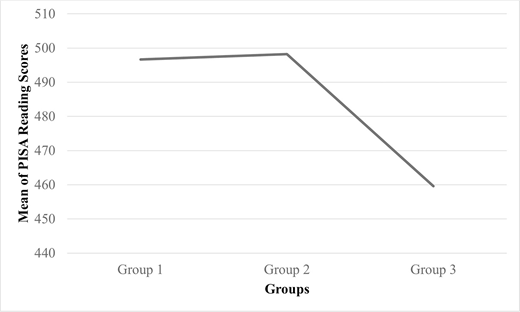
Descriptive statistics (Table 2) showed the average score of reading performance based on each group. Group 1 had the highest score, 496.67, while Group 3 had the lowest score, 459.56, and the difference between the two groups’ scores was 37.11.
Specifically, three groups, Group 1 (very high internet access group), Group 2 (high internet access group), and Group 3 (moderate internet access group) were compared based on the mean of the reading scores (performance) from PISA.
For the assumption check, the normality and homogeneity tests were conducted. Since Shapiro-Wilk and Levene’s test showed p > .05 (Tables 3 and 4), all assumptions were met, and no modifications were required.
The result of the finding showed F-statistic, F(2, 24) = 10.121, p < .05 from the one-way ANOVA analysis result in Table 5.
Therefore, the Alternative Hypothesis (Ha) from the research question was adopted since the significance level was less than .05. The implication was that at least one group’s mean score differed from the others (Table 6).
From the post hoc test (Table 6), the result showed that there was a significant difference between the two groups (G1 and G2) and a moderate internet access group (G3) based on the reading achievement score (p < .05, α = .05). This finding implies that having internet access affects students’ performance positively. Group 1, having a very high internet access level, had a similar reading score (over 490) to Group 2; Group 3, having a moderate internet access level, had the lowest reading score (below 460; Figure 1).
Discussions
This study explored the relationship between the internet access levels by OECD and literacy using reading scores presented by PISA. The findings imply that having some high levels of internet access does not affect reading scores that much. On the other hand, having very low internet access could affect student reading scores. It is understandable that it is challenging to access educational resources without internet access, especially in underprivileged areas (Walters, 2020). Our result, in consonance with Watters (2020), shows a relationship between internet access level and reading performance scores. Therefore, statistically, the null Hypothesis is not valid.
The group with the lowest internet access had the lowest reading scores among the two groups with higher internet access levels. While it needs further research on the relationship between reading performance and internet access, the finding clearly shows that there is different reading performance based on internet access levels, especially a low internet access level. These results can be used for decision-makers in each location or country regarding utilizing their funding for educational resources in areas with low internet access. Additionally, the result showed that both groups with higher levels (very high and high) of internet access had similar reading scores, averaging 490 on the PISA reading score. On the other hand, the other group with the lowest internet access level had below an average of 460 in the PISA reading score. This is a strong literacy gap. This finding can be interpreted that lacking internet access could negatively affect learning achievement in countries with lower internet access.
Moreover, it is not hard to imagine how the COVID-19 pandemic might threaten marginalized students’ learning due to the lack of access to educational resources, especially the gateway for educational resources, internet access. Students can choose to use those resources or not, but at least access should be provided; it should be fair for every student to access good quality educational resources. Therefore, it is suggested that district or national decision-makers consider expanding internet access for students in marginal areas. In addition, in underdeveloped countries, the support to set up internet access should be actively discussed among educational leaders to improve student learning for the future educational advancement of these countries. Again, internet access can be a gateway that enables all students to connect and collaborate in learning beyond their world (Snyder, 2009).
Finally, we suggest further research should focus more on policies regarding internet access levels and perhaps use that standard for regrouping members of the OECD countries or even more countries that were not included in this study. Future studies can be expanded by using datasets of other subjects among the PISA scores, such as Math and Science, together by adding more countries outside of the OECD that are not included in the current database. The accumulated data and research would bring more insightful dialogues to decision-makers in supporting students in underprivileged areas.
About the author's