Introduction
Why Ask Women About Online Learning?
While women comprise the majority of learners in higher education (Aud et al., 2010), there is little evidence that women are asked to shape higher education or, more specifically, online learning. Research of women in online learning (Bostock & Lizhi, 2005; Graddy, 2006; Halio, 2004; Hoskins & van Hoof, 2005; Rovai & Baker, 2005; Leisure, 2007) provides a framework of investigation; however, the majority of researchers engage in analyses of women acting as participants in online learning rather than as change agents of online learning based on their experience in the field. This is surprising in light of projections that by 2019 females will number 11.2 million (59%) undergraduate enrollments and 2.1 million (61%) postbaccalaureate enrollments (Aud et. al., 2010).
Rovai and Baker (2005) conducted a study of 281 online graduate students, of which 83.9% were females and 16.1% were males, and found that female participants reflected a stronger sense of community and greater levels of perceived learning in the online environment than males. Females posted more messages to discussion boards, indicated they felt more connected to other students, and indicated they felt their online learning experience was more aligned to their educational values and goals. Rovai and Baker (2005) suggested:
The benefit of online education isn’t merely access but includes educational effectiveness. Women participated in the courses at higher rates than male students and identified their experience as socially richer (as evidenced from the sense of community) and educationally more effective (as evidenced by perceived learning) than men. (p. 40)
In this article, the author offers evidence that women, who comprise the majority of online learners, are a valuable resource for While women comprise the majority of learners in higher education (Aud et al., 2010), there is little evidence that women are asked to shape higher education or, more specifically, online learning. Research of women in online learning (Bostock & Lizhi, 2005; Graddy, 2006; Halio, 2004; Hoskins & van Hoof, 2005; Rovai & Baker, 2005; Leisure, 2007) provides a framework those wishing to research the field of online learning. This evidence may be considered by those shaping and improving the field for future learners, as well as online educators who strive to develop student-centered online learning environments.
What Questions Should We Ask Women About Online Learning?
Researchers often fail to consider that women are relational learners (Burge, 1998) and may not be willing to write their experiences in a box on a survey. They want to speak to someone who understands what it means to be an online learner. As Dirkx (2006) suggested, there are times when evidence-based research methods and technical-rationality fail to address the “particular context, demands, uncertainties, complexities, and ambiguities” (p. 284) of a situation.
Rather, Dirkx (2006) advocated “a reflective, narrative insider approach … to generating deeper understanding of practice” (p. 286) wherein “researchers create opportunities … to perceive and address problems in a situated and contextual manner” (p. 286) to “bring about learning and change, whether in individual understandings and behaviors or institutional and social policies” (p. 287).
Qualitative Research of Women in Online Learning
So, the old saying, “It doesn’t take a rocket scientist …” might apply to the dearth of research focusing on women’s experiences in online learning and why that information is not being used to bring about improvements in the field. Women who are completing, or have completed, online degrees should be asked: Why are you choosing online education? What are the barriers you have had to overcome to enter online education? What do you expect to gain from earning an online degree? Did earning an online degree change you or your life? If so, what kind of change did you experience? What qualities do you value most in online instructors? How do you define a quality online instructor? How do you define quality online education? Asking these and other questions of the majority of online learners, women, might lead to improvements that will benefit all learners. Asking these and other questions could help institutions better prepare online instructors; develop engaging, student-centered online courses or programs; and offer learning opportunities superior to mind-numbing memorization and regurgitation associated with passive learning.
In 2006, I set out to ask questions of women who had earned a fully online master’s degree. The women who participated in my study did so voluntarily. They were contacted by the directors of their online programs, and they e-mailed me if they wanted to participate. Eighteen women met the criteria for the study. I traveled approximately 5,000 miles to ask them in-depth questions about their experiences in online learning and what effect, if any, earning the degree had on their lives.
The women shared insights about a wide range of issues surrounding online learning. Some voiced appreciation of the anonymity, freedom from prejudice, and less threatening environment they sensed in their online programs. Many described barriers that had threatened their dream of educational attainment, including pregnancy, severe morning sickness, serious illness, physical disability, incarceration, disruption as a military spouse, responsibilities of a single mom, care of elderly parents, obesity, shyness, preference for the online learning environment, geographic distance from a campus, and so on. Women I spoke to were able to overcome barriers through online learning, and, in so doing, recognized changes that occurred in their lives. The variance associated with change will be discussed in the next section.
How do Women Define Excellent Online Instructors?
When asked, these women shared perspectives about characteristics of excellent online instructors, quality online courses, and the benefits of online learning, in general. With the growth of online enrollments at 21% while the growth of overall higher education enrollments lags at less than 2% (Allen & Seaman, 2010), it is prudent to respect the feedback of women completing online learning. Understandably, information from 18 graduates of online programs may not be generalized to all online learners, but their insights contribute to the body of knowledge that exists regarding online learning. Table 1 provides statements from the participants about the characteristics of excellent online instructors.
Why Listen and Respond to Women in Online Learning?
Providing and accepting feedback is an excellent means of improving courses, programs, and entire institutions. Women, who represent the majority of online learners, have unique insights that could prove beneficial as institutions struggle to define quality online instruction and set benchmarks to maintain quality in online learning. Will women increasingly choose universities whose online courses demonstrate awareness of and response to their needs? For so long, women have had to adapt to a man’s world in academia; could the status quo be altered in a way that allows learning to become more inclusive? Just as students require feedback from instructors, so do institutions require feedback from the students to complete the circle of improvement in learning. Hirumi (2005) noted:
Feedback is vital to e-learning.… Feedback comes in two basic forms: confirmatory and corrective. Confirmatory feedback lets students know what they did correctly. Corrective feedback identifies areas and provides recommendations for improvement. Current guidelines recognize the importance of providing timely and appropriate feedback, but they do not detail the nature of the feedback.… To establish world-class standards, consider specifying the need to design and sequence e-learning interactions based on grounded instructional strategies. (pp. 317-318)
Such benchmarking encourages quality that “promotes and emphasizes the student in the evaluation of successful learning” (Ellis & Moore, 2006, p. 363).
What are Potential Outcomes of Online Learning for Women?
Online learning can enable learners to attain positive career and personal outcomes, become more self-confident, and serve as role models for others. Yet, online learning can also be a means for realizing heightened self-awareness and transformation of one’s preconceived ideas and beliefs.
Women who participated in the author’s study of online learners experienced change. Some entered new careers, earned promotions or higher salaries, while others gained self-confidence, improved status among their peers, or became a role model to others, particularly to their children. While these changes were expected, other, more significant levels of change seemed to take the learners by surprise; one-third of the women reported unanticipated changes in how they viewed themselves—changes so significant they led to altered relationships and shifts in decisions about the future.
Difficult decisions included leaving a spouse; opposing family members who fought against a mom’s effort to return to school; entering an online doctoral program; or moving from one country to another.
Mezirow (1978) pointed out that transformation is “often gained through an increased sense of competency and through a supportive social climate in which provisional tries are encouraged with minimum risk” (p. 107). Mezirow (2004) also suggested, “The fully developed learner moves through a series of developmental forms to arrive at the highest potential for understanding the capacity to engage in transformative learning” (p. 69). So, there are elements in online learning that support significant, transformational change within learners, particularly regarding their self-perceptions.
Other researchers (Taylor, 2007) were also specific about factors in the online environment that contribute to a transformative learning experience, including an emphasis on writing, life experiences of the participants, and greater opportunity for reflection. Transformation, when and if it occurs, is unique to the individual and may be the result of a crisis that prompts the learner to engage in critical reflection or to change his or her perspective (Kilgore & Bloom, 2002; Palloff & Pratt, 1999).
As mentioned previously, one third of the women in the author’s study had a transformative experience as a result of entering and completing online programs. In other words, the person who entered the virtual classroom was not the same person who exited the virtual classroom because of changes in self-concept, selfacceptance, self-confidence, self-direction, and willingness to act on her altered perceptions (Rogers, 1961).
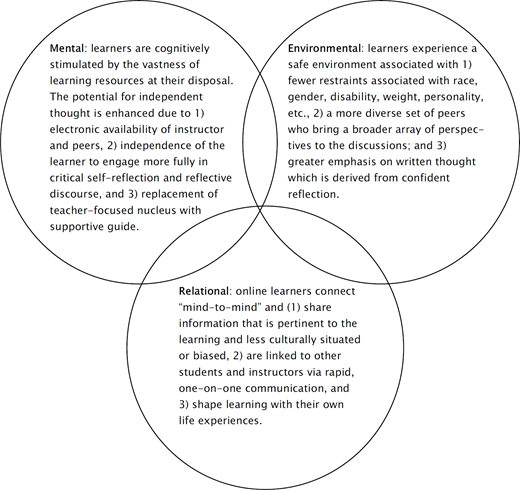
Figure 1 illustrates the potential transformative elements in the online environment, as drawn from the literature on online learning and from the experiences of women in the author’s study.
Several participants emphasized the online environment was a safer environment that prompted greater participation because the individual felt less risk when making contributions. For shy students, or students who had experienced bias or prejudice in traditional classes, the element of anonymity became one of the most important aspects of the learning environment. These and other elements supported the possibility of transformation among those who, as Mezirow suggested, had within them the capacity to engage in transformative learning.
It is significant that online learning offers students an opportunity to become more aware of how they might be different from others (Cranton & Roy, 2003) or to gain a sense of identity, autonomy, and responsibility for their own lives (Mezirow, 1978).
Conclusion
How Can Listening to Women in Online Learning Shape the Future of Online Learning?
Valuable lessons remain to be learned from the thousands of students entering online learning, particularly now that the economy seems to be drawing more students into higher education.
Many more institutions reported seeing an increase in demand for online courses and programs than for face-to-face in 2009. The same pattern is evident this year as well. Three quarters (74.5%) of all institutions say that they are seeing an increase in the demand for online courses and programs as a result of the current economic downturn. (Allen & Seaman, 2010, p. 14)
In order for higher education to gain momentum in a new age of information, decision makers must first acknowledge the voice of the learners they serve and then set about to create learning experiences that correlate with characteristics of those being served. Women who have children, who work full-time, who are remote from a university, or who have other demands placed on them to the degree they cannot attend traditional classes should be seen as a population that can yield information and which should be given consideration by administrators in higher education. Is academe listening? Many among the ranks voice their skepticism that higher education, which has been reluctant to alter its standard mores, is now hearing and responding to the voices of students. “The ivory tower, as academe has been called, is crumbling, just as the Berlin Wall toppled under the economic and societal pressures in an increasingly interrelated and complex world” (Hainline, Gaines, Feather, Padilla, & Terry, 2010, p. 10).
In addition to listening to what female graduates have to say about their experiences, administrators can implement changes to anticipate populations of learners who require greater levels of flexibility in learning or, even more pressing, to prepare for groups of learners whose circumstances threaten the completion of their education.
For example, mentoring is needed to encourage survivors of abuse to enter online learning; after accessing and entering education—often a major hurdle—this population may need to experience the flexibility of distance education and see it demonstrated at higher levels through patience and supportive feedback. Though the problem of abuse among women is significant, it is largely unacknowledged by higher education (Wagner & Magnusson, 2005).
Women interviewed by the author often asked if a mechanism existed by which they could share their knowledge of online learning with other women. In response to this question, the author and a group of approximately 30 women in the field of distance education founded the Collaborative Online Resource Environment for Women (CORE4Women), which is a free online social network where women discuss online learning. Currently, more than 400 women have joined CORE4Women.org to ask questions about online learning or to give others encouragement and guidance about online learning. The need for mentoring among women is prevalent, and this forum takes one step toward meeting that need, particularly for those who are non-traditional, adult learners.
As Kramarae (2001) indicated, “many of the most critical issues for women in online education are only now being recognized” (p. 6). Accordingly, the potential research topics mentioned here are only a portion of those that could be undertaken to research women in online education. As interest in distance education and the numbers of women in online education continue to grow, research will, hopefully, proliferate and provide a more enlightened framework by which to shape policies, programs, and theories in online learning.