Introduction
In low-income communities of color with limited social capital and educational resources, school is not often a space of liberation but rather continued marginalization unless there are active and conscious efforts to teach and learn in a creative context that goes beyond the low expectations for children living in poverty (Pigza, 2005). Social justice is essential to foster an educational system that benefits all who participate. The educational structure is not limited to those who work in the school and the families they serve. Professors of education are also part of this expanded community and play a significant role in training the pool of education workers who need to develop and advance their students’ critical thinking and academic relevancy to break the cycles of academic neglect that perpetuates limited access toward liberation for children of color living in poverty caused by segregation.
In an effort to reconnect to children living in low income communities near NSU, professors of education partnered with a local public school to better understand the growing cognitive needs of one of the poorest elementary schools in the state of Florida. NSU began as an alternative education graduate school and has a history in the creative and inclusive building of education pioneers. The school has since evolved into various departments in many academic fields; nonetheless, the core of its philosophy still resides in the college of education. Professors help to shape the next generation of educators, but at the same time are often removed from the children who ultimately should benefit from their expertise in the field of education. How often do professors go back to the classroom and truly engage young people in theories of learning toward an understanding of education as a tool of liberation?
Having had this opportunity, the research team decided to create a space of learning and teaching to a group of children in a nearby low income community utilizing a science, technology, engineering, and mathematics (STEM) lens. Hillside Elementary School (pseudonym) serves a low-socioeconomic status (SES) population in suburban Broward County, Florida. Of the 608 students enrolled in grades pre-K– 5, 96% are on free or reduced lunch. Additionally, the school serves a predominately minority population, with 91.7% of the students identifying as Black/African American and 5.42% as Hispanic. In 2013, Hillside Elementary received an F grade on the Florida statewide assessment, the Florida Comprehensive Assessment Test, and was identified as a FOCUS-D school by the Elementary and Secondary Education Act. Hillside Elementary is a Title I School that failed to make Adequate Yearly Progress for the last 2 years and has been in the bottom 20% of all schools in the state of Florida based on the 2013–2014 Florida Comprehensive Assessment Test results.
Why STEM?
STEM is the term that has come to symbolize a national need for educational reform in the science, technology, engineering, and mathematics disciplines. This focus has developed to address the growing concern that the United States is failing to prepare individuals to compete with their international counterparts in the 21st century global market. According to the Report from the President’s Council of Advisors on Science and Technology (2012), the United States will need to educate an additional 1 million STEM professionals over the next decade to maintain its global leadership position and meet the economic challenges of this century. In order to fill these positions, the United States will need to recruit STEM talent across all student groups.
While many students begin their education with a positive perception of the STEM disciplines and the talent needed to pursue and succeed in STEM careers, STEM talent attrition occurs amongst both women and people of color. This is concerning as the U.S. Census Bureau (2009) reports people of color will comprise almost 50% of the U.S. population by 2050 and are currently underrepresented as U.S. STEM discipline majors. The United States cannot afford to lose the potential contributions of people of color as it struggles to maintain its position as a global innovative leader.
The STEM Project
This year-long partnership with Hillside Elementary began by providing a 1-week professional development institute that included a segment on strategies for addressing STEM content through STEM Design Challenges, a project-based approach to engaging students in the interdisciplinary learning of the STEM disciplines. The institute provided the opportunity for the research team to get to know the Hillside faculty and discuss their current pedagogical strategies for addressing STEM. As is typical in many schools, the research team learned the disciplines were being taught in isolation and the current curriculum did not include opportunities for students to engage in projects such as the STEM Design Challenges. However, as the research team began to expand interactions with the teachers, they became very concerned that in this particular school, in response to perceived student behavior issues, the pedagogical strategies being used were limited to direct instruction with very few opportunities for students to engage in any activity that promoted collaboration, creativity, communication, and critical thinking amongst students. Given the need to develop these skills in students, the research team became very concerned.
In response to this concern, the research team decided to create a learning space that would promote collaboration among Hillside instructional coaches, fourth- and fifth-grade faculty, NSU university faculty across colleges, and community partners, to develop STEM Design Challenges that would align with STEM content standards and focus on identified areas of weaknesses as determined through analysis of quarterly data assessments. To begin the process, as professors with expertise in STEM, elementary education, and multicultural studies, the research team met with Hillside Elementary instructional coaches for mathematics and science to plan the first STEM project for fifth grade. This first STEM project focused on aviation and was designed to target science and mathematics standards that fifth grade students had not mastered based on the last quarter assessment. Once created, the instructional coaches then shared the project with the fifth grade faculty. Fifth grade faculty implemented the project and then participated in planning the next design challenge, which focused on marine pollution, with the fourth grade teachers.
STEM Plan, Design, Check, Share
Each design challenge was built around the elementary design cycle of plan, design, check, and share. University faculty along with the Hillside Elementary instructional coaches and eventually Grade 5 and 4 teachers, developed a STEM journal distributed to each student that included activities to address each of the design cycle phases. During the plan phase, students were asked to analyze and write about readings related to the theme (e.g., aviation, marine, etc.) that were differentiated according to student reading level. These readings were selected purposefully to help guide student thinking related to the design challenge. Part of the plan phase were multiple activities and investigations that addressed the science and mathematics content needed to complete the design challenge. Additionally, students used iPads to engage in digital apps that were selected to align with the science and mathematics content, and as a last stage of the plan phase, students created their own individual prototype drawings.
During the design phase, students discussed the strengths and weaknesses of their individual prototype drawings and then collaboratively decided on a group design. Students created their prototypes based on the selected design. As part of the check phase, students tested whether their prototype met the constraints of the design challenge. If needed, students returned to the plan or design phase to adjust their prototype to meet the design challenge. One student said, “I learned that when you draw out your plan, if it doesn’t work, then try again.” Lastly, students shared their final designs with the class along with any challenges encountered during the phases.
Four Cs Development
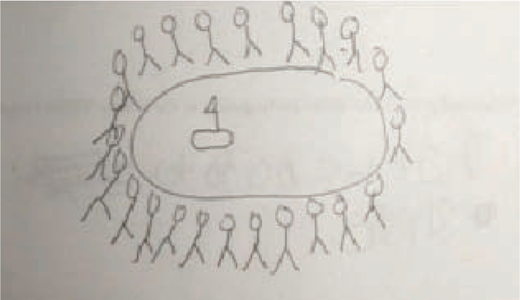
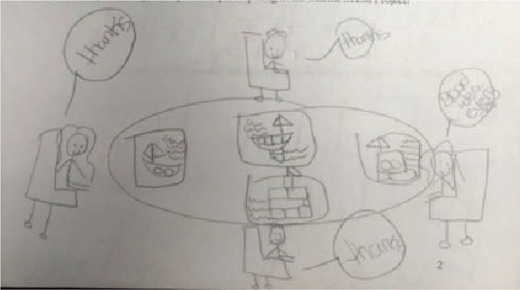
According to the Partnership for 21st Century Learning (2011), students need to move beyond the basics and embrace the four Cs, otherwise known as “superskills”: collaboration, communication, creativity, and critical thinking. All of these skills were embedded into the STEM Design Challenges and provided students with a new way to learn about science, technology, and math. Students indicated that they “liked helping my friends and my teammates,” “had a great experience building the boat,” and “made something out of nothing.” Rather than learning the subjects separately, science, technology, engineering, and math were integrated into a marine project in which students were required to research and then work collaboratively to design a boat made of recycled materials. Students had to come up with creative designs for their boats and use critical thinking skills when determining which materials would be able to hold the most weight. Two students drew pictures that (1) expressed the community building and communal learning context of the project and (2) expressed thanks and gratitude for the collaborative learning experience.
Interactions With Community Partners
Embedded in each of the STEM Design Challenges were opportunities for the students to interact with mentors from the community. The research team organized a group of 10 high school seniors from University School, a K–12 private school on NSU’s campus, who volunteered to work one on one with students every Tuesday and Thursday for 2 hours from January through June. The tutoring was focused on all subjects, with a strong focus on reading and math. Additionally, there were two volunteers from America Reads/America Counts who supported Hillside Elementary students once a week for 2 hours for most of the academic year starting in the fall. An intern of color from NSU was placed in one of the Hillside Elementary classrooms to work with students. Additionally, two graduate students from the NSU Guy Harvey Oceanographic Center came to the school to present information on marine pollution, recycling, and career opportunities for the future. This enabled students to make real life connections with the topics and standards that were being covered in class.
The research team also included guest speakers in STEM fields that gave students an opportunity to ask questions about specific topics of interest and provided them with information about community events they could attend with their families. Many of the students were amazed when they learned about the amount of time it takes for items that people throw away to break down in landfills. They also learned about the different things they could do to take care of the earth and the oceans. The graduate students provided their contact information for teachers and students at Hillside Elementary in an effort to establish a partnership for future collaborative projects and presentations.
As a culminating classroom experience, students learned how to use digital storytelling to reflect on the STEM Design Challenge and share their experiences. One of the university professors spent time in the classroom teaching students how to create a story using PowerPoint. Students worked in their collaborative groups to create a final product to present to the class at the end of the year using the 21st century skill of communication. Fourth and fifth grade students also had the opportunity to visit and learn about the Everglades on an airboat tour at the end of the marine STEM Design Challenge. During the field trip experience students were guided by a captain through sawgrass and cattails for a 30-minute airboat ride to learn more about the ecosystem of the Everglades. They were able to see the native and exotic plants and animals that live in their natural habitat. The field trip also included several wildlife exhibits including reptiles, tortoises, peacocks, a panther, and other small mammals. It was the first time many of the students had an opportunity to visit the Everglades, even though the school was less than an hour away. One of the advantages of students participating in the STEM Design Challenge was that students were able to interact with new community partners that were not previously involved at the school.
Conclusion
Engaging poor children of color requires not only an understanding of educational theory, but also a recognition of using education as a tool of liberation. This was accomplished at Hillside Elementary School by expanding educational opportunities through a creative process of engagement involving STEM Design Challenges. The challenges encouraged students to interact with intergenerational partners in developing a comprehensive understanding of STEM content. Students were provided opportunities to learn the STEM disciplines through an integrated approach, interact with community members and experts in the STEM fields, and experience STEM in real-life contexts. This allowed students to learn STEM concepts in an authentic way by interacting with others and developing an understanding of how STEM plays a role in their daily lives.
To evaluate the effectiveness of this partnership, issues of equity and access were important lenses to consider. As professors of education responsible for developing future teachers, it is imperative to also have them analyze the various communities and needs that they will serve. Not only was Hillside in a financially impoverished community, there was also a label of major student behavioral problems. These two stigmas played a significant role in the lack of academic resources provided, the low expectations of the students, and the approach to learning. Interestingly, STEM provided greater relevance to these students as they looked at their community not as lacking, but overflowing with all sorts of materials and people that contribute to the larger STEM project needs for the future of the world. They became present in the conversation, having exposure and the opportunity to actively engage in conversation, activities, and field trips to further understand and comprehensively make meaning of STEM to their respective academic and social realities. There were no behavioral issues; they engaged respectfully as the research team engaged them respectfully. There was not a stigma of poverty as a lens; they were simply children of color gifted with the thirst to learn in a context of relevancy, community, and support. As faculty of academic privilege, the research team learned from the students simply that teachers have not done enough to engage their strengths, gifts and abilities. It is an obligation to be vigilant in university classrooms and in the K–12 school community to be agents and partners in social justice learning as a tool of liberation for all children.
After participating in the STEM Design Challenges, results from the annual statewide science assessment revealed fifth grade students’ scores at Hillside Elementary School increased for the first time in several years. With an approximate 12% increase from the previous year’s scores, teachers and administrators were thrilled and energized. The school principal said, “The experiences provided by the faculty at NSU were invaluable to our learners and our staff. Their mentorship, leadership, and friendship built a relationship that has provided a wonderful foundation for our school to move forward in educating our children.” A requirement of social justice teaching is that teachers approach instruction in ways that support the active, engaged learning of all students. Additionally, teachers need to incorporate course content relevant to students’ lives, including both students’ experiences and the communities in which they live (Brown & Brown, 2011).
About the author's