Introduction
Approximately 75% of the content of a typical doctor of physical therapy (PT) course does not require the instructor and students to be together in the same classroom, laboratory, or clinic. Physical therapist education includes a large amount of psychomotor clinical skills. Traditionally, psychomotor skills are taught face to face in laboratory courses with teacher-led skill introduction and demonstration followed by student practice with instructor feedback (Gaida et al., 2016; Maloney, Storr, Paynter, Morgan, & Ilic, 2013). A goal of hybrid course redesign is to balance elements essential to face to face with those that can be delivered online. Ideally, online and face-to-face classrooms work in a symbiotic way without being duplicative. The dynamic nature of learning psychomotor skills makes hybrid redesign of PT courses challenging. This article describes the redesign of a traditional PT lab course using the community of inquiry (CoI) model as a framework and Google Blogger as the main platform for an online skills lab. A description and discussion of course design, time allocations, student learning outcomes, and student perceptions are provided.
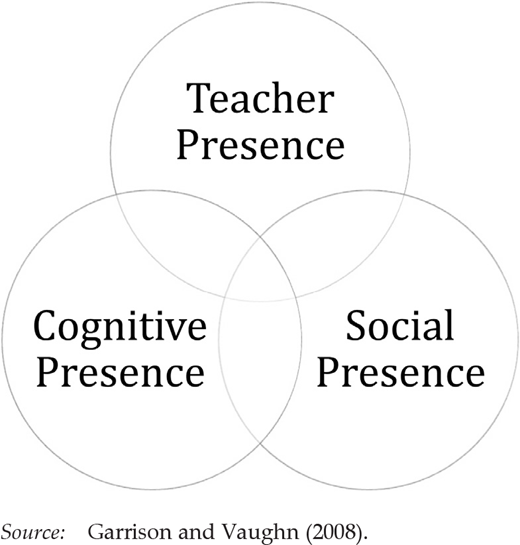
Student needs for flexibility and rising health care workforce demands influence a trend toward hybrid delivery in health care education; however, substantiation of the ways technology can effectively replace face-to-face instruction is needed (Brandt, Quake-Rapp, Shanedling, Span-naus-Martin, & Martin, 2010). Hybrid education is a category of distance education in which online activities replace face-to-face activities. This contrasts with other models of blended learning such as a flipped classroom, which incorporate online instruction as an adjunct to face-to-face instruction without a reduction of face-to-face time. Garrison and Vaughn (2008) described hybrid or blended learning as a “thoughtful fusion of face-to-face and online learning experiences” (p. 8). The CoI model provides a framework for hybrid course design using online and face-to-face instruction in a way that each mode enhances without duplicating the other (Garrison, Anderson, & Archer, 2010). The mixture of online and face-to-face activities varies from case to case (Means et al., 2013). In the CoI model, three essential components overlap to create an educational experience: teaching presence, cognitive presence, and social presence (Garrison & Vaughn, 2008; see Figure 1). Teaching presence is the design of class activities, facilitation of discourse, and direction of instruction. Cognitive presence comes as students engage, explore, and integrate the course content. Social presence occurs as class participants interact in open communication, to build camaraderie and group cohesion (Garrison & Vaughn, 2008).
Educational Technology in Physical Therapy Education
Recent systematic reviews found that integration of educational technologies in health care education was equivalent or better than traditional teaching methods alone (George et al., 2014; Rasmussen et al., 2014). Heterogeneity of studies prevents more definitive conclusions, but emerging evidence supports the use of educational technologies in PT education. A variety of approaches have been described including flipped classroom methods, using supplemental technology resources, and using collaborative technology tools. As in higher education in general, PT education most commonly uses technology to teach didactic content or achieve cognitive objectives (Rowe, Bozalek, & Frantz, 2013). In studies comparing a flipped model to traditional teaching methods for didactic content, student learning outcomes and perceptions varied, but variation in methods may account for some of the differences. One study found improved student learning outcomes using flipped methods (Boucher, Robertson, Wainner, & Sanders, 2013). Another found no difference in overall student performance scores, but those in the flipped group did better with higher order questions (Bayliss & Warden, 2011). A third found no difference in student achievement between traditional and flipped methods (Murray, McCallum, & Petrosino, 2014). In this case, students were provided previewing materials, but face-to-face class times began with 20-30 minute lectures, which may have undermined the need for preparation, an important component of the flipped model. Student perceptions were positive for previewing prerecorded lectures before class (Boucher et al., 2013), but showed no increased preference for previewing PowerPoint lecture slides (not recordings) (Bayliss & Warden, 2011). The variety of techniques used make it difficult to draw global conclusions.
Supplemental online or computer activities in addition to traditional instruction have shown favorable results in cognitive learning outcomes and student perceptions, in higher education in general (Cain & Pitre, 2008; Meyer, 2014). In a neurological PT course, it was found that students with access to supplemental computer modules with embedded video and practice questions had better clinical reasoning and learning outcomes compared to receiving traditional lecture and lab alone (Veneri & Gannotti, 2014). In addition, student perceptions of learning were better in the group with the added computer modules. Similarly, Gardner et al., (2016) investigated student perceptions of an e-learning package to teach PT students about rheumatoid arthritis. The e-learning package was given in addition to three live lectures about general chronic disease management. Students had positive perceptions of the experience and preferred a blended approach to the subject matter. Rowe and colleagues (2013) used Google Drive as a platform for a blended PT case activity and found that students valued the authentic learning approach and had shifts in their perceptions about learning. In an online PT pharmacology course that incorporated a collaborative learning activity, students had positive attitudes about the course design without a change in the grade distribution (Pittenger & Olson-Kellogg, 2012).
Teaching psychomotor skills with educational technologies and blended methods has emerging support in the literature, but like didactic content there are a variety of methods and outcomes reported. Some studies found no difference in outcomes between traditional and methods using technology (Maloney, Storr, Paynter, et al., 2013; VanDuijn, Swanick, & Donald, 2014), and others found improved outcomes with the use of technology (Arroyo-Morales et al., 2012; Maloney, Storr, Morgan, & Ilic, 2013; Preston et al., 2012). Physical therapy students have reported higher perceived satisfaction with blended methods of teaching psychomotor skills, particularly including video versus traditional methods (Coffee & Hillier, 2008; Gaida et al., 2016; Hurst, 2016; Maloney, Storr, Morgan, et al. 2013; Maloney, Storr, Paynter, et al., 2013). Video has been show to enhance engagement, social presence, and learning (Kliger & Pfeiffer, 2011). Further, incorporating student-produced skill demonstration videos (self-videos) were found to improve student skill performance on assessments and increase students’ perceptions of educational value over traditional teaching methods (Maloney, Storr, Morgan, et al., 2013; Maloney, Storr, Paynter, et al., 2013).
Regardless of approach, mastering psychomotor skills requires instructor presence through feedback. Traditionally this occurs in the classroom setting face-to-face (Gaida et al., 2016); however, video can be used as a vehicle for receiving feedback at a distance. Student self-videos of skill performance have been effectively used to give formative feedback on performance at a distance (Maloney, Storr, Morgan, et al., 2013; Maloney, Storr, Paynter, et al., 2013).
Available studies investigating the use of blended models or supplemental education technologies in PT education have studied learning outcomes, student perceptions, and satisfaction with favorable findings. No study could be found that investigated changes in the distribution of time as an outcome. This is an important consideration in the implementation of a hybrid course design in which face-to-face time is replaced by online time, because the shift in time allocation has implications for students and faculty. In addition, heterogeneity of studied instructional methods makes findings difficult to interpret (George et al., 2014; Rasmussen et al., 2014; Veneri, 2011). Evidence is lacking for teaching psychomotor skills in a hybrid course whereby online instruction replaces traditional face-to-face instruction.
Case Description
The course was a 1-credit hour laboratory course focused on psychomotor and affective objectives of performing surface palpation. It was part of the first-year curriculum of the Nova Southeastern University Hybrid Doctor of Physical Therapy Program (HDPT). The course was converted to hybrid from an existing traditional course that met weekly. The redesigned hybrid course occurred in a 16-week semester with four face-to-face on-campus institutes. Four-day on-campus institutes took place throughout the semester at the end of every fourth week (Thursday through Sunday). The class met for a 3-hour face-to-face lab session at each on-campus institute for a total of 12 face-to-face instructional hours. This equates to 25% of the face-to-face time if the course was taught traditionally (completely face to face), with the remainder of class-time (75%) occurring online.
Initial course redesign began by differentiating activities that must occur face-to-face from those that could occur online. The conclusion was that two key components must occur face to face: (a) face-to-face practice with feedback and (b) skills assessment. Given the on-campus institute time constraints, it was decided students should have an introduction and be practicing skills online in preparation for face-to-face time. The layout of the course schedule placed one body region in each week for 12 weeks, with 4 weeks remaining at the end of the course for review of cardinal plane joint motions and application of palpated landmarks to postural assessment.
The course design was constructed with components that created the elements of the CoI model (see Figure 2). Activities that supported these design components were carefully selected with the underlying pedagogy in mind and the understanding that technology does not drive student achievement (Means, Toyama, Murphy, Bakia, & Jones, 2010; Meyer, 2014).
 The diagram shows three overlapping circles in a Venn arrangement. The top circle is labeled Teacher Presence with bullet points for instructional video series, assignment organization, individual feedback, and public feedback. The bottom left circle is labeled Cognitive Presence with bullet points for self video, photo assignment, and peer feedback. The bottom right circle is labeled Social Presence with bullet points for blog interaction, peer benchmarking, and public feedback.
Community of inquiry model complete with course design components.
The diagram shows three overlapping circles in a Venn arrangement. The top circle is labeled Teacher Presence with bullet points for instructional video series, assignment organization, individual feedback, and public feedback. The bottom left circle is labeled Cognitive Presence with bullet points for self video, photo assignment, and peer feedback. The bottom right circle is labeled Social Presence with bullet points for blog interaction, peer benchmarking, and public feedback.Community of inquiry model complete with course design components.
Online Classroom
Constrained face-to-face time required students to arrive to the physical classroom having been introduced to a skill set and having basic proficiency. To include instruction, deliberate practice, and feedback in a meaningful way during online time, instructor, cognitive, and social presence were considered in the online course design. Instructional content was delivered via textbook and video. A text was selected for its format, engaging illustrations, and accompanying instructional DVD. Supplemental videos were produced by the course instructor and published online for content not adequately covered by the text-companion DVD.
Deliberate practice and feedback were incorporated in course design through weekly online assignments with the goal of moving beyond skill introduction and toward proficiency prior to on-campus institute. To reach proficiency with psycho-motor skills requires feedback. Students took turns rotating through one of two assignments each week where they could receive feedback from instructor and classmates. For one assignment, students identified and labeled palpation landmarks on a partner volunteer, which they photographed and submitted to the instructor. They received private instructor feedback on landmark palpation accuracy.
A second, video-based assignment incorporated all components of the CoI model, most notably social presence. In it, students made short self-videos demonstrating palpation on a partner that was shared using a class weblog (blog). The class blog, hosted on Google Blogger, was private and restricted to members of the course. An outside blog platform was chosen for ease of use, especially for embedding video, as compared to the university learning management system. In addition, the class blog remained available as a resource to students after the course ended. The entire class had authorship allowing them to post and comment freely. Classmates were required to watch each other’s videos and give feedback comments to one classmate weekly. Peer coaching has been found to improve psychomotor skill development in nursing students (Himes & Ravert, 2012). An instructor gave feedback comments to all videos using a feedback guideline that included dimensions of communication, positioning, body mechanics, draping, technique, accuracy, and time management. All posts and feedback comments (students’ and instructor’s) were visible to all members of the class blog.
A shared blog allows collaborative online learning between presenter and audience, enhances social presence, and can positively affect student learning (De Jong, Savin-Baden, Cunningham, & Verstegen, 2014; Fluckiger, Vigil, Pasco, & Danielson, 2010; Huang, Huang, & Yu, 2011; Means et al., 2013; Tan, Ladyshewsky, & Gardner, 2010). Blogs also overcome some face-to-face classroom limitations like space shortages, time constraints, and student anxiety about evaluating peer work (Huang et al., 2011). Student-class-instructor interaction in the class blog also allows peer benchmarking that can improve student self-assessment and understanding of performance expectations (Maloney, Storr, Paynter, et al., 2013).
Face-To-Face Classroom
With all skills introduced and practiced online, face-to-face lab time was used for refinement and mastery of palpation skills in preparation for practical skills assessment. During a 3-hour lab session, students rotated through stations supervised by lab instructors who reviewed content and gave hands-on feedback. An optional, unstructured practice time was available to students outside of class with a lab assistant present to answer questions.
Each on-campus institute ended with a practical skills assessment of psychomotor learning. performance dimensions, as in the video assignment, were proper techniques, body mechanics, positioning, draping, accuracy, communication, and time management. The fourth and final skills check was cumulative.
Outcomes
Subjects were 123 first-year DPT students (71 females) from three successive cohorts spanning 2012-2014 (cohorts A, B, C respectively). Outcomes were analyzed including (a) student performance scores on practical skills assessments, (b) online engagement rates, and (c) student course evaluations. Performance scores and engagement rates were analyzed using descriptive statistics. Course evaluation rating scores were analyzed using descriptive statistics and comments were thematically analyzed. One subject of the 2014 cohort withdrew from the university at the beginning of the course and these data were removed from analysis.
Online Participation and Engagement
As a measure of student engagement in the online lab activity, counts of student blog page views, blog posts, and comments were collected from the blog statistics page. Students met posting requirements with few exceptions. Students exceeded the required/expected number of peer comments and page views at a rate of roughly double the comments and 8–10 times the page views (see Table 1).
| Engagement With Blog | Cohort | ||
|---|---|---|---|
| A (n = 39) | B (n = 39) | C (n = 45) | |
| Page views per student per week | 10 | 8.3 | 10.1 |
| Original post rate for cohort (percent of required) | 100% | 98% | 99% |
| Commenting rate for cohort (percent of required) | 182% | 199% | 186% |
Note: Engagement values based on actual counts obtained from blog corrected for instructor activity. Engagement rates reported as a percentage of actual activity as compared to expected activity based on assignment instructions/requirements.
Student Performance
Practical skills assessments required that students perform palpation skills on a preselected set of palpation landmarks drawn at random. Performance was scored using a score sheet that captured performance dimension like those of the video assignment on a binary met/not-met scale. The score sheet was created by the lead faculty, a physical therapist, who was board certified in orthopedic physical therapy and a certified clinical instructor. It was used in its original form with a preceding cohort and refined with input from other faculty subject matter experts. While no formal validity testing was performed, the development process gives the score sheet increased face and construct validity. To improve score reliability, it was standard practice for course faculty to meet after testing and to reach consensus on any points of concern or disagreement in grading. Seventy-five was set as a passing score as per HDPT program policy. The range of median performance scores was high but narrow (see Table 2). Among the three cohorts, only one failing score on a skills check was recorded.
| Student Performance (%) | Cohort | ||
|---|---|---|---|
| A(n = 39) | B (n = 39) | C (n = 45) | |
| Skill Assessment 1 | 98.00 (88–100) | 86.00 (65–91) | 86.00 (74–91) |
| Skill Assessment 2 | 98.00 (89–100) | 93.50 (78–100) | 96.00 (82–100) |
| Skill Assessment 3 | 98.00 (91–100) | 95.00 (87–100) 97.00 | (89–99) |
| Skill Assessment 4 (cumulative) | 96.67 (91–100) | 95.79 (78–99) | 96.97 (81–99) |
| Final Course Grade | 97.85 (93–100) | 91.53 (78–94) | 96.50 (91–99) |
Note: Student performance score reported as median (range).
Course Evaluations and Student Perceptions
Online course evaluation surveys were completed anonymously online. The response rate was 100% as it is a university requirement. The survey contained space for open commenting and six scored sections: course organization, course activities, grading, preparation of course material, delivery of instruction, and student-instructor interactions. Each section contained 5–7 items ranked on a 4-point Likert scale (1 = stronglydisagree to 4 = strongly agree). Sections with items that most related to the CoI model included course organization, preparation of course material, course activities, and student-instructor interaction. Survey items mostly pertained to instructor presence and were completely lacking in items pertaining to social presence. Rankings in all sections were consistently high over the 3-year period. Mean section rankings ranged from 3.56–3.93 and median score for all sections was 4.0 (see Table 3).
| Course Evaluation Section | Cohort | 3-Year Mean | ||
|---|---|---|---|---|
| A (n = 39) | B (n = 39) | C (n = 45) | ||
| Course Organization | 3.64, 0.84 | 3.83,0.58 | 3.57.0.86 | 3.68 |
| Course Activities | 3.69, 0.73 | 3.84, 0.54 | 3.58, 0.80 | 3.70 |
| Grading | 3.68, 0.73 | 3.80, 0.56 | 3.56, 0.82 | 3.68 |
| Preparation of Course Material | 3.80, 0.56 | 3.93, 0.25 | 3.64, 0.79 | 3.79 |
| Delivery of Instruction | 3.77, 0.58 | 3.89, 0.31 | 3.62, 0.80 | 3.76 |
| Student-Instructor Interaction | 3.76, 0.58 | 3.89, 0.25 | 3.62, 0.79 | 3.76 |
| Overall mean score | ||||
Note: Section items ranked on a 4-point Likert Scale: 1 = strongly disagree; 2 = disagree; 3 = agree; 4 = strongly agree. Section values reported as mean, standard deviation.
Students gave feedback in two open comment sections on the course evaluations pertaining to the overall course and to the lead instructor. One hundred and five comments were reviewed and thematically coded (see Table 4). Six themes emerged from the comments: student satisfaction/engagement, teaching presence— course design, teaching presence—responsiveness, cognitive presence, social presence, and assessment. The most common comments pertained to satisfaction/ engagement with the course and included descriptors such as, “fun,” “excellent,” “enjoyed,” and “favorite.”
| Themes | Descriptors (Comment Count) |
|---|---|
| Satisfaction/engagement | General positive comments (33) |
| Teaching presence–course design | Organization, expectations, time management, instruction (33) |
| Teaching presence—responsiveness | Feedback and face-to-face interaction (21) |
| Cognitive presence | Learning, hands-on practice, and course assignments (24) |
| Social presence | Peer interaction and peer benchmarking (5) |
| Assessment | Grader consistency and fairness (5) |
Note: Major themes with comment descriptors from analysis of comments of three successive cohorts.
Comments in the teaching presence— course design theme referred to being well organized, having clear expectations, aiding time management, and instruction (see Table 4). The comments were generally positive. One student wrote “I felt like I knew what was expected of me ahead of time, and I had ample time to prepare.” Another wrote, “there were no surprises.” Another commented that he/she “felt prepared for … institute and institute felt more like a review.” Some constructive feedback was given regarding videos and face-to-face time. One student suggested that videos be more detailed and descriptive, and another suggested more instructor-made videos, versus the text companion DVD. While comments were largely positive regarding face-to-face instruction, four students felt that the time was too short and one felt it was too long.
Teaching presence—responsiveness theme comments related to feedback and face-to-face interaction. Comments about both formative and summative feedback online and face-to-face were very common and largely positive (see Table 4). Some students also commented positively on the timeliness of feedback, highlighting the temporal quality of this theme. Further, students commented about a period when feedback was unavailable due to a technical problem. Some gave constructive feedback in this theme pertaining to perceived variability between online instruction (text and video), face-to-face instruction (in lab), and between individual lab assistants in lab.
The cognitive presence theme emerged with comments related to learning, hands-on practice, and course assignments (see Table 4). Comments in this theme support positive student learning perceptions in both online and face-to-face modes. Some commented that assignments and varied media enhanced learning, with one student noting a preference for video over photo assignments and another writing that “the video blog is a great idea.” One student commented that he or she “learned the most in class on institute weekends”; however, three students referred to “hands-on” learning as a positive aspect of the course despite being largely taught online at a distance. This paradox is underscored by the comment “never knew that I can [sic] learn palpation online!”
Social presence was not measured in the course evaluation survey, but was evident in student comments. While not as prevalent, comments about peer interaction and peer benchmarking emerged as a social presence theme (see Table 4). Several students commented positively on the use of videos and a blog as an assignment platform that allowed for interaction. One student commented “I liked having the opportunity to get feedback from … classmates on a weekly basis.” Another student reflected peer benchmarking in the comment, “I really like being able to see what my classmates are doing in their videos.” No constructive feedback was given in this theme area, except the feedback that video assignments were preferred to photo assignments. It is not known if the lack of social presence survey items affected contributed to the lack of open comments offered.
The final theme, assessments, emerged in comments about course assessments and their scoring (see Table 4). These comments were split. Two students commented that assessments were “fair,” while three students commented on perceived inconsistencies between graders. These three comments came only from cohort B, but are consistent with comments about variation between instructors in the face-to-face lab.
Discussion and Conclusion
It is common perception that psychomotor physical therapy skills must be learned with the instructor and students working together in the same lab, classroom, or clinic. Rather, 75% of the instruction in a psychomotor physical therapy course was successfully taught to distant learners challenging the notion that while educational technologies are effective supplements to traditional teaching, they could not be a replacement for them (Arroyo-Morales et al., 2012; Davies, Ramsay, Lindfield, & Couperthwaite, 2005). While technologies have demonstrated benefit to student learning outcomes and student perceptions, their ability to replace face-to-face class time has not been a focus in PT education research. This case report describes the hybrid redesign of a traditional course using the CoI model. The outcomes demonstrate a significant savings in face-to-face instructional time with favorable learning outcomes and student satisfaction.
Students generally have positive perceptions of using educational technology and blended approaches. Accessibility, flexibility, and time to reflect and prepare are positive features of the hybrid course design (Garrison & Vaughn, 2008). In a hybrid course, promoting student engagement online is an important factor because of competing time and attention demands outside a physical classroom and fewer ways to connect when at a distance (Meyer, 2014). Tools such as blogs, that facilitate and enhance student-teacher interaction, establish social presence, which improves outcomes and empower students in their learning (Kliger & Pfeiffer, 2011; Means, Toyama, Murphy, Bakia, & Jones, 2010; Rowe, Bozalek, & Frantz, 2013). In this case, a course blog served as a virtual meeting place to reduce social and psychological distance between course members, which is a positive predictor of student perception of learning and satisfaction (Meyer, 2014).
There were limited constructive or negative comments received across three cohorts of feedback. What was received related to instructional variations between instructors face-to-face, between feedback online versus face-to-face, or between graders during assessments. Attempts were made proactively to standardize instructed skills; however, there exists technique variation among physical therapists, often with several correct ways to perform a skill. These student comments may be a function of the novice learner not yet comfortable reconciling this variability. More thorough qualitative methodology such as focus groups may be better suited to generate constructive feedback in future research.
In contrast to other studies, technology was not found to be a detractor, barrier, or consideration for participants in this course (Button, Harrington, & Belan, 2014; Dejong et al., 2014; Hayward, 2004; Kliger & Pfeiffer, 2011). In this case, the sample was comprised of students enrolled in a program delivered entirely in hybrid format. As such, participants have an expectation of heavy technology use and may be more technology literate and tolerant.
While student satisfaction and engagement is desirable, alone it gives limited insight into the achievement of desired learning outcomes. In the current study, student learning outcomes were favorable across three cohorts. Without a comparison group, it is impossible to assert superiority of any teaching method based on these results. In a systematic review with meta-analysis, hybrid education was found more effective than traditional or online-only education (Means et al., 2010). This may be because of the varied instructional techniques, expanded learning time, and space to practice and reflect that this delivery method affords (Garrison & Vaughn, 2008; Means et al., 2010). Course activities that included peer-to-peer feedback facilitate independence in learning (Asghar, 2010; Bayliss & Warden, 2011; Himes & Ravert, 2012; Moore, Westwater-Wood, & Kerry, 2016). Creating self-videos facilitates improved performance on assessments by promoting self-critique and reflection-on-action through attention to performance, behaviors, and mannerisms (Maloney, Storr, Morgan, et al., 2013; Maloney, Storr, Paynter, et al., 2013; Stephens & Parr, 2013).
The three elements of the CoI model used to design the course were evident in course feedback. In contrast to the basic three elements of the model, four themes emerged from student comments reflecting two subthemes of teacher presence: course design and responsiveness (Carlon et al., 2012). Course design relates to matters of organization, clear instruction, tool selection, and planning assignments that support student learning through sound pedagogical choices (Dejong et al., 2014; Meyer, 2014). Responsiveness, related to instructor behaviors and timeliness of communication, are positive predictors of student perceptions and improve outcomes (Kliger & Pfeiffer, 2011; Meyer, 2014).
Social presence was the weakest theme to emerge from student comments, but was evidenced by blog participation rates. It is noteworthy that the course feedback survey lacked items related to social presence, which may have contributed to its underrepresentation in the comments. Alternatively, perhaps components of the course design intended to create social presence were not sufficient or social connection in the online portion of the course is not a priority for this sample of students who see each other monthly. More in-depth investigation is needed to address this question, but the current research will be used to inform revisions to the course feedback survey to better evaluate social presence in future HDPT courses.
Analysis of faculty outcomes was not part of this case; however, faculty are a pivotal component of hybrid course delivery. The initial design of a hybrid course and online set-up requires considerable time, skill, and resources (Button et al., 2014; Pittinger & Olson-Kellogg, 2012; Rowe et al., 2013). Care must be taken to identify quality instructional materials or produce them when unavailable. Once established, faculty technology literacy, overarching support from administration, and technology support staff are potential barriers (Meyer, 2014; Phillips, Forbes, & Duke, 2013). While flexible, time demands are considerable and hybrid delivery may not decrease faculty time, but merely change when and how time is spent. In this case, time spent tending to the online course ranged from 5-6 hours per week (for a 1-credit hour lab course). More study is needed to realistically analyze the workload and resource demands of blended teaching models.
This case report has several limitations. The context of the described course is uniquely situated within a completely hybrid-delivered DPT program. This may limit generalizability and potentially introduces selection bias. Participant students, faculty, and administration involved have the expectation of heavy technology use and results may not be easily reproduced in another curricular context. Validity, reliability, and precision of the skill assessment instrument is not known and grader variation was one of the negative comments received from students. The grading instrument was created and tested in an iterative process by a team of content experts, which gives face and content validity at best. Attempts to improve reliability were made by training proctors to use the instrument, maintaining a consistent pool of graders across assessments, and conducting postassessment discussion to clarify and standardize scoring by consensus. Scoring subjectivity was reduced by scoring criteria based on a met/ not-met scale, but this reduced measurement sensitivity and contributed to the low stratification of assessment grades.
More in-depth qualitative analysis including focus groups is needed to explore possible constructive feedback or negative perceptions. Further quantitative research is needed to compare outcomes of psychomotor objectives taught with hybrid versus traditional teaching methods to support the most effective and efficient teaching methods.
Despite the prevailing traditional model for the instruction of psychomotor skills, this case report suggests that hybrid delivery is capable of achieving satisfactory outcomes with a substantial reduction of face-to-face time. Purposeful course redesign using the CoI framework, sound pedagogical principles, and supportive technology that did not supersede pedagogy was used to create a rich online lab environment that complemented a face-to-face lab classroom.
Strategies described in this case report have been adopted and adapted for use in other courses in the HDPT program with psychomotor and affective skills.
About the author