

In most institutions of higher education, there are suites of educational technologies available for faculty, students, and staff to use that have often been selected by administrators within them. Even so, online educators and their students still have some autonomy over which technologies they might actually use, whether or not they are the technologies made available to them through their institutions of higher education. Yet, how do they choose which technologies to use, what influences their choices, and which ones do they persist in using? The ability to answer these questions might help with the adoption, use of, and confidence in using various technologies. However, there are many factors that influence the use of any technology. For example, there is considerable research that has shown a relationship between one’s self-efficacy (Bandura, 1993, 1997) and use of technology (e.g., Ertmer, 2005; Ertmer et al., 2012; Ertmer, & Ottenbreit-Leftwich, 2010; Kopcha et al., 2020; Milman & Molebash, 2008; Tondeur et al., 2017). Moreover, a variety of technology theories and models exist such as the unified theory of technology acceptance and use (Venkatesh et al., 2003), the diffusion of innovation theory (Rogers, 2003), the concerns-based adoption model (Hall & Hord, 1987), and the technology acceptance model (TAM) (Davis, 1989). In this article, we describe TAM and ways in which online educators might use the TAM when making plans to use new instructional technology tools and/or resources with students.

Human-Technology Collaboration PHD Student, George Washington University, Graduate School of Education & Human Development, 2134 G ST, NW, Washington, DC 20052.
Human-Technology Collaboration PHD Student, George Washington University, Graduate School of Education & Human Development, 2134 G ST, NW, Washington, DC 20052.

Professor of Education Technology, George Washington University, 2134 G ST, NW, Washington, DC 20052. Telephone: (202) 994-1884.
Professor of Education Technology, George Washington University, 2134 G ST, NW, Washington, DC 20052. Telephone: (202) 994-1884.
What Is TAM?
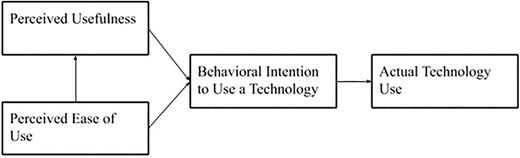
TAM, originally created in the field of information systems, is a popular contemporary theory for investigating both the behaviors of educators and their students vis-a-vis technology. The core variables of TAM are perceived usefulness and perceived ease of use. These variables are theorized to impact an individual’s acceptance of a technology which ultimately affects the individual’s use of that technology. Perceived usefulness is a measure of an individual’s view of how helpful the technology is for its stated purpose. Perceived ease of use is the perception that the technology of note is user-friendly and easy to operate and understand (Davis, 1989; Venkatesh, 2000; Venkatesh & Bala, 2008, Venkatesh & Davis, 2000). See Figure 1 for a diagram of the core TAM variables. Additional studies have suggested determinants of both perceived usefulness and perceived ease of use. These include factors like computer self-efficacy, computer anxiety, perceptions of control, and output quality. Table 1 outlines each of the theorized major determinants. Additionally, experience and voluntariness may moderate relationships between the determinants and perceived usefulness and perceived ease of use with increased experience and the technology being voluntary facilitating higher perceptions of usefulness and ease.
Determinants of Perceived Ease of Use and Perceived Usefulness
| Determinants of Perceived Ease of Use | Determinants of Perceived Usefulness |
|---|---|
|
|
Note: Descriptions are from Venkatesh and Bala (2008).
Since research using the TAM has been shown to foster higher levels of technology acceptance and use, it is a helpful theory to incorporate in one’s teaching. This can be accomplished by using existing protocols or very simply, just using the variables of perceived usefulness and ease of use and how these pertain to any new technologies introduced to students. This can be accomplished by explicitly discussing with students how useful a technology is, as well as its ease of use. For example, a popular technology used in online courses is asynchronous online discussions. However, students new to online education may not have any experience using such technology tools. Therefore, online educators should allocate time to explain how asynchronous online discussions help build skills relevant to their students’ desired careers (perceived usefulness), as well as how they encourage student playfulness and getting to know one another, all important to building learning community.
Online education relies on students to reliably and actively engage with a learning management system as the mode for learning. In research analyzing higher education student acceptance and use of a learning management system, the TAM has been frequently validated with computer self-efficacy highlighted as a major determinant of perceived ease of use (Alshammari, 2020; Ameen et al., 2019; Yeou, 2016). This suggests that online educators may be able to facilitate improved computer self-efficacy in their students by offering opportunities for students to build self-regulation skills by supporting their academic choices (Schunk & Ertmer, 2000). Beyond the learning management system, online educators frequently use additional digital tools and resources during instruction. Each of these technologies may have different factors for acceptance and use than a learning management system. A study on higher education student acceptance of Google Apps verified the importance of social image on perceived usefulness (Rejón-Guardia et al., 2020). Similarly, researchers of another study about the acceptance of YouTube verified the core TAM variables finding that perceived usefulness and perceived ease of use both impacted acceptance and use of YouTube by the higher education student sample (Maziriri et al., 2020). Nagy’s (2018) study of generic video use in online instruction also verified the role of self-efficacy in the process. These findings demonstrate how important TAM variables are to the acceptance and use of technology.
Yet, while TAM is generalizable (Scherer et al., 2019) and offers guidance on the factors that improve technology use for one particular technology, research is still lacking in how using multiple, new technologies at the same time may impact the model. This gap is important to gain a deeper understanding of technology acceptance and use as new technologies, both big and small, are a constant in contemporary life, and in particular, online education.
