

Providing authentic learning experiences to connect theory to practice is a principal component of effective distance/online education. Authentic learning prepares students for the workforce. This article will describe the process of designing, delivering, and evaluating an authentic learning module that was incorporated into an online undergraduate capstone course. The capstone course is the culminating project for the online, undergraduate BS degree in instructional design and technology at a regional university. Students were led through an authentic learning experience to solve a performance improvement problem for a practitioner. Students were empowered to work collaboratively with the client during the course. Students were encouraged to showcase their analysis, design, critical thinking, problem-solving, communication, collaboration, planning, and evaluation skills. During the capstone course, the instructor led the students through an authentic learning experience connecting research to practice.

Graduate Student, University of West Florida, 6745 Crooked Creek Rd., Tallahassee, FL 32311.
Graduate Student, University of West Florida, 6745 Crooked Creek Rd., Tallahassee, FL 32311.

Associate Professor, University of West Florida, College of Education, Instructional Design and Technology Department, 11000 University Parkway, Pensacola, FL 32514.
Associate Professor, University of West Florida, College of Education, Instructional Design and Technology Department, 11000 University Parkway, Pensacola, FL 32514.
The instructional design and technology (IDT) bachelor of science degree at the University of West Florida is designed to develop instructional design and performance improvement practitioners that will be effective in various industries. While the program is housed in the school of education, graduates are prepared to function in different business and educational environments. The curricula include theoretical, foundational, and practical concepts in instructional design, emerging technology, and performance improvement. Course work involves project-based learning and is focused on “those seeking employment as training and development specialists, instructional designers, face-to-face educators, and online educators or those passionate about improving performance and/or integrating performance technology in the workplace” (University of West Florida, 2022). The capstone project aims to encompass all aspects of the acquired and applied knowledge of the student.
Opportunity for Improvement
In the spring of 2020, educators/designers determined that the current undergraduate capstone course could be improved by providing an authentic learning experience. With a focus on high-impact practices, the faculty in the IDT department began creating an authentic learning opportunity as the culminating project for students graduating with the IDT bachelor’s degree. The following goals were established for the capstone project:
move from a scenario-based to a real-world business problem with the support of a business partner;
function as a consulting business within the capstone project; and
allow students to interact with a business in discovery and reporting.
The reimagined capstone would allow students to work on an authentic team where collaboration and performance improvement are tools to produce necessary deliverables.
Review of Relevant Research
Before a direction for the capstone could be set, a current literature review was necessary. Dr. Audrey Rule’s editorial on the components of authentic learning provided a comprehensive review of the literature before 2006. Rule reported that there are four major themes important to authentic learning (Rule, 2006).
First, authentic learning must contain real-world problems encountered in professional life. Rule found that authentic learning needs to focus on real problems that may have an impact beyond the classroom. When the problems to be solved are real-world, assigned activities are less of an academic assignment and more of an emotional connection to a real-life situation. The assignment, thus, becomes a type of problem-based learning. According to Hmelo-Silver, instructors who utilize Instruction focus on four components: motivation, facilitation, collaboration, and reflection (Hmelo-Silver, 2004). PBL instructors emphasize the value of inspired learning, individual and team investigation, and individual and group success. The entire PBL process is designed to be reflective (Pecore & Bohan, 2012).
Second, authentic learning must require students to use critical thinking by being exposed to a problem that does not have an immediate clear solution. Beyond being real-world, authentic learning utilizes a high level of cognition and engagement in active learning. Science educators use a discovery process to imprint and solidify understanding. The discovery process is “inquiry training, concept attainment, the learning cycle, concept formation, unguided inquiry, and cooperative learning” (Guillaume, 2015, p. 42).
When students are in an environment that encourages thinking critically about what they are learning, the learning content becomes relevant and brings about a transformation like how students think. Learning principles create learning environments that enable students to acquire higher order analysis skills and learn complex communication skills. Authentic Learning forces students to realize that textbook answers can’t solve real-world problems; this would give them assistance when they graduate and begin working. (Yeen-Ju et al., 2014, p. 2)
Based on an understanding of the discovery process defined by Guillaume, we can ascertain that students of all ages have engaged in this type of learning for decades and therefore accept its value and impact. The learning theory, asserted by constructivism, asserts “the idea that learners construct knowledge for themselves— each learner individually (and socially) constructs meaning—as he or she learns” (Hein, 1991, Constructivism section). Based on constructivism theory, when a learner engages in the hunt for knowledge and understanding, it builds on previous knowledge. Such knowledge holds more significant value to the learner.
Third, students must engage in interactive learning. The scientific discovery process and constructivism reinforce education as an individual and social process. This basis of scaffold learning increases the opportunity to learn in the community and individually through progressive learning exercises. Collaboration is one of the hallmarks of authentic learning and critical to learning success. “The learning event encourages students to compare their interests with those of an active learning community: Can I see myself becoming a member of this culture? What would motivate me? What would concern me? How would I work with the people around me? How would I make a difference?” (Lombardi, 2007, What Is Authentic Learning section)
Fourth, students must make independent choices that result in improved understanding. Rule found that learning occurs best when a problem is open-ended and can be understood personally. Student choice occurs in defining and solving the problem. Research shows that effective teaching requires a level of personalized and individualized instruction.
When we approach a subject for the first time, we immediately try to perceive the relevance of the new concept to our lived experience. A new piece of information is often rejected when it simply doesn’t fit our existing knowledge structures (or “schemas”). The more the learner is encouraged and provided the opportunity to be personally invested in the material, the easier it will be to assimilate the unfamiliar. (Lombardi, 2007, p. 8)
Hart Research Associates conducted a study for the American Association of Colleges and Universities in 2015. This report analyzes the discrepancy between the student’s perception of preparedness and the perception of student preparedness by employers. 66% of students believe they are highly prepared to utilize critical/analytical thinking. Conversely, employers reported that only 26% of students were prepared to use critical/analytical thinking within the labor force (Hart and Associates, 2015). Eighty to 85% of employers agreed they preferred students who proved their ability to:
effectively communicate orally,
work effectively with differing perspectives in a team dynamic,
Effectively communicate through writing,
perform ethical judgment and decision-making,
critically think and utilize analytical reasoning skills, and
apply knowledge and skills to a real-world setting.
Authentic learning experiences aim to bridge the gap between theory and practice.
High Impact Practices
High-impact practices are defined as “specific educational practices correlated with higher levels of academic challenge, student engagement, and achievement” (Kuh & O’Donnell, 2013, Abstract section). These activities can include applications that close the gap between theory and practice. The University of West Florida has the mandate to utilize high-impact practices based on the work of George Kuh. These practices have been used on university campuses for decades. Kuh published High-Impact Educational Practices: What They Are, Who Has Access to Them, and Why They Matter in 2008, formalizing a list of eleven practices. One of the 11 is offering a capstone course. “Whether they’re called “senior capstones” or some other name, these culminating experiences require students, nearing the end of their college years, to create a project that integrates and applies what they’ve learned. The project might be a research paper, a performance, a portfolio of “best work,” an exhibit of artwork or an applied project done in coordination with an institution or agency. Capstones are offered in departmental programs and, increasingly, in general education” (American Association of Colleges and Universities, 2022, Capstone Courses and Projects section).
Kuh advocates for the presence of high-impact practices in higher education. Kuh also recommends the proper implementation of these practices. Much high-impact practice research is confusing and contradictory. The presence of a high-impact practice alone is not enough to enhance learning (Kuh & Kenzie, 2018).
Capstone experiences are “summative curricular approaches such as courses synthesizing all of the content to date within a particular major (and often attempting to connect that concept back to the institution’s basic theme of general education and the liberal arts)” (Gardner & Van der Veer, 1999, p. 83). The Boyer Commission on Education in the Research University advocated that “final semesters should focus on a major project and utilize to the fullest the research and communication skills learned in the previous semesters” (Boyer Commission on Educating Undergraduates in the Research University, 1998, p. 27). Jayne Brownell and Lynn Swaner in “Five Impact Practices: Research on Learning Outcomes, Completion, and Quality,” state, “The senior year experience brought attention to the use of capstone experiences as a way to provide opportunities for integration, application, and closure to the senior year—and in some cases to a student’s entire academic career” (Brownell & Swaner, 2010, p. 37).
There are many goals for capstone experiences, but the “most common goal of senior seminars and capstone courses was to foster integration and synthesis within the academic major.” The second most important goal was “connecting the academie major to the work world” (Henscheid, 2000, p. 128). Henscheid reported that “Capstone experiences are generally not experiential in nature, so students who are engaged in capstones often do not have the opportunity to practice the ideas and skills they have learned in the workplace or community” (Brownell & Swaner, 2010, p. 38).
Connecting Research, Education, and Practice
Review of the research relative to the practice of delivering authentic learning experiences reveals an excellent opportunity for educators to “meet the need for a culminating or integrating experience that encourages students to view information from various [business and management] courses holistically” (Cycyota et al., 2019, p. 458). However, research and literature focus on the university perspective of delivery and education-based outcomes.
Student-feedback shows that students want to participate in projects and tasks that provide real and meaningful exposure to the requirements of their future career and profession” (Anderson & Mourgues, 2014, p. 74). Much like the design reviewed later in this paper, Anderson and Mourgues discussed the need for students to engage in an experience that involves the business community. In this setting, students are able to utilize/apply the knowledge and skills they have obtained during their academic careers. Anderson and Mourgues stated that when businesses play a role in an authentic learning experience, real-world knowledge and real-life experience is transferred to the student. This bridging from student to workplace happens when the student is allowed to:
apply current industry practices, knowledge, tools, and resources to the academic environment;
experience current industry problems and issues;
observe a broad-based representation of industry needs;
influence, through feedback and university involvement, curriculum content to match and better suit student and industry needs;
develop, maintain, and keep fresh a long-term and meaningful relationship with both industry and the university; and
provide a mechanism to evaluate the success/failures of the capstone process, so that a process of continuous improvement is developed (Anderson & Mourgues, 2014, p. 74).
Creating authentic learning experiences through capstone courses enhances the outcomes for the student and the university. When the experience “contributes current industry practices, knowledge, tools, and resources to the academic environment,” the curriculum is enriched and value is added to business practices that students encounter in the workplace. This is important to the student, the university and industry, since ever-changing business environments and evolving practices are the norm for all involved. The partnership between universities and businesses can create a powerhouse of learning for students, industry and academia.
A well-designed capstone course involves planning and high-level engagement from an instructor, students and participating business. The business provides project ideas, related data, company processes, workplace culture guidelines, answer to student questions, and pertinent information that will make the cooperative effort function for all involved. Sometimes, the business offers feedback that is considered in grading a student’s performance. This commitment may create a challenge for the business. However, “these challenges are overcome with the appreciation of the benefits this participation can bring to the company. Some of these benefits are the relationships formed with students and faculty, the chance to hire the best students from chosen universities, the positioning of the company in the future professionals’ minds, and the fulfillment of a social role” (Anderson & Mourgues, 2014, p. 74).
A single capstone course “may not be robust enough to accomplish the multiple capstone goals of theory, integration, and application” in today’s educational environments (Cycyota et al., 2019, p. 458). According to the research of Cycyota et al., a series of such courses may bring ideas and practices together for effective learning. Capstone courses in series presents foundational courses that extend the learners’ understanding of concepts that are difficult to teach through practitioner-based methodology. For example, courses focused on theory and strategy are critical to understanding essential concepts but are not necessarily utilized as a practice. Such courses are, rather, the concepts that guide the practice. According to Cycyota et al., the idea of multiple capstone courses, or more broadly, multiple authentic learning experiences, could be explored by educators as a means of expanding learning that includes both application-based instruction and concept-based instruction.
With the expansion of online learning, creating authentic learning opportunities offers unique challenges. Creating communities of learners is more challenging when students are remote from one another. Communities of practice (CoP) are one way of structuring the online learning environment. Albrecht quoted Étienne Wenger as describing CoPs as “groups of people who share a concern or a passion for something they do and learn how to do it better as they interact regularly.” In doing so, Wenger points out the similarities between authentic learning and CoP approaches to teaching and learning. “If CoP are about learning through action and interaction, the parallels with learning through participation in cultural practice are evident” (Albrecht, 2012, Authentic learning and CoPs section).
Design
Based on the literature review, current research, learning theories, and experience, the journey to redesign the capstone course was initiated. A university-based design team set forth one basic focus that would drive the redesign project. The new focus was to move, structurally, away from a scenario-based capstone model to a practice-based capstone model.
The previous capstone course was a scenario-based project. In this design, students chose from predefined scenarios which were structured by the university. Scenarios might be real-world or they might be fictional. The scenarios had limited information and required students to create additional context to answer questions, obtain data and find solutions.
The lack of real-world and real-time context impacted the ability of students to work effectively in teams. Some of the new information that was needed for the project was assumed/fabricated. Conceptually, such scenarios were based on a nonauthentic foundation. As discussed earlier, research shows that this type of project lacks the emotional connection students may experience from a project that goes beyond the classroom.
The newly designed course utilized the literature review and previous authentic-learning research. One foundational concept was to apply Rule’s four themes of effective to authentic learning:
authentic learning must contain real-world problems encountered in professional life;
authentic learning must require students to use critical thinking by being exposed to a problem that does not have an immediate clear solution;
students must engage in interactive learning;
students must make independent choices that result in improved understanding (Rule, 2006).
The learning must contain real-world problems that are typical in professional life. The newly designed capstone project was based on an industry problem from an actual business with an actual client. Students were assigned to a single team that acted as a consulting company during the project. Each team member assumed a typical business role aligned with their strengths and weaknesses, allowing for personalization and individualization. Roles included communication lead, data analyst, data collection (data scientist type role), team lead, and project coach—personalized for the group.
The project had a real client and specific stakeholder(s), requiring meetings with each for data gathering, project progress/management and updates. Meetings with an executive of the consulting company were also conducted. In our design, the instructor assumed the role of executive to simulate actual workplace meetings, including providing new and sometimes distracting information. The simulated situation allowed the students to determine if the information was pertinent to the project goals or just ancillary data. The learning required students to use critical thinking and be exposed to a problem that did not have an immediate clear solution.
Students must engage each other. The team met independently and sometimes in subgroups to complete tasks. Each step produced and resolved questions. Actual ownership was expected by each team member, and discussions happened in-person, via Zoom meetings, using chat/texts and using hybrid settings.
Students must make independent choices resulting in expansion of understanding. Each student owned a piece of the work but was instrumental in reviewing work from other members. Each student was expected to pursue stated goals and hold themselves and others accountable for project choices.
Project Execution
The project was designed to allow students to experience an authentic learning process in the context of a real-world problem/solution scenario. As stated earlier, the team was briefed on the project and the roles each would play. The team would act as a consulting company team working for a company. In this case, it was a manufacturer of blinds. In the consulting company’s executive role, the instructor provided the team with the client details and defined problems. The project group (the students) was formed to address the problem(s). Solutions were produced utilizing the methodologies and strategies learned throughout the degree program.
The team first met to discuss the roles needed. After the initial team meeting, the project timeline was defined. The group then met with the manufacturing company to review and gain approval for the project plan (Table 1). Subsequent ad hoc meetings and communications occurred with the client, especially when access to clients, employees, or additional data was required.
Project Timeline
| Meeting #1 (March 3) | Meeting #2 (March 17) | Meeting #3 (March 31) | Meeting #4 (April 14) | |
|---|---|---|---|---|
| Introduce |
|
|
|
|
| Delivery |
|
|
|
|
| Comms |
|
| Identify components-products:
|
|
| Goal |
|
|
|
|
The team followed the human performance technology model defined by Van Tiem et al. (2012). This performance improvement model provided a format for identifying critical factors related to the problem statement.
The following key steps were completed:
organizational analysis;
environmental analysis;
gap analysis;
cause analysis;
intervention selection, design, and development; and
intervention implementation and maintenance.
The team conducted a task analysis to map the work completed in a typical blind order. The analysis shown in Figure 1 is the ideal process.
 The process flow diagram shows a sequence of steps beginning with a start circle. The first step is Receive sheet with barcode that contains blind details. A second box is Scan barcode to input in manufacturing system. A third box is Gather required amount of wood slash plastic and color for specified job. The next box is Place material on automated cutting machine and double check. The flow continues to Turn on machine and it will automatically cut to the specified measurements in the system. The next step asks, Is measurement accurate, which branches to a no and yes path. The no path leads to a box labeled Double check measurements and if still incorrect restart process, then to an X in a circle. The yes path leads to a box labeled Material is transferred and is put together to complete the item, which leads to an end circle. A step labeled Worker manually measures the cut material to check accuracy is shown leading into the Is measurement accurate box.
Task analysis.
Note: This analysis is the product of the referenced capstone course.
The process flow diagram shows a sequence of steps beginning with a start circle. The first step is Receive sheet with barcode that contains blind details. A second box is Scan barcode to input in manufacturing system. A third box is Gather required amount of wood slash plastic and color for specified job. The next box is Place material on automated cutting machine and double check. The flow continues to Turn on machine and it will automatically cut to the specified measurements in the system. The next step asks, Is measurement accurate, which branches to a no and yes path. The no path leads to a box labeled Double check measurements and if still incorrect restart process, then to an X in a circle. The yes path leads to a box labeled Material is transferred and is put together to complete the item, which leads to an end circle. A step labeled Worker manually measures the cut material to check accuracy is shown leading into the Is measurement accurate box.Task analysis.
Note: This analysis is the product of the referenced capstone course.
The team learned three sources of sizing errors through data analysis and surveys. Based on this information, causation had to be established and interventions identified. The outcome of this exercise is shown below in Figure 2 and Table 2.
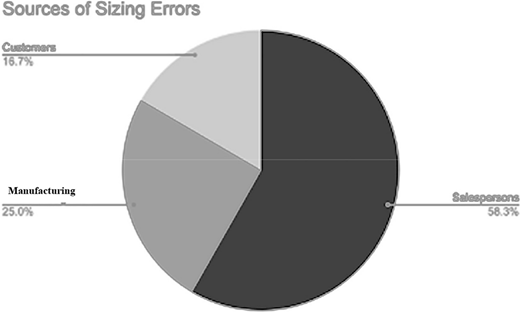
Error analysis—causation.
Note: This analysis is the product of the referenced capstone course.
Error analysis—causation.
Note: This analysis is the product of the referenced capstone course.
Decision-Making Plan
| Issue Identified | Path to Root Cause | Recommendations |
|---|---|---|
| Measurements are not accurate and are leading to defective orders |
|
|
| Machine operation |
|
|
Note: This analysis is the product of the referenced capstone course.
The rigor of this project allowed for the demonstration of expertise in several areas such as content knowledge, project management skills, time management skills, and professional communication. It was intended to be challenging, and the following was expected by each student:
function in a student-led, remote environment;
adjust to a workload that varied from time to time;
address problems including time management and client communication; and
focus on client’s needs as they occurred throughout the project.
Outcomes
Student feedback is one primary method for measuring the effectiveness of capstone courses (Brownell & Swaner, 2010).
Student feedback was obtained by two methods. The first was through an anonymous survey conducted through the university student assessment system. The second was through an assigned reflection paper, written by each individual student. The student assessment survey was administered through the automated university system at the end of the semester. Students responded to standard Likert-scale questions as well as free-response prompts. One hundred percent of the students ranked the course as excellent in terms of communication of ideas and information, the value of assignments, and the overall assessment of the course. The free-response sections included the following quote, “the class accomplished its goals of achieving its ‘real world’ simulation. I had a blast.”
In addition to the university-administered survey, the students were assigned a reflection paper at the end of the course. The following questions guided the reflection:
Realizing you may not have any experience in the field yet, how relevant or applicable did you find the case study to the “real world”? Provide any insight or anticipated relationship between the case study and job experiences.
Reflecting on the course, what do you believe was the most valuable part for you?
What was the least valuable?
How does the experience relate to what you are currently doing?
What did you learn through the case study that you didn’t or couldn’t learn from your traditional coursework?
What did you learn about being a team member, and what value is that to you now?
What did you learn from participating in the online collaboration meetings?
What did you learn from making the revisions and working collaboratively? How is this valuable to you now?
What did you learn from the brainstorming sessions?
What did you learn from the time commitment?
What did you learn from participating and preparing for the case study presentations?
What did you learn from the “client” and responding to their questions?
As with many bachelor-level degree programs, students had varying levels of professional experience. One student with limited professional experience consisting of entry-level service-worker positions stated,
For me, this course was not only an eyeopener since I have zero field experience, but it was also a big steppingstone for me. I completed a full project with people whom I consider friends and I got to speak my mind throughout the project and feel like an equal. In our group, I believe I had the least amount of real-world experience, so having everyone hear my opinions and agree with those thoughts boosted my confidence. (H. Handley, personal communication, April 14, 2021)
This feedback represents the highest level goal of this capstone redesign: to provide an opportunity for students to utilize their knowledge in an authentic scenario, to boost student confidence in applying tools learned in the degree program and to confirm applied understanding of practice in the performance improvement/human performance technology model. Other statements from the guided reflection questions included (H. Handley, personal communication, April 14, 2021):
“I think my favorite thing about the scenario was the interaction with an actual ‘client.’ He kept us on our toes with questions that we were not expecting at all, and I think that is what made the whole scenario feel so real.”
“In the end, the course was amazing, and the layout was perfect. Adequate time was given between tasks that allowed us to completely develop our ideas and refine them into a product worth submitting for a grade.”
“To me, the real-life experience was the most valuable aspect. We had to juggle working as a team while also each juggling outside responsibilities. I found this to be very in line with real work experience.”
Future Considerations
Considering the literature reviewed and the outcomes achieved, it is evident that the redesign of the capstone course was meaningful and relevant to students. The original course design provided opportunities for demonstrating personal understanding and competencies but was limited to the details presented in the scenario. The old course design did not allow students to work collaboratively in a real-life context and learn from each other.
In the original course design, students did not have the opportunity to interview or gather additional details through client or stakeholder interactions. The human performance technology model requires practitioners to follow specific processes to determine solutions to problems. Solutions often involve interacting with clients and stakeholders. As the literature suggests, customizing the capstone experience offers a unique opportunity for students to get a glimpse of the work world they are about to enter. The capstone experience and future course customization may include modifications based on:
individual student strengths and weaknesses;
curriculum highlights and changes;
availability of authentic learning opportunities;
trends in workplace and marketplace; and
other factors that will enhance learning.
The capstone course discussed in this paper proved successful due, in large part, to the familiarity of the students with the Department and instructor of record, the clarity of the role of the performance improvement practitioner, and tools/concepts learned by students throughout the degree program. The learning experience is enhanced significantly when the customization allows the learning to “foster integration and synthesis within the academic major” (Henscheid, 2000, p. 139).
However, the value of customizing an authentic learning experience is essential for students in all scenarios because it offers a new way, for a cohort of students, to apply what they have learned in the classroom.
Author Note
This article is based on a presentation initially presented at the Association for Educational Communications and Technology Annual Conference in 2021.
