Just as community building has been an important mechanism for engaging users in e-commerce, the value added by developing community also applies in online education. The newest incarnation of education community building is burgeoning in the form of the student organization. Virtual Student Organizations (VSOs) can alleviate distance students’ sense of isolation from a physical campus, as well as deepen the engagement of students in their studies. These organizations ensure student representation, provide academic support, serve as a liaison between students and instructors, as well as aid graduates with networking opportunities.
Student representation is especially important to student populations that are isolated from a physical campus. Individual voices and occasional evaluations conveying administrative and academic concerns will not typically be given the same weight as the voice of a recognized and unified student group. By broadening the representation of students to include student organizations that support students who are taking courses solely at a distance, educational institutions can recognize and address many of the challenges faced by distance students.
VSOs can help administration and faculty to better serve their distance student body. In some ways, being a distance student can be analogous to having a physical disability that limits access to academic resources. Distance students often have trouble with administrative paperwork, receiving student identification cards for library access, technical issues, and transitioning into an online format. The “disability” of not being physically on campus can, however, be overcome by engaging in a proper dialogue between students and administration/faculty. The VSO is an organized channel of communication that can help improve the distance student experience.
Through VSOs, online students can also take advantage of opportunities to develop leadership skills and responsibilities. Organizing a VSO requires leaders to conceptualize and communicate the value of a student organization differently with peers, administrators, and instructors. After all, since interactions are conducted via threaded bulletin boards, polls, e-mails, and chat rooms, the unique leadership and communication strategies must be selected carefully. Leaders participating in student organizations as officers can additionally have the opportunity to lead by working on initiatives and delegating tasks to committees. Officers must also help facilitate conversations, answer questions, and communicate the group’s concerns to administration and faculty. Newsletters are especially vital to VSOs because they convey the achievements and direction the group has taken, and offer a record for future leaders in the organization.
Using online bulletin boards, VSOs offer students the ability to support each other in their academic pursuits. While many individual online courses have a student lounge for social interaction, the advantage of a VSO-supported bulletin board is that it is both continuous from semester to semester and it can be available to all distance students in general, or distance students within a particular major. This allows students to confer about classes, textbooks, graduation, seminars, job opportunities, conferences, and other educational opportunities. This interaction can, furthermore, help foster long-term bonds between students as they progress through a program of study.
A VSO can also lend a personality and a face to students, instructors, courses, and the school. Students feel connected to the school through a VSO, and may feel a sense of allegiance and belonging. This can set up a vital behavior pattern of involvement, which is fundamental to the existence of a VSO, and can help promote the e-learn-ing study skills necessary for success in classes that require participation.
As an aid to students as they transition into the workforce, a VSO can additionally provide a network of peers in the same industry. Instructors, alumni, and students can use the bulletin board as a means by which to distribute job postings, share industry news, as well as advice and mentoring. Oftentimes, online programs try to blend students’ work experiences and what they are learning in their classes. A VSO can further support these efforts and this advantage can last beyond the scope of the single semester. In addition, the asynchronous nature of a VSO adds flexibility for members so they can have opportunities to participate in student organization activities that have traditionally been available only to on-campus students.
VSOs serve a vital role in transforming the identity of distance students and can influence how students interact. A VSO community can engage students deeper into their major, deepen counselors/faculty relationships, and provide opportunities for unique student involvement. The identity of a distance student is often described as one of a faceless e-mail address that generates papers and participates in online forums. As a result, distance students are often forgotten when it comes to offering job postings, internships, publication opportunities, and student government activities.
To date, there have been very few examples of sustained VSOs. Some institutions support their student organizations with program administrators, while other student organizations are student-sponsored, -developed, and -maintained. VSOs can also be differentiated by those that are completely online and those that have a blended format with elements of online communication as well as a face-to-face component.
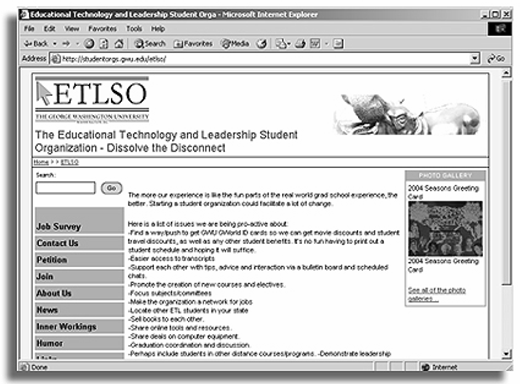
The George Washington University has a VSO that is a model of a completely student-initiated and university-sponsored group. The Educational Technology Leadership Student Organization (ETLSO) was established to connect distance Educational Technology Leadership (ETL) graduate students with each other and The George Washington University campus. ETL students live all over the world. They are separated by time zones and locale, but are joined through technology. ETLSO is intended to be a social, educational, and networking forum for ETL students. Through ETLSO, ETL students have opportunities to demonstrate leadership, practice their technology skills, and prepare for the workforce.
A look at the inner workings of the group can reveal many useful rules, roles, and norms involved in creating a successful and sustainable VSO. For example, members must subscribe to the online newsletter and bulletin board, as it is the only centralized form of communication, and members are considered to have voluntarily withdrawn from the student organization if they remove themselves from the newsletter mailing list. There are no dues for the organization, though donations are always accepted. In order to sustain the organization and develop internal leaders, there are seven officers in the Educational Technology Leadership Student Organization: president; vice president of communications; Web site administrator; recruitment and public relations officer; and facilitators of education, leadership, and technology.
The role of the president is to lead and plan the activities of the organization, as well as direct the activities of the other officers. The president must help ensure high participation levels in the organization, as well as ensure that the organization members have a positive and active experience. The Vice president of communications’ function is to coordinate members’ involvement in the weekly and/or monthly newsletter. The vice president will personally create and/or seek out newsletter submission topics, articles, links, requests, inquiries and all other meaningful content.
The role of the Web site administrator is to update and organize online content for the organization. He or she helps to facilitate a sense of belonging and online community. The recruitment and public relations officer is in charge of promoting the ETLSO to ETL students without spamming them, and he or she informs new ETL students of ETLSO’s existence and what ETLSO has to offer. the facilitators of education, leadership, and technology help initiate and moderate online bulletin board discussions and chats. They also seek opportunities for the organization to become more involved with its members, the campus, and the community. All of the officers contribute to the newsletter, as that is the centralized means of facilitating communication.
Even though ETLSO is still a pioneer of virtual student organizations, it has reaped positive results for ETL students, the instructors, and the academic program. The forums get especially busy when topics like class registration, book purchasing, and graduation are discussed. Students have been able to hold educational chat sessions on practical topics, such as Web page creation and educational technology. A few students have been fortunate to meet in person after networking and discussing their travel plans for various seminars around the country. Some postings have even sought advice for practical job-related issues, such as choosing a learning management system, while other postings report the latest news in educational technology.
ETLSO’s plans involve more communication with alumni and employers, as well as scheduled guest “speakers” for chat room events. Alumni and employers have great potential in regard to networking for jobs, internships, and volunteer opportunities. Through guest speakers and visiting professors, the goals of the VSO are to sustain interest and engagement, to enlighten members on industry trends, and share wisdom about current topics.
Overall, VSOs are a rethinking of how conventional student organizations function and the role of distance learning students in education. Technology is a great translator of physical world activities into virtual ones. The ability of technology to create useful communities for online students is a story that is just now being written. With the dynamic communication options offered by the Internet, VSOs now have the potential to offer engaging and active online experiences to students that may never set foot on the traditional campus and, with virtual student organizations, online degree programs can add value to what could otherwise be an isolating, impersonal educational journey.
About the author