

Introduction
There are too few opportunities for learning service professionals and students to practice authentic instructional design as a part of their respective training and academic preparation. The professional practice of instructional design (ID) requires high-level problem solving, critical thinking, and interpersonal skills because design problems are often complex and multidimensional. Novice instructional designers encounter practical issues for which they are unprepared (Julian, Larsen, & Kinzie, 1999). Analyzing cases provides an opportunity to explore professional issues while students learn (Kinzie, Hrabe, & Larsen, 1998). A case approach aids the instructional systems design (ISD) learning process and helps to facilitate further research of online learning environments. Learning through a case-based environment allows novice instructional designers to analyze the case, reflect on relevant theories and techniques in attempting to understand a real problem, develop a response, and consider potential consequences.

Myung Hwa Koh, PhD student, Department of Educational Psychology and Instructional Technology, 604 Aderhold Hall, Athens, GA 30602. Telephone: (706) 542-4410.
Myung Hwa Koh, PhD student, Department of Educational Psychology and Instructional Technology, 604 Aderhold Hall, Athens, GA 30602. Telephone: (706) 542-4410.

Robert Maribe Branch, Professor, Department of Educational Psychology and Instructional Technology, 604 Aderhold Hall, Athens, GA 30602. Telephone: (706) 542-3958.
Robert Maribe Branch, Professor, Department of Educational Psychology and Instructional Technology, 604 Aderhold Hall, Athens, GA 30602. Telephone: (706) 542-3958.
Case studies have been an effective tool for developing professional knowledge across disciplines; however, case events dedicated to the study and practice of instructional design are limited among learning services professionals. This article is based on the experiences of the authors during a recent instructional development project using authentic training cases for online learning environments and similar distance education contexts. We have explored aspects of an educational approach using an online case event that served to provide designers with an opportunity for teamwork in an authentic environment. The components of this discussion include: (1) an overview of the case method as a learning strategy, (2) the role of a case in an online learning environment, and (3) learning instructional design from a case experience.
The Case Method as a Learning Strategy
Online case-based events are student-centered, active learning experiences in which students can reflect on relevant theories and techniques in attempting to understand a genuine problem and develop the most appropriate response by considering a variety of acceptable responses to a given situation. Case methods help students examine theories during the learning process and to apply these theories to situations they may encounter upon completing a distance learning course. Authentic instructional design should emphasize learning objectives that represent the training context while on-the-job objectives represent the actual performance context. Learning objectives describe what the learners will be able to demonstrate within the learning environment. However, the learner’s performance in the classroom or at the computer in a distance learning environment is not necessarily the same as on-the-job performance. Learning on simulators, models, through hands-on practice, role-play scenarios, and actual equipment and tools provides more effective training than learning exclusively from lectures, demonstrations, and other passive techniques.
Online case events provide authentic learning experiences for students, so it helps them to investigate various solutions based on their situation and find a final solution. Over the past year, a case method approach has been explored by constructing an online case event (http://www.itcaseevent.com/) hosted at the Educational Psychology and Instructional Technology Department at The University of Georgia. The online case event provides an opportunity for novice instructional designers to use instructional systems design in an authentic, team-oriented online learning environment. The process of participating in the case event is a rewarding, challenging, and complex endeavor. While developing a case for an event, consideration should be given to the fact that novice instructional designers require a genuine problem to reflect the situations that they would encounter in the workplace, or approximate this environment as closely as possible. The intended audience for the event needs to be determined. The rationale for authentic learning is that learners can only realize the utility of the concept being taught by focusing on an authentic problem and, hence, providing an authentic solution. Each episode of guided learning is distinctive and separate, while remaining part of a larger cur-ricular scheme. By using case methods and an online learning environment, students’ learning space becomes larger than a traditional classroom and is similar to performance space (see Figure 1). A case needs to be created that illustrates an authentic problem requiring an instructional design solution.
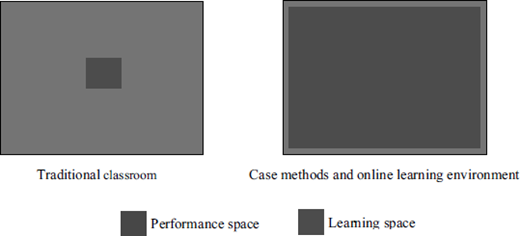
Traditional classroom compared to potential for online learning environment.
Traditional classroom compared to potential for online learning environment.
Case events help learners to think like practicing professionals by allowing them to seek solutions in realistic situations. Case events have been used extensively in professions such as law, business, and medicine, and more recently have gained popularity in other professions such as teacher education, engineering, nursing, and instructional design (Ertmer & Russell, 1995). Merseth (1994) advocates case study methodology as an appropriate tool for teacher education, stating that a case study is a descriptive research document, often in narrative form that is based on an authentic situation. According to Merseth (1996), “there are three purposes for using cases: (1) cases as exemplars; (2) cases as opportunities to practice analysis, the assimilation of differing perspectives, and the contemplation of action; and (3) cases as simulations for personal reflection” (p. 3). Case studies provide realistic scenarios that encourage students to recognize the link between theory and practice, weigh resource constraints in choice alternatives, practice analytical skills, and develop related skills such as group decision making and communication (Ruth, 1993). Thus, the case-based approach assists students in examining theories and applying them to their situations, so it helps them to close the gap between what happens in the classroom and expectations associated with performance realities outside the classroom.
Cases provide students with genuine opportunities to experience the risks and consequences associated within a defined context, allowing students to explore professional issues while they are still learning about design, yet within a safe environment. Case events allow students to construct knowledge in authentic environments, assume personal responsibility for learning, and work cooperatively to produce something of real value (Grabinger, 1996). Kinzie et al. stated, “cases should offer enough depth and complexity to provide realistic challenges” (1998, p. 55). Case-based competition is beneficial to learners because knowledge and skills are best learned in contexts that reflect the way they will be useful in various realities. Learning in a case-based environment allows teams to analyze a case while experts in the field pose questions, evaluate case responses, and contribute their own perspectives.
The Role of a Case in an Online Learning Environment
Internet technologies provide an effective vehicle for delivering cases to students and other case event participants. The use of the Internet provides case materials and online environments for case discussion. The Internet provides a unique environment for presenting case studies that allows users to gather information, identify issues, create solutions, receive feedback, and gain experience through problem solving. The interactive nature of the Web and e-mail encourages students to consider various perspectives and possible solutions and to develop a rationale for decision making while enabling worldwide discussions.
Case studies are now available online, and case discussions can be conducted using asynchronous and synchronous online discussion tools. Perry (2000) claims that the “Internet and multimedia, which includes the nonlinear integration of video, audio, graphics, and text, can provide a rich environment for case studies that promote the construction of knowledge about integrating technologies into the curriculum of a learning community of peers and faculty facilitators” (p. 4). The online instructional design case event discussed here subscribes to Perry’s position that an online case experience promotes an integrated, action learning approach with the potential to increasing effective practice. Kovalchick, Hrabe, Julian, and Kinzie (1999) suggest that the Web provides three significant capabilities for the delivery of case studies: the ability to simulate real-world complexity, the ability to use multiple media in case presentations, and the ability to use hyperlink/hypertext navigation features.
Presenting case studies on the Web offers additional educational benefits, including incentives to learn new and flexible learning methods (Hayden & Ley, 1997). The contention here is that the capabilities as described herein are an effective way to learn instructional design at a distance.
Learning Instructional Design From a Case Experience
Instructional design is often learned informally on the job or as an isolated, stand alone college course. However, recent evidence suggests an action learning approach as an effective strategy for becoming proficient in the practice of instructional design (Bannan-Ritland, 1999). The principles of an action learning approach provide a framework for re-examining methods of teaching instructional design. Action learning is an instructional strategy used in training and education to increase the fidelity between learning performance and job performance. The problem is that many training tasks are decontextualized and incongru-ent with workplace realities due to ineffective distance education strategies, thus having a low fidelity between what occurs during classroom preparation and what is expected on the job. Action learning is a performance-oriented, learner-centered, instructional strategy. The purpose of action learning is to promote immediate and long-term learning transfer. Action learning is facilitated through a coaching model approach in which an experienced person is partnered with an individual or team and the coach is available to answer process questions during the training and for a designated period after completion of the training. While action learning incorporates several learning theories, five attributes are necessary for an instructional strategy to be considered as an action learning approach: active, interactive, situated, authentic, and case based.
Components of action learning correlate closely with the specific challenges involved in teaching the ill-structured, complex problem-solving processes of the practice of instructional design. An action learning approach provides instructional design practice in businesses, schools, and government as a part of their respective training and academic preparation prior to assuming employment as an instructional designer. Authentic instructional design should emphasize learning objectives that represent the training context while on-the-job objectives represent the actual performance context. Learning objectives describe what the learners will be able to demonstrate within the learning environment.
Recommendations
We have explored the role of a case or an authentic scenario in an online learning environment, and investigated aspects of an educational approach using an online case event that served to provide designers with an opportunity for teamwork in an authentic environment. This discussion has focused on ways in which online case events provide opportunities for learning service professionals to engage intellectually in solving authentic instructional design problems. The following recommendations are offered here, based on the belief that experiences shared by participants in an online case event promote discussion of complex educational dilemmas, reflection on successful learning strategies, and ways to evaluate issues in instructional design.
The case event should illustrate a genuine and authentic problem that requires an instructional design solution.
The case event should be designed to challenge participants to demonstrate knowledge of instructional design principles and this exercise should incorporate the problem that was presented.
The project manager for the online case event should be chosen based on ability to generate a plan for communication between all stakeholders and excellent time management skills.
Careful preparation allows design teams to anticipate obstacles and potential barriers to accomplishing their goal.
The support of the design team and client are important. Sufficient aid from external sources is imperative, including technical support staff and colleagues with mutual goals at other distance education training organizations.
References
Call for Papers
Publish inDistance Learning
The editors ofDistance Learningwould like to publish your paper. We are interested in papers dealing with practical applications of distance education in a variety of settings. Contact Michael Simonson, editor, if you have questions about your idea (954-262-8563; simsmich@nova.edu). Guidelines for submitting your paper can be found on page ii of this issue.
