Legend has it that Abraham Lincoln walked 20 miles a day to attend school and studied by candlelight in order to obtain an education. That took place nearly 200 years ago. Ironically, even today, children in rural areas still must rely on their own perseverance and resiliency if they desire to achieve a formal education.
Residents of urban areas in the United States have the advantage of educational choices. Students typically live within the proximity of a number of local high schools, private and public, any of which they may attend. Tuition, course offerings, quality of teaching, reputation, convenience, and college preparation programs are among the things students and parents may consider when making a selection. However, things are quite different in rural areas where population density is low, schools are few and far between, and school choice is literally nonexistent. Enabling students to obtain a quality education, one that would prepare them for a competitive society, presents many problematic issues for rural school officials.
Course offerings are slim, as finding enough qualified teachers in a variety of subjects is almost impossible. Funding schools in rural communities takes creative thinking and plenty of outside help, as raising property taxes to pay for education, the usual panacea in American cities, is not an option when the population is very small, and many are poor. In the late 1990s, with the expansion of high-speed Internet access, came a potential solution to an educational crisis—the “virtual” school.
E-learning is established and accepted as a legitimate form of education at the postsecondary level. However, in the elementary and secondary school systems, virtual schools are still finding their way, and it is too soon to tell what the ultimate outcome will be. How will this form of education affect the futures of young students? The state of Arkansas is among the first to implement the virtual high school, and will likely be the site of future research. Beginning with only 50 students in the spring of 2000, the Arkansas Virtual High School (AVHS) has grown from an experimental, pilot project into a major institution hosting over 1,700 students in the fall 2006 semester.
Virtual schooling is a trend whose time has come. Increasing demands on rural communities for funding, providing required and desirable elective courses, attracting staff members, and developing an environment conducive to competition, are among the reasons states choose this path. Of course, all states can benefit from the virtual school technology, but especially for states such as Arkansas with a population density of 52, that is, 52 people per square mile. Compare Arkansas to the state of Florida with a population density of 308, or Illinois with a population density of 228, and the benefits are potentially dramatic (Netstate-AR, 2005; Netstate-IL, 2005; Netstate-FL, 2005; SchoolMatters, 2005).
DEVELOPMENT OF THE ARKANSAS VIRTUAL HIGH SCHOOL
Distance learning in Arkansas is coordinated by the state Department of Education’s Arkansas Distance Learning Development Program. A federal grant under the Voluntary Public School Choice 2000 program to the Arch Ford Educational Service Cooperative provided initial funding for the AVHS pilot initiative. Arch Ford manages the school in cooperation with the Arkansas Distance Learning Center (Assurance Policies, 2006). Tuition is free to Arkansas students.
The purpose of the AVHS, as stated on their Web page (http://avhs.k12.ar.us), is to
provide an online alternative learning environment for the students of Arkansas’ public schools who need assistance in completing coursework that is difficult to receive due to factors such as schedule conflicts, homebound due to extenuating circumstances, and other factors that might impede a student’s progress through grades 9-12. (About AVHS, 2006)
The first seven courses were developed in-house during the fall semester of 1999, for their introductory run the following spring. The initial offerings included U.S. history, world history, algebra, calculus, English, biology, and Spanish. A few teachers were hired to conduct these courses based on certification status and completion of at least three distance learning courses. Additionally, teachers were required to attend weekly training sessions throughout the instructional design phase (eSchool News, 1999). By the fall 2006 semester, 33 courses were available, which included the secondary school core curriculum, a number of electives, and several advance placement courses. The AVHS instructional staff had expanded to three full-time teachers and 21 part-time teachers (Watson & Ryan, 2006). Figure 1 shows the enrollment per course category over the years 2004-2006.
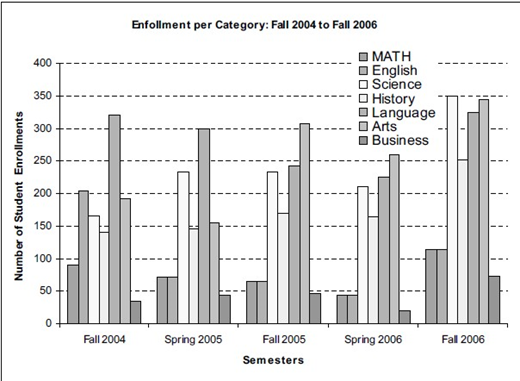
Student enrollment in various categories of courses from fall 2004 to fall 2006.
Student enrollment in various categories of courses from fall 2004 to fall 2006.
The first semester of the AVHS proved to be a learning experience for all involved. A number of adjustments were necessary to continue. One of the primary changes involved the system through which lessons were developed and delivered to students. The school switched platforms from Lotus Notes Learning Space to WebCT, a more user-friendly environment, which remains in place today.
A second major adjustment involved textbooks. Initially, teachers tried designing courses that did not require textbooks. Lectures were posted, electronic links and graphics were provided, and so on, but this method turned out to be ineffective, more so for some courses than others. Teachers found that posting lectures and exercises took too much time, formatting presented technical hassles, often students had problems with the links, and the graphics—well, students soon became familiar with the little red box with the x in it. Ultimately, the product did not return the desired outcomes. However, requiring a course textbook helped to resolve these issues for many courses, and greatly influenced the manner in which instructors and students were spending their time (S. O’Reilly, personal communication, November 19, 2006).
The characteristics of the students attending AVHS have changed, as well. As director Sandy O’Reilly has noted, some students enrolled thinking that online classes would be a lot easier, and they were not prepared for the amount of work demanded (S. O’Reilly, personal communication, November 19, 2006). Thus, for the first two years, the length of the pilot program, only 47% of students completed their courses. However, some school officials attributed the low completion rate to the fact that during the pilot phase, all courses were free. Beginning in the fall of 2002, affiliate schools were charged a fee of $150 per half-credit (one-semester) course, per student (Denton, 2002). Schools were then pressured to stay on top of student progress, and it apparently paid off, as enrollment grew to over 30 times its original size in 6 years (Watson & Ryan, 2006) (see Figure 2).
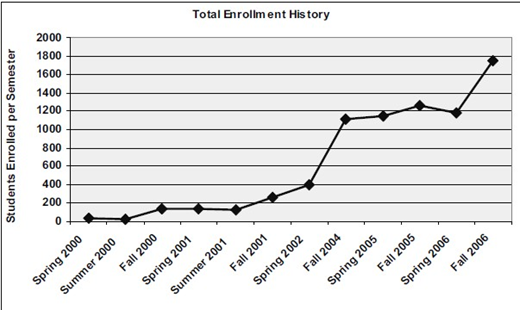
Total enrollment over the history of the AVHS using available data.
Total enrollment over the history of the AVHS using available data.
STANDARDS
The questions on the minds of educators regard the long-term effects of a virtual education on high school-age learners. The National Education Association (NEA), recognizing these concerns, and the differences in teaching young students as opposed to college students, recently issued their Guide to Online High School Courses (NEA, 2006), in which they focus on standards for curriculum, instructional design, assessment, management and support systems. They indicate that while some post-secondary school course standards and characteristics may “also apply to online courses in a high school environment, to be effective there, online courses must address the unique social, educational, and emotional needs of the high school student” (par. 4).
Technology may remove the geographical and economic barriers to a high-caliber education, but the challenge faced by virtual schools is ensuring that the quantity and diversity of courses increases, while enhancing the quality of the educational experience (NEA, 2006). Simply put, the concern is to provide the courses students need and want, while maintaining a consistent level of authenticity. Clearly, the methodologies involved in teaching and learning online are different from those practiced in the traditional classroom. Therefore, the NEA Guidelines explore and document a number of these issues, including communication between teacher and student, appropriateness of courses for online delivery, completeness and accuracy of assessment tools, flexibility issues for individual student needs, timeliness of teacher response, and responsibilities of online instructors.
Special attention is given to teacher certification, teacher preparedness, professional development, and student monitoring. Further, intellectual property rights, notification and approval of parents, equivalency in course credits, course evaluations, and access to the equipment, software, and connections necessary to make the student’s experience legitimate and rewarding are part of the published set of guidelines (NEA, 2006).
With these standards at the forefront of the process, developing the virtual school entails the implementation of enabling technologies to support learning anywhere, anytime, and at any pace (to borrow a phrase from the Florida Virtual High School). The speed of the digital environment make some processes especially important: the virtual school must have a system in place to maintain integrated and ever-changing data files, to report student progress, and to provide a variety of well developed learning resources (Salisbury, 1996).
AVHS STANDARDS
The AVHS is clearly intent on complying with the Arkansas Department of Education Rules Governing Distance Learning (2005), in detail. This is apparent on their Web site by the way the viewer is informed. The AVHS uses refreshingly readable fonts; they set off important issues with enough “white space” so that they cannot be missed, and other graphical techniques are employed for emphasis as well. Nothing is hidden, and it would be very difficult for a student, parent, or affiliate school not to understand the straightforward process of course enrollment.
In line with the Rules Governing Distance Learning (2005), the AVHS created their own set of policies to address local issues. For example, students must be enrolled at one of the affiliate schools in the 21 school districts encompassed by the Arch Ford Co-op to be eligible to take AVHS courses. In fact, students must be registered by their school counselor; they are not permitted to register themselves. This procedure guarantees that the school district will accept and issue course credit to the student for AVHS classes. Affiliate schools have the responsibility of providing students a place to work, access to a computer, an adequate Internet connection, and whatever resources are necessary so that they will be able to accomplish course requirements (Assurance Policies, 2006).
Additionally, affiliate schools must provide proper technical assistance and monitor students as they access courses to ensure security and fairness. Each affiliate school must designate a site coordinator for the purposes of disseminating information to students, as well as reporting their progress and any other pertinent issues that may arise. Affiliate schools must agree to accept the grade provided by the AVHS and record the course credits for participating students. These items are presented to affiliate schools in a formal document called the Arkansas Virtual High School Assurance Policies (2006), requiring the signatures of school officials before a student is admitted.
A COOL WAY TO LEARN ON THE FLY!
This is the AVHS motto. It runs across the top of the Web site like a ticker tape. It may give students the wrong impression, but it is accurate. Hinson and Bordelon (2004) note that preparing an online course involves extensive planning, and details that may be overlooked in the classroom must be explained clearly to the virtual student. Instructors must remember that students cannot raise their hand and ask a question or talk about things after class. Therefore, everything must be accessible online, a task that is not that easy to accomplish. However, the AVHS has managed to provide students with an easy-to-understand opening page and menu links leading to other equally simple structures (see Figure 3).
This simple menu appears on each page of the AVHS Web site.
This simple menu appears on each page of the AVHS Web site.
An impressive element of the Web site is the Utilities page, where various program viewers (WORD, PowerPoint, and so on) can be found. Often, online instructors create something for students that, due to computer configurations, they are unable to view. The AVHS shows that they have thought about this issue and provided all the necessary programs in one easy-to-find place (see Figure 4).
The form of the presentation and the nature of instructional materials are of major concern to experienced instructional designers. There is a difference between the digital format and the print material format, although it may seem a subtle point to instructors (Hinson & Bordelon, 2004). Too often, instructors present lectures or assignment material in a linear fashion, as if writing on a chalkboard. However, the digital format is conducive to lists, bullet points, and a style of organization that presents the student with information already in outline form. Course designers must anticipate likely questions and provide students a method to find the answers without wasting time. In other words, to accommodate the virtual student, instructional designers must develop courses that are truly virtual courses, and not merely replicas of the traditional class (Palloff & Pratt, 2003).
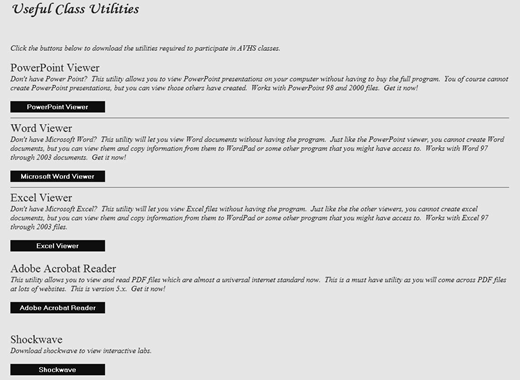
The utilities page provides electronic program viewers.
The utilities page provides electronic program viewers.
Moreover, to be able to evaluate the effectiveness of the AVHS, one must be able to put oneself in the student’s position, to have access to a real course. Only a portion of each course is available to the public. However, what can be seen is extremely well-organized and includes homework criteria, descriptions and due dates of quizzes and exams, grading calculations, ways to obtain extra help, tips for success, and other details that give students a realistic picture of what a course entails.
An impressive feature of the AVHS Web site is the tutorial explaining in pictures exactly how to get around WebCT. Detailed instructions are provided for all major functions of the WebCT platform. An excerpt is shown in Figure 5.
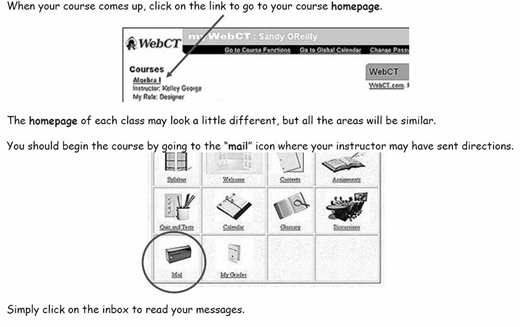
A sample page from Part I of the WebCT tutorial.
A sample page from Part I of the WebCT tutorial.
While distance education has a long track record of success, and research is plentiful, virtual schooling for high school students is a technology in its infancy. Over the coming years, the virtual high school will surely be the topic of dissertations and other research studies, especially if it proves to be successful. Of course, not all students are suited to this style of learning, but there are many advantages over the classroom setting. These include the absence of disciplinary problems, the ability for students to take needed courses unavailable at their local schools, the absence of transportation issues, especially for students who, for a multitude of reasons, are unable to attend the traditional high school. As Steven Wyatt, principal of the Clarksville High School, stated, “We want to continue to expand the use of the virtual high school. We are looking at the possibility of having a teacher available at night so students who work during the day can come in and work on their courses” (personal communication, December 11, 2006).
The AVHS is filling a need. As Steve Thomas, Superintendent of the Wonderview High School, noted, “It’s a great opportunity for us to meet standards because of the lack of certified teachers in certain areas. We needed a foreign language teacher and couldn’t afford one full time” (personal communication, December 11, 2006). The results for the AVHS students and affiliate schools, to this point, are promising.
About the authors