INTRODUCTION
Your institution is considering a change in its learning system. As a leader, practitioner, and/or decision maker, you are called on to be part of the decision-making and implementation processes. What do you need to know in order to recommend the best system for your institution and its learners? This article will provide a comparison between two types of learning systems and will recommend one over the other based on its suitability according to Moore's (1993) transactional distance theory.
DESCRIPTION OF LEARNING SYSTEMS
A learning system is a type of tool used to manage the knowledge assets of an institution and make them available to learners (Graf, 2008). Learning systems are used to manage courses, deliver content to learners, conduct learning activities, and evaluate learning outcomes. The learning systems software used to deliver online, hybrid, and Web-supported courses are known by many different names. They have been called courseware, course management systems, learning management systems, learning content management systems, and virtual learning environments, among others. In this paper, for ease of reference, they are referred to as "learning systems." They all fall under the general classification of tools for the management of information and learning (Graf, 2008). Until recently, course management systems (CMSs) like WebCT were the norm. They allowed institutions to focus on creating courses and populating them with content and students. More recently, however, a new type of system has emerged called learning management systems (LMSs) because they are designed with the learner in mind and promote a focus on the learner in addition to the content.
Should you recommend the institution consider a CMS, or an LMS? How, exactly, are they different? What are the benefits of licensing a newer-generation LMS rather than a CMS like WebCT? WebCT is a great tool for the management and delivery of course content. At this author's institution, however, we recently transitioned from the WebCT CMS to a new LMS known as ANGEL (ANGEL Learning, 2007). Why did we change from a CMS to an LMS? Simply put, we were looking for two things: a scalable enterprise-level portal system capable of interacting with our student systems, and a system that had better learning management tools.
This paper explores the differences between CMSs and LMSs and suggests the clear advantage of an LMS if your institution and faculty desire the best type of system for the learner. Two theories that relate to this choice are examined in this paper: transactional distance theory (Moore, 1993), and diffusion of innovations theory (Rogers, 2003). A theoretical model for the evaluation of learning systems (Malikowski, Thompson, & Theis, 2007) is also reviewed and discussed. Suggestions for evaluation and implementation are also offered based on our experience transitioning from a CMS to an LMS. Also suggested is the importance of training faculty during the implementation in order to speed the process of diffusion of the innovation throughout the system.
LEARNING SYSTEMS USAGE
Learning systems have become the core technology used by institutions that deliver courses at a distance, and they are also widely used by institutions for hybrid courses and for other blended learning environments (Black, Beck, Dawson, Jinks, & DiPietro, 2007). But more than any other delivery model, learning systems are used by instructors who choose to enhance their traditional classes with online content or who wish to take advantage of the communications tools in those systems. Indeed, learning systems are used three times more often for technology-enhanced traditional courses than for hybrid and online courses (Falvo & Johnson, 2005; Green, 2001; Morgan, 2003). Irrespective of the course model, millions of students are using learning systems in higher education and a growing number of K–12 students have been exposed to these systems. As a result, a focus on the learner is appropriate.
COMPARISON BETWEEN COURSE AND LEARNING MANAGEMENT SYSTEMS
CORE COMPONENTS OF A CMS/LMS
Most learning systems include a set of the following core components: course management tools (syllabus, calendar, drop boxes, announcements), content tools (content pages, quizzes, assessments), and communication tools (asynchronous e-mail, discussion forums, chat), all of which allow instructors to provide content and learning activities, test learning, receive assignments, and conduct discussions and other course-related activities in a principally asynchronous online environment (Simonson, Smaldino, Albright, & Zvacek, 2006). Learning management tools have become an important option for course delivery in higher education since they were introduced. Indeed, Simonson and his coauthors (2006) refer to them as the "de facto standard by which the majority of asynchronous distance education courses are delivered, particularly in higher education" (p. 240).
DIFFERENCES BETWEEN A CMS AND AN LMS
According to Simonson and his colleagues (2006), CMSs were introduced in the 1990s and later evolved into LMSs. They report that CMSs are often mistakenly identified as LMSs. The major difference between them, according to the authors, is that a CMS is focused on "the delivery of courses" while an LMS is focused on "an individual and tracks the learning needs and outcomes achievement of that person" (p. 240). Smaldino, Russell, Heinich, and Molenda (2006) add that the needs generated by the "standards movement" in education has brought about the evolution of CMSs to LMSs, which are now capable of tracking the achievement of individual students against state standards and outcomes and are being used in K–12 and higher education for that purpose. Ceraulo (2005) maintains that an LMS is superior for “its emphasis on learning management rather than course management, its ability to store educational content so that it can be referenced by many courses, and its ability to streamline a distance or elearning instructor's tasks" (p. 7).
GROWTH AND CONTRIBUTIONS OF CONTENT AND LEARNING MANAGEMENT SYSTEMS
According to Carmean and Haefner (2002), since their inception 30 years ago, CMSs and their newer counterparts, LMSs, have been swiftly adopted and enthusiastically embraced. They stated that the swift adoption of these systems is remarkable given that the academy is slow to change and to adopt new systems. They concluded that the "enthusiastic embrace" of these systems by faculty and students makes it evident that they are meeting an important need. Their conclusion has been supported by recent studies that asked students how they felt about these systems. For instance, in a study of 18,039 students who replied to a 2004 survey, Kvavik and Caruso (2005) reported that 75.2% of the students had positive or very positive feelings about the system. The fact that so many students are using these systems made it inevitable that the focus of these systems would shift to the learner.
A FOCUS ON THE LEARNER
THE LEARNING DIFFERENCE: BENEFITS OF AN LMS
While CMSs are adequate for adding and delivering content, the LMS clearly outshines them on its focus on the learner. If your institution wants a system that promotes a focus on a quality experience for the learner, then you probably want an LMS. For instance, WebCT does a fine job of organizing and managing content, and their communication tools are good and easy to use. However, the ANGEL LMS is a clear winner when it comes to focusing on the learner. In ANGEL, you can program "agents" (ANGEL Learning, 2007) to scour the course and return data on which you can take action. For example, you can create an agent that determines who is missing an assignment and automatically sends them a reminder e-mail. You can program an agent that determines who has completed assignments and sends them a congratulatory e-mail. You can program steps ahead of time so that content is unfolded as the individual learner achieves mastery of previous content. You can monitor student logins and send reminders to their external e-mail accounts. In short, you can take action before events occur (or after) and can increase interactivity between you and the learner. All it takes is a bit of planning and forethought and the system can deliver the type of interaction and focus on the individual student that is not possible with CMSs.
THE FUTURE OF LEARNING SYSTEMS
Morgan (2003) maintains that the structure of a CMS/LMS has the potential to allow the academy to adapt their teaching to the needs and learning styles of each individual learner. It is evident that experienced online instructors can do remarkable things with any system. Like Clark (1991) said, it is the instruction, not the method that matters. Indeed, many instructors who use these systems are what Lowes (2008) calls “mental migrants" and "trans-classroom teachers" (p. 1) because they teach in both traditional and online formats and use strategies from each to inform their teaching. However, instructors who teach online courses at our institution have long voiced a concern that teaching online is more time-consuming and rigorous than teaching face to face. The newer LMSs allow faculty to automate some of the processes so that a lot of the work is done up front. The interaction takes place constantly throughout the term and each learner receives immediate individual feedback as he or she progresses through the content and activities. At present, that kind of interaction is not possible in a CMS unless faculty spend an inordinate amount of time reviewing each student's work on a daily basis. If the instructor is teaching several courses at the same time and the class sizes are large (there are 28–30 students in online courses at our institution), the instructor would be hard-pressed to have the time to do that.
THEORETICAL SUPPORT FOR AN LMS
MOORE'S TRANSACTIONAL DISTANCE THEORY
Moore's (1993) theory of transactional distance provides a theoretical foundation for the benefits of an LMS over a CMS. Moore proposed that that “the physical separation [in online courses ] leads to a psychological and communications gap, a space of potential misunderstanding between the inputs of instructor and those of the learner" (Moore, 1991, Transactional Distance, ¶ 2). Moore called that gap "transactional distance." Central to Moore's theory is the idea that we must reduce the distance that students perceive between themselves and their tutors in online courses. Moore believes that two variables play a role in bridging that distance: dialogue and structure. The higher the level of dialogue, the less distance the learner feels, whereas the more structure there is the more distant the learner feels. According to Moore, dialogue is the "interaction between the teacher and learner when one gives instruction and the other responds" (1991, Transactional Distance section, ¶ 5). Structure is an aspect of the rigidity or flexibility of the objectives, teaching strategies, and evaluation methods. Structure "describes the extent to which an education program can accommodate or be responsive to each learner's individual needs" (1991, Transactional Distance section, ¶ 6). Transactional distance is lessened in courses with high levels of dialogue and little predetermined structure because learners receive ongoing guidance from instructors and are able to modify instructional materials to meet their needs (Moore & Kearsley, 1996). It follows, then, that using an LMS like ANGEL to increase dialogue in the course via a series of automated agents that constantly give feedback to the learner would increase dialogue and reduce transactional distance. Moreover, using an LMS like ANGEL to allow for more individual learning needs like allowing students to progress at their own pace, would reduce structure and thus also reduce transactional distance. Figure 1 depicts the relationship between dialog and structure according to Moore (2007).
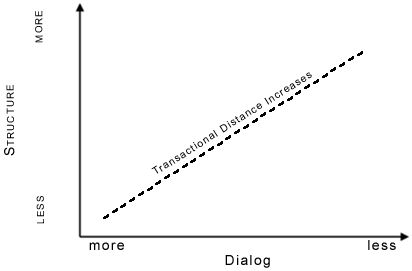
Relationship of structure, dialog, and transactional distance.
Relationship of structure, dialog, and transactional distance.
TRAINING
IMPORTANCE OF TRAINING
Learning management systems are here to stay and investing in training the faculty to use them to their fullest advantage seems, to this author, like a good investment. Morgan concurs they are a good investment given the “knowledge driven-era" (p. 84) we are living in. Many believe that the Net Generation learns by doing (McNeely, 2005), but it must be remembered that they have a low tolerance for frustration and are used to instant access and quick responses (Oblinger & Oblinger, 2005). Therefore, taking advantage of the increased interactivity possible with an LMS can also be seen as a way to increase interaction and prevent frustration.
THE NEED FOR TRAINING
While learning systems have become ubiquitous, training on their use is critically important to the success of an implementation. Instructors who have delivered courses in a content management system will need a considerable amount of training before they are ready for the pedagogical demands of a learning management system. The focus on the learner could be an enormous paradigm shift for the instructor used to focusing on the content of the course, not necessarily on the learner's experience as they interact with the course. The training that should be offered is not just on how to operate the new system, but on how to program instructional milestones and agent technology to take advantage of these learner-centered systems.
EVALUATION AND IMPLEMENTATION
A MODEL FOR EVALUATING LEARNING SYSTEMS
Malikowski et al. (2007) proposed a model for evaluation of learning systems that takes into consideration not just its features, but also its suitability for learning. Their model has five related categories: transmitting content, evaluating students, evaluating courses and instructors, creating class discussions, and creating computer-based instruction. The categories, reshuffled for the purpose of clarity in the figure, are depicted in Figure 2.
This model has the potential to broaden the scope of research on learning systems. By focusing on these five wide areas, the authors simplify the process of evaluating learning systems. They must first, of course, be good vehicles for the creation of content. Most newer-generation learning systems have html editors that allow creation of content on the fly. Once the content is created, the question becomes their efficacy in transmitting that content to the learner. Newer systems have more intuitive interfaces that students can relate to, more readily accept a variety of file types, and can stream content from external and internal sites. Learning systems have long been known for their excellent communication tools. Nevertheless, the LMSs like ANGEL have several new tools like instant messaging and voice conferencing that are especially appealing to students. Finally, learning systems are also well known for their evaluation tools and those tools are getting better with every new release.
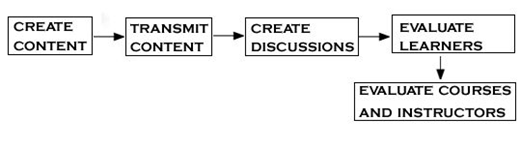
Malikowski et al. (2007) proposed model for research.
Malikowski et al. (2007) proposed model for research.
RECOMMENDATIONS FOR EVALUATION
Institutions that are evaluating a new learning system are faced with the challenge of how to choose the best system to fit the needs of all members of the institutional community. Our recommendations for evaluation of an LMS based on our recent experience are that you appoint a request for proposal committee and staff it with members from all academic channels and ranks: information technology staff, instructional designers, administrators, faculty, support staff, and students. The act of putting all constituents on the committee and having them thoroughly evaluate the available systems will build in a set of proponents and early adopters who will champion their choice.
RECOMMENDATIONS FOR IMPLEMENTATION
Institutions contemplating a change in learning systems also will be faced with the challenge of how best to implement the change. Rogers' (2003) diffusion of innovations theory can illuminate the path to acceptance of the change. Rogers defines diffusion as "the process in which an innovation is communicated through certain channels over time among the members of a social system" (p. 5). Innovations must be communicated through a process of convergence as individuals exchange information and meaning. Rogers asserted that every new technology follows a specific process as it is introduced into a system. He clarified that change is difficult, so there is likely to be great resistance to change. At our institution, there was resistance as our faculty had been using WebCT for years and did not see the need for change. However, once they began to see the learning benefits of the new ANGEL system, they began to come around.
The process of diffusion of the innovation at our institution has followed the process identified by Rogers (2003). According to Rogers, an innovation follows a set path to acceptance, going from introduction by innovators and influential change agents (in our case, these were the members of our request for proposal committee who evaluated all the systems), to knowledge of the innovation (promotion and training events), to acceptance and promotion by early adopters (the faculty who were on the committee who were the first to use the new system), then early majority (the first group of faculty to convert to the new system), to late majority (the second group of faculty converting midstream), and ultimately to laggards (the faculty who are still in the planning stages and still using the old system) (p. 37). The diffusion process is depicted in Figure 3.
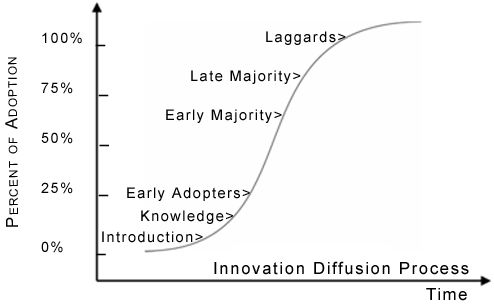
Innovation diffusion process at author institution.
Innovation diffusion process at author institution.
CONCLUSION
If you are a leader, practitioner, and/or decision maker, you may be called on to evaluate learning systems and participate in the decision-making process. The clear choice, as explored here, is an LMS. Once a decision is made, you may also be involved in the process of implementation. Regardless of your role, it is important that you promote the idea of extensive training for faculty before the new system is rolled out to ensure a successful diffusion of the innovation. Learning management systems offer an enriched environment that goes beyond the usual content management tools to automated agents that allow instructors to focus on the individual learner in ways they might not have been able to before. Full-time faculty with a teaching load of several courses might have a large number of students each term, making it very difficult for faculty to provide a personalized touch to each student. Automating some of these processes through an LMS so they happen automatically in response to each learner's unique pacing and content mastery will improve the learning experience for online students.
“A LEARNING SYSTEM IS A TYPE OF TOOL USED TO MANAGE THE KNOWLEDGE ASSETS OF AN INSTITUTION AND MAKE THEM AVAILABLE TO LEARNERS.”
About the author