This paper presents a viewpoint that considers the construction of ‘expertise’ as an impediment to successfully using cross-functional expertise in the organization. The construction of expertise forms a bounded perspective that creates hidden impediments to success that culminate in organizational underachievement.
Experiential knowledge of the authors that incorporated 20 years of organizational management experience and extensive practice of hiring experts to progress organizational learning, knowledge, and development is the primary basis of this work.
A common misperception of ‘expertise’ relates to a limiting perspective on what expertise is? Organizations segregate expertise (silo) as a way of increasing functionality and division of labor in an organizational structure. However, organizational underachievement is not due to functional arrangement in the organization’s structure (which is a commonly held belief) rather a byproduct of a bounded perspective necessary to construct expertise.
Organizations who understand that the bounded perspective of expertise is the source constraining use of their acquired expertise gain insight to an actionable opportunity to rectify cross-functional restraints. Core elements are offered to minimize the impact of organizational silofication.
This paper is unique in that it introduces a bounded perspective as the source impeding the use of workplace expertise rather than functional placement.
Introduction
Organizational silos are common in workplace settings. The term ‘silo’ originated from agricultural storage towers that segregate grain uniquely from other types of grain. Similarly, acquired expertise is built uniquely through segregated knowledge. Organizations often structure acquired expertise based on unique functionality such as human resources, engineering, and information technology. Recent scrutiny has associated this arrangement with organizational underachievement (Henman, 2020). This paper offers a viewpoint that workplace expertise may have inherent challenges, not as a product of functional arrangement (silo) but rather a consequence of the bounded perspective from which the ‘expertise’ was developed (e.g. the expertise of a computer programmer is a technical solution drawn from their programing expertise). Moreover, an expert’s bounded perspective is typically reinforced in organizational settings for capital advantage. This paper extends this condition to a process of organizational silofication.
Workplace expertise
Organizations need expertise—a distinguishable advanced knowledge or skill—and organizations hire experts to exploit their skills for capital advantage. Rooted in any expertise are boundaries which shape perspective that are selective to inclusion and exclusion. As expertise matures, boundaries—and the expert’s perspective—are strengthened. When expertise is introduced to the workplace, so too is the influence of the bounded perspective that formulated the expertise. These bounded perspectives may become impermeable and can provoke cross-functional discord. This cycle is often perpetuated by organizational settings that reinforce bounded perspectives with workplace groupings.
Workplace groupings
Workplace groupings assimilate expertise to maximize collective benefit. This arraignment creates a singular detached environment because expert groupings tend to only learn and operate from the perspective of their collective expertise (Carpenter, 2021). Workplace groupings based on functional expertise leads to a paradox in which rationalized dysfunction evolves from each groups bounded perspective. Worse yet, expert knowledge is rationalized from the group’s bounded perspective and acted upon routinely. Consequently, the singular perspective of workplace groupings may contribute to underachievement in cross-functional settings.
Workplace segregation
Organizational work is complex; the desire to create simplicity from complexity is important to organizational success (Cabrera and Cabrera, 2018). A popular approach to simplifying organizational complexity is the segregation of work into workplace groupings or ‘silos’. Workplace segregation reinforces the comfort of functional bias offered by a bounded perspective of expertise (Schreurs et al., 2019). Through reinforcement of workplace segregation, distance between diverse expert groupings is increased. Functional bias is highlighted when multiple workgroups are asked to work together and struggle to do so. Opportunities for rich contribution made possible by cross-functional expertise become diluted, under accessed, and siloed.
Workplace silofication
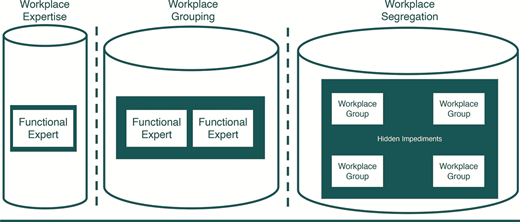
Workplace settings reinforce the bounded perspective of expertise. This reinforcement creates challenges to cross-functional settings. A common research thread suggests resolution is found by deconstructing the functional arrangement (silos). While this may overcome restricting influences found within functional groupings, it does not overcome the bounded perspective of expertise within the group. The unadjusted presence of expertise is embedded with impermeability classified by the designation of expertise (e.g. the agency of expertise sees uniquely through segregated knowledge). When not explicated and adjusted, the perspective of expertise tends to create invisible boundaries that prevent productive cross-functional collaboration. By overlooking and reinforcing the bounded perspective of expertise, the conditions that manifest organizational silofication occur. Here we define organizational silofication as workplace expertise that is grouped and segregated because of organizational reinforcement of expert perspectives and results in organizational underachievement (Figure 1).
Because functional arrangements (silos) are structurally supported by organizational policies and practices, simply adjusting the structural orientation is insufficient. This action detracts from the ability to consider the hidden impediment restricting cross-functional collaboration. In other words, one must explicate the impeding perspective(s) and actively work to combat the unintended organizational consequences of the bounded perspective. There has been an abundance of research done that demonstrates the simple act of explicating a perspective can have a dramatic effect when diverse perspectives are comingled (Cabrera et al., 2021).
Despite the historic success of workplace groupings, the hidden impediments in organizational silofication—magnified by acquired bounded perspectives—should be given keen consideration for maximizing organizational potential. These hidden impediments may include:
Common language is more segregated than collective (i.e. division, department, unit);
Grouping concerns override cross-functional needs in priorities of work;
Conscious or unconscious positioning of grouping priorities to decision making;
Performance and recognition based solely on expert groupings; and
Group function has more structure (required), cross-functional is flexible (optional).
Advice to practitioners and future research considerations
The effects of organizational silofication promote organizational underachievement. The following core elements are offered to minimize the impact of organizational silofication;
Empower “One Team” Thinking: Adjust performance metrics to reinforce emphasis on ‘we are all working towards the same outcomes’ by associating outcomes to common goal and purpose of the broader organization.
Action the Language of Partnership: Reward co-creation and partnership in action by replacing “internal customer” or “service provider” or “stakeholder” with partnership “we are in this together” devoid of silo or hierarchy.
Create Better Value Collectively: Bring together the right people to engage in dialogue and action to experiment and move initiatives forward regardless of title or position in the organization.
Leverage the Power of Invitation: Actively and curiously seek different views, inviting a broader range in thinking—especially opposing views and discourse—to contribute to actions and outcomes.
Shift Thinking to Better Outcomes: Encourage the underlying thinking of inclusion and multi-perspective contribution to create holistic outcomes over protectionist or expertise driven outputs.
To fully capture the implications of organizational silofication, it will require a future research agenda on the agency of expertise as a constrained barrier. Although this should be the primary focus of future research, it would be prudent to extend this view with other causal conditions. For example, silofication research should be broadened to include an array of experiences, interactions, and interventions more inclusive than just perspective constructed by the agency of expertise. These include not only interactions with leadership and managers, but also interactions with expert peers. The clear weight of evidence indicates that such interactions have important implications on cross-functional execution.
Conclusion
This viewpoint offers that organizational underachievement sourced to workplace expertise is a product of bounded perspective constructed by the agency of expertise. Embedded in any bounded perspective is limitations to what can be seen. Organizations that seek to leverage expertise solely on their agency risk organizational silofication. We conclude that recognizing organizational silofication is an opportunity for organizations to address organizational underachievement by addressing the perspectives that create the hidden impediments limiting their overall potential.