Indigenous Environmental Knowledge (IEK) remains central to disaster risk reduction in many African communities; however, its contribution to flood resilience, especially across different cultural groups, is under-examined in Nigeria. Previous Nigerian flood research has concentrated on physical and infrastructural drivers, with little comparative attention to how cultural knowledge systems vary across ethnolinguistic groups. This study addresses this gap by comparing how IEK shapes flood anticipation, interpretation, and response across nine communities representing the Yorùbá of Ogun State, the Nupe of Kwara State, and the Igbo of Enugu State.
Between January and March 2025, data were collected through 36 focus group discussions with 362 participants, including men, women, youth, and persons with disabilities. Data were analysed thematically and complemented by participatory ranking of practices.
Findings reveal that IEK shapes flood response through three interrelated domains: practical engineering improvisations (drainage clearing, wooden bridges, sandbags, canoes), collective labour mobilized through culturally embedded governance systems (bell-ringing summons, emirate structures, kinship obligations), and spiritual-ethical practices tied to cosmology and land (ritual offerings, water-use taboos, ecological early-warning indicators). Ecological indicators such as fish species, frogs, rainfall patterns, and tree phenology remain widely used but increasingly blend with radio and phone alerts. Despite recurring losses, destroyed crops, contaminated water, damaged homes, communities across all three groups consistently refuse relocation, citing ancestral identity, livelihoods, and spiritual obligations to land.
The findings suggest that, in these settings, IEK operates as an integrated system linking technical adaptation, collective governance, and moral-ecological meaning, offering culturally grounded pathways for disaster resilience. Integrating these knowledge systems into formal flood governance could strengthen community-centred anticipatory action in Nigeria.
1. Introduction
Flooding, as a hydrometeorological hazard driven by intense rainfall, river overflow, and upstream dam releases, remains the most recurrent and damaging disaster affecting riverine and low-lying communities across the southern and middle-belt regions in Nigeria (Umar and Gray, 2023; Eteh et al., 2024; Amaechina et al., 2022; Abu and Ibebuchi, 2025). Disaster risk reduction (DRR) approaches have largely relied on engineering and policy interventions, yet technical solutions alone do not fully account for local realities. (Wachinger et al., 2013; Tiepolo et al., 2019). Globally, DRR frameworks have prioritized structural engineering, relocation, and model-based forecasting (UNDRR, 2015), yet local knowledge, social organization, and cultural values are increasingly recognized as shaping how communities understand, anticipate, and respond to hazards (Mercer et al., 2012; Nyamwanza and Bhatasara, 2023). Studies from Asia, the Pacific Islands, and Latin America demonstrate that risk perception is influenced not only by scientific forecasts but also by spiritual beliefs, livelihood dependencies, kinship ties, and attachment to land (Ayeb-Karlsson et al., 2019; Acharya and Prakash, 2019).
Indigenous Environmental Knowledge (IEK) has been increasingly recognized as valuable for understanding risk perception, early warning systems, and coping strategies in vulnerable regions (Mercer et al., 2012). IEK encompasses ecological observations, spiritual values, livelihood practices, and informal governance systems emerging through long-term interactions with local environments (Schipper and Dekens, 2009). In this study, IEK is operationalised through three observable domains that structured the analysis: ecological early-warning signals, collective-labour and governance systems, and ritual and water-use practices. Studies demonstrate that IEK can enhance disaster preparedness, ecological restoration, and decision-making, particularly where access to forecasting technologies is limited (Ayeb-Karlsson et al., 2019; Acharya and Prakash, 2019; Olaniyan and Govender, 2023; Olaopa, 2025). Community-level flood resilience, defined here as the capacity to anticipate, absorb, and adapt to hydrometeorological hazard events while maintaining essential community functions, constitutes a primary outcome of DRR. IEK provides a culturally embedded governance pathway through which such resilience is sustained.
In Nigeria, IEK remains under-examined in disaster governance despite a long history of indigenous water management, as flood-vulnerability research has largely emphasized physical drivers and climate change (Nkwunonwo, 2016). While these dimensions are essential, they overlook the cultural, spiritual, and social systems through which communities enact resilience. What remains less understood is how these knowledge forms operate as adaptive systems, how they vary across cultural groups, and how they interact with modern technologies, formal warnings, and infrastructural constraints. While existing studies recognize the role of Indigenous knowledge in disaster contexts, few have examined how IEK operates simultaneously as technical adaptation, moral ecology, and governance across multiple ethnolinguistic settings. This study addresses this gap through comparative analysis of Yorùbá, Nupe, and Igbo communities examining how IEK operates as an adaptive governance system in contexts where formal state support remains limited. Ethnolinguistic communities are socially organized groups defined by shared language, historical identity, territorial affiliation, and cultural institutions. These features shape collective interpretations of environmental risk and influence patterns of coordination and response during hazard events.
This study is guided by four research questions: How do Yorùbá, Nupe, and Igbo communities use IEK to anticipate and interpret flooding events? How do cultural norms, spiritual-ethical worldviews, and collective labour systems shape community-led flood responses? How do people with different social identities (men, women, youth, and persons with disabilities) participate in flood resilience and decision-making across the three ethnolinguistic groups? How can IEK-based practices complement or strengthen formal disaster-risk reduction and anticipatory action frameworks in Nigeria? The study makes three contributions. First, it reconceptualizes IEK as a moral-ecological governance system integrating ecological observation, spiritual meaning, and collective authority, moving beyond instrumental treatments of local knowledge as technical data. Second, systematic comparison across Nupe, Yorùbá, and Igbo communities reveals internal variation within IEK systems, challenging homogenized portrayals of indigenous knowledge. Third, it shows how IEK increasingly hybridizes with communication technologies, offering pathways for integration into formal flood governance.
2. Methods
2.1 Study area
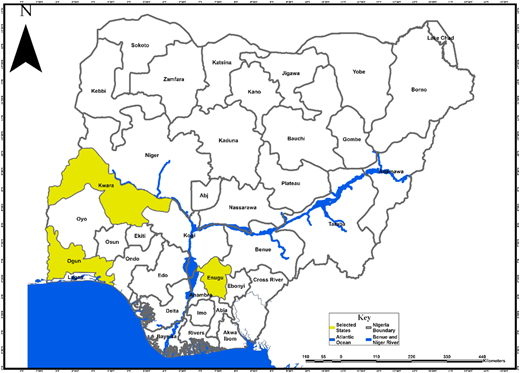
Research was conducted in nine communities across three ethnolinguistic regions of Nigeria (Figure 1), purposively selected based on: identification as highly flood-vulnerable by SEMA and Nigeria Red Cross Society datasets, representation of variation in settlement type (urban, semi-urban, rural), and security and accessibility considerations.
In Ogun State (Yorùbá), Ibiade, Isheri, and Sokori were selected for recurrent seasonal flooding from heavy rainfall, river overflow, and inadequate drainage. In Kwara State (Nupe), Patigi, Lafiagi, and Fangan were chosen as riverine settlements vulnerable to Niger River flooding exacerbated by dam releases, with fishing and rice farming as primary livelihoods. In Enugu State (Igbo), Amechi-Idodo, Okpanku, and Ogwuagor captured upland and peri-urban flood contexts, with the former emphasizing ancestral rites and farming, the latter highlighting drainage blockage and short-term displacement.
2.2 Conceptual framework
This study interprets flood resilience through an integrated moral-ecological and governance lens, treating IEK as more than environmental observation or coping strategy. DRR scholars increasingly recognize that resilience is socially constructed and mediated by institutions, belief systems, and cultural authority (Mercer et al., 2012; Ayeb-Karlsson et al., 2019). However, many vulnerability frameworks privilege structural exposure and climatic variables while under-theorising how moral obligation shapes collective environmental action.
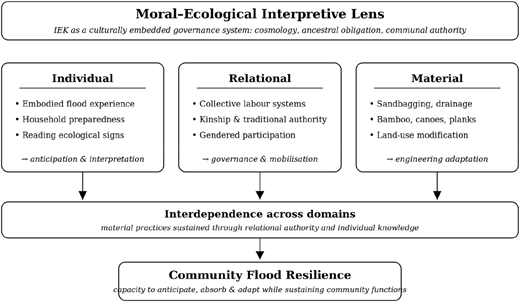
Recent resilience research emphasises that adaptation is embedded within local governance arrangements and value systems rather than as a purely technical response (Tiepolo et al., 2019; Nyamwanza and Bhatasara, 2023). Drawing on moral ecology, the study interprets IEK as a collectively binding relational system linking environmental practice to ethical responsibility, ancestral attachment, and communal labour norms — distinct from risk perception, which is primarily individual and cognitive (Schipper and Dekens, 2009; Nche and Michael, 2024). Flood management, therefore, operates not solely as risk mitigation but as a culturally mediated governance process. To analytically operationalise this perspective, the study adopts an Individual–Relational–Material (IRM) framework. The IRM framework (Figure 2) is an analytical structure, not a data-collection method, organising analysis across three interrelated domains. The individual dimension captures embodied experience, household-level preparedness, and subjective interpretation of ecological indicators.
The relational dimension examines collective labour systems, gendered participation, kinship authority, and traditional leadership structures that coordinate response.
The material dimension focuses on ecological indicators, land-use practices, infrastructural modifications, and environmental engineering measures such as sandbagging or vegetation buffers.
Unlike conventional vulnerability models, this approach explicitly links environmental practice to governance authority and moral obligation, allowing IEK to be examined at once as ecological knowledge, coordination system, and culturally embedded resilience mechanism. It informed the coding strategy so that patterns were read across the three domains rather than as isolated practices.
2.3 Research design and comparative analytical strategy
A qualitative comparative design examined how IEK operates across three ethnolinguistic contexts in Nigeria, enabling intra-group and cross-cultural comparison of how governance structures, religious transformation, and settlement context shape its mobilization in flood-prone environments. Ethnolinguistic group was treated as the principal analytical variable, on the premise that shared language, authority structures, and cosmology shape how communities coordinate flood response. Using constant comparison, each theme was tested against every community and social group, identifying convergence and divergence systematically rather than impressionistically.
2.4 Data collection
Fieldwork occurred between January and March 2025. In total, 36 focus group discussions (FGDs) were convened across nine communities (Table 1), organized into four purposive groups per community including men, women, youth, and persons with disabilities, with PWD convened in dedicated sessions to ensure an enabling space free from mixed-ability social dynamics. Each group comprised 8–12 participants, purposively selected across gender, age, occupation, and ability. Community entry was facilitated through NRCS community resilience committees (CRCs) coordinating with traditional leaders. Informed consent was secured from all participants.
Discussions were conducted in Yorùbá, Nupe, and Igbo with trained moderators and local interpreters, lasting 90–120 min. All FGDs were digitally recorded, transcribed verbatim, translated into English, and cross-checked for consistency. Each discussion received a unique identifier linking community, state, ethnolinguistic group, gender/age group, and date for thematic analysis.
2.5 Translation protocol
In the communities, translation was conducted by local community members serving as trained research assistants, nominated by the CRCs. These translators were fluent in both English and the local language (Nupe or Igbo). Culturally specific terms like Yorùbá àjọṣe (communal cooperation with moral obligation depth) and Igbo unwa mmiri (bird indicating flood omen) were retained with narrative explanations to preserve semantic complexity.
2.6 Data analysis
Data were analysed thematically, and all English translations were imported as separate sources, with each FGD created as a case linked to attributes (state, community, ethnolinguistic group, gender/age group, disability status, date), allowing cross-group comparison.
Analysis proceeded in three stages: (1) close readings generating descriptive codes; (2) grouping codes into three analytical themes; and (3) Matrix queries exploring theme variations across communities and social groups. Participatory Ranking: To complement thematic analysis, participants collectively scored flood management practices on a five-point scale as seen in Table 2 (1 = least frequent/effective; 5 = most frequent/effective) at each FGD's end. Visual cards numbered 1–5 facilitated group discussion and consensus. For example, in Patigi (Nupe), men initially scored “raising riverbank markers” as 5, while women scored it 3 (markers often washed away). After discussion, participants agreed on 4, acknowledging strengths and limitations.
2.7 Quality assurance and ethics
To enhance validity, the study triangulated data from three sources: FGD transcripts, moderator field notes, and participatory ranking scores. Transcripts were verified against recordings and field notes; 20% were independently double-coded, with discrepancies resolved by consensus; and coded frequencies were cross-checked against FGD rankings.
Ethical approval was granted by the University of Ibadan's Social Sciences and Humanities Research Ethics Committee (UI/SSHREC/2025/064, valid until June, 2026), ensuring compliance with Nigeria's National Code for Health Research Ethics. Given IEK is cultural property embedded in belief systems, the study upheld principles of respect, reciprocity, and recognition of community knowledge holders (Smith, 2021). Permission was obtained from community leaders (village heads, Nupe Emirate Council, Igbo traditional rulers), and informed consent secured from all participants with anonymity and confidentiality assurances.
3. Results
Findings are organised in line with the Individual–Relational–Material (IRM) framework, allowing examination of IEK across material adaptations, relational governance systems, and individual interpretations of risk.
3.1 Practical engineering improvisations
A striking finding is how far households and communities engage in low-cost, experience-driven engineering to cope with rising waters (Table 3), a practices of ingenuity and necessity that arise where formal infrastructure is absent or inadequate. While Yoruba communities emphasize drainage clearing, sand barriers, planks, and boats, similar improvisations were observed among Nupe and Igbo groups, adapted to their ecological and cultural settings.
Disaggregated by gender and age, men's groups across all three regions emphasized physically intensive tasks, digging gutters, strengthening embankments, building wooden bridges or stick platforms, while women's and youth groups spoke more of protecting food stores and children, raising belongings, and organising relocation routes. Persons with disabilities (PWD) described greater dependence on kin and neighbours for evacuation and access to boats, highlighting how physical limitations intersect with exposure to flooded terrain.
3.1.1 Drainage clearing and channelization
Drainage clearing emerged as the most consistently emphasized practice in Yorùbá towns and in Ogwuagor (Igbo), where participants described organized bell-ringing mobilizations to summon community labour when channels overflow. In Nupe communities, drainage infrastructure was less developed, making this practice less relevant despite participants expressing desire for improved channelization.
3.1.2 Wooden bridges and planks
Participants across Yorùbá communities described plank-based crossings as indispensable for maintaining mobility during months-long inundation. In Isheri, women explained:
Some of us use the wisdom of laying wood as bridge … If there was no opportunity to do that, we would have to pack out. (Yorùbá FGD, Isheri Women, Ogun State, 19 February 2025)
In Nupe communities such as Lafiagi, mobility improvisations extended to constructing boats before floods arrived:
When the community begins to notice the sign of the flood, our men begin the construction of the boats. They construct boats so that they can convey the material any time it comes … sometimes it is at night that it enters the communities. (Nupe FGD, Lafiagi Youth, Kwara State, 28 January 2025)
Among the Igbo of Okpanku, men reported planting bamboo trees along flood lines to act as natural barriers and reduce soil erosion:
The way the flood used to come, if you are able to plant bamboo trees on the line, when the bamboo tree stands, it will help reduce the power of the rain to reduce, it will not affect the farm so much. (Igbo FGD, Okpanku Men, Enugu State, 21 March 2025)
In Ogwuagor, participants described laying blocks as stepping stones on flooded streets: “We do place blocks on the road to enable us to place our legs on it and pass.” (Igbo FGD, Ogwuagor Men, Enugu State, 14 March 2025)
3.1.3 Shared boats and canoes
In riverine communities, particularly among the Nupe, boats are essential household assets. Yorùbá participants in Ibiade emphasized that boats are shared across kin networks:
The river will be so full even cars cannot pass … Not every house owns a boat, but four houses will share two. (Yorùbá FGD, Ibiade Men, Ogun State, 25 February 2025)
PWD participants expressed both dependence on and exclusion from these systems. A respondent in Patigi highlighted: “If flood comes suddenly, we no get canoe … na neighbors we dey depend on to help us move or block water.” (Nupe FGD, Patigi PWD, 22 January 2025)
For Igbo households in Amechi-Idodo, boats were less common, with families relying more on kin-based relocation: “What we do, we pack our things out for a while to other nearby places, depending on when the flood lasts. The whole family packs out if there is a flood.” (Igbo FGD, Amechi-Idodo Women, Enugu State, 5 March 2025)
3.1.4 Sand barriers and elevation of goods
Sandbagging was widely reported across all three groups as a communal improvisation. In Sokori (Yorùbá), participants explained that doorways are blocked with sandbags or earth mounds, while valuables are raised onto rafters or shelves during high-water events:
If there is a flood and there are bags of clothes on the floor, we pack them and put them up … when the rain stops, we sweep out the water and dry the floor well and return the bags of clothes back to their original position. (Yorùbá FGD, Sokori Women, Ogun State, 11 February 2025)
Among the Nupe, sandbagging operated on a communal scale, with participants emphasizing collective labour:
We pack sand in sacks to block the water path. Each family contributes labour. Men, women, even children, all help in filling and carrying the sandbags. (Nupe FGD, Lafiagi Youth, 28 January 2025)
In Ogwuagor (Igbo), residents recalled being “called to use a cement bag to pack sand and line up around this sewage,” while also lifting belongings when heavy rain is forecast. These practices illustrate the material dimension of the IRM framework, a ecological knowledge translated into infrastructural adaptation under limited state support.
3.2 Collective labour and governance
Flood management operates as a collective endeavor enforced through traditional governance mechanisms that differ across Yorùbá, Nupe, and Igbo groups. Gendered divisions of labour were evident across the sites. In Yorùbá communities, for example, men typically dug trenches while women cleared debris and channelled water away from homes, a pattern also reported in Nupe and Igbo settlements where women described “packing the foodstuffs and the children before the flood comes.” (Igbo FGD, Amechi-Idodo Women, March 2025). Youth groups in Fangan and Lafiagi stressed their roles in spreading warnings, filling sandbags, and assisting households with limited mobility, including PWD.
3.2.1 The bell as a mobilization tool
In both Ibiade and Isheri (Yorùbá), participants emphasized the custom of ringing a bell to summon communal labour when drainage channels overflow:
When the bell is rung, everybody comes out. Men will dig while women clear … If you do not come out, people will talk. (Yorùbá FGD, Isheri Men, 18 February 2025)
Among the Nupe, mobilization occurred through emirate structures. Once elders detected flood signs, they informed the Emir, who dispatched town criers:
Once the elders see the signs, they inform the Emir and he calls a meeting. From there the town crier will beat drums so everyone prepares. (Nupe FGD, Fangan Elders, 5 February 2025)
Igbo leaders in Okpanku activated communal support through kinship networks, focusing on relief rather than infrastructure:
If houses are affected, the leaders will gather and raise up something for the affected ones and also provide temporary solutions by inviting some to live with them. (Igbo FGD, Okpanku Men, 21 March 2025)
PWD participants described dependence on family networks: “It is our children that inform us … they pick us up to safe places.” (Nupe FGD, Lafiagi PWD, 29 January 2025)
3.2.2 Gendered but cooperative divisions of labour
FGD participants consistently emphasized gendered roles in these mobilizations. Men dig trenches and strengthen embankments, while women clear debris and channel water. As one youth leader summarized:
We all need to participate; it concerns every one of us. If one person suffers it, all of us suffer it. (Nupe FGD, Lafiagi Youth, Kwara State, 28 January 2025)
In Igbo settings, cooperation was organized along family and age-grade lines. Youth mobilized to help vulnerable households relocate, while women concentrated on protecting food and children:
Our role is to help our husbands by packing the foodstuffs and the children before the flood comes. (Igbo FGD, Amechi-Idodo Women, 5 March 2025)
Scoring rubric: 1 = lowest, 5 = highest, combining frequency of mention across FGDs and perceived effectiveness reported by participants. The rankings show the sharpest cross-group divergence on drainage clearing (scored 5 in Yorùbá towns and Ogwuagor but 2 elsewhere) and canoe reliance (4 among the Nupe but 1 in Ogwuagor), indicating that these practices track settlement type and hydrology more closely than ethnolinguistic identity alone.
3.3 Anticipation, interpretation, and spiritual-ecological knowledge
Across the three ethnolinguistic groups, anticipation operates through both environmental observation and culturally structured meaning-making.The FGDs revealed that flood practices are not only technical responses but also expressions of moral ecology grounded in cosmology, ritual, and religious ethics. Across Yorùbá, Nupe, and Igbo groups, spirituality frames how floods are explained, prevented, or endured, though the practices diverge in form and emphasis.
3.3.1 Ritual offerings and divine agency
In Ibiade (Yorùbá), elders connected flooding severity to the anger of rivers and described ritual offerings to water deities as necessary protection, though some participants, especially Christians, rejected rituals in favor of prayer:
We don't do that here. We are Christians. (Yorùbá FGD, Isheri Fisherman (Men), 18 February 2025)
Among the Nupe, elders explained that rituals were once practiced but are now largely abandoned under Islamic influence:
Before, they did it with goat or even cow sometimes, depending on the flooding. But now, because of religion, Islam does not tolerate that, so we stopped. Now we only pray. (Nupe FGD, Lafiagi Elders, 29 January 2025)
By contrast, in Igbo communities, ritual continuity was stronger. In Okpanku, elders described sacrifices to the land as essential for preventing destruction:
There are some sacrifices meant to be sacrificed to the land of Okpu. There are families that are designated to do it. When the Unwa mili (a bird) comes out around June or July, it signifies the coming flood. (Igbo FGD, Okpanku Men, 21 March 2025)
Ogwuagor participants explicitly reported no community-wide rituals: “What happens here is not mysterious … there is no point going spiritual on it.” (Igbo FGD, Ogwuagor Men, 14 March 2025)
These accounts reveal a spectrum: Yorùbá blending ritual with Christianity, Nupe replacing rituals with Islam, and Igbo sustaining ancestral sacrifices in some communities while others adopt secular framings.
3.3.2 Rules of water use and environmental ethics
Even where ritual practices have declined, ethical rules continue to guide water behavior. Participants described separating washing from drinking points along rivers, reflecting an indigenous ethic of restraint and respect for water as a living force (Olofinsao, 2024).
Among the Nupe, ethics focused on Islamic injunctions against waste and pollution:
If you cut one tree, you should plant another. Our Emir even told us that. But people are not listening now, that is why erosion is getting worse. (Nupe FGD, Fangan Youth, 4 February 2025)
In Igbo households, rules were tied to sacred groves and rivers. Women in Amechi-Idodo explained that certain streams were reserved for rituals or cleansing, and violating these rules was believed to anger spirits and increase disaster risk.
3.3.3 Indigenous early-warning systems
Participants demonstrated detailed ecological knowledge in predicting floods. Elders across all three groups cited signs such as snails climbing trees, snake fish moving against currents, or the sudden appearance of soldier ants as indicators of imminent rainfall and flooding:
When we go to the bush and we see snails climbing trees from down to up, it means rain is coming. And when soldier ants appear, that is another sign of impending rain and flood. (Yorùbá FGD, Ibiade Women, 26 February 2025)
These indicators are increasingly supplemented by modern technologies. Youths reported relaying radio weather bulletins and phone alerts:
When we see weather news on our phones, we inform our families … when we tell them like that, they will also tell another person, and it goes on and on. (Yorùbá FGD, Ibiade Youth, 26 February 2025)
Nupe participants also described natural indicators:
When we see foam forming on top of the water, or when frogs start croaking, it means flood is coming. Even cold breeze at night can tell us the river is rising. (Nupe FGD, Lafiagi Youth, 28 January 2025)
They also associated certain fish species (e.g. Ekugi, Econko) with impending floods:
Once we start catching that fish, even if it is one, we know flood will come in ten days. (Nupe FGD, Fangan Youth, 4 February 2025)
Igbo elders in Okpanku pointed to natural warning signs:
When we hear frogs croaking endlessly, or when the rainbow appears from the west, we know flood will follow within weeks. (Igbo FGD, Okpanku Men, 24 March 2025)
Some added arboreal indicators:
There is a tree we call Jigere. If the seeds ripen, then flood will come. If they remain unripe, no flood (Nupe FGD, Fangan Men, 7 February 2025)
Early warning in Ogwuagor is largely experiential: heavy rain intensity serves as the trigger, and the community sensitizes newcomers each season about flood risk and expected actions.
Scoring rubric: 1 = lowest, 5 = highest, combining frequency of mention across FGDs and perceived effectiveness reported by participants.
3.4 Lived impacts and attachments to place
Despite these practices, flooding devastates livelihoods, destroyed goods, crops, homes, and restricted mobility. Yet communities refuse relocation, citing deep attachments to ancestral land. Women's FGDs emphasized food insecurity and caregiving burdens; men highlighted asset loss and rebuilding costs; PWD stressed mobility difficulties and shelter inaccessibility.
3.4.1 Destroyed goods and damaged homes
In Yorùbá Sokori, participants explained:
The water destroys a lot of things … it rises up to our knee level in living rooms. When the water dries, that is when we start repairing things again. The ones it destroyed last year, many people are still struggling with it.(Yorùbá FGD, Sokori Women, 11 February 2025)
Nupe farmers in Lafiagi described devastating crop losses, especially during dry-season farming when dam releases were unexpected:
Millions of naira have been lost. People invested loans in rice farming, but before harvest the water came suddenly and washed everything away. (Nupe FGD, Lafiagi Men, 26 January 2025)
In Okpanku, Igbo men emphasized both farm destruction and the strain of displacement:
If there is no bamboo tree it will remove everything, cassava, yam, and the rest. If there is flood, the whole family packs out until the water reduces. (Igbo FGD, Okpanku Men, 21 March 2025).
In Ogwuagor, heavy rainfall can render homes uninhabitable for 2–3 days, prompting temporary moves to relatives. Residents emphasised financial constraints and called for drainage rehabilitation and dredging rather than relocation.
3.4.2 Refusal to relocate: attachments to land and rivers
Despite these hardships, participants were unanimous in their refusal to relocate. As one woman put it:
No, we cannot leave here, our great-grandfathers’ house … any assistance you can offer to us is what you should do, but we cannot leave this place.(Yorùbá FGD, Isheri Women, 26 February 2025)
Nupe elders in Fangan echoed this sentiment, pointing to fishing and land disputes as reasons relocation is impossible:
Government says we should move to upland, but how will we survive? Fishing is our life. And if we leave, another village will take our land. (Nupe FGD, Fangan Elders, 5 February 2025)
In Amechi-Idodo, participants tied attachment to ancestral land to identity and spirituality:
This is our forefathers' land. We cannot abandon it. It is God who oversees all. (Igbo FGD, Amechi-Idodo Men, 4 March 2025). Nuances were nonetheless evident: in Ogwuagor, younger male participants framed non-relocation as a demand for state accountability and drainage rehabilitation rather than ancestral obligation, while some PWD participants in Pategi indicated willingness to relocate if the community moved collectively, suggesting attachment to community rather than place per se.
These findings underscore the moral-ecological foundation of IEK, where environmental management is inseparable from cosmology, religious transformation, and ethical obligation.
3.5 Interaction between IEK and formal disaster systems
Participants consistently reported that formal institutional presence remained sporadic, with relief assistance more commonly associated with NGOs than with regular State Emergency Management Agency (SEMA) engagement. In this context, IEK functions as the primary and continuous resilience system, while formal mechanisms operate intermittently and supplementarily. Complementarity between IEK and formal DRR thus currently operates informally and unevenly, yet indicates clear potential for more structured collaboration.
4. Discussion
Interpreted through a moral-ecological lens across material, relational, and spiritual domains, the findings suggest IEK operates not merely as environmental observation but as a culturally embedded governance system for managing recurrent flooding where formal state support is limited. 4.1 IEK as Moral-Ecological Systems: A Theoretical Contribution.
Addressing the study's overarching theoretical aim, the findings extend existing scholars on culture and hazard perception (Schipper and Dekens, 2009; Mercer et al., 2012) by indicate that cosmology does not merely influence interpretation of risk but structures adaptive practice. Across the three ethnolinguistic contexts, flood response integrates material improvisation, collective authority, and ethical obligation. This supports arguments that resilience is socially constructed through governance arrangements and value systems rather than functioning solely as a technical response (Ayeb-Karlsson et al., 2019; Tiepolo et al., 2019).
Material adaptations, such as sandbagging, drainage clearing, bamboo planting, and canoe sharing, are sustained through relational authority systems that mobilize labour and enforce participation. Flood management therefore emerges as both technical action and moral duty, embedded in ancestral attachment, communal obligation, and religious ethics.
4.1 Comparative insights: cultural variation in IEK mobilization
The comparative design reveals both convergence and divergence: all communities demonstrate adaptive capacity, but governance mechanisms differ by political and cultural structure. Yorùbá mobilization reflects town-based deliberative systems reinforced by social sanction; Nupe coordination operates through emirate-linked hierarchies; and Igbo responses are shaped by kinship networks with rural–peri-urban variation.
These findings suggest urbanization influences secularization more strongly than ethnolinguistic identity alone, complicating homogenized portrayals of indigenous knowledge (Mercer et al., 2012)
4.2 Power, gender, and social differentiation in IEK systems
Although IEK enables collective resilience, it is not internally egalitarian. This section examines how gender, age, and disability shape participation across the three ethnolinguistic contexts. The precise configuration of hierarchies differs structurally across governance systems. In Yorùbá communities, bell-ringing mobilizations create deliberative labour participation, yet ritual and cosmological knowledge remains concentrated among male elders, excluding women and youth from spiritual decision-making while assigning them care roles. Among the Nupe, the emirate structure centralises flood governance under the Emir's authority, making women and youth structurally dependent on elder male leadership to initiate collective action. Among the Igbo, age-grade associations allow youth notable agency in evacuation support, yet patrilineal custodianship of land sacrifices in Okpanku concentrates spiritual authority within specific family lines, again limiting women to domestic preparedness roles. Across all three groups, women's ecological knowledge, food protection, water management, child safety, is operationally essential yet framed as domestic rather than authoritative (Martinez et al., 2020). Youth exhibit emergent epistemic agency by relaying phone-based alerts without awaiting elder endorsement. Persons with disabilities experience “benevolent marginalisation” (Hemingway and Priestley, 2006): cared for collectively but excluded from planning, physically intensive preparation, and decision-making, with their specific needs incorporated into community flood plans.
These dynamics carry a direct implication for DRR integration: uncritical incorporation of IEK risks institutionalising existing hierarchies at scale. Safeguards must include disaggregated planning processes that create deliberative spaces for women, youth, and PWD, and that formally recognise women's ecological knowledge. The question is not simply “integrate IEK” but “integrate whose IEK, governed by whom, and for whose benefit?”
4.3 Religious transformation and IEK adaptability
Religious change does not uniformly erode IEK but reconfigures its moral foundations: observational ecological indicators remain durable across contexts, while ritual-sacrificial practices vary more. Among the Nupe, Islamic stewardship ethics sustain environmental responsibility without sacrificial continuity. Yorùbá communities demonstrate religious layering, while Igbo communities exhibit intra-group variation shaped by settlement type.
This selective adaptation confirms that indigenous knowledge systems are dynamic, not static (Mercer et al., 2012), ecological functionality persists even where ritual-sacrificial practices lapse.
4.4 Hybridization and implications for policy and practice
On the fourth question, the evidence is suggestive rather than conclusive: participants, particularly youth, interpreted ecological indicators alongside radio forecasts, pointing to informal, uneven complementarity rather than integration. Building on this, four potential integration pathways are proposed. First, co-management could formalize SEMA partnerships with traditional governance structures through memoranda of understanding. Second, hybrid early-warning systems could pilot validated ecological indicators, Nupe fish species (Ekugi, Econko), Igbo tree phenology for seasonal warning, and frog and snail cues for short-range signals, alongside NiMet bulletins. Third, curriculum integration could support intergenerational transmission (Omilani and Bada, 2024). Fourth, sacred groves and riparian corridors could be formally recognized in state land-use plans (Onyekwelu et al., 2024), consistent with the Sendai Framework's emphasis on traditional and indigenous knowledge (UNDRR, 2015). Obstacles remain institutional resistance, legal ambiguities, and resource constraints, and participants reported limited sustained state engagement, relying primarily on NGOs and traditional structures. On this evidence, IEK is better understood not as supplementary folklore but as a potential operational partner in anticipatory action, whose fuller integration would require the structured collaboration that does not yet exist.
5. Conclusion
Across nine communities where sustained state support is limited, IEK emerged as a layered system operating simultaneously at material, relational, and moral-ecological levels to manage recurrent flooding. Comparative analysis demonstrates that IEK is neither static nor homogeneous. Variation across and within ethnolinguistic groups, particularly between rural and peri-urban contexts, reveals that governance structures, religious transformation, and settlement conditions significantly shape how flood knowledge is mobilized. Observational ecological indicators remain widely used, yet are increasingly hybridized with radio forecasts and mobile-phone alerts, illustrating adaptive integration rather than epistemic displacement.
The findings reframe IEK as moral-ecological governance embedded in authority, obligation, and identity; indicate that indigenous knowledge varies structurally across political-cultural systems; and suggest that IEK already interacts with formal early-warning systems, suggesting pathways for structured complementarity in anticipatory action.
Despite persistent flood losses, communities overwhelmingly reject relocation, grounding their decisions in ancestral attachment, livelihood dependency, and moral responsibility to land. This highlights the limits of technocratic relocation policies that overlook cultural and governance dimensions of resilience.
This study is limited by its cross-sectional, qualitative design and purposive sampling strategy, communities were selected for flood vulnerability and accessibility, which may not represent more isolated or less-organised settlements. The findings document practices and perceptions but do not measure flood-loss differentials between IEK-practicing and non-practicing communities. Despite rigorous translation protocols, some culturally specific concepts may resist full semantic equivalence. Security constraints in certain parts of the study region further limited community access and may have affected the comparative breadth of the data. Nevertheless, IEK remains a dynamic and adaptive governance system, and recognizing these culturally embedded structures offers a more contextually grounded approach to strengthening disaster risk reduction in Nigeria. Future research should pursue longitudinal designs tracking how IEK adapts across flood seasons and mixed-method studies quantifying flood-loss differentials between IEK-practicing and less-organised communities.
Ethical approval statement
Ethical approval for this study was granted by the University of Ibadan Social Sciences and Humanities Research Ethics Committee (UI/SSHREC/2025/064). Informed consent was obtained from all participants. Data were anonymized to maintain confidentiality.