With the rise of the Fourth Industrial Revolution, technology-driven healthcare solutions have become vital to public health. In Malaysia, MySejahtera (MySJ) mobile application originally developed for pandemic management has transitioned into a broader digital health tool. This shift has raised concerns about users’ continuance intention in the post-pandemic era. This study examines the key factors influencing MySJ users’ continuance intention with particular emphasis on the moderating role of trust.
A quantitative study was performed using purposive sampling. A total of 468 responses were gathered from the higher education faculty and students via self-administered questionnaires. Data analysis was performed using the SmartPLS software.
The findings revealed that system quality, information quality, service quality, use and user satisfaction had a positive impact on users’ continuance intention towards MySJ. Continuance intention is also positively associated with perceived quality of life. Additionally, trust also strengthens the relationship between system quality, information quality and use.
This study provides new insights into user behavior regarding the long-term use of the MySJ app as Malaysia’s Ministry of Health seeks to reposition the app as a national digital health platform. The outcomes contribute to the understanding of factors sustaining user engagement and offer practical guidance for enhancing public digital health services while also opening the door for continued development and improvement of the application.
1. Introduction
The rapid growth of smartphones has increased the demand for mobile health (mHealth) applications, thereby revolutionizing digital healthcare (Zamri & Syed Mohideen, 2021). With the increasing integration of technology into daily life, developers have continuously enhanced mHealth applications to meet users’ needs. These applications are critical to health care because they offer accessible technology-driven solutions for both providers and patients. The onset of the COVID-19 pandemic has further accelerated their adoption, prompting governments worldwide to develop mHealth apps as part of their public health strategies (World Health Organization, 2018). Moreover, Matt, Teebken, and Özcan (2022) conducted research on users of contact-tracing apps in Australia, Germany, and the UK during its initial stages and found that the government plays a crucial role in affecting individuals’ decision to use the app and that the adoption of the app is highly likely among citizens when provided by the government.
Initially designed for pandemic management, many of these apps became obsolete once the crisis subsided. In response, governments that sought to retain their platforms introduced new features to sustain continuous usage (Government of Malaysia Mobile App Gallery (GAMMA), 2023). However, maintaining long-term user retention has proven challenging, particularly because users perceive these apps to have diminished relevance in the post-pandemic era.
Malaysia developed MySejahtera (MySJ), which was among the most widely downloaded applications during the peak of the pandemic (Data.ai, 2022). Although the Ministry of Health (MOH) continuously updates MySJ by integrating new features to enhance its long-term value (Salehinejad, Niakan Kalhori, Hajesmaeel Gohari, Bahaadinbeigy, & Fatehi, 2021), the continuance intention regarding MySJ is uncertain because many individuals now view it as unnecessary unless another outbreak occurs (Sulaiman, 2023). Recent studies (Alshami, Abdulghafor, & Aborujilah, 2022; Ashar et al., 2025; Samsuri, Hussin, & Badaruddin, 2022) have emphasized the importance of continuous system updates and performance, user satisfaction, and trust in influencing the sustained use of mHealth applications particularly MySJ.
Although the MOH has already announced its intention to turn the MySJ mobile app into a single health super app and has consistently added useful features to the app, the user’s intent to continue using it remains unclear. As the app has been developed for pandemics for more than four years, it has not yet been shut down. Even though users voice their uncertainty about their continuance intention towards it, many still keep the app on their smartphone, as it contains important information such as vaccination records and other health information. Post pandemic trend in digital health adoption suggest that user retention cannot be assumed and must be carefully examined (Ashar et al., 2025; Jang, 2023). Moreover, Kasim and Rozaini (2021) urged to extend further study on the MySJ app. This raises critical questions about factors driving users’ continuance intention in this new context. Without addressing determinants of continuance intention, there is a risk of diminishing app relevance and user disengagement, potentially undermining the app’s future role in supporting the public health services.
Given these challenges, this study examined the factors influencing MySJ usage and satisfaction, which ultimately drive continuance intention (Bhattacherjee, 2001; DeLone & McLean, 2003). As Malaysia’s MOH aims to transform MySJ into a comprehensive public health platform, understanding how to sustain user adoption is critical (Daim & Basyir, 2023). The study also aligns with Sustainable Development Goal (SDG) 3, highlighting the importance of well-being in a post-pandemic world. Using the DeLone and McLean (D&M) Information Systems (IS) success model, this study evaluated the key factors of MySJ continuance intention to leverage technology-driven healthcare solutions to enhance quality of life.
The findings provide valuable insights for Malaysia’s MOH in optimizing MySJ’s usability that can inform the app’s sustainable development in the post-pandemic landscape, particularly for academic institutions where it remains relevant for attendance management. In alignment with the MOH’s vision, this study highlights key factors grounded in the updated D&M IS success model that drive user satisfaction and continuance intention, ultimately contributing to an improved perceived quality of life. Accordingly, this study has two primary objectives.
To examine the key factors influencing the continuance intention of MySejahtera (MySJ) in the post-pandemic era using the D&M IS success model.
To evaluate the role of trust, system quality, information quality, service quality, and user satisfaction in sustaining long-term engagement with MySJ as a national digital health platform, providing insights for the Ministry of Health (MOH) to enhance its adoption and impact on perceived quality of life.
2. Literature review and hypotheses development
This study conducts a literature review of the D&M IS success model and its key determinants to better understand its integration into various IS and mobile applications. SMARTPLS was used to assess the hypotheses developed from the literature review.
2.1 DeLone and McLean model
System quality represents the technical effectiveness of an information system (IS) from the user perspective (DeLone & McLean, 2003). It encompasses attributes, such as ease of navigation, search efficiency, structured layout, user friendliness, and functional adequacy. In the context of mHealth like MySJ, system quality is crucial because it directly influences user’s ability to efficiently access and interact with health features. Prior studies have shown that well-designed system enhances user engagement and fosters long-term satisfaction (Kasim & Rozaini, 2021; Samsuri et al., 2022). Given that MySJ is primarily accessed via mobile device, features such as intuitive navigation, responsive design, and seamless functionality are essential.
Information quality measures the effectiveness of an IS in conveying clear, relevant, reliable, complete, and updated information (DeLone & McLean, 2003). In the MySJ context where users receive health updates and vaccination records, information accuracy directly impacts user's use and satisfaction. Samsuri et al. (2022) emphasized that up-to-date and reliable information significantly contributes to user acceptance of MySJ. Consistent with this, Ashar et al. (2025) found that optimizing MySJ’s information delivery and analytics is central to sustaining engagement in post-pandemic digital health services. As mobile applications come with push notifications, it is vital that MySJ consistently updates its users with latest features and health news. The notification feature enables users to consistently engage with the app, thereby increasing their level of satisfaction.
Service quality refers to the support and responsiveness provided by a service provider (DeLone & McLean, 2003). Key aspects include assistance availability, personalized attention, timely service delivery, and knowledgeable responses. Overall service quality is significant in determining a user’s decision to continue using a service in an electronic environment (Akrong, Shao, & Owusu, 2023). Previous research has confirmed that service quality plays a critical role in shaping user engagement and overall satisfaction of a health information system (Ikenyei & Haggerty, 2024). Support and responsiveness provided are deemed crucial to the user’s use and level of satisfaction with the application. Therefore, any troubleshooting faced by MySJ users must be resolved carefully and appropriately by service personnel to achieve user satisfaction and continued use.
Use refers to the actual interaction and engagement of users with an IS, which is the extent to which they utilize various features and functions. In mHealth platforms, regular use is often linked to the app’s perceived utility and ease or use (Jang, 2023). In Malaysia, Samsuri et al. (2022) highlighted that the continued use of MySJ is strongly influenced by the app’s practical features, such as access to vaccination records and health updates. When features are not perceived as useful or relevant, user engagement tends to decline.
User satisfaction is a key determinant of continuance intentions in mHealth applications. It reflects the extent to which users find an IS reliable, and efficient. If one is not satisfied with the experience of using a specific technology, it is highly unlikely that one will continue using it (Lee & Kim, 2021). Satisfaction in the MySJ context is largely shaped by perceptions of system functionality and information reliability, as emphasized in local studies (Kasim & Rozaini, 2021; Samsuri et al., 2022). Prior research also supports the strong link between system usage and user satisfaction, which ultimately drives sustained engagement (Haddad & Bhat, 2025).
Hence, the following hypotheses were formed:
System quality positively impacts use.
Information quality positively impacts use.
Service quality positively impacts use.
System quality positively impacts user satisfaction.
Information quality positively impacts user satisfaction.
Service quality positively impacts user satisfaction.
Use positively impacts user satisfaction.
2.2 Continuance intention
Continuance intention has become one of the most researched dependent variables for measuring IS (Park & Kim, 2023; Zhu, Jiang, & Cao, 2023). This can be considered as a pertinent success factor for mHealth. The continuance intention of an IS is defined as its long-term usage following its initial adoption and acceptance with key factors, use, and user satisfaction. The long-term use of mHealth can lead to improved life (Akgul, Uymaz, & Uymaz, 2024; Franque, Oliveira, & Tam, 2021). Since MySJ was developed during the onset of COVID-19, it initially served a crisis management role. However, as the pandemic eased, the focus shifted towards encouraging long-term use and integration into users’ health routines which still remains relevant (Tong & Tay, 2022). Therefore, the intention to know the continuance intention of MySJ in this study was examined, and it refers to the user’s intention to continue using MySJ to fulfill health needs.
With that said, the following hypotheses were formed:
System quality positively impacts continuance intention.
Information quality positively impacts continuance intention.
Service quality positively impacts continuance intention.
Use positively impacts continuance intention.
User satisfaction positively impacts continuance intention.
2.3 Perceived quality of life
The perceived quality of life concept indicates that people who continue using mHealth with great satisfaction are deemed to have better quality of life (Alam, Alam, Uddin, & Mohd Noor, 2022). In recent years, the term has expanded from being a social scientific index related to the well-being of the population as an individual aspect of the modern mind (Alhassan & Adam, 2021). Since the onset of the COVID-19 pandemic, mHealth has become part of community norms. Hence, it is deemed an important tool that contributes to the improvement of the quality of life of users. There is an increasing need for greater awareness of mHealth platforms, particularly after the COVID-19 pandemic (Al Dhaheri et al., 2021).
Continuance intention positively impacts perceived quality of life.
2.4 Trust
Trust reflects a user’s perception of a service provider’s ability and integrity (Bélanger & Carter, 2008) and has been identified as a key factor influencing system use. Trust is the belief that an essential relational structure enables the achievement of a desired positive decision (Chong, Hashim, Osman, Lau, & Aw, 2023). Previous studies have found that trust affect the behavioral intention to use an mHealth (Lee, Fu, Mendoza, & Liu, 2021; Liu, Sorwar, Rahman, & Hoque, 2023; Wu, Yang, Yuan, & Zhang, 2025). This study examined trust as a moderating variable, potentially shaping the relationship between key factors and use (Noh & Lee, 2016). In the context of MySJ, trust becomes especially pivotal given its government-operated status and past concerns related to data security. When users believe that their personal health data are securely managed, that the health information provided is credible and up-to-date, and that they can rely on timely and helpful support when needed, their willingness to continue using the app is significantly enhanced (Tong & Tay, 2022).
Trust strengthens the relationship between system quality and use.
Trust strengthens the relationship between information quality and use.
Trust strengthens the relationship between service quality and use.
2.5 Conceptual framework
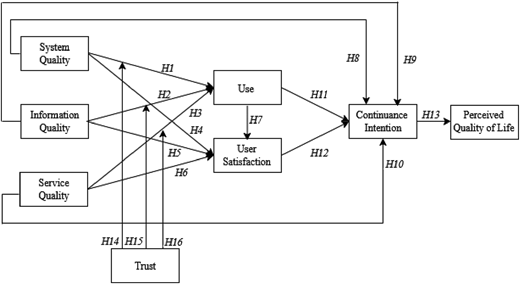
Figure 1 presents the conceptual research framework based on the literature review. The D&M IS success model provides a comprehensive framework for evaluating the success of information systems by focusing on system quality, information quality, service quality, user satisfaction, and system use (DeLone & McLean, 2003). This model has been widely adopted to assess both the initial adoption and the sustained use of IS platforms, including mobile health applications.
In the context of this study, the primary aim is to examine the key factors that influence the continuance intention of the MySJ app, particularly as it transitions into a national digital health platform. The D&M model is especially suited to this purpose because it directly addresses user satisfaction and system use as critical outcomes; both of which are central to continuance intention. While other models such as the Unified Theory of Acceptance and Use of Technology (UTAUT), are often utilized in technology acceptance studies, this study focuses on post-adoption continuance rather than initial acceptance. Given the matured stage of MySJ adoption and the post-pandemic context, where users are already familiar with the system, the D&M model provides an adequate and focused theoretical lens to evaluate the continuance intention without the need to integrate additional acceptance models. A holistic approach shows that the interdependencies among technical features, output, and support collectively influence user satisfaction and usage. The comprehensive analysis allows us to see deeper into the key factors that affect the user’s decision in their intent to continue using MySJ.
Furthermore, trust is incorporated as a moderating factor to enhance the robustness of the model in capturing user perceptions specific to digital health platforms. Proposing trust as a potential moderator among the relationships between key factors and use could provide deeper insight into how users perceive trust in their use of MySJ (Alshami et al., 2022; Chan, Wok, Sari, & Muben, 2021). Finally, the perceived quality of life, which is the proposed net benefit, encompasses overall well-being among users who intend to continue using the MySJ mobile application.
3. Methodology
This study employed a quantitative correlational design to examine the relationships between key factors and continuance intention of mHealth apps, and to determine the role of trust as a moderator in the relationships between key factors and use. A self-administered online questionnaire was used for data collection. SPSS was used for data screening and PLS-SEM was used to validate the measurement model and test the hypotheses.
The questionnaire was adapted from established studies and underwent a pre-test with five academicians and a pilot test with 30 MySJ users. The reliability analysis confirmed Cronbach’s alpha values above 0.80. Purposive sampling was performed. Participants were selected from private higher education institutions in Malaysia using the MySJ mobile application. The selection criteria include Malaysians who are at least 18 years old and have at least 3 COVID-19 vaccination records in their MySJ app. Preliminary interviews with several universities confirmed that MySJ continues to be actively used within these settings for purposes such as attendance monitoring and campus entry management. This makes university communities a highly relevant and engaged population for examining continuance intention in the post-pandemic context. The selection of this group is also appropriate given their sufficient experience with MySJ which can provide meaningful feedback. Respondents to the survey participated voluntarily and were fully aware that any data collected were solely for the purpose of this research, that their confidentiality remained safeguarded, and that no monetary incentives were given. A total of 20 institutions were approached. Approximately 1,000 invitations were distributed via email, with follow-up reminders to encourage participation, resulting in 468 valid responses.
The survey items used in this study were adapted from previous research. Specifically, five measurement items for “system quality,” five for “information quality,” and four for “service quality” were adapted from Tam and Oliveira (2016). For “continuance intention,” three items were adapted from Bhattacherjee (2001) while four items for “perceived quality of life” were adapted from Akter, D’Ambra, and Ray (2010). Trust was measured using four items, adapted from Bélanger and Carter (2008). All items were assessed using a seven-point Likert scale (1 = strongly disagree, 7 = strongly agree). Eight items for “use” were developed by the researcher. To ensure the validity of these new items, 15 subject matter experts with interdisciplinary expertise in information systems (including digital public health), and mobile app development reviewed the survey instruments. The experts assessed the items for clarity, relevance, and appropriateness to ensure they accurately reflected the functionalities of MySJ. Based on their feedback, minor wording adjustments were made to better align the items with MySJ’s actual features. No major changes were required, reflecting the overall robustness items as they were initially developed. Additionally, three items for “user satisfaction” were adapted from Birkmeyer, Wirtz, and Langer (2021), and one item was adapted from Tam and Oliveira (2016) with these items measured on a five-point Likert scale (1 = not at all, 5 = to a very large extent).
4. Results
A total of 468 valid responses were collected for the analysis. The demographic information of the participants is presented in Table 1. The sample consisted of both genders; 280 (59.8%) were female and 188 (40.2%) were male. The sample consisted of participants of all ages as follow: 18–24 years n = 164, 35.0%), 25–34 years n = 82, 17.5%), 35–44 years n = 115, 24.6%), 45–54 years n = 79, 16.9%), 55–64 years n = 22, 4.7%), and 65 years and above (n = 6, 1.3%).
4.1 Assessing measurement model
Smart PLS 4.0 was utilized to validate the measurement model and assess the structural model. PLS-SEM was used to assess the measurement model and to ensure convergent and discriminant validity. Item loadings, average variance extracted (AVE), and composite reliability (CR) were used to evaluate the convergent validity. As advised by Hair, Page, and Brunsveld (2020), item loadings in this investigation that surpass the 0.70 criterion show strong indication dependability. This suggests that the underlying constructs are sufficiently represented by observable variables. In addition, the internal consistency of the measurement model was confirmed by CR, and Cronbach’s alpha values exceeded 0.70. Additionally, the latent constructs captured more variance from their indicators than from errors, as indicated by AVE values exceeding 0.50 (see Table 2).
To ensure that each construct in the model was distinct from one another, discriminant validity was assessed using the heterotrait-monotrait (HTMT) ratio and Fornell-Larcker criterion. To do this, the square root of each construct’s average variance extracted (AVE) was compared to its correlations with other constructs using the Fornell-Larcker criterion. If the AVE of the construct’s square root is higher than the correlation values it shares with other constructs, it indicates strong discriminant validity (Hair et al., 2020). As shown in Table 3, all constructs in this study satisfy this requirement. The HTMT values were also assessed. When the HTMT values remained below 0.85, the model further confirmed construct distinctiveness (Henseler, Ringle, & Sarstedt, 2015) (see Table 4). This means that the construct explains more variance in its own indicators than it does with any other variable in the model. Once the measurement model was confirmed, the structural model was analyzed.
4.2 Assessing structural model
The bootstrapping method was employed to test the proposed research hypotheses as recommended by Hair et al. (2022). To evaluate the hypotheses, this study relied on the beta coefficients, t-values, and p-values. The significance level for all the statistical tests was set at p < 0.01, ensuring a high level of confidence in the results. Table 5 presents the path analysis and hypothesis-testing results. As shown in Table 5 – H1, H2, H4, H5, H7, H8, H9, H10, H11, H12, H13, H14, and H15 were all supported, whereas H3, H6, and H16 were not.
The results of the hypothesis testing show that system quality and information quality have a positive association with use and user satisfaction. There is also a positive association between use and user satisfaction. System quality, information quality, service quality, use, and user satisfaction are positively associated with continuance intention (Akter, Wamba, & D’Ambra, 2019; Al Amin, Muzareba, Chowdhury, & Khondkar, 2024; Koghut & Ai-Tabbaa, 2021).
However, service quality was not associated with use or user satisfaction. Furthermore, the result of the moderating variable trust suggested that high system quality was affected by high trust, which in turn churned high use of the MySJ mobile app. The moderating variable trust also showed that high information quality is affected by high trust, which in turn churned high use of the MySJ mobile app (Kabakuş & Küçükoğlu, 2022). The results of the analysis further showed that continuance intention is positively associated with perceived quality of life. This means that a high continuance intention of MySJ leads to greater perceived quality of life among users.
The blindfolding approach, which methodically leaves a single data point and guesses the missing value to evaluate the PLS path model, is used to test the prediction quality of the model. As shown in Table 6, this procedure produces Q2 values, all of which are above zero, demonstrating the superior predictive performance of our model. Additionally, in accordance with Shmueli et al. (2019), case-level predictions can be produced at item and construct levels using the PLS-Predict approach. To do this, a holdout sample-based method employing PLS-Predict and a 10-fold cross-validation process was used to evaluate predictive relevance. Our model has modest predictive potential because, as Table 6 shows, the majority of item differences show lower PLS-SEM prediction errors than the linear model (LM) benchmark (Hair et al., 2022).
5. Discussion
This study examined the continued use of the MySJ app, originally designed for COVID-19 monitoring in Malaysia. By leveraging the D&M IS Success Model, this study evaluates the behavioral intentions of faculty members and students from private higher education institutions in Malaysia. A quantitative research approach was adopted utilizing Smart PLS to test the proposed hypotheses. The findings further confirmed that key factors, such as system quality, information quality, service quality, use, and user satisfaction, play critical roles in developing user's continuance intention toward the MySJ mobile app. These results were consistent with those of previous studies (Akter et al., 2019; Guo & Lyu, 2023; Ikenyei & Haggerty, 2024; Oppong, Hinson, Adeola, Muritala, & Kosiba, 2018; Song et al., 2021).
Users are more likely to continue using MySJ when they perceive the app as technically reliable, easy to navigate, and capable of delivering accurate and up-to-date health information that supports their health decisions and planning. Timely and reliable responses from support personnel further reinforce user’s sustained use. Our study further highlights that system and information quality significantly enhance usage, which in turn increases user satisfaction, ultimately reinforcing MySJ’s continued adoption by higher-institution students and staff.
Interestingly, this study found that service quality did not significantly influence use (H3) and user satisfaction (H6) (Lotfi, Fatehi, & Badie, 2020). One possible explanation is that users may have lower service quality expectations for government-operated applications like MySJ, where they are accustomed to less personalized or less responsive support. While traditional IS studies emphasize service quality as a key determinant of user satisfaction (Kaium, Bao, Alam, & Hoque, 2020), findings in mHealth contexts suggest that the role of service quality may be less dominant when users primarily engage with self-service applications (Wang et al., 2023). This is particularly relevant for MySJ, where most user interactions are system-driven rather than service-dependent. As such, users may use the application not because of service excellence, but due to other factors such as system functionality and information relevance.
Moreover, our study revealed that trust strengthens the relationship between system quality and use as well as information quality and use. The impact of system quality and information quality on app usage becomes stronger when users have a high level of trust in the app. Trust enhances users’ willingness to engage with the system’s features and rely on its health information. Nevertheless, unlike the findings of Noh and Lee (2016), trust has no significant moderating effect on the relationship between service quality and trust level (H16). This extends the notion that service quality may play a less central role in the MySJ environment, where technical functionality and information delivery are prioritized over interpersonal service experiences. It suggests that trust may not play a meaningful role in shaping users’ perceptions of service quality. Interestingly, other studies in different settings have found the opposite. Umar et al. (2024) reported that trust significantly strengthened the relationship between service quality and user engagement in agricultural cooperatives. This shows that in some service-heavy environments, trust can boost users’ responses to service quality. However, in platforms like MySJ, most user interactions are self-service and system driven with minimal direct service encounters. This unique finding highlights the evolving nature of user expectations in public digital health platforms, where users may value seamless self-service and data reliability over direct service interactions. As a result, users may not expect or rely on interpersonal service quality in the same way they do on commercial platforms. Therefore, trust primarily strengthens perceptions of system and information quality but exerts less influence on service quality because service interactions are less prominent in the digital platform. Furthermore, a positive relationship was observed between continuance intention and perceived quality of life, suggesting that consistent use of the app improves overall well-being (Alam et al., 2022).
6. Conclusion
6.1 Theoretical contributions
This study advances the D&M IS Success Model by applying it to a post-pandemic, government-operated digital health platform, MySJ. This study affirms its contributions to theory by demonstrating that the model is sufficient to explain continuance intention in the context of government-operated digital health applications beyond initial adoption stage. A unique theoretical insight of this research is the reduced role of service quality in influencing use and user satisfaction on government platforms. Unlike commercial platforms where service quality often plays a dominant role, this study highlights that system quality and information quality, moderated by trust, are primary factors of use of MySJ. This finding challenges the assumption that service quality is always a critical factor across platforms and emphasizes the need to consider the unique dynamics within government-managed digital health services.
The study also refines understanding of the moderating role of trust. Trust significantly strengthens the relationship between system quality and information quality and use, but not between service quality and use. This asymmetry can be explained by the MySJ environment where users primarily interact with system features and health information rather than direct personnel. As a result, their trust judgments are anchored in data security and technical reliability rather than service responsiveness (Zainal & Lee, 2022). This finding extends the theory by highlighting that the moderating effect of trust may be domain-specific and contingent on the type of user interaction predominant on the platform. This study extends the model’s relevance to government-operated digital health platforms that have become critical tools for managing public health crises. The research addresses the evolving user behaviors and expectations shaped by the pandemic, such as increased reliance on digital services for health management and the prioritization of data security, thus filling an important gap in the existing theory that primarily focused on commercial and pre-pandemic settings.
Beyond trust, this study reaffirms that system quality, information quality, service quality, use, and user satisfaction are fundamental to continuance intentions (Al Amin et al., 2024). Users are more likely to continue using MySJ when they perceive it as having strong technical capabilities, accurate and relevant information, and reliable support services. Notably, even when some users experience unsatisfactory service, they may continue to use MySJ because of its essential role in storing critical health records such as vaccination certificates and test results. This behavior underscores the importance of system design and perceived usefulness in driving sustained engagement. Additionally, a favorable correlation between perceived quality of life and continuance intention was noted in our study, indicating that regular usage of the app enhances general well-being (Alam et al., 2022).
6.2 Practical contributions
From a practical standpoint, this study offers clear recommendations for the MOH to strengthen the long-term adoption of MySJ. Our model showed acceptable predictive performance using the PLS-predict setting. These findings indicated that the predictive accuracy of our model may be effective for unseen data as accurate prediction is essential for policymakers and application developers to make better decisions. MOH should continue to invest in system functionality improvements, ensure that health information provided through the app remains timely and relevant, and proactively address user concerns about data security. Emphasizing transparent communication about privacy protections and leveraging users, can help maintain consistent app engagement. Communicating the evolving purpose of MySJ beyond pandemic management will also be the key to sustaining public trust and continued usage of the public digital health tool.
In addition, since the transition of the MySJ from a pandemic management tool to a comprehensive public digital health platform has received little attention, it is essential to examine the key factors influencing the continuance intention of the MOH and the relevant stakeholders to formulate effective strategies for long-term sustainability in order to make MySJ a super health digital app for the country a success. MOH can reconsider how service elements are delivered. Since service quality played a weaker role in influencing use and user satisfaction, investments may be better focused on system performance and information delivery, while using automation or in-app self-service support to address basic user needs. Communicating MySJ’s transition from a pandemic-management tool to a national digital health super-app can reinforce its importance to public health and encourage sustained engagement. These actions directly support Malaysia’s digital health strategy and United Nations’ Sustainable Development Goal 3 (SDG 3), which encourages good health and well-being (Alisherovna & Djamshedovna, 2024).
7. Limitations and future research directions
This study has several limitations that should be acknowledged. First, the sample was limited to university staff and students from private higher education institutions in Malaysia, which may restrict the generalizability of the findings to the wider Malaysian population or to users in other countries. Additionally, while the study provides valuable cross-sectional insights, it does not capture changes in user perceptions or behaviors over time.
To extend the scope of this study, future research should examine the impact of trust beyond academia by focusing on public perceptions of MySJ’s security, reliability, and long-term value in Malaysia’s digital health ecosystem. Longitudinal designs to capture how user engagement with MySJ evolves over time can be studied, particularly as new features are introduced and public health policies change. It could provide deeper insights into how continuance intention develops and whether the influence of system quality, information quality, and trust fluctuates as the app matures. Cross-cultural studies comparing MySJ with similar mobile health platforms in other countries would also help determine whether the observed patterns are unique to Malaysia or reflect broader trends in public sector digital health adoption. Additionally, future research could explore other potential moderators, such as perceived risk, health status, or digital health literacy, to further enrich the understanding of factors influencing continuance intention.