


Job crafting is widely studied, but antecedent evidence is limited. Further, leisure crafting is underexplored, and research incorporating job and leisure crafting behaviors is rare. Guided by the Conservation of Resources theory, the central focus of this study is to examine job crafting as a key mechanism through which high-performance work systems influence employee well-being and performance outcomes, while also considering leisure crafting as a cross-domain pathway.
Using time-lagged data (n = 126) from New Zealand, we tested the direct and mediating relationships among HPWS, job crafting, leisure crafting, well-being (positive affect, WHO-5 and insomnia) and performance outcomes (innovative work behaviors and organizational citizenship behaviors). We also conducted dominance analysis to compare the relative importance of job and leisure crafting across outcomes.
HPWS is positively related to job and leisure crafting, as well as all well-being and performance outcomes. Job crafting plays a partial mediating role, although full mediation towards citizenship behaviors. Dominance highlights strong effects from leisure crafting.
Findings demonstrate the value of dual crafting perspectives and suggest that organizations should foster job and leisure crafting to sustain employee well-being and performance.
Introduction
Among proactive strategies for enhancing employee functioning, job crafting has emerged as a promising avenue for improving engagement, performance and well-being (e.g. Abukhalifa and Kamil, 2025; Han and Hwang, 2021). Job crafting refers to the ways individuals proactively modify their work tasks, relationships or perceptions to make their roles more meaningful and better aligned with personal values (Wrzesniewski and Dutton, 2001). Research has also advocated for a whole-life perspective that extends beyond work to understand employee well-being and performance better (Tims et al., 2022). In this regard, leisure crafting involves the intentional shaping of one’s free time to foster goal setting, personal growth, learning and social connection (Petrou and Bakker, 2016). Although leisure crafting remains relatively nascent, it provides a useful extension to the job crafting literature by capturing proactive behaviors in the non-work domain.
However, limited studies have examined job and leisure crafting together to explain employee well-being and job outcomes. Another issue is that the literature has focused more on job crafting’s outcomes than on its antecedents (Gong et al., 2024). These gaps are important as they leave it unclear how these two proactive behaviors across work and non-work domains are shaped by organizational conditions. In such regards, HPWS represents a relevant organizational antecedent for addressing these gaps. HPWS has been defined as a coherent system of mutually strengthening human resource practices, including rigorous selection, skill development and work design, that encourages employees to address problems creatively (Harley et al., 2007). HPWS is not merely associated with gains in organizational performance (Combs et al., 2006), but also with employee outcomes, although prior review evidence suggests that these effects are not uniformly positive and may differ across dimensions of well-being (Haar and Harris, 2023). Recent research further suggests that HPWS influences outcomes through mediating mechanisms, including job crafting (Miao et al., 2023; Wang and Chen, 2022). Although the link between HPWS and job crafting has begun to receive empirical attention, studies of downstream effects on employee well-being and extra-role performance are still scarce, leaving gaps in understanding how these processes work (Wang and Chen, 2022).
To address these gaps, the current study examines job crafting as a key mechanism through which HPWS impacts employee well-being and extra-role performance, while also considering leisure crafting as a complementary cross-domain pathway. It addresses the following research questions: (1) Is HPWS positively associated with job and leisure crafting? (2) Do job and leisure crafting mediate the relationship between HPWS and employee well-being? (3) Do job and leisure crafting mediate the relationship between HPWS and employee extra-role performance? Addressing these research questions is important for understanding employees from a whole-life perspective rather than merely as work-self (Han and Hwang, 2021). This understanding considers how work practices influence employees’ lives beyond the workplace.
Our study model is grounded in the Conservation of Resources (COR) theory (Hobfoll et al., 2018) and makes three contributions. First, to our knowledge, this study is among the first studies to examine job and leisure crafting together as mediators while exploring HPWS as an antecedent. It extends the crafting literature by incorporating leisure crafting and adopting a whole-life perspective that integrates work and non-work domains (Tims et al., 2022). Second, it responds to recent calls to investigate HPWS as an antecedent to job crafting and subsequent outcomes (Wang and Chen, 2022). Third, the study strengthens our understanding of crafting influences by conducting a dominance analysis to determine whether job crafting or leisure crafting is more important to outcomes, which can offer implications for organizational practices that support employees from a whole-life perspective.
Theoretical foundations: COR
COR theory is relevant to the current study because it explains how organizational practices, proactive crafting behaviors and employee outcomes are linked through resource gain processes. COR theory holds that “individuals strive to obtain, retain, foster and protect those things they centrally value,” especially when confronted with stress and uncertainty (Hobfoll et al., 2018, p. 106). These resources include object resources (e.g. laptop), condition resources (e.g. tenure), personal resources (e.g. self-efficacy and support) and energy resources (e.g. time) (Hobfoll et al., 2018). COR theory further suggests that resources exist in resource caravans, functioning in interconnected clusters rather than independently. According to COR theory, HPWS represents an organizational source of resources that can provide employees with resource-rich conditions, such as developmental opportunities, supportive task structures, autonomy and skills building (Haar and Harris, 2023). These conditions may encourage employees to engage in proactive coping behaviors that help them retain, protect and further build their resource base (Hobfoll et al., 2018).
Job crafting reflects such proactive resource investment within the work domain, as employees reshape tasks, relationships and cognition to improve meaning at work and strengthen personal and energy resources (Bruning and Campion, 2018). Leisure crafting reflects similar proactive investment in the non-work domain, as employees reshape their leisure activities with purpose to improve growth, recovery and social connection, strengthening personal and energy resources (Petrou et al., 2017). In this way, both job and leisure crafting can be understood through the lens of COR theory as resource-building behaviors operating across work and non-work domains (Manzanares et al., 2024; Teng and Chen, 2025).
The present study also addresses the broader challenge of understanding how multiple resources operate together within supportive environments and how such resources are translated into real benefits, by considering COR’s theory’s principle of resource caravans (Hobfoll et al., 2018). It extends the resource caravans by examining how HPWS, job crafting and leisure crafting can allow resources to be accumulated in interconnected clusters (Hobfoll et al., 2018). Specifically, HPWS may initiate resource gain by providing a supportive organizational context, while employees build on these gains through job and leisure crafting. Through these processes, resources provided by organizations might be converted into employee well-being and performance. The current study moves beyond a single-domain view of crafting by using a dual-crafting view that uses COR theory to explain resource spillover across work and non-work domains (Hobfoll et al., 2018). The dual-crafting view responds to calls for research on dynamic and cross-domain resource processes in employee functioning.
Job crafting and leisure crafting
Job and leisure crafting are key proactive strategies through which individuals accumulate and invest personal and energy resources across work and non-work domains (Teng and Chen, 2025). Job crafting is defined as “the physical and cognitive changes individuals make in the task or relational boundaries of their work” (Wrzesniewski and Dutton, 2001, p. 179), while leisure crafting, similarly, involves the intentional structuring of one’s free time to promote goal setting, personal growth, learning and social connection (Petrou and Bakker, 2016). Job crafting examples include trying to learn new things at work and asking co-workers for help, while leisure crafting examples include building relationships and new skills through leisure activities, such as working out (Tims et al., 2012; Petrou and Bakker, 2016). Tims et al. (2012) outlined four dimensions of job crafting: increasing structural job resources (e.g. developing capabilities), increasing social job resources (e.g. seeking feedback or coaching), increasing challenging job demands (e.g. taking on additional responsibilities) and decreasing hindering job demands (e.g. minimizing emotionally draining tasks).
Recently, a holistic perspective that integrates work and non-work domains to better understand employee well-being and performance has been raised (Han and Hwang, 2021; Tims et al., 2022). Petrou and Bakker (2016) argue that work and leisure are not separate spheres but dynamically interact and shape one another. While job crafting enables resource generation and fits within the work domain, leisure crafting supports recovery and enrichment outside of work, highlighting their compensating roles in sustaining well-being (Petrou et al., 2017). Together, these forms of crafting reflect agentic strategies for resource regulation across life domains, including personal resources (e.g. skill and self-efficacy), energy resources (e.g. time and knowledge) and social support, as conceptualized in COR theory (Hobfoll et al., 2018). These crafting behaviors are not only the outcomes of supportive environments but also mechanisms through which resources are transformed into enhanced well-being and performance, aligning with COR theory.
Few studies have integrated both crafting behaviors to examine their antecedents or their role as mediating mechanisms. As noted above, failure to include both domains of crafting may lead to a strong focus on job crafting, which is the dominant approach. However, empirical evidence indicates that both forms of crafting positively influence employee well-being (e.g. reducing burnout) and foster beneficial job outcomes such as thriving at work, with Han and Hwang (2021) demonstrating that job and leisure crafting mediated the relationship between protean career orientation and thriving, self-development and personal life enhancement at work. However, the organizational factors that facilitate dual crafting remain underexplored. Teng and Chen (2025) propose that engaging in job and leisure crafting enables individuals to acquire and preserve resources across both work and non-work domains. Building on this view, the present study investigates whether HR practices, such as HPWS, serve as an organizational antecedent of these two forms of crafting, and if they in turn mediate the relationship between HPWS and employee well-being and performance.
Hypothesis development
Although the specific components of HPWS vary across studies, their overarching purpose is to enhance HR performance and generate positive employee and organizational outcomes (Haar et al., 2022; Haar and Harris, 2023). Shijaku et al. (2015) noted that HPWS can enhance employees’ abilities, increase job autonomy and promote intrinsic motivation through practices such as training, participation opportunities and compensation policies. Within COR theory, these practices can be understood as organizational-level resources that help employees acquire and build valued resources (Haar and Harris, 2023). Meanwhile, critical research has raised concern that HPWS may also intensify work and undermine employee functioning (Choudhary and Kunte, 2024) or have dual-edged effects (Haar, 2025). However, prior research has generally supported a positive association between HPWS and job crafting, suggesting that supportive and resource-rich work context encourage employees to proactively craft their jobs through increasing resources and seeking challenges (e.g. Miao et al., 2023). From the COR perspective, this occurs because employees who experience greater organizational resources are better positioned to invest those resources in further resource-building behaviors (Hobfoll et al., 2018). Because of this, the potential work intensification caused by HPWS is not expected to undermine job crafting in the present model.
Although direct empirical evidence linking HPWS to leisure crafting remains limited, COR theory suggests that organizational resources may spillover beyond the work domain (Hobfoll et al., 2018). Kosenkranius et al. (2021) showed that employees engage more in leisure crafting when they experience stress at work but have home autonomy, highlighting the importance of available resources in shaping leisure. Building on this logic, we argue that the autonomy, self-efficacy, flexible arrangements and extensive benefits suited by HPWS may carry over into how individuals craft their leisure activity. For example, HPWS may provide time-related resources or benefits, such as fitness support, that facilitate engagement in leisure activities, while also strengthening personal resources such as self-efficacy that encourage proactive behaviors outside work. As a resource-rich organizational system, HPWS may thus provide developmental, motivational and structural resources that can facilitate job and leisure crafting. We posit the following:
HPWS will positively influence (a) job crafting and (b) leisure crafting.
Next, we explore the influence of HPWS on well-being outcomes and take a multidimensional approach (Haar and Harris, 2023), focusing on its emotional, psychological and physical dimensions, represented by positive affect (PA), subjective psychological well-being (as measured by the WHO-5) and insomnia. PA reflects a high-energy, pleasurable mood state characterized by enthusiasm, alertness, interest and joy (Watson et al., 1988). It serves as an indicator of emotional well-being. Complementing this, psychological well-being is assessed using the WHO-5 Well-Being Index, a widely validated scale with solid psychometric properties (Topp et al., 2015), acting as a general indicator of subjective well-being. Finally, insomnia is a negative health outcome that reflects psychological strain outcomes around sleep and is increasingly recognized as an important well-being outcome in workplace studies (Haar and Harris, 2023). Greenberg (2006) noted that insomnia is often triggered by stress, making it a meaningful inverse indicator of well-being.
Although HPWS is often associated with beneficial employee outcomes, recent research has also highlighted its potential downside (e.g. Haar, 2025). Research indicates that the relationship between HPWS and employee well-being has been widely examined, although there are examples of detrimental effects. For instance, Choudhary and Kunte (2024) argue that HPWS may intensify work and create pressures that may undermine employee well-being, despite its intended benefits for organizational growth. Haar and Harris (2023) showed that HPWS was negatively related to insomnia, suggesting a beneficial association for this specific indicator. Taken together, these differing findings highlight the need to examine how HPWS relates to specific well-being outcomes rather than assuming a uniform positive or negative pattern.
From a COR perspective, HPWS may enhance well-being by providing access to valued organizational resources, such as training opportunities, support and flexible arrangements, that help employees obtain and build further resources (Hobfoll et al., 2018; Haar and Harris, 2023). Access to such resources is expected to promote positive emotional and psychological states, reflected in higher PA and WHO-5, while also buffering against stress-related conditions like insomnia. We expect the following:
HPWS will positively influence (a) PA, (b) WHO-5 and (c) negatively influence insomnia.
Next, we focus on the influence of HPWS on performance outcomes. Building on Wang and Chen’s (2022) call for future research, we address a critical gap in understanding how HPWS influences extra-role performance outcomes through crafting behaviors. We examine organizational citizenship behaviors (OCBs) and innovative work behaviors (IWBs) as extra-role performance outcomes. OCBs refer to voluntary employee behaviors that contribute to the organization or co-workers, go beyond formal job requirements and are not formally rewarded (Organ et al., 2005). IWBs involve generating, promoting and implementing novel ideas to enhance performance and are regarded as a form of extra-role behaviors requiring initiative beyond routine responsibilities (Janssen, 2000).
Prior empirical studies separately showed that HPWS were positively associated with OCB and IWBs (e.g. Aboramadan, 2022). Drawing from COR theory, HPWS, as a source of organizational resources, supports employees to build energy resources (time) and personal resources (competence) while also enhancing employees’ abilities, motivation and opportunities (Haar et al., 2022; Hobfoll et al., 2018). For instance, training opportunities that support creative skills and thinking may facilitate employees’ IWBs (Aboramadan, 2022). In addition, when employees experience resource support from their organization, they may be better positioned to invest those resources in discretionary behaviors that benefit their organization and co-workers (Aboramadan, 2022). Accordingly, we posit the following:
HPWS will positively influence (a) OCBs and (b) IWBs.
Direct effects of crafting behaviors
Job crafting is generally positively associated with employee well-being and job performance (e.g. Manzanares et al., 2024; Teng and Chen, 2025). Specifically, prior research suggests that job crafting contributes to IWBs (Teng and Cheng, 2025), OCBs (Gouda et al., 2021) and PA (Slemp et al., 2015). However, its potential impact on broader indicators of psychological and physical well-being, such as the WHO-5 and insomnia, remains underexplored. From a COR perspective, job crafting enables employees to actively acquire, protect and utilize resources, and those with greater resources are better able to invest them in beneficial work behaviors and well-being outcomes (Hobfoll et al., 2018; Manzanares et al., 2024). For example, employees can redesign their tasks in ways that foster innovation, leading to creative behaviors (Teng and Cheng, 2025). They may also seek challenges, which can encourage extra-role behaviors such as OCBs. Meanwhile, reducing hindering job demands may help preserve energy and lower strain, thus supporting PA and WHO-5, and lowering insomnia (Tims et al., 2022). We posit the following:
Job crafting will positively influence (a) PA, (b) WHO-5 and (c) negatively influence insomnia.
Job crafting will positively influence (a) OCBs and (b) IWBs.
Next, we extend the above logic from job crafting to leisure crafting, capturing a more holistic, whole-life perspective. The present study applies the resource spillover approach by incorporating leisure crafting as a proactive strategy that individuals shape non-work experiences to restore resources that may, in turn, support well-being and extra-role performance (Hobfoll et al., 2018). Leisure crafting has been shown to influence work outcomes via cross-domain resource accumulation (Petrou and Bakker, 2016; Teng and Chen, 2025). For example, Chen and Choi (2024) found that leisure crafting contributed to innovative behaviors both directly and indirectly by playful work design, suggesting that resources acquired during leisure might spill over to the work domain. Drawing from COR theory, resources (e.g. emotional energy and optimistic perspectives) gained through leisure crafting may promote proactive workplace behaviors. For example, an employee who gains energy and personal growth from restorative leisure activities may display greater OCBs, while one who develops creativity through leisure pursuits may channel it into IWBs.
Regarding well-being, recent work by Manzanares et al. (2024) suggests that leisure crafting enhances psychological health. From a COR perspective, leisure crafting allows individuals to generate valuable resources, such as positive emotions and recovery through quality sleep, which in turn strengthen overall well-being (Hobfoll et al., 2018). Building on this rationale, we expect leisure crafting to enhance PA and WHO-5 and lower insomnia. We posit the following:
Leisure crafting will positively influence (a) PA, (b) WHO-5 and (c) negatively influence insomnia.
Leisure crafting will positively influence (a) OCBs and (b) IWBs.
Mediating effects of crafting behaviors
Prior research has examined job crafting as a mediating role linking HR practices to employee outcomes (Guan and Frenkel, 2018; Miao et al., 2023; Wang and Chen, 2022). For instance, Guan and Frenkel (2018) showed that job crafting mediated the relationship between employees’ perceptions of HR practice and employee performance. Building on this line of research, the present study extends the literature in two ways. First, it moves beyond a sole focus on job crafting and incorporates leisure crafting, thereby capturing resource processes across work and non-work domains. Second, it extends the links between HPWS and job crafting to employee well-being and extra-role performance (Gong et al., 2024; Wang and Chen, 2022).
We propose that crafting behaviors act as a mediating mechanism that links HPWS to employee well-being and performance outcomes. That is, when employees are supported by resource-enabling HR practices (HPWS), job and leisure crafting are more likely to flourish, which in turn may enhance well-being and promote extra-role behaviors such as OCBs and IWBs. The mediating logic aligns with the resource caravan approach of COR theory, where resources provided by HPWS and further built through job and leisure crafting may accumulate in interconnected clusters (Hobfoll et al., 2018). In effect, HPWS provides employees with valued resources, such as time, confidence, support and development opportunities, which enable them to craft their job and leisure activities. Via this process, employees may generate additional resources that ultimately enable greater well-being and performance. For instance, skill-development programs and supportive feedback under HPWS can increase employees’ confidence to take initiative, leading them to craft their work roles and seek out leisure challenges that replenish energy and creativity. We posit the following, and our study model is presented in Figure 1:
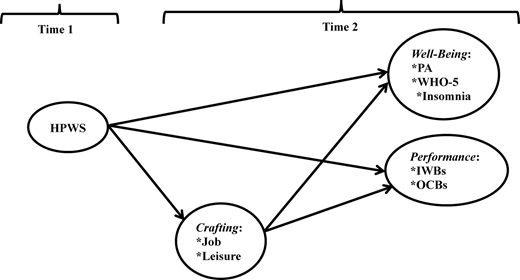
Job and leisure crafting will mediate the direct effect of HPWS on (a) well-being outcomes and (b) performance outcomes
Methods
Recommendations by Podsakoff et al. (2003) were followed, with time-lagged data collected with a one-month separation. Data were collected using a Qualtrics survey panel (for details see Haar, 2023), which is representative of the New Zealand workforce (institutional ethics reference: HEN#4000027489). To qualify, respondents need to be (a) aged 18 years and older, (b) be in paid employment working a minimum of 20 h/week, and (c) not be a business owner or self-employed. The last criterion ensures HPWS is adequately captured, with the 20/hour per week minimum providing respondents with the opportunity to engage in job and leisure crafting. We followed standard panel studies (e.g. Haar and Harris, 2023) and included an instructed response item (“For this question, answer strongly disagree only”), with failed attention leading to removal from the survey. We also removed responses that were completed too fast or too slow ( ± 30% median time). Overall, 404 respondents answered survey 1, and ultimately, 126 matched responses (surveys 1 and 2) were collected. There was no evidence of non-response bias. Power analysis shows this is within the range of 90% confidence level, with the large population size (1 million workers), and an 8% margin of error, which has an ideal sample size of n = 106 (Qualtrics, 2026). We suggest that the time-lagged nature of the data makes the 8% error margin acceptable. Overall, respondents’ average age was 37.06 years (SD = 10.43), with 61.9% female, working an average of 42.06 h/week (SD = 7.37). By industry classification, respondents came from 19/20 industries, with the largest being healthcare and social assistance (12.7%) and retail (11.1%), with only mining not represented. By sector, the majority were in the private sector (67.5%), followed by the public sector (30.2%).
Measures
HPWS was measured at time 1 with 16-items by Lepak and Snell (2002), coded 1 = strongly disagree, 5 = strongly agree. This scale has been well validated in New Zealand (e.g. Haar et al., 2022; Haar and Harris, 2023). The measure has five dimensions (3-items each except first dimension with 4-items): job design (e.g. “In my job I am empowered to make decisions”), recruitment and selection (e.g. “The recruitment/selection on for employees emphasizes promotion from within”), training and development (e.g. “Our training activities for employees are comprehensive”), performance management (e.g. “Performance appraisals include developmental feedback”) and compensation (e.g. “Compensation/rewards for employees place a premium on their industry experience”). A Confirmatory Factor Analysis (CFA) was employed to assess HPWS as a higher-order construct (in AMOS, v.30), and this resulted in a good fit to the data: χ2(df) = 164.4(103), CFI = 0.93, RMSEA = 0.07 and SRMR = 0.07. This equates well with Tims et al. (2012). An alternative CFA was tested regarding a single factor for HPWS, and this resulted in a significantly poorer fit (p < 0.001). Aligned with standard practice (e.g. Haar and Harris, 2023), items were summed to calculate a single HPWS factor (α = 0.90).
Job Crafting was measured at time 2 using the short scale of Tims et al. (2012), coded 1 = never, 5 = often, specifically 12-items by Sora et al. (2018). The scale has four dimensions each with 3-items: (a) increasing structural job resources, sample item “I try to develop myself professionally” (α = 0.82), decreasing hindering job demands, sample item “I try to ensure that my work is emotionally less intense” (α = 0.66), increasing social job resources, sample item “I look to my supervisor for inspiration” (α = 0.84), and increasing challenging job demands, sample item “When there is not much to do at work, I see it as a chance to start new projects” (α = 0.81). For the scale, a higher-order construct was confirmed by CFA in AMOS (v.29), and this was an excellent fit to the data: χ2(df) = 52.0(53), CFI = 1.00, RMSEA = 0.00 and SRMR = 0.06 (α = 0.82). This equates well with Sora et al. (2018). An alternative CFA was tested (a single factor), which resulted in a significantly poorer fit to the data (p < 0.001). This scale has been validated in New Zealand (e.g. Jindal et al., 2023).
Leisure Crafting was measured at time 2 using the 9-item scale by Petrou and Bakker (2016), coded 1 = not at all, 5 = very much. The scale has a single dimension, with a sample item “Through my leisure activities, I look for inspiration from others” (α = 0.94). This scale is yet to be validated in New Zealand.
Positive Affect was measured at time 2 using five items from Watson et al. (1988), coded 1 = very slightly, to 5 = extremely. Items were in relation to the way that work makes participants feel, for example, “excited” and “energized.” This measure has been validated in New Zealand (e.g. Rashid et al., 2025) and had excellent reliability (α = 0.91).
WHO-5 was measured at time 2 using the 5-item scale by the World Health Organization (1998), coded 0 = at no time, 5 = all the time. A sample item is “Over the last two weeks I have felt cheerful and in good spirits” (α = 0.93). This scale is well validated (see Topp et al., 2015).
Insomnia was measured at time 2 using the 4-item scale from Greenberg (2006), coded 1 = not at all, 5 = to a great extent. Questions followed the stem “Indicate the extent to which you have experienced each of the following symptoms over the past month,” sample item “Waking up several times per night” (α = 0.89). This construct has been validated in New Zealand (Haar and Harris, 2023).
OCBs were measured at time 2 using the four-item short measure by Saks (2006), coded 1 = never, 5 = always, focusing on the organization. Questions followed the stem “How often do you engage in the following behaviors …” with a sample item “Take action to protect the organization from potential problems” (α = 0.87). This construct has been validated in New Zealand (Roche et al., 2026).
IWBs were measured using nine items by Janssen (2000), coded 1 = never, 5 = almost always. The scale has three dimensions (3-items each), and questions follow the stem “How often do you engage in the following …”. Sample items and dimensions are “Creating new ideas for difficult issues” (idea generation, α = 0.91), “Making important organizational members enthusiastic for innovative ideas” (idea promotion, α = 0.91), and “Evaluating the utility of innovative ideas” (idea realization, α = 0.92). This scale is validated in New Zealand (e.g. Ghafoor and Haar, 2022). A higher-order construct was confirmed by CFA in AMOS (v.29), and this was an excellent fit to the data: χ2(df) = 35.0(26), CFI = 0.99, RMSEA = 0.05 and SRMR = 0.02 (α = 0.96). An alternative CFA was tested (a single factor), which resulted in a significantly poorer fit to the data (p < 0.001).
Control Variables: There is meta-analytic support for demographic variables towards crafting behaviors (e.g. Rudolph et al., 2017), and we controlled for: Age (in years), Gender (1 = female, 0 = male) and Education (1 = high school, 2 = technical college qualification, 3 = university degree, 4 = postgraduate qualification).
Measurement models
Constructs were confirmed using CFA with AMOS (version 30). One challenge with the present study is that the three measures (HPWS, job crafting and IWBs) are all higher-order constructs, reflecting many items overall. Parceling can be a useful strategy (see Haar and Harris, 2023) as it can minimize random errors, reduce item-specific biases and provide more stable parameter estimates. However, Marsh et al. (2013) noted that parceling is only problematic if a CFA is not conducted before parceling. Each measure of CFA showed they had no cross-loading item issues, and thus a full CFA was conducted with each of the higher-order scales having items parceled for each of their dimensions. We also parceled leisure crafting due to its 9 items, changing this to a 3-item scale (with each parcel representing items 1–3, 4–6 and 7–9, respectively). This resulted in a CFA that was a good fit to the data: χ2(df) = 719.63(467), CFI = 0.92, RMSEA = 0.07 and SRMR = 0.07. Alternative CFAs were tested on the data (e.g. combining crafting behaviors), and these were all significantly poorer fit (all p < 0.001).
Measurement validity
Fornell and Larcker (1981) offered the average variance extracted (AVE) as an indicator of how well items explain a construct and convergent validity. Values above 0.5 offer support. Results of Composite Reliability/AVE for the study variables are: HPWS (0.97/.66), job crafting (0.96/.65), leisure crafting (0.95/.68), PA (0.94/.74), WHO-5 (0.95/.77), insomnia (0.92/.75), OCBs (0.91/.78) and IWBs (0.98/.85). For discriminant validity, the square root of the AVE scores is calculated, and given these values were higher than the correlation values, it also provides support for discriminant validity.
Analysis
Hypotheses were tested using Structural Equation Modeling (SEM) in AMOS (version 30). Three models were run:
Direct effects model. HPWS predicts all factors.
Full mediation model. HPWS predicts job and leisure crafting (only), and then job and leisure crafting predicts all outcomes (performance and well-being).
Partial mediation model. HPWS predicts all factors, and job and leisure crafting predicts all outcomes (performance and well-being). All models had control variables included, and the outcomes co-varied with each other. All tests of significance are two-tailed.
The post hoc dominance analysis is used to establish if one crafting behavior dominates the influence on outcomes using LeBreton’s (2006) Excel spreadsheet with macros. Analysis requiring re-running regression models (without moderation) and entering the independent variables (job and leisure crafting) individually and then in combination, to compare and determine their unique contribution (overall variance) to each outcome.
Results
Descriptive statistics for the study variables are shown in Table 1.
Correlations and descriptive statistics of study variables
| Variables | M | SD | 1 | 2 | 3 | 4 | 5 | 6 | 7 | 8 | 9 | 10 |
|---|---|---|---|---|---|---|---|---|---|---|---|---|
| 1. Age | 37.06 | 10.43 | – | |||||||||
| 2. Education | 2.52 | 1.02 | 0.11 | – | ||||||||
| 3. HPWS | 3.46 | 0.64 | −0.09 | 0.10 | – | |||||||
| 4. Job Crafting† | 3.30 | 0.57 | −0.20* | 0.05 | 0.46** | – | ||||||
| 5. Leisure Crafting† | 2.83 | 0.91 | −0.07 | 0.18* | 0.20* | 0.46** | – | |||||
| 6. PA† | 3.03 | 0.93 | 0.09 | 0.04 | 0.29** | 0.23** | 0.24** | – | ||||
| 7. WHO-5† | 2.59 | 1.19 | 0.19* | 0.16 | 0.41** | 0.39** | 0.31** | 0.64** | – | |||
| 8. Insomnia† | 2.75 | 1.16 | −0.06 | −0.27* | −0.36** | −0.19* | −0.24** | −0.38** | −0.51** | – | ||
| 9. OCBs† | 2.75 | 1.01 | −0.03 | −0.09 | 0.38** | 0.60** | 0.37** | 0.08 | 0.19* | 0.01 | – | |
| 10. IWBs† | 2.98 | 0.96 | −0.05 | 0.07 | 0.46** | 0.65** | 0.53** | 0.15 | 0.26** | −0.02 | 0.77 | – |
Note(s): N = 126. † = time-lagged 1 month *p < 0.05, **p < 0.01
Table 1 shows that HPWS is significantly correlated with all time 2 outcomes (all p < 0.01, except leisure crafting r = 0.20, p = 0.027), as is job crafting (all p < 0.01 except insomnia, r = −0.19, p = 0.036) and leisure crafting (all p < 0.01).
The results of the direct and mediation analyses are presented in Figure 2. The analysis showed the partial mediation model was a superior fit to full mediation (Δχ2(df) = Δ13.2(Δ5), p < 0.05) and the direct effects model (Δχ2(df) = Δ84.9(Δ10), p < 0.001).
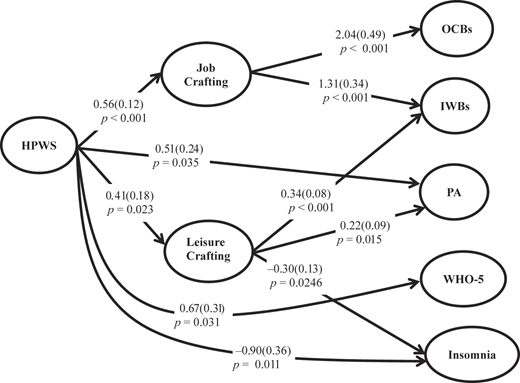
The direct effects model (results not shown) show HPWS is directly and significantly related to job crafting (time 2) (β = 0.56 (0.12), p < 0.001 [LL = 0.35, UL = 0.80]) and leisure crafting (time 2) (β = 0.41 (0.18), p = 0.011 [LL = 0.07, UL = 0.80]). HPWS is directly and significantly related to PA (time 2) (β = 0.56 (0.18), p = 0.002 [LL = 0.21, UL = 1.00]), WHO-5 (time 2) (β = 1.06 (0.26), p < 0.001 [LL = 0.57, UL = 1.74]) and insomnia (time 2) (β = −0.89 (0.27), p < 0.001 [LL = −1.48, UL = −0.48]). This supports Hypotheses 2a–2c. HPWS is also directly and significantly related to OCBs (time 2) (β = 1.03 (0.56), p = 0.001 [LL = 0.56, UL = 1.60]) and IWBs (time 2) (β = 1.11 (0.75), p = 0.001 [LL = 0.75, UL = 1.61]), supporting Hypotheses 3a and 3b.
Hypotheses 4–7 focused on the direct effects of crafting behaviors. Towards PA (time 2), job crafting is non-significant (p > 0.05), although leisure crafting is significantly related (β = 0.22 (0.09), p = 0.015 [LL = 0.04, UL = 0.440]), supporting Hypotheses 6a but not 4a. Towards WHO-5, neither job crafting nor leisure crafting is significantly related (both p > 0.05), failing to support Hypothesis 4b or 6b. Towards insomnia, only leisure crafting is significantly related (β = −0.30 (0.13), p = 0.024 [LL = −0.61, UL = −0.03]) supporting Hypothesis 6c, but 4c. Towards OCBs, only job crafting is significantly related (β = 2.04 (0.49), p < 0.001 [LL = 1.07, UL = 3.68]), supporting Hypothesis 5a but not 7a. Towards IWBs, job crafting is significantly related (β = 1.31 (0.34), p < 0.001 [LL = 0.57, UL = 2.45]) as is leisure crafting (β = 0.34 (0.08), p < 0.001 [LL = 0.18, UL = 0.54]). This supports Hypotheses 5 and 7b.
The next set of hypotheses focuses on whether crafting behaviors mediate the influence of HPWS on well-being and performance outcomes. There is evidence of partial mediation towards PA (time 2), with a reduction in the strength of HPWS from β = 0.56 (0.18), p = 0.002, reducing to β = 0.51 (0.24), p = 0.035, similarly towards WHO-5 (time 2), with a reduction in the strength of HPWS from β = 1.06 (0.26), p < 0.001 reducing to (β = 0.67 (0.31), p = 0.031), insomnia (time 2), with a reduction in the strength of HPWS from (β = −0.89 (0.27), p < 0.001 reducing to β = −0.90 (0.36), p = 0.011. Overall, this supports Hypothesis 8a, with both crafting behaviors playing a partial mediating effect on well-being outcomes. There is evidence of full mediation towards OCBs (time 2), with a reduction in the strength of HPWS from β = 1.03(0.56), p = 0.001 reducing to β = −0.08 (0.28), p = 0.768, and towards IWBs (time 2) there is evidence of partial mediation, with a reduction in the strength of HPWS from 1.11 (0.75), p = 0.001 reducing to β = 0.31 (0.21), p = 0.144. We also examine the indirect effects on performance, as this is where full mediation occurs. Here we find the indirect effects for HPWS through crafting behaviors are significant towards OCBs: β = 1.02 and IWBs: β = 0.746 (both p < 0.05). This supports Hypothesis 8b with full mediation effects to performance outcomes, although with significant indirect effects.
Among the control variables (not shown), age is significantly related to WHO-5 (β = 0.03 (0.01), p = 0.001 [LL = 0.01, UL = 0.05]) and OCBs (β = 0.023 (0.01), p = 0.011 [LL = 0.01, UL = 0.04]), while gender is significantly related to insomnia (β = 0.49 (0.19), p = 0.012 [LL = 0.18, UL = 0.82]), while education is significantly related to insomnia (β = −0.19 (0.09), p = 0.042 [LL = −0.36, UL = −0.04]).
Post-hoc analysis
Lips-Wiersma et al. (2020) highlighted that dominance analysis can provide important nuance to relationships. This is especially true in the context of the dual pathway approach with dominance analysis, meaning we can compare job crafting with leisure crafting to understand their respective influences (e.g. does one dominate). The results of the dominance analysis indicate that towards wellbeing outcomes, it is leisure crafting that dominates towards WHO-5 (60.2% versus 39.8%) and PA (54.4% versus 45.6%), but even towards insomnia (51.4% versus 48.6%). Towards job performance, job crafting dominates OCBs (69.8% versus 30.2%) and IWBs (64.2% versus 35.8%).
Discussion
This paper advances our understanding of how HPWS influences employee well-being and performance outcomes via dual crafting pathways. In line with previous studies, HPWS were positively associated with job crafting and OCBs and negatively associated with insomnia (Miao et al., 2023; Wang and Chen, 2022; Haar and Harris, 2023). Extending this literature, we also found positive associations between HPWS and leisure crafting, PA, WHO-5 and IWBs. Supporting COR theory, HPWS enables conditions that help employees acquire resources such as time, energy and self-esteem (Haar and Harris, 2023). The stronger effect of HPWS on job crafting compared to leisure crafting reflects COR’s emphasis on resource gain (Hobfoll et al., 2018) and suggests that resource gains are more easily activated in the work domain than carried into the non-work domain. Similarly, while HPWS are job-centered practices, they also generate resources that spill over into the non-work domain (Hobfoll et al., 2018).
Although HPWS was more closely tied to job crafting, our evidence also indicates that leisure crafting played a superior role in well-being. Specifically, job crafting was not significantly related to well-being outcomes, while leisure crafting was positively associated with PA and insomnia, although not with WHO-5. COR theory emphasizes that protecting against resource loss tends to be disproportionately more harmful than gains are helpful (Hobfoll et al., 2018). Viewed this way, leisure crafting’s ability to buffer employees from strain represents a more consequential pathway to sustaining well-being, even if HPWS fosters job crafting more strongly. Nevertheless, we are cautious in interpreting the non-significant effects of job crafting on well-being outcomes. These findings may reflect the relatively small sample size (n = 126) compared to prior studies that reported links between job crafting and PA in larger samples (e.g. n = 250; Slemp et al., 2015). Moreover, job crafting may also prolong cognitive aspects beyond working hours, which could interact with sleep processes. Future research could employ larger and longitudinal samples that help clarify these relationships.
Turning to job performance outcomes, there is solid support for job crafting emerging as the dominant pathway, being positively associated with both OCBs and IWBs, consistent with prior research (Gouda et al., 2021; Teng and Cheng, 2025). Leisure crafting also shows a positive association with IWBs, aligning with Chen and Choi (2024), but its effect on OCBs was not supported. In the mediation models, job crafting fully and partially mediated the effect of HPWS on OCBs and IWBs separately. However, leisure crafting only partially mediated IWBs. These findings suggest that in the resource caravan effects with HPWS, job crafting provides a more robust mechanism for enhancing performance outcomes. Taken together with the well-being results, job crafting channels HPWS resources into job performance, while leisure crafting channels them into health protection. This perspective supports COR’s view of resource fit, in which different resources serve different functions in response to demands (Hobfoll et al., 2018). Overall, these findings provide strong support for a whole-life perspective on crafting behaviors (Tims et al., 2022).
Theoretical implications
The present study responds to recent calls to examine how job crafting mediates the relationship between HPWS and employee outcomes (Miao et al., 2023; Wang and Chen, 2022). This is important because we know little about how HPWS leads to well-being and behavior, and both job and leisure crafting may explain this link. Second, this is the first study to examine leisure crafting as a mediator and to identify HPWS as a potential antecedent. Although research increasingly emphasizes that resources are accumulated and exchanged across domains, empirical work rarely incorporates leisure crafting into job crafting research (Tims et al., 2022). Third, by employing dominance analysis, we provide novel evidence that, under job and leisure crafting, work performance and well-being outcomes are separately dominated.
These findings also support and extend COR theory. Resources generated by HPWS do not operate in isolation but move together in resource caravans (Hobfoll et al., 2018). Importantly, these caravans display specificity: job crafting primarily channels resources into work performance, while leisure crafting channels them into health protection. This finding suggests that caravans are not uniform streams of resource gains but can be domain-sensitive, where certain resources flow more effectively towards specified outcomes (Hobfoll et al., 2018). The protective effect of leisure crafting reducing insomnia further illustrates Hobfoll’s argument that preventing resource loss can be more urgent than resource gain, underscoring the value of recovery-focused strategies within caravans. Together, these insights enrich COR by clarifying how organizationally provided resources are translated through distinct crafting pathways to sustain employee functioning.
Practical implications
Organizations should recognize that HPWS not only enhances performance but also supports employee well-being. Regarding work performance, organizations can incorporate job crafting into the training and development aspects of HPWS, as it strengthens OCBs and IWBs. For instance, managers can provide employees with discretion in task design or offer coaching opportunities to foster proactive job crafting behaviors. Furthermore, organizations should not overlook leisure crafting, which is emerging as a critical factor in well-being. It also played a role towards IWBs, perhaps indicating that employees can gain new insights and ideas from their leisure activities that crossover back into work. Employers can foster this by adopting flexible scheduling, work–life balance initiatives and wellness programs that help employees proactively manage their free time. By supporting both job and leisure crafting, organizations can sustain high levels of performance while also protecting employee health.
Limitations
Our biggest limitation is a relatively small sample size. While our sample was adequate and largely representative of the New Zealand workforce by age and location, and included almost all industries, it does restrict generalizability. Future research should test the model with a larger sample. While issues around common method bias can be problematic, our design employed a time-lagged survey, which reduces but does not eliminate these concerns (Podsakoff et al., 2003). Our study shows that such time-lagged designs can lead to a sizeable reduction in sample size, suggesting a trade-off that researchers might need to be aware of. We also acknowledge that two performance measures were highly correlated (IWBs and OCBs at r = 0.77). However, such levels are common with Purwanto et al. (2021) reporting r = 0.84. Further, we conducted a CFA, and the two measures individually were a better fit than a combined measure (p < 0.001), supporting that both constructs are highly related but distinct. Overall, the present study does provide strong evidence of effects, even with the small sample size, and provides useful insights into understanding crafting pathways.
Future research
The current research also opens several avenues for future research. First, replicating the study outside New Zealand would help determine whether the effects hold across different cultural contexts. Further, future studies could examine how HPWS and crafting processes operate among Indigenous employee groups like Māori (Haar, 2023). In addition, although we developed a whole-life perspective by examining both job and leisure crafting, the interplay between the two behaviors remains underexplored. Testing for interaction effects is encouraged. Inspired by COR theory, future work could view HPWS as a contextual moderator, along with climate or leadership style, acting as a resource caravan passageway that strengthens the effects of crafting behaviors on outcomes. Another possible boundary mechanism is the level of work demands, which may shape whether HPWS is more likely to encourage job crafting or lead to work intensification. According to COR theory, such contextual conditions may facilitate or hinder resource accumulation (Hobfoll et al., 2018).
Conclusion
This study offers insights into HPWS, cross-domain (work and non-work) effects of dual crafting behaviors, and both performance and well-being outcomes. We find that job and leisure crafting function as different channels within the resource caravans enabled by HPWS. Job crafting primarily drives work performance and mediates HPWS, whereas leisure crafting safeguards well-being by enhancing PA and reducing insomnia. These findings extend job crafting research by integrating non-work activities such as leisure crafting into employee functioning, thereby advancing COR theory on how resources operate across life domains (Hobfoll et al., 2018). This study underscores the importance of fostering both job and leisure crafting to support employees as whole people and sustain their performance and well-being.

