Quality assurance (QA) plays an important role in the reverse logistics supply chains (RLSCs) of demolition waste (DW); however, it is adversely impacted by information deficiencies, which create epistemic uncertainties that are not isolated but integrated. No previous study has modelled the effect of interrelated epistemic uncertainties on an operational performance criterion, such as QA. This study aimed to develop and empirically validate an information processing model for QA in RLSCs of DW.
An explanatory sequential mixed-method research approach was followed. First, 20 structured interviews were conducted with experts in the DW management sector. Then, the Bayesian belief network (BBN) modelling approach was used to develop the conceptual information processing for QA. Finally, a focus group discussion was conducted to validate the developed model empirically.
The study developed a conceptual information processing model, where the impact on QA was reflected through the combined effect of macro-, meso- and micro-level uncertainties in the RLSCs. The demolisher’s epistemic uncertainties are propagated through macro-level uncertainties to meso- and micro-level uncertainties and then connect with the waste processor’s uncertainties through “mixed waste received from demolishers”.
The model can be used to enhance the practitioners' understanding of the impact of epistemic uncertainties on QA within the supply chain. This study also contributes to the knowledge by identifying cause-and-effect relationships between epistemic uncertainties for QA, which is an overlooked area in the discipline.
- X1
Regulatory uncertainties of the demolisher
- X2
Incentivising uncertainties of the demolisher
- X3
Contractual uncertainties from FSC-upstream actors
- X4
Management of demolisher’s sub-contractors
- X5
As-is condition of the building
- X6
Management of contaminated/hazardous substances
- X7
Health and safety concerns of the demolisher
- X8
Workflow uncertainties of the demolisher
- Y
QA in RLSCs of DW
- X9
Regulatory uncertainties of the waste processor
- X10
Incentivising uncertainties of the waste processor
- X11
Contractual uncertainties from FSC-downstream actors
- X12
Mixed waste received from the demolishers
- X13
Product description complexities
- X14
Human errors
- X15
Health and safety concerns of the waste processor
- X16
Workflow uncertainties of the waste processor
Introduction
The construction industry is a significant sector contributing to global socio-economic growth. The industry serves nearly 25% of the gross domestic product and produces job opportunities for up to 7% of the world population (Norouzi et al., 2021). These economic benefits are realised if only the construction practices are sustainable and environmentally friendly (Algarni et al., 2023). However, the construction industry accounts for 40% of global waste generation, mainly due to the construction, renovation, and demolition activities (Rondinel-Oviedo, 2023). Of all waste categories, demolition waste (DW) holds more than 70% (Chen et al., 2021). The waste generated per unit area of a demolition site is 50 times more than that generated on a construction site (Butera et al., 2014). With a highly heterogenous composition, the impact of DW on the environment is detrimental (Wang et al., 2019); thus, managing DW more effectively and efficiently is crucial.
Closing the traditional linear supply chains by embracing well-planned and well-executed reverse logistics supply chains (RLSCs) has emerged as a veritable initiative to manage DW while providing solutions for growing amounts of natural resource consumption and waste generation in the construction industry (Chen et al., 2024). From the construction industry perspective, the RLSC moves the materials and associated information from the end-of-life (EoL) of a building to the new construction to retake the lost value of waste, or else destined at landfills (Jayasinghe et al., 2022). This indicates that the RLSCs include processes to convert salvaged materials produced at the EoL of a structure to value-added products, which can be introduced again into the forward supply chain. Considering this, producing quality reprocessed products is a key concern of practitioners involved in RLSCs of DW in the construction industry.
However, the poor quality of reprocessed products is a major hurdle to RL implementation in the construction industry. To encourage end-users to buy reprocessed products, the quality of these products should be at least equivalent to the quality of new materials (Tennakoon et al., 2024). However, these authors stressed that this has been challenging in RLSCs as no assurance is given about maintaining the same quality and performance of reprocessed products throughout the process. It is not possible to produce good quality products without following a systematic process of assuring quality during all phases of an RLSC (Jayasinghe et al., 2019). In this regard, quality assurance (QA), a systematic method to determine whether the final product fulfils the customer requirements, occupies an influential part in the RLSCs of DW (Wijewickrama et al., 2021b). Correspondingly, via a systematic literature review (SLR), the authors found that QA in RLSCs of DW is a system involving four aspects: people, process, policy, and technology combined within an information-enabled environment.
In fact, the body of literature has repeatedly outlined that the scarceness of useful information is a serious concern in RLSCs of DW (Chileshe et al., 2019; Wu et al., 2022) due to the fragmented, and chaotic nature of the supply chain (Chileshe et al., 2019). The term “useful information” refers to an organised repository of data or knowledge that is applicable, precise, well-timed, and obtainable for making informed decisions (Lotfi et al., 2013). According to the organisational information processing theory (OIPT), “uncertainties” arise when useful information needed for decision-making is lacking (Galbraith, 1973), which latterly identified as “epistemic uncertainties” (Khanmohammadi, 2021). The OIPT theory posits that epistemic uncertainties form information processing needs (IPNs), which could be overcome by adopting suitable information processing mechanisms (IPMs) (Galbraith, 1973). Herein, the term “information processing” means collecting, analysing, and combining information for making decisions in organisations (Guida et al., 2023).
Recent studies have explained the information processing in RLSCs in the construction industry by using the theoretical lens of OIPT. For example, van den Berg et al. (2020), per the underpinnings of OIPT, provided insights into how demolition organisations coordinate the EoL practices of buildings. Importantly, Wijewickrama et al. (2022) used OIPT in the context of RLSCs of DW to identify epistemic uncertainties for QA and IPMs that could be undertaken in response to those. Flynn et al. (2016) stated that epistemic uncertainties tend to propagate back and forth along the supply chain, thus affecting its performance. Conforming, Wijewickrama et al. (2022) pointed out that the epistemic uncertainties in RLSCs are also not isolated but could propagate and cause an impact on epistemic uncertainties in the same phase or the subsequent phase. Furthermore, the interrelationships between epistemic uncertainties could systematically affect the information-centric QA in the RLSCs of DW. Due to the interdependent nature of epistemic uncertainties, the IPMs implemented in response to one epistemic uncertainty could also impact others. None of the previous studies, to date, have attempted to investigate this interdependency modelling approach for epistemic uncertainties in the context of RLSCs of DW. Moving towards fulfilling this need in the literature, the current study aims to adopt a Bayesian Belief Network (BBN) modelling approach to develop and empirically validate an information processing model for QA in RLSCs of DW through establishing the interrelationships between epistemic uncertainties that lead to IPNs. The rest of the article begins with a literature review and then presents the research methodology. Afterwards, the study’s results, discussion and conclusions are outlined.
This study was undertaken in South Australia (SA), as it is a state pioneer in construction and demolition waste (CDW) management in Australia, with a CDW diversion rate of 90% in 2020, which is expected to augment by 5% by 2025 (Green Industries South Australia [GISA], 2020). Furthermore, it is recognised as a state that embraces the best approaches and urges statutory reforms to create a greener environment (GISA, 2020). Considering these facts, conducting this study in a context with excellence in waste management is permissible and would help in creating the best repository of knowledge.
Information processing for QA in RLSCs of DW
The RLSC in the construction industry encompasses the flow of DW and information from an EoL phase of structure up until the waste is reprocessed and introduced secondary products to the market for reapplications in the industry (Chileshe et al., 2019). The RLSC of DW primarily includes two organisations involved in the sequential stages of building dismantling, and off-site waste processing (Wijewickrama et al., 2021a). Thus, this process is conceptualised as a supply chain with a dyadic configuration.
Since the inferior quality of secondary products is a major concern, QA, which steers through an information-enabled integrated system of four aspects: people, process, policy, and technology, is imperative to undertake in the RLSCs of DW (Wijewickrama et al., 2021a). However, the body of literature claimed that the RLSCs of DW do not benefit from an efficient and effective information flow (Chileshe et al., 2019; Wu et al., 2022), creating epistemic uncertainties that negatively affect operational performance activities (van den Berg et al., 2020), like QA. Per the central proclamation of OIPT, organisations must process information by undertaking appropriate IPMs to reduce epistemic uncertainties to achieve organisational performance (Galbraith, 1973). The epistemic uncertainties of a supply chain could originate from multiple levels in an organisation, namely, macro-, meso- and micro-levels (Flynn et al., 2016). Macro-level uncertainties form with the ineffective external stakeholder’s influence, micro-level uncertainties stem from the internal organisational environment, and meso-level uncertainties arise from the interactions with actors within the supply chain. Foundational to these tenets, as shown in Table 1, previous studies identified many epistemic uncertainties for QA in RLSCs, which were classified as macro-level, meso-level and micro-level uncertainties (Wijewickrama et al., 2021a, 2022). Accordingly, the demolishers and waste processors each confront three macro-level, one meso-level and four micro-level uncertainties.
As an interesting finding, previous studies pointed out epistemic uncertainties do not exist in isolation but have interactions (Bhatnagar and Sohal, 2005; Flynn et al., 2016; de Vasconcelos Gomes et al., 2018). For instance, de Vasconcelos Gomes et al. (2018) found through their empirical study that epistemic uncertainties become collective due to propagation and impact on the organisation’s performance. In the supply chain context, Bhatnagar and Sohal (2005) asserted that epistemic uncertainties always “tend … to propagate up and down the supply chain, and this affects supply chain performance” (p. 444). On this note, it is understandable that, despite various classified epistemic uncertainties, they would not appear as distinct levels but by forming cause-and-effect relationships in how they interact. In general, the cause-and-effect relationships reflect the propagation of variables to employ a systemic consequence on the operational performance criterion of the study (Jayasinghe et al., 2022). As mentioned above, even if epistemic uncertainties for QA in RLSCs were found, the previous studies have not attempted to identify their cause-and-effect relationships, which would undeniably exert a systemic effect on QA. By addressing this need in the literature, the current study aims to develop and empirically validate an information processing model for QA in RLSCs of DW.
Methodology
This study employed a BBN modelling approach to develop and empirically validate an information processing model for QA in RLSCs of DW. Many studies have identified the development of BBNs as a formal modelling approach for representing epistemic uncertainties (Khanmohammadi, 2021; Leong, 2018), particularly in supply chain contexts (Jayasinghe et al., 2022; Langseth and Portinale, 2007), such as RLSCs. Leerojanaprapa (2014) asserted that some modelling techniques, such as failure modes and effects analysis (FMEA) or failure mode and effects criticality analysis (FMECA), are unable to represent logical or physical relationships between variables in a visual model. Moreover, compared to system dynamics and analytical hierarchy process, BBNs can model both qualitative and quantitative information, making them versatile for various types of data and domains. With this, BBNs can incorporate either expert knowledge or data-driven insights into a model (Woldesellasse and Tesfamariam, 2023). Given the above points, it is evident that, compared with other modelling techniques, the BBNs are more effective in visualising causal relationships between variables, enabling their propagation analysis (Jayasinghe et al., 2022; Rezakhani, 2021). Therefore, BBN modelling is most appropriate for the current study to develop the information processing model for QA in RLSCs of DW. This BBN modelling approach is primarily associated with an explanatory sequential mixed-method research design involving quantitative and qualitative research methods. This research design provides better opportunities to comprehend and respond to research questions (Bryman, 2006). The study was conducted in two sequential phases: (1) structured interviews and (2) a focus group discussion. Previous studies, for instance, Jayasinghe et al. (2022) and Khanh et al. (2022), followed the same sequential mix-methods design to develop and validate a BBN-based model by establishing the interrelationships between different variables.
Phase I: structured interviews
In the realm of RLSCs of DW, the recent studies of Wijewickrama et al. (2021a, 2022) found that building dismantling and off-site waste processing stages each encounter three macro-level, one meso-level and four micro-level epistemic uncertainties (See Table 1). The current study primarily used these findings to develop the conceptual information processing model for QA in RLSCs of DW by establishing the cause-and-effect relationships between epistemic uncertainties. Quantitative data were needed to achieve this and could be obtained through pair-wise comparisons between variables (Jayasinghe et al., 2022; Nadkarni and Shenoy, 2004; Nasir et al., 2003). Even if unstructured and semi-structured interviews enabled an in-depth overview of the selected research area (Winwood, 2019), pair-wise relationships could not be derived from qualitative data obtained via these types of interviews; thus, they were disregarded for this phase. Therefore, as the first phase, a quantitative research method was followed by conducting 20 structured interviews to establish the cause-and-effect relationships between epistemic uncertainties. Saunders et al. (2019) stated that structured interviews, in contrast to questionnaire surveys, provide an opportunity for the interviewer to explain in detail the aim of the study, the purpose of the interview and any ambiguous areas in the interview guidelines. Bryman (2006) mentioned that, unlike questionnaire surveys, as interviewees are selected purposively in structured interviews, the researcher knows the interviewees before they participate in the interview. Therefore, compared to questionnaire surveys, structured interviews can be used to obtain rich and accurate responses from interviewees as the method provides an opportunity to select a true purposive sample comprising experts with sound experience and knowledge in the field. In line with the purpose of the current study, inexperienced interviewees from the construction industry would not be able to make accurate pair-wise comparisons between the variables. Instead, the researcher sought to incorporate a purposive selection of interviewees with sound experience and expertise, holding decision-making positions and representing the construction industry’s DW management sector. Given these requirements, the facts of the preference for structured interviews over a questionnaire survey and recruiting interviewees using a purposive sampling method were justifiable.
Accordingly, 20 structured interviews were conducted with experts in the DW management sector, representing the building dismantling and on-site processing phase and the off-site waste processing phase across SA. Krueger et al. (2012) defined an expert as “anyone with relevant and extensive or in-depth experience in relation to a topic of interest” (p. 4). Accordingly, the pre-determined group for structured interviews in this phase comprised interviewees with a minimum of 10 years of experience in the DW management sector, specifically in either building dismantling and on-site processing or off-site waste processing. Furthermore, all interviewees held decision-making positions in their respective organisations (See Table A1 in the Appendix for the interviewees' demographic details). The purpose of structured interviews in BBN-based studies is not to make a statistical generalisation but to obtain insights into the phenomenon (Jayasinghe et al., 2022). To perform pair-wise comparisons in BBN-based studies, a certain level of analytical knowledge and domain-specific expertise is required (Sharma and Rai, 2020). Therefore, rather than requiring many non-expert participants for pair-wise comparisons, previous studies employ a limited number of participants with substantial expertise and knowledge in the domain to enhance the credibility of the findings. For instance, Aldowah et al. (2020) interviewed 17 experienced instructors to assess cause-and-effect relationships between factors affecting student drop-out in open online courses. Notably, the latest study by Jayasinghe et al. (2022) interviewed 18 experts to create a BBN-based risk model for RLSCs of DW. According to these studies, a sample of at most 20 experts was adequate for a study that aimed to make pair-wise comparisons to develop cause-and-effect relationships between variables, which is the purpose of the current study.
The structured interview guideline for the current phase was prepared by incorporating epistemic uncertainties identified through the literature review. The interview guideline included a cause-and-effect matrix in which all 16 epistemic uncertainties appear as causes and effects on either side (i.e. horizontal, and vertical axes) of the matrix. In addition, this matrix was used to assess the effect of each epistemic uncertainty on the performance measurement criterion, that is, QA in RLSCs of DW. Interviewees were asked to rank the relationships based on the criteria: 0 = no relationship; 1 = weak relationship; 2 = strong relationship; and 3 = very strong relationship (see Jayasinghe et al., 2022; Nasir et al., 2003). The boxes in the matrix where the same variables intersect were indicated as shaded boxes, as these did not require a relationship. All interviews were conducted using a face-to-face approach and lasted for approximately 60–90 minutes. No probing questions were raised, but if the interviewee needed further clarification or support in understanding the question, the researcher responded to him/her during the interview.
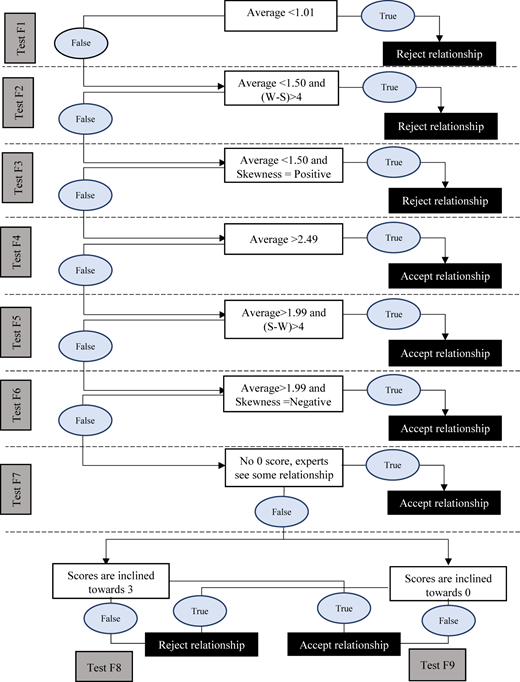
After the structured interviews, the gathered data were analysed using the “nine logical tests” introduced by Nasir et al. (2003), as presented in Figure 1. These tests helped extract the strongest relationships of epistemic uncertainties to develop the preliminary causal map of information processing for QA in RLSCs. This causal map was then converted into a BBN-based conceptual information processing model for QA using the principles of the causal mapping approach during the same data collection phase. Table A2 in the Appendix presents the differences between a causal map and a BBN-based model. According to Table A2 (See the Appendix), the transformation process of a causal map into a BBN-based model primarily involves two major principles: (1) eliminating circular relationships and (2) distinguishing between direct and indirect relationships (see Nadkarni and Shenoy, 2004).
Phase II: a focus group discussion
A focus group discussion, which originated within the broad paradigm of qualitative research, was next organised and conducted to validate the developed BBN-based conceptual information processing model empirically. It was found that many studies used focus group discussions to validate BBN-based models (Jayasinghe, 2019; Kleemann et al., 2017; Qazi et al., 2018), with this also being the purpose of the current study. In these previous studies, a focus group discussion was used as it facilitated receiving prompt constructive feedback on the instrument (Jayasinghe, 2019). Previous studies have noted the practicality of focus group discussions, especially in engaging time-constrained experts for simultaneous data collection (Martakis and Daneva, 2013), a feature that proved invaluable in the context of this research as well.
Purposive sampling was used to select participants for the focus group discussion. As the opinion of experts was sought in this phase, it was a prerequisite to choose participants for the focus group discussion purposively, not simply to represent the population, but rather to select them based on their experience and expertise (Kleemann et al., 2017). Accordingly, similar to Phase I, a group of 11 experts involved in the DW management sector in SA were first invited for the study; however, only five attended the session (See Table A3 in the Appendix for demographic details of the focus group participants). These participants had more than 10 years of experience in the domain and held senior designations in their respective organisations. Previous studies aimed at empirically validating BBN-based conceptual models have used focus groups with the following sample sizes: five (Jayasinghe, 2019); two (Qazi et al., 2018); and 11 (Kleemann et al., 2017). Consequently, the number of focus group participants incorporated in the current study, that is, five participants, was within the acceptable range.
Results
Cause and effect relationships of epistemic uncertainties
This section describes the cause-and-effect relationships identified from structured interviews between epistemic uncertainties, which lead to IPNs, and each epistemic uncertainty and the performance measurement criterion (i.e. QA in RLSCs of DW). The relevant notations for each uncertainty (X1,2,3,4,… … 16) and the performance measurement criterion (Y) are as follows:
When all epistemic uncertainties and the operational performance criterion were included in a matrix, altogether, 256 cause-and-effect relationships were derived. After evaluating all these relationships using nine logical tests (See Figure 1), 187 relationships were rejected, and the remaining were considered to create the preliminary causal map of information processing for QA in RLSCs of DW. In the preliminary causal map, the nodes represented by ovals indicate epistemic uncertainties (X) and Y. QA in RLSCs of DW, which is the performance criterion of the study. The different colors represent the macro-level, meso-level and micro-level uncertainties separately during the building dismantling and on-site processing phase and the off-site waste processing phase, as indicated in the legend. The cause-and-effect relationships are indicated using arrows.
The top 10 cause-and-effect relationships with the highest averages are shown in Table A4 (See Appendix). Of all the accepted cause-and-effect relationships, X12-Y (i.e. mixed waste received from demolishers–QA in RLSCs of DW) received the highest average of 2.70. Therefore, this is the strongest relationship. The relationships between micro-level uncertainties during the building dismantling and on-site waste processing phase, such as X6-X7 (i.e. management of contaminated/hazardous substances–health and safety concerns of demolisher) and X5-X6 (i.e. “as-is” condition of the building– management of contaminated/hazardous substances) are the next strongest with the highest averages. The performance measurement criterion (i.e. Y. QA in RLSCs of DW) appears as the “effect” in three of the top 10 relationships (those with the highest averages). In these relationships, the epistemic uncertainties that cause the performance criterion are mixed waste received from the demolishers (X12), workflow uncertainties of the demolisher (X8) and product description complexities (X13). These findings show that the relationships between epistemic uncertainties or relationships caused by epistemic uncertainties during the building dismantling and on-site processing phase appear at the top with the highest averages.
The arrangement of the causal map, as shown in Figure A1 in the Appendix, has many cause-and-effect relationships. Therefore, it is practically challenging to interpret significant epistemic uncertainties in the map and their interrelationships with the QA in RLSCs of DW. Consequently, the preliminary causal map (Figure A1 in the Appendix) was converted into a BBN-based conceptual model by reducing its redundant relationships, following the principles of the causal mapping approach.
The transformation process of the causal map to a BBN-based conceptual
After developing the causal map, a systematic procedure was established to construct a BBN-based conceptual model using the principles of the causal mapping approach, which are discussed in detail in the following subsections.
Elimination of circular relationships
There are five circular relationships in the causal map (See Figure A1 in the Appendix) that do not comply with the acyclic graphical structure needed for a BBN. Therefore, this study eliminated inappropriate circular relationships by distinguishing causal linkages between concepts based on deductive versus abductive reasoning (See Table A2 in the Appendix). According to previous studies, the relationships with lower average values were considered eliminating if there were circular relationships, as in most cases, those relationships adhere to abductive reasoning (Jayasinghe et al., 2022). Consequently, the circular loops between X8-X7, X8-X4, X7-X4, X12-X14 and X16-X14 were considered for elimination as they had lower averages than averages of their vice versa relationships.
Distinguishing between direct and indirect relationships
According to the principles of the causal mapping approach, the direct relationships between variables in the causal map should be eliminated when there is an indirect relationship between them, despite those direct relationships being identified as most significant based on nine logical tests (Nadkarni and Shenoy, 2004). Accordingly, 44 direct relationships between epistemic uncertainties that lead to IPNs were identified for elimination to make a clear understanding of the nature of relations between nodes. For example, as shown in Figure A1 (See the Appendix), “regulatory uncertainties of the demolisher (X1)” is conditionally independent of “contractual uncertainties from FSC-upstream actors (X3)” given the “incentivising uncertainties of the demolisher (X2)”. According to the principle of conditional independence, even though the causal map connects regulatory uncertainties of the demolisher and contractual uncertainties from FSC-upstream actors, this link is unnecessary due to the presence of incentivising uncertainties of the demolisher. This emphasises that regulatory uncertainties of the demolisher affect contractual uncertainties only through incentivising uncertainties. Therefore, the arrow from regulatory uncertainties to contractual uncertainties from FSC-upstream actors is eliminated as it is redundant, and it increases the model’s complexity. Similarly, all such direct relationships between epistemic uncertainties were eliminated.
BBN-based conceptual information processing model
Many redundant cause-and-effect relationships were eliminated from the causal map when transforming it into the BBN-based conceptual model, complying with the principles of the causal mapping approach. Figure A2 (See the Appendix) shows the BBN-based conceptual information processing model before empirical validation. However, it is important to highlight that removing redundant relationships based on the causal mapping approach principles is not always acceptable, as some relationships could be present in the model based on the real-world context. Therefore, it is important to empirically validate the BBN-based conceptual model to confirm whether all the eliminated relationships are valid and reasonable.
On examining the status quo presentation of the BBN-based conceptual model (i.e. after eliminating all the redundant relationships) (See Figure A2 in the Appendix), the focus group participants agreed to add 15 additional cause-and-effect relationships to the model, as per the RLSCs of DW context. Table 2 presents a summary of these additional relationships and the rationale for adding them, as explained by the focus group participants.
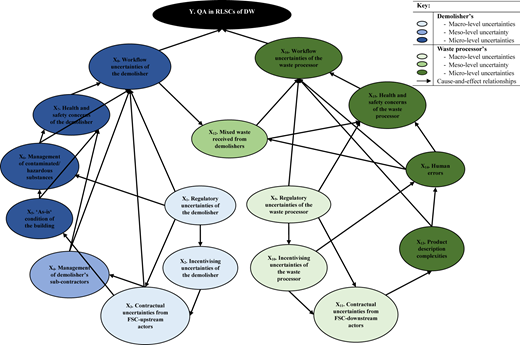
The final BBN-based conceptual information processing model was developed once all alterations were made to the causal map, as illustrated in Figure 2. This conceptual model separately outlines the epistemic uncertainties of the demolisher (blue ovals) and the waste processor (green ovals). Similar to the causal map, the BBN-based conceptual model has two independent parent nodes: “regulatory uncertainties of the demolisher (X1)” and “regulatory uncertainties of the waste processor (X9)”. All the remaining epistemic uncertainties appear as child nodes that depend upon one another. When considering the demolisher’s side, all the macro-level uncertainties are connected with the meso-level and micro-level uncertainties to “workflow uncertainties of the demolisher (X8)”. Then, “workflow uncertainties of the demolisher (X8)” leads to “mixed waste received from demolishers (X12)”, which is the meso-level uncertainty of the waste processor. The “mixed waste received from demolishers (X12)” is the epistemic uncertainty that links the demolisher’s and waste processor’s uncertainties. Similar to the demolisher’s arrangement, the waste processor’s epistemic uncertainties start with regulatory uncertainties (X9). This is then propagated through other macro-, meso- and micro-level uncertainties to “workflow uncertainties of the waste processor (X16)”. The BBN-based conceptual model has only two nodes: “workflow uncertainties of the demolisher (X8)” and “workflow uncertainties of the waste processor (X16)”, which are directly linked to Y. QA in RLSCs of DW.
Discussion
The current study developed a BBN-based information processing model for QA in RLSCs of DW, consolidating all findings from the two sequential data collection phases: structured interviews and the focus group discussion.
The information processing model for QA includes 16 epistemic uncertainties, comprising six macro-level uncertainties, two meso-level uncertainties, and eight micro-level uncertainties. Some micro- and macro-level uncertainties are common to the building dismantling and on-site processing phase and the off-site waste processing phase, while some are specific to one of these phases (Wijewickrama et al., 2021a, 2022). As shown in Figure 2, all epistemic uncertainties are arranged in the direction of causation, that is, from cause to effect. Corresponding to Wijewickrama et al. (2022), the impact on QA was reflected through the combined effect of macro-, meso- and micro-level uncertainties. Herein, Wijewickrama et al. (2022) pointed out that the three levels of uncertainties have interacted in such a way that they appear as levels of an onion diagram. Going beyond this, the current study identified how these uncertainties interact with QA in RLSCs of DW and how the epistemic uncertainties are related. As shown in Figure 2, the macro-level uncertainties appear at the bottom of the model, and then they propagate through meso-level and micro-level uncertainties to QA in RLSCs of DW. Many prior studies claimed that having an improper statutory framework is a crucial obstacle that hinders successful CDW management in countries like China (Wei et al., 2023), the United Kingdom (Ghaffar et al., 2020) and Hong Kong (Bao et al., 2020). As a different elucidation to confirm this fact, the current study found that regulatory uncertainties cause incentivising and contractual uncertainties, thereby creating all the other epistemic uncertainties. Notably, this arrangement is similar in the case of both demolisher and waste processor.
In accordance with the arrangement of the information processing model, most micro-level uncertainties were positioned at the top level of the model, triggered by both macro- and meso-level uncertainties. Previous studies asserted that subcontracting, in most cases, makes quality management chaotic in the construction industry since it is challenging and dispute-oriented while absorbing the profit of organisations (Emmanuel et al., 2023; Vaux and Kirk, 2018). While making a different view, this study found that management of subcontractors, which is a demolisher’s meso-level uncertainty, leads to creating and compounding micro-level uncertainties of building dismantling and on-site processing stage of RLSCs of DW. van den Berg et al. (2020) pointed out that demolishers confront many micro-level uncertainties (e.g. as-is condition of the building, workflow uncertainties) that were considered in the current study when they coordinate their project activities at the EoL of buildings. Per this study, these micro-level uncertainties appear to individuals without making interactions. However, by giving a contrasting elucidation, the current study established that all the micro-level uncertainties were not independent; they made cause-and-effect relationships not only with micro-level uncertainties but also with macro-level and meso-level uncertainties.
“Mixed waste received from demolishers” was an important epistemic uncertainty in the information processing model for two reasons. Firstly, it bridged the demolisher’s and waste processor’s epistemic uncertainties in the model. As shown in Figure 2, the compounding effect of the demolisher’s epistemic uncertainties generated bulk mixed waste, which, if transported to a material recovery facility (MRF), significantly increased the waste processor’s micro-level uncertainties. Secondly, among all the epistemic uncertainties, it had the strongest effect on QA in RLSCs of DW, even if it did not directly relate to this performance criterion. Previous studies have criticised that, even if mechanical demolition is cheap and speedy, it generates large piles of mixed waste that cannot be easily sorted (Roussat et al., 2008; Tennakoon et al., 2022). The unsorted or mixed piles of waste, including contaminants, are often not accepted for reprocessing; instead, they are directly dumped illegally or at landfill sites (Roussat et al., 2008; Sawaya et al., 2023). However, as in any waste management sector, informal “scavengers” engaged in DW management adopt fast-track approaches to demolition and unprofessionally send mixed waste to MRFs to avoid paying extremely high landfill disposal levies (Wijewickrama et al., 2021a). If mixed waste is received and accepted into MRFs, low-quality products would be the output, thus ending the waste processor’s business (Noguchi et al., 2015). On this note, the significance of unsorted waste received from demolishers as an epistemic uncertainty for QA in RLSCs is admissible. Faruqi and Siddiqui (2020) alleged that demolishers delivered mixed waste for waste processing, which utterly messed up the entire reprocessing process. However, the current study found that waste processors also have a responsible role in detecting mixed waste at MRF; if not, their human errors will undeniably increase the uncertainty of “mixed waste received from demolishers”. Besides, as per the arrangement of the information processing model, only workflow uncertainties had direct relationships with QA in RLSCs of DW.
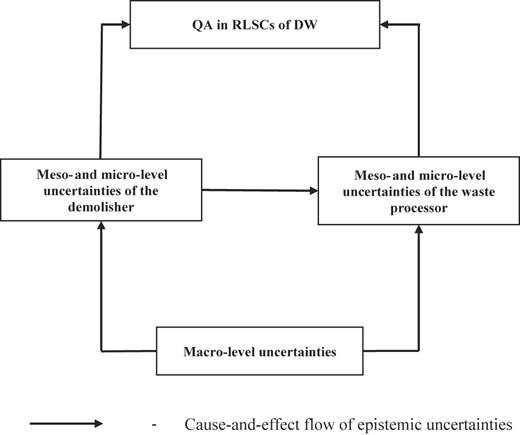
To be a BBN-based conceptual model, the foundation of the causal map must be aligned with the deductive reasoning underlying the direction of causation (Nadkarni and Shenoy, 2004). In their study, Jayasinghe et al. (2022) found that the cause-and-effect relationships in the BBN-based risk model appear in the order of the physical material flow of the RLSCs of DW. Corresponding with Jayasinghe et al. (2022), in the current study, the information processing model also indicates that cause-and-effect relationships between epistemic uncertainties are aligned with operational and material flows of RLSCs of DW. Therefore, the information processing model consists of a logical relationship in the direction of causation, as shown in Figure 3, which is an essential criterion in a BBN-based model (See Table A2 in the Appendix).
As shown in Figure 3, the demolisher’s epistemic uncertainties are propagated through macro-level uncertainties to meso- and micro-level uncertainties and then connect with the waste processor’s epistemic uncertainties through “mixed waste received from demolishers (X12)”. The micro-level uncertainties also appear in the sequence of operations undertaken at each phase of RLSCs of DW. For example, from the demolisher’s perspective, the four micro-level uncertainties are positioned in the sequence of operations undertaken in the building dismantling and on-site processing phase (see Chileshe et al., 2019).
Implications for practice
Previous studies highlighted that a conceptual model was a way of advocating synergising knowledge into policy and practice (Brady et al., 2020). Similarly, the information processing model in the current study provides a robust comprehension of information-enabled QA for both internal and external stakeholders of RLSCs of DW. The model informs internal stakeholders in RLSCs of DW, irrespective of whether they are large scale or small and medium scale, that they are vulnerable to three types of epistemic: macro-level, meso-level and micro-level uncertainties. By following the conceptual information processing model, internal stakeholders of the RLSCs could learn that if one uncertainty arises, it will lead to a series of uncertainties as they create cause-and-effect relationships. Accordingly, they could understand that the degree of uncertainty of epistemic uncertainties increases from the bottom to the top of the model. Besides, the compounding effect of demolishers’ epistemic uncertainties led to the creation of mixed waste at the end of their process, which ultimately will become a make-or-break uncertainty for waste processors. With this finding, on the one hand, the study reminds demolishers that they are operating within an integrated supply chain, where their operational inefficacies adversely affect the operational performance of the subsequent phase and, most importantly, the QA of the entire supply chain. On the other hand, the study advises waste processors that the survival of their businesses relies on quality-assured waste from demolishers; thus, they should take appropriate measures to ensure that they deal with the most reliable input customers in the industry.
Implications for policy
The findings of the current study have implications for policymakers related to RLSCs of DW. As macro-level uncertainties are sources for the meso- and micro-level uncertainties, they must be managed at their source. However, internal stakeholders have limited capability to manage them as these macro-level uncertainties have stemmed from reasons beyond their control (Wijewickrama et al., 2021a). Therefore, the current study raised the need for policymakers to undertake measures that minimise the possibility of these macro-level uncertainties happening. The study’s findings also have implications for FSC actors in the construction industry. The FSC actors should comprehend that they are important players in QA in RLSCs. Even an approach that FSC actors might think is not impactful can feed internal stakeholders with useful information for QA if not otherwise, creating epistemic uncertainties for QA, which will propagate and create new epistemic uncertainties.
Implications for theory
Previous studies have highlighted that epistemic uncertainties in a supply chain are not isolated but interact with each other (Bhatnagar and Sohal, 2005; de Vasconcelos Gomes et al., 2018; Flynn et al., 2016). Herein, Flynn et al. (2016) posited that supply chains were embedded with macro-, meso- and micro-level uncertainties that formed interactions. The authors further raised the need for a future empirical study to investigate the different types of uncertainties inherent in supply chains and their potential interactions. On this note, to the best of the researcher’s understanding, the current study is the first empirical analysis that has attempted to meet the need in the literature mentioned above. Accordingly, the findings of the current study have provided empirical evidence of the cause-and-effect relationships between different types of macro-, meso- and micro-level uncertainties for QA, based on the context of RLSCs of DW in SA.
According to Phillips and Johnson (2022), applying techniques or approaches in a new area of study is a way of contributing to the theory. Accordingly, this study used the BBN modelling approach to establish cause-and-effect relationships between epistemic uncertainties in RLSCs of DW. The reason for using the BBN modelling approach was primarily that it advocates for effectively visualising causal relationships between variables in supply chains (Jayasinghe et al., 2022; Rezakhani, 2021). This approach has been widely used in various domains of construction supply chains to develop supply chain risk models (Jayasinghe, 2019); delay analysis (Balta et al., 2021) and health and safety analysis (Guo et al., 2020). Even though previous studies introduced BBN as an ideal modelling approach to represent the cause-and-effect relationships of known epistemic uncertainties (Bullen et al., 2006; Khanmohammadi, 2021), none of them have used the technique for that purpose. In this vein, the current study contributed to the knowledge by applying the BBN modelling approach to develop an information processing model for QA in RLSCs of DW.
Conclusions
With the ultimate goal of producing quality reprocessed products, the current study developed and empirically validated an information processing model for QA in RLSCs of DW. In this information processing model, the impact on QA was reflected through the combined effect of macro-, meso- and micro-level uncertainties in the building dismantling and on-site processing phase and the off-site processing phase. The model also indicates that cause-and-effect relationships between epistemic uncertainties are aligned with operational and material flows of RLSCs of DW. The macro-level uncertainties appeared at the bottom of the model, triggering the occurrence of meso- and micro-level uncertainties. Regulatory uncertainties were propagated through the other macro-level uncertainties to the meso- and micro-level uncertainties. Per the arrangement of the information processing model, the demolisher’s epistemic uncertainties are propagated through macro-level uncertainties to meso- and micro-level uncertainties and then connect with the waste processor’s epistemic uncertainties through “mixed waste received from demolishers”. “Mixed waste received from demolishers” was an important epistemic uncertainty in the information processing model for two reasons. Firstly, it bridged the demolisher’s and waste processor’s epistemic uncertainties in the model. Secondly, among all the epistemic uncertainties, it had the strongest effect on QA in RLSCs of DW, even if it did not directly relate to this performance criterion. As per the arrangement of the information processing model, only workflow uncertainties had direct relationships with QA in RLSCs of DW. Most micro-level uncertainties were positioned at the top level of the model, getting impact from both macro- and meso-level uncertainties. The findings also confirmed that micro-level uncertainties appear in the sequence of operations undertaken at each phase of the RLSCs of DW.
The study is conducted with a few limitations, which are worth noting. The information processing model includes epistemic uncertainties for QA as variables. However, as per the proclamations of OIPT, organisations should respond to epistemic uncertainties that create IPNs by adopting appropriate IPMs (Galbraith, 1973). In their study, Wijewickrama et al. (2022) found the IPMs that the RLSCs of DW could adopt to overcome the epistemic uncertainties. Therefore, the BBN-based information processing model could expand to an influence diagram in future research by incorporating IPMs. Furthermore, this study is only limited to developing the BBN-based information processing model for QA in RLSCs of DW by following the principles of the causal mapping approach. However, future research could use this model to apply in real contexts of RLSCs of DW either through using probabilistic elicitations from experts’ views or learning algorithms from historical data and experts’ views.
The authors would like to acknowledge the Australian government’s financial support through an Australian Government Research Training Program (RTP) Scholarship for PhD studies and support from the University of South Australia.
References
Futher reading
The supplementary material for this article can be found online.