This paper introduces a novel hybrid deep learning model aimed at enhancing human intention prediction in human–robot collaboration for utility tunnel maintenance. Recognizing the inherent dangers and the confined nature of utility tunnels, the study aims to advance safety and operational efficiency by improving robot assistants’ ability to accurately interpret and predict human-worker intentions. The purpose is to reduce human exposure to hazardous environments and optimize task execution through precise and timely robot actions.
Our approach involves a hybrid deep learning architecture combining traditional time-series image classification with advanced semantic information extraction. The proposed hybrid intentions prediction deep learning model (HIPM) utilizes convolutional neural networks, long short-term memory networks and the contrastive language–image pre-training model for a comprehensive feature extraction and intention prediction. This integration enables the model to process visual and contextual data from dynamic and challenging tunnel environments, addressing the inadequacies of traditional vision-based and physical-based intention prediction methods.
Empirical validation conducted on real-world utility tunnel data from Jiangsu Province, China, demonstrated that HIPM significantly outperforms traditional models. HIPM achieved a precision of 91.52% and a recall of 91.20%, indicating a high level of accuracy in predicting human intentions. The results underscore the model’s robustness and reliability, confirming its effectiveness in understanding and responding to complex human-worker behaviors in utility tunnel settings.
The originality of this research lies in its novel integration of multimodal deep learning techniques to enhance the interpretability and adaptability of robots in human-robot collaborative environments. The HIPM model’s ability to interpret both human actions and environmental contexts presents a significant advancement over existing models, offering a more reliable and efficient approach to managing the safety and efficiency of utility tunnel maintenance operations. This study contributes a pioneering solution to the challenges of human intention prediction in one of the most hazardous and demanding industrial settings.
1. Introduction
Utility tunnel maintenance (UTM) is a frequent and hazardous task involving infrastructure inspection, repairs, cleaning, ventilation and security monitoring (Lee et al., 2018; Hai et al., 2024; Wang, 2021). Conducted in confined underground spaces, UTM exposes workers to risks such as poor air quality, hazardous materials, structural collapses and high-voltage electrical or gas-related dangers (Zhang et al., 2020; Sousa and Einstein, 2021). Human–robot collaboration (HRC) is essential to reducing human exposure to these risks, enabling robots to take on high-risk tasks. For effective collaboration, robots must accurately and timely recognize human intentions (Lin and Lukodono, 2021; Pan and Yu, 2024), allowing them to dynamically adjust their actions, provide necessary tools and assist in emergencies. This capability enhances safety, efficiency and coordination while minimizing misunderstandings and operational risks.
Human intention prediction (HIP) refers to inferring a collaborator’s near-future goals and actions from observable cues – such as body pose, hand–object interactions and task/environment context – before those actions are completed. Accurate HIP is pivotal in HRC because it enables proactive robot behaviors (e.g. handing the right tool, yielding space or triggering safety responses), thereby improving safety and task efficiency in risk-intensive, time-critical settings like utility tunnels. However, existing human intention prediction (HIP) methods are difficult to apply in UTM scenarios. Current mainstream HIP methods can be divided into physical-based (contact) and vision-based (contactless) approaches (Robinson et al., 2023; Semeraro et al., 2023).
Physical-based methods use various physical sensors to collect human motion data to help robots understand human intentions. For example, tactile gloves (Zou et al., 2024), surface electromyography (EMG) (Zhang et al., 2022) and electroencephalography (EEG) (Buerkle et al., 2021) have all shown good potential in HIP applications but are almost inapplicable in UTM scenarios. Tactile gloves and other wearable devices are highly sensitive to moist environments (Büscher et al., 2015), which are common in underground utility tunnels where handling water pumps or groundwater leakage is frequent. Methods like surface EMG and EEG require heavy auxiliary equipment to function (Soufineyestani et al., 2020; Jamil et al., 2021), making them unsuitable for long-term use.
Another approach, vision-based HIP, is achieved through the collection and real-time algorithmic processing of images of bodily and environmental features of the target personnel. In recent years, vision-based HIP has demonstrated strong potential in various HIP fields (Razali et al., 2021; Cui et al., 2021; Dani et al., 2020). Despite these advances, their application in UTM scenarios remains underexplored and fraught with challenges. (1) Lack of environmental context integration: Most existing vision-based HIP methods primarily focus on human-centric cues such as body gestures (Laplaza et al., 2022, Wang et al., 2021) and skeletal movements (Li et al., 2020; Wei et al., 2021) while neglecting critical environmental contexts. Poor lighting, water vapor, steam or dust can rapidly alter visibility and distort the physical context, making it difficult to rely solely on human-generated signals for accurate predictions. (2) Adaptability to environmental variability. In UTM scenarios, vision-based HIP methods encounter unique challenges stemming from the specific lighting arrangements within these environments (Huang et al., 2021). Artificial lighting in UTM is typically spaced at fixed intervals (University of Washington Facilities, 2024; Ministry of Housing and Urban-Rural Development of China, 2015), leading to abrupt changes in lighting conditions as robots navigate the tunnels. These rapid shifts in lighting can significantly impair the performance of vision sensors, affecting the accuracy and robustness of the system's judgments (Rezaei et al., 2015). Since most existing methods are designed for stable, well-controlled environments, they cannot reliably handle the rapid lighting changes of UTM scenarios, where high precision is crucial under variable conditions.
To address these challenges, this paper proposes a hybrid intentions prediction model (HIPM) that integrates sophisticated image processing and semantic analysis technologies. Specifically, HIPM combines convolutional neural networks (CNNs) for visual feature extraction, long short-term memory networks (LSTMs) for temporal dynamics and the CLIP (contrastive language-image pre-training) model (Radford et al., 2021) for semantic understanding of environmental context. This design enables HIPM to capture not only human-centric cues such as gestures or skeletal movements but also contextual environmental information – including tools, infrastructure and background elements – that are often overlooked by traditional vision-based methods (Guo et al., 2021). Moreover, by leveraging time-series image classification, HIPM adapts to abrupt lighting changes and harsh visibility conditions common in utility tunnels, ensuring robust prediction performance (Canto-Perello and Curiel-Esparza, 2013). To enhance classification precision, HIPM further employs contrastive loss alongside cross-entropy loss, refining feature separability. Experimental evaluation on 2,636 images collected from real underground utility tunnels in Jiangsu Province, China, shows that HIPM achieves an average precision of 91.52% and a recall of 91.20%, significantly outperforming state-of-the-art approaches such as CNN + LSTM (88.22%/82.77%) and Vision Transformer (68.25%/70.41%). These results highlight HIPM's practical applicability and its contribution to advancing human–robot collaboration in safety-critical utility tunnel maintenance by improving both intention recognition accuracy and operational efficiency.
2. Related work
Human–robot collaboration (HRC) has emerged as a transformative approach in industrial and hazardous environments, enabling robots to assist human workers in complex and high-risk tasks (Arents et al., 2021; Zhang et al., 2023). Despite increasing research in HRC, existing methodologies face significant limitations in UTM scenarios, largely due to the inadequacies of HIP, which hinder effective human–robot interaction in these complex environments. This section critically reviews related works, identifies knowledge gaps and establishes the novelty of the proposed approach.
2.1 Human–robot collaboration (HRC) in utility tunnel maintenance
In tunnel scenarios, maintenance personnel face risks such as poor air quality, confined space hazards and exposure to electrical and gas systems (Zhang et al., 2020; Bai et al., 2020; Sousa and Einstein, 2021). HRC is therefore critical in enabling robots to undertake high-risk tasks such as structural inspections, leak detection and equipment maintenance, thereby reducing human exposure (Shahrour et al., 2020; Che et al., 2020). HRC can also enhance maintenance efficiency through intelligent task allocation and automation.
However, while there are successful demonstrations – such as robots for natural gas pipe leakage inspection (Liu et al., 2019) and crack detection in underground tunnels (Gu et al., 2022) – these primarily focus on task substitution or monitoring rather than deep collaboration (Lin and Lukodono, 2021; Pan and Yu, 2024; Wang et al., 2021). The lack of robust HIP mechanisms limits robots’ ability to anticipate and coordinate with human workers. Thus, the state of the art in HRC for UTM demonstrates technical feasibility but falls short of seamless, collaborative interaction due to insufficient intention prediction capabilities.
2.2 Human intention prediction (HIP) in utility tunnel maintenance
HIP is a core enabler of HRC, allowing robots to anticipate and respond to human actions in dynamic settings (Hoffman et al., 2023; Liu and Wang, 2017). Existing HIP methods can be categorized into physical-based (contact) and vision-based (contactless) approaches (Hoffman et al., 2023; Semeraro et al., 2023).
Physical-based HIP methods: Physical-based methods use wearable sensors such as tactile gloves (Yu et al., 2023a, b; Zou et al., 2023), EMG (Wang et al., 2021; Ison and Artemiadis, 2015), and EEG (Buerkle et al., 2021; Liu et al., 2021). These achieve high accuracy in controlled settings but face severe limitations in UTM due to humidity, water exposure and user discomfort (Niu et al., 2020; Jang et al., 2021; Tai et al., 2022; Apak et al., 2022). Wearables also require frequent calibration, reducing practicality for continuous operations.
Vision-based HIP methods: Vision-based HIP techniques leverage camera-based systems to interpret human gestures, body posture and movement trajectories. Early works relied on static features (Li et al., 2020; Du et al., 2025), while later studies introduced CNN–LSTM hybrids to exploit temporal dynamics (Sarabu and Santra, 2021; Saif et al., 2023) and transformer-based models for intent forecasting (Zhang et al., 2024). These advances significantly improve recognition accuracy. Nevertheless, most vision-based HIP studies remain narrowly focused on human-centric cues, paying little attention to contextual environmental information (e.g. tool usage, infrastructure and background activities), which is crucial in UTM. Table 1 presents a comparative analysis of existing vision-based HIP models and the proposed HIPM model, highlighting their respective features.
2.3 Limitations and research gaps
Despite significant progress in HRC and HIP, existing studies reveal key gaps that hinder their effective deployment in UTM:
Challenges of physical-based HIP methods in UTM: Physical-based HIP methods, such as tactile gloves (Yu et al., 2023a, b; Zou et al., 2023), EMG (Wang et al., 2021; Ison and Artemiadis, 2015) and EEG (Buerkle et al., 2021; Liu et al., 2021), face severe limitations in UTM due to the harsh environmental conditions. The high humidity and dust levels (Ma et al., 2023; Zhai et al., 2024) in utility tunnels negatively affect the reliability and durability of these wearable devices, making them unsuitable for prolonged use. Furthermore, UTM tasks are frequently performed over extended periods and at high frequencies, making the use of heavy auxiliary equipment impractical for such high-intensity applications.
Limitations of vision-based HIP methods in UTM: Existing vision-based HIP approaches struggle to achieve accurate predictions in UTM due to poor lighting conditions and high environmental complexity. Most traditional methods concentrate on human-centric cues such as body gestures (Wang et al., 2021; Vianello et al., 2021; Park et al., 2021) and skeletal angles (Vianello et al., 2021; Duan and Zou, 2024). While effective in controlled environments, these approaches become unreliable in utility tunnels, where visibility is often compromised by dust, steam and low-light conditions. More importantly, they largely overlook contextual environmental information – such as tool usage, surrounding infrastructure and background activities – that could substantially enhance prediction accuracy (Wei et al., 2021; Girase et al., 2021). In addition, the alternating presence of overly bright and dark areas in UTM further degrades the robustness of vision-based HIP methods (Mukherjee et al., 2022), making reliable deployment in such scenarios highly challenging.
Therefore, the state of the art demonstrates promising techniques but lacks context-aware, multimodal HIP approaches capable of robustly handling the unique environmental variability of UTM.
2.4 Novelty and contributions
Building on the identified gaps, this study introduces a hybrid intentions prediction model (HIPM) with the following contributions:
Multimodal deep learning integration: HIPM fuses CNN (visual features), LSTM (temporal dependencies) and CLIP (semantic understanding), addressing the limitation of unimodal methods.
Context-aware HIP: By incorporating environmental cues (tools, infrastructure and background activities) through CLIP-based semantic analysis, HIPM overcomes the neglect of contextual data in prior studies.
Robustness to lighting variability: Time-series image classification with uniform frame sampling ensures stable predictions despite abrupt lighting fluctuations.
Empirical validation in real tunnels: HIPM is trained and evaluated on 2,636 images from real UTM environments, achieving superior precision and recall compared with CNN + LSTM and transformer baselines.
In this way, this study directly addresses the key limitations of prior HIP methods, advances the state of the art and provides a practical, validated framework for safe and efficient HRC in utility tunnels.
3. Methodology
The human intention prediction model (HIPM) proposed in this study is a hybrid deep learning model specifically designed for UTM scenarios.
3.1 Model architecture
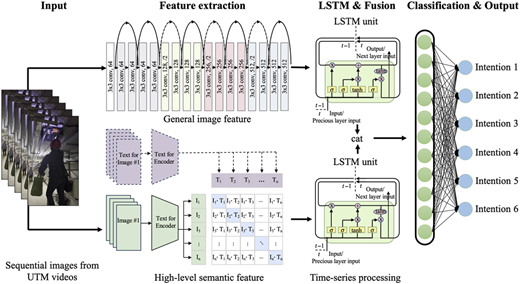
The model architecture integrates convolutional neural network (CNN), CLIP (contrastive language–image pre-training) model and long short-term memory (LSTM) networks to harness both visual and semantic features for HIP classification performance, as shown in Figure 1. The framework operates as follows:
3.1.1 Input
The input for the HIPM model is key frames uniformly extracted from continuous video footage captured from a simulated robot’s perspective during the UTM process. These images are resized to a uniform dimension of 224 × 224 pixels to match the input size expectation for the image and semantic feature extraction part. Then they are converted to PyTorch tensors and transferred into two different processing streams.
3.1.2 Parallel feature extraction
The feature extraction process leverages two powerful models: ResNet-18 and CLIP. In this model, the classic ResNet-18 provides the general image features needed for the HIP classification task. The primary role of CLIP is to offer additional semantic features, enhancing the model’s feature representation capability by combining with the traditional CNN (ResNet-18) features.
ResNet-18 for general image features: ResNet-18 is a widely used CNN architecture known for its balance between computational efficiency and strong feature extraction capabilities (Pandey and Srivastava, 2023). Compared to deeper architectures like ResNet-50 or ResNet-101, ResNet-18 offers faster inference while maintaining competitive accuracy, making it suitable for real-time processing in UTM scenarios (Ou et al., 2019). In the HIPM, the ResNet-18 is initialized with weights pretrained on the ImageNet dataset (Deng et al., 2009), which helps in capturing general visual patterns and textures. Then, the network layers extract hierarchical features, starting from low-level features like edges and textures. The final feature vectors obtained from ResNet-18 represent the basic visual content of the images for the human intention prediction task. And the fully connected layer was excluded to focus solely on feature extraction.
CLIP for high-level semantic features: The CLIP model is pretrained on a large dataset of 400 m images and their associated textual descriptions (Radford et al., 2021), allowing it to learn rich semantic representations that go beyond low-level visual patterns. Given the complexity of UTM environments, where human actions are influenced by tools and background context, CLIP’s ability to capture semantic relationships enhances intention prediction accuracy compared to purely vision-based models (Du et al., 2025; Li et al., 2020; Saif et al., 2023). This training allows CLIP to learn a shared embedding space for images and text. In HIPM, the input images are processed concurrently through ResNet-18 and CLIP for feature extraction. Unlike the general image features extracted by ResNet-18, CLIP captures high-level semantic features. CLIP’s training involves visual and textual data, allowing it to understand and embed images in a contextually rich and semantically meaningful way (Krojer et al., 2022). The CLIP’s embedding captures the underlying concepts and relationships that are present in the images. This dual understanding – combining visual patterns with contextual semantics – enables CLIP to generate features that encompass not only just what the image looks like but also what it represents or means within a broader context. For example, a traditional CNN might excel at identifying the shapes and colors within an image of a cat, whereas CLIP, due to its multimodal training, would recognize the image as a “cat” and understand related concepts such as “pet,” “feline” and “animal.” This semantic embedding makes CLIP particularly powerful for tasks that benefit from a deeper understanding of image content beyond mere visual details (Sain et al., 2023).
By integrating these features, the model benefits from the strengths of both approaches, resulting in a richer and more comprehensive representation of the input data. Multimodal learning has been shown to improve classification accuracy in complex real-world environments (Bayoudh et al., 2022), making it particularly beneficial for HIP in UTM scenarios, where environmental factors and human motion cues interact dynamically (Liu et al., 2019; Gu et al., 2022).
3.1.3 Long-shot term memory and intention prediction
The LSTM network is designed to capture temporal dependencies and patterns in sequential data, which is particularly useful for tasks involving time series or sequences of images. By processing the features through LSTMs, the model can learn to recognize how features evolve over time or across frames in a video sequence (Ullah et al., 2017).
In the HIMP, the LSTM networks play a crucial role in processing and understanding sequential data. The visual features from ResNet-18 and the semantic features from CLIP are each fed into their respective LSTM layers. The LSTM layers process these features, retaining relevant information through their gating mechanisms, which help in handling long-term dependencies and mitigating the vanishing gradient problem (Waqas and Humphries, 2024). The outputs of the LSTM layers are then concatenated, combining the temporal dynamics of both the visual and semantic features. This combined representation is richer and more informative, allowing the model to make more accurate predictions by leveraging detailed visual patterns and the high-level semantic context over the sequence.
3.1.4 Loss functions
The HIPM model employed two loss functions as follows:
Cross-entropy loss: Employed for the primary classification task, this loss measures the discrepancy between the predicted probabilities and the actual class labels. For a multi-class classification problem in this study, the cross-entropy loss can be defined as formula (1). Where is the total number of classes. is the true label for class i, with i = 1 indicating that the sample belongs to the class and 0 indicating it does not. is probability predicted by the model that the sample belongs to class i.
Contrastive loss: This custom-defined loss function enhances the discriminative power of the model by encouraging the minimization of distances between similar pairs and maximization between dissimilar pairs. It is computed based on the Euclidean distance between image and semantic feature representations, as shown in formula (2). Where, is the Euclidean distance between the feature representations of two samples. is a binary label associated with the pair, if the pair is dissimilar (from different classes), and if the pair is similar (from the same class), . is a margin, a hyperparameter that defines how far apart the dissimilar pairs should be pushed in the feature space. The margin acts as a threshold beyond which no further loss is accumulated for dissimilar pairs.
3.2 Human–robot collaboration intention classification
The essence of vision-based human intention prediction is the classification of images for human-robot collaboration. Therefore, the classification of human intentions in targeted scenarios is crucial. This section determines the specific categories and descriptions for the HIPM by analyzing the daily operational processes of UTM from ISO (International Organization for Standardization) standard (smart community infrastructures – operation and maintenance of utility tunnels) [61].
3.2.1 Maintenance processes
Routine monitoring and inspection. The operation of utility tunnels involves regular monitoring and inspection to ensure the functionality and safety of infrastructure. Human workers perform checks on electrical systems, structural integrity and other critical components (e.g. induced draft fan and water pump).
Emergency responses. Maintenance teams are also tasked with responding to emergencies such as system malfunctions or safety hazards. These situations require quick, precise actions to mitigate risks and restore normal operations. Repair and upkeep. Scheduled and unscheduled repairs form a significant part of maintenance work, involving the replacement of worn-out parts or the upgrading of systems to ensure continued reliability and efficiency. Logistical operations. This includes the handling and transportation of materials and tools necessary for maintenance tasks, which must be done efficiently to minimize downtime and ensure that workers have the necessary resources when and where they need them.
The operational needs and scenarios identified in these maintenance processes naturally lead to the formulation of specific human–robot collaboration intentions. These intentions are categorized to streamline interactions and enhance mutual understanding between humans and robots during maintenance operations. The categories are specifically designed to cover a comprehensive range of activities that robots are expected to understand and act upon, ensuring that all aspects of maintenance are addressed efficiently and safely.
3.2.2 Collaboration intentions
The intention classifications of HIPM need to provide precise judgment criteria for robots to support an efficient UTM operational process while also conforming to the characteristics of robot (computer) vision judgment to ensure the reliability of intention recognition. In the classification of the HIPM for engineering practices, the following key factors must be considered: (1) Coverage of entire processes: The classification should ensure coverage of all key stages of maintenance and operation to effectively support human workers under all circumstances. It should be detailed enough to identify the needs of all maintenance operations, such as inspection, repair and material handling, to optimize the efficiency and effectiveness of human–robot interaction. (2) Granularity of classification: The level of detail in classification needs to be sufficient to distinguish between different operational demands and contextual environments. For instance, there should be clear distinctions between tasks that require precise operations, like specific repairs and broader tasks like material transportation or patrolling. This helps the robot to recognize and execute tasks more accurately, reducing errors or unnecessary operations, thereby ensuring safety and optimal use of resources. However, classifying scenarios down to the level of specific operational procedures would be exceedingly extensive. Detailed subdivision of procedures with high repetitiveness is not the focus of this study. Therefore, this study only classifies at a coarser granularity to validate the feasibility of the HIPM methodology. (3) Feasibility: The feasibility of the classification should fully consider the complexity of the UTM scenarios and the limitations of current robotic vision capabilities. The classification should be realistic, considering the current state of technology and the practical challenges faced in tunnel environments. It must be designed with a pragmatic approach, ensuring that the tasks assigned to robots are within their operational capabilities while being sufficiently robust to handle the unpredictability of such environments. Additionally, the classification scheme should be flexible enough to adjust and optimize as technology evolves.
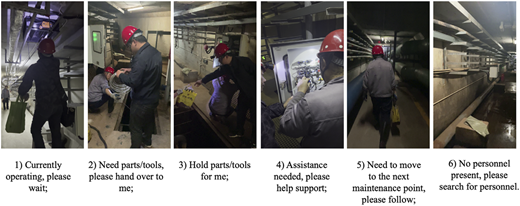
Considering these factors, this study divides the specific human operational intentions in HIPM into the following six categories: (1) Currently operating, please wait; (2) need parts/tools, please hand over to me; (3) hold parts/tools for me; (4) assistance needed, please help support; (5) Need to move to the next maintenance point, please follow and (6) No personnel present, please search for personnel. Table 2 provides detailed descriptions of the specific scenarios for each category. Plate 1 illustrates the examples for these different intention scenarios.
3.3 Evaluation metrics
Evaluating the performance of the HIPM model goes beyond a single metric, incorporating these metrics to gain a holistic understanding of the model’s behavior in practical applications. To thoroughly assess the performance of the HIPM, this study utilizes four popular statistical metrics to evaluate the model’s accuracy, robustness and reliability. The evaluation metrics applied include Precision, Recall, F1 score and AUC (Area Under the ROC (Receiver Operating Characteristic) Curve).
The Precision, Recall, F1 score are derived from the counts of samples classified into four categories by the model: True Positive (TP), True Negative (TN), False Positive (FP) and False Negative (FN), based on the actual classification results, as shown in Table 3. The specific formulas used to calculate Precision, Recall and F1 score are presented in equations (3, 4, and 5), respectively. The ROC curve is generated by varying the decision threshold and computing the True Positive Rate (TPR) and False Positive Rate (FPR) at each point. It plots FPR against TPR to visualize the model’s discrimination ability. Considering is a multi-class classification model, the One-vs-Rest (OvR) approach was applied, where a separate ROC curve is plotted for each class by treating it as the positive class while considering all other classes as negative. The final multi-class AUC is obtained by averaging the AUC values across all classes, using either macro or weighted averaging.
4. Experiments
4.1 Data collection and processing
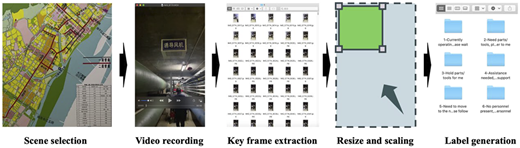
For the experimental part of this study, 2,636 frames were collected in a practical utility tunnel environment in Jiangsu Province, China. The dataset includes key frames extracted from continuous video streams captured from a simulated robot perspective, covering various maintenance activities and worker interaction scenarios. Figure 2 illustrates the data collection and processing steps. To ensure dataset variability, data was collected under diverse environmental conditions, including variations in lighting, worker positions and tunnel layouts. Furthermore, temporal sequences were incorporated to allow the model to capture dynamic interactions, enhancing its adaptability to real-world UTM scenarios.
4.1.1 Collection steps
Scene selection: Multiple typical tunnel maintenance scenes were selected to ensure a wide range of environmental conditions and tasks, including inspections of lighting and ventilation systems, equipment and structural repairs and emergency handling, as mentioned in section 3.2.
Video recording: High-resolution cameras were used to record from the simulated robot’s working perspective (manually). Each video lasted at least 30 min, ensuring the capture of comprehensive action sequences and interaction details. Key frame extraction: Key frames were uniformly extracted from the recorded videos. The selection of key frames was based on the importance and representativeness of the activities, with at least five frames extracted for each key action to capture sufficient action information.
4.1.2 Data processing
Image preprocessing: The extracted key frames were resized to ensure consistency and quality of the input data. Additionally, the images were normalized, scaling pixel values to between 0 and 1 to reduce the impact of lighting variations and background differences on model training. Label generation: Each frame was annotated by professional tunnel maintenance engineers, defining the human work intentions present. Labels might include six categories: (1) Currently operating, please wait; (2) Need parts/tools, please hand over to me; (3) Hold parts/tools for me; (4) Assistance needed, please help support; (5) Need to move to the next maintenance point, please follow and (6) No personnel present; please search for personnel.
This thorough data collection and processing method resulted in a high-quality and representative dataset, providing a solid foundation for subsequent model training and validation. These data not only help in training robots to better understand and predict human work intentions but also provide valuable experimental material for studying interaction patterns between humans and robots in complex environments.
4.2 Experiment results
To evaluate the effectiveness of the proposed HIPM model, a series of controlled experiments were conducted by comparing it with CNN, LSTM, CNN + LSTM and Vision Transformer. The models were implemented in PyTorch and trained using an NVIDIA RTX 3090 GPU with 24 GB VRAM. The experimental setup was designed to ensure fair comparisons across all models.
Hyperparameter tuning and model training: (1) Dataset split: The dataset was divided into 80% training, 10% validation and 10% test to ensure robust model evaluation. (2) Optimization algorithm: All models were trained using the Adam optimizer with an initial learning rate of 0.0001. (3) Batch size and training duration: All models were trained for 50 epochs with a batch size of 32.
Model selection justification. The baseline models used for comparison were selected based on findings from our literature review, which indicates that vision-based HIP models predominantly utilize CNN, CNN + LSTM or transformer-based architectures. Several studies have demonstrated the effectiveness of these architectures in intention recognition and HRC: (1) CNN-based models have been widely used in HIP due to their strong spatial feature extraction capabilities for recognizing human gestures and postures (Wang et al., 2021; Vianello et al., 2021; Duan and Zou, 2024). (2) LSTM models have been introduced to enhance intention prediction by capturing temporal dependencies in human motion sequences (Waqas and Humphries, 2024). (3) CNN + LSTM hybrids are frequently employed in HIP research, combining spatial and temporal features to improve prediction accuracy (Ravipati et al., 2023). (4) Vision Transformers represent a newer approach in HIP, leveraging self-attention mechanisms to model complex relationships between human actions (Domínguez-Vidal and Sanfeliu, 2024).
Given the prevalence of these architectures in prior studies, our experimental comparison against CNN, LSTM, CNN + LSTM and Vision Transformer ensures that HIPM is benchmarked against the most relevant and widely adopted HIP methodologies. By validating our model against these baselines, we provide a fair assessment of HIPM’s advantages in multimodal feature integration and adaptability to dynamic UTM environments.
4.2.1 Experimental setup
The experiment compared several mainstream deep learning models. The models were evaluated using Precision, Recall and F1 score to evaluate their performance.
4.2.2 Model performance comparison
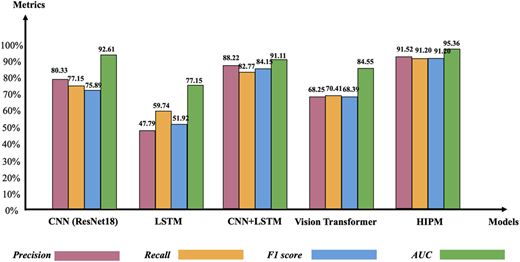
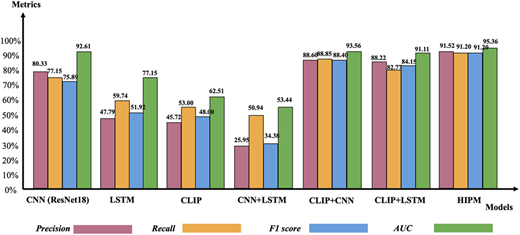
To more comprehensively evaluate the performance of various models in predicting tunnel maintenance worker intentions, comparisons were made among CNN, LSTM, CNN + LSTM, Vision Transformer and the proposed HIPM model. Table 4 and Figure 3 shows the performance of each model in the experiment. The following provides a detailed analysis of each model’s performance:
CNN: Leveraging its robust image processing capabilities, CNN performed well in this image classification tasks, achieving a precision of 80.33 and 77.15% of recall. However, due to its lack of ability to handle temporal data, its performance in dynamic scenes was limited, with an F1 score of 75.89%. CNN achieved an AUC of 92.61%, significantly higher than LSTM (77.15%). This indicates that despite some Recall limitations, CNN maintains strong overall classification performance with a robust ability to distinguish between worker intention classes.
LSTM: As a typical model for handling temporal data, LSTM has unique advantages in capturing behavioral dynamics. Nevertheless, the LSTM model's precision was only 47.79% and 59.74% of recall. This may be because a standalone LSTM struggles to extract sufficient spatial features from static images. LSTM achieved an AUC of 77.15%, the lowest among all models. This suggests that its decision boundary is unstable, likely because it does not have strong spatial feature extraction capabilities, making it prone to misclassifications.
CNN + LSTM: Combining the spatial feature extraction capabilities of CNN with the temporal sequence processing abilities of LSTM, this hybrid model significantly improved performance, achieving a precision of 88.22% and an F1 score of 84.15%. This indicates that the combined model outperforms single models in handling complex scenarios involving both temporal and spatial information, which is a very popular approach to improve. The CNN + LSTM model achieved an AUC of 91.11%, slightly lower than CNN alone but still significantly better than LSTM. This suggests that while CNN + LSTM enhances sequential understanding, the temporal dependencies introduced by LSTM slightly impact its overall decision boundary stability.
Vision Transformer: As a popular emerging model that utilizes self-attention mechanisms for image tasks, the Vision Transformer underperformed compared to the CNN + LSTM combination in this experiment. It achieved a precision of 68.25% and an F1 score of 68.39%. This could be attributed to the Vision Transformer’s requirement for large amounts of data to reach optimal performance, which might not have been met in the data-limited experimental setup. Vision Transformer obtained an AUC of 84.55%, which is lower than CNN and CNN + LSTM. This suggests that its overall classification capability is weaker and that its decision boundaries fluctuate more. This is consistent with the well-known limitation of transformers: they require large-scale data to reach their full potential, which was not fully met in this experiment.
HIPM: The proposed HIPM model performed exceptionally well on the dataset, with all metrics exceeding 91%. This demonstrates that the HIPM model effectively integrates temporal and spatial features, enhancing the accuracy and robustness of intention prediction. HIPM achieved the highest AUC of 95.36%, outperforming all other models. This suggests that HIPM not only classifies samples accurately but also maintains the most stable decision boundary, even in varied data distributions. A higher AUC implies that HIPM is more reliable in distinguishing between worker intentions, making it the most robust model for practical applications.
4.3 Summary of results
The experiment results showed that the proposed HIPM model significantly outperforms all other comparison models across all metrics, achieving over 91% in Precision, Recall and F1 score. This underscores the HIPM model’s excellent performance in predicting human–robot interaction intentions in tunnel maintenance scenarios. By combining the strengths of traditional convolutional neural networks and long short-term memory networks and incorporating contrastive loss functions to optimize the learning process with the contrastive language-image pre-training component, the HIPM model effectively enhances classification accuracy and robustness in the human intention prediction task under the UTM scenario.
5. Discussion
5.1 Why HIMP works?
The proposed HIPM model represents a technological advancement in predicting human intentions in hazardous and dynamic UTM environments. By integrating CNN, CLIP and LSTM, HIPM achieves a synergistic fusion of visual, semantic and temporal information. This section critically examines the interactions among these components and compares HIPM’s effectiveness with existing methodologies.
Complementary strengths: Visual, semantic and temporal dimensions. The integration of CNN, CLIP and LSTM allows HIPM to process data across multiple dimensions. CNNs are well-documented for their ability to extract detailed visual features (Wang et al., 2021; Vianello et al., 2021; Duan and Zou, 2024), making them essential for identifying objects and contextual elements within images. However, CNNs alone often lack higher-order semantic understanding, a limitation that CLIP effectively mitigates. CLIP enhances CNN’s output by aligning visual features with textual semantics (Radford et al., 2021), which is crucial for understanding human activities and their implicit intentions. LSTM further augments this framework by capturing temporal dependencies in sequences of images, a technique proven effective in activity recognition (Waqas and Humphries, 2024). The combination of these methods enables HIPM to achieve a level of interpretability and predictive accuracy beyond what each component could provide individually.
Fusing information for robust predictions. Unlike traditional ensemble approaches that simply concatenate features, HIPM integrates CNN, CLIP and LSTM outputs in a manner that maximizes complementary strengths. CNNs often struggle with ambiguous or occluded visuals (Nath and Behzadan, 2020), a challenge mitigated by CLIP’s ability to infer missing information through semantic understanding. Moreover, CLIP + CNN alone achieves high precision (88.60%), but the absence of temporal awareness, as seen in the CLIP + LSTM combination (25.95% precision), highlights the necessity of all three components. Our findings, summarized in Table 5 and Figure 4, confirm that the holistic fusion in HIPM significantly outperforms other model combinations, achieving a precision of 91.52%, a recall of 91.20%, F1 score of 91.20% and an AUC of 95.36%. These results align with existing literature demonstrating that hybrid models incorporating both spatial and temporal feature extraction outperform static models (Tripathi and Verma, 2023).
A comparative analysis further underscores the necessity of HIPM’s design. While CNN + LSTM (precision: 88.22%) captures spatial and temporal features well, the lack of semantic integration leads to suboptimal performance in ambiguous environments. Similarly, CLIP + CNN, despite performing well, does not account for sequential dependencies, limiting its applicability in dynamic environments where intention evolves over time. These comparisons illustrate how HIPM’s architectural synergy provides superior predictive capabilities.
5.2 Limitations
The HIPM model, despite its effectiveness, has several limitations. First, data dependency. The model’s performance is highly dependent on data quality and diversity. Regarding dataset size, while 2,636 images may seem limited, prior studies in human intention recognition and industrial task prediction have successfully trained deep learning models on smaller or similar dataset sizes (Kong and Fu, 2022). However, this dependency introduces operational risks in UTM environments, where unexpected conditions such as structural anomalies, water leakage or unique tunnel configurations may challenge the model’s adaptability (Zhou et al., 2023). To mitigate these risks, domain adaptation techniques and continuous model retraining with diverse datasets should be considered.
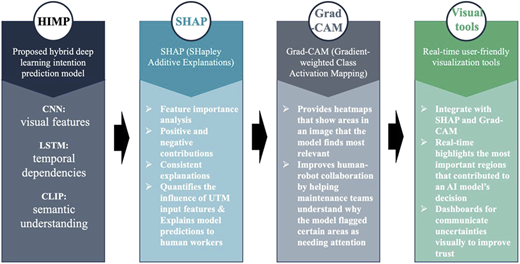
Second, interpretability. The HIPM model’s complex structure creates a “black box” effect, limiting transparency and reducing trust in its predictions (Hassija et al., 2024). In practical UTM environments, this lack of interpretability poses operational risks, as maintenance workers may be reluctant to rely on AI-driven assessments without clear justification. A lack of understanding of why the model predicts certain intentions or risks may lead to hesitation, misinterpretation or even human override of correct AI recommendations, potentially compromising safety and efficiency. To address this, explainable AI techniques should be integrated into the system to provide real-time, user-friendly explanations. Methods such as feature importance analysis (e.g. SHAP (Lundberg, 2017)) and saliency-based methods (e.g. Grad-CAM (Selvaraju et al., 2017)) can help clarify how the model arrives at its predictions. Additionally, human factors influencing robot acceptance should be carefully considered. Training programs that educate maintenance workers on interpreting AI outputs, along with visualization tools that allow for HRC feedback loops, can help build trust and adoption (Pinto et al., 2022).
Third, computational complexity. The hybrid model's computational demands are high, potentially restricting real-time applications or use in environments with limited resources. In practical UTM operations, where efficiency is critical, excessive computation time could delay maintenance tasks or require costly high-performance hardware. Potential mitigation strategies include model optimization techniques such as edge computing integration (Zhou et al., 2020) to ensure faster inference while maintaining accuracy.
6. Conclusion and future works
This study introduced HIPM, a novel hybrid deep learning model designed to enhance human intention prediction in UTM through an integrated approach combining CNNs, LSTM and the CLIP model. By leveraging both image features and high-level semantics, HIPM effectively addresses key challenges in existing HIP methods, particularly in environmental adaptability and multimodal feature fusion.
The experimental results demonstrate that HIPM significantly outperforms mainstream models, achieving over 91% in precision, recall and F1 score. These findings underscore its superior predictive capabilities in complex and hazardous UTM environments, where traditional vision-based methods often struggle due to lighting variability, environmental complexity and the lack of contextual information integration. By incorporating temporal dynamics and semantic context, HIPM ensures more robust and reliable intention recognition compared to conventional approaches. This research contributes to both theoretical advancements and practical applications in HRC: Theoretically, HIPM integrates multimodal deep learning techniques to enhance the accuracy and robustness of human intention prediction in dynamic environments, setting a new benchmark for future research. Practically, HIPM improves the responsiveness of robotic assistants in UTM settings, enhancing safety by reducing human exposure to hazards while optimizing task efficiency and collaboration.
To improve the HIPM model for utility tunnel maintenance, future research could focus on two key areas: (1) Explainability and trust: Integrate explainable AI techniques, such as attention mechanisms and saliency maps, to make HIPM’s predictions more interpretable. This will help build trust with maintenance workers by clarifying the model’s decision-making process, thus enhancing human-robot collaboration. Specifically, as shown in Figure 5, SHAP (Lundberg, 2017) could be used to quantify the impact of input features on predictions, while Grad-CAM (Selvaraju et al., 2017) could visualize the most influential regions in image-based decision-making. Integrating attention maps in the LSTM component would help illustrate how temporal dependencies contribute to human intention recognition. Additionally, incorporating user-friendly visualization tools that provide real-time feedback on model predictions could enhance human trust and facilitate better human–robot interaction. (2) Human–robot interaction studies: Conduct field trials and user studies to assess HIPM's effectiveness in real-world settings. Understanding worker interactions, perceptions of the model, and impacts on efficiency and safety will provide insights for refining the model and optimizing its role in maintenance.
In conclusion, HIPM represents a significant step forward in improving safety, efficiency and collaboration in hazardous maintenance environments. By bridging the gap between human intention prediction and robotic assistance, this research paves the way for more adaptive, intelligent and reliable HRC systems in industrial settings, ultimately contributing to the advancement of intelligent robotics in safety-critical operations.