Modular construction (MC) is gaining global attention for its potential to deliver improved efficiency, safety, and sustainability in the built environment. However, despite these benefits, Australia’s adoption of MC remains comparatively low. Given the critical role of government in shaping industry direction, effective policy intervention is essential to accelerate MC uptake. This study, therefore, aims to develop a policy framework – supported by a practical implementation guide – to better position Australia to harness the full benefits of MC.
A systematic literature review was conducted following the Preferred Reporting Items for Systematic Reviews and Meta-Analyses guidelines. A total of 63 relevant publications were identified and analyzed. Afterward, a thorough content analysis was done to extract recurring thematic barriers, drivers, policy positions and implementation trends.
The review identified five policy barriers constraining MC adoption and six policy enablers that support its successful implementation. The findings integrate insights from both international experiences and the Australian MC policy landscape, offering a balanced understanding of global trends and local realities.
Theoretically, this research advances the development of structured policy framework and implementation guide to support MC adoption in Australia. Practically, it provides policymakers with a clear, evidence-informed pathway to strengthen MC capability, encourage innovation and enable the broader uptake of modular technologies across the Australian construction sector.
The study proposed a forward-looking policy framework that consolidates the fragmented knowledge on MC adoption. To ensure its relevance for Australia, the framework is complemented by an implementation guide outlining actionable steps that policymakers and industry stakeholders can follow.
1. Introduction
Traditionally, the construction industry (CI) employs a cast-in-situ workflow, a site-intensive approach where most construction activities must be carried out on-site (Zhang et al., 2021). Although widely accepted, this workflow has notable shortcomings, including significant construction waste, low productivity, inefficiency, and unsustainability (Wuni et al., 2020; Zhang et al., 2021). Despite these shortcomings, existing studies opined that conventional construction is still widely adopted due to its familiarity, ease of implementation, resistance to change, and lack of support for new technologies (Shahzad et al., 2024; Zhang et al., 2021). To enhance the performance of the architecture, engineering, and construction industry, prefabricated construction (PC) and modular construction (MC) have emerged in recent years as alternatives to conventional construction (Zhou et al., 2024; CIC, 2024).
PC and MC are distinct building approaches to traditional construction (TC) that enable the production of components or modules at factories and their transportation to the site for installation (CIC, 2023b; Wu et al., 2024b). Though with limitations, such as high initial costs, transportation constraints, and inadequate design and installation knowledge, PC, generally refers to the industrialized manufacturing of individual building components (e.g. walls, beams, columns, panels), has been demonstrated to have significant benefits, such as enhancing sustainability, safety, quality, reusability potentials, and reducing waste, dust, and noise, among others (Navaratnam et al., 2022). Additionally, MC, a more advanced type of PC, has been noted in existing literature to even further enhance construction productivity through the application of prefabrication as volumetric (3-dimensional) modules (Xu et al., 2020; Feldmann et al., 2022). Due to the high degree of industrialization and self-contained characteristics of MC, it is a more effective solution to enhance the performance of the CI compared to PC and TC. For instance, using MC technology to construct the Leishenshan hospital during the COVID-19 pandemic within only half a month. It might have taken 3–5 years to build through TC (Chen et al., 2021). Also, due to the housing shortage in Hong Kong, the government initiated the building of transitional housing and Light Public Housing (LPH) with MC in recent years. On average, 30% of the construction time was saved, and module reuse was achieved (CIC, 2024).
Despite the benefits and uptake of MC in other countries, its adoption in Australia is currently gaining traction. In response to the historic high in housing prices in Australia in 2024, the Ministers for the Department of Industry, Science and Resources (2025) announced the initiation of $54 million to advance the manufacturing of prefabricated and modular housing. Of this, $49.3 million supports state and territory governments to supercharge MC housing development, while $4.7 million is allocated to developing the national certification process. This initiation could resolve the housing crisis in Australia, under the circumstances that MC in Australia is currently just taking up merely 3–5% of the CI, lagging other developed countries such as Sweden (80%), the Netherlands (20%), Germany (9%), and Japan (12–16%), though fairly better than the UK (2%) (Steinhardt and Manley, 2016; Navaratnam et al., 2022).
The government’s participation in MC is essential for enhancing its adoption across the entire project lifecycle in developed and developing countries. Existing literature opined that formulating and initiating government policies, which should include promotion, regulation, coordination, grant approval, supporting, incentivizing, subsidizing, guiding and developing codes and standards, are key driving factors to overcome the barriers of MC adoption in the CI (Sun et al., 2020; Wuni et al., 2020; Bello et al., 2024a). Therefore, Luo et al. (2021) developed a roadmap for optimizing prefabrication policies from standard, regulation, guidance, initiative, and incentive perspectives through mixed content analysis on 133 policies between 1956 and 2018 in China. Gan et al. (2023) took a similar approach to study the policy instruments adopted by the Chinese government in prefabrication development and summarized them according to patterns and focuses. The study proposed a roadmap by utilizing demand, supply, and environmental instruments to improve the policies of prefabrication development in China. Jin et al. (2022) reviewed and categorized the critical policy drivers for MC in Hong Kong, highlighting their importance at the initiation, planning and design, and construction phases, respectively. Also, Jin et al. (2025) utilized system dynamics modelling to simulate the dynamic influence of policy-driving forces at different construction stages.
Government participation in MC in Australia has also been explored in recent years. For example, Correia et al. (2020) determined through case studies in Western Australia that regulation is one of the factors governing off-site manufacturing of commercial projects. Navaratnam et al. (2022) encouraged cooperation among the Australian government, financial services, and individual firms to support prefabrication projects. Khan et al. (2024) identified the constraints for PC’s implementation in Australia and pinpointed the stakeholders responsible for mitigating them. Of the eight constraint categories, the government or policymakers are responsible for seven of them, demonstrating their importance. Existing studies have shown the significance of the government and its associated policies and regulations in the uptake of MC, along with their drivers and barriers for implementation. However, the contributions of these studies are fragmented, making it difficult to interpret the inter-relationships of each barrier and enabler and to understand the complete framework. This results in a lack of a national action plan for MC implementation in Australia.
Therefore, there is a lack of research proposing a fundamental roadmap and implementation guidelines for MC adoption in Australia. Adopting a systematic literature review (SLR) in conjunction with understanding current construction practices in Australia and other developed economies could identify gaps between best practices of MC and existing policies. Subsequently, formulating a framework that could help fill those gaps and optimize the implication of existing policies.
Thus, this study aims to propose a conceptual policy framework and implementation guidelines for MC adoption in Australia. To achieve this, three key research questions have been developed: (1) What are the key policy barriers and enablers that impede or contribute to the adoption of MC? (2) What practices and policies should be adopted to overcome the barriers and enhance the enablers of MC adoption? and (3) What are the key stages across the CI where MC development can be integrated for enhanced adoption? To do this, (1) the Preferred Reporting Items for Systematic reviews and Meta-Analyses (PRISMA) methodology was adopted to retrieve crucial articles in Scopus based on theme-based specific keywords; (2) an in-depth content analysis was conducted to summarize the barriers and enablers of policy implementation for MC adoption in the CI; (3) the barriers and enablers of policy implementation for MC adoption in the Australian CI were highlighted; and (4) a conceptual policy framework and implementation guidelines for MC adoption in Australian CI was formulated.
2. Methodology
2.1 Bibliographic collection strategy
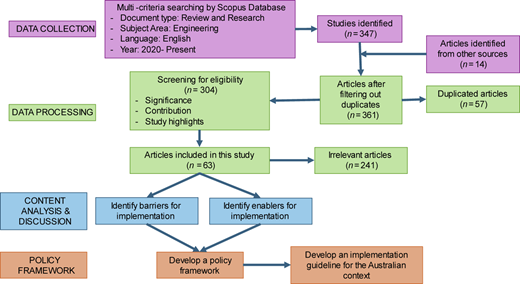
Secondary data on PC/MC adoption in the CI were gathered for this study using an SLR approach. The SLR followed the PRISMA guidelines for reporting systematic reviews by setting out the advanced methodology in identifying, selecting, appraising, and synthesizing studies. PRISMA ensures the SLR’s transparency, completeness, and accuracy (Page et al., 2021). This approach was utilized widely in studies regarding the CI. Alhawamdeh and Lee (2024) employed the PRISMA approach to sort out relevant articles for systematic analysis and identified the barriers of off-site construction. Wuni et al. (2020) and Wuni and Shen (2020b) utilized the same methodology to study the critical risk and success factors for MC application, respectively. The PRISMA 2020 statement suggested a flow diagram template for conducting the SLR (Page et al., 2021). The data retrieval process in this study is referenced to the flow diagram, and incorporating the research methodology, the research framework is summarized in Figure 1.
2.2 Data retrieval
The articles for the study were retrieved from the Scopus database. The Scopus database was used because it is the largest peer-reviewed academic database covering the widest range of journals, including the major journals in the construction engineering and management domain (Hu and Chong, 2019). Scopus is also considered the most user-friendly database, as its interface can easily restrict search results (Wuni et al., 2020).
Keywords such as MC, PC, policies, and their derivatives were identified and searched in the “title, abstract, and keywords” field of Scopus. Four target-specific searches were performed to acquire data for four predefined criteria, and each was used to gather studies on (1) policies related to MC, (2) policies related to PC, (3) policies related to MC/PC in Australia, and (4) barriers and drives to PC/MC implementation The complete search strings are as follows: (1) (“volumetric construction” OR “modular construction” OR “modular integrated construction” OR “construction modularization”) AND (“government” OR “regulation” OR “policy”); (2) (“prefabricated construction” OR “construction prefabrication” OR “construction industrialization” OR “industrialized construction” OR “off-site construction”) AND (“government” OR “regulation” OR “policy”); (3) (“modular construction” OR “modular integrated construction” OR “prefinished volumetric construction” OR “prefabricated construction” OR “construction prefabrication” OR “construction industrialization” OR “industrialized construction” OR “off-site construction”) AND (“Australia” OR “Australian”); and (4) (“modular construction” OR “modular integrated construction” OR “prefinished volumetric construction” OR “construction modularization” OR “prefabricated construction” OR “construction prefabrication” OR “construction industrialization” OR “industrialized construction” OR “off-site construction”) AND (“barrier” OR “driver”). Further limitations were applied to the searches, including limiting the years to the last five years (i.e. 2020 to present), document type to “Review” and “Research”, subject area to “Engineering”, and language to “English”. The search is limited to the past 5 years, to ensure that current literature only is included in the study due to the growing development and advancement in MC literature. However, other important articles from other sources and grey literature were also included, which may be dated further than the last five years.
As of April 2025, these four query strings retrieved a total of 347 records, 57 of which are duplicates and 290 unique articles. After reviewing the titles and abstracts of the articles with predefined criteria, including significance, contributions, and study highlights, 49 articles were found relevant and considered important for further analysis. 14 literature from other sources concerning the Australian context and other countries’ industrial and policy references of MC, a total of 63 publications contributed to the basis of this SLR study.
2.3 Analysis and discussion
To delineate the articles, various information was extracted for statistical analysis, including publication year, spatial and continental trend, country classification, study methodologies, thematic distribution, and study area. This information helped summarize some general characteristics and overall research trends associated with the topic. Besides, a summary table (Supplementary Material 1) of 16 selected key articles is included as supplementary material, which depicts the landscape of all publications being reviewed in this study. After that, a detailed content analysis is performed, concluding the general barriers and enablers of MC adoption in Australia. The discussion utilized the findings from the SLR to propose a conceptual policy framework, with an implementation guideline that conceptually paves the way for the adoption of MC in Australia.
3. Results
3.1 General Mapping of selected literature
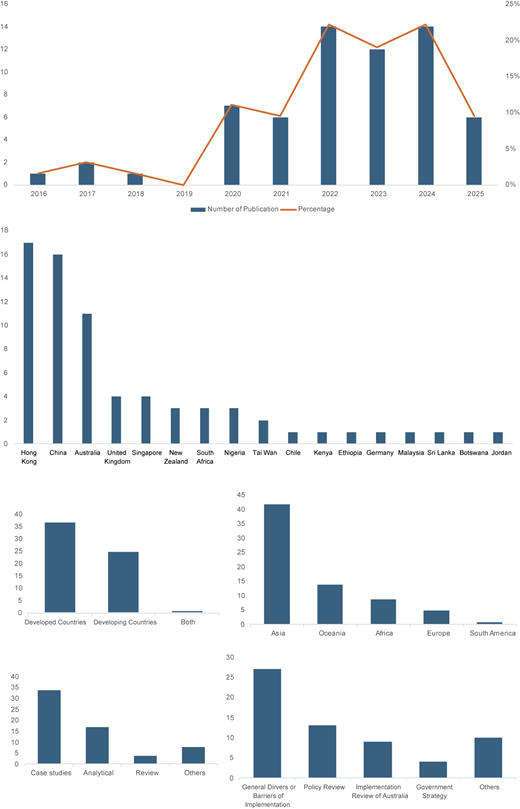
After the statistical analysis (Figure 2), the temporal trend of publications indicates that the earliest article is a grey literature published in 2016. On average, research related to MC or PC policies and implementation have increased over time. The publications in 2020 and 2021 contributed 11% and 10% of the total selection, respectively. From 2022 onward, the articles contributed at least 19% of the total publications each year. This trend shows that the research theme is gaining traction.
Regarding spatial trend, the following order was used for classification: (1) location specified in case studies; (2) location of data sources; and (3) institution location of the first author. Some articles discussed various countries simultaneously, and they were considered individually. Most publications are from Hong Kong and China. Although Hong Kong is a special administrative region of China, these publications consider the two places separately. Despite the grey literature selection and a Scopus search focusing on the Australian context, the publications from Australia are still lower than those from Hong Kong and China. The Australian context was used to specifically refer to the key policies, standards, market conditions published in grey documents or published articles focusing on barriers and drivers of MC adoption in Australia. Notwithstanding, Hong Kong, China, and Australia stand out among other countries, contributing 44 publications altogether. Followed by the United Kingdom and Singapore with 4 studies each, New Zealand, South Africa, and Nigeria, with 3 studies each, and Taiwan with 2 studies. Other countries, including Chile, Kenya, Ethiopia, Germany, Malaysia, Sri Lanka, Botswana, and Jordan, were each included in 1 study.
Considering the continental trend, Asia most dominantly includes 40 publications, among which China and Hong Kong contribute significantly. Followed by Oceania, which includes Australia dominantly and New Zealand, with 14 publications, then Africa (9), Europe (5), and South America (1). Though Africa is the third most published continent, no country stands out. The number of studies is distributed across 5 different countries in Africa. Furthermore, there is a lack of studies from Europe (except for the United Kingdom) and North America, which are considered more developed continents.
The classification of the countries into developed and developing was based on the list published by the Minister for Foreign Affairs of Australia (2022), which concluded that China (excluding Hong Kong), South Africa, Nigeria, Kenya, Ethiopia, Malaysia, Sri Lanka, and Botswana are developing countries. The results showed that 38 publications are from developed countries, 24 publications from developing countries, and 1 publication mentioned both. Although publications from developed countries do not dominate developing countries, China contributes to more than half of the studies from developing countries. On the other hand, Hong Kong and Australia account for 70% of the studies of developed countries. Therefore, studies of PC/MC policy and implementations are more governed by countries themselves rather than their continents or development status.
For the study methodology among the selected articles, 34 publications were case studies. These studies evaluated the PC/MC implementation under certain contexts, mostly based on a particular country or development status (e.g. Correia et al., 2020; Gan et al., 2022). Analytical studies followed, with 17 publications. These studies analysed PC/MC implementation from different aspects, such as major barriers or enabling factors, proposing strategies and decision-making criteria (e.g. Han et al., 2022; Ali et al., 2024). This methodology tends to overcome contextual limitations and yields more general conclusions. Review articles and others include 4 and 8 publications, respectively. These studies delved into the existing publications in PC/MC policy adoption and implementations (e.g. Gad et al., 2022; Alhawamdeh and Lee, 2024).
Regarding the study scope, 27 publications were associated with the general barriers and enablers of PC or MC implementation. These publications were based on industrial perception and case review (e.g. Liu et al., 2023; Khan et al., 2024). Policy reviews followed, with 13 publications. These studies reviewed existing PC/MC policies from various countries to assess their effectiveness (e.g. Gan et al., 2023; Jin et al., 2025). 9 publications reviewed the PC/MC implementation status in Australia (e.g. Zhang et al., 2022; Gad et al., 2022). Studies proposing government strategies are the least, contributing four publications (e.g. Han et al., 2022). Others, which the majority are contributed by grey literature, take up 10 publications.
4. Discussions
4.1 Barriers to MC adoption
4.1.1 Inadequate policies and regulations
Existing articles raised that the lack of regulatory processes and the immaturity and constraints of policy systems hinder prefabrication adoption (Li et al., 2021; Navaratnam, 2022; Oyefusi et al., 2024). For instance, Zhou et al. (2024) stated that insufficient government support and policymaking are the most critical barriers in the political, economic, social, and technological (PEST) analysis. Their implications could extend throughout the project lifecycle. Similarly, Zhang and Tsai (2021) noted that laws and regulations should be established to manage the entire prefabrication process. Still, their study indicated that current laws and regulations were not extensive enough to support prefabrication development. Wuni and Shen (2020a) argued that the lack of government policies and regulations for private MC projects is a primary reason for the ongoing dominance of TC.
For the Australian context, Khan et al. (2024) similarly opined that a lack of policies, laws, and guidance obstructs the development of MC. The current policies discourage MC adoption, and it would be difficult to shift the CI culture without significant support from regulations and legislation. Therefore, the government should assert more pressure to mandate MC policies. Meanwhile, Gad et al. (2022) stated that the existing policies and regulations are tailored for TC, which are not adaptable or beneficial for MC implementation. For example, the role of the building inspector and the approval process for MC are yet to be clarified.
4.1.2 Lack of codes, standards, and specifications
Different studies have mentioned that the lack of codes, standards, and specifications is a barrier obstructing the development of MC (Akinradewo et al., 2021; Ortega et al., 2023; Ali et al., 2024). For example, Wuni et al. (2020) stated that the lack of design codes and standards is a critical risk factor that drags on the adoption of MC, as it fails to provide the regulatory frameworks and requirements that guide compliance with MC. Rangasamy and Yang (2025) found that the absence of codes and standards is an overarching barrier for prefabrication adoption, because it also significantly contributes to other implementation barriers.
Zhang et al. (2022) mentioned that the current prefabrication design greatly relies on the TC design standards. However, they might not be adaptable due to the intrinsic difference in MC and TC’s construction methodologies. Khan et al. (2023) explained that there is a lack of codes and standards in Australia because MC is a rather new technology. Admitting there are publications such as The Handbook for the Design of Modular Structures (The Design Handbook) and the Prefabricated, Modular and Offsite Construction Handbook (The Handbook) by the Modular Construction Codes Board of Monash University (MCCB, 2017) and the Australian Building Codes Board (ABCB, 2024) of the Australian Government. Nonetheless, the former is not a law-enforcing document and is applicable at the state level only (MCCB, 2017; Zhang et al., 2022). The latter is guidance material without any new provisions for MC to the National Construction Code (NCC) nor law-enforcing implications (ABCB, 2024; Gad et al., 2022). Given that the NCC is performance-based, more prescriptive and performance requirements are needed to govern the different properties (e.g. structural and building services) of MC compared to TC (Gad et al., 2022). Furthermore, Correia et al. (2020) confirmed that local compliance concerns arise when overseas regulations and standards guide manufacturers. In conclusion, the existing standards are ineffective in guiding MC adoption in Australia.
4.1.3 Lack of incentives and subsidies
A wide range of studies have addressed the lack of government incentives and subsidies as major barriers to MC (Al-Aidrous et al., 2023; Bello et al., 2024b; Rangasamy and Yang, 2025). The risks of high initial and total cost of MC are one of the most critical uncertainties that developers are unwilling to bear (Ortega et al., 2023; Han et al., 2025). Even though certain incentives, such as fiscal subsidies, tax breaks, and preferential loans, were introduced in some countries, the industries perceive that they are inadequate to overcome the risk of cost increment (Sun et al., 2020). Therefore, more comprehensive incentive and subsidy provisions are required.
Gad et al. (2022) stated that a lack of incentive is a reason for the low adoption of MC in Australia. This could be attributed to the lack of awareness and understanding about the advantages of MC, as well as its low demand in Australia. Zhang et al. (2022) further clarified that the total cost of prefabrication projects is high because of the relatively expensive manufacturing in Australia. Additionally, due to the uncertainties expected from banks and financial institutions, fabrication projects could hardly secure financial support, and companies with small to medium scales struggled and were disincentivized to MC (Correia et al., 2020; Khan et al., 2024).
4.1.4 Insufficient technical guidance
Technical guidance is not law-enforcement material. It is the supporting material that facilitates the implementation of MC (Luo et al., 2021). Jin et al. (2022) and Wuni and Shen (2020a) stated that a lack of technical guidance is a major obstacle to MC implementation. Though there are some technical guidelines established for MC in various countries, such as The Design for Manufacturing and Assembly–Prefabricated Prefinished Volumetric Construction (BCA, 2017) by the Building and Construction Authority (BCA) of Singapore or MiC Installation and Disassembly (CIC, 2023a) by the Construction Industry Council (CIC) of Hong Kong, Xu et al. (2020) and Jin et al. (2025) determined that they lack authority and are still immature.
Khan et al. (2024) similarly agreed that the lack of guidance is a regulatory constraint that impedes MC adoption in Australia. Although The Design Handbook is intended to guide the design and construction of MC, Gad et al. (2022) suggested that it is not sufficiently detailed, and additional guidance materials should be established (Zhang et al., 2022).
Apart from the technical aspect, a lack of guidance on contractual and procurement aspects is another factor that hinders MC implementation (Hwang et al., 2018; Badran and Saad, 2025). Due to the complex supply chain and stakeholders involved for MC, the traditional procurement process of design-bid-build deployed in Australia would be unsuitable, including payment terms, communication, and collaboration problems (Charlson and Dimka, 2021; Khan et al., 2023; Daniel et al., 2023). Therefore, more suitable procurement methods should be introduced to guide MC implementation in Australia.
4.1.5 Lack of infrastructure support
Supply chain management is critical for effective MC delivery, and transportation support is a crucial element (Khan et al., 2023). Sun et al. (2020) stated that selecting transportation routes and containers based on module weight and dimensions is a common limitation for MC delivery. Regardless of the delivery method, this often results in unavoidable damage to modules. Wuni and Shen (2020b) attributed this to a lack of infrastructure support, which prolongs the transportation, storage, and assembly processes, significantly hindering MC delivery.
Khan et al. (2024) and Navaratnam et al. (2022) highlighted that, due to the limited number of module manufacturers, their location in remote areas, and the considerable distance between major cities, there is a substantial lead time and high transportation cost for module delivery in Australia. Furthermore, the existing road system does not favor delivering large modules. Therefore, Khan et al. (2023) and Zhang et al. (2022) opined that Australia heavily relies on offshore manufacturing, which still hardly achieves just-in-time delivery. Such delays significantly impact MC adoption and should be resolved.
4.2 Enablers to MC adoption
4.2.1 Develop policies and regulations
From a legislative perspective, Alhawamdeh and Lee (2024) noted that typically, the government enforces political decisions through a top-down approach. This effectively helps to resolve political barriers by shaping the framework and regulatory environment of prefabrication. Sun et al. (2020) suggested that mandatory policies could draw more attention to MC by different stakeholders. Wu et al. (2024a,b) and Jin et al. (2022) further proposed that compulsory land and presale policies alongside urban planning should be implemented to effectively uptake prefabrication adoption. For example, the Singapore government enforced 65% of new residential housing, and the Hong Kong government directed the LPH project to be built with MC (Sun et al., 2020; Legislative Council, 2022). With this recommendation, Rangasamy and Yang (2025) addressed that a recurring process of collecting feedback from the industry while drafting the standards would be influential for policy implementation.
In addition, Zhang and Tsai (2021) and Gan et al. (2022) advised that policies and regulations should be developed to facilitate the MC. For instance, deviating from the design-approval-construct approach of TC, Xu et al. (2020) introduced pre-acceptance mechanisms in Hong Kong and Singapore, which pre-approve standardized module designs. This saves effort from undergoing the approval process for the same product for each project. This approach suggests that the regulatory process could be streamlined and leverage the benefits of MC. Optimizing the policy and regulatory processes could be considered throughout the initiation, planning and design, and construction phases of MC adoption in Australia (Jin et al., 2022). Therefore, Gad et al. (2022) suggested that the local government in Australia, as the primary regulatory authority of planning approvals, should substantially review the planning framework to obsolete the outdated regulations.
4.2.2 Establish codes, standards, and specifications
Sun et al. (2020) and Rangasamy and Yang (2025) acknowledged the differences in the workflow and requirements between TC and MC. Their study suggested that new codes and standards should be published to specify requirements from different domains for MC implementation. Wuni and Shen (2020b) elaborated that design codes and specifications tailored for MC could facilitate its permitting and statutory approval process. For instance, the Code of Practice for Precast Concrete Construction (2016) (BD, 2016) and PNAP ADV-36 (BD, 2019) from the Buildings Department (BD) in Hong Kong are law-enforcing codes and standards that guide the design and construction of MC. Furthermore, the Architectural Services Department (ArchSD) in Hong Kong incorporated a section for MC in the General Specification for Building (2022 Edition) (ArchSD, 2022).
In the Australian context, Zhang et al. (2022) and Khan et al. (2024) opined that establishing proper legal standards and codes is essential to the overall delivery of projects with prefabrication. While Gad et al. (2022) acknowledged the contribution of The Design Handbook, their study suggested more aspects should be further investigated and incorporated, such as temporary loading considerations, precision and tolerance criteria, and installation techniques. In addition, apart from reviewing and modifying the existing standards, a new suite of Australian Standards is recommended, particularly for MC, to facilitate its design and construction in Australia (Gad et al., 2022).
4.2.3 Economic incentives
In parallel with the top-down approach, the government should also implement bottom-up strategies to encourage the adoption of MC. Economic incentives are strongly promoted for MC development in various countries (Liu et al., 2023; Yan et al., 2023; Dou et al., 2024), and interest-free loans, tax reductions, financial subsidies, and targeted awards are the common incentives recommended in existing studies (Xu et al., 2020; Jayawardana et al., 2024; Wu et al., 2024a). For example, the Chinese government proposed a RMB 100/square meter subsidy scheme for developments meeting specific criteria, with a maximum subsidy of RMB 10 million (Han et al., 2023). In Singapore, a tax break mechanism was established for the Integrated Construction and Prefabrication Hubs development, and financial grants are available for private MC projects (Xu et al., 2020; Liu et al., 2023). Also, the Hong Kong government initiated a gross floor area (GFA) concession scheme by granting MC projects a 6% GFA exemption (Tsz Wai et al., 2021). This proposal allows more usable areas to be recovered from the double column of MC. These are some of the economic incentives that could encourage the adoption of MC, and they are encouraged to be launched at the early stage of the project (Han et al., 2023).
Khan et al. (2024) recognized the importance of the Australian government’s financial support for MC developers. Gad et al. (2022) recommended including a certain percentage of government projects to commit to MC, which could raise practitioners’ incentives in adopting MC. Additionally, the government’s incentives could help overcome challenges in obtaining funding from financial institutions. Navaratnam et al. (2022) suggested that incentives, especially monetary ones, could strengthen the growth of prefabrication. Khan et al. (2024) summarized that the Australian government plays a facilitator role in incentivizing MC and recommended adopting incentive strategies from some Asian countries.
However, economic incentives alone are inadequate in settling the perceived financial risks. Sun et al. (2020) advised that mandatory policies be implemented concurrently to optimize their implication.
4.2.4 Provide technical guidance
Existing studies have identified the importance of providing technical guidance to enhance MC adoption (Jayawardana et al., 2024; Morake et al., 2024). Oyefusi et al. (2024) and Tsz Wai et al. (2021) noted that a comprehensive policy framework should include clear guidelines to comprehensively list all compliance and regulatory issues in MC projects. It also assists in smoother project delivery and reduces contractual risks. For example, the Statutory Requirements for Modular Integrated Construction Projects published by the CIC (2023c) provides a clear roadmap to comply with all statutory requirements in Hong Kong. It is one of the practical guidance materials that effectively streamlines MC project delivery. Apart from publishing documentation, another effective way to consolidate the MC adoption process is to organize forums or workshops for the practitioners (Khan et al., 2024; Rangasamy and Yang, 2025).
Zhang et al. (2022) stated that, in addition to The Design Handbook, more detailed guidance should be provided to the production, lifting, installation, and inspection processes of MC adoption in Australia. According to the study done by Gad et al. (2022), the technical guidance should be comprehensive, easy to follow, and mutually recognized by the NCC to retain its authority. Furthermore, the study suggested incorporating temporary loadings, maintenance during delivery, precision and tolerance, and connection criteria into the technical guidance.
To overcome procurement and contractual barriers, the government should initiate, promote, and guide the industry to adopt new contract-binding tools to facilitate MC delivery. For example, Jin et al. (2022) and Khan et al. (2023) suggested that public-private partnership, private finance initiatives, design-build, or turnkey contracts would be more ideal tools for MC implementation, compared to design-bid-build. While the CI stakeholders in Australia are not familiar with these tools, the government should provide adequate guidance to guide their application.
4.2.5 Initiate pilot projects
Another aspect is the initiation of pilot projects. Pilot projects provide indications on how existing policies are favorable for MC delivery and give insights to refine them (Rangasamy and Yang, 2025). Wu et al. (2024a, b) summarized that China adopts a significant number of pilot projects to guide and demonstrate the delivery of projects with prefabrication, which effectively enhances the quality and efficiency of the CI. Han et al. (2023) reinforced that pilot projects could boost market demand for prefabrication and promote its hidden value. Furthermore, to optimize the impact of pilot projects, these projects should be diverse, considering factors such as metropolitan and rural areas, buildings with different functionalities and characteristics, to expand their practical implications (CIC, 2022; Yan et al., 2023).
Perera et al. (2025) highlighted that the CI in Australia relies heavily on pilot projects to demonstrate the feasibility of new construction technologies. Khan et al. (2024) corroborated that pilot projects demonstrate the knowledge and best practices of MC implementation. Therefore, initiating pilot projects is essential to the uptake of MC.
4.2.6 Infrastructure advancement
Sufficient support from transport infrastructure is a baseline for the successful delivery of MC projects (Zhang and Tsai, 2021; Gan et al., 2022; Yan et al., 2023). Kedir et al. (2022) and Wuni and Shen (2020b) highlighted that infrastructure is strongly related to construction productivity and could streamline the entire delivery process. Therefore, investment in optimizing infrastructure, especially the quality of roads, power, and water supply networks, is required for MC adoption. Khan et al. (2023) and Khan et al. (2024) similarly recommended enhancing local manufacturing and logistics advancement, which could drive the growth of MC in Australia.
5. Policy framework for MC adoption
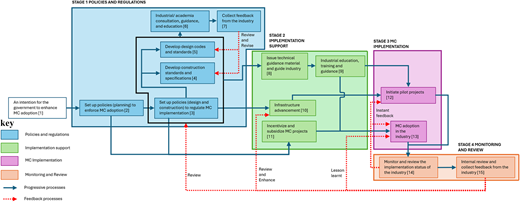
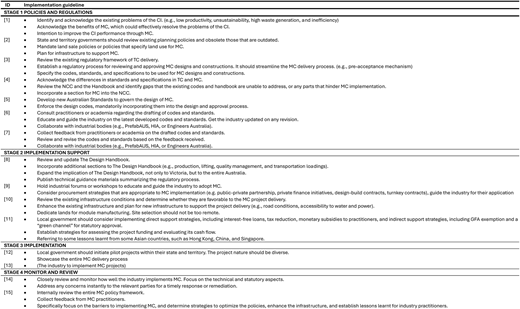
Based on the identified implementation barriers and enablers from existing publications, a policy framework to improve MC adoption is proposed below (Figure 3). The entire framework can be divided into four stages: policies and regulations, implementation support, implementation, and monitoring and review. For each activity, an ID is assigned to link to the implementation guideline (Figure 4) in the following section. Before entering these stages, the government should first establish an intention to enhance CI performance through MC. It is essential to acknowledge the limitations of the existing TC and the potential of MC in resolving these limitations.
The first stage, policies and regulations (Stage 1), acts as the foundation of the entire program, which aims to respond strategically by establishing policies with a top-down approach to govern the MC implementation process. The government can boost MC adoption through planning, design, and construction efforts. For planning, the government could enforce MC implementation in land sale policies or designate land use for MC. Additionally, infrastructure planning to support MC adoption is crucial at this stage. Regarding design and construction, the goal is to formulate a framework and policies for MC project delivery, including the regulatory process (e.g. review and approval), the governing codes, and specifications to be complied with. After that, draft design and construction standards. To maximize their effectiveness, industry involvement is vital. A recurring process of collecting feedback from the industry is introduced to allow continuous refinement of policies, codes, and standards.
To support MC implementation (Stage 2), guiding the industry is indispensable. Issuing technical guidance materials and guiding the industry for implementation would be necessary. The guidance should focus on providing a roadmap and guidelines for statutory compliance as well as practical considerations during implementation. Although not mandatory, mutual recognition between the technical guidance material and other law-enforcing documents (e.g. NCC) would be desirable. Meanwhile, organizing forums and workshops for practitioners to train, address, and educate on the essential issues of MC delivery is recommended.
Optimizing the infrastructure for MC delivery would also be essential, for example, site selection of manufacturing factories, accessibility of water and power, and dimensions and quality of roads. The entire MC footprint should be incorporated to advance infrastructure. Infrastructure advancement aims to focus on local manufacturing, to alleviate offshore manufacturing, and to allow viable and non-destructive delivery options. To incentivize and subsidize the industry for MC implementation, direct financial support, such as interest-free loans, tax reductions, and monetary subsidies, could be considered. Moreover, indirect support, such as a GFA award mechanism or a “green channel” for obtaining statutory approval (Gan et al., 2022), could be established to stimulate developers and contractors to deploy MC.
When moving on to implementation (Stage 3), pilot projects act as pioneers of MC. On one hand, they demonstrate the entire process of MC implementation to practitioners and showcase the regulatory process from planning to construction. On the other hand, they help identify gaps in the current policy, allowing for further efforts to be made to improve it as needed. It is recommended that pilot projects be of various natures and characteristics. With pilot projects serving as a pivot, it would reduce the uncertainties encountered and build up confidence for the industry to adopt MC.
The reviewing stage (Stage 4) should be conducted alongside the implementation stage. This phase is vital because it lays the foundation for MC compliance and future improvements. While the industry adopts MC, the government should actively monitor project implementation and support any technical, safety, or statutory compliance issues that arise. Feedback from practitioners should be gathered after project completion to identify barriers faced during the project and suggestions for future improvements. This allows the government to review current policies, further develop infrastructure, and create case studies for industry learning from past projects.
While the blue arrows in the framework represent the progressive processes, the red-dashed arrows show the feedback processes. It is worth highlighting the three feedback loops in the framework: one during policy establishment, the other during project delivery, and the last upon project completion. Continuous feedback among different stakeholders is useful in enhancing MC performance for policy establishment and project delivery. Although this framework aims to boost MC adoption, there is no destination where it should terminate. It sets out an iterative approach. Even when MC implementation is utilized, this recurring policy framework could still be deployed to strive for further optimization.
The overall policy framework is complex, and it involves various stakeholders, including policymakers at the state or territory and federal levels, academia, practitioners, suppliers, and industrial and financial institutions. Each of them is engaged at different stages of the framework, and so it requires a high degree of collaboration for effective implementation. Effectively implementing the policy framework could also enhance supply chain performance, accelerating MC’s implementation.
5.1 Implementation guidelines for Australia
The framework in Figure 3 illustrates the entire footprint for enhancing MC implementation. It demonstrates a progressive roadmap to overcome barriers and facilitate enablers to fill the gaps in current Australian construction practices. Although the Australian government or policymakers may have been attentive to certain components of the framework, further actions to optimize them are desirable. To solidify the framework for the Australian context in actions, an implementation guideline is shown in Figure 4. For the policies and regulations stage, planning policies have yet to be established in Australia. Despite the Treasury Ministers (2024) introducing the high-level objective to mobilize national capital to boost the MC industry from 5% to 15%, the plan to realize it is outstanding. The state and territory governments should substantially review the existing planning policies and mandate new policies to pave the way for MC adoption.
Considering the design and construction policies, the government could develop an agenda to streamline the review and approval process for MC designs and constructions, to replace the existing complex process. Especially for housing development in Australia, the pre-acceptance mechanism would be of great benefit, as one standardized design can be repeatedly applied to different projects. Moreover, to mitigate the over-reliance on excessive Australian Standards for current MC designs, the government could support the publication of a unique suite for MC. Regarding NCC, The Handbook provides an in-depth understanding of the NCC and existing standards and regulations. However, it is not tailored for MC, and it cannot effectively address every technical aspect of MC. Learning from the General Specification for Building (2022 Edition) from Hong Kong, it would be desirable if the MC performance objectives could be fully incorporated into the NCC.
For the implementation support stage, The Design Handbook provides useful information for MC designs and constructions. However, the guidance provided is too brief, and specifications such as temporary loadings during transportation, quality management, repair and maintenance, or other construction issues, such as production, lifting, and installation, are outstanding. In addition, the first edition of the handbook was published in 2017. Considering the changes in the construction industry in recent years, a substantial revision of the handbook would be desirable. The current version of The Design Handbook is only applicable to Victoria, and expanding its applicability to suit other states and territories would be more effective. In the meantime, guiding the adoption of suitable procurement and contractual tools in lieu of the traditional design-bid-build would be critical to encourage the Australian CI implementing MC.
To mitigate the challenges encountered for interstate or overseas production and transportation, the Australian government should encourage local manufacturing and delivery. The state and territory governments should commit to dedicating land for MC factories and enhancing the surrounding infrastructure systems to support their production and delivery. The site selection should be close enough to the majority of construction sites, which are near metropolitan areas, to reduce lead time and expedite just-in-time delivery.
For incentives and subsidies, as mentioned above, the Ministers for the Department of Industry, Science and Resources (2025) are initiating $54 million to advance the manufacturing of prefabricated and modular housing, which is effective in bringing up MC. The local government could consider utilizing the money for interest-free loans, tax reductions, and monetary subsidies to practitioners. Indirect support should also be deployed concurrently to motivate the industry to adopt MC. Meanwhile, due to an anticipated higher up-front cost for MC compared to TC, it is also critical to establish new strategies for assessing project funding and evaluating its cash flow.
During the implementation stage, the local government should initiate pilot projects in its state or territory. Since some MC-related policies and regulations are restricted to the state and territory domain, such as planning regulations and state/territory requirements from the NCC, they are unique for different states and territories. Showcasing pilot projects locally could be more contextualized and effective in demonstrating the entire project delivery process. The Department for Housing and Urban Development (2025) of the Government of South Australia, for example, initiated a pilot project with 120 turnkey homes of PC and MC that were assembled in the regional and metropolitan areas. The objective of the pilot project was to showcase MC’s ability to resolve high housing demand and serve as a pioneer toward a wider adoption of MC. Pilot projects of a similar kind should be considered in different states and territories.
6. Conclusion
The emergence of MC aims to address the shortcomings of TC by industrializing the production of building components and transporting them to the site for installation. Although MC offers benefits such as improving the safety, quality, and efficiency of the CI, its adoption rate remains low in Australia. Existing literature highlights the importance of government and policy support in increasing MC adoption, but a clear policy roadmap is still missing. Using a systematic literature review approach, this study seeks to develop a policy framework with implementation guidelines to encourage MC adoption in Australia.
An in-depth content analysis was conducted from the selected publications to identify the barriers that obstruct MC implementation and the enablers that facilitate its development. Existing literature suggests that the main obstacles are attributed to inadequate policies and regulations, lack of codes, standards, and specifications, absence of incentives and subsidies, insufficient technical guidance, and infrastructure support. To improve MC adoption, the government should consider developing policies and regulations, establishing codes, standards, and specifications, providing economic incentives and technical guidance, initiating pilot projects, and advancing infrastructure.
A policy framework is then proposed based on the identified barriers and enablers. The framework includes four stages: policies and regulations, implementation support, implementation, and monitoring and review. Each of them has a different role and objective within the roadmap for boosting MC. The three feedback loops of the framework were stressed: one during policy setup, one at MC implementation, and the last upon completion and review. The iterative process is essential for optimizing the performance of MC, as feedback from the industry is collected, and further enhancements could be made.
To ensure the policy framework can be effectively applied within the Australian context, we propose an accompanying implementation guideline. This guideline functions as a practical bridge, connecting the realities of current construction industry practices in Australia with the strategic directions outlined in the proposed policy framework. The federal and local governments should substantially review the developed guideline and apply the federal or local context-specifics to it to enhance seamless adoption at grassroots. Creating a streamlined review and approval process is also important to maximize the benefits of MC at all levels. Moreover, state and territory governments should strengthen their infrastructure to support MC deployments, with site selection being a key factor. Different incentive strategies, including direct and indirect support, should be implemented to encourage practitioners to adopt MC. Additionally, pilot projects initiated by local governments would be beneficial to demonstrate the pathway for delivering MC projects within their jurisdiction.
This study fills a knowledge gap by developing a policy framework and implementation guidelines for MC adoption in the Australian context. The findings from the study are sufficiently substantial for Australian federal, state, and territory governments to devise policies to boost MC development in Australia, including enhancing modular housing to resolve the housing crisis in the country. However, the framework and guidelines are just the first step i.e. preliminary, and further efforts are required to address the limitations of this study. Subject to the limitations of retrieving articles, such as keywords, years, language, and subject area, the framework and implementation guidelines development might be restricted. In addition, the framework formation is based on literature from various countries, whereby not all the resultant findings might fully suit the Australian context. The developed framework and implementation guideline for Australia can be adopted in other developed nations with similar industrial, regulatory and market structures but this should be tailored to the specific countries’ policy landscape and local needs.
To consolidate the results, future studies could focus on validating the framework and policy guidelines with experts and developing key performance indicators to assess the performance across the four stages of the framework. In addition, achieving widespread adoption of MC in Australia requires attention not only to supply-side capability, but also to demand-side acceptance. Future studies could explore how clients, developers, and end-users can be encouraged to embrace MC solutions. Moreover, because each Australian state and territory operates under distinct regulatory settings and geographical conditions, implementation strategies may need to vary across jurisdictions. Future research could therefore examine MC adoption within specific states or territories to identify locally appropriate approaches.
The authors gratefully acknowledge the Faculty of Sciences, Engineering and Technology, University of Adelaide, for support provided through the 2024 Early‑ to Mid‑Career Researchers (EMCR) Grant.
The supplementary material for this article can be found online.