

Decisions taken during the early design of adaptive façades involving kinetic, active and responsive envelope for complex commercial buildings have a substantial effect on inclusive building functioning and the comfort level of inhabitants. This study aims to present the application of an analytic network process (ANP) model indicating the order of priority for high performance criteria that must be taken into account in the assessment of the performance of adaptive façade systems for complex commercial buildings.
The nominal group technique (NGT) stimulating and refining group judgments are used to find and categorize relevant high performance attributes of the adaptive façade systems and their relative pair-wise significance scores. An ANP model is applied to prioritize these high performance objectives and criteria for the adaptive façade systems.
Embodied energy and CO2 emission, sustainability, energy saving, daylight and operation maintenance were as the most likely and crucial high performance criteria. The criteria and the weights presented in this study could be used as guidelines for evaluating the performance of adaptive façade systems for commercial buildings in planning and design phases.
This research primarily provides the required actions and evaluations for design managers in accomplishing a high performance adaptive façade system, with the support of an ANP method. Before beginning the adaptive façade system of a building design process, the design manager must determine the significance of each of these attributes as high performance primacies will affect the results all through the entire design process.
In this research, a relatively innovative, systematic and practical approach is proposed to sustain the decision-making procedure for evaluation of the high performance criteria of adaptive façade systems in complex commercial buildings.
1. Introduction
Façade as a building component represents the main constituent of the building climatic skin, and it provides physical comfort for building users (Sadineni et al., 2011). In buildings, it is crucial to ensure controllable isolation, daylighting, change of lucent heat, solar shading, control of humidity, ventilation and energy collecting in adaptable façade systems (Loonen et al., 2015; Sandak et al., 2019). The diversity of technical solutions applied to create “high performance” commercial building façades are built on basic building physics conceptions for daylighting, control of solar heat collecting, ventilation and inner space acclimatizing (Lee et al., 2002). Façade adaptivity (a self-setting of specific façade's features) can be illustrated in different ways: by the physical modification of the façade configuration, dynamic regulation of the energy flow or activating the concept of clean and renewable energy (Perino and Serra 2015; Sandak et al., 2019). Adaptive façades, especially, comprise of multi-purpose, extremely adaptive systems, wherein the physical partition between the indoor and outdoor area can modify its tasks, characteristics or behavior over time in reaction to temporary functioning requirements and boundary settings in order to boost the complete building performances (Loonen et al., 2015; Romano et al., 2018). The concept of adaptive façade is properly incorporated with European Union (EU) future view of nearly zero energy building (nZEB), considering that adaptive façades have a confident influence on the indoor environment condition caused by considerable decreases in usage of building energy and CO2 emissions (Loonen et al., 2015; Sandak et al., 2019). Adaptive façades are able to increase the efficacy of building's energy and economics, by means of the potential to modify the behavior in real time in line with interior–exterior environment factors, utilizing materials modules, and procedures. Consequently, adaptive façades are able to achieve a major and sustainable influence to accomplishing the targets of EU's 2020 (European Commission, 2012). A number of various forms of adaptive façade models were previously created, and a rise in promising, novel products is anticipated in the coming years (Romano et al., 2018).
There is a challenge to find the gaps associated to adaptive façade systems' assessment necessities and procedures and to deliver perceptions of recent developments and potential challenges in this field. Attia et al. (2018) present an evaluation structure with key performance indicators (KPIs), proposed to construct the evaluation of necessities, performance criteria and technical qualitative features of adaptive façade systems. Romano et al. (2018) built a narrative, behavioral and procedural approach in exploring the topic of high performance façades that encompass substantially novel and response-based systems. Boeke et al. (2019) compiled the exterior limit settings and interior well-being conditions of adaptive façades. A superposition matrix was developed for the evaluation of performance-fit adaptive façade tasks. Hosseini et al. (2019) developed a theoretical framework for creating a morphological method for designing kinetic façade throughout interdisciplinary exploration.
The use of multi-criteria decision-making (MCDM) approaches in the construction industry is gaining growing attention with technological developments and rising functioning demands of building systems and components (Hopfe et al., 2012, 2013; Balcomb and Curtner, 2000). Currently in order to achieve maximum efficiency in their designs, engineers move from conventional design approaches focused primarily on practice to implementation of systematic decision-making processes (Wong and Li, 2008; Brauers et al., 2008; Zavadskas et al., 2008; Si et al., 2016). The design of building façade is one of the fields that is required to formulate and increase the building performance, particularly in respect to the energy efficiency and system influence on the ecosystem that are currently primary problems. The use of MCDM approaches for façade design procedure is exceptionally new and limited (Šaparauskas et al., 2011; Raphael, 2014). The current literature has been primarily concerned with accounting for the ecological, financial and social impact of façade systems, while concentrating on the development of sustainable façade systems. Zavadskas et al. (2008, 2013) and Nadoushani et al. (2017) examined multiple-criteria based techniques for the selection of façade systems employing sustainability measures. Moghtadernejad et al. (2018) classified the prospects from an appropriate MCDM technique for the design of façade systems and compared numerous generally applied MCDM practices. Mirza et al. (2019) presented a Choquet-based design approach to obtain the fuzzy rations for design of building façades.
Analytic hierarchy process (AHP) and analytic network process (ANP), as mathematically based MCDM tools, are used to measure especially intangible factors by using pairwise comparisons with judgments that represent the dominance of one element over another with respect to a property that they share (Chung et al., 2005). The ANP is a generalization of the AHP. Many decision problems cannot be structured hierarchically because they involve the interaction and dependence of higher-level elements in a hierarchy on lower-level elements (Saaty and Özdemir, 2005). While the AHP represents a framework with a unidirectional hierarchical AHP relationship, the ANP allows for complex interrelationships among decision levels and attributes (Yüksel and Dağdeviren, 2007). Sasirekha et al. (2015) signified that uncertainty and vagueness during the pairwise comparison process is eliminated through fuzzy data in fuzz AHP (FAHP). However, Bostancioglu (2020) pointed out that the FAHP and AHP method proposed the same alternative as the best choice. Both methods have generated the same ranking in a calculation made with priority weights based on the results presented at the end of the case study involving double skin façade assessment. On the other side, technique for order preference by similarity to ideal solution (TOPSIS) is a method of compensatory aggregation that compares a set of alternatives by identifying weights for each criterion, normalizing their scores and calculating the geometric distance between each alternative and the ideal alternative (Penades-Pla et al., 2016). Consequently, the TOPSIS works one-way and is a method that is mostly used in a single alternative selection and results in almost the same as AHP (Widianta et al., 2018). In recent years, the ANP is one of the most widely practiced methods for MCDM in the sustainable building design process. The most significant feature that characterizes the ANP method from the other MCDM methods, such as TOPSIS, FAHP, elimination and choice translating reality (ELECTRE) and preference ranking organization method for enrichment evaluation (PROMETHEE), is the feedback between the criteria and inner and outer dependencies. In fact, the ANP model provides good traceability of the decision made and a quality assurance given by consistency indexes (CIs) and facilitates more efficient and realistic decisions (Yücelgazi and Yitmen, 2020). The ANP has the ability to handle multiple, correlated and conflicting criteria (Sayyadi and Awasthi, 2018). The ANP as a network structure can accommodate complex relationships to provide more accurate results (Atmaca and Basar, 2012). The ANP is a versatile comparison method that uses internal and external dependencies and gives importance to all factors by ranking according to the priority values of the factors under more than one category, not choosing an alternative (Kadoić, 2018). Since this study did not concentrate on selecting a single factor and did not contain uncertain human preferences as input information in the decision-making process, the ANP model was preferred to obtain a comprehensive result.
Decisions taken during the early design of adaptive façades involving kinetic, active and responsive envelope for complex commercial buildings hold a considerable influence on total building performance and the degree of comfort of inhabitants. Therefore, design of adaptive façade for complex commercial buildings requires an evaluation of multifunctional attributes like energy efficiency and environment, indoor comfort conditions, performance related functions and adaptivity. Design managers are encouraged to implement improved optimization techniques for achieving a balance between the essential performance qualities. This study aims to present the application of an ANP model indicating the order of priority for high performance criteria that must be taken into account in the assessment of the performance of adaptative façade systems for complex commercial buildings.
In section two, the applicable high performance attributes for the selection of adaptive façade system are identified and categorized. Section three includes an ANP developed to prioritize these high performance objectives and criteria for alternative adaptive façade systems. In section four, multifunctional attributes for adaptive façade system are prioritized by using Super Decisions software. Section five discusses the results. In section six, managerial implications are presented and finally conclusions are drawn, and recommendations are proposed in section seven.
2. Theoretical background
There is an increasing importance in a variety of building façade systems revealed as innovative products existing in the construction market (Sezegen and Edis, 2020). Designers are frequently determined by their vision involving aesthetics, visualization and functionality for creating dynamic building façades with restricted evaluation of performance measures solution. Dynamic building façades are generally categorized as responsive, transformable kinetic structures, utilizing innovative materials features and adaptive intelligent system (Mallasi, 2019). Façade components as transformed from passive technical outputs to active systems can primarily convert a building in a dynamic and adaptive system and generate renewable energy with spatial arrangements and behavior of its exterior coverings to enhance settings of interior comfort. By the existence of innovative materials and mechanized systems with various levels of complications, the building, thus, turns out to be a dynamic system, wherein each component responds to exterior and interior conditions, familiarizing to the environmental settings so as to regulate and optimize the total energy stability needed for its performing (Romano et al., 2018). Multi-functional, adaptive and dynamic façades can be considered the future significant breakthrough in façade technology. Adaptive building façades can act together with the ecosystem and the user by responding to exterior conditions, insulating merely if needed, generating energy if practicable, shading or ventilating whenever required to enhance indoor comfort and familiarizing the behavior and functionality consequently (Aelenei et al., 2015). Adaptive façades empower energy savings by acclimating to current climate settings and sustain comfort levels by instantaneously reacting to inhabitants' requirements and choices (Loonen et al., 2013). Therefore, adaptability is recognized as a system capability to provide desired practicality, contemplating multiple criteria in varying circumstances, due to the factors of design altering the tangible assesses throughout time (Ferguson et al., 2007).
Adaptive façades have to deliver an acceptable response to variations in the interior and exterior conditions to maintain or enhance the operational needs of the building skin as per the solar heat, rain penetration, flow of air and water vapor, strength and stability, fire, noise and aesthetics. Consequently, multi-functional adaptive façades must be able to react continually and conversely over the years to variations in functional conditions and changing environmental circumstances. Adaptive façades must be capable of providing controllable thermal mass and insulation, energy collecting, lucent heat exchange, daylighting, solar shading, ventilation or humidity control (Aelenei et al., 2016).
The adaptive façades recently constructed in various terrestrial zones are qualified by the supportive attribute of the building technologies, and the existence of by-laws and directives formulates them a crucial component in the complex building system (Romano et al., 2018). High performance adaptive façade system models are presented in Table 1.
High performance adaptive façade system models
| Adaptive façade system | Description | Reference |
|---|---|---|
| Active façades (ACFs) | Comprising integrated components that self-adjust to changes commenced by the internal or external building environments, accomplishing comfort conditions whereas minimizing energy consumptions | Ochoa and Capeluto (2008) and Romano et al. (2018) |
| Advanced façades (ADFs) | Outer, weather-protecting layer of a building that can provide heating, cooling, ventilation and lighting requirements and support interior comfort through efficient, energy saving measures | Van der Aa et al. (2011) and Romano et al. (2018) |
| Biomimetic or bio-inspired saçades (BIFs) | Phototropism (i.e. changing in response to light) and heliotropism (i.e. changing in response to the sun) utilized in the climate adaptive building shells concepts that facilitate the active collection or rejection of solar energy | Vermillion (2002), Loonen et al. (2015) and Romano et al. (2018) |
| Kinetic Façades (KFs) | Involving a particular type of motion and being able to guarantee variable locations or mobility and/or variable geometry to all or one of its parts and designating an organism's response to a specific kind of stimulus in biology and an ability to control energy in its primary arrangements: visible light and heat | De Marco Werner (2013), Loonen (2010), Fox and Yeh (1999), Wang et al. (2012), Fortmeyer and Linn (2014) and Romano et al. (2018) |
| Intelligent façades (ITFs) | Responding to climatic changes through the automatic reconfiguration of its systems, changing itself through “instinctive autonomic adjustment”, optimizing the integrated building's systems relative to climate, energy balance and human comfort, typically based on predictive models | Knaack and Klein (2008), Masri (2015) and Velikov and Thün (2013) |
| Interactive façades (IRFs) | Requiring human input to initiate a response, equipped with sensors and an automated building management system and programmed to optimize energy conservation whereas concurrently ensuring the comfort of its residents | Velikov and Thün (2013) and Romano et al. (2018) |
| Movable façades (MFs) | Rapidly adapting to the environmental conditions and location, the opening elements as separate parts of adaptable enclosures are equipped with photovoltaic elements tracking and following the position of the sun and producing renewable energy | Schumacher et al. (2010) and Romano et al. (2018) |
| Responsive façades (RFs) | Utilizing sensor networks and actuators to monitor the environment and automate control of operable building elements, moveable, operable, manually controlled elements of buildings, assist in sustaining a proper balance between optimum interior conditions and energy performance by reacting in a controlled and holistic manner to outdoor and indoor environment changes and to occupants' requirements and also including interactive features such as computational algorithms allowing the building system to self-adjust and learn over time | Meagher (2015), Heiselberg et al. (2006), Kolodziej and Rak (2013), Velikov and Thün (2013) and Romano et al. (2018) |
| Smart façades (SMFs) | Modifying the physical geometric features to adapt to changes in their environment by utilization of dynamic solar screenings, positioned as a second skin on new and existing buildings | Velikov and Thün (2013), Brugnaro et al. (2014) and Romano et al. (2018) |
| Switchable façades (SWF) | Integrating smart glasses and smart adaptive materials to control light and energy flows through glass façades | Beevor (2010) and Romano et al. (2018) |
| Transformable façades (TF) | Efficiently tuned to climatic conditions, different locations, changing operational needs or emergency circumstances from a compact to an expanded process and consisting of controlled, secure movements and resulting in a rigid structure | Chloë (2016) and Romano et al. (2018) |
Due to the inherent complexity of the dynamic performances of the adaptive façade systems, methods for simulations and experiments and consistent evaluation criteria are yet progressing. Consequently, researchers are actively involved in the description of the required standardized methods that are able to assist the accomplishments of adaptive facades in buildings (Favoino et al., 2018).
3. Analytic network process
The methodology employed in this research for evaluation of the performance of adaptive façade systems in complex commercial buildings encompasses application of ANP. The ANP is a method developed by Saaty (1996) representing a network structure applied to model the criteria for the decision-making of complex subjects. The ANP considers the dependencies among determinants and utilizes the relations of aforesaid interdependencies. The ANP delivers a further realistic methodology to decision problems and an improved assessment (Yücelgazi and Yitmen, 2020). The ANP method comprises five main stages (Gür et al., 2016), as shown in Figure 1.

First, the issue investigated is thoroughly analyzed, the objectives are specified evidently and criteria are determined to assess the objectives. Through dividing the system into separate parts, the network structure of the decision problem is created. Second, to exactly clarify the structure of the problem that is separated to its parts, all interrelations between criteria are considered accordingly. Third, the criteria determined in the identified problem are evaluated by the relevant experts. Using Saaty's (1996) 1–9 scales, superiorities are determined by comparing the criteria with each other accordingly. Pairwise comparison matrices are created by evaluating the criteria built on the relevant experts' viewpoints. Fourth, supermatrices comprising fragmented structures, into which the dependencies between the criteria are transferred, are created to facilitate in achieving the priorities with values of eigenvectors. Extracted eigenvectors are placed in unweighted supermatrix columns. Consequently, the sum of each column is normalized to create the weighted supermatrix. Decisively, to sort the priority weights values, the effect of the weighted super matrix is raised until they converge, and the new matrix acquired is named as the limit super matrix. Fifth, the resultant limit matrix exhibits the degree of importance of the compared objectives and criteria. The objectives and criteria are ranked in the order of priority.
4. Analysis and results
4.1 Implementation of ANP model for evaluating the performance of adaptive façade systems in complex commercial buildings
The method carried out in this study to create and implement an ANP model is indicated in Figure 2.
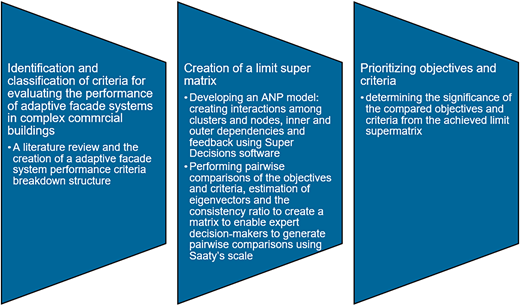
Implementation of ANP model for evaluation of the performance of adaptive façade systems in complex commercial buildings
Implementation of ANP model for evaluation of the performance of adaptive façade systems in complex commercial buildings
4.2 Identification and categorization of high performance criteria for adaptive façade systems in complex commercial buildings
Objective and criteria are identified on the basis of related literature studies, reports and data collected along with interviews and focus groups wherein the complete potential criteria are considered. In this research, the performance criteria for adaptive façade systems complex in commercial buildings were acquired from a literature analysis, as presented in Table 2. The interviews were semistructured based on a literature review involving high performance criteria of adaptive façade systems. The interview questions primarily focused on validation of the multifunctional, dynamic and adaptive façade systems involving energy efficiency and environment, indoor comfort conditions, performance-related functions, maintenance and life cycle and adaptivity. The interview structure consisted of four main sections including background information and professional experience of the interviewees, definition of adaptive façade systems, advantages and performance indicators of adaptive façade systems and future of adaptive façade systems. Consequently, a questionnaire was distributed to producer and supplier companies specialized in adaptive façade systems for commercial buildings. The categorization of the respondents was done on the basis of their responsibilities and actions related with the projects. Table 3 shows the distributions of the respondents of the survey from different participating organizations and groups. A total of 120 completed questionnaires, as indicated in Table 3, were collected, providing a high response rate of 65%. This shows that the procedure in sampling was efficient, and the participants understood the research to be applicable and meaningful. The contributors were requested to rate the significance of the objectives and criteria based on a five-point Likert scale of 1 (strongly disagree) to 5 (strongly agree).
Previous studies undertaken in the identification of high performance criteria of adaptive façade systems
Distributions of the respondents' background and their positions in the company
| Respondent | Position | Year of experience | Number/% |
|---|---|---|---|
| Producer | Production Manager | 16 | 9/7.5 |
| Line Manager | 12 | 12/10 | |
| Design Manager | 11 | 12/10 | |
| Designer | 10 | 15/12.5 | |
| Supplier | Project Manager | 15 | 15/12.5 |
| Construction Manager | 14 | 15/12.5 | |
| Design Manager | 13 | 24/20 | |
| Designer | 10 | 18/15 | |
| Total | 120/100 |
Production managers, line managers, design managers, designers, project managers and construction managers were allocated ratings of significance based on the categorization of high performance criteria for adaptive façade systems. Figure 1 illustrates the average of these importance levels. A prominent level of similarity in high performance criteria of adaptive façade system was demonstrated by the responses of the various groups of participants as seen in Figure 3.
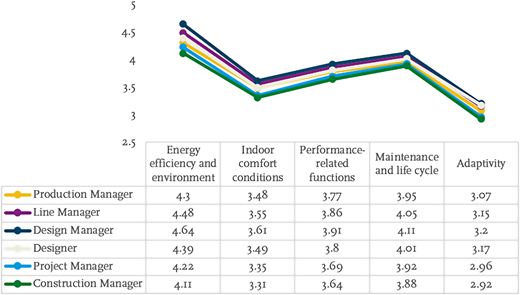
Similarity of the importance given to the high performance criteria of adaptive façade system among the respondents
Similarity of the importance given to the high performance criteria of adaptive façade system among the respondents
The nominal group technique (NGT) is applied to measure and rank viewpoints by confirming that group discussion to produce ideas occurs with a precise format. This admits prioritization of many viewpoints with mutual contribution (Kermanshachi et al., 2016). It supports the group of experts to accomplish consent by way of scoring. This procedure is favored as it enables rapid and shared decision-making among the participants. With respect to the priority rankings, high performance criteria were created by employing NGT with 20 experienced contributors. Table 4 quantitatively reveals the profile of qualified contributors, including Production Manager, Line Manager, Design Manager, Designer, Project Manager, Construction Manager, with the years of their experience.
Focus groups participants' profile
| Respondent | Position | Year of experience | Number/% |
|---|---|---|---|
| Producer | Production Manager | 15 | 2/10 |
| Line Manager | 13 | 2/10 | |
| Design Manager | 10 | 3/15 | |
| Designer | 10 | 3/15 | |
| Supplier | Project Manager | 14 | 2/10 |
| Construction Manager | 13 | 2/10 | |
| Design Manager | 12 | 3/15 | |
| Designer | 10 | 3/15 | |
| Total | 20/100 |
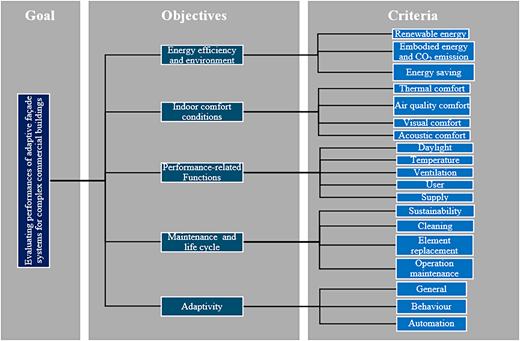
Identification of high performance criteria of adaptive façade system process may lead to imprecise information if it is not performed correctly and accurately. Therefore, it is necessary to determine the relations between high performance criteria and transform them into a clear structure when acquiring high performance criteria. Consequently, as demonstrated in Figure 4, an adaptive façade system breakdown structure was created by separating the high performance criteria related with adaptive façade systems into five main objectives and setting criteria under each of these main objectives.
4.3 The process of the developing the limit supermatrix
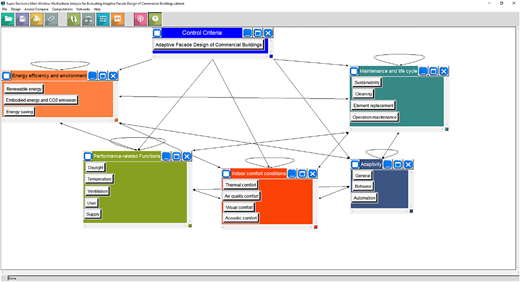
The ANP method encompasses feedback and interdependence attributes. Hence, the criteria determined by external clusters (groups of performances of adaptive façade systems in each classification) can additionally be associated within themselves. Regarding the studies based on ANP, dependencies between clusters are known as external dependencies, and dependencies within clusters are named as internal dependencies. Furthermore, because the ANP approach encompasses mutual connections among the internal dependencies and the criteria, it secures more valuable and reasonable solutions in the decision-making phase (Görener, 2009). Considering the adaptive façade system breakdown structure achieved using Super Decisions software and the usage of connections between objectives and criteria including inner and outer dependencies, an ANP model was developed as demonstrated in Figure 5.
Afterward, comparison matrices were created and circulated to 40 expert decision-makers along with the Saaty's (1996) 1–9 scale. Table 5 indicates the profile of the respondents who completed pairwise comparisons. As illustrated, the respondents consist of production manager, line manager, design manager, designer, project manager and construction manager.
Pairwise comparison of respondents' profile
| Respondent | Position | Year of experience | Number/% |
|---|---|---|---|
| Producer | Production Manager | 15 | 8/20 |
| Line Manager | 13 | 4/10 | |
| Design Manager | 10 | 4/10 | |
| Designer | 10 | 4/10 | |
| Supplier | Project Manager | 14 | 8/20 |
| Construction Manager | 13 | 4/10 | |
| Design Manager | 12 | 4/10 | |
| Designer | 10 | 4/10 | |
| Total | 40/100 |
Table 6 illustrates a blank template of the comparison matrix to be filled in by the 40 experts involving the objectives “energy efficiency and environment”. The experts were requested to fill in the blank fields applying the values of Saaty's ranking scale. For instance, regarding the objective “energy efficiency and environment” shown in Table 8, when the criterion “embodied energy and CO2 emission” is compared to the criterion “renewable energy”, the value 1/8, indicating that embodied energy and CO2 emission is very strong important than renewable energy. In this context, the geometric average of all the criteria rated by 40 experts was taken and reduced to objective tables. Values of scale shown in Tables 8–12 have been filled in accordingly. The calculation of eigen vectors is obtained by normalizing the paired comparison matrix and taking the average of each row. The main reason for calculating eigenvectors is to check the consistency of the comparison ratings. The maximum eigenvector is determined by multiplying the eigenvectors with the matrix size and taking the average of the eigenvector column. Afterward, the consistency ratios (CRs) are calculated by using the maximum eigenvectors to find the CI . If the consistency values are below 0.1, they are considered sufficiently consistent; otherwise iterations are repeated if they exceed the threshold value.
A sample of pairwise comparison matrix presented to experts
| Renewable energy | Embodied energy and CO2 emission | Energy saving | |
|---|---|---|---|
| Renewable energy | 1 | - | – |
| Embodied energy and CO2 emission | ■ | 1 | – |
| Energy saving | ■ | ■ | 1 |
Note(s): ■ indicates not to be filled in; 1 indicates equal importance; - indicates Fill in by one of the numbers of the scale: 1/9, 1/7, 1/5, 1/3, 3, 5, 7 and 9
– intermediate values 1/8, 1/6, 1/4, 1/2, 2, 4, 6 and 8
Pairwise comparison regarding energy efficiency and environment
| Renewable energy | Embodied energy and CO2 emission | Energy saving | Eigenvector | |
|---|---|---|---|---|
| Renewable energy | 1 | 1/8 | 1/4 | 0.070 |
| Embodied energy and CO2 emission | 8 | 1 | 4 | 0.707 |
| Energy saving | 4 | 1/4 | 1 | 0.222 |
Note(s): Consistency ratio (CR) = 0.05156
Pairwise comparison regarding indoor comfort conditions
| Thermal comfort | Air quality comfort | Visual comfort | Acoustic comfort | Eigenvector | |
|---|---|---|---|---|---|
| Thermal comfort | 1 | 6 | 3 | 8 | 0.587 |
| Air quality comfort | 1/6 | 1 | 1/3 | 3 | 0.108 |
| Visual comfort | 1/3 | 3 | 1 | 5 | 0.251 |
| Acoustic comfort | 1/8 | 1/3 | 1/5 | 1 | 0.051 |
Note(s): Consistency ratio (CR) = 0.03694
Pairwise comparison regarding performance-related functions
| Daylight | Temperature | Ventilation | User | Supply | Eigenvector | |
|---|---|---|---|---|---|---|
| Daylight | 1 | 6 | 3 | 8 | 9 | 0.516 |
| Temperature | 1/6 | 1 | 1/3 | 6 | 6 | 0.138 |
| Ventilation | 1/3 | 3 | 1 | 8 | 9 | 0.272 |
| User | 1/8 | 1/6 | 1/8 | 1 | 2 | 0.041 |
| Supply | 1/9 | 1/6 | 1/9 | 1/2 | 1 | 0.030 |
Note(s): Consistency ratio (CR) = 0.08298
Pairwise comparison regarding maintenance and life cycle
| Sustainability | Cleaning | Element replacement | Operation maintenance | Eigenvector | |
|---|---|---|---|---|---|
| Sustainability | 1 | 4 | 9 | 3 | 0.536 |
| Cleaning | 1/4 | 1 | 7 | 1/3 | 0.144 |
| Element replacement | 1/9 | 1/7 | 1 | 1/9 | 0.034 |
| Operation maintenance | 1/3 | 3 | 9 | 1 | 0.284 |
Note(s): Consistency ratio (CR) = 0.09258
Pairwise comparison regarding adaptivity
| General | Behavior | Automation | Eigen vector | |
|---|---|---|---|---|
| General | 1 | 1/4 | 1/7 | 0.075 |
| Behavior | 4 | 1 | 1/4 | 0.229 |
| Automation | 7 | 4 | 1 | 0.695 |
Note(s): Consistency ratio (CR) = 0.07348
Comparisons of the objectives and criteria achieved were exploited simultaneously in Super Decisions software to calculate the eigenvectors (order of priority) and CRs. CI is calculated by Equation (1):
where λmax is the largest eigenvalue, and n is the number of criteria.
CI is then used to calculate the CR, as seen in Equation (2):
Table 7 shows the random index (RI) values (Saaty, 1980).
Random index (RI) values (Saaty, 1980)
| N | 1 | 2 | 3 | 4 | 5 | 6 | 7 | 8 | 9 | 10 | 11 | 12 | 13 | 14 | 15 |
|---|---|---|---|---|---|---|---|---|---|---|---|---|---|---|---|
| RI | 0 | 0 | 0.58 | 0.90 | 1.12 | 1.24 | 1.32 | 1.41 | 1.45 | 1.49 | 1.51 | 1.48 | 1.56 | 1.57 | 1.59 |
In Table 8, the “embodied energy and CO2 emission” criterion has the highest significance with an eigenvalue of 0.707. Simultaneously, the CR (0.05156) calculated on the line of the eigenvectors is below 0.1 and shows that it is sufficiently consistent. In Table 9, the “thermal comfort” criterion has a high significance with an eigenvalue of 0.587. Concurrently, the CR (0.03694) obtained in the light of eigenvectors shows that the rating made under indoor comfort conditions is sufficiently consistent. Table 10 indicates that the “daylight” criterion has a high significance with an eigenvalue of 0.516. In fact, the calculated consistency rate (0.08298) displays that the ratings made under performance-related functions are consistent. In Table 11, the “sustainability” criterion is of primary importance with an eigenvalue of 0.536. Certainly, the determined consistency value (0.09258) demonstrates that the comparison made under maintenance and life cycle is consistent. In Table 12, “automation” is rated as the most important criterion with an eigenvalue of 0.695. Concurrently, the consistency value obtained proves the consistency of the rating made under adaptivity. Table 13 illustrates a cross section of the limit supermatrix (priority values) obtained in the Super Decision software. Parallel to this, Table 14 represents the priority values as collectively and as percentages.
A section of limit super matrix for high performance criteria of adaptive façade systems in complex commercial buildings (priority values)
| Energy efficiency and environment | Adaptivity | ||||||
|---|---|---|---|---|---|---|---|
| Renewable energy | Embodied energy and CO2 emission | Energy saving | General | Behavior | Automation | ||
| Energy efficiency and environment | Renewable energy | 0.028640 | 0.028640 | 0.028640 | 0.028640 | 0.028640 | 0.028640 |
| Embodied energy and CO2 emission | 0.288673 | 0.288673 | 0.288673 | 0.288673 | 0.288673 | 0.288673 | |
| Energy saving | 0.090926 | 0.090926 | 0.090926 | 0.090926 | 0.090926 | 0.090926 | |
| Indoor comfort conditions | Thermal comfort | 0.057857 | 0.057857 | 0.057857 | 0.057857 | 0.057857 | 0.057857 |
| Air quality comfort | 0.010703 | 0.010703 | 0.010703 | 0.010703 | 0.010703 | 0.010703 | |
| Visual comfort | 0.024792 | 0.024792 | 0.024792 | 0.024792 | 0.024792 | 0.024792 | |
| Acoustic comfort | 0.005086 | 0.005086 | 0.005086 | 0.005086 | 0.005086 | 0.005086 | |
| Performance-related functions | Daylight | 0.083587 | 0.083587 | 0.083587 | 0.083587 | 0.083587 | 0.083587 |
| Temperature | 0.022503 | 0.022503 | 0.022503 | 0.022503 | 0.022503 | 0.022503 | |
| Ventilation | 0.044193 | 0.044193 | 0.044193 | 0.044193 | 0.044193 | 0.044193 | |
| User | 0.006742 | 0.006742 | 0.006742 | 0.006742 | 0.006742 | 0.006742 | |
| Supply | 0.004877 | 0.004877 | 0.004877 | 0.004877 | 0.004877 | 0.004877 | |
| Maintenance and life cycle | Sustainability | 0.142288 | 0.142288 | 0.142288 | 0.142288 | 0.142288 | 0.142288 |
| Cleaning | 0.038394 | 0.038394 | 0.038394 | 0.038394 | 0.038394 | 0.038394 | |
| Element replacement | 0.009138 | 0.009138 | 0.009138 | 0.009138 | 0.009138 | 0.009138 | |
| Operation maintenance | 0.075405 | 0.075405 | 0.075405 | 0.075405 | 0.075405 | 0.075405 | |
| Adaptivity | General | 0.004993 | 0.004993 | 0.004993 | 0.004993 | 0.004993 | 0.004993 |
| Behavior | 0.015162 | 0.015162 | 0.015162 | 0.015162 | 0.015162 | 0.015162 | |
| Automation | 0.046041 | 0.046041 | 0.046041 | 0.046041 | 0.046041 | 0.046041 | |
Priority orders
| Objectives | Criteria | Priority | Priority % |
|---|---|---|---|
| Energy efficiency and environment | Embodied energy and CO2 emission | 0.28867 | 28.87 |
| Maintenance and life cycle | Sustainability | 0.14229 | 14.23 |
| Energy efficiency and environment | Energy saving | 0.09093 | 9.09 |
| Performance-related functions | Daylight | 0.08359 | 8.36 |
| Maintenance and life cycle | Operation maintenance | 0.07541 | 7.54 |
| Indoor comfort conditions | Thermal comfort | 0.05786 | 5.79 |
| Adaptivity | Automation | 0.04604 | 4.60 |
| Performance-related functions | Ventilation | 0.04419 | 4.42 |
| Maintenance and life cycle | Cleaning | 0.03839 | 3.84 |
| Energy efficiency and environment | Renewable energy | 0.02864 | 2.86 |
| Indoor comfort conditions | Visual comfort | 0.02479 | 2.48 |
| Performance-related functions | Temperature | 0.02250 | 2.25 |
| Adaptivity | Behavior | 0.01516 | 1.52 |
| Indoor comfort conditions | Air quality comfort | 0.01070 | 1.07 |
| Maintenance and life cycle | Element replacement | 0.00914 | 0.91 |
| Performance-related Functions | User | 0.00674 | 0.67 |
| Indoor comfort conditions | Acoustic comfort | 0.00509 | 0.51 |
| Adaptivity | General | 0.00499 | 0.50 |
| Performance-related functions | Supply | 0.00488 | 0.49 |
The results of CRs were examined to validate that they were below 0.1. Among all pairwise comparisons that were made, displayed in Tables 8–12. Following the application of pairwise comparisons and confirmation of CRs, the Super Decisions software is performed to acquire the limit supermatrix for achieving the high performance criteria sorted in the priority order. Table 13 represents a section of the limit super matrix that was acquired.
5. Discussion of results
The values obtained in Table 14 reveal that the most significant high performance criteria are listed in energy efficiency and environment and maintenance and life cycle categories. The first two important criteria signifying the “embodied energy and CO2 emission” and “sustainability” display the priority values of 28.87 and 14.23%, respectively. The results are congruent with the recent previous studies (Azari and Abbasabadi, 2018; Crespi and Persiani, 2019) supporting the contention that the amount of embodied energy is anticipated to increase with the growing number of low energy buildings that reduce their operational energy at the distribution of a rise in their embodied energy through the integration of active and passive technologies and building systems (Azari and Abbasabadi, 2018). Based on the requirements for optimization of operational energy in buildings that the theme of adaptive facades has created a significant form of technological solutions encouraging for higher comfort conditions while reducing energy use. Adaptive façade systems are characterized by their specific functioning and considered of energy efficiency signifying views of the system's real sustainability. Embodied energy and CO2 emission of the system is extremely interesting as a result of its potential to reduce the environmental impacts on the usage phase (Crespi and Persiani, 2019).
The third high performance criterion is “energy saving” having the priority value of 9.09%. The results are consistent with the recent previous studies (Tabadkani et al., 2020a, b; Bui et al., 2020; Albag et al., 2020) supporting the view that adaptive façade systems include building envelopes, which can manage occupant's visual and thermal comfort along to increase energy savings (Tabadkani et al., 2020a, b). Adaptive façade systems are reflected as a probable solution to improve the energy efficiency of buildings (Bui et al., 2020). Adaptive façade systems, utilizing stimulus-responsive materials and smart handling systems, can transform in response to environmental settings, consequently increasing inhabitants' comfort and improving energy savings (Albag et al., 2020).
The fourth high performance criterion is “daylight” having the priority value of 8.36%. The results are coherent with the recent previous studies (Bui et al., 2020; Cheong et al., 2020; Loonen et al., 2013; Tabadkani et al., 2020a, b) supporting the argument that the changes of climatic condition, i.e. daylight, cause major challenges to the performance of an adaptive façade system for net zero energy buildings (nZEB) (Bui et al., 2020). Specifically, in office buildings, it is crucial to ensure effective daylighting systems to control undesirable solar gains and discomfort brightness, whilst counteracting electrical lighting loads (Cheong et al., 2020). Building façades have to be adaptive to short-time weather variations, daily cycles or seasonal repetitions and have the ability to compensate aggressive performance criteria of indoor environment of inhabitants to accomplish enhanced performance contrasted to static shading systems (Loonen et al., 2013). Hence, adaptive façade systems can maintain the stability between the daylight collecting and maximizing outdoor view while reducing visual discomfort and energy load of building (Tabadkani et al., 2020a, b).
The fıfth high performance criterion is “operation maintenance” having the priority value of 7.54%. The results are accordant with the recent previous studies (Loonen et al., 2015; Aresta, 2017; Santos et al., 2020; Attia et al., 2018) supporting the opinion that adaptive facade systems function in inherent manner that is capable of self-setting; subsequently, the adaptive performance is routinely stimulated by environmental incentives (Loonen et al., 2015), requiring no processors or external power (Aresta, 2017), thereby allows low-cost operation and maintenance (Loonen et al., 2015; Santos et al., 2020). Smart and predictive maintenance can ensure adaptive façade systems’ vigorous performance and their liability (Attia et al., 2018).
The sixth high-performance criterion is “thermal comfort” having the priority value of 5.79%. The results are congruent with the recent and previous studies (Altomonte et al., 2019; Pastore and Anderson, 2019) supporting the contention that evaluating comfort and inhabitants' satisfaction is an increasing concern in adaptive façade systems, as growing appreciation of the significance of comfort of inhabitants in office buildings. Thermal comfort is one of the firmest discern of comfort and satisfaction of inhabitants in buildings (Altomonte et al., 2019; Pastore and Anderson, 2019).
The seventh high-performance criterion is “automation” having the priority value of 4.60%. The results are consistent with the recent and previous studies (Dominges et al., 2016; Boeke et al., 2019; Böke et al., 2020; Attia, 2018) supporting the view that automation currently performs a critical role in facility management of buildings. Building automation systems (BASs) operate, monitor and control numerous features of building services to ensure the interior comfort while saving energy (Domingues et al., 2016). The related intelligent assistance of automated adaptive façade operations, stimulated by intelligent technological systems in Industry 4.0, suggests a prospective for the total building performance (Böke et al., 2020). A tool for evaluating the automated adaptive application of specific façade operations based on predescribed attributes was presented (Boeke et al., 2019). Adaptive façade comprising automated dynamic solar screen reacts dynamically and automatically to the angle of the sun, thereby enhances the control of energy consumption, solar radiation and brightness with the capacity to permit natural light into the building (Attia, 2018).
The eighth high performance criterion is “ventilation” having the priority value of 4.42%. The results are coherent with the recent previous studies (Iommi, 2018; Sánchez et al., 2020) supporting the argument that an air gap is created for the adaptive façade module to adjust the energy efficiency, provide a ventilated façade or increase the thickness insulation content if necessary (Iommi, 2018). Ventilated façades are very commonly utilized passive components unified inside to buildings, specifically to minimize these loads. This decrease is as a result of the airflow generated in the air chamber through the resilience forces, as the solar waves warm the external tier of the façade (Sánchez et al., 2020). The ventilated façades are described primarily through the existence of a ventilated conduit built among the interior and exterior layers of the building façade. An effective design of these approaches must thoroughly contemplate operational and implementation involvements, along with aesthetic options and architectural concerns.
The ninth high performance criterion is “cleaning” having the priority value of 3.83%. The results are accordant with the recent and previous studies (Sandak et al., 2019; Romano et al., 2021) supporting the opinion that as the requirement for building maintenance is rising, automated building façade cleaning has turned out to be vital. Distinctive adaptation solutions can be employed in innovative materials, which are utilized in building façade built in certain climate zones. The optimization process is supposed to stimulate the advancement of active biomaterials acting as interfaces between outside settings and interior comfort that are capable to balance and coordinate self-clean and self-heal (Sandak et al., 2019; Romano et al., 2021).
The tenth high performance criterion is “renewable energy” having the priority value of 2.86%. The results are congruent with the recent and previous studies (Perino and Serra, 2015) supporting the contention that adaptive façade systems can achieve significant improvement in energy efficiency and in encouraging the usage of renewable energy in the built environment. The components in these adaptive façade systems can constantly and proactively respond to outdoor and indoor environment conditions and enable and improve the utilization of renewable and low energy sources (Periono and Serra, 2015).
The eleventh high performance criterion is “visual comfort” having the priority value of 2.48%. The results are consistent with the recent and previous studies (Michael et al., 2018; Tabadkani et al., 2019) supporting the view that the adaptive façade systems enable the enhancement of the visual comfort conditions of the buildings' inhabitants through optimization of natural lighting performance and the reduction of glare problems, together with the minimization of energy consumption of the building produced by the usage of artificial lighting (Michael et al., 2018). There is the necessity of adaptive solar façade systems allowing adaptability to climate change and having capability of optimized visual comfort (Tabadkani et al., 2019). A hexagonal adaptive system to accomplish the highest visual comfort level based on the inhabitants' preferences that can be the foundation for potential asset on smart building envelopes was presented.
The twelfth high performance criterion is “temperature” having the priority value of 2.25%. The results are coherent with the recent and previous studies (Böke et al., 2020; Rizi and Entawel, 2021; Hosseini et al., 2019) supporting the argument that adaptive façade systems involve the automated control of blinds reliant on the outdoor temperature, amount of light and wind speeds and revealed that optimized adaptive shadings reduce the heat gain due to high temperature at significant levels (Rizi and Entawel, 2021). Kinetic façade systems adapt microclimate in an ecological environment by regulating airflow, solar radiation throughout the facade body causing in modifying surfaces temperature of the building close to the interior spaces (Hosseini et al., 2019).
This study is unique in terms of implementing the ANP method for evaluating the comprehensively compiled objectives and high performance criteria of adaptive façade systems. Performing such quantitative and qualitative evaluations of the explored wide domain of design parameters for adaptive façade systems will contribute to the development of a generative design approach in a multi-disciplinary platform. The presented approach will encourage cumulativity and divergent thinking and facilitate functional decomposition of performance criteria in the design of adaptive façade systems for complex buildings.
6. Managerial implications
This research primarily provides the required actions and evaluations for design managers in accomplishing a high performance adaptive façade system by utilizing an ANP method. In developing a systematic decision-making process, the design managers can primarily describe adaptive façade system goals, objectives, criteria and limitations. Before beginning the adaptive façade system of a building design procedure, the design manager should decide on the significance of each of these criteria since high performance priorities will affect the determinations during the overall design procedure. For this purpose, design managers need to compare the high performance criteria. The ANP model signifies the interdependencies of high performance goals, objectives and criteria in detail. Pairwise comparison values of CRs and limit super matrices acquired through Super Decisions. Pairwise comparisons facilitated the order of the priorities between criteria. Validity of the comparisons is tested by consistency indices. Priority values of the high performance criteria are exposed by the limit supermatrix; moreover, the comparisons of criteria priority orders are unambiguously expressed. This ANP model could attract attention of design managers of producer and supplier firms. The findings achieved through presented research could be provided as a guideline and promote the evaluation of potential adaptive façade systems. Additionally, the findings could be applied to contrast and differentiate the priority orders of high performance criteria for evaluating adaptive façade systems forthcoming MCDM research studies and verify alterations. This ANP model accomplishes encouraging consequences for evaluation of high performance criteria in planning and designing phases of adaptive façade systems in complex commercial buildings.
The ANP method implemented in this study can contribute to the design of multifunctional, dynamic and adaptive façade systems. A comprehensive understanding of the function and technological solutions for the building envelope are provided for the designers. Designers will be aware of these technologies to be enabled to effectively design better and support industry to develop sustainable solutions. Such systems could be used as responsive and dynamic building elements and contribute to an improved performance and energy efficiency of building envelope. A sample of a design criteria assessment for the performance of adaptative façade systems is illustrated in Table 15. The criteria and associated objectives, behavior/action and benefits of each of them are specified. It is worth to note that prioritized criteria have their own objectives and goals regarding the performance of the type of adaptive façade system under consideration. Design managers can use the prioritized criteria as an executive tool for the systematic assessment of adaptive façade functions in accomplishing building envelopes to analyze the technical basis for implementation. This systematic assessment of adaptive façade functions could contribute to the designers' parametric design thinking approaches facilitating quantitative and qualitative evaluations, combining many design variants and diverse methods and creating a multidisciplinary platform for exploring wide domain of design varieties. Such generative design approach is generally aimed at improving the indoor environmental quality, at facilitating the exploitation of renewable energy sources at the building scale and can involve novel / smart materials or an extension of specific principles (like bio-mimetic and nature-based concepts) for building enclosures.
A sample of a design criteria assessment for the performance of adaptative façade systems
| Criteria | Objectives | Behavior/Action | Benefits |
|---|---|---|---|
| Embodied energy and CO2 emission | Energy efficiency and environment | Integration of active and passive technologies | Reduced operational energy |
| Sustainability | Maintenance and life cycle | Minimizing operational maintenance | Reduced life cycle costs |
| Energy saving | Energy efficiency and environment | Optimization of heating and cooling loads | Reduced energy consumption |
| Daylight | Performance-related functions | Maintaining the stability between daylight collecting and maximizing outdoor view | Reduced visual discomfort and energy load of building |
| Operation maintenance | Maintenance and life cycle | Ensuring smart and predictive maintenance | Low-cost and vigorous performance |
| Thermal comfort | Indoor comfort conditions | Controlling solar radiation and maintaining comfortable operative temperatures | Ensured comfort level of indoor environment |
| Automation | Adaptivity | Reacting dynamically and automatically to environmental conditions | Automated and adaptive façade operations |
| Ventilation | Performance-related functions | Regulating vigorously the air-flow intake under suitable weather conditions | Utilized low energy or passive components to minimize energy loads |
| Cleaning | Maintenance and life cycle | Active biomaterials acting as interfaces between outside settings and interior comfort | Balanced and coordinated self-clean and self-heal |
| Renewable energy | Energy efficiency and environment | Constantly and proactively responding to outdoor and indoor environment conditions | Enabled and improved utilization of renewable and low energy sources |
| Visual comfort | Indoor comfort conditions | Optimization of natural lighting performance and the reduction of glare problems | Enhanced lighting levels and visibility to the outer environment |
7. Conclusions and recommendations
Several fields and information sources are included in the decision-making procedure of evaluating performances of adaptive façade systems for complex commercial buildings. The multi-disciplinary character of adaptive façade systems, besides the need for the necessity for ensuring high-performance criteria, lead the decision-making process to turn out to be significantly complex. This complexity is more evident during the evaluation of the entire essential high-performance criteria that may be mutually contradictory. Consequently, a comprehensive method is required to evaluate the high performance criteria of adaptive façade systems in complex commercial buildings.
In this research, a relatively innovative, systematic and practical method is suggested to support the decision-making process for evaluation of the high performance criteria of adaptive façade systems in complex commercial buildings. For this purpose, major goals, objectives as well as criteria, which compose a high performance adaptive façade system, were identified, and the design managers were procured with a collaborative and comprehensive guidance for the evaluation of adaptive façade system that defines the considerations required for high performance criteria.
A prevalent literature review was primarily performed to identify the high performance criteria for evaluation of adaptive façade systems. Congruently, explanatory sessions with competent specialists were organized, and a hierarchical adaptive façade system breakdown structure was developed. With the hierarchical adaptive façade system breakdown structure, the Super Decisions software was employed for the application of an ANP model. The pairwise comparisons acquired through the ANP model were accomplished in collaboration with competent specialists in adaptive façade systems. The limit supermatrix was achieved to obtain the orders of priority for high performance criteria employing pairwise comparison matrix values in the Super Decisions software. Embodied energy and CO2 emission, sustainability, energy saving, daylight and operation maintenance were acknowledged as the most significant high performance criteria for adaptive façade systems in complex buildings.
Though this research suggested a variety of prospects for future research, it has limitations as well. First, the objectives and criteria identified for evaluation were constrained. Second, objectives and criteria were limited to complex commercial buildings. Third, this research focused on the high performance criteria of adaptive façade systems challenged during planning and design phases. For future studies, it could be investigated to what extent the determined high performance criteria have a major influence on total building performance and the comfort level of inhabitants.

