


This paper explores the evidence of a long-run co-movement between aggregate unemployment insurance spending and the labor force participation rate in the USA. The unemployment insurance (UI) program tends to expand during an economic downturn and contract during an expansion. UI may incentivize unemployment and may also facilitate better matching in the labor market. Statistical evidence of the presence of a co-movement will thus shed new light on their dynamics.
This research applies time-series econometric approach using monthly data from 1959:1 to 2020:3 to test threshold cointegration and estimate a threshold vector error-correction (TVEC) model. The estimates from the TVEC model investigating the nature of short-run dynamics.
The Enders and Siklos (2001) test find evidence of threshold cointegration between the two indicating the presence of long-run co-movement. The estimates from the TVEC model investigating the nature of short-run dynamics find evidence that the growth in aggregate UI spending and the growth in labor force participation rate adjust simultaneously to maintain the long-run co-movement above the threshold in the short run. The author also observes the same short-run dynamics for the growth in aggregate UI spending and the growth in the labor force participation rate for females.
This model is bi-variate by construction and does not address causality.
The author argues that the UI program positively impacts the female labor market outcomes, for example, better matching. This finding may explain the upward trend in the labor force participation rate for females in the USA.
The research findings may justify the transfer programs for minority and immigrants.
This is first research that analyzes the UI programs impact on the labor force participation using a macroeconometric approach. To the best of the author's knowledge, this is the first study in this genre.
1. Introduction
Does the unemployment insurance (UI) program influence unemployment and labor force participation? Usually, the government expands the coverage and duration of eligibility for the UI program when the labor market is sluggish. We also observe the government (both state and federal) change the UI eligibility and duration once the economy starts to revive from a business cycle contraction [1]. The motivation to expand the UI program is to mitigate the negative consequences of income loss caused by cyclical unemployment during a recession, which may function as an automatic stabilizer during recessions. There is a plethora of microeconometric and theoretical models in labor economics that investigate various aspects related to the UI program's impact on unemployment and/or duration of unemployment and the labor force participation rate. Results from these studies find evidence of the UI program impacting unemployment and duration of unemployment (for example, Farber, Rothstein, & Valetta, 2015). The discussion on UI policy's impact on the labor market outcome is not free from controversy. The UI program creates an incentive for unemployed people to delay their job search, therefore impacting the labor force participation (Hagedorn, Karahan, Manovskii, & Mitman, 2015; Mulligan, 2012). These studies conclude that a generous UI program creates an incentive to remain unemployed as an unintended consequence of the policy. On the other hand, some studies emphasize the potential stimulus effects of increasing transfers to unemployed individuals (Congressional Budget Office, 2012; Kekre, 2021; Maggio & Kermani, 2016). It is required for the UI recipients to search for jobs while receiving unemployment benefits. The UI program may likely improve labor market matching among frictionally or structurally unemployed. Hence, it is plausible that aggregate UI spending and the labor force participation rate may depict a common trend overtime.
The labor force participation rate overtime is a key macroeconomic indicator that shows us how the work-eligible adult population is performing in the labor market. The UI program is likely to influence labor force participation. Unemployment insurance spending is subject to a lot of political debate and scrutiny. Policymakers tend to expand UI spending with the rise in cyclical unemployment. The aggregate UI spending and labor force participation rate are arguably related [2] depicting the presence of a common long-run trend. We may also expect the common long-run trend to depict some interesting short-run dynamics. Cyclical unemployment increases during recessions. If the UI program disincentive the labor force seeking formal employment, we may observe the labor force participation to rise in the short run. The unemployment rate falls during economic expansions, and we observe the aggregate UI spending to fall as well. If the UI program is improving labor market matching for the unemployed, we may expect the UI spending to accommodate in the short run. The labor market dynamics may show different variations for male and female members of the labor force. In the USA, we observe the labor force participation rate for females depicts an increasing trend, whereas the labor force participation rate for males depicts a decreasing trend (see Figure 1). The UI program may impact the female labor force differently than the male labor force. The short-run dynamics may depict different variations from a gender perspective as well.
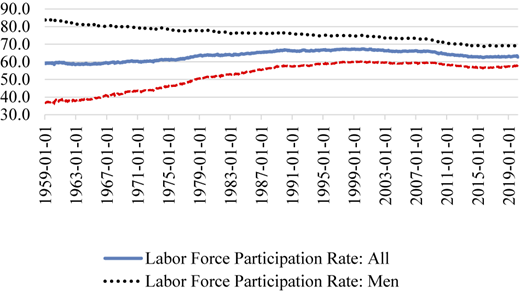
We may observe that the aggregate UI spending and labor force participation may show some common dynamics in one regime in comparison to another. The UI spending expands during recessions when cyclical unemployment rise. During expansions, we may observe the labor market respond in a lagged manner. The policymakers may choose to curtail the funding or shorten the eligibility when the economy is expanding. As such, the short-run dynamics discussed earlier may show different dynamics in the short run in one regime as opposed to the other. In this paper, we investigate the dynamics between aggregate UI spending and the labor force participation rate from a macroeconomic perspective in the USA. This paper envisages investigating the presence of a long-run equilibrium relationship or co-movement between aggregate UI spending and labor force participation rate, and how the co-movement adjusts in the short run in one regime as opposed to another. The sign and direction of the short-run adjustment of the long-run relationship may indicate whether the UI discourages job search or improves matching in the labor market or otherwise in one regime as opposed to another. The labor force participation rate is very much likely to be influenced by a myriad of the labor market and demographic factors. For example, technological transformation through automation will create redundancy in the labor market, and spousal movements may create involuntary unemployment as well as nonparticipation. We also observe state-level variations in the implementation of the UI policy. These aspects are very important for the labor market and have received a lot of attention in microeconomic studies. The UI is a government policy program, whereas the labor force participation rate is a macroeconomic aggregate involving the labor market. This research envisages investigating the long-run dynamic association between aggregate UI spending and the labor force participation rates and their short-run dynamics in a macroeconomic regime-based perspective.
This research uses monthly time series data on aggregate UI spending and the labor force participation rate in the USA spanning from 1959:1 to 2020: 03 [3]. The data are collected from the Federal Reserve Bank of St. Louis website. The labor force participation rate is an aggregate for the labor market and further disaggregated into male and female. To investigate the presence of co-movement or the presence of a long-run equilibrium relationship, we test for cointegration. The Johansen test (1990) and the Phillips and Ouliaris (1990) tests find no evidence of cointegration or a long-run co-movement. Most macroeconomic time-series are subject to structural breaks and respond to the business cycle. The aggregate UI spending during a recession and reduces during an expansion. To address this nonlinearity, we employ the Enders and Siklos (2001) threshold cointegration test. This test finds formal statistical evidence of threshold cointegration between the two. This test also finds evidence of threshold cointegration between the aggregate UI spending and the male and female labor force participation rates. These results provide robust statistical evidence of a common long-run trend between aggregate UI spending and the labor force participation rate in the USA. To analyze the short-run dynamics of this long-run common trend, we estimate the threshold vector error-correction (TVEC) model. The estimates from the TVEC model investigating the nature of short-run dynamics find evidence that the growth in aggregate UI spending and the growth in labor force participation rate adjust to maintain the long-run co-movement above the threshold in the short run simultaneously. This finding is consistent with the microeconometric studies and conforms to economic reality. We observe the same short-run dynamics for the aggregate UI spending and the labor force participation rate for females above and below the threshold in the short run. The estimates from the TVEC model find evidence that the growth in aggregate UI spending and the growth in labor force participation rate for females adjust simultaneously in the short run to maintain the long-run co-movement above and below the threshold. Perhaps, the UI program positively impacts the female labor market outcomes, for example, better matching. This finding may explain the upward trend in the labor force participation rate for females in the USA.
2. Literature review
There is a plethora of research in labor economics that investigates various aspects related to the UI policy and how it impacts the unemployment, unemployment duration and incentive mechanism in the labor market. The findings from these studies vary in their conclusion as the studies themselves vary in their respective research questions and the corresponding empirical approach [4].
Johnston and Mas (2018) investigate the impact of a reduction or cut in the UI eligibility weeks' impact on the job search behavior among the recipients in the state of Missouri. This study finds evidence of increased job search, subsequently almost 1% point decline in the unemployment rate due to the benefit cut. The authors argue that an influx of workers did not crowd out the other job seekers in the labor market after the benefit cut at the times of high unemployment during the Great Recession period. This study, however, finds limited effects of shortened benefit duration on the long-term unemployment rate. Chodorow-Reich and Karabarbounis (2016) investigate the impact of benefit extension on unemployment from a macroperspective. The authors use data revisions to decompose the variation in the duration of UI benefits into parts coming from economic conditions and measurement error. Results indicate that the UI benefits extension has a limited influence on state-level macroeconomic indicators. This study also finds that the benefits extension increases the unemployment rate by 0.3% points during the Great Recession. Barnichon and Figura (2015) investigate the impact of the Emergency and Extended Benefits (EEB) program on the unemployment rate and labor force participation rate. These authors examine how exit rates from unemployment change across different points of the distribution of unemployment duration, with and without the EEB availability, controlling for labor market demand and demographics. They find the unemployment rate goes up by one-third percentage point during the most recent recession; however, it did not impact the labor force participation rate. Mukoyama, Patterson, and Şahin (2018) investigate job search behavior and the business cycle in the USA. One of their key findings indicates that job search behavior among the UI recipients is countercyclical. They also find evidence that the UI recipients, as they get closer to their UI benefit expiration, increase their search efforts. These authors argue that the UI benefits extension has a smaller disincentive effect.
The theoretical literature point towards an ambiguity on the impact of the UI extension on job seekers (Johnston & Mas, 2018), and economic theory does not provide a one-to-one mapping between the magnitude of microeconomic and macroeconomic effects between the UI and the labor market outcomes (Chodorow-Reich & Karabarbounis, 2016). In the search models with job rationing, sticky wages and diminishing returns to labor increase job search, thereby creating a negative externality on other workers (Michaillat, 2012). The models with constant marginal returns and perfectly elastic labor supply such externalities do not exist (Landais, Michaillat, & Saez, 2010). In the literature involving Nash bargaining, the macroelasticity of the UI benefits is larger than microelasticity as a result of wage externality (Pissarides, 2000). Acemoglu and Shimer (2000) argue that UI increases labor productivity by encouraging workers to seek higher productivity jobs, and by encouraging firms to create those jobs. Authors calibrate a quantitative model, which is comparable to a moral hazard model in magnitude, captures the behavior of the US labor market. This paper argues that UI may increase unemployment but subsequently also changes total output and welfare. Fujita (2018) argue that changes in the demographics or industry composition do not account for the trend in the labor market. Using a labor matching model, the author argues that experienced workers restart their career in other sectors when they suffer a job loss. These experienced skilled workers tend to accept a wage loss. Shapiro (2018) uses a search model, with endogenous participation and self-employment, and finds that factors such as volatility in wages, cyclical aggregate dynamics amid productivity and interest shocks are important aspects in explain unemployment volatility in the emerging economies.
The empirical and the theoretical literature extensively investigate the effects of the UI, and UI benefits extension on many aspects related to the unemployment rate and job search. The government repeatedly extends UI benefit dictated by the apparent changes in the state of the economy, for example, a recession or economic downturn. Theoretical as well as microeconometric studies from labor economics do indicate that the labor force responds to such changes in the UI policy. Macroeconomic aggregates, such as the labor force participation rate itself, react to recessions and expansions. Mukoyama et al. (2018) find evidence of counter-cyclicality in the relationship between the UI extension and labor market behavior. Studies report evidence of UI creating an incentive that impacts the unemployment rate, and there are theoretical studies that impact matching in the labor market. In this paper, we envisage investigating the presence of a long-run relationship or co-movement between the aggregate UI spending and the labor force participation rate using time-series techniques. This paper does not intend to provide a theoretical background linking the two, rather we will emphasize the data properties to draw conclusions and develop further insight.
3. Data and methodology
In this section, we discuss the data and methodology. This paper uses monthly data from 1959:1 to 2020:03 on the aggregate UI spending (or personal transfers in billions of dollars) and the labor force participation rate in the US [5]. All the data are seasonally adjusted and are collected from the Federal Reserve Bank of St. Louis online database (FRED). The labor force participation rate is further disaggregated into male and female aggregates. We use , and to denote the aggregate labor force participation rate, aggregate labor force participation rate for males and aggregate labor force participation rate for females respectively. denotes the natural log of aggregate UI spending (or personal transfers in billions of dollars). We deflate the aggregate UI spending using the consumer price index. Figure 1 plots the labor force participation rate data from 1959:1 to 2020:3. We can find the labor force participation steadily rises until 2007 and then we find the aggregate starts to decline. When we observe the female and male disaggregates, we find the labor force participation rate for females depicts an upward trend. Whereas the labor force participation rate for males depicts a downward trend. Figure 2 plots the aggregate UI transfers to individuals from 1959:1 to 2020:3, where observe spikes on or around the recessions in the USA. In this paper, our objective is to investigate the presence of a long-run relationship or co-movement between the aggregate UI spending and the labor force participation rates in the USA. The empirical approach used in this paper follows Holmes (2011) and Ahmed (2019). The labor force participation rate for females vs males portrays a different trend. It is plausible that long-run co-movement may show different short-run dynamics for females vs males. The empirical approach uses a bivariate structure [6].
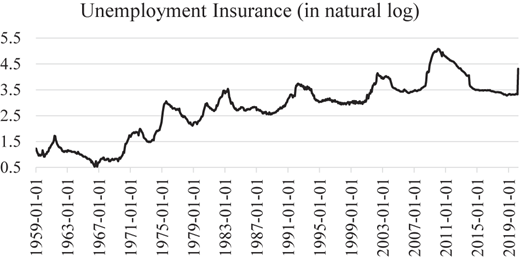
In time-series literature, the presence of a long-run relationship between two (or more) variables is defined as cointegration. As a prerequisite to testing for cointegration between the two, we begin our analysis by investigating the presence of a unit root in the data. We proceed with simple unit root tests, namely the augmented Dickey and Fuller (1981) (ADF test) and the Phillips and Perron (1988) tests (PP test). In the presence of a structural break, various augmented Dickey and Fuller (1981) test statistics are biased toward nonrejection of a unit root, while the Phillips and Perron (1988) procedure assumes the date of the structural break is known (Enders, 2010). Plots of the data in Figure 1 indicate that all series may have structural breaks at unknown dates. Hence, we use the Zivot and Andrews (1992) (ZA test) test to investigate the stationarity property of the data in the presence of structural breaks at unknown data points. As per the definition of cointegration, we need the data to be nonstationary at the level to proceed to the cointegration analysis.
Once the nonstationarity of the data series at the level is confirmed, we then proceed to investigate if the two data series have cointegration or a common long-run relationship or co-movement between the two. There are three potential scenarios: first, there is no cointegration or no long-run relationship; second, there is cointegration or a long-run relationship and third, there is threshold cointegration or a threshold long-run relationship. In our empirical approach, we investigate all three cases. We first discuss the simple cointegration model, given by
Following the Engle and Granger (1987) procedure, we estimate the above equation and test if the estimated residual ( is stationary or not. While checking for stationarity, we use the Enders and Granger (1998) test for unit root test for asymmetric adjustment. We use this test as the aggregate UI spending rise during a recession and falls during an expansion. In addition, we use the Johansen and Juselius (1990) as well as the Phillips and Ouliaris (1990) procedures to detect the presence of cointegration between the two. The null hypothesis is no cointegration, and the alternative is cointegration for all the above procedures. There is a large volume of empirical literature that uses these techniques, and there exists a large volume of discussion on them. For brevity, this paper will not discuss these procedures in detail. We will briefly discuss the threshold cointegration and the motivation therein. There are empirical papers that investigate the presence of threshold cointegration in the policy response behavior by the fiscal authority (see Arestis, Cipollini, & Fattouh, 2004; Ahmed, 2019), and conventional wisdom suggests that macroeconometric time-series models must address structural break and/or regime shifts (Balcilar, Gupta, & Miller, 2015; Granger, 1996). The threshold cointegration is one possible opportunity that allows us to consider the presence of regimes [7] in our estimation and further testing for a co-movement or long-run relationship. The cointegration methodology suggested by Engle and Granger (1987) involves estimation of Equation (1) and testing if the residual has a unit root or not. Since the augmented Dickey and Fuller (1981) test on the residual or the error-correction term from Equation (1) does not consider potential nonlinearity in the process, we run the following regression and conduct the RESET test.
To inspect the case for potential nonlinearity, we perform the following test . Pippenger and Goering (1993) and Balke and Fomby (1997) have shown that tests of the unit root have lower power in the presence of asymmetric adjustment. The nonlinear nature of the policy response during a recession as opposed to expansion could lead to asymmetric adjustment. We consider a threshold autoregression (TAR) structure for the error-correction term as follows:
In the above threshold regression, are the parameters of the model for lag length i = 1, … l and is the error term with an added subscript to distinguish it from the non-threshold error term. is the dummy such that
In this case, represents the endogenously chosen threshold following the method by Chan (1993). We arrange the endogenously chosen threshold variable in ascending order and trim 15% at the top and 15% at the bottom to avoid overfitting. We estimate the model for each value of the threshold variable and save the sum of squared residuals. We chose the model with the lowest sum of squared residuals as our chosen model and the corresponding value of the endogenous threshold variable as our threshold. As in Engle and Granger (1987), the lag length, l, typically is chosen by some type of information criterion so that the model is well specified and the results in the being white noise. We will explore two important aspects of the above structure. First, we will investigate the presence of threshold cointegration. Second, we will test if the lag length is greater than 1 in the threshold model. Testing for whether the lag length is greater than 1 is important because this reveals information relevant to the proper error-correction structure in the threshold vector error-correction model we will use this to explore the short-run dynamics. As noted by Krishnakumar and Neto (2012), if the lag length is only equal to 1, then the threshold structure appears in the error-correction term only in the threshold vector error-correction model. While if the lag length is greater than 1 the threshold structure extends to all the lagged dependent variables, including the error-correction term. Krishnakumar and Neto (2012) suggest checking whether a second lag improves the fit in the model described by Equation (3).
In addition, we will use the formal testing techniques proposed by Enders and Siklos (2001). This test is based on the Engle and Granger (1987) procedure for testing cointegration with potential asymmetric adjustment in the cointegrating vector. The authors describe two possible test statistics: and . These authors refer to the first one as statistics and the second one as t-max statistics, and also note that the former has more power than the t-max statistics. The null hypothesis implies no cointegration between the variables, and the alternative implies the presence of threshold cointegration. The Enders and Siklos (2001) test do not have a standard distribution for the threshold cointegration test. This research uses the critical values available in the original article by the authors Enders and Siklos (2001). Since the exact nature of non-linearity may be unknown, we use the momentum threshold autoregression (M-TAR) with the threshold defined on (Enders, 2010). M-TAR adjustments can be especially useful when the policymakers are viewed as attempting to smooth out any large changes in the series (Enders & Siklos, 2001). One limitation of this approach is that this process only applies to a bi-variate model.
Once the presence of a threshold cointegration relationship is confirmed, we proceed to estimate the TVEC model to analyze the short-run dynamics using either or as the threshold variable. There are two alternative ways of estimating a TVEC model. We can estimate the TVEC model either by considering the threshold effect applied only to the error correction term or we can estimate a model with a threshold effect applied to all the independent variables. We use the typical Bayesian information criterion (BIC) to select the appropriate lag lengths for the model described below:
where are the parameters of the model, j, = 1…l, and k = 1…m, represent the lag length and represents the error term. In the above specification, is the dummy set as per Equation (4) described earlier. The threshold effect is applied to all the right-hand side variables of the model. We will focus on the coefficient for the error-correction term – . These parameters inform us about the speed of adjustment from any deviation from a long-run relationship between the aggregate UI spending and the labor force participation rates. The signs of the corresponding error-correction parameters also describe the direction of adjustment in the short run for each dependent variable. To corroborate the robustness of our findings, we will use two additional measures of the labor force participation rate: the male and female disaggregates. We will repeat all the empirical procedures outlined above for these two measures. Figure 1 depicts two different trends overtime for the females as opposed to the males. The TVEC estimates will provide us with insight on their dynamics in the long run and short run.
4. Results and analysis
This section presents the results of the data analysis for this paper. The results will be presented in the following order: first, we present the results for the stationarity analysis; we then proceed to cointegration tests followed by threshold cointegration tests. Finally, we present the TVEC model estimation results and their analysis.
4.1 Stationarity analysis
We begin our analysis with the unit root tests. The labor force participation rates are percentages and the aggregate UI spending is in the natural log in the subsequent analysis. Table 1 below presents the unit root test results using the ADF and the PP tests. The labor force participation rates are nonstationary as per the ADF and the PP tests. The aggregate UI spending is stationary as per the ADF test, whereas it is nonstationary as per the PP test. One particular problem is the presence of a structural break(s) in the data. These tests are susceptible to nonrejection of the null in the presence of such structural break(s). The Phillips and Perron (1988) test considers the presence of a structural break at known dates. As discussed earlier, we consider the case with structural breaks in the data. To this end, we employ the Zivot and Andrews (1992) test to investigate stationarity, which considers the presence of more than one structural break at unknown dates. For the Zivot and Andrews (1992) test, we consider two breaks at unknown dates in the intercept, trend and both in the testing procedure. Results in Table 2 indicate that all the variables are nonstationary, i.e. have a unit root, in the presence of structural breaks. Thus, we conclude that they are nonstationary at their level values.
Unit root test: ADF and PP tests
| Test type | Aggregate unemployment insurance spending | Labor force participation rate | Labor force participation rate: Male | Labor force participation rate: Female |
|---|---|---|---|---|
| ADF test: with intercept and trend | −3.95* | 0.67 | −2.22 | 0.88 |
| PP test: with intercept and trend | −2.90 | 0.53 | −2.78 | 0.79 |
Note(s): (1) Augmented Dickey-Fuller test critical values: −3.97 for 1% (**), −3.41 for 5% (*) and −3.13 for 10%, (2) Phillips-Perron test critical values: −3.97 for 1% (**), −3.41 for 5% (*) and −3.13 for 10%
Zivot-Andrews test
| Variable | Test type | Test statistics |
|---|---|---|
| Aggregate unemployment insurance spending | Breaks in intercept | −4.31 |
| Breaks in trend | −4.03 | |
| Breaks in intercept and trend | −4.57 | |
| Labor force participation rate | Breaks in intercept | −2.01 |
| Breaks in trend | −3.98 | |
| Breaks in intercept and trend | −3.67 | |
| Labor force participation rate: male | Breaks in intercept | −4.65 |
| Breaks in trend | −3.43 | |
| Breaks in intercept and trend | −4.07 | |
| Labor force participation rate: female | Breaks in intercept | −2.38 |
| Breaks in trend | −4.16 | |
| Breaks in intercept and trend | −3.67 |
Note(s): (1) Critical values for breaks in intercept are −5.34 at 1%, −4.80 at 5%, (2) critical values for breaks in trend are −4.93 at 1%, −4.42 at 5%, (3) critical values for breaks in intercept and trend are −7.19 at 1%, −6.75 at 5% and −6.48 at 10%
We proceed by taking the first difference and conduct the same set of tests to investigate the stationarity property of the data. Since the aggregate UI spending is in the natural log, the corresponding first difference approximates the percentage change in aggregate UI spending or growth in UI spending. Test results, presented in Tables 3 and 4, indicate that we have evidence of stationarity of the data in their first difference. Based on the results presented, we find that the variables are nonstationary at their level and stationary at their first difference. Hence, we conclude that they are integrated of order 1, or I(1). This is the necessary condition to proceed towards the tests for cointegration or long-run co-movement between them.
Unit root test first difference: ADF and PP tests
| Test type | Aggregate unemployment insurance spending | Labor force participation rate | Labor force participation rate: Male | Labor force participation rate: Female |
|---|---|---|---|---|
| ADF test: without trend and intercept | −5.17** | −5.70** | −14.92** | −3.85** |
| PP test: with intercept | −21.60** | −37.61** | −41.97** | −35.81** |
Note(s): (1) Augmented Dickey-Fuller test critical values: −3.99 for 1% (**), −3.42 for 5% (*) and −3.13 for 10%, (2) Phillips-Perron test critical values: −3.45 for 1% (**), −2.87 for 5% (*) and −2.57 for 10%. (3) Values are in their first difference
Zivot-Andrews test
| Variable | Test type | Test statistics |
|---|---|---|
| Aggregate unemployment insurance spending | Breaks in intercept | −5.22** |
| Labor force participation rate | Breaks in intercept | −9.71** |
| Labor force participation rate: male | Breaks in intercept | −11.50** |
| Labor force participation rate: female | Breaks in intercept | −10.15** |
Note(s): * for 1% and ** for 5%
4.2 Cointegration test
The earlier analysis confirms the stationarity of the data at their first difference, i.e. they are I(1). We now proceed to test for the presence of cointegration among the two variables, which are nonstationary at their levels. We begin with the Johansen procedure and the Phillips-Ouliaris tests to investigate the presence of cointegration. The null hypothesis is no cointegration and the alternative is cointegration. We conduct two tests to confirm the presence of cointegration or no cointegration. In Tables 5 and 6 we present the Phillips and Ouliaris and the Johansen procedure test results, which yield no evidence of cointegration between the two variables. These results hold for both male and female labor force participation rates as well. Based on these two tests, we find no evidence of a long-run co-movement or equilibrium relationship between the aggregate UI spending and the labor force participation rates over the sample period. It is interesting to note that in Table 6, the Johansen procedure rejects the null hypothesis of no cointegration, for the case of , between aggregate UI spending and the aggregate labor force participation rates. However, the results show that we cannot reject the null hypothesis of no cointegration for at least one cointegration relationship.
Phillips and Ouliaris test
| Test type | Aggregate unemployment insurance spending and labor force participation rate | Aggregate unemployment insurance spending and labor force participation rate for male | Aggregate unemployment insurance spending and labor force participation rate for female |
|---|---|---|---|
| 1.34 | 0.90 | 0.31 | |
| 27.29 | 17.82 | 27.89 |
Note(s): (1) Critical values for the are 27.85 for 10%, 33.71 for 5% and 48.00 for 1%, (2) Critical values for the are 47.58 for 10%, 55.22 for 5% and 71.92 for 1%
Johansen procedure
| Test type | Cointegrating vector | Aggregate unemployment insurance spending and labor force participation rate | Aggregate unemployment insurance spending and labor force participation rate for male | Aggregate unemployment insurance spending and labor force participation rate for female |
|---|---|---|---|---|
| Lambda max statistics | 1.76 | 0.43 | 5.41 | |
| 18.79** | 14.90** | 21.02** | ||
| Trace statistics | 1.76 | 0.43 | 5.41 | |
| 20.55** | 15.32 | 26.42** |
Note(s): (1) Critical values for the are 6.50 for 10%, 8.18 for 5% and 11.65 for 1% for the Lamda test and the Trace test, (2) Critical values for the are 12.91 for 10%, 14.90 for 5% and 19.19 for 1% for the Lamda test and 15.66 for 10%, 17.95 for 5% and 23.52 for 1% for the Trace test, (3) for Lambda max statistics * for 1% and ** for 5% and (4) for Trace statistics * for 1% and ** for 5%
The UI policy arguably impacts the labor market. There is a plethora of microeconometric research that confirms this aspect. The UI recipients are, by law, required to maintain job search to maintain their eligibility. As such, we argue that the two variables are expected to depict a common trend from a macroeconomic perspective. We also argue that the adjustment in the long-run relationship or the co-movement could be nonlinear and/or asymmetric. It is common knowledge that UI spending rises during a recession and falls during an expansion. It is plausible that the cointegration could depict a nonlinear adjustment. Thus, we proceed towards the threshold cointegration test in the next section.
4.3 Threshold cointegration
This section discusses the threshold cointegration test results. We begin our analysis using the simple two-step Engel-Granger procedure. We estimate the following model and test the stationarity of the residuals. The augmented Dickey–Fuller test result on the residual indicates stationarity contradicting the earlier tests. The test statistics is −3.70** for the labor force participation rate and aggregate UI spending, which is smaller than the critical values at 5% and 10%. The ADF test contradicts the earlier results from the more formal tests for cointegration. Bilgili (1998) has shown that the Johansen procedure outperforms the Engle-Granger method, and the Engle-Granger procedure depends on the ordering of the variables as well. Thus, we adhere to the results presented in Tables 5 and 6 and conclude that there is no cointegration. It is also likely that nonlinearity may impact the testing procedure. Thus, we estimate the model described by Equation (3) earlier and conduct the RESET test on the coefficients of the polynomials of order 2 and above. The RESET test LM test statistics is 275.13 with a p-value of 0.0 and F-test statistics is 436.86 with a p-value of 0.0 results indicating that nonlinearity is an important issue as the coefficients for the polynomials are statistically significant. We find the same results for the labor force participation rate for females and males as well. For brevity, we do not discuss the results here. It is also argued that macroeconomic time-series tend to follow the business cycles, and there are empirical papers that argue that the government's policy response is asymmetric (Balcilar et al., 2015). Hence, we conduct the Enders-Granger threshold unit root test on the residual, presented in Table 7.
Enders Granger threshold unit root test
| Variable | Threshold model | Test statistics | Lags |
|---|---|---|---|
| Aggregate unemployment insurance spending and labor force participation rate | TAR adjustment | 5.56 | 13 |
| M-TAR adjustment | 7.60** | 13 | |
| Aggregate unemployment insurance spending and labor force participation rate male | TAR adjustment | 3.74 | 13 |
| M-TAR adjustment | 4.86 | 13 | |
| Aggregate unemployment insurance spending and labor force participation rate female | TAR adjustment | 6.89** | 13 |
| M-TAR adjustment | 13.04** | 13 |
Note(s): (1) Critical values are 6.03 for 5% with no lagged change for the TAR adjustment and 5.64 for 5% with no lagged change for the M-TAR adjustment, (2) for TAR adjustment * for 1% and ** for 5% and (3) for M-TAR adjustment * for 1% and ** for 5%
These test results provide mixed evidence leading to some ambiguity. The aggregate UI spending is not cointegrated with the male labor force participation rate in the presence of a threshold. Results indicate the presence of cointegration between the aggregate UI spending and aggregate labor force participation rate in the presence of a threshold. This result holds for the female labor force participation rate as well. The aggregate UI spending is cointegrated in the presence of a threshold under momentum TAR adjustment. However, this is not the case for TAR adjustment. Thus, we do not have any conclusive evidence of cointegration. The Ender-Granger unit root test report 13 lags. This information prescribes that we use the threshold structure in all the right-hand side variables while estimating the TVEC model (Krishnakumar & Neto, 2012). These findings also affirm the use of the threshold effect for potential nonlinearity in the adjustment.
We now move to the more formal tests of threshold cointegration using the Enders and Siklos (2001) test. The null hypothesis for this test is no cointegration, and the alternative is threshold cointegration for the Enders and Siklos (2001) test; the results are presented in Table 8. The test results confirm the evidence of threshold cointegration for the case of momentum threshold auto-regression (M-TAR) adjustment. The Enders and Siklos (2001) test find no evidence of threshold cointegration for TAR adjustment. These results corroborate findings from the Enders-Granger threshold unit root test presented in Table 7. When we control for auto-correlation by adding lags for the dependent variable, with 1 and 4 lags, the test confirms the evidence of threshold cointegration. These results hold for the male and female disaggregates as well. These test findings provide formal statistical evidence of a threshold cointegration or threshold co-movement or threshold long-run relationship between the aggregate UI spending and the labor force participation rates in the USA. Table 8 also presents the threshold values used in the test as well. We can find that the threshold values for the TAR adjustment for all three cases are close to each other. We can find a similar feature in the estimated threshold values for M-TAR adjustment as well. Enders and Siklos (2001) argue that M-TAR adjustment is more relevant because this adjustment perhaps captures the changes made by the policymakers. The UI spending is a policy variable, which is often reviewed and adjusted by Congress in the USA during economic recessions. In this paper, we will hence emphasize the results from the M-TAR adjustment.
Ender-Siklos test
| Test statistics | Lags | Threshold | |
|---|---|---|---|
| Aggregate unemployment insurance spending and labor force participation rate | |||
| CI | 3.67 | 0 | 6.70 |
| 4.44 | 1 | 6.70 | |
| 7.13 | 4 | 10.61 | |
| 4.26 | 0 | −0.5440 | |
| 7.28** | 1 | −0.5440 | |
| 10.89** | 4 | −0.5440 | |
| Aggregate unemployment insurance spending and labor force participation rate male | |||
| CI | 2.19 | 0 | 9.01 |
| 2.63 | 1 | 9.01 | |
| 4.24 | 4 | 9.01 | |
| 5.52 | 0 | −0.8230 | |
| 7.44** | 1 | −0.6381 | |
| 10.25** | 4 | −0.8230 | |
| Aggregate unemployment insurance spending and labor force participation rate female | |||
| CI | 5.94 | 0 | 8.89 |
| 6.69 | 1 | 8.89 | |
| 9.71** | 4 | 8.89 | |
| 3.90 | 0 | 0.7095 | |
| 4.49 | 1 | −0.6107 | |
| 7.74** | 4 | −0.6107 | |
Note(s): (1) Critical values for the TAR adjustment for CI are 6.93 for 5% with no lagged change, 6.93 for 5% with one lagged change and 7.56 for 5% with 4 lagged change, (2) Critical values for the M-TAR adjustment for CI are 6.62 for 5% with no lagged change, 6.63 for 5% with one lagged change and 6.32 for 5% with 4 lagged change, (3) for TAR adjustment * for 1% and ** for 5% and (4) for M-TAR adjustment * for 1% and ** for 5%
4.4 Threshold vector error-correction model
The earlier section confirms the evidence of a threshold cointegration between the aggregate UI spending and the labor force participation rates in the USA. This finding holds for male and female labor force participation rates as well. In this section, we proceed to investigate the nature of the short-run dynamics of the disequilibrium or movement away from the long-run equilibrium relationship using the TVEC model. We use 3 lags for the TVEC model estimation based on the BIC. Tables 9 and 10 present the TVEC model estimations for the aggregate UI spending and labor force participation rate for all and the aggregate UI spending and labor force participation rate for females. The estimation for the labor force participation rate for males and aggregate UI spending do not provide us any interesting finding, thus for brevity, we do not present them in this paper. We define two regimes, based on the M-TAR adjustment and the threshold from the Enders and Siklos (2001) test, in the estimated TVEC model presented in Tables 9 and 10.
Threshold VECM with threshold effect in all
| Dependent variable: | Dependent variable: | |
|---|---|---|
| Constant | 0.005 (0.004) | −0.0008 (0.013) |
| 0.001** (0.0002) | 0.0002** (0.0008) | |
| −0.023 (0.025) | −0.11* (0.07) | |
| −0.021 (0.020) | −0.03 (0.06) | |
| −0.008 (0.021) | 0.004 (0.059) | |
| 0.14** (0.07) | −0.18 (0.19) | |
| −0.003 (0.069) | −0.02 (0.16) | |
| 0.14** (0.05) | 0.21 (0.16) | |
| Constant | −0.010** (0.004) | 0.003 (0.013) |
| 0.0001 (0.0003) | 0.0001 (0.0009) | |
| 0.310** (0.082) | −0.27** (0.08) | |
| 0.04 (0.05) | −0.10** (0.07) | |
| 0.213** (0.056) | −0.05 (0.06) | |
| −0.0004 (0.0221) | 0.17 (0.22) | |
| −0.002 (0.021) | −0.03 (0.14) | |
| −0.008 (0.022) | −0.19 (0.17) | |
Note(s): (1) Eicker-White heteroskedasticity consistent standard error, (2) Approximately, 75% of the observations are in Regime 1 and 25% are in Regime 2 and (3) * for 1% and ** for 5%
Threshold VECM with threshold effect in all (female labor force participation rate)
| Dependent variable: | Dependent variable: | |
|---|---|---|
| Constant | −0.0006 (0.005) | −0.014 (0.018) |
| 0.0018** (0.0003) | 0.002** (0.001) | |
| −0.01 (0.01) | −0.004 (0.07) | |
| −0.009 (0.018) | 0.02 (0.07) | |
| 0.013 (0.016) | 0.05 (0.06) | |
| 0.03 (0.08) | −0.67** (0.24) | |
| −0.0006 (0.068) | 0.04 (0.17) | |
| 0.14** (0.05) | 0.22 (0.22) | |
| Constant | −0.004 (0.004) | 0.03** (0.01) |
| −0.0009** (0.0004) | −0.002* (0.001) | |
| 0.001 (0.019) | −0.29** (0.07) | |
| 0.011 (0.020) | −0.06 (0.07) | |
| −0.007 (0.016) | −0.06 (0.06) | |
| 0.235** (0.080) | 0.09 (0.24) | |
| 0.04 (0.05) | 0.01 (0.15) | |
| 0.16** (0.06) | −0.23 (0.24) | |
Note(s): (1) Eicker-White heteroskedasticity consistent standard error, (2) Approximately, 77% of the observations are in Regime 1 and 23% in Regime 2 and (3) * for 1% and ** for 5%
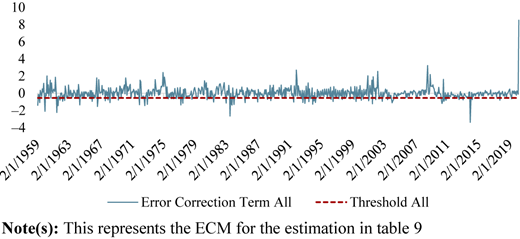
In Table 9, we present the threshold vector error-correction model for the aggregate UI spending and the labor for participation rate for all. In Regime 1, we find the changes in the long-run relationship or the error-correction term are above the threshold. Approximately, 86% of the observations fall in Regime 1 and mostly capture periods of economic expansion in the USA (see Figure 3). We define this as the disequilibrium or error correction from the long-run relation above the threshold. The disequilibrium arises due to larger growth in the labor force participation rate (denoted by ) than the growth in aggregate UI spending (denoted by ). The coefficients for the term in the and the equations are positive and statistically significant. In terms of magnitude, the coefficient of the error-correction term for the labor force participation adjusts at a larger speed than the aggregate UI spending. This indicates that the growth in the UI spending and the growth in the labor force participation rate are adjusting simultaneously in the short run. This similarity in dynamics is consistent with the economic dynamics in the labor market and policy adjustment we observe. The labor market indicators are known as lagged indicators, which respond to the actual economic downturn or upswing in a lagged manner. The government usually enhances UI spending and with extended UI eligibility duration during economic recessions. These programs are also extended when the economy has already started an expansion. The UI recipients are required by law to search for jobs while receiving the benefits. The labor force participation rate, by definition, includes both employed and unemployed. Perhaps therefore we observe a common pattern in the short-run adjustment between the growth in aggregate UI spending and growth in labor force participation rate. In Regime 2, we find the changes in the long-run relationship or in the error-correction term is below the threshold. Approximately, 15% of the observations are in this regime and mostly correspond to economic recessions in the USA (see Figure 3). We define this as the disequilibrium or error correction from the long-run relation below the threshold. The disequilibrium arises due to smaller growth in the labor force participation rate than the growth in aggregate UI spending. During a recession, cyclical unemployment rises, and not everyone in the labor force is eligible for the UI program. Besides, it may take time for approval of one's UI application due to the bureaucratic processes. The coefficients for the term in the equation and the equations are positive indicating that the government is adjusting, but are not statistically significant.
As the coefficient for the labor force participation rate is rising implies a larger fraction in the labor force needs and uses support from the government. The Congress and Senate thus may respond by increasing government transfers. The coefficients are not statistically significant in Regime 2, whereas they were significant in Regime 1. We argue that this may be due to the following reasons: (1) the labor market adjusts with a lag, and (2) the bureaucratic process is not instantaneous. The short-run dynamics during the recession do not immediately capture the effects rather passed onto the expansionary periods.
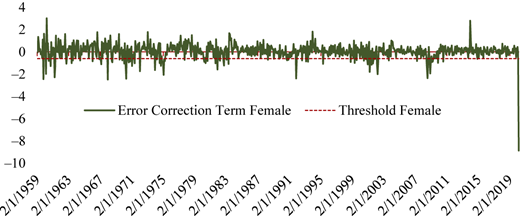
Table 10 presents the TVEC model estimation between the aggregate UI spending and labor force participation rate for females. The threshold is based on the Enders and Siklos (2001) test for M-TAR adjustment. The two regimes define the disequilibrium or errorcorrection from the threshold long-run relationship. In Regime 1, the long-run disequilibrium or error correction is defined by larger growth in the labor force participation rate than the growth in aggregate UI spending above the threshold. Approximately, 87% of the observations fall in Regime 1 and mostly capture periods of economic expansion in the USA (see Figure 4). The coefficients for the term in the and equations are positive and statistically significant. This indicates that the growth in government UI spending and the growth in labor force participation are adjusting simultaneously in the short run for female workforce. The coefficients are similar in size. We argue that the UI program may cater to support helping job search and subsequently better job matching for female workers. In Regime 2, the long-run disequilibrium or error correction is defined by smaller growth in the labor force participation than the growth in aggregate UI spending below the threshold. Approximately, 13% of the observations are in this regime and mostly correspond to economic recessions in the USA (see Figure 4). The coefficients for the term in the and equations are negative and statistically significant indicating the UI policy and labor market are adjusting simultaneously both above and below the threshold for females.
This finding is different than the results presented in Table 9. This difference in short-run dynamics may explain the upward trend of the labor force participation rate for females in the USA. Perhaps, the UI program facilitates improved matching in the labor market for the female participants vis-a-vis the males. These findings are interesting and may explain why the labor force participation rate for females depicts an upward trend compared to their male counterparts in the USA. We argue that UI policy may have favored the female labor force relatively more than the males in the USA.
Figures 3 and 4 present the threshold and the error-correction term for the two estimations presented in Tables 9 and 10. We can find similar dynamics and patterns. The preponderance of Regime 2 mostly coincides with the recessionary periods in the USA [8]. In both the models, more than three-fourth of the observations are Regime 1, and the remainder are in Regime 2.
5. Conclusion
In this paper, we investigate the nature of dynamics between the aggregate UI spending and labor force participation rates in the USA from a macroeconomic perspective. The policymakers adjust the UI policy following the labor market and the state of the economy. The labor force participation rate is a macroeconomic aggregate reflecting the labor market, which also responds to business cycle fluctuation. During recessions, cyclical unemployment raises, and subsequently, the government expands the UI program. During expansions, on the other hand, cyclical unemployment declines, and UI spending is reduced. Arguably, a long-run association or co-movement between the two is imperative. The labor force participation rates for females depict an upward trend in comparison to male counterparts in the USA. The UI spending is criticized for creating a negative incentive to job search. But this can also help job search and better matching in the labor market. To this end, we investigate the presence of a long-run relationship and how the long-run dynamics change in the short run in one regime as opposed to the other.
We begin our analysis by investigating the stationarity properties of the data while considering structural breaks in the testing procedure. Results indicate that the data are integrated of order 1, or I(1). The cointegration test results find no evidence of cointegration or co-movement between the two. This finding contradicts the microeconometric studies. The Enders and Siklos (2001)'s threshold cointegration test confirms the presence of threshold cointegration. This finding also holds for the male and female disaggregates as well. Thus, we find evidence of a threshold long-run relationship or threshold co-movement in the data. The estimates from the TVEC model investigating the nature of short-run dynamics find evidence that the growth in aggregate UI spending and the growth in labor force participation rate adjust simultaneously to maintain the long-run co-movement above the threshold. This finding is consistent with what we observe in the economy. We observe similar short-run dynamics for the growth in aggregate UI spending and the growth in labor force participation rate for females. The estimates from the TVEC models investigating the nature of short-run dynamics find evidence that the aggregate UI spending and the labor force participation rate for females adjust to maintain the long-run co-movement above and below the threshold. Perhaps, the UI program positively impacts the female labor market outcomes, for example, better matching. This finding may explain the upward trend in the labor force participation rate for females in comparison to males in the USA.
We argue that the UI program positively impacts the labor market outcome for females increasing their participation in the USA. This paper proposes that policymakers may consider the UI program directed towards ethnic and religious minorities in the USA and other countries for a better labor market outcome in the long run.
The author would like to thank the anonymous referees, the editor, and the associate editor for their thoughtful comments and feedback. The author would also like to thank Professor Kenneth H. Brown for some initial feedback on an earlier version of the paper.
Funding: Not applicable. This research did not receive any specific grant from funding agencies in the public, commercial and not-for-profit sectors.
Data and code availability: Data and software codes are available upon request. This paper uses secondary data available in Federal Reserve Bank of St. Louis online database.
Authors' contribution: Haydory Akbar Ahmed contributed to the study conception and design. Material preparation, data collection and analysis were performed by Haydory Akbar Ahmed. The first draft of the manuscript was written by Haydory Akbar Ahmed and all previous versions of the manuscript. The author, Haydory Akbar Ahmed, had read and approved the final manuscript.
Research involving human participants and/or animals: Not applicable.
Informed consent: Not applicable.
Conflicts of interest/Competing interest: There is no conflict of interest.
Notes
For example, in 2011, a group of state legislators of Missouri blocked proposed federal assistance that extends the unemployment insurance program.
The relationship may indicate some form of causal interpretation. Microeconometric studies discuss the causality between the two. However, from a macroeconomic modeling perspective, such causal interpretation requires a different approach. We do not explore the causality question in this research.
This research did not include the observations from the second and third quarters of 2020 as COVID-19 created unusual market conditions.
See Krueger and Meyer (2002) for a survey.
Personal current transfer receipts or the unemployment insurance transfer from the government to individuals is denoted as W825RC1, civilian labor force participation rate is an aggregate percentage for the civilian population denoted as CIVPART, civilian labor force participation rate for males is an aggregate percentage for the civilian population denoted as LNS1130001 and civilian labor force participation rate for females is an aggregate percentage for the civilian population denoted as LNS1130002.
This approach is bivariate, which is a limitation of this methodology.
This paper does not intend to explain the motivation and\or the procedures behind the existence of such regimes. Also, the paper does not intend to explicitly explain the mechanisms through which these regimes may arise. Economic circumstances, such as a recession, are exogenous. Macroeconomic policy interventions are often associated with concurrent changes in the economic environment. This paper intends to explain the difference in the behavior of the adjustments in the UI and the labor force participation rate in the presence of such regimes.
The sharp drop in the last period is the beginning of COVID-19 pandemic.

