


This paper examines the impact of marginal changes in municipal council size on the diversity of candidates and elected councilors in Brazil, focusing on age, gender, race, and educational attainment. Understanding how institutional changes affect representation is crucial for assessing the effectiveness of legislative reforms in promoting political diversity.
We employ a regression discontinuity design (RDD) using population thresholds set by Constitutional Amendment 58/2009. The analysis covers the 2017–2020 and 2021–2024 electoral cycles, using data from the Brazilian Institute of Geography and Statistics (IBGE) and the Superior Electoral Tribunal (TSE). This methodology allows for a causal interpretation of the impact of small adjustments in council size on political representation.
Our results indicate that marginal increases in council size lead to a higher absolute number of non-white and high school-educated councilors but do not significantly change their proportional representation. Moreover, no significant effects are observed for gender or age diversity. These results suggest that the specific institutional adjustment examined—expanding council size within existing rules—does not meaningfully increase political diversity, highlighting the role of broader systemic factors.
This study contributes to the literature on political identity and institutional design by examining the interplay between legislative size and electoral outcomes. It also informs debates about whether structural changes in local governance effectively promote diversity or whether alternative interventions are needed.
1. Introduction
The Brazilian Constitution of 1988 strengthened local governments by granting them political and fiscal autonomy, enabling them to govern more independently and to develop policies tailored to local needs. Municipalities influence the provision of public services and local legislation, making municipal councils and their members crucial intermediaries between communities and the government (Abrucio, 1994; Souza, 1997; Boulding & Brown, 2014; Rocha & Kerbauy, 2014; Mignozzetti & Cepaluni, 2019).
The personal characteristics of elected officials can shape their policy preferences and decision-making. Studies suggest that political identity influences legislative behavior, as seen in evidence that black legislators are more likely to advocate for policies that benefit black communities and that female legislators prioritize policies that address gender issues (Bratton, 2002; Chattopadhyay & Duflo, 2004). More broadly, characteristics such as age and professional background also shape policymaking. Younger politicians tend to be more strategic in their political careers (Alesina, Cassidy, & Troiano, 2019), while elected officials’ professional backgrounds influence environmental and economic outcomes (Bragança & Dahis, 2022).
Given the importance of who gets elected, recent research has increasingly examined whether institutional characteristics, such as the legislature’s size, influence the demographic composition of elected bodies. In a cross-national analysis, Allen and Stoll (2023) show that larger legislatures are associated with higher representation of women and racial minorities. Latner, Santucci, and Shugart (2021) find that larger legislatures and districts increase the likelihood that political parties will field and elect Black and non-white candidates. Studies of local councils support these findings for women: Kjaer and Elklit (2014) and Kjaer, Carroll, and Carroll (2018) show that council size is positively associated with the presence of female councilors. In Brazil, the evidence is mixed. Correa and Madeira (2014) and Meireles and Rubim Andrade (2017) suggest that larger councils may increase female representation. In contrast, Mignozzetti and Cepaluni (2019) and Kresch, Schneider, Veras, and Walker (2021) find little or no evidence that council size affects the election of women, non-white candidates, or other local characteristics.
The size of municipal councils is a key institutional feature that can influence political representation by shaping the incentives and constraints of the electoral system. Larger councils offer more seats, which can lower electoral thresholds, reduce disproportionality, and allow for broader representation of social groups. Shugart and Taagepera (2017) argue that the absolute size of the legislature directly affects electoral disproportionality, which in turn affects the size of the party system and ultimately representation. Allen and Stoll (2023) similarly suggest that larger legislatures—especially when legislators represent fewer constituents—provide greater opportunities for inclusive representation. Building on these theoretical insights, this study examines the impact of municipal council size on the diversity of candidates and elected council members, analyzing differences in age, gender, race, and educational attainment. The findings contribute to ongoing debates about how institutional structures shape representation and provide evidence to policymakers seeking to increase diversity in local government.
The rules governing the size of municipal councils in Brazil have undergone reforms. Initially, the 1988 Constitution established a proportional relationship between population and the number of councilors. However, flexibility in its application led to inconsistencies, with municipalities of similar size having different council sizes. A 2004 reform standardized the population-based allocation of seats, and Constitutional Amendment 58/2009 introduced new population thresholds that dictate the maximum number of councilors per municipality, while allowing municipalities discretion in choosing their exact council size within these limits.
To estimate the effect of municipal council size on diversity, we use a regression discontinuity design (RDD) based on the population thresholds defined by Constitutional Amendment 58/2009. This design exploits the abrupt changes in maximum council size near the population thresholds, allowing for a causal interpretation of the effect of marginal adjustments in council size on the composition of elected representatives. We analyze data from the 2017–2020 and 2021–2024 election cycles, focusing on municipalities with populations below 100,000. Our primary data sources include population estimates from the Brazilian Institute of Geography and Statistics (IBGE) and electoral data from the Superior Electoral Tribunal (TSE).
Our results show that changes in council size have, at best, marginal effects on representation. While a slightly larger council increases the absolute number of elected non-white councilors and those with at least a high school education, these shifts do not translate into meaningful changes in their proportional representation within councils. We also find no significant effects on gender or age representation. These findings suggest that simply increasing the number of seats available within the existing institutional framework does little to overcome barriers to representation.
This study contributes to two strands of literature. First, it relates to research on political identity and policy choice. Legislators’ personal characteristics influence their policymaking behavior, with demographic diversity associated with shifts in policy priorities (Bratton, 2002; Minta, 2009; Broockman, 2013; Alesina et al., 2019; Dahis, Ivan, & Saavedra, 2023). While much of this research has focused on the behavior of elected officials once in office, more recent work has increasingly examined how institutional characteristics—such as legislative size—affect who is elected and the representativeness of legislative bodies (Kjaer & Elklit, 2014; Kjaer et al., 2018; Latner et al., 2021; Allen & Stoll, 2023). Second, this study connects to the broader literature on the effects of legislative size. Existing studies provide mixed results: some suggest that larger legislatures reduce government spending (Pettersson-Lidbom, 2012; Höhmann, 2017; Benedetto, 2018; Lewis, 2019), while others suggest a positive effect (Egger & Koethenbuerger, 2010; Halse, 2016; Kresch et al., 2021). Moreover, the size of the legislature may affect policy outcomes, service delivery, party system dynamics, and levels of corruption (Chang & Golden, 2007; Egger & Koethenbuerger, 2010; Halse, 2016; Mignozzetti & Cepaluni, 2019; Kresch et al., 2021; Correa & Madeira, 2014; Britto & Fiorin, 2020; Frey, 2021). By linking these literature, this study provides new causal evidence on how institutional design affects the demographic composition of local legislative bodies.
2. Institutional context
Brazil is comprised of more than 5,500 municipalities, which form the basic political and administrative structure of the country. These municipalities are responsible for organizing and providing locally relevant public services such as health care, early childhood education, primary education, and public transportation, among others. To accomplish these tasks, the structure of local government is divided into an executive branch, headed by the mayor, and a legislative branch, represented by the municipal council, both of which are elected by direct vote every four years (Brasil, 1988).
In this context, to serve the interests of the municipality, the Constitution assigns several responsibilities to the Municipal Council. These include deliberating on matters related to municipal taxation, creating, modifying, and abolishing public positions, authorizing credit operations, granting public services, and approving municipal development plans and urban regulations. In addition, councilors are charged with formulating the budget for municipal revenues and expenditures, as well as supervising the financial management of the municipality (Brasil, 1977).
To be elected as a city councilor in Brazil, candidates must meet certain requirements, including being a Brazilian citizen by birth or naturalization, being at least 18 years old, being registered to vote, and being affiliated with a political party (Brasil, 1988). Parties may register up to 150% of the number of seats to be contested, with 30% of these candidates being women (Brasil, 1997) [1].
Regarding the composition of municipal councils, the 1988 Constitution stipulated that the number of councilors should be proportional to the population of the municipality, within certain limits. However, these limits were not specific enough and allowed municipal councils undue discretion in determining the number of seats, which encouraged distortions [2]. Faced with this flexibility, the Federal Supreme Court adopted a new interpretation in 2003, stipulating that the relationship between population and the number of seats should be more precise.
This reinterpretation led to Resolution No. 21.702/2004 of the Superior Electoral Tribunal (TSE), which established a strict ratio between the number of councilors and the population of municipalities (Brasil, 2004). Figure 1a illustrates the number of seats in Brazilian councils for the 2008 elections in municipalities with a population of up to 100,000 inhabitants. According to this new framework, municipalities with up to 47,619 inhabitants would be entitled to 9 councilors, those with a population between 47,620 and 95,238 would have 10 councilors, and so on [3]. This proportional relationship was used in the 2004 and 2008 elections.
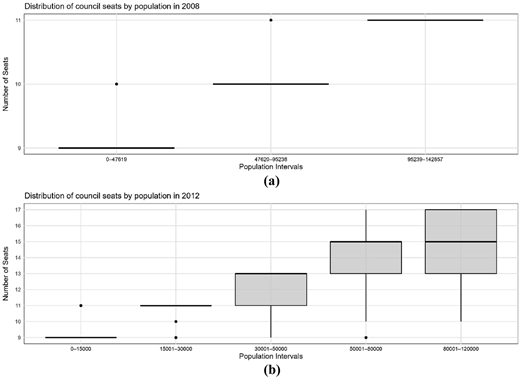
Distribution of council seats by population in 2008 and 2012. Note: This figure shows the distribution of the council size based on population in municipalities at two different points in time: the 2008 elections (Panel A) and the 2012 elections (Panel B). Source(s): Figure by authors
Distribution of council seats by population in 2008 and 2012. Note: This figure shows the distribution of the council size based on population in municipalities at two different points in time: the 2008 elections (Panel A) and the 2012 elections (Panel B). Source(s): Figure by authors
However, in 2009, an institutional change occurred with the approval of Constitutional Amendment No. 58/2009. This amendment changed the relationship between the number of councilors and the population, moving away from the principle of proportionality. Instead, the amendment introduced a new model by establishing a maximum number of seats for each municipality, determined by 24 different population ranges (Brasil, 2009). Figure 1b illustrates the number of seats in Brazilian councils for the 2012 municipal elections in municipalities with a population of up to 100,000.
This change marked a return to the original decentralization model provided for in the 1988 Constitution. Municipalities with comparable population sizes could now have different numbers of representatives in municipal councils. Consequently, by replacing strict proportionality with a more flexible system, Constitutional Amendment No. 58/2009 resulted in a significant increase in the number of councilors across the country.
Figure 2 shows the distribution of the number of council seats at an intersection of population ranges, including both the rule in place for the 2004 and 2008 elections and the rule in place since 2012.
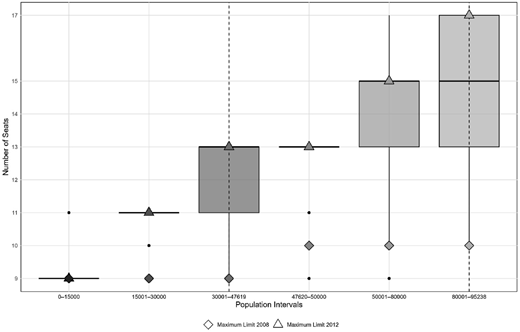
Distribution of council seats between the 2008 and 2012 rules. Note: Population data provided by IBGE and the number of council seats provided by TSE were used for this analysis. The dashed vertical line in the graph represents the population ranges of 2008. The x-axis corresponds to the intersections of the population ranges between the 2004/2008 and 2012 electoral rules. The resulting intersections (0–15,000, 15,001–30,000, 30,001–47,619, 47,620–50,000, 50,001–80,000, 80,001–95,238, and 95,239–120,000) were used to directly compare the number of councilors in 2012 (y-axis), accounting for population variation within each range. Source(s): Figure by authors
Distribution of council seats between the 2008 and 2012 rules. Note: Population data provided by IBGE and the number of council seats provided by TSE were used for this analysis. The dashed vertical line in the graph represents the population ranges of 2008. The x-axis corresponds to the intersections of the population ranges between the 2004/2008 and 2012 electoral rules. The resulting intersections (0–15,000, 15,001–30,000, 30,001–47,619, 47,620–50,000, 50,001–80,000, 80,001–95,238, and 95,239–120,000) were used to directly compare the number of councilors in 2012 (y-axis), accounting for population variation within each range. Source(s): Figure by authors
The number of elected councilors increased from 51,999 in 2008 to 57,434 in 2012. Approximately 30% municipal chambers, representing 1,694 municipalities, opted to increase the number of legislative seats. In addition, 4,801 municipalities, or about 86% of the total, adhered to the maximum number of seats allowed by the new electoral legislation.
3. Data and summary statistics
The primary dataset comes from the open data portal of the Superior Electoral Tribunal (TSE) in Brazil. We obtained detailed records from the 2016 and 2020 municipal elections. These records include information on the number of council seats in each municipality, as well as the demographic and educational characteristics of candidates and elected councilors. Using the TSE data, we calculated the number and proportion of candidates and councilors by age, gender, race, and educational background.
To construct the running variable and verify the implementation of seat allocation rules, we use population estimates from the Brazilian Institute of Geography and Statistics (IBGE). The number of seats in the 2016 and 2020 elections is based on municipal population figures from 2015 and 2019, respectively, as officially reported by IBGE.
Our analysis focuses on the 2017–2020 and 2021–2024 electoral cycles and restricts the sample to municipalities with fewer than 100,000 inhabitants. This restriction is justified by the fact that approximately 95% of Brazilian municipalities fall within this range (see Figure A1 in the Appendix). This allows the analysis to focus on cases in which variation in council size is most relevant, which constitute the vast majority.
Table A1, presented in the Appendix, provides descriptive statistics for municipal characteristics, as well as for the demographic and educational profiles of candidates and elected councilors. The table reports the mean, standard deviation, minimum, and maximum values for each variable.
The average number of seats in municipal councils is 9.94, reflecting the predominance of municipalities within the initial population threshold. The average municipal population is 17,000, with an average of about 7 candidates per seat.
Women make up about 35% of candidates but only 15% of elected councilors, highlighting a persistent gender gap in political representation. Notably, the proportion of female candidates is close to the legal minimum of 30%.
Regarding racial representation, the proportion of non-white candidates and elected council members is similar, with both groups making up nearly half of the total. Age distribution statistics show that candidates under 30 years of age represent about 10% of the total, while those over 60 years of age represent about 9%.
In terms of education, the majority of candidates (59%) and elected councilors (67%) have completed high school. Meanwhile, 18% of candidates and 26% of elected councilors have a university degree, suggesting that educational attainment may play a role in electoral success.
4. Empirical strategy
We used a regression discontinuity design (RDD) to estimate the impact of marginal changes in the size of municipal councils on the diversity of candidates and elected councilors, considering age, gender, race, and education level. This approach makes use of the population thresholds established by Constitutional Amendment 58/2009, which determines the maximum number of councilors in each municipality. Our analysis focuses on the 2017–2020 and 2021–2024 electoral cycles.
A sharp RDD is appropriate in this context because, although there is some noncompliance—municipalities are not required to fill the maximum number of council seats—deviations from the threshold are relatively rare, as shown in Table A2 in the Appendix. Our baseline model is specified as follows:
Where represents the outcome of interest for municipality in year ; is a treatment indicator variable denoting whether the municipality lies to the right of the threshold; and is a polynomial function of the running variable. We normalize and pool pre-election population values around the first four thresholds to create a single cutoff, following Brollo, Nannicini, Perotti, and Tabellini (2013). Our main specifications are estimated without controls. The coefficient of interest, , captures the effect of having additional contested seats on electoral outcomes.
We estimate bias-corrected regression discontinuity coefficients and robust standard errors, using non-parametric functions within narrow windows on either side of the cutoff (Calonico, Cattaneo, Farrell, & Titiunik, 2014). This approach is more robust to bandwidth choices and valid under weaker conditions than conventional methods. We use a uniform kernel and compute the optimal mean squared error (MSE) bandwidth as in Calonico, Cattaneo, and Farrell (2020). The procedure for selecting the optimal bandwidth was implemented using the R package provided by Calonico, Cattaneo, and Farrell (2015) [4]. Following Gelman and Imbens (2019), we use a first-degree polynomial in the estimation procedures.
When treatment is not a deterministic function of the running variable, the reduced-form coefficient from Equation (1) serves as an intention-to-treat (ITT) estimator. To ensure the robustness of our results, we rely on bias-corrected coefficients and cluster-robust confidence intervals computed according to Calonico, Cattaneo, and Farrell (2018).
A fundamental assumption of the RD design is that municipalities cannot systematically manipulate population counts to influence treatment assignment. Additionally, other policies tied to the cutoff or imbalances in outcome determinants at the threshold could introduce biases. We examine and discuss these potential threats in Section 5.2.
5. Results
We first test for an increase in the probability of treatment at the threshold. Then, we estimate the reduced-form effect of the council size on the participation in municipal elections of non-whites, women, those under 30 and over 60, and those with a high school diploma or higher education. Finally, the identification assumptions are discussed. The main reduced-form results are accompanied by graphs of the local linear regression of the outcome on the running variable, without controls.
5.1 Main results
Our analysis first confirms that the population thresholds defined by Constitutional Amendment 58/2009 lead to a discontinuous increase in the number of municipal council seats at the threshold. As shown in Column 1 of Table 1 and in Figure A2 in the Appendix, municipalities just above the threshold have, on average, 0.7 more councilors than those just below the threshold. This difference is significant at the 1% level and remains consistent across alternative bandwidths and kernel specifications. This observed discontinuity establishes the validity of the Regression Discontinuity Design (RDD) for estimating the effects of small adjustments in council size on outcomes.
Effects of municipal council size in local elections
| Electoral outcomes | |||
|---|---|---|---|
| (1) | (2) | (3) | |
| Seats | Total candidates | Candidates per seat | |
| β bias-correcteds.e. | 0.726*** | 11.494* | 0.582 |
| (0.145) | (5.046) | (0.467) | |
| Bandwidth | 1,736 | 1,469 | 1,109 |
| Observations | 2,075 | 1,823 | 1,464 |
| Racial representation | |||||
|---|---|---|---|---|---|
| (4) | (5) | (6) | (7) | (8) | |
| Non-white candidates | Non-white elected | At least 1 non-white | Share of non-white candidates | Share of non-white elected | |
| β bias-correcteds.e. | 7.268 | 1.136** | 0.035 | 5.715* | 5,503 |
| (3.849) | (0.357) | (0.022) | (2.735) | (3.051) | |
| Bandwidth | 1,336 | 1,405 | 2,222 | 1,717 | 1,781 |
| Observations | 1,728 | 1,926 | 2,609 | 2,103 | 2,276 |
| Gender representation | |||||
|---|---|---|---|---|---|
| (9) | (10) | 11) | (12) | (13) | |
| Women candidates | Women elected | At least 1 woman | Share of women candidates | Share of women elected | |
| β bias-correcteds.e. | 3.718* | 0.029 | 0.014 | −0.377 | −0.473 |
| (1.745) | (0.097) | (0.036) | (0.241) | (0.754) | |
| Bandwidth | 1,370 | 2,987 | 2,784 | 1,432 | 5,639 |
| Observations | 1,725 | 2,918 | 2,795 | 1,788 | 4,552 |
| Age representation | ||||||||
|---|---|---|---|---|---|---|---|---|
| (14) | (15) | (16) | (17) | (18) | (19) | (20) | (21) | |
| Candidates under 30 | Share of candidates under 30 | Elected under 30 | Share of elected under 30 | Candidates over 60 | Share of candidates over 60 | Elected over 60 | Share of elected over 60 | |
| β bias-correcteds.e. | 1.636** | 0.685 | 0.000 | −0.042 | 0.911 | −0.278 | −0.046 | −0.974 |
| (0.531) | (0.360) | (0.069) | (0.670) | (0.665) | (0.406) | (0.066) | (0.796) | |
| Bandwidth | 1,455 | 3,734 | 3,024 | 3,502 | 1,635 | 2,583 | 4,142 | 2,701 |
| Observations | 1,831 | 3,424 | 3,070 | 3,396 | 2,015 | 2,705 | 4,182 | 3,144 |
| Educational attainment representation | ||||||||
|---|---|---|---|---|---|---|---|---|
| (22) | (23) | (24) | (25) | (26) | (27) | (28) | (29) | |
| High school graduates candidates | Share of high school graduates candidates | High school graduates elected | Share of high school graduates elected | College graduates candidates | Share of college graduates candidates | College graduates elected | Share of college graduates elected | |
| β bias-correcteds.e. | 7.358* | 0.661 | 0.858*** | 2.786 | 2.147 | 1.566* | 0.497* | 3.392 |
| (3.416) | (1.040) | (0.236) | (1.697) | (1.225) | (0.781) | (0.194) | (1.868) | |
| Bandwidth | 1,444 | 2,006 | 1,368 | 1,885 | 1,378 | 1,586 | 1,637 | 1,366 |
| Observations | 1,801 | 2,263 | 1,722 | 2,184 | 1,749 | 1,961 | 2,001 | 1,753 |
Note(s): This table reports the reduced-form effects of council size on the pool of candidates and elected councilors in local elections. The estimates are derived from regression discontinuity (RD) designs, utilizing a local polynomial estimator with a uniform kernel. The optimal bandwidth for each regression, minimizing mean squared error (MSE), was chosen following the method outlined in Calonico et al. (2014, 2018). Significance levels are denoted by: ***p < 0.01, **p < 0.05, *p < 0.1
Source(s): Table by authors
The effect of council size on the racial representation of elected council members is presented in columns 4 to 8 of Table 1 and illustrated in Figure A3 in the Appendix. The results show an increase in the absolute number of non-white representatives. Specifically, municipalities with larger councils elect an average of 1.136 additional non-white councilors, which is significant at the 5% level (see column 5). However, this effect does not extend to the proportion of non-white representatives on the council, as the estimated change in their proportion is not statistically significant. Moreover, the probability of electing at least one non-white candidate does not show any meaningful variation, suggesting that while the absolute number of non-white elected councilors increases, their overall representation remains relatively stable.
In terms of gender representation, no statistically significant effects are observed for the number of women elected, the probability of electing at least one woman, or the proportion of female councilors (see columns 9 to 13 of Table 1 and Figure A4 in the Appendix). These results suggest that marginal changes in council size do not significantly affect gender representation in local elections.
The composition of candidates and elected councilors by age follows a similar pattern. While there is an increase in the number of candidates under 30, this does not translate into a higher proportion of young elected councilors or significant changes in the probability of electing younger representatives (see columns 14 to 21 of Table 1 and Figure A5 in the Appendix). Similarly, no significant effects are observed for candidates or elected councilors over the age of 60, suggesting that small adjustments in council size do not systematically affect age representation.
The effect of council size on educational attainment representation is presented in Columns 22 to 29 of Table 1 and illustrated in Figure A6 in the Appendix. An examination of this dimension reveals a statistically significant increase in the absolute number of elected representatives who possess at least a high school diploma. This increase exhibits an estimated effect of 0.858 additional high school graduates in municipalities with larger councils, which is significant at the 1% level (see column 24). However, as with racial representation, this increase in absolute numbers does not translate into a proportional change in the share of high school-educated councilors among elected representatives.
The findings of this study indicate that small changes in council size have, at best, a marginal effect on the diversity of elected representatives. While an increase in the number of seats results in a slightly higher absolute number of non-white and high school-educated councilors, these shifts do not alter the relative composition of municipal councils. The lack of significant effects on gender and age representation further reinforces the limited role of council size in shaping the diversity of elected councilors. These findings are consistent with prior research examining the relationship between city council size and political representation in Brazilian municipal elections (see references: Correa and Madeira, 2014; Britto and Fiorin, 2020; Frey, 2021). This reinforces the conclusion that merely adjusting the number of council seats is unlikely to produce substantive changes in political representation. This highlights the need to consider broader institutional and electoral reforms to effectively enhance diversity in local governance.
5.2 Validity and robustness
Additional results are presented in the Appendix to check the robustness of the results to specification and methodological variations. Table A3 in the Appendix presents local linear regressions estimated with triangular rather than uniform kernels. These results are consistent with the main results, providing further confidence in the validity of our estimates.
To ensure that the treated units are comparable to the control units near the cutoff point, we conduct placebo tests on four outcomes that are independent of municipality size: the percentage of non-whites in the municipal population, the percentage of individuals with a high school education, the percentage of females, and the percentage of individuals aged 18 to 29. The results presented in Table A4 in the Appendix show no statistically significant discontinuities at the cutoff point, reinforcing the validity of our regression discontinuity design. This suggests that the observed effects on council size are not driven by pre-existing differences between municipalities.
We used the Cattaneo, Jansson, and Ma (2020) manipulation test to verify that there are no abrupt changes in the number of observations at the cutoff that could indicate manipulation. The test result yielded a test statistic of 1.2517 with a p-value of 0.2107, meaning that we do not reject the null hypothesis that there is no difference in the density of treated and control observations at the cutoff. Figure A7 in the Appendix visually confirms that the distribution of the running variable is continuous, with no sudden shifts at the cutoff. The validity of the design is further strengthened by the fact that the population estimates used to determine treatment assignment were provided by the Brazilian Institute of Geography and Statistics (IBGE), an independent national agency, making data manipulation unlikely.
We conducted sensitivity analyses to assess the robustness of our RD results to the choice of bandwidth. We estimated our model with alternative bandwidth choices of 5,000 and 7,500. The results obtained with both bandwidths are similar regarding point estimates, but the confidence intervals are wider for the larger bandwidth. These results are consistent with the literature on the robustness of discontinuous regression results. Tables A5 and A6 in the Appendix present the full estimates of the sensitivity analysis.
Finally, we estimate our models separately for the 2017–2020 and 2021–2024 electoral cycles. The results remain consistent across both periods, as shown in Tables A7 and A8 in the Appendix, demonstrating the robustness of our findings over time.
6. Conclusion
This study examines the impact of municipal council size on the diversity of candidates and elected councilors. Using a regression discontinuity design, we estimate the causal effect of small adjustments in council size on the diversity of candidates and the composition of elected councilors using data from the 2017–2020 and 2021–2024 election cycles. This approach provides a framework for assessing how institutional design affects the demographic composition of municipal legislatures.
Our results indicate a slight increase in the absolute number of non-white councilors elected in municipalities with slightly larger councils. In addition, we observe a statistically significant increase in the number of elected councilors with at least a high school education. However, these increases do not translate into higher proportions of non-white or more educated councilors relative to the total number of seats. This suggests that while a slightly larger council allows for more representation of underrepresented groups, it does not fundamentally change the demographic composition of local councils.
Regarding gender and age representation, we find no significant effects. Council size does not systematically affect the election of women or the likelihood of electing at least one female representative. Similarly, there is no discernible effect on the representation of council members under 30 or over 60, underscoring the limited role of institutional adjustments in promoting demographic diversity within municipal chambers.
These findings highlight that while increasing the number of seats may marginally expand opportunities for diverse candidates, it is insufficient to address the broader systemic barriers that underrepresented groups face in securing elected positions. Structural factors such as electoral dynamics, access to campaign resources, and social biases are likely to play a more decisive role in shaping political representation.
The policy implications of these findings suggest that efforts to increase diversity in local government should go beyond adjusting council size. Addressing structural barriers—such as disparities in campaign finance, candidate recruitment processes, and voter perceptions—may prove more effective in promoting meaningful political inclusion. From a normative perspective, descriptive representation is a core dimension of democratic legitimacy, as it relates to the extent to which elected bodies reflect the composition of the populations they serve. From an instrumental perspective, more inclusive legislatures can contribute to greater responsiveness, increased trust in institutions, and the inclusion of diverse perspectives in policymaking. Thus, promoting political inclusion requires not only institutional reforms, but also sustained efforts to address the social and political underpinnings of exclusion.
A key limitation of this study is the lack of comprehensive data on municipal legislative activity, which prevents an assessment of whether larger councils differ in their legislative output or policy decisions. Future research could examine whether variation in council size affects governance outcomes beyond representation, shedding further light on the broader implications of municipal institutional design.
The authors are grateful to Coordenação de Aperfeiçoamento de Pessoal de Nível Superior of Brazil (CAPES) for providing partial financial support for this study.
Notes
For example, if a city council has 9 seats up for election, each party may register up to 14 candidates. If a party registers 14 candidates, 4 of them must be women.
To illustrate the lack of proportionality, consider the following examples: Sumaré (SP), with a population of 168,058, had 13 councilors. São Manuel (SP), with 38,271 inhabitants, had 21 councilors. Guarulhos (SP), with 972,197 inhabitants, had the same number of councilors.
The number 47,619 is obtained by dividing 1,000,000 by 21. The original Constitution defined the first range as “a minimum of nine and a maximum of twenty-one councilors in municipalities of up to one million inhabitants”. Therefore, the number 47,619 now represents the lower limit of this range, and for each additional 47,619 inhabitants, the number of councilors increases by one.
Available on January 2024 at: https://rdpackages.github.io/rdrobust
This article is part of the special issue Selecta 2024, featuring the best papers from the 52nd Brazilian Economic Meeting. It was nominated by the conference’s scientific committee. Following an invitation to submit, the paper underwent a condensed review process, with a single referee recommending minor revisions.
References
The supplementary material for this article can be found online.

