While DEI practices aim to enhance the outcomes of disadvantaged groups, their impact remains uncertain, with disparities often persisting. This paper examines whether the accumulation of DEI practices helps reduce psychological and work disparities between employees, considering both their objective (e.g. gender and race) and subjective (or perceived) (dis)advantage.
Study 1 surveyed 602 employees to assess the impact of perceiving their organization as having many or few DEI practices on their sense of inclusion and job satisfaction. Study 2 used an experimental design (N = 739) to extend the findings of Study 1 by manipulating the number of DEI practices.
Study 1 showed that the effects of DEI practices on work experiences depended on gender and subjective disadvantage: more practices increased inclusion and job satisfaction for subjectively disadvantaged women but decreased them for subjectively disadvantaged men. Study 2, in which the number of DEI practices was manipulated again found that more DEI practices predicted worse anticipated outcomes for subjectively disadvantaged men. Study 2 also found that White participants, regardless of subjective disadvantage, had worse anticipated outcomes when there were more DEI practices.
These studies emphasize the importance of both objective and subjective (dis)advantage in understanding the signaling effect of DEI practices, offering insights into designing policies that address group disparities in light of status dynamics.
Introduction
Organizational Diversity, Equity, and Inclusion (DEI) practices have been criticized for over-emphasizing or under-emphasizing difference (e.g. Plaut et al., 2018), being toothless (e.g. Dobbin and Kalev, 2022; Gündemir et al., 2024) and being discriminatory toward traditionally advantaged groups (e.g. Leslie, 2019; Nittrouer et al., 2024). Although these critiques vary in focus and origin, they collectively underscore the importance of understanding the impact of an organization's DEI practices on employees' work experiences. We propose that an employee's group status may significantly influence the impact of DEI practices on work outcomes. Specifically, we argue that objective (e.g. race, gender) and subjective (dis)advantage play pivotal and intersecting roles in determining whether DEI practices translate into positive outcomes for a given employee. We test this in two studies—one observational and one experimental—to assess whether the number of DEI practices has differential impacts depending on objective (both gender and race) and subjective group status. Ultimately, our work highlights the critical role of matching or mismatching objective and subjective (or perceived) (dis)advantage in predicting the impact of DEI practices on employees.
DEI practices and impact
DEI policies are defined as “the implementation of one or more practices aimed at enhancing the workplace experiences and outcomes of groups that face societal disadvantage” (Leslie, 2019, p. 538). Organizations implement DEI practices for various reasons, ranging from genuine efforts to address persistent disparities to less sincere attempts to appear socially conscious or avoid legal challenges (Schoen and Rost, 2021). For most, however, the purpose of DEI practices is to tackle social inequity and improve the outcomes of historically disadvantaged groups by increasing their representation (i.e., diversity), closing career gaps with advantaged groups (i.e., equity), and improving the overall experience of employees from these groups (i.e., inclusion) (e.g. Iyer, 2022; Nishii, 2013; Joshi et al., 2015). Together, these three pillars—diversity, equity, and inclusion—aim to provide transformative and emancipatory impacts that reduce long-standing disparities and advance social justice for disadvantaged groups (Nittrouer et al., 2024).
The amount of money spent by companies worldwide on DEI has grown substantially in the past years, with investments growing from $7.5 billion in 2020 to $9.4 billion in 2022—numbers expected to exceed $24 billion by 2030 (Coleman, 2025). Despite widespread implementation and significant resource investment, progress in DEI has been slow (Dobbin and Kalev, 2016), and overall success remains limited (Kang et al., 2016; Leslie, 2019). As Kalev et al. (2006) highlight, while much is known about workplace inequity, there is less evidence on the effectiveness of interventions designed to counter it. The empirical evidence is decidedly mixed on the impacts of the most common DEI practices: while some studies show positive effects of DEI practices, such as targeted recruitment and mentorship programs on increased diversity in leadership roles or employee resource groups on decreased turnover intentions of minority employees (e.g. Dobbin et al., 2015; Kalev et al., 2006; Nittrouer et al., 2024), other evidence suggests that they can have neutral or even negative consequences (e.g. Dobbin and Kalev, 2022; Timmers et al., 2010; Verbeek and Groeneveld, 2012). This leaves organizations with “best guesses” instead of best practices (Kalev et al., 2006) and difficulties in determining which practices should be prioritized, how they should be implemented, and what results they can realistically achieve (Nishii et al., 2018). Furthermore, backlash against DEI practices has become increasingly prominent and politically successful (Murray and Bohannon, 2025).
While prior research has explored the impact of individual DEI practices on organizational outcomes, it remains unclear whether having more DEI practices leads to better outcomes. This question is increasingly relevant, as many organizations today implement multiple practices simultaneously in their efforts to appear committed to diversity and inclusion (Nishii et al., 2018; Schoen and Rost, 2021). Yet, as Nishii and colleagues (2018, p. 72) observed, “we were surprised by how little research has examined how diversity practices in combination influence outcomes”. Most studies still evaluate DEI practices in isolation, thereby overlooking the potentially additive or synergistic effects of combining multiple practices, or conversely, the possibility that saturation or misalignment could reduce their impact. Workplace inequalities arise from multiple, intersecting barriers, making it unlikely that a single practice can drive meaningful change (Lyness and Grotto, 2018). A broader and more comprehensive set of practices may therefore be necessary to address these varied challenges.
Moreover, the number of DEI practices implemented may serve a signaling function. DEI policies not only reflect internal intentions but also shape employee perceptions of what is valued and rewarded in the workplace (Dover et al., 2020). Schoen and Rost (2021), among the few to have studied this question quantitatively, argue that each additional DEI practice reflects greater organizational effort, making window-dressing less plausible and signaling more authentic commitment. Their findings show that organizations implementing more DEI practices had higher representation of women in management, supporting the potential effectiveness of a comprehensive approach. However, while they focus on representational outcomes (e.g. leadership diversity), as we will discuss below, our study shifts the lens to the psychological impacts of having many or few practices.
Impacts of DEI practices for advantaged and disadvantaged groups
From our perspective, the primary goal of DEI practices should be to equitably reduce disparities between employees from traditionally advantaged and disadvantaged groups (Dover et al., 2025). Group status is often defined based on demographic characteristics such as gender, ethnicity, or race (referred to as objective status in this paper). Research suggests that disparities between groups persist, with disadvantaged employees' psychological and organizational outcomes often lower than those of advantaged employees (Berry and Bell, 2012). An effective suite of policies should, then, positively impact the work experiences of disadvantaged groups (compared to the baseline) and reduce group disparities. Scholars have called for research examining how DEI practices affect both psychological and organizational outcomes (e.g. Nishii et al., 2018). In this research, we examine how the number of DEI practices impacts employees from disadvantaged and advantaged groups on two core outcomes: sense of inclusion, which fosters belonging and psychological well-being (Jansen et al., 2016), and job satisfaction, a key driver of engagement and retention (Roberge et al., 2021) given their critical role in shaping employees' work experiences. Prior research indicates that when employees perceive DEI practices as genuinely inclusive, they are more likely to report positive organizational outcomes such as increased job satisfaction (Nishii, 2013; Mor Barak et al., 2016; Acquavita et al., 2009). We chose to focus on these two outcomes because they reflect both a psychological experience closely tied to the goals of DEI (inclusion) and a broader but related work outcome with clear implications for organizational practice (job satisfaction), making them key indicators of the impact of DEI practices.
For disadvantaged groups, having numerous DEI practices signals that their organization values their group(s) and is committed to including them and treating them fairly. Each additional practice may be interpreted as a stronger commitment to DEI, and organizations with more DEI practices tend to be more successful in overcoming barriers and achieving greater representation of women and minorities in management positions (Schoen and Rost, 2021; Kalev et al., 2006). From a social identity perspective (Tajfel and Turner, 2004), a stronger DEI commitment enhances the organizational identification of disadvantaged employees, thereby improving their psychological and organizational experiences. However, many DEI practices often fall short of addressing structural inequalities, so despite their presence, disadvantaged employees may continue to experience discrimination, restricted career advancement, and adverse psychological and health outcomes (Nishii et al., 2018; Syed and Pio, 2010).
For advantaged groups, having numerous DEI practices may signal that organizational efforts are directed toward other groups, causing them to perceive DEI initiatives as unfair or threatening, which in turn can lead to resistance and a sense of victimization (Dover et al., 2020). In addition, advantaged groups tend to perceive DEI practices as a zero-sum game, where gains for disadvantaged groups are interpreted as losses for advantaged groups (Leslie, 2019). In line with this, Brown et al. (2022) demonstrated across multiple studies that advantaged group members often misperceive equality-enhancing policies as limiting their access to resources, even when these policies actually have no such effect. Conversely, they tend to view policies that maintain or amplify inequality as beneficial to their group, even when their position remains unchanged, reflecting a broader tendency, rooted in social identity theory, to favor relative advantage of one's group over absolute gains (Tajfel and Turner, 2004). Additionally, the increasing representation of minority groups has been linked to higher claims of reverse discrimination among majority members, particularly those who believe their social status is earned and deserved (Nittrouer et al., 2024). More broadly, resistance and lack of support toward DEI practices often stem from intergroup threat perceptions (Plaut et al., 2018; Dover et al., 2016), where advantaged groups may experience resource threats (fear of losing power), symbolic threats (concern that DEI challenges dominant norms), and in-group morality threats (discomfort about their group's role in inequality) (Iyer, 2022). These perceived threats can shape attitudes and behaviors by signaling potential losses in resources, cultural dominance, or moral standing, even without explicit prejudice.
Objective status will moderate the relationship between the number of DEI practices (or perceptions thereof) and employees' sense of inclusion and job satisfaction, such that the relationship will be positive among objectively disadvantaged employees and negative among objectively advantaged employees.
Objective and Subjective (Dis)Advantage. Despite the widespread use of binary classifications (e.g. advantaged vs. disadvantaged) and demographic characteristics (e.g. gender, race), these categories often oversimplify how (dis)advantage operates across diverse contexts. Objective status alone may not fully capture how individuals experience and respond to DEI practices. Subjective status—perceptions of one's social standing or experience of (dis)advantage—may play a powerful role in shaping reactions to organizational practices (Laplante et al., 2011). In the medical context, multiple studies have shown that subjective social status is a stronger predictor of mental and physical health outcomes than traditional objective indicators such as education, income, or occupation (Hoebel and Lampert, 2020). Similarly, in the DEI context, subjective perceptions of (dis)advantage may uniquely and powerfully shape how individuals respond to organizational DEI efforts. In this research, we propose that it is necessary to consider both objective and subjective (dis)advantage when understanding how individuals respond to DEI efforts. More specifically, we argue the importance of considering status match or mismatch—that is, whether subjective and objective group status align (e.g. subjectively and objectively disadvantaged) or diverge (e.g. objectively disadvantaged but subjectively advantaged). While evidence suggests that responses to DEI signals depend on deeper attributes than objective group membership, such as identification with that group (Kim and Gelfand, 2003), to our knowledge, no research has directly examined how the match or mismatch between objective and subjective (dis)advantages influences employees' reactions to DEI practices.
The interaction between objective and subjective status will influence the relationship between the number of DEI practices (or perceptions thereof) and employees' sense of inclusion and job satisfaction, depending on whether these (dis)advantages match or mismatch.
People do not uniformly identify with their objective group memberships; instead, they adopt diverse strategies depending on their experience and evaluation of their social context (Tajfel and Turner, 2004). While some individuals may embrace their group identity in response to DEI efforts, others may distance themselves from it. Group identification may not be solely determined by objective group membership, but rather by how well a group satisfies an individual's needs for inclusion and differentiation (Brewer, 1991). Often, individuals are motivated to strike a balance between feeling like they belong (inclusion) and maintaining a unique identity (differentiation). In the context of DEI practices, we can identify four profiles based on the match or mismatch between objective and subjective status, likely to influence how employees respond to DEI signals:
(1) Match between objective and subjective disadvantage: Presumably, if DEI policies are doing what we expect them to do, they should be more impactful for disadvantaged employees who also feel subjectively disadvantaged, as such individuals are more sensitive to evidence that their group is valued within the organization (Walton et al., 2015). These individuals will likely respond quite positively because they are more likely to perceive DEI efforts as relevant and beneficial, satisfying their need for inclusion (Cachat-Rosset et al., 2019).
Among employees who are objectively and subjectively disadvantaged (match), the relationship between DEI practices and inclusion or job satisfaction will be the most positive, relative to all other status configurations.
(2) Mismatch between objective disadvantage and subjective advantage: Individuals who belong to a disadvantaged group but do not feel disadvantaged—whether due to personal distancing or context-based motivations—may experience fewer benefits from DEI practices (Kim and Gelfand, 2003). Their need for differentiation may lead them to resist, seeing such efforts as irrelevant or even stigmatizing. This is consistent with dynamics such as the “Queen Bee” phenomenon, where individuals downplay their group membership to maintain personal distinctiveness or align with higher-status norms (Derks et al., 2016).
Among employees who are objectively disadvantaged but feel subjectively advantaged (mismatch), the positive relationship between DEI practices and inclusion or job satisfaction will be weaker than among those who are both objectively and subjectively disadvantaged (H2a).
(3) Match between objective and subjective advantage: In the context of DEI, if objectively advantaged individuals still feel advantaged, this may indicate that they do not see a zero-sum threat (Brown et al., 2022) and thus may be more neutral or less reactive to DEI practices. They may not feel that they personally benefit from DEI policies, but they may acknowledge that they are important for others. This match between their objective and subjective advantage suggests that despite the presence of DEI practices, their optimal balance between inclusion and differentiation remains largely intact.
Among employees who are objectively advantaged and feel subjectively advantaged (match), the relationship between DEI practices and inclusion or job satisfaction will be weaker than among objectively disadvantaged employees (in H2a and H2b statuses) but less negative than among those who are objectively advantaged but subjectively disadvantaged (H2d).
(4) Mismatch between objective advantage and subjective disadvantage: Individuals who feel subjectively disadvantaged despite having an objective advantage, particularly in the presence of DEI practices, may be the most likely to react negatively. This subjective disadvantage may, in the presence of DEI practices, lead to resentment and perceptions that only other groups are receiving benefits, thus exacerbating their own subjective disadvantage and affecting their inclusion and satisfaction. The resulting identity threat may heighten their need to restore distinctiveness and a sense of belonging, leading to resistance or backlash.
Among employees who are objectively advantaged but feel subjectively disadvantaged (mismatch), the relationship between DEI practices and inclusion or job satisfaction will be the most negative, relative to all other status configurations.
To test these hypotheses, we conducted two studies. Study 1 employed a correlational, two-wave panel design with employees from organizations with DEI policies (N = 602). At Time 1, participants reported on the presence of DEI policies and specific practices in their organization. Three weeks later, we assessed their sense of inclusion and job satisfaction. Study 2 used an experimental design to further investigate these findings. Participants (N = 739) were assigned to one of two conditions where they imagined working in an organization with a DEI policy that included either few (three) or many (thirteen) DEI practices. We then measured the anticipated impact on psychological and work outcomes. In both studies, we investigated the role of objective status using self-reported race and gender. Subjective status was operationalized with a new measure of perceived disadvantage.
Study 1
Methods
Participants and procedure
Study 1 was launched in June 2023 and relaunched in January 2024 to achieve a final, better-balanced sample of 753 full-time or part-time employees based in the United States, recruited through Prolific using a two-wave structure. At Time 1, participants provided sociodemographic information and reported on the presence of DEI policies in their organizations. Because we did not want participants to report their inclusion and job satisfaction directly after being exposed to their organization's DEI policy, we measured these variables three weeks later. We excluded 151 participants who reported being unaware of their organization's DEI policies, resulting in a final sample of 602 employees working in organizations with DEI policies. Participants were 62.6% women (Mage = 40.53, SD = 11.98). 40% of participants indicated being White (n = 241), while 60% belonged to racial minority groups (n = 361), with substantial representation from African American (n = 163), East Asian (n = 56), and Latino-Hispanic (n = 44) respondents. The reported gender and race were used to determine participants' objective (dis)advantage.
Measures
Perceived total number of DEI practices
Participants were presented with a list of 11 DEI practices (e.g. diversity recruitment initiatives, bias training, ERGs) and asked to indicate which practices were currently in place in their organization. The practices were selected based on a comprehensive review of commonly implemented diversity initiatives (e.g. Dover et al., 2020; Nishii et al., 2018; Nittrouer et al., 2024), and reflected broad categories typically used in organizational DEI efforts (cf. Supplementary Materials for the full list). No explicit target groups were mentioned in the presentation of these practices and the categories were intentionally broad because in practice, DEI targets may vary from one organization to another depending on organizational priorities or workforce composition. The total DEI practice score was calculated by summing the number of practices reported.
Subjective Disadvantage was measured using an 8-item scale capturing employees' perceptions of their group-based advantages or disadvantages in society and in their workplace. Participants were given a brief description of societal power dynamics, explaining that some groups are advantaged and hold more power, while others are disadvantaged, face more discrimination, exclusion, and suffer from limited access to resources (full-scale details are described in the Supplementary Materials). Then, they were asked to assess whether they felt their groups were advantaged or disadvantaged in society and within their workplace (e.g. “My career is negatively [positively] affected by my group memberships.“; “In society, I generally feel disadvantaged or stigmatized [favored or advantaged.]”). All items were rated using a 7-point Likert scale, ranging from 1 (strongly disagree) to 7 (strongly agree). Because participants tended to respond similarly to both the societal and workplace items, and because the two subscales were strongly and positively correlated (r(602) = 0.68, p < 0.001), we grouped them into one score with a higher score indicating stronger feelings of disadvantage (α = 0.88, M = 3.61, SD = 1.21). Importantly, this scale captures a general sense of perceived disadvantage, rather than a context-specific experience where workplace disadvantage would be too closely tied to DEI practices.
Sense of Inclusion was assessed using a shortened version of the “Perceived Group Inclusion Scale” (Jansen et al., 2014). From the initial 16-item scale, we selected 9 items with the highest factor loadings based on their original validation study, capturing two core dimensions of inclusion: belongingness (e.g. “My organization makes me feel like I am part of their group.”) and authenticity (e.g. “My organization makes me feel like I can be who I am.”) on a 7-point Likert scale (α = 0.96, M = 5.19, SD = 1.32).
Job Satisfaction was evaluated using a 5-item scale adapted from Van Saane et al. (2003). Participants indicated their agreement to statements such as “I feel real enjoyment in my work” on a 7-point Likert (α = 0.88, M = 4.95, SD = 1.40).
Results
Analysis Plan. To test our hypotheses, we ran two sets of moderated regression models using PROCESS (Model 3; Hayes, 2022), one for each dependent variable: Sense of Inclusion and Job Satisfaction. The first set used self-reported race as the marker of objective status, and the second used self-reported gender (both coded −1, 1). Each model included the perceived number of DEI Practices, the Objective Status (race or gender), and Subjective Disadvantage [1]. All predictors were centered. Within these full models, Hypothesis 1 was tested by examining the two-way interaction DEI Practices by Objective Status. Hypothesis 2 was tested through the three-way interaction DEI Practices by Objective Status by Subjective Disadvantage with simple slopes analyses probing differences between match and mismatch situations of (dis)advantage.
Moderating Effect of Objective Status. Our first hypothesis concerned the moderating effect of objective (dis)advantage on the relationship between the perceived number of DEI Practices and the outcomes, namely Sense of Inclusion and Job Satisfaction.
Race. When operationalizing Objective Status as Race (i.e., Non-White = objectively disadvantaged; White = objectively advantaged), Hypothesis 1 was not supported as analyses revealed no significant interactions with DEI Practices (see Table 1). Specifically, Race did not moderate the relationship between the perceived number of DEI Practices and Sense of Inclusion (B = −0.03, SE = 0.02, 95% CI [−0.06, 0.01], t = −1.43, p = 0.153), nor between DEI Practices and Job Satisfaction (B = −0.03, SE = 0.02, 95% CI [−0.07, 0.01], t = −1.37, p = 0.173). Moreover, no significant three-way interactions were found when Subjective Disadvantage was added as a moderator. Therefore, we proceeded to test our hypotheses using the other indicator of Objective Status: Gender.
Gender. When operationalizing Objective Status as Gender (i.e., Women = objectively disadvantaged; Men = objectively advantaged), the two-way interaction between Objective Status and DEI Practices was significant for both outcomes (see Table 2). Regarding Hypothesis 1, Gender moderated the relationship between the perceived number of DEI Practices and Sense of Inclusion (B = −0.05, SE = 0.02, 95% CI [−0.09, −0.02], t = −2.96, p = 0.003), as well as between DEI Practices and Job Satisfaction (B = −0.05, SE = 0.02, 95% CI [−0.09, −0.01], t = −2.45, p = 0.015). The interaction pattern suggests that DEI Practices were more predictive of outcomes among women than men. As the two-way interactions were further qualified by a three-way interaction with Subjective Disadvantage that approached significance, full simple slopes analyses were conducted for the higher-order interaction.
The Match or Mismatch Between Objective and Subjective Status. Hypothesis 2 posited that the interaction between objective and subjective (dis)advantage would influence the relationship between DEI Practices and employee outcomes, depending on Status match or mismatch. Our findings reveal that the three-way interaction (DEI Practices × Gender × Subjective Disadvantage) was on the verge of significance for both Sense of Inclusion (B = −0.03, SE = 0.02, 95% CI [−0.06, 0.001], t = −1.87, p = 0.062) and Job Satisfaction (B = −0.03, SE = 0.02, 95% CI [−0.07, 0.004], t = −1.77, p = 0.078). Given that our hypotheses specifically predicted differences in outcomes for match versus mismatch conditions, we proceeded to simple slopes analyses to test our sub-hypotheses.
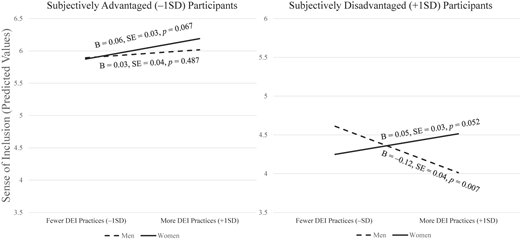
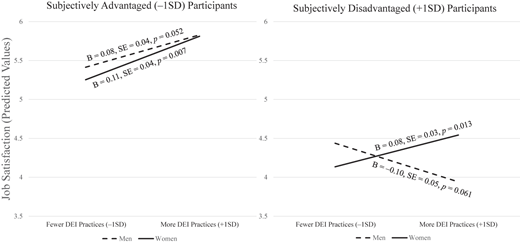
As a reminder, a match reflects alignment between objective and subjective group status (e.g. women who feel disadvantaged), while a mismatch reflects a divergence (e.g. men who feel disadvantaged). To test our match and mismatch hypotheses, simple slopes analyses were conducted at ±1 SD of DEI Practices for men and women at low and high levels of Subjective Disadvantage (±1 SD) (see Figures 1 and 2).
Match between objective disadvantage and subjective disadvantage (H2A). For women who felt disadvantaged (high levels of subjective disadvantage), as expected, perceiving more DEI Practices was associated with greater Sense of Inclusion (B = 0.05, SE = 0.03, 95% CI [−0.001, 0.11], t = 1.95, p = 0.052) and higher Job Satisfaction (B = 0.08, SE = 0.03, 95% CI [0.02, 0.15], t = 2.50, p = 0.013).
Mismatch between objective disadvantage and subjective advantage (H2B). For women who felt advantaged (low levels of subjective disadvantage), the positive effect of DEI Practices on Sense of Inclusion was on the verge of significance (B = 0.06, SE = 0.03, 95% CI [−0.004, 0.13], t = 1.84, p = 0.067). Regarding Job Satisfaction, however, the effect was unexpectedly stronger than for their subjectively disadvantaged counterparts (B = 0.11, SE = 0.04, 95% CI [0.03, 0.19], t = 2.71, p = 0.007).
Match between objective advantage and subjective advantage (H2C). For men who felt advantaged, the effect of DEI Practices on Sense of Inclusion was not significant (B = 0.03, SE = 0.04, 95% CI [−0.05, 0.10], t = 0.70, p = 0.487). However, somewhat unexpectedly, more DEI Practices were associated with higher levels of Job Satisfaction in this group (B = 0.08, SE = 0.04, 95% CI [−0.001, 0.17], t = 1.95, p = 0.052).
Mismatch between objective advantage and subjective disadvantage (H2D). For men who felt disadvantaged, as hypothesized, perceiving more DEI Practices was associated with lower Sense of Inclusion (B = −0.12, SE = 0.04, 95% CI [−0.21, −0.03], t = −2.72, p = 0.007). For Job Satisfaction, this negative effect was on the verge of significance (B = −0.10, SE = 0.05, 95% CI [−0.20, 0.005], t = −1.88, p = 0.061).
Discussion
Results of Study 1 partially support our hypotheses, demonstrating that Objective Status, when operationalized as Gender but not Race, moderates the relationship between perceived DEI Practices and employee outcomes (Hypothesis 1). Although the three-way interactions with Subjective Disadvantage were on the verge of significance for both outcomes, simple slopes analyses revealed patterns consistent with our match-mismatch hypothesis (Hypothesis 2). Subjectively disadvantaged women (match) reported greater inclusion and job satisfaction as more DEI practices were perceived, whereas subjectively advantaged women (mismatch) and subjectively advantaged men (match) showed nonsignificant effects on inclusion but did experience higher job satisfaction with increasing DEI practices. Critically, subjectively disadvantaged men (mismatch) reported significantly lower inclusion and job satisfaction when more DEI practices were perceived. Given that many organizational DEI efforts focus predominantly on women (Schoen and Rost, 2021), this emphasis may inadvertently signal to men that they are undervalued or excluded. Such perceptions can foster feelings of intergroup threat, potentially explaining why men who perceive themselves as disadvantaged report negative outcomes.
However, these findings relied on self-reported perceptions from employees working in various organizations, with no objective data on the actual scope and nature of their organization's DEI practices. We conducted a follow-up experimental study to further investigate the findings of Study 1 and address its limitations. By manipulating the number of DEI practices of a hypothetical organization's DEI policy, we aimed (1) to test the causal effect of the number of DEI practices on inclusion and job satisfaction; and (2) to investigate whether the group-based disparities found in real organizations are consistent with what people expect in a hypothetical situation.
Study 2
Methods
Participants and procedure
Study 2 involved 854 U.S.-based employees recruited through the Prolific platform with an initial launch in July 2024 and a relaunch in January 2025 to achieve balanced representation across objective status groups. The study aimed to examine the signaling impact of DEI practices by manipulating their number. After reporting demographic information and subjective (dis)advantage, participants were randomly assigned to one of two conditions, each describing a hypothetical organization that had recently implemented DEI practices. In the few DEI practices condition, the company was presented as having adopted three DEI practices, whereas, in the many DEI practices condition, the policy included thirteen practices. Practices reflected core DEI initiatives, using the same categories as in Study 1. In the many DEI practices condition, the initial list of 11 broadly formulated practices was expanded by describing two additional practices—grievance procedures and dedicated diversity staff (cf. Supplementary Materials). Anti-bias training, employee resource groups, and mentorship programs were included in both conditions. After reading about the DEI practices, participants were instructed to imagine themselves as employees of this organization and report their anticipated sense of inclusion and job satisfaction.
Participants also completed an attention check indicating the number of DEI practices the company had implemented in their condition: a total of 115 participants failed this check and were excluded. The final sample consisted of 739 U.S. employees (49.8% women, Mage = 37.74, SD = 11.71) with 52.6% in the Few DEI practices condition (n = 389) and 47.4% in the Many DEI practices condition (n = 350). Regarding racial background, 56.3% of participants identified as White (n = 416) and 43.7% as racial minorities (n = 323), with the highest representation from African American (n = 243), Latino-Hispanic (n = 55), and Asian (n = 54) groups.
Measures
Study 2 used the same measures as Study 1 to assess subjective disadvantage (α = 0.85, M = 3.30, SD = 1.19), sense of inclusion (α = 0.98, M = 5.19, SD = 1.45), and job satisfaction (α = 0.80, M = 5.04, SD = 1.15). However, unlike in Study 1, the sense of inclusion and job satisfaction measures asked participants to imagine themselves as employees of the hypothetical organization described in the manipulation and to anticipate how they would feel in that context. Exploratory analyses examined intersectional identities by testing the interaction between our two operationalizations of objective status (Gender × Race). Separate analyses were also conducted with Perceived Intergroup Threat as the outcome variable, testing whether objective and subjective (dis)advantage moderated the relationship between the number of DEI practices and perceptions of intergroup threat. These results are presented in the Supplementary Materials.
Results
Analysis Plan. To expand upon Study 1 findings, we conducted again two sets of moderated regression analyses using PROCESS (Model 3; Hayes, 2022) to test the same hypotheses for anticipated Sense of Inclusion and Job Satisfaction. The procedure was identical, except that the number of DEI Practices was experimentally manipulated (−1 = Few DEI Practices, 1 = Many DEI Practices). Models included the main effects and all interaction terms among DEI Practices, Objective Status (race or gender), and Subjective Disadvantage (centered). The two-way interaction between DEI Practices and Objective Status tested Hypothesis 1, while the three-way interaction tested Hypothesis 2 through simple slopes analyses comparing match and mismatch conditions in this experimental context.
Moderating Effect of Objective Status. Our first hypothesis predicted that objective (dis)advantage would moderate the relationship between DEI Practices and the anticipated outcomes of Sense of Inclusion and Job Satisfaction.
Race. When operationalizing Objective Status as Race (i.e., Non-White = objectively disadvantaged; White = objectively advantaged), Hypothesis 1 was supported as analyses revealed significant interactions with the manipulated number of DEI Practices (see Table 3). Race significantly moderated the relationship between DEI Practices and anticipations of Sense of Inclusion (B = −0.11, SE = 0.05, 95% CI [−0.20, 0.01], t = −2.18, p = 0.029) and was on the verge of significance for Job Satisfaction (B = −0.08, SE = 0.04, 95% CI [−0.16, 0.003], t = −1.90, p = 0.058). Simple-slopes analyses showed that DEI Practices did not significantly predict inclusion among non-White participants (B = 0.12, SE = 0.08, 95% CI [−0.03, 0.27], p = 0.127), but a negative association (on the verge of significance) was observed among White participants (B = −0.12, SE = 0.07, 95% CI [−0.26, 0.01], p = 0.069). A similar nonsignificant pattern emerged for Job Satisfaction (Non-White: B = 0.09, SE = 0.06, 95% CI [−0.04, 0.21], p = 0.167; White: B = −0.08, SE = 0.06, 95% CI [−0.19, 0.03], p = 0.159). Overall, the interaction indicates that DEI Practices were differentially associated with anticipated outcomes across racial groups, with more negative estimated slopes for White participants than for non-White participants, despite nonsignificant conditional effects within each group. However, because no significant three-way interaction emerged with Subjective Disadvantage as a moderator, subsequent analyses focused on Gender.
Gender. When operationalizing Objective Status as Gender (i.e., Women = objectively disadvantaged; Men = objectively advantaged), Hypothesis 1 was not supported as the two-way interaction between Objective Status and DEI Practices was not significant for either outcome (see Table 4). Gender did not moderate the relationship between DEI Practices and anticipated Sense of Inclusion (B = −0.002, SE = 0.05, 95% CI [−0.10, 0.10], t = −0.05, p = 0.963), nor between DEI Practices and anticipated Job Satisfaction (B = −0.05, SE = 0.04, 95% CI [−0.13, 0.03], t = −1.29, p = 0.199). Overall, women and men reported similar anticipations of inclusion and job satisfaction across DEI Practices conditions (Few vs. Many). However, as the three-way interaction with Subjective Disadvantage was significant or on the verge of significance, full simple slopes analyses were conducted to examine the match and mismatch patterns predicted in Hypothesis 2.
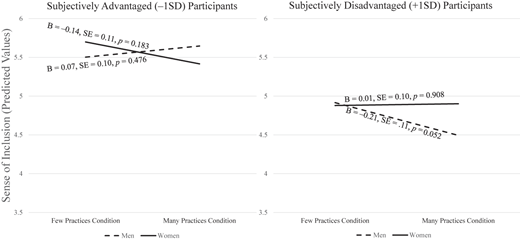
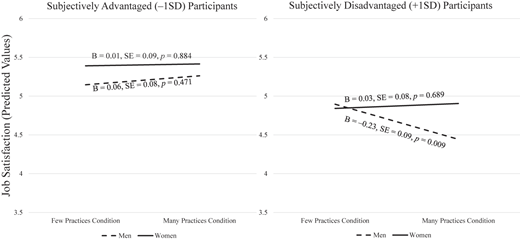
The Match or Mismatch Between Objective and Subjective Status. Hypothesis 2 proposed that the interaction between objective and subjective (dis)advantage would shape the relationship between DEI Practices and anticipated outcomes, depending on whether employees experienced a status match or mismatch. The three-way interaction (DEI Practices × Gender × Subjective Disadvantage) was significant for anticipated Sense of Inclusion (B = −0.09, SE = 0.04, 95% CI [−0.18, −0.01], t = −2.10, p = 0.036) and on the verge of significance for Job Satisfaction (B = −0.06, SE = 0.04, 95% CI [−0.13, 0.01], t = −1.83, p = 0.067). Given that our hypotheses specifically predicted differences between match and mismatch conditions, we conducted simple slopes analyses to test them. A match reflects alignment between objective and subjective group status (e.g. women who feel disadvantaged), whereas a mismatch reflects divergence (e.g. men who feel disadvantaged). Accordingly, simple slopes were examined at low (−1 SD) and high (+1 SD) levels of Subjective Disadvantage for men and women (see Figures 3 and 4).
Match between objective disadvantage and subjective disadvantage (H2A). For women who felt disadvantaged (high levels of subjective disadvantage), the manipulated number of DEI Practices did not significantly influence anticipated Sense of Inclusion (B = 0.01, SE = 0.10, 95% CI [−0.18, 0.21], t = 0.12, p = 0.908) nor Job Satisfaction (B = 0.03, SE = 0.08, 95% CI [−0.12, 0.19], t = 0.40, p = 0.689).
Mismatch between objective disadvantage and subjective advantage (H2B). For women who felt advantaged (low levels of subjective disadvantage), the manipulated number of DEI Practices did not significantly influence anticipated Sense of Inclusion (B = −0.14, SE = 0.11, 95% CI [−0.35, 0.07], t = −1.33, p = 0.183) nor Job Satisfaction (B = 0.01, SE = 0.09, 95% CI [−0.15, 0.18], t = 0.15, p = 0.884).
Match between objective advantage and subjective advantage (H2C). For men who felt advantaged, again the manipulated number of DEI Practices did not significantly influence anticipated Sense of Inclusion (B = 0.07, SE = 0.10, 95% CI [−0.13, 0.27], t = 0.71, p = 0.476) nor Job Satisfaction (B = 0.06, SE = 0.08, 95% CI [−0.10, 0.22], t = 0.72, p = 0.471).
Mismatch between objective advantage and subjective disadvantage (H2D). Interestingly, the only significant effect appeared for men who felt disadvantaged. As hypothesized, imagining many DEI Practices was associated with lower anticipations of Sense of Inclusion (B = −0.21, SE = 0.11, 95% CI [−0.43, 0.002], t = −1.94, p = 0.052) and Job Satisfaction (B = −0.23, SE = 0.09, 95% CI [−0.40, −0.06], t = −2.60, p = 0.009).
Discussion
Results of Study 2 offered partial support for our hypotheses. Objective Status, when operationalized as Race but not Gender, moderated the relationship between DEI Practices and anticipated outcomes, such that the association between DEI Practices and both inclusion and job satisfaction was less favorable for White participants than for non-White participants (Hypothesis 1). Although the three-way interactions with Race and Subjective Disadvantage were nonsignificant, Gender interacted with Subjective Disadvantage in ways broadly consistent with our match–mismatch expectations (Hypothesis 2) and with Study 1 results. Simple slopes analyses revealed that only subjectively disadvantaged men (mismatch) anticipated lower inclusion and job satisfaction when imagining many DEI practices, whereas no other groups differed across DEI conditions. Overall, the number of DEI practices did not meaningfully shift anticipations for women or for men who felt advantaged, while subjectively disadvantaged men and White participants consistently reported the lowest anticipated inclusion and job satisfaction across conditions. These results suggest that the mere presence of DEI practices (even a small number) can serve as a signal that shapes expectations of work experiences.
General discussion
This research examined how the presence of more versus fewer DEI practices affects the psychological and work experiences of employees considering both their objective and subjective (dis)advantage. We hypothesized that employees from objectively disadvantaged groups would benefit from more DEI practices, interpreting them as signals of organizational commitment, whereas advantaged employees might perceive these practices as exclusionary, resulting in lower work outcomes. More specifically, we proposed that the alignment or mismatch between objective and subjective group status would shape distinct responses: objectively disadvantaged employees who also felt disadvantaged (match) would respond most favorably, whereas objectively advantaged employees who felt disadvantaged (mismatch) would show the least positive outcomes.
Findings from Studies 1 and 2 provided partial support for our hypotheses and revealed a similar pattern in how employees interpret DEI practices depending on their objective and subjective (dis)advantage. In Study 1, Objective Status moderated the relationship between perceived DEI practices and outcomes when operationalized as Gender, but not Race, and simple slopes analyses supported the match–mismatch logic: subjectively disadvantaged women (match) benefited most from perceiving more DEI practices, while subjectively disadvantaged men (mismatch) showed the lowest inclusion and job satisfaction as practices increased. Study 2 replicated this broader pattern using an experimental design. Objective Status moderated the impact of DEI practices on anticipated outcomes when operationalized as Race (but not Gender), with White participants showing a more negative pattern of associations between DEI practices and both inclusion and job satisfaction than non-White participants. Although Race did not interact with Subjective Disadvantage, Gender did, as in Study 1. However, in this case, only subjectively disadvantaged men (mismatch) were affected by the manipulation anticipating lower inclusion and job satisfaction when imagining many DEI practices, whereas the other groups showed no differences between conditions.
Across both studies, a significant pattern emerged in how individuals responded to DEI practices, underscoring again that these initiatives do not affect all groups equally (e.g. Kalev et al., 2006; Nishii et al., 2018). In both studies, the interaction between DEI Practices, Gender, and Subjective Disadvantage revealed that subjectively disadvantaged men (mismatch between objective advantage and subjective disadvantage) reported the lowest levels of inclusion and job satisfaction when confronted with DEI practices. Conversely, employees whose subjective and objective disadvantages aligned (subjectively disadvantaged women in Study 1) and objectively disadvantaged groups (women in Study 1 and non-White participants in Study 2) tended to report more positive experiences. These converging findings suggest that as DEI efforts become more prominent, some men may experience them as exclusionary or irrelevant to their concerns, potentially perceiving such initiatives as undermining their status within the organization (Leslie, 2019). This interpretation aligns with accounts that DEI efforts, often focused on advancing women and racial minorities (Schoen and Rost, 2021), can inadvertently elicit feelings of reverse discrimination or exclusion among certain advantaged groups (Dover et al., 2020; Morrison et al., 2010; Kaiser et al., 2021). More broadly, our findings align with Optimal Distinctiveness Theory (Brewer, 1991): when employees' objective and subjective disadvantages match, DEI practices can satisfy their need for inclusion by signaling that their group is recognized and valued. In contrast, men whose subjective disadvantage conflicts with their objective advantage may experience heightened tension and diminished inclusion, responding negatively to DEI practices that they perceive as a threat to their established identity or social position.
Despite these parallels across studies, notable differences emerged regarding the role of Race. In Study 1, Race did not moderate the relationship between perceived DEI practices and employees' actual experiences of inclusion and job satisfaction, whereas in Study 2, Race significantly moderated anticipated outcomes in a hypothetical organization where the number of DEI practices was experimentally manipulated. This discrepancy highlights the distinction between real-world experiences and expectations formed in imagined contexts. In practice, disadvantaged racial groups may encounter an implementation gap or decoupling between formal DEI initiatives and their tangible effects (Beckert and Koch, 2025), limiting the extent to which an increased number of practices improves daily experiences. By contrast, in hypothetical scenarios where organizational commitment appears explicit, DEI practices serve as clear signals of potential inclusion, allowing participants to anticipate positive psychological and work experiences, consistent with Social Exchange Theory (Cropanzano and Mitchell, 2005), which posits that employees reciprocate cues of organizational support with more favorable reactions (or expectations). The experimental results also suggest a potential ceiling effect: increasing the number of DEI practices (thirteen versus three) did not enhance anticipated inclusion or job satisfaction for disadvantaged groups, who already reported relatively positive outcomes. Instead, the mere presence of DEI practices shaped expectations, producing lower anticipated inclusion and job satisfaction among subjectively disadvantaged men while offering limited additional gains for other groups.
Implications for future research
These findings underscore the importance of moving beyond broad demographic categories in DEI research. While much of the existing literature has focused primarily on race and gender (Nishii et al., 2018), our results suggest that within-group differences and intersectional identities—such as the interplay between race, gender, and subjective (dis)advantage—can significantly shape how employees perceive and respond to DEI practices. Objective (dis)advantage alone does not fully explain this variability. Subjective (dis)advantage adds meaningful explanatory power: employees whose objective and subjective disadvantage align tend to respond more positively to DEI efforts, whereas those who are objectively advantaged but feel subjectively disadvantaged report the least favorable outcomes. Incorporating greater attention to these intersecting dimensions would bring much-needed nuance and depth to the field (Salter et al., 2021). Although our operationalization of objective status focused on race and gender, other axes of structural inequality may also explain why some employees, including certain men in our sample, perceive themselves as disadvantaged. While the patterns in our data appear more closely linked to objectively advantaged employees expressing anti-DEI sentiments, as increasing DEI practices corresponded with increasingly negative outcomes, future research incorporating additional markers of objective (dis)advantage (e.g. age, disability, or socioeconomic status) could further clarify how intersecting forms of inequality shape subjective (dis)advantage and responses to DEI initiatives.
What emerges most clearly from our results is the negative impact of DEI practices on objectively advantaged groups who feel subjectively disadvantaged. Even the mere presence of DEI efforts is linked to poorer psychological and work experiences among these individuals. Yet this effect is not universal: men who feel subjectively advantaged show little to no negative impact, offering a hopeful sign that DEI is not harmful to all men while emphasizing the need to understand why others feel disadvantaged or excluded. Several factors may negatively influence reactions to DEI signals among these men. Perceptions of intergroup threat—whether tied to concerns about resource loss, cultural change, or moral accountability—may drive resistance (Iyer, 2022). Others may view DEI through a zero-sum lens, interpreting equity gains for other groups as losses for their own group (Leslie, 2019) or broader feelings of victimhood and exclusion (Dover et al., 2020). Political orientation may also play a role, as conservatism has been shown to intensify pro-White attitudes in response to diversity cues (Hachem and Dover, 2024). However, prior studies indicate that these responses are not always explained by political beliefs, prejudice, or social dominance orientation (Dover et al., 2016; Kaiser et al., 2021). Adherence to traditional masculine norms (Mahalik et al., 2003) may further shape how men interpret DEI practices, particularly when implemented practices are gender-focused. To disentangle these dynamics, future research should explicitly measure and examine these potential drivers, including political orientation, endorsement of masculine norms, perceived male victimhood, and zero-sum beliefs, doing so would ultimately contribute to a more precise understanding of how and why DEI practices affect different groups of men in divergent ways.
Additionally, future studies should consider the impact of individual DEI practices and the broader implications of implementing multiple practices. While isolating the effects of a single practice can clarify its specific benefits, organizations rarely introduce DEI initiatives in isolation. Instead, they implement a bundle of practices collectively serving as a powerful signal of organizational commitment to DEI (Dover et al., 2020), unless those practices are perceived as disconnected from DEI progress (De Cock et al., 2025). Therefore, this signal is not uniformly interpreted—advantaged and disadvantaged groups may perceive and react differently. Women do not always benefit from diversity practices, for example, when framed as fairness-discrimination policies (Toma and Martin, 2024). As our findings suggest, adding more DEI practices does not necessarily yield better outcomes for all disadvantaged groups—in real organizational settings, subjectively advantaged women do not necessarily feel more included when more DEI practices are present, and when anticipating one's inclusion and job satisfaction in a setting with DEI practices, women (whether subjectively advantaged or disadvantaged) do not seem to benefit from adding more DEI practices. This highlights the importance of examining how different combinations of practices influence various employee groups rather than assuming a linear relationship between the number of DEI practices and their impact.
Limitations
Despite the contributions of our research, several limitations warrant consideration. First, the operationalization of our independent variable, DEI practices, differed across Studies 1 and 2. In both studies, DEI practices primarily functioned as signals rather than direct measures of the impact of specific policies or a set of practices. Study 1 employed a correlational design relying on employees' self-reports of their knowledge about DEI practices within their organizations. This approach effectively captures the signaling effect of perceiving many or few DEI practices, although the results may also be mixed with the actual impact of those policies on employees' work experiences. Acknowledging this limitation in Study 1 provided the rationale for Study 2's experimental design, which aimed to manipulate the number of DEI practices. However, this design lacks ecological validity, as it measures projected impacts in hypothetical scenarios detached from the complexity of real organizational settings.
Another limitation concerns the absence of a true control condition in Study 2. Participants were exposed to hypothetical DEI policies describing either three or thirteen practices, but no comparison group without any DEI practices was included. As a result, we were unable to assess the differential impact of having DEI practices versus having none. Although our findings suggest that for certain groups the mere presence of DEI practices may matter more than their quantity, the lack of a no-DEI baseline limits the conclusiveness of this interpretation. While this design reflects the reality that most organizations today implement some DEI initiatives, including a control condition would have allowed for a better understanding of the effects DEI practices might have on different employee groups.
Finally, subjective disadvantage was measured prior to the outcome variables (inclusion and job satisfaction), which may have influenced participants' responses through increased salience or priming effects. Explicitly prompting participants to reflect on their perceived status before assessing their work experiences could have strengthened the observed associations between subjective disadvantage and the dependent variables. Although this methodological choice aligns with our intent to encourage employees to reflect on their perceived status, it raises the possibility that the temporal ordering of measures may have inflated these relationships. Future research could address this by reversing the order of measurement—administering the subjective disadvantage scale after outcome measures—to better understand potential causal dynamics and reduce priming bias.
Practical implications
Rather than automatically assuming that more DEI practices lead to better outcomes, organizations should address inequities specific to their context. A “more is better” approach elicits resistance from objectively advantaged groups and alienates some disadvantaged employees who may perceive excessive DEI efforts as performative rather than substantive. When organizations implement numerous initiatives without a clear strategy, these efforts can appear as window-dressing—signaling a commitment to diversity without enacting meaningful change. This can lead to organizational cynicism, disengagement, and backlash from both advantaged and disadvantaged employees, as disadvantaged employees may feel tokenized by diversity-washing practices (De Cock et al., 2025).
A more effective strategy requires moving beyond symbolic compliance to critically assess and address an organization's specific DEI challenges. Organizations should systematically measure group disparities using objective and subjective indicators. Objective measures, such as representation in leadership and wage gaps, provide a concrete assessment of structural inequities, while employee surveys and focus groups can capture perceptions of DEI efforts and employees' sense of (dis)advantage. These insights can help pinpoint where inequalities persist and guide the development of more effective, goal-oriented DEI strategies. By implementing fewer DEI practices that are more targeted at reducing group-based disparities, organizations can reduce inequities while minimizing resistance and maximizing benefits for all groups.
Note
The subjective status variable is called “Subjective Disadvantage” because higher values on the scale indicate stronger feelings of disadvantage.
The supplementary material for this article can be found online.