This scoping review maps and synthesises fragmented research on disability inclusion from a workplace culture perspective and develops a definition of a disability inclusive workplace culture.
Following Arksey and O'Malley's scoping review framework, 32 empirical studies across organisational settings were systematically reviewed. The studies were charted according to their characteristics and analysed thematically. The analysis was then synthesised into a definition capturing how disability inclusive workplace cultures are constituted.
The review finds that disability inclusive workplace cultures comprise shared patterns of organisational structures, social practices and psychological experiences that enable employees with disabilities to access and engage meaningfully in the cultural life of the organisation. Cultural inclusion develops through the complex interaction of these dimensions, with leadership and job design acting as central mechanisms. Such cultures are characterised by diversity practices and inclusive leadership, by supportive peer relations and inclusive norms and by employees' experiences of self-confidence, belonging and fairness. In this way, a disability inclusive workplace culture represents a structural framework, a social practice and a subjective experience.
This review is the first to provide an empirically grounded definition of a disability inclusive workplace culture. The review contributes to the field of disability studies in organisations by conceptualising inclusion as a cultural phenomenon and by bringing together fragmented insights that have not previously been integrated.
Introduction
Despite increasing emphasis on diversity and inclusion in recruitment, individuals with disabilities remain significantly underrepresented in labour markets across countries (OECD, 2023). This underscores the need to advance our understanding of how organisations can foster inclusive workplace cultures. Existing research demonstrates that, while employers often express positive attitudes towards recruiting employees with disabilities, such intentions rarely translate into hiring (Bredgaard and Salado-Rasmussen, 2021; Kaye et al., 2011). This disparity suggests that knowledge is still limited regarding how inclusion is operationalised in organisations.
Existing research highlights the central role of organisational culture in facilitating the inclusion of employees with disabilities but emphasises the need for a deeper understanding of the cultures that support meaningful participation (e.g. Enehaug et al., 2022; Hagner et al., 2015; Schur et al., 2005). At the same time, research on disability inclusion has been conducted across a range of disciplinary traditions, including disability studies, social and organisational psychology, health sciences, and organisation and management studies. These traditions have approached disability inclusion from different analytical perspectives and have consequently generated diverse but often disconnected insights into workplace inclusion (Van Berkel and Breit, 2025; Palumbo et al., 2025). Organisational culture is itself a multidimensional concept, which may help explain the absence of a consolidated body of research on disability inclusive workplace culture.
Several existing literature reviews have addressed disability inclusion in organisations more broadly (Barak, 1999; Shore et al., 2011, 2018; Schur et al., 2005; Spataro, 2005; Van Berkel and Breit, 2025). Collectively, these reviews have examined topics such as organisational diversity, inclusive climates, cultural orientations towards disability, organisational practices, and the organisational outcomes of inclusion initiatives. While this body of work has generated important knowledge about disability inclusion, none of the existing reviews has focused specifically on workplace culture as the primary unit of analysis. No review has systematically synthesised this literature from a workplace culture perspective or developed a conceptual definition of a disability inclusive workplace culture. Consequently, the cultural foundations of disability inclusion remain undertheorised.
While existing research has identified a wide range of factors associated with disability inclusion, including individual experiences of inclusion, inclusive leadership behaviours, workplace accommodations, organisational practices and inclusion outcomes, these dimensions have often been studied in isolation.
Hence, a cultural perspective is relevant as it offers a framework for bringing together these fragmented analytical perspectives and examining how they are connected. Culture is therefore not simply another factor among many, but an overarching framework that connects and gives meaning to the various factors shaping disability inclusion. In doing so, it provides a more coherent understanding of inclusion. Accordingly, this scoping review maps and synthesises the existing literature on workplace culture and disability inclusion and develops the first empirically grounded definition of a “disability inclusive workplace culture”.
Organisational culture and disability inclusion
The term organisational culture is a contested concept that is not always directly visible or measurable. One of the most influential definitions is provided by Edgar Schein:
A pattern of basic assumptions invented, discovered, or developed by a given group (…) that has worked well enough to be considered valid and, therefore, to be taught to new members as the correct way to perceive, think and feel (Schein, 1985, p. 17).
Schein (1985) further distinguishes between three levels of culture. The first comprises artefacts, the visible aspects of organisational life such as symbols, language, rituals, dress codes and observable behaviour, in other words, what members do and speak. The second level involves values and norms, referring to ideals and unwritten rules of social conduct that define what is considered right or wrong. The third level consists of basic assumptions, which are implicit, taken for granted and rarely questioned. These guide how members think, feel and experience their work environment. Culture therefore ranges from visible expressions to deeper assumptions that shape organisational life and is produced through social interaction (Schein, 1985; Schein and Schein, 2017).
Contemporary scholars emphasise that organisational cultures are plural and embedded in wider contexts. Organisations often contain multiple subcultures and are shaped by broader national and societal value systems (Alvesson, 2002; Schein and Schein, 2017; Hofstede et al., 2010). These broader cultural contexts may influence assumptions about normality, social responsibility and inclusion. This helps explain why similar practices may lead to different inclusion outcomes in different organisations, countries or sectors (Hofstede et al., 2010).
Inclusion must therefore be understood as a social and dynamic process within this cultural context. Inclusion refers to meaningful participation in organisational life. It entails opportunities for employees with disabilities to contribute on equal terms, while recognising that participation may require different forms of support or accommodation. This understanding is grounded in a relational perspective, in which inclusion entails equal access to participation, while also being a subjective experience (Shakespeare, 2006; Shore et al., 2011).
Studies on disability inclusion frequently employ labels such as inclusive climate or inclusive workplace. While closely related to inclusive culture and often used as synonyms, these are analytically distinct (Schein and Schein, 2017). Inclusive climate refers to employees' shared perceptions of the workplace (Ehrhart et al., 2014; Schein and Schein, 2017). Such climates capture collective experiences, but they do not address the deeper cultural assumptions, values and norms. Research on inclusive workplaces focuses more broadly on hiring, policies and practices, hence the more measurable outcomes of inclusion (Shore et al., 2011, 2018; Van Berkel and Breit, 2025). Culture operates at a deeper level than climate and more practice-based understandings (Schein, 1985; Alvesson, 2002; Schein and Schein, 2017; Van Berkel and Breit, 2025).
Although the broader field of disability inclusion is more mature, the conceptualisation of disability inclusion as a cultural phenomenon remains fragmented. Given this fragmentation, a scoping review was chosen as such reviews are particularly suited to empirically developed but terminologically heterogeneous fields (Arksey and O'Malley, 2005). Hence, the purpose of this review is to synthesise diverse empirical contributions to advance the first empirically grounded definition of a disability inclusive workplace culture.
Scoping review
This review explores and maps current knowledge on organisational culture and the inclusion of employees with disabilities and proposes a definition. Given this aim and the fragmented nature of the field, a scoping review was chosen (Arksey and O'Malley, 2005; Peters et al., 2015). The review follows Arksey and O'Malley's (2005) five-stage framework.
Stage 1 - identifying the research question
The following research questions guided the review:
How is disability inclusive workplace culture constituted in existing literature?
How can insights from the literature be synthesised into a definition of a disability inclusive workplace culture?
The results section addresses the first question by examining how the literature conceptualises organisational culture in relation to disability inclusion. The discussion builds on these findings to address the second research question by synthesising these insights into a definition.
Stage 2 - identifying relevant studies
The identification of studies was guided by the JBI PPC framework, designed for scoping reviews (Peters et al., 2015). PPC refers to population, concept and context (Table 1). “Population” refers to all individuals with disabilities, consistent with the inclusive nature of scoping reviews. This enabled the inclusion of diverse disability groups. The review adopts a relational understanding of disability, aligned with the UN Convention on the Rights of Persons with Disabilities and contemporary disability scholars. In a relational model, impairments do not necessarily constitute disability, rather, disability arises when societal barriers prevent individuals with impairments from participating on equal terms (Shakespeare, 2006; Thomas, 2004). Only a few studies were excluded based on population, typically because they focused on other minority groups.
The “Concept” concerns inclusion within workplace cultures, while the “Context” encompasses organisational settings across countries. Consequently, studies from any organisational or cultural context were eligible for inclusion.
Although organisational culture is a broad concept, the search strategy focused specifically on studies examining workplace culture and disability inclusion. Broader reviews of disability inclusion already exist (e.g. Shore et al., 2018; Schur et al., 2005; Spataro, 2005), whereas no review has synthesised the fragmented body of culture-relevant literature.
This choice may have resulted in the exclusion of studies that hold cultural relevance but do not employ terms such as organisational culture, which is a weakness of this review.
Moreover, only studies published in English were included. Although this may have excluded relevant studies, the decision was necessary, as conducting searches and translations across multiple languages would have been too resource intensive.
The use of the PPC framework contributed to ensuring a systematic and transparent approach to the identification of literature.
The literature searches were conducted between 30 January and 10 March 2025. A search was undertaken across multiple databases (Table 2).
Google Scholar generated substantially more results (17,500) than the other databases. Therefore, results were ranked by relevance and only the first 100 records were reviewed, as relevance declined considerably beyond this point.
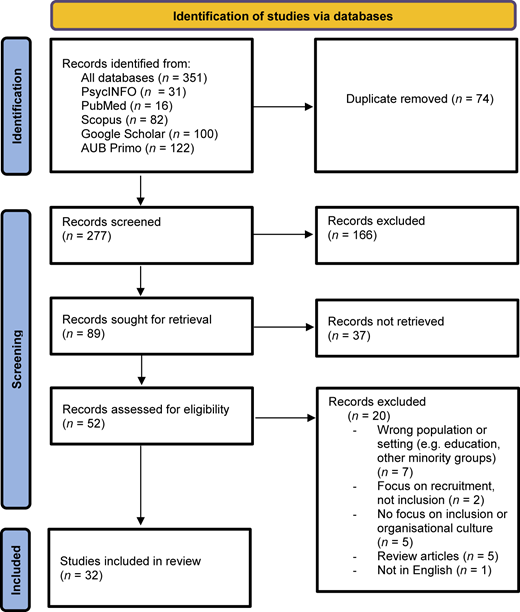
In AUB (Aalborg University's database), it was necessary to specify peer-reviewed sources, as the initial search returned non-academic material such as blog posts and local news articles (429 results before filtering). In the remaining databases, all results were skimmed. All search results were imported into RefWorks and duplicates were removed. The remaining records were screened by title and abstract and studies meeting the inclusion criteria were read in full before a final round of exclusions.
Many studies were excluded due to lack of relevance. As mentioned, to maintain conceptual focus, only studies that examined disability inclusion in relation to workplace culture were included. Consequently, studies addressing disability inclusion more generally were excluded. Common reasons for exclusion also included a focus on educational inclusion, other minority groups, return-to-work after stress, literature reviews and non-English publications. Studies concerning adjacent populations (e.g. mental health) were retained where workplace culture was central.
The use of multiple databases was intentional, as research on disability inclusion is dispersed across different disciplinary traditions. Consequently, the included studies vary in how they conceptualise key concepts such as disability, inclusion and organisational culture. As these traditions differ in emphasis, they contributed different perspectives on disability inclusion. Studies rooted in organisation and management research more often emphasised organisational structures, leadership and workplace practices. Health and psychological research frequently focused on workplace accommodations, support mechanisms, well-being and employees' experiences of inclusion. Social and disability studies perspectives more often highlighted participation, recognition, social relationships, collegial interactions and the lived experience of inclusion. These differing emphases informed the three dimensions identified in the review.
Stage 3 - study selection
Study selection was guided by the inclusion and exclusion criteria (Table 3) as outlined in the PRISMA Diagram (Figure 1). Eligible publications comprised peer-reviewed articles, book chapters and academic reports in English. Consistent with the scoping review approach, a broad range of studies was accepted (Arksey and O'Malley, 2005; Peters et al., 2015).
Several limitations should be acknowledged. First, only English-language publications were included. Although few non-English studies were identified due to English search terms, relevant research in other languages may have been overlooked. Second, grey literature and conceptual contributions were excluded. While this ensured a focus on empirical studies, it may have limited the broader insights such literature offers.
Stage 4 - charting the data
Following the full-text review, 32 studies were charted to capture key characteristics. AI assistance (ChatGPT and Copilot) was integrated to support the synthesis of findings. The AI models were provided with each study's title, DOI, author and publication year and were asked to generate a table summarising methods, study populations and key findings (Appendix 1).
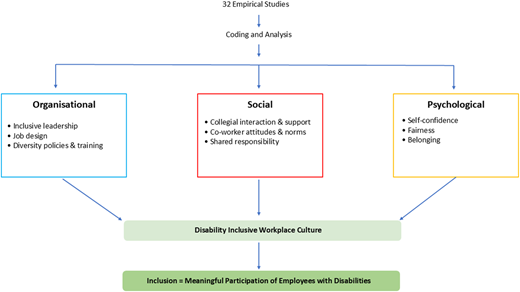
This revealed several thematic patterns. Many studies focused on organisational structures such as management and diversity policies, others on social relations and interactions and some on experiences of inclusion. Through iterative coding, these patterns were consolidated into three cultural dimensions: (1) organisational, (2) social and (3) psychological. Together, these capture the multidimensional nature of inclusive workplace cultures. The author then defined each dimension and used AI to assist in coding the studies according to the dimensions (Table 6). This helped organise the material. AI was also used to identify recurring concepts within each of the three dimensions, which were synthesised into key components.
Figure 2 illustrates the analytical process through which the reviewed literature was synthesised into three dimensions of disability inclusive workplace culture and their associated key components. The dimensions represent the broader patterns identified across the literature, while the components capture the content of each dimension. Together, they informed the proposed definition. The dimensions and their associated components are further elaborated in the Results section, while their interrelationships and contribution to the definition are discussed and synthesised in the Discussion section.
It should be noted that all final coding was conducted by the author. All AI-generated outputs were checked and verified. AI functioned solely as a supportive tool to structure, organise and critically reflect on the material, in accordance with Emerald's policy on the use of AI. To mitigate bias and blind spots associated with AI, a human-in-the-loop protocol was used. Meaning, AI-generated summaries and code suggestions were treated only as prompts, not as final results and were critically verified against the full texts (Erslev and Tretow-Fish, 2025).
As shown in Tables 4 and 5, methodological trends were identified. Many studies employed surveys or interviews, typically as single data collections with employers or HR professionals. Eight studies used case study or mixed-method approaches, while only a few involved long-term observations. Variations in study populations were also observed (Table 5). Four studies focused exclusively on employees with disabilities, 16 on employers, HR or other employees and 12 included mixed workplace samples comprising both employees with and without disabilities, HR professionals and managers.
There is an overrepresentation of US-based, cost-benefit-oriented studies with limited attention to employees' perspectives. Only four studies investigated the experiences of employees with disabilities exclusively, whereas several focused solely on employers or HR professionals. This dominance of organisational viewpoints limits understanding of how inclusion is experienced by employees with disabilities themselves.
Stage 5 - collating, summarising and reporting the results
The 32 studies are organised into three dimensions identified in the literature: (1) psychological, (2) social and (3) organisational. Together, these dimensions capture how disability inclusive workplace cultures are constituted. The following sections first present the psychological dimension, followed by the social and organisational dimensions. Within each dimension, three key components are identified and discussed, providing a more detailed content of each dimension.
The 32 studies are relatively evenly distributed across the dimensions, indicating that each plays a role in shaping an inclusive workplace culture. As shown in Table 6, several studies fall under more than one dimension, reflecting that many (n = 13) address overlapping aspects. However, no studies were found to encompass all three dimensions. The most represented dimension is organisational, followed by social and psychological.
Psychological dimensions of an inclusive culture
This dimension reflects how an inclusive culture is felt and internalised by employees with disabilities. The analysis identified three key components within this dimension: (1) self-confidence, referring to feelings of capability and pride arising from meaningful participation, (2) fairness, referring to perceptions of equitable treatment, opportunities and expectations and (3) belonging, referring to the experience of being respected and acknowledged as a valued member of the organisation.
Buciuniene and Kazlauskaite (2010), drawing on interviews with HR managers at a Lithuanian retail chain, show that successful inclusion depends more on self-confidence than on ability, underscoring the value of supportive inclusive environments that affirm individual potential. Similarly, Kalef et al. (2014), in fieldwork involving 49 participants in a Norwegian employment training programme (Telenor Open Mind), found that the program led to increased self-confidence and a stronger sense of inclusion. Sanders (2021), based on interviews with 15 retail leaders, reports that they view employees with disabilities as motivated and proud of their work, noting their positive contribution to workplace morale. These findings highlight the importance of recognising individual performance in fostering an inclusive culture.
Belonging and fairness are also highlighted as essential feelings for an inclusive culture. De Carvalho-Freitas et al. (2024) conducted surveys across 11 Brazilian organisations (120 managers and 244 employees with disabilities) and found that being treated fairly, having a voice and feeling recognised are central to how individuals with disabilities experience inclusion. Similarly, Glade et al. (2020), drawing on qualitative interviews with 26 individuals, show that being acknowledged, listened to and treated as equals contributes to feelings of belonging, confidence, motivation and self-worth.
Schur et al. (2009), analysing survey data from nearly 30,000 employees across 14 companies, demonstrate that employees with disabilities report lower job satisfaction, reduced organisational commitment and less perceived fairness than their colleagues without disabilities. However, these disparities were reduced in inclusive cultures characterised by trust, fairness and responsiveness. In such cultures, the differences between employees with and without disabilities were almost eliminated.
Based on interviews with nine individuals with disabilities in Iceland, Hafsteinsdóttir and Hardonk (2023) find that feeling a sense of belonging, being trusted with responsibilities and being able to contribute meaningfully are essential to an inclusive culture.
Other studies highlight the psychological consequences of non-inclusive cultures. Fillary and Pernice (2006), using Hagner's Workplace Culture Survey among employers and employees with and without disabilities in New Zealand, find that supported workers report significantly lower levels of inclusion than their colleagues. Barriers are especially linked to co-workers’ low expectations, which undermine individuals' perceived value in the workplace. Gustafsson et al. (2018), drawing on interviews with 19 employees in supported employment in Sweden, also stress the importance of fairness and belonging, hence being seen as capable as essential to an inclusive culture. Finally, Hashim and Wok (2014), based on a Malaysian survey (195 employers, 384 employees with disabilities and 206 co-workers), show that employees with disabilities report high levels of motivation, loyalty and satisfaction when working in an inclusive environment.
Social dimensions of an inclusive culture
This dimension reflects how an inclusive culture is created through social interactions and shared practices among employees. The analysis identified three key components within this dimension: (1) collegial interaction and support, referring to the importance of everyday collaboration, support and interaction between employees with and without disabilities, (2) co-worker attitudes and norms, referring to how peer perceptions and shared norms influence acceptance, respect and stigma reduction and (3) shared responsibility, referring to colleagues with and without disabilities working towards common goals and sharing responsibility for organisational tasks.
In a US-based study using participant observation and interviews with employees with disabilities, Butterworth et al. (2000) describe how inclusive cultures are characterised by “multiple context relationships” and “specific social opportunities”. The first term refers to informal connections such as shared breaks, while the second describes formal initiatives and planned collaborations. Similarly, in a Swedish study with 19 individuals in supported employment, Gustafsson et al. (2018) highlight how “natural support” from colleagues, rather than formal support, is central to inclusion. Natural support refers to the assistance that develops organically, such as helping with tasks and offering advice.
Glade et al. (2020), based on interviews with 26 employees with disabilities in the United States, also show how an inclusive culture is co-produced through the daily practices such as shared routines and collaborative work.
Peer interaction and support also involves designing jobs and tasks to allow for interaction and shared working tasks between employees with and without disabilities. This is supported by findings from Fillary and Pernice (2005, 2006), who conducted studies in New Zealand involving employers, employees with disabilities and their co-workers. They found that a lack of shared responsibilities encouraged subtle exclusion, whereas full-time employment and reduced reliance on external support correlated with greater inclusion due to more opportunities for interaction. In a related study in the United States including 53 employment specialists and supported employees, Hagner et al. (2015) identified that segregated roles, conflicting schedules and work tasks led to exclusion through limited opportunities for interaction between employees with and without disabilities. Also in the United States, Novak et al. (2011) conducted an observational study with six employment specialists and their supported employees and found that social integration improves when employees with and without disabilities share work goals.
More formal external collaboration also plays a role. In a United States study, Butterworth et al. (1997) show how employment training specialists support social integration by collaborating with co-workers and supervisors to encourage inclusive behaviours across the team. Similarly, Kwan (2021), drawing on interviews with eight employees without disabilities in Hong Kong, finds that social workers improve disability inclusion by guiding social interactions. In a multi-method case study of eight companies from the United States, Samant et al. (2009) expand on this by describing social workers as “organisational change agents” who promote inclusive values through daily practices that challenge discriminatory norms.
The third component concerns how co-worker attitudes and unspoken norms influence disability inclusive cultures. This means that all employees in varying degrees contribute to the inclusion of colleagues with disabilities. In a Belgian survey study, Nelissen et al. (2017) show that prosocial motivation, meaning the individual desire to help others, only leads to inclusive behaviour in teams with strong inclusive norms.
Kalargyrou (2014), who conducted a case study with 22 managers in the United States, finds that inclusive practices help reduce stereotypes and stigma while fostering psychological safety for the workforce. In a survey study across 15 organisations in Spain, Sanclemente et al. (2024) likewise find that low-stigma cultures and positive emotional climates predict stronger co-worker support for employees with disabilities. Also in the United States, Iwanaga et al. (2021) surveyed 284 HR managers and found that collegial support and inclusive team practices are associated with higher disability employment rates.
Kulkarni et al. (2016), who interviewed HR managers from India and Germany, found that inclusion becomes more sustainable when supported by all organisational actors, from leadership to frontline employees. Lastly, Lindsay et al. (2019), who conducted interviews with 18 employers in Canada, also highlight the importance of stigma reduction for all employees as strategies for building inclusive cultures.
Organisational dimensions of an inclusive culture
This dimension captures the structural aspects that enable an inclusive culture. The analysis identified three key components within this dimension: (1) inclusive leadership practices, referring to participation-oriented and supportive management styles that promote involvement, recognition and respect, (2) job design, referring to the structuring of tasks, schedules and workplace arrangements in ways that enable participation and collaboration, and (3) diversity policies and training programmes, referring to formal initiatives that institutionalise an inclusive culture through policies, awareness and training.
The significance of inclusive leadership is a finding that recurs across many studies. In a Norwegian survey, Enehaug et al. (2022) find that participation-oriented management styles are strongly associated with successful inclusion outcomes. Managers who prioritise involvement, development opportunities and manageable workloads contribute to supportive cultures. Similar findings emerge from a series of US-based studies by Moore et al. (2020a, b, 2022), which describe how disability inclusive management is characterised by attention to individual strengths, team-based collaboration and responsive communication. A case study by Kalargyrou (2014) further illustrates that leadership commitment strengthens both disability inclusion and overall workforce morale. Likewise, qualitative findings from Butterworth et al. (2000) identify a team-oriented management style as key to building supportive organisational cultures. The second component concerns the design of the job, which also intersects with the social dimensions as they influence interaction. Hagner et al. (2015) report that reduced or atypical schedules, role segregation and exclusion from workplace incentives limit the development of an inclusive culture for employees with disabilities. In a study with employers of individuals with autism, Waisman-Nitzan et al. (2019) emphasise that designing jobs with flexibility and clear procedures is vital for sustaining an inclusive culture.
Butterworth et al. (1997) describe how employment training specialists support inclusion by restructuring tasks and fostering co-worker support. In Norway, Kalef et al. (2014) evaluate the Telenor Open Mind programme (employment programme), demonstrating how formalised training, structured support and tailored job roles contribute to high levels of satisfaction. Likewise, Sanders (2021) finds that inclusive hiring is most effective when accompanied by enabling job structures and ongoing co-worker support.
The third component relates to diversity policies and training initiatives. Based on surveys with over 400 HR professionals in the United States, Iwanaga et al. (2018, 2021) identify disability inclusion preparedness as central to building an inclusive culture. This includes disability training for all employees. Kwan (2021) finds that social workers play a key role in facilitating disability awareness in Hong Kong workplaces, while Samant et al. (2009) highlight how social workers help implement inclusive cultures and policies by bridging communication between management and staff with and without disabilities.
Maini and Heera (2019), in a survey of Indian HR managers, also emphasise the importance of aligning formal HRM systems with the needs of employees with disabilities. Several studies also underscore the role of formalised inclusion policies. Drawing on data from the 2004 Workplace Employment Relations Survey, Jones (2016) finds that disability policies are associated with greater satisfaction and organisational commitment among employees with disabilities. Bruyère et al. (2003), analysing data from over 1,400 HR professionals, report that training initiatives help sustain an inclusive culture by supporting retention of employees with disabilities. Similar patterns are observed in the cross-national study by Kulkarni et al. (2016), where corporations in India and Germany found that implementing disability sensitisation programmes fostered an inclusive culture.
Discussion
The 32 studies were categorised under organisational, social and psychological dimensions, which indicates that an inclusive culture develops through the interaction of structural conditions, social relations and subjective experiences. Not all dimensions need to be equally present for all employees, as inclusion is also shaped by individual needs (Shakespeare, 2006; Shore et al., 2011). Some may primarily experience inclusion through meaningful work, while others rely more on social participation.
Across the literature, inclusive leadership and inclusive job design appear as the mechanisms that connect the three dimensions. Inclusive leadership is characterised by participation-oriented and relational practices that involve employees in decision-making, adapt work structures to individual strengths and cultivate a respectful and collaborative culture (Enehaug et al., 2022; Moore et al., 2020a, b, 2022; Kalargyrou, 2014; Butterworth et al., 2000). These practices shape the social dimension by influencing everyday interactions and team norms, while also affecting the psychological dimension through employees' experiences of being recognised and treated fairly. Inclusive job design refers to the structuring of tasks, schedules and workflows in ways that foster collaboration and shared responsibilities (Butterworth et al., 1997; Hagner et al., 2015; Kalef et al., 2014; Waisman-;Nitzan et al., 2019; Sanders, 2021). When work is organised in ways that promote shared routines and meaningful roles, opportunities for social integration are strengthened and employees' experiences of recognition and belonging are enhanced.
Together, these two mechanisms illustrate that the three dimensions do not function independently but operate in a layered way. Organisational structures set the conditions under which social and psychological processes unfold and these processes, in turn, reinforce and give meaning to organisational arrangements. This interconnectedness also illustrates the value of a cultural perspective on disability inclusion. Existing research has often examined organisational structures, social relations and employees' experiences of inclusion separately. By contrast, a cultural perspective brings these elements together and highlights how they are interconnected and mutually reinforcing each other to shape inclusion.
It is also important to distinguish between the characteristics of an inclusive culture, the mechanisms that sustain it and its outcomes. The dimensions and their components are conceptualised here as characteristics of the culture, whereas leadership and job design function as mechanisms. Some psychological experiences, such as belonging and fairness, could also be viewed as outcomes, yet they are included here as cultural characteristics because they reflect how individuals perceive and internalise the culture.
It is also important to recognise that the findings are shaped by broader contexts. The included literature is dominated by studies from Western high-income countries (75%). This suggests that the findings reflect characteristics of Western work environments and that disability inclusive cultures may take other forms in different national settings. The definition proposed in this review should therefore be interpreted with this contextual limitation and future research would benefit from examining how inclusive cultures manifest in other countries.
Disability inclusive workplace culture: a definition
A disability inclusive workplace culture is understood as structural, social and personal. It is structural in the sense that it requires formal organisational arrangements that create opportunities for interaction. It is social in that it is enacted through relations, everyday norms and support. And it is personal in that it is experienced by employees as self-confidence, belonging and fairness. Organisational structures seem to shape the conditions under which colleagues interact and the extent to which employees feel valued. In this sense, the organisational dimension not only provides the formal stage for inclusion but also exerts influence through the two key mechanisms: inclusive leadership and inclusive job design. Based on this, the review proposes the following definition:
“A disability inclusive workplace culture is defined by shared patterns of organisational structures, social practices and psychological experiences that enable employees with disabilities to access and engage meaningfully in the culture of the organisation. Such cultures are particularly sustained through inclusive leadership and the design of inclusive jobs that foster collaboration”.
The terms meaningful participation and access are used to indicate that inclusion does not require identical forms of participation (Shakespeare, 2006; Shore et al., 2011). Employees may experience inclusion differently, as long as opportunities for participation are available on the same terms as for employees without disabilities. To illustrate the distinction, a workplace may have disability policies and recruitment initiatives, but if employees with disabilities remain socially isolated or do not experience belonging and recognition, the workplace may be inclusive in principle without necessarily exhibiting a disability inclusive workplace culture.
Table 7 summarises the key components of each dimension. These components of the dimensions inform the proposed definition.
The definition draws on Schein's (1985) understanding of organisational culture as shared patterns through which members of an organisation learn to perceive, think and feel. A long-standing debate in organisational research concerns whether culture is something organisations have (formal structures and artefacts) or something organisational members experience (Alvesson, 2002; Schein and Schein, 2017).
In line with Schein (1985) the definition recognises culture as ways of perceiving and feeling, which also resonates with the three-level model of culture. Organisational dimensions correspond to artefacts, understood as the visible practices that establish the broader framework within which the other dimensions unfold. Social dimensions correspond to values and norms that guide behaviour and shape collegial relations. However, the psychological dimension does not correspond to basic assumptions, as these are implicit and unconscious, whereas psychological experiences are conscious and felt. Instead, basic assumptions may relate to the implicit and taken-for-granted understandings of disability and inclusion that exist within the members of the organisation. Such assumptions influence how employees with disabilities are perceived and included, even when they are not explicitly articulated. In this sense, the psychological dimension may also be shaped by these deeper assumptions.
The definition is further informed by more contemporary perspectives. Schein and Schein (2017) and Alvesson (2002) highlight how culture emerges through ongoing interaction and may consist of multiple co-existing subcultures. Moreover, national and institutional contexts also shape underlying assumptions and everyday practices (Hofstede et al., 2010). This means that a disability inclusive culture is not to be treated as a homogeneous entity but should be understood as dynamic and multi-layered, and in this case embedded within a western context. Hence, future research should examine how such cultures develop, are sustained and change over time, ideally in non-Western contexts.
Especially, there is a need for qualitative and longitudinal studies exploring how organisational structures, social relations and psychological experiences interact and reinforce each other. Such research would contribute to a deeper and more holistic understanding of disability inclusion.
Finally, viewing disability inclusion through a cultural lens narrows the analytical scope and may leave out other aspects of inclusion, but at the same time it offers a coherent understanding. By bringing together insights that are typically dispersed across studies and seen in isolation, the framework integrates these into a single cultural perspective and demonstrates how they collectively constitute a disability inclusive culture.
Conclusions
This scoping review synthesised findings from 32 studies to explore how disability inclusive workplace cultures are constituted. This resulted in the finding of three dimensions: organisational, social and psychological. Organisational dimensions provide the visible framework and act through the key mechanisms inclusive leadership and job design. Social dimensions highlight the importance of collegial interactions, shared routines and inclusive norms, while psychological dimensions emphasise employees' experiences of self-confidence, fairness and belonging.
Drawing on this, the review proposes that a disability inclusive workplace culture is characterised by shared patterns of organisational structures, social norms and subjective experiences that enable employees with disabilities to participate meaningfully in the culture of the organisation. This underscores that such a culture is simultaneously a structural framework, a social practice and a subjective experience. The proposed definition offers organisations a tool for critically reflecting on their own workplace cultures. The review also advances existing research by conceptualising inclusion as a cultural phenomenon. Existing research has often focused on organisational structures, social relations and experiences of inclusion in isolation. By bringing these together within a single cultural framework, the review demonstrates how they reinforce each other, are connected and interact to shape inclusion. The contribution of the concept of disability inclusive workplace culture therefore lies in providing a broader, more coherent and holistic understanding.
The supplementary material for this article can be found online.