This study explores the role of generative artificial intelligence (G-AI) as a lever for process innovation in food firms. In particular, it analyses how different levels of G-AI implementation influence innovation performance (incremental, frugal, radical) and how this relationship is moderated by two key organisational factors: IT culture and organisational flexibility.
The empirical investigation is based on a questionnaire administered to 3,250 European, US and Australian companies operating in the primary food processing (P-FM) sector. The questionnaire was constructed from scales validated in the literature and pre-tested for clarity and semantic consistency. After the data cleaning process, 281 complete questionnaires were considered valid. The collected data were analysed using structural equation modelling (SEM).
The results show that generative artificial intelligence has a positive and significant impact on incremental and frugal innovations but not on radical ones. IT culture and organisational flexibility positively moderate the effect of G-AI on all types of innovation, with a synergistic effect for less complex innovations. The positive influence of radical innovation strongly depends on the combination of high organisational capabilities and firm size.
To realise the potential of G-AI, companies need to invest in widespread digital culture and adaptive organisational structures. Policymakers should foster access to innovation networks and training supports to enable even small and medium-sized enterprises (SMEs) to realise meaningful and sustainable innovations.
1. Introduction
The environmental and competitive landscape in which food companies operate is becoming increasingly turbulent due to climate change, environmental crises, and radical transformation in consumer behaviour (Castillo-Valero and García-Cortijo, 2021; Shen et al., 2021). In this environment of uncertainty and rapid change, the ability of companies to utilise intra- and inter-organisational factors to define and implement innovation effectively has become a priority not only for competitiveness but also for their survival (Bigliardi et al., 2020). As widely discussed in the literature, innovation strategies should include dimensions of marketing, product, process and organisational models (Earle, 1997; Bigliardi et al., 2020). Due to climate change severely affecting resource availability, rising energy costs throughout the supply chain, and consumer demand for increasingly healthy and functional products, process innovation has become more important. Food companies must overcome the traditional view of the sector as a “low-innovation industry” in terms of their processes and products, and develop capabilities to implement open, dynamic innovation models and innovation-oriented technologies (Capitanio et al., 2010; Bigliardi and Filippelli, 2022).
More recently, in many other industries, including the food sector, generative artificial intelligence (G-AI) has emerged as a transformative technological opportunity to support innovation (Krupitzer, 2024). G-AI refers to a set of machine-learning models designed to exploit the underlying distribution of data to generate realistic outputs (Rane, 2024). G-AI models, as opposed to predictive artificial intelligence systems, are specifically tailored to generate novel content, such as text, images, sounds, or complex data structures, through probabilistic and sequential mechanisms that closely mirror human creativity (Feuerriegel et al., 2024; Singh et al., 2024).
G-AI tools can be publicly available (commercial and open-sourced) or proprietary systems designed for internal corporate use and trained on proprietary data. However, proprietary G-AI offers greater control, high data privacy, and alignment with specific business needs; its advanced technical complexity and cost, however, undermine its deployment in micro and small businesses (Feuerriegel et al., 2024). Key factors explaining the proliferation of open-source or commercial G-AI tools include accessibility, low adoption costs, minimal technical requirements, and democratisation of creative capabilities (Fui-Hoon et al., 2023; Corvello, 2025; Gupta and Rathore, 2024). In addition, G-AI tools have high versatility for application across multiple organisational domains, including product development, process innovation, marketing strategies, and organisational design itself (Corvello, 2025; Feuerriegel et al., 2024). From the user’s point of view, publicly available G-AI systems are characterised by usability, scalability and interactivity, attributes that enable even non-experts to experiment with new forms of human-machine collaboration (Corvello, 2025; Gupta and Rathore, 2024). Moreover, unlike other AI technologies, publicly available G-AI presents a distinctive feature: its adoption can be driven proactively by individual employees without requiring immediate top-down institutionalisation (Corvello, 2025; Cimino et al., 2025). This bottom-up dynamic could open the possibility for informal, decentralised dissemination adoption trajectories within organisations (Feuerriegel et al., 2024; Gupta and Rathore, 2024). Evidence from the literature suggests that effective adoption of commercial and open-source G-AIs can improve organisational ambidexterity and support both exploratory and exploitative process innovation (Roberts and Candi, 2024; Corvello, 2025). G-AI could both accelerate innovation cycles for large firms and act as a “compensator”- mitigating financial and human barriers to innovation in SMEs and microenterprises (Roberts and Candi, 2024). It is worth noting that, despite its apparent promise, the innovative impact of G-AI is not a foregone conclusion. On the one hand, G-AI can produce plausible but unworkable results that are insensitive to context, difficult to translate into stable routines, or, in the worst case, hallucinations (Cimino et al., 2025; Corvello, 2025). On the other hand, its ability to reshape social systems and redefine the boundaries of work, including the demand and resources associated with it, can create organisational tensions (Hopf et al., 2023; Corvello, 2025).
Building on the absorptive capacity framework as applied to the implementation of technological and innovation systems, it can be hypothesised that the organisational dimensions of information technology culture (ITC) and organisational flexibility (OFL) may influence the extent to which G-AI effectively generates innovation within firms (Heimberger et al., 2024; Mao et al., 2021). A strong ITC – marked by digital familiarity, experimentation, and continuous learning – could enhance the organisation’s ability to recognise, assimilate, and leverage the new knowledge and creative outputs produced by G-AI systems (Harper and Utley, 2001; Heimberger et al., 2024). Likewise, OFL may enable the reconfiguration of routines, workflows, and structures needed to integrate and scale the emergent and often unpredictable outputs of generative technologies. These organisational features might be particularly important in contexts where G-AI use originates from decentralised, bottom-up experimentation rather than through planned top-down implementation strategies (Mao et al., 2021; Heimberger et al., 2024).
To date, academic literature has addressed the relationship between G-AI and innovation performance in the food sector only in a fragmented, unsystematic manner. No studies currently assess G-AI across distinct levels of implementation, namely individual adoption, informal diffusion, and organisational institutionalisation. Moreover, the interaction between G-AI adoption level, ITC, and OFL in shaping process innovation performance has not been systematically explored.
In response to this gap, the present study aims to investigate the interplay among these factors empirically. The objective of this research is to contribute to the literature on G-AI adoption, with theoretical and managerial implications for the design of effective implementation strategies. To this end, two research questions were defined:
Is process innovation in food companies influenced by different levels of G-AI implementation?
Is there a moderating role of ITC and OFL in the relationship between G-AI implementation level and innovative process performance?
This study contributes to the literature in three ways. Firstly, it conceptualises the implementation of G-AI as a continuum that overcomes the binary concept of “adoption/non-adoption.” Secondly, it theorises and analyses the joint moderating role of two enabling organisational conditions, ITC and OFL in the relationship between G-AI implementation and innovation performance. Thirdly, it assesses the impact of G-AI on different dimensions of innovation, showing how the relationship between G-AI and innovation is contingent on complexity.
To answer these questions, an empirical study was conducted using a survey of 281 primary food manufacturers (P-FMs). With this purpose in mind, the article consists of five sections: theoretical background, formulation of research hypotheses, research methodology, results, discussion and conclusion.
2. Theoretical background
2.1 The role of G-AI in process innovation in the food sector
Process innovation assumes a strategic role for companies in the food sector, as it directly contributes to organisations’ ability to adapt to changing and competitive environments (Earle, 1997; Della Corte et al., 2018). Three key types of process innovation are identified in the literature: incremental, radical and frugal (Purba et al., 2018). Incremental innovation is characterised by continuous, progressive improvements to existing processes, often achieved through the adoption of mature technologies or the efficient reorganisation of operational activities (Capitanio et al., 2010). By contrast, radical innovation introduces discontinuous and transformative changes that rewrite production logic (Bigliardi and Filippelli, 2022). Lastly, frugal innovation is distinguished by its potential to generate simple, inexpensive and sustainable solutions, often born out of the creative adaptation of existing resources (Prabhu, 2017).
G-AI emerges today as one of the most promising tools for process innovation in the agribusiness sector (Ben Ayed and Hanana, 2021). Its potential extends to all the types of innovation mentioned above. For example, regarding incremental innovations, G-AI can be utilised to analyse production data, identify inefficiencies, and provide real-time suggestions for operational changes (Fui-Hoon et al., 2023; Gupta and Rathore, 2024). In food processing lines, G-AI can support predictive quality control, automatic calibration of production parameters or automated detection of anomalies in pasteurisation and sterilisation processes (Izquierdo-Bueno et al., 2024; Krupitzer, 2024).
At the level of radical innovation, if properly trained, G-AI could generate entirely new food formulations, for example, based on consumer nutritional or sensory preferences. This may indirectly translate into the development of new production processes (Pitsilou et al., 2024; Krupitzer, 2024).
Regarding frugal innovations, G-AI represents a high-efficiency solution for resource-constrained realities, particularly small businesses, which can leverage open-source generative tools and even pre-trained templates for tasks such as automatic labelling, simplified HACCP data management or optimisation of energy consumption in refrigeration cells (Ben Ayed and Hanana, 2021; Razzaq et al., 2023).
However, as already mentioned, the positive results of implementing G-AI are not self-evident. Although G-AI can expand the space of cognitive possibilities, it does not necessarily translate possibilities into stable process change. On the contrary, G-AI requires effective governance at both the individual employee and organisational levels of appropriation. This technology poses numerous risks, including hallucinations, decision-making and operational fragmentation (solutions that cannot be implemented due to tacit process constraints), which can create circles of waste. This is particularly critical in primary food processing, where biological variability, compliance constraints, and process interdependencies are high (Ben Ayed and Hanana, 2021; Bigliardi and Filippelli, 2022).
2.2 The trajectories of G-AI implementation in companies
Given the diverse nature of G-AI technologies, their adoption in enterprises may follow two distinct but potentially complementary trajectories (Cimino et al., 2025; Fui-Hoon et al., 2023). The first, which applies to any G-AI, is based on a top-down managerial approach. Traditionally, the adoption of new technology has been described in terms of the stages of acquisition, assimilation, transformation, and exploitation of knowledge and technology. According to this model, the organisation utilises its dynamic capabilities to recognise the value of new technology, assimilate it, and apply it for innovative purposes (Flatten et al., 2011; Yu, 2013). These capabilities, which are based on a mix of prior knowledge, technological infrastructure and organisational routines, determine the speed and effectiveness with which a technology such as G-AI can be integrated into core processes (Mao et al., 2021; Cohen and Levinthal, 1990).
The second trajectory, involving public G-AIs, is a bottom-up approach triggered by informal initiatives of individual actors or teams (Cimino et al., 2025; Feuerriegel et al., 2024). In this scenario, adoption stems from unplanned exploratory activities supported by personal factors, such as intrinsic motivation, familiarity with digital technology, and self-directed learning ability (Cimino et al., 2025). The emergence of these trajectories is not a given: their stabilisation and scalability depend on complementary organisational conditions (Cimino et al., 2025; Feuerriegel et al., 2024). Because these two trajectories can coexist, they should not be understood as alternatives or sequential but rather as potentially coexisting and interactive. In other words, bottom-up experimentation might constitute a first level of “pre-absorption” that facilitates subsequent formalisation.
As demonstrated in the literature, top-down strategies for implementing information technology solutions are most effective when built on established practices or in environments where employees have confidence in new technologies (Martínez-Caro et al., 2020; Shin et al., 2023). Moreover, the degree of successful adoption depends on the organisation’s ability to transform individual knowledge into organisational knowledge by enabling both emergent and intentional learning cycles (Nonaka et al., 1996; Cohen and Levinthal, 1990). Based on these specific factors, the implementation of G-AI technologies can be understood as a dynamic continuum, ranging from informal, opportunistic adoption to strategic, systemic integration. Governing this continuum requires substantial organisational effort to manage resources, policies, and skills, integrating and enhancing the two trajectories to transform individuals’ knowledge and skills into collective assets. It is important to emphasise that different levels of appropriation can generate organisational tensions (Hopf et al., 2023). Informal experimentation could create “shadow” practices that circumvent formal controls, producing heterogeneous use cases and irregular behaviours that are misaligned with objectives. Conversely, excessive formalisation can suppress exploration by limiting experimentation or generating cognitive and compliance constraints that reduce perceived utility. Consequently, the relationship between the implementation trajectory and innovation is shaped by how organisations balance exploration, coordination, and accountability.
2.3 IT culture and organisational flexibility in G-AI adoption processes
The absorptive capacity framework states that the value of digital technologies does not depend solely on their standalone functionality but on the organisational conditions that enable sensemaking, learning, and routinised exploitation (Cohen and Levinthal, 1990; Flatten et al., 2011). In this perspective, and in line with theories on dynamic capacity, absorption capacity recognises two enabling factors that cut across all stages of organisations’ technological appropriation processes, namely innovative culture and organisational flexibility (Cohen and Levinthal, 1990; Flatten et al., 2011). With regard to G-AI and the new organisational paradigms associated with it, ITC cannot be reduced to infrastructure availability or to the choice and adoption of tools. It concerns, on the one hand, the shared interpretative orientation – which shapes the way in which members of the organisation perceive and evaluate technology and the credibility of the outputs it produces – and, on the other hand, technology management decisions and behaviours (Corvello, 2025; Pradana et al., 2022). ITC affects the cognitive schemas of employees and organisational decision-makers. When ITC is high, members of the organisation are more likely to interpret G-AI as a legitimate tool for innovation and recognise its potential use cases beyond the immediate automation of tasks (Shin et al., 2023). This perception increases the likelihood that G-AI outputs will be treated as plausible hypotheses to be explored rather than as marginal or unreliable artefacts. ITC facilitates learning processes by legitimising experimentation and promoting individual autonomous learning and peer-to-peer knowledge exchange. These mechanisms – particularly when G-AI adoption emerges from bottom-up practices – can accelerate the acquisition and assimilation phases of absorption capacity (Shin et al., 2023; Martínez-Caro et al., 2020). Finally, ITC shapes knowledge management practices by fostering collaborative routines, shared vocabularies, and self-reflective practices (Mao et al., 2021). These support the transformation of scattered local insights into organisational knowledge (Mao et al., 2021). However, while a high level of ITC can promote appropriation practices, excessive enthusiasm for experimentation could encourage the spread of poorly validated practices or normalise misuse that creates governance risks (Cimino et al., 2025; Hopf et al., 2023). Therefore, given the characteristics of G-AI, ITC needs flexible routines to support the evaluation, validation, and codification of knowledge and uses.
OFL is defined as an organisation’s ability to adapt its structure, decision-making processes, and operating models in response to internal or external stimuli and can play an equally crucial role in supporting the introduction and diffusion of G-AI (Golden and Powell, 2000). Conceptually, since OFL allows for the coexistence of exploratory and instrumental uses of technologies, it can be interpreted through the lens of organisational ambidexterity (Yu et al., 2023). Specifically, three cognitive-behavioural mechanisms related to OFL can support the use of innovation-oriented G-AI. First, flexible work resources reduce the perceptual and structural constraints associated with experimentation. This leads to increased individual proactivity and cross-functional permeability. These conditions increase the variety of experimental use cases (Ni et al., 2021; Golden and Powell, 2000). Secondly, OFL supports adaptive work routines (e.g. rapid role adjustment, iterative workflow redesign, dynamic coordination mechanisms) that facilitate the application of G-AI outcomes in production contexts (Corvello, 2025). Thirdly, the coordination systems that characterise the OFL promote the processes of diffusion and appropriation of G-AI by enabling distributed governance arrangements (e.g. cross-functional forums, cross-cutting roles, and feedback loops from local to central) through which emerging practices can be selected, refined, and institutionalised (Cimino et al., 2025). In literature, the concepts of permeability between functions, reduction of hierarchical constraints, promotion of spaces for confrontation between roles and departments, and tolerance of error as learning opportunities have emerged as elements that support the implementation of G-AI (Golden and Powell, 2000; Corvello, 2025). OFL could be particularly relevant in cases where the adoption of G-AI occurs spontaneously (Corvello, 2025; Cimino et al., 2025). However, where multiple local G-AI use cases proliferate simultaneously, OFL can entail coordination trade-offs (Hopf et al., 2023). While decentralisation and autonomy enable rapid experimentation, they may also introduce interpretive issues, undermine standardisation, and lead to misalignment across functions.
Taken together, ITC and OFL suggest that the innovation impact of G-AI depends not only on the presence of enabling conditions, but also on whether organisations can simultaneously sustain local experimentation and system-level coordination.
2.4 Research hypothesis
Based on a positive view of technology, the theoretical framework of absorption capacities, and finally, the socio-technical view of technology appropriation, the following assumptions are made:
The implementation of G-AI in food companies positively impacts process innovation performance.
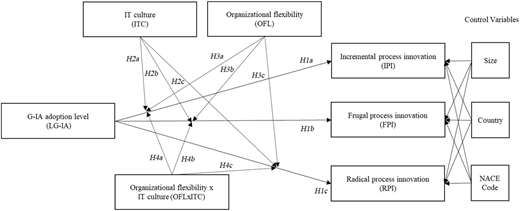
Integrating G-AI tools into production processes can enhance efficiency, facilitate experimentation with new solutions, and make innovative practices more accessible, even in resource-limited and traditionally challenging contexts. The ability of G-AI to analyse data, suggest production alternatives and generate useful knowledge in real-time can support the incremental improvement of existing activities (H1a), the adoption of simple and economically sustainable solutions to reduce resource use (H1b) and the introduction of deeper process transformations (H1c).
ITC positively moderates the relationship between G-AI implementation and process innovations.
In organisations with a solid digital culture built on training, personal and organisational prior experience, openness to experimentation, and the availability of digital routines, the adoption of G-AI is more likely to result in significant innovations. Moreover, the presence of integrated digital infrastructures and change-oriented leadership enables companies to fully leverage the transformative potential of technology, whether it is oriented towards incremental (H2a), frugal (H2b), or radical (H2c) innovations.
OFL moderates the relationship between G-AI implementation and process innovations, facilitating their effective translation into concrete results.
Business environments that can adapt quickly, reduce structural rigidities, and encourage bottom-up initiatives can create the ideal conditions for the use of G-AI to drive innovation. The opportunity for employees to experiment, collaborate across boundaries and propose improvements makes it more likely that individual uses of technology will translate into widespread practices and shared implementable solutions. Such practices and solutions may concern incremental (H3a), frugal (H3b) and radical (H3c) process innovations.
The combined moderating effect of OFL and ITC strengthens the relationship between G-AI implementation and process innovations.
Organisations that simultaneously leverage flexibility and ITC create synergistic conditions to maximise the use of G-AI to support innovation. The combination of flexibility and culture could enhance both experimentation and management of innovative practices, moving beyond isolated technology applications into systemic process improvements. Thus, the synergistic moderation of organisational flexibility and IT culture enhances the successful exploitation of G-AI in incremental (H4a), frugal (H4b), and radical (H4c) process innovations.
Since the size of the enterprise influences the trajectories and types of innovation, the specifics of the production system and products, and the territorial area to which they belong (e.g. presence of business clusters, research institutions, national funding opportunities, territorial vocation, regulations, etc.) (Bigliardi and Filippelli, 2022; Bigliardi et al., 2020) these variables are used as control variables. Figure 1 represents the proposed research framework. Throughout this research, size is coded according to the European Commission Recommendation 2003/361/EC (EU Commission, 2003), while the type of company is identified by the code “International Nomenclature statistique des activités économiques dans la Communauté européenne” (NACE) (EU Commission, 2022).
3. Research methodology
3.1 Background to the companies involved in the study
The study draws on a quantitative survey of primary food manufacturers (P-FMs) across Europe, the US, and Australia. P-FMs are enterprises that transform raw food materials, including milk, grains, grapes, meat, or olives, into food products for human consumption. They differ from secondary food manufacturers (S-FMs), which transform ingredients or semi-finished products into finished, ready-to-eat products (e.g. cookies, snacks, processed meat, ready meals) (European Commission, 2022). P-FM provides a theoretically interesting empirical context for examining G-AI-enabled process innovation, as it combines structural conditions that increase the need for innovation with those that limit its feasibility (Bigliardi et al., 2020; Marolla et al., 2025). These companies operate under high intrinsic variability in processes and results: the biological characteristics of inputs, seasonality, and territorial conditions can generate instability in process parameters and performance outcomes (Bigliardi and Filippelli, 2022). While this encourages the development of “exception management” skills, it also reduces the possibility of predicting the results of innovation processes (Marolla et al., 2025; Bigliardi et al., 2020). The P-FM sector is regulated by strict regulatory, safety, and traceability regimes (European Commission, 2022). These compliance requirements affect operational routines and discourage experimentation, thus implementing innovative process solutions particularly challenging (Bigliardi et al., 2020). Furthermore, upstream and downstream interdependencies between processes, traceability between partners, and coordination among actors in the logistics chain require network-level innovation processes rather than isolated adjustments at the company level (Bigliardi et al., 2020). This limits the possibility of embarking on path-breaking process innovations that could disrupt the logistics chain. It should be emphasised that the historical view of P-FM as a “low innovation” sector, due to established traditions and practices, has been superseded (Bigliardi et al., 2020; Bigliardi and Filippelli, 2022). Today, the literature emphasises that this low-innovation characteristic is better understood as an indicator of high innovative complexity (Bigliardi and Filippelli, 2022). Moreover, while modern highly automated farms and advanced processors represent an important exception, most P-FM firms continue to exhibit comparatively lower levels of ITC and limited dedicated resources for digital solutions, which further constrain their capacity to absorb and operationalise advanced technologies (Bigliardi and Filippelli, 2022; Marolla et al., 2025). For these reasons, P-FMs provide an analytically rigorous context for investigating how G-AI, given its usability, low entry costs, and ability to democratise advanced analytical and creative functions, can serve as enabling infrastructure for process innovation even where traditional barriers are high.
3.2 Questionnaire construction
The construction and validation of the questionnaire follow the framework proposed by Petroni et al. (2017). Firstly, through an in-depth literature review, preliminary items were identified for operationalising the constructs ITC, OFL, Incremental Process Innovation (IPI), Frugal Process Innovation (FDI), and Radical Process Innovation (RPI). Selected items related to ITC and OFL were extrapolated from validated scales in the literature (see Table 1). The independent variable “level of adoption of G-AI (LG-AI)” comprises a single item measured on a 5-level ordinal scale that reflects the increasing continuum of formalisation and diffusion of AI use. A single-item measure is appropriate in this case because the construct is concrete, unidimensional, and factual in nature (implementation stage), rather than a latent psychological disposition. Therefore, the LG-AI element captures the implementation’s organisational maturity status, a condition in which adjacent levels should be interpreted as incremental steps along a single maturity dimension. These are 1. Informal and sporadic use by individuals; 2. Informal and continuous use by groups of people; 3. Formalisation of procedures to govern the use of G-AI in particular areas; 4. Formalisation of procedures to spread the use of AI throughout the organisation and 5—full integration of formal and informal modes, aimed at innovative exploration and effective dissemination of G-AI. Although LG-AI is measured using a five-level ordered response format, in the empirical model it is treated as an approximately continuous indicator of implementation maturity. This choice is consistent with common practice in organisational survey research when ordinal scales are used to represent a theoretically monotonic continuum.
The preliminary items were submitted to a panel consisting of five CEOS of highly innovative P-FM companies (from different countries) and four university professors with expertise in innovation management and organisational behaviour for piloting. Clear construct-specific introductions were implemented to minimise carryover and consistency motifs. The evaluators analysed the relevance and clarity of each item with respect to the theoretical reference construct, helped eliminate redundant items, and formulated preliminary questions. To evaluate perceived consensus, the content validity index (I-CVI) was assessed for each item (Koller et al., 2017). Items with I-CVI greater than 0.78 were included in the analysis. Table 1 summarises the results of the content validity. Items related to ITC reflect digital leadership and the ability to absorb digital technology. Those related to organisational flexibility address the decentralisation of decision-making and the capabilities for structural readjustment. Finally, items about types of process innovations were selected and discussed with reference to G-AI opportunities in the food industry.
After content validity was completed, the preliminary questionnaire was constructed by organising it into thematic sections corresponding to the main variables of the theoretical model. In particular, to mitigate common method effects, the questionnaire separated predictors and outcomes into distinct thematic sections. The variables in the model, except for the control variables, are measured using a 1–5 Likert scale. While being aware of the influence on equidistance between scale items, to facilitate understanding of the questions and improve self-assessment for each item, each scale value was associated with a description (Petroni et al., 2017). The preliminary questionnaire was tested on a subsample of 110 companies, comprising 20 Italian, 21 Spanish, 18 French, 30 American, and 21 Australian companies. Through a telephone survey, the following were assessed: language comprehension (Repke and Dorer, 2021), semantic interpretation of questions, and consistency of responses (Petroni et al., 2017). Thus, the pre-test based on item comprehension rate was used to ensure semantic equivalence and minimise item ambiguity (4.8% flagged as unclear). The results showed no need for revision, so the preliminary questionnaire was not modified.
The final questionnaire consists of five sections: 1) company description (name, country, classification, turnover, employees, G-AI type); 2) one question on G-AI implementation level; 3) six questions on ITC; 4) eight questions on OFL; 5) twelve questions on process innovation (four for each of the types of innovation). To discourage automatic and non-compliant response patterns and ensure data quality in each section, a reverse-coded question was included (Skinner, 2009).
3.3 Data collection
The final questionnaire was administered via Google Forms to 3,250 companies over a 6-month period. Companies were identified from publicly accessible directories of national sectoral associations, industry observatories, and official registries (Marolla et al., 2025). The companies were identified and selected using simple random selection methods from publicly accessible lists of national associations and sectoral agencies, as well as sector monitors (Marolla et al., 2025). To reduce apprehension about evaluation and social pressures, participation was voluntary, and responses were collected anonymously. Listwise deletion was used for case selection. Therefore, surveys with missing values were excluded (22 eliminated) using a comprehensive approach. The final sample consists of 281 fully completed questionnaires. Non-response bias was assessed using a χ2 test, which compared the proportion of responding companies that are G-AI users and non-users with the proportion of total questionnaires sent out in each country (Petroni et al., 2017). Results did not show any significant difference (G-AI users: χ2 = 3.97, d.f. = 4; p-value = 0.41; G-AI non-users: χ2 = 5.05, d.f. = 4; p-value = 0.28) and thus data were accepted as non-biased. Table 2 summarises the distribution of the sample according to country, company type, size, and G-AI type.
3.4 Measure
As noted earlier, LG-AI was measured using a single item. G-AI type was measured as “Publicly available” = 1; “Proprietary system” = 2. Dummy transformation was used to code the country and NACE codes, while the size variable is coded as follows: “Micro” = 1; “Small” = 2; “Medium” = 3; “Big” = 4.
To assess the validity and reliability of the OLF, ITC, RPI, FPI and IPI measurement scales, a confirmatory factor analysis (CFA) was first performed, and then the square root of the explained mean-variance (AVE) of each factor was compared with the values of correlations with other constructs (Hair et al., 2014). The indicators related to the global CFA model - Kaiser-Meyer-Olkin Test (KMO; KMO>0.90) and Bartlett’s test of sphericity (p < 0.01) - and to the individual constructs – average variance extracted (AVE; for each factor AVE>0.50) and Cronbach’s alpha (α; for each factor α > 0.70) - confirm the goodness of the theorised constructs (Table 3). The comparison of AVE and correlation indexes confirms that each construct shares more variance with its own items than with other constructs (Table 4). The heterotrait-monotrait ratio of correlations (HTMT) technique was performed to test the discriminant validity of the latent constructs (Hair et al., 2014). The HTMT values remained below the threshold of 0.85 (minimum = 0.19, maximum = 0.61).
The relationship between the control variables was also assessed. The country significantly influences the type of company (χ2 = 27.30; d.f. = 16; p = 0.03) but marginally the size (χ2 = 19.20; d.f. = 12; p = 0.08). Despite being counterintuitive, there are no substantial differences in size across company types (χ2 = 19.44; d.f. = 12; p = 0.08).
4. Results
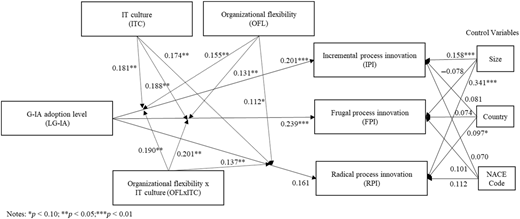
The theoretical model was tested using structural equation modelling (SEM) in AMOS 25. The model shows acceptable fit (x2/df = 2.21; CFI = 0.91; NFI = 0.89; IFI = 0.91; RMSEA = 0.07), while the TLI (TLI = 0.88) is slightly below the conventional threshold of 0.90. These model indicators suggest room for improvement, but overall, the fit is good. It is critical to note that no multicollinearity issues emerged (variance inflation factor values range from 1.85 to 3.65) (Hair et al., 2014). Harman’s single-factor test indicates that the first unrotated factor accounts for less than 50% of the total variance, suggesting that common variance in the method is not a significant concern (Hair et al., 2014). Before analysing the direct and moderating effects among factors, the impact of control variables on innovation variables was evaluated. Among the control variables, firm size shows a strong positive association with radical process innovation (β = 0.341, p < 0.001), while its association with incremental innovation is weaker (β = 0.158, p < 0.001). This indicates that larger firms tend to report higher levels of radical process innovation – consistent with the resource intensity of disruptive process change. The other control variables have no impact on the types of process innovation.
The results of the direct relationships between LG-AI and process innovation variables show that LG-AI has a moderate and significant impact on IPI (βLG-AI = 0.201, p < 0.001) and FPI (βLG-AI = 0.239, p < 0.001), but has a weak and “less significant” impact on RPI (βLG-AI = 0.161, p = 0.011). Thus, considering level of significance (α) = 0.01 for robustness, while the results support H1a and H1b, they do not support H1c. The direct effects of moderating variables and the resulting variable of their product on innovations were also evaluated. The results show that OFL has a significant effect on IPI (βOFL = 0.194, p < 0.01) and FPI (βOFL = 0.211, p < 0.01), but it does not on RPI (βOFL = −0.019, p = 0.734). Regarding ITC, it has a significant impact on IPI (βITC = 0.263, p < 0.01), FPI (βITC = 0.221, p < 0.01) and RPI (βITC = 0.178, p < 0.05). Finally, OFL × ITC has a significant positive impact on FPI (βOFL×ITC = 0.191, p < 0.05) and IPI (βOFL×ITC = 0.186, p < 0.05), while it also exhibits a significant, albeit weaker, effect on RPI (βOFL×ITC = 0.141, p < 0.05).
The moderation assessment required constructing four interaction terms. Interaction terms were computed as products of the corresponding predictors; collinearity diagnostics (VIF) indicate acceptable levels. The first is obtained by multiplying LG-AI and OFL (LG-AIxOFL); the second is obtained by multiplying LG-AI and ITC (LG-AIxITC); the third and fourth are, respectively, the products of OFL and ITC (OFLxITC) and the three variables LG-AI, OFL, and ITC (LG-AIxOFLxITC). The four new variables were used as independent variables in the structural equation model (SEM). The analysis of moderation effects reveals that ITC exhibits a significant positive moderating effect across all types of process innovation: IPI (βLG-AIxITC = 0.181, p < 0.05), FPI (βLG-AIxITC = 0.188, p < 0.05) and RPI (βLG-AIxITC = 0.174, p < 0.05). These results support H2a–H2c.
OFL exhibits a significant positive moderating effect between LG-AI and both IPI (βLG-AIxOFL = 0.155, p < 0.05) and FPI (βLG-AIxOFL = 0.131, p < 0.05), but not RPI (βLG-AIxOFL = 0.112, p = 0.084). Hence, while the results support H3a and H3b, they do not support H3c.
The combined moderation of OFL and ITC is captured by the three-way interaction term (LG-AI × OFL × ITC). In the model, this interaction is positive and statistically significant for IPI (βLG-AIxOFLxITC = 0.190, p < 0.05) and FPI (βLG-AIxOFLxITC = 0.201, p < 0.05). These results indicate that the marginal effect of LG-AI on these outcomes is stronger when ITC and OFL are jointly high, consistent with a synergistic capacity configuration. With regard to RPI, the three-way interaction remains positive. However, it exhibits a smaller magnitude (βLG-AIxOFLxITC = 0.137, p < 0.05), indicating that the joint capability configuration provides a weaker amplification of the LG-AI effect. This evidence suggests a more attenuated and not fully synergistic effect. Hence, while the results fully support H4a and H4b, H4c is only partially confirmed.
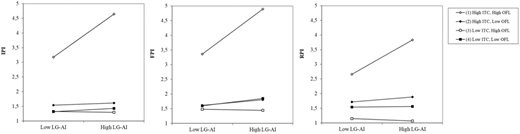
Figure 2 represents the model and the indices derived from the analysis. Figure 3 shows the three moderating effects for each type of innovation.
In particular, Figure 3 highlights how OFL and ITC individually moderate the relationship between LG-AI and innovation outcomes, reinforcing the importance of adaptive capabilities and technological orientation within firms. The direct and positive interaction effect between OFL and ITC clearly emerges from the representation. It strengthens the influence of each factor on FPI and IPI. However, when RPI is taken into account, the joint moderation effect loses its intensity. This suggests that these internal enablers alone may be insufficient to unlock the full potential of LG-AI for more disruptive innovation. Although the results confirm that P-FMs adopting G-AI are more likely to achieve significant process innovation results when they combine technological culture with organisational flexibility, such synergies may not be sufficient to achieve radical innovation goals.
5. Discussion and conclusion
The results of the empirical analysis provide an articulated picture that is partly consistent with the theoretical hypotheses formulated. The implementation of G-AI in the first food processors is positively associated with process innovation performance, with a differentiated impact depending on the type of innovation. The direct effect is significant for incremental (H1a) and frugal (H1b) innovations but not for radical (H1c) ones. This highlights that G-AI, especially in its publicly available version, is predominantly used to support progressive improvements, low-cost adaptations and sustainable solutions. The less pronounced effect on RPI might be due to the more complex and structurally transformative nature of these innovations, which requires not only internal capacity but also favourable external conditions. Moderator analyses show that both IT culture (ITC) and organisational flexibility (OFL) strengthen the relationship between G-AI and incremental and frugal innovation (H2a, H2b, H3a, H3b). However, only ITC appears to have a positive effect on RPI (H2c confirmed; H3c unsupported), suggesting that the effectiveness of the most disruptive innovations depends more strongly on the organisation’s cognitive, interpretative, and experimental capacity. The results of joint moderation indicate that OFL and ITC constitute a synergistic capability configuration that amplifies the impact of G-AI on incremental and frugal innovation processes (H4a, H4b). However, this configuration has a much weaker impact on the relationship between G-AI and radical innovation processes (H4c, partially supported). These findings are consistent with what Cohen and Levinthal (1990) theorised: that the most complex innovations require not only the ability to absorb new knowledge but also the ability to transform and exploit it strategically. The centrality of IT culture in generating radical innovations is reflected in the work of Harper and Utley (2001) and Pradana et al. (2022), who argue that the availability of digital tools must be accompanied by an organisational culture predisposed to learning, experimentation, and risk management. At the same time, the importance of organisational flexibility in the early stages of informal G-AI adoption is reflected in the analyses of Golden and Powell (2000) and Ni et al. (2021). They identify the reduction of structural rigidities and the promotion of horizontal dynamics as key factors for the emergence of innovation. Further evidence concerns the influence of firm size on RPIs: the model shows that larger firms tend to perform better in terms of radical innovation. This result confirms the findings in the literature by Bigliardi et al. (2020) and Capitanio et al. (2010) that radical innovations require more substantial resources, both in terms of R&D investments and specialised skills, which are scarce in micro and small enterprises. This reinforces the idea that, although G-AI lowers the barriers to access to innovation (Gupta and Rathore, 2024), it is not in itself a sufficient lever to produce profound transformations without an appropriate enabling environment.
An interesting insight concerns the nature of moderation effects: the results suggest that, in organisations with high ITC and OFL, even relatively low levels of G-AI implementation (LG-AI) can still yield appreciable innovative performance, especially for incremental and frugal innovations. This implies that, in culturally mature and organisationally adaptive contexts, widespread competencies, cross-functional collaboration, and openness to learning allow even an initial, informal or experimental use of G-AI to be valorised. Conversely, in the absence of such conditions, even a high level of implementation does not guarantee significant outcomes, especially for more complex innovations. Interpreting these results through the theories of absorption capacity and dynamic capacity, the capacities for recognition, assimilation, transformation, and exploitation constitute a lever for translating the uses of G-AI into innovation. The OFL seems to assume the role of a structural factor in the reconfiguration of routines oriented towards the integration of new emerging practices. At the same time, ITC can be thought of as a useful tool for triggering the cognitive components of learning. This evidence contributes to a critical reinterpretation of the dynamic capabilities framework.
From a social-technical perspective on adoption, the different ways in which G-AI is appropriated suggest the existence of organisational conditions that can either favour/tolerate decentralised and localised use or steer the organisation towards scalable and routine adoption of the technology. In line with Cimino et al. (2025), the ability to generate innovation with G-AI does not depend exclusively on top-down strategies. However, also bottom-up emergent dynamics are activated by internal actors and supported by distributed learning micro-practices. The role of G-AI as an interstitial generative infrastructure (Roberts and Candi, 2024) is realised precisely in its ability to activate unplanned innovation processes, provided that there are environments capable of recognising, supporting and scaling them. From a practical implications point of view, companies wishing to exploit the innovation potential of G-AI must develop both widespread digital skills and organisational structures capable of absorbing and reworking generative inputs. For SMEs, this means strengthening targeted training formats, distributed leadership, creating mechanisms for cross-functional experimentation, and collaborative platforms to promote learning, as well as investing in digital culture, all of which combine to operationalise the study’s learnings.
From a policy implications perspective for public decision-makers and intermediary actors, it becomes a priority to provide support in the form of training and access to innovation networks and common infrastructure to enable even the smallest enterprises to participate actively in the digital transformation of the G-AI sector.
The study has some limitations that open opportunities for further inquiry. First, it relies on cross-sectional data, limiting the ability to infer causality. Longitudinal studies could provide deeper insights into the evolution of G-AI adoption trajectories. Second, the research focuses exclusively on primary food manufacturers; replicating the study across other sectors could validate and extend the findings’ generalizability. A further limitation concerns the operationalisation of LG-AI as a single ordinal indicator. Future research will aim to operationalise the LG-AI factor using multi-item maturity scales, built through longitudinal research designs, to capture both transitions between implementation phases and the technical and socio-organisational factors that explain these paths. Finally, while the model controls for company size, further research could examine in more detail how resource constraints, such as financial investment capacity and human capital, influence the systemic integration of G-AI into innovation processes.