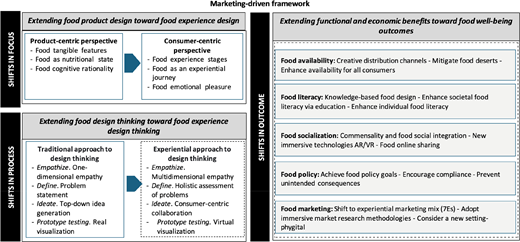
The purpose of this paper is to advance advances the food experience design (FED) framework by transforming it into a structured, process-based, operational model. The extended FED integrates the consumer’s experiential pleasure as a core design driver by embedding the stages of the food experiential journey into each design step, while positioning the five pillars of food well-being as both strategic drivers and outcomes. These transformations move FED from abstract theory to actionable practice.
This research refines the FED through the theoretical integration of design thinking, food innovation, experiential food consumption and food well-being literatures.
The extended FED framework introduces a dual-perspective model that bridges the producer’s design process (empathizing, defining, ideating, immersive visualization) with the consumer’s food experience journey (contemplation, connection, creation), aligning each design step with the overarching innovation objective of advancing food well-being.
As a conceptual contribution, the framework has not yet been empirically validated. Future studies should test its application and explore the use of immersive tools to simulate multisensory food dimensions.
The extended FED framework serves as a practical roadmap for innovation teams, marketers and policy designers. It guides cross-functional teams in embedding consumer experience into food innovation from the outset.
This research advances FED from a conceptual model to a structured, operational framework that can contribute to the creation of meaningful and socially grounded food innovations. It offers specific tools, strategies and process refinements that unify consumer experience design and food well-being principles.
1. Introduction
Food innovation is undergoing a fundamental transformation: shifting from product-focused improvements driven primarily by technical or sensory enhancements toward experience-oriented design that explicitly supports food well-being. Food well-being is defined as “a positive psychological, physical, emotional and social relationship with food at both the individual and societal levels” (Block et al., 2011, p. 9). It emphasizes the quality of our relationship with food, fostering enjoyment, emotional balance, social connection and equitable access, rather than merely focusing on what we eat to nourish the body.
Food experiences extend beyond the material composition of food to encompass the context in which food is prepared, presented and consumed. For instance, rice served at home in a familiar bowl evokes different emotional and cultural meanings than rice offered in sophisticated packaging at a fine dining restaurant. Though similar in texture and ingredients, the context alters the sensory experience and symbolic significance of the meal. These contextual elements are not merely incidental; they fundamentally transform the food experience. When positive and fulfilling, they contribute meaningfully to food well-being.
This paper builds on this integrated view of food experience and is grounded in the understanding that marketing has long encompassed experience design as a core strategic lever. Experience design is integral to how marketing creates, communicates and delivers value. Consistent with the foundational logic of marketing strategy and the marketing mix, we conceptualize product design as encompassing the entire customer experience, including sensory properties, symbolic meanings and contextual cues. Within this view, design is not an aesthetic add-on but a strategic mechanism through which marketing creates meaning, fosters engagement and advances well-being.
Reflecting this experiential orientation, Food Experience Design (FED; Batat and Addis, 2021) has emerged as a holistic, marketing-driven framework for food innovation. FED conceptualizes innovation as an experiential, multisensory and meaning-based process. It builds on the principles of design thinking, a human-centered and iterative approach to problem solving and innovation (Brown, 2008; Buchanan, 1992). Traditional design thinking seeks to balance desirability, feasibility and viability (Brown, 2008). In food contexts, it emphasizes empathy, ideation, prototyping and testing to develop innovative solutions. FED advances this foundation by explicitly showing how design methods can structure and operationalize experiential food innovation. Moreover, it reframes the goal of food innovation by moving beyond consumer satisfaction or nutrition to position food well-being as the ultimate objective (Addis et al., 2022). Through this integration of experiential design with the multidimensional framework of food well-being, FED clarifies how marketing can leverage design to embed cognitive, emotional and social dimensions of consumption into innovation processes that advance both consumer value and well-being.
Despite this promise, FED faces three key limitations that restrict its potential to operate as a fully integrated marketing framework: limited insight into how consumers experience food pleasure, an underdeveloped treatment of food well-being and a lack of actionable, process-based guidance for innovation. First, although FED positions itself as an experiential, consumer-centered approach, it provides limited insight into how consumers experience pleasure through food. This creates a gap with respect to marketing’s long-standing focus on the sensory, emotional and symbolic dimensions of consumption. The Food Experiential Journey (Batat et al., 2019) provides a valuable lens for addressing this gap. It conceptualizes food pleasure as unfolding across three emotionally rich stages: contemplation (preconsumption anticipation and meaning-making), connection (social and cultural engagement during consumption) and creation (postconsumption reflection, sharing and identity formation). Without fully integrating these experiential dimensions, FED remains conceptually constrained, focused on product characteristics rather than lived experiences. This limits its ability to support innovation that genuinely resonates emotionally, symbolically and contextually with consumers.
Second, FED treats food well-being as a singular, overarching outcome, overlooking its multidimensional nature. Food well-being extends beyond nutrition and spans how consumers access, learn about, share and emotionally engage with food. Block et al. (2011) identified five interrelated pillars that support this construct: food availability (access to food across settings and socioeconomic contexts), food policy (regulations and standards related to safety, labeling and sustainability), food socialization (cultural, familial and media influences on food behaviors), food literacy (knowledge, skills and motivation to make informed food choices) and food marketing (the impact of branding, advertising, pricing and product placement on consumer decisions). Although Addis et al. (2022) proposed incorporating these pillars into the design process, the integration remains underdeveloped. Without systematically embedding them, FED lacks the depth required to guide diverse and impactful innovation.
Third, FED provides no clear guidance on how food experiences can be systematically embedded within the design thinking process. From a marketing perspective, this creates a gap between experiential principles and the concrete processes required to translate them into market-ready innovations. As a result, practitioners receive limited direction on how to move from abstract food design concepts to actionable food experience design applications. The absence of clearly specified tools and steps reduces the practical relevance of the framework and constrains its potential to support meaningful or transformative innovation. This challenge is not unique to FED. Prior research shows that design thinking frequently underperforms when it lacks operational structure, often resulting in incremental rather than transformative outcomes (Costa and Jongen, 2006; Nussbaum, 2011; Batat, 2021).
This research addresses these limitations by transforming FED into a systematic, process-based framework grounded in both consumer experience and the principles of food well-being. We combine the experiential food journey with core tenets of design thinking and marketing management, while embedding the five pillars of food well-being across all steps of the design process. The resulting extended FED model offers a structured pathway for designing experience-centered, well-being oriented innovations that move beyond product optimization. In doing so, it shifts FED from a conceptual framework to an actionable and strategically grounded model aligned with market-driven innovation. Specifically, this research advances FED in three key ways:
embedding the consumers’ perspective by integrating the three stages of the Food Experiential Journey into each design step;
aligning each design step with one or more pillars of food well-being to establish concrete, measurable outcomes; and
creating an operational framework that enhances the applicability of FED in marketing and strengthens its capacity to guide firms and policymakers toward well-being-oriented innovative food solutions (see Table 1).
The extended FED framework makes explicit how design functions as a core strategic lever and value creation tool within marketing by operationalizing co-creation. It reveals how to reframe consumers from passive recipients to active contributors who shape product meaning, experiential value and market relevance. By embedding consumer insights at the outset, the extended FED reveals how product development can be aligned with strategic marketing goals. While marketing strategy sets the overarching direction for value creation through segmentation, targeting, positioning, pricing and promotion, the extended FED provides a structured design process that translates these strategic priorities into concrete, emotionally resonant product experiences. In this way, FED and marketing strategy operate at complementary levels within a unified marketing perspective, with FED enabling the experiential realization of strategic intent and supporting product innovation that advances food well-being.
The paper proceeds as follows. We begin by revisiting the foundations of the FED framework and its experiential underpinnings, establishing the need for an action-oriented, processual approach. We then introduce the extended FED, illustrating how each step connects to both the experiential journey and the five pillars of food well-being. We conclude by discussing theoretical, practical and policy implications and identifying opportunities for future research.
2. The origins of food experience design
Design thinking is a human-centered innovation approach that emphasizes creativity, empathy and iterative experimentation to solve complex problems, combining aspects of creative problem-solving with a strong focus on the end user (Brown, 2008; Buchanan, 1992). It typically involves four steps: problem exploration, ideation, prototyping and testing. Across sectors, it has been employed to better align solutions with end users’ needs by engaging them throughout the innovation process (Liedtka, 2015; Pitsis et al., 2020).
In the food industry, design thinking has often been applied to improve product-related attributes (e.g. flavor, texture, packaging, nutritional content) typically through iterative processes informed by consumer feedback (Grunert et al., 1995; Olsen, 2015). While these applications have traditionally emphasized functional and economic goals (e.g. optimizing nutrition, extending shelf life, increasing sales), marketing and consumer research have long highlighted that food also carries experiential, emotional and cultural meanings in everyday life. Accordingly, scholars have increasingly examined esthetics, sensory perception and consumer co-creation in food design (Mendini et al., 2024; Parasecoli, 2017; Zampollo, 2016; Zampollo and Peacock, 2016), in line with the idea that food innovation does not refer only to what people eat but also how they experience it.
FED emerged from the principles of design thinking to articulate and structure the experiential dimension of food innovation within a marketing perspective. This view is consistent with broader work in food studies and sensory research that conceptualizes food not merely as a product, but as a designed experience embedded in cultural practices, rituals and multisensory environments (Parasecoli, 2017; Spence et al., 2016). Rather than replacing existing approaches, FED makes explicit how design-oriented methods can be used within marketing to integrate the sensory, emotional, symbolic and social aspects of consumption into food development. In doing so, it offers a coherent framework for connecting consumer experiences to food innovation processes, in line with broader trends that emphasize immersive, emotionally rich and well-being-oriented food encounters. FED does not shift the focus away from the physical product but extends marketing-driven innovation by clarifying how experiential and symbolic dimensions can be systematically incorporated into the design process. It also emphasizes food well-being as a central outcome of innovation, complementing traditional objectives such as satisfaction and nutritional improvement. This orientation aligns with an expanding body of research demonstrating that food functions not merely as a commodity or source of sustenance, but as a carrier of memory, identity, cultural meaning and emotional connection (Addis and Holbrook, 2019; Batat et al., 2019). Positioning food well-being at the center thus reflects and advances marketing’s growing attention to consumer experiences and their broader psychological, cultural and social implications.
3. Operationalizing food experience design: a process-based integration of food experience
To enhance the practical utility of FED, this research refines its underlying design logic to offer concrete direction for firms, designers and innovation teams. We develop a customer-centric, process-based model that integrates the food experience journey (consumer perspective) with the steps of the design process (producer perspective), all aligned with the overarching goal of advancing food well-being (innovation objective). This transformation moves FED from a primarily conceptual framework to a structured, action-oriented model. Figure 1 provides an overview of the extended FED framework, highlighting the three core shifts. While the shift in focus has been discussed conceptually above, the following sections elaborate on the process and outcome dimensions in detail.
We adapt the traditional four-step design thinking process, i.e. empathizing, defining, ideating and prototyping-testing (Brown, 2008), to address the specific demands of experiential food innovation. The adaptation involves four key modifications:
expanding one-dimensional empathy into multidimensional empathy;
broadening narrowly defined problem statements into holistic assessments;
enriching ideation with consumer-centric insights; and
complementing real-world testing with immersive visualization techniques.
To anchor these revised steps in consumers’ lived experiences, we embed the Food Experiential Journey (Batat et al., 2019) into each step of the design process. This journey captures how food pleasure unfolds through a progressive, multisensory and emotionally rich trajectory across three stages:
Contemplation: The anticipatory phase, visual, olfactory and textual cues evoke aesthetic appreciation, curiosity and expectation.
Connection: The social and cultural dimension, shaped by rituals, traditions and communal sharing that support identity and belonging.
Creation: The participatory phase, including food preparation, customization and storytelling, the symbolic and emotional meaning is cocreated and personalized.
By integrating these experiential stages into each step of the design process, the extended FED framework ensures that sensory, emotional and symbolic aspects of food are systematically incorporated into innovation practices. This approach operationalizes FED while enhancing its capacity to generate measurable food well-being outcomes across individual, social and systemic dimensions.
The following subsections detail each revised step, offering conceptual justification and illustrative examples, using an insect-based snack as the primary illustrative example. Table 2 provides a secondary example focused on a farm-to-table restaurant.
3.1 Empathize reimagined: from one to multidimensional empathy
Empathy, the ability to connect with consumers by stepping into their shoes, is a foundational step in the design thinking process (Brown, 2008; Olsen, 2015). In food innovation, empathy has traditionally focused on the tangible features of food products and implies that designers should capture how foods feel (Hermannsdóttira et al., 2016). However, this focus, while valuable, does not fully incorporate the rich experiential, emotional and sociocultural layers emphasized in marketing and consumer research.
Building on these insights, we adopt a multidimensional view of empathy that extends beyond sensory cues to include emotional and cognitive insight, sociocultural awareness and compassion-driven action. This approach aligns with the experiential theory of consumption and draws on research from psychology and neuroscience (e.g. Burch et al., 2016; Leiberg and Anders, 2006). Specifically, we suggest application of six forms of empathy (Batat, 2019) – each relevant at different stages of the Food Experiential Journey: emotion contagion (feeling and sharing others’ emotions), empathic accuracy (correctly identifying others’ emotional states), emotion regulation (managing and reframing emotional reactions), perspective taking (cognitively adopting another’s viewpoint), concern for others (caring for others’ well-being) and perspective engagement (acting skillfully based on empathic insight).
The contemplation stage refers to the anticipatory phase of eating, where sensory, emotional and cognitive expectations are formed. At this stage, designers should attune to the consumer’s preconsumption emotions, which are often shaped by personal experiences and cultural associations with food. This stage primarily draws on three key forms of empathy: emotion contagion, empathic accuracy and emotion regulation. For example, when designing an insect-based snack, empathy entails recognizing the strong initial emotional reactions (e.g. curiosity, disgust), accurately identifying the emotions and strategically reshaping the experience, as adoption has been shown to depend on repeated exposure, familiarity-building and positive experiential cues (Caparros Megido et al., 2014; House, 2016). Such affective reactions are widely documented in the literature on entomophagy, which consistently shows that food neophobia, disgust sensitivity and lack of cultural familiarity are among the strongest predictors of rejection of insect-based foods in Western contexts, often operating prior to tasting and shaping anticipatory evaluations of such products (Batat and Peter, 2020; Hartmann and Siegrist, 2016; La Barbera et al., 2018; La Barbera et al., 2020; Mancini et al., 2019). Consistent with prior research on culturally sensitive and morally charged food categories, consumer responses to insect-based foods are often shaped by strong affective reactions such as disgust, symbolic stigma and moral resistance rather than by functional evaluations alone (Zhang, Cai, and Zheng, 2024). This could involve selecting a brand name, visual identity or flavor profile that frames the product as adventurous, sustainable or ethically forward, thus transforming discomfort into curiosity and engagement. In a farm-to-table restaurant context, contemplation focuses on designing sensory cues that evoke feelings of freshness, nature and tradition. Designers use emotion contagion to recognize emotions tied to experiences like picking vegetables in a garden or smelling homemade bread. Through empathic accuracy, these cues are interpreted – often as nostalgia, comfort or warmth – and amplified using emotion regulation. This might involve incorporating natural textures, evocative menu language or ambient aromas that trigger personal memories, turning the anticipation of dining into a rich, emotionally resonant experience.
The connection stage focuses on the social and cultural meaning of food – how people share, talk about and relate to what they eat. At this stage, perspective taking and empathic accuracy allow designers to step into the shoes of diverse consumers and understand correctly how food is experienced within different cultural or communal contexts. Take the example of an insect-based snack. Perspective taking allows designers to understand that eating insects is a common and respected practice in many Southeast Asian cultures. Recognizing this can help them reframe the product for Western consumers – not as unusual or off-putting, but as sustainable, globally accepted and even forward-thinking. In a different context, such as a farm-to-table restaurant, empathy helps designers understand that many diners care about where their food comes from and how it supports local communities. Perspective taking might involve seeing the meal through the eyes of a customer who values transparency, freshness and ethical sourcing. Empathic accuracy can help designers recognize emotions like pride, trust or a sense of connection. Based on these insights, they might add farm stories to the menu, include photos of local producers, or design a communal seating area to reinforce shared values and create a more meaningful dining experience.
The creation stage involves active consumer participation through food preparation, customization or storytelling. It often represents the point at which meaning-making and emotional investment peak. At this stage, two forms of empathy are especially valuable for designers: concern for others and perspective engagement. For example, in the case of an insect-based snack, designers can anticipate that some consumers care deeply about environmental sustainability. By emphasizing how choosing insects over beef helps reduce carbon emissions, designers activate concern for others and build that empathy into the product itself. Using perspective engagement, they can weave this value into the product’s narrative – through messaging, visuals or packaging that highlights the environmental impact. In doing so, empathy becomes a deliberate design tool in a way that complements traditional marketing communication, giving consumers the sense that their food choice actively supports a more sustainable future. In a farm-to-table restaurant context, designers may recognize that consumers care about transparency and ethical sourcing. Activating concern for others involves acknowledging and celebrating the contributions of local farmers and food systems. Perspective engagement allows designers to cocreate storytelling experiences (e.g. interactive menus, farmer photo walls, ingredient origin maps) that help diners emotionally connect with their food’s journey. These design choices reinforce values like sustainability and community, turning the act of eating into a more meaningful, purpose-driven experience. Together, these empathic tools allow designers to move beyond surface-level consumer insight and create food experiences that resonate emotionally, socially and ethically.
3.2 Define reimagined: from problem statement to holistic assessment
The second step of design thinking involves identifying unmet needs by articulating the gap between a product’s current state and its desired outcome (Brown, 2008). In conventional practice, this step is often approached narrowly through solution-driven interviews or self-reported feedback that asks users “what is wrong.” While helpful, this method tends to isolate variables and overlooks the broader sociocultural and emotional context in which food is experienced.
Our revised approach does not replace this important diagnostic function, but rather complements it with a holistic definition and assessment that captures the full complexity of food experiences across the food experiential journey, from contemplation to creation, and translates these insights into concrete design priorities. This calls for interdisciplinary collaboration, as food experiences are shaped by individual, social and cultural dynamics. The revised approach also integrates both interpretive methodologies (e.g. ethnographic observation, contextual inquiry) and empirical methods (e.g. qualitative and quantitative research). This methodological diversity enables exploration of problems from multiple angles and across experiential stages.
At the contemplation stage, holistic assessment focuses on how sensory input, attention and environmental context work together to shape consumers’ expectations and anticipatory experiences with food. While prior research has explored these elements separately, such as sensory perception (Krishna, 2012), attentional focus (Mustonen and Tuorila, 2010) and contextual factors such as music, lighting and ambient temperature (Framson et al., 2009), these investigations often isolate variables for experimental precision. A holistic assessment integrates these insights, offering a more integrated and contextualized view of how consumers form initial impressions and emotional orientations toward food.
For example, consider the design of an insect-based snack. Prior research on insect-based foods shows that rejection frequently occurs before tasting and is strongly shaped by anticipatory cues (e.g. visual appearance, perceived appropriateness, symbolic associations) rather than by sensory evaluation alone, with affective reactions (e.g. disgust and ambivalence) playing a central role in these early judgments (Verbeke, 2015; Tan et al., 2016; Tan et al., 2017; Onwezen et al., 2019). Research in consumer psychology shows that unfamiliar foods often elicit automatic affective reactions that precede cognitive evaluation, shaping rejection or acceptance independently of nutritional or functional attributes (Khan and Pandey, 2023). Consumer responses are shaped by sensory unfamiliarity, emotional discomfort and cultural barriers arising even before tasting occurs. Through a holistic assessment, designers might discover that visual appearance, odor or naming conventions trigger anxiety or disgust. Instead of addressing these factors individually, the assessment explores their combined impact. Designers can refine product shape, aroma or storytelling to ease apprehension and foster openness. Similarly, farm-to-table design elements like open kitchens or rustic interiors can heighten anticipation by evoking nostalgia and trust. Rather than focusing narrowly on a single feature (e.g. lighting), the holistic assessment emphasizes how multiple environmental cues interactively shape consumer expectations and engagement from the outset.
At the connection stage, holistic assessment explores how social interactions and cultural contexts influence food experiences. Eating practices are closely tied to broader sociocultural dynamics, including ethnicity, religious traditions and social class (Delormier et al., 2009). These cultural factors shape distinct patterns of consumption, creating food experiences that are embedded in everyday social practices and shared cultural narratives. Fully capturing these nuanced dynamics requires a more integrative, context-sensitive approach rather than studying individual aspects separately.
In the case of insect-based snacks, designers could examine how group identities and cultural norms shape food acceptance – particularly where consuming insects carries social stigma. Rather than designing collective tasting events, which fall outside the product designer’s control, insights from social dynamics can inspire storytelling, communication strategies or experiential scenarios, such as those related to the cultural traditions from Southeast Asia. Such approaches can help consumers view the snacks as desirable and socially endorsed. Similarly, in farm-to-table dining, understanding the shared values among diners (e.g. supporting local producers, sustainability, embracing slow-food practices) can guide designers toward meaningful experiences. These elements align naturally with broader marketing strategy objectives such as positioning and brand meaning. For example, highlighting stories of local farms on menus, using communal dining tables, or organizing farm visits can enhance diners’ emotional connections both with one another and the larger community around food.
Finally, the creation stage focuses on how consumers actively create meanings through food. With insect snacks, this would involve narratives around sustainability or responsible consumption, conveyed through storytelling, symbols and visual communication. In a farm-to-table restaurant, diners may seek connections to farming traditions or ingredient origins, which can be reinforced through interactive menus, producers’ narratives or place-based storytelling.
3.3 Ideate reimagined: from expert-led ideation to consumer-centric collaboration
In conventional food innovation, ideation involves identifying a problem and generating possible solutions, typically through expert brainstorming or by asking consumers to evaluate already developed ideas (Parasecoli, 2017). This conventional approach positions consumers primarily as evaluators or end-users rather than as active participants in innovation. Building on these practices, the revised approach reframes ideation into a collaborative, consumer-centered process that actively involves consumers throughout the food experience journey – from initial anticipation to social connection and final meaning-making. Instead of merely collecting consumer feedback through isolated taste-testing sessions, this model engages consumers as genuine cocreators, empowering them to shape food experiences aligned with their sensory preferences, emotional reactions, social contexts and cultural identities. The key difference from traditional methods lies in consumer involvement: rather than reacting to predetermined solutions at the end of development, consumers participate from the earliest stages, influencing innovation trajectories from their inception. Previous studies show that purely utilitarian or sustainability-driven appeals can backfire in the promotion of insect-based foods, reinforcing perceptions of sacrifice or moral pressure rather than increasing willingness to try (Martin, 2012; La Barbera et al., 2018; Onwezen et al., 2019).
While traditional food design thinking emphasizes value-in-use (Ramaswamy, 2008), this revised approach adopts a value-in-experience perspective (Batat, 2019), placing emotional engagement, cultural relevance and personal identity at the heart of the innovation process. Consumers become active idea contributors, not merely by stating preferences, but by sharing meaningful stories, traditions and values that shape their relationship with food. This form of collaboration is consistent with marketing approaches that consider value as cocreated through consumer engagement. By fostering deeper consumer engagement, designers can expand beyond product-focused thinking and develop innovations that authentically reflect the emotional and cultural richness underlying each phase of the food experience journey.
During the contemplation stage, co-ideation explores the emotional and sensory anticipation associated with food experiences. Consumers can contribute by recounting memorable food-related moments that sparked joy, comfort, satisfaction or a sense of well-being. This collaboration enables designers to go beyond surface-level likes or dislikes, uncovering richer emotional and contextual insights. For instance, when developing an insect-based snack, involving parents and children in sharing stories of enjoyable eating moments – such as feeling adventurous or comforted – can lead designers to consider creating familiar forms like insect-protein pancakes, using vibrant, playful packaging and engaging storytelling. This strategy emphasizes fun and confidence rather than purely nutritional attributes. Similarly, in a farm-to-table restaurant scenario, inviting diners to reflect on nostalgic experiences – like picking herbs with grandparents or the aroma of home-cooked meals – could inspire design elements such as open kitchen layouts, rustic interiors or evocative menu descriptions, all aimed at recreating feelings of warmth, authenticity and local connection.
At the connection stage, ideation centers on the social and cultural dimensions of eating, emphasizing how food experiences build community, shape identity and express cultural values. Working closely with consumers from different backgrounds allows designers to identify cultural elements crucial for meaningful food experiences and to develop solutions that resonate within various social contexts. For instance, when designing an insect-based snack, collaboration with communities where insects are traditionally consumed can highlight specific rituals, social interactions or sensory preferences that frame insects as culturally valued foods. These insights can guide product design choices, such as how the snack is presented, packaged or discussed, shifting perceptions away from novelty toward familiarity, tradition and community-building. Similarly, in the farm-to-table restaurant context, collaborating with diners might reveal how communal dining rituals, shared storytelling and family-style dishes enhance feelings of belonging and community. These consumer insights can guide design decisions like incorporating communal seating, menus emphasizing local farmers or dishes served family-style, reinforcing social bonds and shared values. By intentionally designing around these insights, the restaurant evolves from a simple eating establishment into a meaningful community space, fostering continuity of cultural and social traditions.
At the creation stage, ideation revolves around consumers actively shaping their identities and symbolic meanings through food. This phase encourages collaborative development of stories, rituals and experiences aligned with personal beliefs, values and aspirations. For instance, with insect-based snacks, designers might partner with eco-conscious consumers to craft narratives that emphasize climate action and sustainability. Product naming, packaging styles or visual themes can position consumers as proactive advocates for environmental responsibility, reinforcing their self-perception as ethical, forward-thinking individuals. In a farm-to-table restaurant setting, designers might engage diners in developing interactive menus, decor elements or local storytelling that highlights regional farming traditions. These collaborative elements can turn dining into a meaningful cultural event, enabling patrons to express their commitment to values such as community involvement, heritage preservation and ethical sourcing.
3.4 Prototype testing reimagined: from tangible to immersive visualization
Prototyping and testing are essential in food innovation, enabling ideas to become tangible and explored collaboratively (Liedtka, 2015). Traditionally, this phase relies on low-fidelity models (e.g. kitchen mockups, storyboards or role-playing scenarios) focusing on flavor, texture and packaging (Parasecoli, 2017). Traditional approaches often face three constraints: expert-driven prototypes, product focus and end-user-only testing.
Our extended FED approach extends and enriches this phase through immersive visualization – a method that blends real tasting with multisensory, virtual and narrative tools to simulate full food experiences. Designers can test emotional, social and contextual aspects – not just taste. Visualization allows designers to simulate presentation (e.g. a home vs a restaurant), storytelling and mood. It also supports rapid iteration, particularly early in development when the experience is evolving. In short, visualization enriches the design of the food journey, not just the food itself.
Building on this foundation, the extended FED framework reconceives prototype testing as a critical space where the insights and concepts developed during the first three steps of the design process are measured, simulated and stress-tested using immersive visualization tools. The earlier steps of design generate multisensory, social and symbolic design intentions. Immersive prototyping and testing then allow designers and stakeholders to evaluate whether these experiential and emotional goals have been successfully translated into lived food experiences.
At the contemplation stage, immersive visualization enables designers to simulate and test the anticipatory aspects of eating, serving as a validation tool for emotional alignment. It helps determine whether visual, sensory and symbolic cues – designed to precede consumption – effectively evoke intended emotions such as curiosity, excitement or comfort, and align with the desired experiential goals. In the insect-based snack example, designers can use AR to cocreate and test visual elements (e.g. bright colors, playful characters, animations) and olfactory cues (e.g. cocoa or cinnamon scents) that reframe the product as fun and familiar. These elements are then tested with children, parents and other relevant stakeholders to assess whether they reduce aversion and build excitement. In the farm-to-table restaurant case, immersive visualization allows diners to cocreate and test atmospheric elements that signal freshness and tradition. Multisensory cues can be layered and adjusted to ensure they resonate with diners’ memories and expectations – creating a more emotionally evocative and personalized lead-up to the meal.
At the connection stage, immersive visualization serves as a tool to simulate and test the social and cultural dimensions of food experiences. It validates whether the designed experience fosters emotional connection, shared meaning and cultural resonance among diverse stakeholders. In the insect-based snack example, immersive tools can be used to prototype and test storytelling elements that frame insect consumption as a global tradition. For instance, AR experiences might allow users to explore how insects are enjoyed in different cultures – through virtual street markets, family rituals or traditional recipes – helping consumers reframe the snack as a socially accepted and meaningful choice. These simulations can be tested with multicultural groups to assess whether they promote connection and reduce perceived unfamiliarity. In the farm-to-table restaurant case, immersive visualization can be used to cocreate and evaluate communal dining layouts, local storytelling features or farmer introduction videos. Such elements help simulate the social rituals of sharing food, honoring producers and fostering intergenerational connection. Testing helps determine whether the experience meaningfully strengthens diners’ sense of community and cultural identity.
At the creation stage, immersive visualization assesses whether the designed experience elements (e.g. narratives, interactive tools) enable consumers to see themselves as cocreators of value – building symbolic meaning, personal identity or social impact through their choices. In the insect-based snack example, immersive tools like a virtual dashboard could visualize the environmental impact of food choices (e.g. how switching from beef to insect protein reduces carbon emissions). Testing in this immersive environment can evaluate whether users feel empowered and aligned with the product’s message. The process can also incorporate feedback from environmental advocates or educators to ensure accuracy and broader social resonance. In the farm-to-table restaurant example, immersive tools like AR-enhanced menus or virtual walk-throughs can be used to test whether diners feel a stronger sense of connection to the food, the land and the people behind it. The testing process can also invite input from community organizers, cultural experts or sustainability advocates to ensure the storytelling resonates broadly.
Immersive tools assess the full food experience and help bring abstract ideas to life, enabling decision-makers to explore innovations in emotionally and culturally resonant ways (Urban et al., 1996). As a result, immersive visualization becomes a powerful tool for testing not just what food is, but how it feels, connects and transforms consumer experience – addressing the core limitations of traditional prototyping in three ways. Specifically, immersive visualization (i) broadens prototyping from expert-led routines to cocreated practices involving multiple stakeholders, (ii) shifts testing from isolated product attributes to experience-enriched evaluations in realistic consumption contexts and (iii) extends end-user testing to multi-stakeholder assessment aligned with the five pillars of food well-being (Violante et al., 2019; Frøst and Jaeger, 2010).
4. Advancing food well-being through the extended food experience design framework
To advance the potential of FED in supporting food well-being, we propose a systematic integration of the five food well-being pillars (food availability, food literacy, food socialization, food marketing, food policy; Block et al., 2011) into each step of the design thinking process. While previous work has highlighted these pillars as important outcome domains (Addis et al., 2022), their process-level implications have remained underdeveloped. Our extended FED framework makes these connections explicit by embedding the goals of food well-being directly into each revised step of the food experience design process (empathizing, defining, ideating and immersive visualization).
This integration makes food well-being a guiding principle. The five pillars function as both outcome domains and design parameters, shaping how food experiences are conceptualized, prototyped and tested. Each pillar informs the design logic in distinct ways, shaping the types of empathy, methods, collaborations and validation strategies appropriate for that stage. The result is a design process that moves beyond product optimization toward systemic well-being innovation.
Food availability refers to whether consumers can access food in everyday settings (e.g. home, school, work), and draws attention to disparities like food deserts as well as economic barriers that affect who can experience food innovations. Traditional design thinking has rarely treated availability as an explicit design concern, as it typically centers on product optimization for existing markets. The extended FED framework broadens the first design step, empathizing, through concern for others and perspective taking, enabling designers to recognize the emotional and lived experiences of underrepresented groups. Importantly, this does not imply that designers directly control availability outcomes, but that availability-related constraints and opportunities are made explicit within the design process. Next, the holistic assessment step entails interdisciplinary collaboration to identify structural barriers to food access. This may include mapping availability across socioeconomic groups or exploring how systemic inequalities shape food experiences. In the consumer-centric ideation stage, this well-being goal would entail collaborating with communities affected by inaccessibility to generate feasible, desirable solutions. Finally, immersive tools can validate whether availability-enhancing ideas resonate emotionally and functionally.
For example, in the insect snack case, the empathizing stage might involve designers using concern for others and perspective taking to engage directly with students, parents and school staff in underserved communities. In the assessment phase, interdisciplinary collaboration with school nutritionists, sociologists and public health experts can help uncover systemic barriers that limit access to innovative snacks. During ideation, designers and community members might codevelop snack concepts that are both appealing and compliant with school nutrition guidelines. Finally, in the immersive visualization stage, designers can simulate cafeteria settings using AR to test where and how the snack would be displayed (e.g. lunch line, vending machine), and gather emotional and practical feedback from multiple stakeholders, including students, teachers, cafeteria staff and school administrators, ensuring the solution is both appealing and contextually feasible. See Table 3 for the farm-to-table example.
Food literacy refers to the conceptual or declarative knowledge (food and nutrition information), procedural knowledge (i.e. skills, abilities and scripts required to use the information) and MAO (motivation, ability and opportunity) to make informed food choices. It covers everything from sourcing and preparation to understanding health impacts. Traditional design thinking often focuses on improving product attributes (e.g. adding nutrients), but fails to consider whether consumers have the knowledge or contextual support needed to apply that information. The extended FED framework addresses this gap by embedding food literacy into each step of the design process. Empathizing reveals how consumers feel when they lack confidence or skills in food-related tasks. During holistic assessment, interdisciplinary collaboration with nutritionists, educators and behavioral scientists enables the identification of food literacy gaps across contexts and populations. It prompts exploration of how emotions (e.g. curiosity, confidence, intimidation) affect food literacy beyond nutrition labels. In the consumer-centric ideation phase, consumers are invited as cocreators to identify tools, formats or experiences that empower them to navigate food choices more effectively. Finally, immersive visualization enables the testing of whether food literacy solutions are emotionally engaging, easy to use and effective in building confidence for all parties involved.
For example, in the insect snack case, the empathizing step may involve working with families to understand children’s discomfort not only with the idea of eating insects but with not knowing how they are made or how to talk about them. In the assessment phase, collaborating with educators, psychologists and food scientists can surface cognitive and emotional barriers to understanding insect-based foods. In the ideation step, designers might cocreate playful learning tools that explain the snack’s ingredients and preparation. Finally, immersive visualization could simulate school or home snack settings, testing whether such tools improve understanding, comfort and motivation among children, parents, teachers and even grandparents.
Food socialization refers to the ways people develop their understanding of food through shared practices, cultural traditions, family habits and media influences. These social experiences play a central role in shaping food preferences, eating routines and the symbolic meanings attached to meals. However, conventional design thinking tends to prioritize individual consumption and personal preferences, often missing the relational aspects of food. The extended FED steps place food socialization at their core. During the empathizing phase, techniques such as emotion contagion and perspective taking help designers grasp how people engage with food in communal contexts. In the holistic assessment phase, cross-disciplinary collaboration uncovers how eating behaviors are taught, inherited and adapted within families, cultures and generations. Teams can explore how remote dining, social media or new rituals are transforming shared food experiences. In the ideation phase, involving consumers directly enables the co-creation of food moments that promote connection, inclusion and identity expression. Finally, through immersive visualization, teams can simulate these scenarios to assess whether the experiences foster meaningful emotional bonds and reflect culturally relevant narratives.
For example, in the case of the insect-based snack, the empathizing phase might uncover that children are hesitant to try the product due to concerns about peer judgment or being perceived as unusual. A deeper assessment could involve collaboration with teachers and media specialists to investigate how social dynamics and cultural messaging shape children’s willingness to try unfamiliar foods. During ideation, designers and children might cocreate rituals (e.g. trading cards or food stories) to make insect snacks a point of pride. Finally, immersive visualization tools could be used to recreate school lunch scenarios, helping designers evaluate whether the new product presentation fosters curiosity, reduces stigma and encourages group acceptance among students, parents and educators.
Food policy encompasses the rules, institutional practices and government-led initiatives that influence the production, labeling, distribution and consumption of food. Although such policies aim to promote health, safety and environmental sustainability, they frequently address these areas in isolation – neglecting the broader experiential and emotional dimensions of eating. Standard design thinking methods rarely engage with policymaking or assess how people feel about food-related regulations. The extended FED framework responds to this gap by integrating food policy into each step of the design process, ensuring that experiential and emotional factors are considered alongside regulatory objectives. In the empathizing step, perspective taking and concern for others help designers understand how consumers emotionally experience policy interventions (e.g. feeling restricted or empowered). Holistic assessment explores how policies intersect with cultural norms and shape emotional and behavioral responses. In the ideation step, consumers and institutional stakeholders cocreate experience-oriented responses to policy frameworks that support autonomy, enjoyment and well-being. Finally, immersive visualization enables testing of how policy-driven experiences feel in context – simulating different implementations and gathering emotional and behavioral feedback from multiple actors.
In the insect snack case, the empathizing phase could involve exploring how both children and parents perceive school policies that introduce these snacks into cafeterias. The assessment stage may include collaboration with parents, educators and policy advisors to better understand concerns around autonomy, freedom of choice and potential resistance. During ideation, stakeholders can be brought together to codevelop policy strategies that reflect shared values and goals. Immersive visualization tools, such as AR, could then be used to model how the policy would be experienced in real cafeteria settings – helping teams evaluate whether the rollout feels supportive, and refine policy and communication accordingly.
Food marketing influences consumer behavior through strategies such as branding, pricing, advertising, and product placement. In many traditional design thinking models, marketing is treated as a downstream activity focused on persuading consumers or optimizing esthetics, often at the expense of deeper cultural, emotional or ethical alignment. This can lead to campaigns that reinforce fleeting preferences rather than supporting long-term well-being. The extended FED framework takes a different approach – positioning marketing as an integral part of the food experience that is cocreated with consumers from the outset. In doing so, FED operationalizes marketing strategy at the level of experience design. In the empathizing step, techniques such as emotion contagion and perspective taking help identify how marketing cues are perceived emotionally – whether they evoke excitement, trust, confusion or exclusion. Holistic assessment explores how audiences interpret brand messages through identity, community and values. During ideation, consumers take part in shaping storytelling, visual language and interactive touchpoints that reflect their well-being goals – emphasizing empowerment, inclusion and authenticity. Immersive visualization tools are then used to prototype and test these marketing experiences in realistic environments, allowing teams to gauge their emotional and cultural impact before launch.
In the insect snack case, empathizing might uncover that children respond positively when the product is positioned as adventurous or environmentally responsible. During the assessment phase, collaboration with parents, teachers and children could help evaluate both emotional and physiological responses to various branding elements. Ideation could involve codeveloping mascots, interactive campaigns or tactile packaging features that enhance appeal and convey meaning. Through immersive visualization, designers can simulate real-world scenarios to test how different marketing affects curiosity and perception.
5. Theoretical and managerial implications
This study makes significant contributions to both theory and practice. Theoretically, the extended FED framework contributes to four intersecting literatures: experiential consumption, design thinking, food well-being and the integration of product design and marketing strategy. First, it extends value-in-experience theory by integrating the consumer’s experiential journey into food innovation, thereby allowing researchers to better analyze how sensory, emotional and symbolic aspects unfold over time and responding to calls for more operational depth in co-creation studies (Addis, 2020).
Second, this study operationalizes the food well-being concept not only as a desired outcome but as a process-level design principle embedded within each stage of innovation. This approach addresses the call by Scott and Vallen (2019) for a deeper inquiry into how marketing can actively foster food well-being. By structuring the design process around five interrelated pillars, the extended FED framework illustrates how these dimensions can inform both the direction and evaluation of innovation. In this way, well-being is positioned not only as an end goal but also as a design constraint for inclusive and socially attuned solutions. This contribution responds to prior appeals for innovation strategies that promote healthier, more sustainable food practices (Zou and Liu, 2019; Huyghe and Kerckhove, 2013), while also providing a conceptual foundation for linking consumer experience to broader public health and societal outcomes.
Third, this research advances the design thinking literature (Pitsis et al., 2020; Zampollo and Peacock, 2016; Olsen, 2015) by reconceptualizing the design process through the lens of food experience and well-being. The proposed framework moves beyond conventional models that tend to isolate consumer input or empathy as ancillary stages. Instead, the extended FED model embeds multidimensional empathy, cross-disciplinary analysis and active consumer involvement into the structure of each design phase. This approach repositions users as collaborators, strengthening the theory-application link and supporting the design of emotionally resonant and socially meaningful food experiences.
Finally, this research addresses the relationship between product design and marketing strategy by presenting an integrated framework that unites these traditionally separate domains. The extended FED framework weaves strategic marketing logic directly into the steps of the design process, ensuring that innovation is not only consumer-centric and experiential but also strategically aligned, market-ready and supportive of consumer well-being. This integration transforms design thinking from a creative tool into a strategic execution pathway for marketing objectives. Within this integrated process, marketers, designers and consumers collaborate from the beginning, codeveloping food experiences that are emotionally compelling, culturally attuned and aligned with broader well-being outcomes. In doing so, the extended FED framework offers a conceptual foundation for understanding how marketing strategy can serve as a catalyst for innovation, bridging the gap between creative design and effective market implementation.
This research has implications for practitioners. The extended FED framework is not only a theoretical contribution. It provides a hands-on, structured guide for food businesses, designers, marketers, innovation teams and policy stakeholders aiming to create food experiences rooted in consumer well-being. FED does more than shift what is developed; it changes how teams operate. It encourages a collaborative workflow in which functions that are often isolated (e.g. marketing, product design, research and development) come together from the earliest stages of innovation. It enables faster learning, earlier testing and agile iteration. Designers take on a broader role by shaping not only form and function but also the emotional and cultural dimensions of food. Consumers, in turn, are not passive recipients of finished products but active participants in shaping them. This shift toward cross-functional, consumer-driven innovation reduces risk, shortens development cycles and leads to food experiences that are more emotionally meaningful, socially inclusive and culturally relevant.
The extended FED framework provides a detailed, integrative guide for developing food experiences that support consumer well-being. In the empathy phase, for example, the framework moves beyond superficial observations to incorporate deeper emotional insights. Practitioners are encouraged to use multidimensional approaches to empathy to fully understand how people experience food. For instance, a company might run workshops where children draw snack journeys or role-play discovery moments. Adopting emotion contagion, empathic accuracy and perspective taking, teams can identify emotional barriers like embarrassment, confusion or curiosity – insights that would be invisible in standard surveys.
In the define (holistic assessment) step, under extended FED, practitioners are encouraged to assemble interdisciplinary teams to investigate the broader social and structural dynamics influencing food-related behavior. Taking the example of an insect-based snack, such a team might draw on ethnographic research in school settings, conduct interviews and use tools like expression analysis to explore stigma, perceptions and mismatches. Rather than defaulting to conventional fixes such as pricing adjustments or packaging redesigns, this process enables teams to reconceptualize the problem in ways that surface more resonant and lasting solutions.
In the (consumer-centric) ideate stage, innovation moves beyond traditional brainstorming or consumer feedback on preformed concepts. Instead, teams engage directly with end users and relevant community stakeholders (e.g. families, educators and cultural figures) in collaborative design sessions. Participants co-develop branding and packaging that reflect children’s social worlds. In this approach, marketing is integrated early, shaping the experience alongside the product rather than being layered on afterward.
In the prototype testing through immersive visualization step, digital technologies such as AR and VR enable practitioners to simulate the entire food experience – not just the product but its surrounding emotions, environment and social context. A team working on the insect snack could simulate lunchbox openings, cafeteria placement or peer-sharing moments using AR/VR. These immersive trials capture feedback from children, parents and school staff – revealing not just product acceptance, but emotional resonance and context fit. This iterative feedback loop reduces risk, accelerates alignment and ensures a better cultural and emotional match before launch.
The findings have important implications for policymakers, too. FED also offers a valuable framework for codesigning the experiential dimensions of policies that feel empowering rather than coercive. Traditional top-down interventions (e.g. healthy lunch mandates) often backfire due to poor emotional framing or lack of stakeholder input. By applying the FED process, schools or governments can involve children, parents, cafeteria staff and community groups in designing policy experiences – from sustainability initiatives to food literacy programs. These experiences can be tested using immersive visualization to assess emotional acceptance and behavioral outcomes before wide-scale rollout. For instance, rather than simply mandating insect snacks in schools, a district might simulate the rollout using AR to test how students and staff feel about the placement, storytelling and choice structure. Simulation reveals whether children view the experience as fun or awkward. Early feedback allows refining both policy and its emotional-social dynamics, improving compliance, equity and effectiveness.
Adopting this new approach may involve a progressive shift in organizational mindset. However, the extended FED framework offers a strong strategic rationale. By identifying potential challenges early in the process, it reduces the likelihood of costly missteps. Its emphasis on iterative development, supported by immersive simulation tools, allows teams to refine ideas more efficiently and with greater stakeholder input. In turn, this fosters stronger emotional connections with consumers and promotes long-term brand loyalty.
6. Limitations and future research
While the extended FED framework offers a conceptually grounded and process-oriented perspective, it has yet to be empirically validated in applied settings. Future research should examine how this model performs in practice compared to conventional food product development processes, particularly in fostering food well-being. This highlights the need to develop tools to measure how each well-being pillar is addressed and operationalized within the design process.
A critical next step for future research is to empirically test the impact of specific process innovations introduced by the extended FED framework. For example, studies could compare the outcomes of applying one-dimensional versus multidimensional empathy in the design process. Do approaches like emotion contagion or empathic accuracy lead to stronger emotional resonance, more compelling product narratives or higher consumer engagement? Such research would help clarify the specific value of different empathy types and guide their strategic use in food innovation.
Another promising avenue for future research is immersive visualization. Studies are needed to test how well AR/VR complement existing sensory evaluation methods in conveying critical experiential dimensions (e.g. aroma, texture, warmth) central to food well-being and whether immersive visualization improves the accuracy of consumer feedback and market predictions, particularly for unfamiliar or stigmatized products like insect-based snacks.
Future research should also examine the framework’s effectiveness across diverse populations and settings – such as urban versus rural consumers, Gen Z versus older adults or under-resourced versus affluent communities. Key questions include:
Does FED foster inclusive innovation across segments?
Do its tools work across ages and cultures?
Investigating these contextual differences will be essential for refining the framework and adapting it for broader, real-world applications.
Finally, the framework invites further exploration into the relationship between innovation processes and marketing strategy, within integrated, cross-functional innovation settings. A key area is how early integration of marketing (e.g. storytelling, segmentation and positioning) shapes team dynamics and outcomes. For instance, what changes occur when marketers actively participate in empathy mapping or codesign sessions? How might this integration influence product–market fit, brand coherence or design cycle time? These questions open opportunities for cross-functional research at the intersection of design, marketing and organizational behavior.
Table 4 presents concrete research questions aligned with each stage of the extended FED process, illustrating how the framework enables new lines of inquiry across marketing, public policy, consumer research and innovation studies.
7. Conclusion
Although scholars have called for more systematic food experience design (Addis et al., 2022; Batat and Addis, 2021; Batat, 2021), existing efforts have largely remained conceptual or fragmented. Innovation still focuses on incremental improvements, with limited attention to emotional, social and symbolic dimensions of food or to structural well-being goals.
This research responds to that gap by advancing a revised, process-based framework for FED. Building on the original framework (Batat and Addis, 2021), the extended FED approach offers an actionable, process-oriented framework for integrating the consumer perspective on the experiential pleasure journey and food well-being into every step of the design process. This framework helps organizations rethink innovation to create more meaningful, inclusive and sustainable food experiences. It offers a structured process that scholars can test, and practitioners and policymakers can adopt to design healthier, more enjoyable and culturally resonant food experiences. The extended FED sees food as an experience and well-being as an opportunity.