


This study aims to investigate the enactment of sustainability practices in everyday life through a “Living Green” campaign. The authors explore how these practices are embraced, challenged or renegotiated in situ within broader networks of routines and sociohistorical understandings.
A three-phase sequential qualitative multi-method approach was used. Data were collected through brainstorming workshops, in-depth interviews, digital diaries, participant observation and introspection journal entries.
The findings highlight the interplay between historically embedded practical understandings and daily (un)sustainable consumption. The authors develop an empirically grounded typology comprising four practice states – pro-transition, constrained embodiment, negotiated continuity and in-reversal – to illustrate how cultural frames and ontological concerns shape the fluidity of social practices throughout the campaign.
The five-week duration of the campaign may limit insight into longer-term shifts in sustainable consumption. Study was conducted in New Zealand, often framed by a “clean, green” national identity which may limit generalisability of findings beyond this context. The predominance of younger participants may limit the applicability of findings to other demographics whose routines differ.
The findings inform the design of public campaigns and policy interventions promoting sustainable behaviours. They also provide guidance for individuals seeking to cultivate more sustainable lifestyles.
This study advances sustainable consumption research through a practice-theoretical lens, foregrounding the ontological underpinnings of everyday action. It offers theoretical insight into how sociohistorical meanings, teleoaffective orientations and sources of ontological security shape the fluid, contested nature of sustainability practices as they unfold in lived contexts.
Introduction
In her quest for a sustainable lifestyle, Emma grapples daily with the tension between ingrained routines and eco-conscious ideals. In the kitchen, she excels at minimising food waste, carefully planning meals and composting diligently. Yet in the bathroom, she indulges in long showers, despite knowing the environmental cost. These contradictions evoke strong emotions: satisfaction in the kitchen, guilt in the shower. This vignette illustrates the emotional complexity embedded in daily practices as individuals attempt to reconcile routines with sustainability aspirations. To uncover the nuances of sustainable consumption, it is vital to understand mundane practices as interconnected and complex sets of social practices (Torkkeli et al., 2020) imbued with emotionality.
Departing from the traditional focus on changing attitudes or behaviours which often overlook the social constraints of everyday life (Joshi et al., 2021), this study centres on “how practices are performed and coordinated as entities” (Evans et al., 2012, p. 123), capturing a core tenet of practice theories (Shove, 2010; Warde, 2005). Theories of practice accentuate processes such as “habituation, routine, practical consciousness, tacit knowledge, [and] tradition” (Warde, 2005, p. 140), shifting focus from individual agents and their behavioural orientations to the practices themselves (Hargreaves, 2011). We conceptualise sustainable consumption as a coordinated set of “doings and sayings”, where bodily activities align with “shared understandings, rules and teleoaffective structures (emotions, attitudes, goals)” constituting the practice (Schatzki, 2001, p. 53).
While a practice-based approach to sustainability is growing (e.g. Beuscart et al., 2023; Gonzalez-Arcos et al., 2021), these studies lack theoretical inquiry into how sustainable practices are contested in real-life settings. Existing research often neglects the interplay among different practices (Khanijou et al., 2021), such as how sustainable consumption coexists with routines related to food, housing or work. Moreover, there is a lack of attention to the variations in how practices are performed (Gram-Hanssen, 2021) especially the role of emotionality and ontological security in explaining these variations. These gaps are explored further in the background literature.
Drawing on social practice theory (Schatzki, 2001; Warde, 2005), this study addresses the following research question: How do consumers experience and integrate newly introduced sustainable practices within established routines? Conventional models often assume motivation drives behaviour. But what if behaviour precedes motivation? Inspired by Robert McKain’s quote, “The common conception is that motivation leads to action, but the reverse is true – action precedes motivation” (Seah, 2015, para. 1), we implemented a “Living Green” campaign, prompting participants to act first by adopting unfamiliar sustainable practices in their daily lives. While the attitude–behaviour gap remains central to sustainable consumption discourse (Scheurenbrand et al., 2018), our practice-based exploration shifts focus to in situ enactments of sustainability, highlighting the overlooked roles of emotion and ontological security.
Unlike Phipps and Ozanne (2017), who show disruption driven by material constraints, we highlight how it emerges through embodied know-how and the emotionality and security tied to practice performances. Rather than applying a linear “stages-of-change” model, we trace how practices shifted throughout the “Living Green” campaign, where participants trialled sustainable actions in real-life contexts. As a practice-based field study, this design enabled us to capture situated experiences of practice change, extending beyond self-reported attitudes. Departing from conventional evaluations of campaign effectiveness, we offer an in situ perspective on how sustainable practices are integrated, resisted, abandoned or transformed as they unfold in everyday life.
Responding to calls for deeper inquiry into how pro-environmental behaviours unfold in everyday contexts (Hargreaves, 2011), this research reframes sustainability not as pre- or post-practice alignment but as a lived negotiation within established routines. This lens foregrounds the fluidity, tensions and moment-to-moment struggles involved in integrating or resisting sustainable practices. We extend current work on practice (mis)alignments by illustrating how newly introduced sustainable practices intersect with existing routines and by advancing practice-oriented research beyond Shove et al.’s (2012) meaning-material-competency framework to consider how emotions, identity, and security are embedded in practices. In doing so, this study offers theoretical insights into how sustainability is lived and contested in everyday life, while offering implications for more effective policy approaches to sustainable practices.
Theoretical background
Sustainable living
We adopt Garnelo-Gomez et al.’s (2022, p. 3273) definition of sustainable living as “patterns of action by people which meet basic needs, provide a better quality of life and minimise the use of natural resources and production of waste and pollutants, without jeopardising the needs of future generations”. Although sustainability has received considerable attention from marketing scholars over the past decades, there are limits in our knowledge and theorising (Davies et al., 2020; Garnelo-Gomez et al., 2022). For example, much attention has been on distinguishing those who practise sustainability from those who do not (Garnelo-Gomez et al., 2022). In addition, sustainable consumption is often simplified to consumer choice or product acquisition, placing emphasis on individual actions while neglecting their significance in sustaining social structures. This narrow perspective merely skims the surface of consumption dynamics (Jaeger-Erben and Offenberger, 2014).
Moreover, most studies rely on behavioural-intention models and quantitative methods to examine antecedents, typically socio-psychological drivers of sustainable consumption (Perera et al., 2018). As Perera et al. (2018) note, such approaches may overestimate sustainable behaviour due to social desirability bias in survey-based research. Consumers frequently express environmental concern in surveys but do not consistently “walk the talk” in their actual behaviour (Johnstone and Tan, 2015) known as the “green attitude-behaviour gap”. While identifying drivers of sustainable consumption is valuable, we still know little about how and why consumers engage with sustainable practices in certain aspects of their lives while resisting or renegotiating them in others (Garnelo-Gomez et al., 2022). Addressing this gap requires a perspective that treats sustainable consumption as socially embedded, unfolding through routines and norms.
Sustainable consumption as a social practice
Reframing consumption as integral to social behaviour reveals its embeddedness in socio-historical and cultural contexts (Jaeger-Erben and Offenberger, 2014). By considering elements beyond individual control such as social norms and culturally embodied consumption patterns, social practice theory broadens our understanding of consumption, emphasising habitual, ritualised behaviours often enacted without deliberate contemplation (Kropfeld, 2023). While theories of practice have laid the foundation for examining sustainable consumption (Kropfeld, 2023), our review identifies three key issues.
First, existing research frequently focuses on a single practice in isolation such as food waste (Sutinen and Närvänen, 2022), food shopping (Fuentes et al., 2021), plastic bag bans (Gonzalez-Arcos et al., 2021), clothing (McEachern et al., 2020) or cycling (Scheurenbrand et al., 2018). However, practices are not performed in isolation but are interwoven into broader networks of various other practices (Khanijou et al., 2021; Schatzki, 2001). While Scheurenbrand et al. (2018, p. 228) call for exploring “the dynamics of relations between practices”, their study remains confined to transport-related practices. In reality, daily life spans multiple interrelated domains, such as food, housing, transport, which must be understood together. This interconnectedness is crucial for understanding how sustainable practices are performed and integrated into the fabric of everyday life (Gram-Hanssen, 2021).
Second, existing research primarily explores reconfigurations of practices either before (e.g. Bartoloni et al., 2022; Thomas and Epp, 2019) or after misalignment (e.g. Gonzalez-Arcos et al., 2021; Phipps and Ozanne, 2017), or focus on symbolic meanings that shape sustainable engagement (e.g. Perera et al., 2018) and behavioural intentions for practice change (e.g. Haj-Salem and Al-Hawari, 2021; Kiss et al., 2024). McEachern et al. (2020), for instance, explored how interactive upcycling workshops and contemplative theatre performance serve as practice-based mechanisms for influencing sustainable change in fashion practices. Yet, few studies theorise how practices are embraced or contested in-situ, particularly when disruptions arise in routine life. As Hargreaves (2011, p. 80) asserts, “[…] close examination of behaviour change processes as they occur in situ reveals many more aspects and complexities of daily life than existing approaches capture” (p. 80). Investigating the in-situ enactment of sustainable practices unfolding in people’s everyday lives would yield valuable insights into effective design and implementation of sustainability campaigns.
Third, while much practice-based sustainability research draws on Shove et al.’s (2012) framework of meanings, materials and competency elements that constitute the practice, it is crucial to recognise that the performance of a practice is deeply intertwined with the individual and their socio-cultural identity. Schatzki (2012) argues that within the sociology of practice, there is a need to emphasise the security and identity-based ontic significance, normative objectives, emotions and the ultimate aims of practice to better understand the organisation of practices. Furthermore, the practice framework of meaning-materials and competency is critiqued for collapsing emotions, values, motivations, and end goals into a single and fixed “meanings” component (Spotswood et al., 2021). On the other hand, Schatzki’s (2002) notion of general understandings lays the groundwork for teleoaffectivity, understood here as how practices are oriented by both goals and emotional investments, by specifying the ends and purposes practices serve and ordering the emotional engagement of the activity. This study views general understandings as implicit and often taken-for-granted knowledge and assumptions that guide practices in a particular domain or social context. This approach allows for a more expansive conceptualisation, better suited to capturing the multiple embodied and intangible forces that sustain practices in the face of disruptions or strategic initiatives. As Friedland (2018) states, “The happening that is the performance of action is at once an unfolding in objective time and a joining of the teleological past, present, and future” (p. 1374).
Finally, contemporary practice-based scholars often overlook variations in practice performance (Gram-Hanssen, 2021), and mechanisms explaining these variations remain underexplored. Scholars have acknowledged the affective dimension of social practices (Gonzalez-Arcos et al., 2021), noting that disruptions often provoke emotional discomfort. Laing (1990) asserts that when routines are disrupted, the experience of ontological insecurity becomes so intolerable that individuals strive to reinstate equilibrium by whatever means necessary, suggesting innate impulses that can drive emotional attachment to environmentally unsustainable practices. Emotional energy generated during practice performance may influence consumer responsibilisation and the recruitment of practitioners into novel (sustainable) practices (Bajde and Rojas-Gaviria, 2021). Molander and Hartmann’s (2018) ethnography shows that emotion intensity tied to various practices varies with the differentially synchronised general understandings of individuals and households. However, research has yet to fully explain how the interplay between emotionality and ontological security accounts for the variations observed in the performance of everyday consumer practices.
Our review highlights three important gaps. First, most studies focus on isolated domains (e.g. food or transport), overlooking how practices are interwoven into broader networks of daily routines. Second, research has typically examined practices either before or after misalignments, with limited attention to their in-situ performance and negotiation as they unfold in real time. Third, prevailing frameworks emphasise material arrangements and competencies but give insufficient weight to emotions, identity, and ontological security, which influence how practices are sustained or reconfigured. Addressing these gaps, this study uncovers how these dynamics shape variations in the performance of sustainable practices as they are taken up, negotiated, or abandoned within the flow of daily life.
Methods
This study used a three-phase sequential qualitative multi-method approach that included brainstorming workshops, in-depth interviews, digital diaries, participant observation, and introspection. This design captured both performative and reflective aspects of sustainable living while ensuring rigour through triangulating multiple data (Lincoln and Guba, 1985). Conducted in New Zealand, the five-week Living Green campaign served as a collaborative platform to support participants in experimenting with sustainable living. As practices are ingrained in daily life and difficult to capture through interviews alone (Bava, Jaeger and Park, 2008), the campaign enabled rich, contextually grounded insights to emerge in real time. The fieldwork was structured into three phases, each designed to progressively deepen engagement and capture practice performances and meaning-making (see Table 1).
Overview of the fieldwork
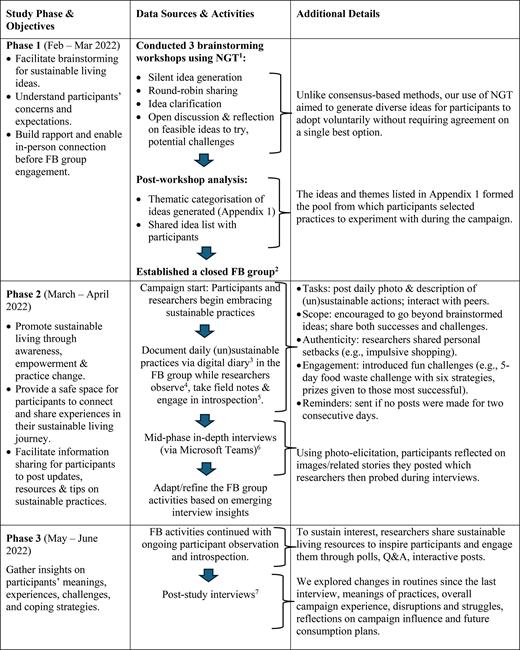 |
Methodological justifications
1 Nominal Group Technique (NGT) is a structured participatory technique promoting systematic idea generation and equal participation (Claxton et al., 1980). Widely applied in sustainability research (e.g. Hugé et al., 2023), it offers an effective alternative to focus groups for fostering diverse ideas, reflection, and peer learning (Ko de Ruyter, 1996)
2 Facebook (FB) served as a digital ethnographic space, capturing organic, lived sustainability experiences in a way that traditional in-person observations could not (Hine, 2020)
3 Digital diaries capture real-time records of participants’ practices, reducing reliance on memory and minimising recall bias, allowing us to capture subtle aspects of practice performance not observable through direct research (Lovett and Peres, 2018)
4 Participant observation allows deeper contextual insights by witnessing practices as they unfold (Kozinets, 2019) while fostering rapport and positioning participants as equal partners in the data-gathering process
5 Introspection enables researchers to critically reflect on their own experiences, identifying challenges and emotions that may resonate with participants and thereby strengthening rapport and interpretation (Wallendorf and Brucks, 1993)
6 Online interviews offered flexibility, allowing participants to reference their FB posts in real time. However, limited visibility of household environments and non-verbal cues restricted contextual insights
7 The post-study interview was essential for capturing participants’ reflections on their engagement, challenges, and motivations, providing insights into how they navigated sustainability practices during the campaign
Participants and recruitment
Participants were recruited through snowball and purposive sampling via the researchers’ networks. We focused on young adults aged 18–40 years to capture an extended transition-to-adulthood cohort. This age range reflects foundational developmental perspectives on young adulthood (Erikson, 1959) while aligning with life-course research showing that pathways into stable adult roles are increasingly variable and less temporally bounded (Shanahan, 2000). Prior research shows that young adults are early adopters of sustainable consumption (Kadic-Maglajlic et al., 2019) and exert strong peer influence (Ndubisi and Nataraajan, 2018). Although older cohorts also engage in sustainability, young adults remain a key group shaping cultural shifts towards sustainable practices. Participants varied in their levels of sustainability involvement from highly engaged to aspirational but inactive and included those already participating in sustainability initiatives. This diversity ensured the practices studied reflected real-life experiences and remained grounded in daily contexts. Eligible participants were responsible for or influenced household consumption decisions, including renters, students in shared housing, and individuals living with family. Sustainability professionals (e.g. environmental scientists) were excluded to maintain focus on everyday consumer perspectives. Proficiency in English was required.
Twenty-one participants (12 females, 9 males; aged 18–36; diverse ethnic backgrounds; Table 2) completed all three phases. The absence of attrition was attributed to the Facebook (FB) group’s ongoing engagement, the manageable campaign duration, and the convenience of online participation. Phase 1 workshop also built rapport and collective ownership, which motivated participants to follow through in later phases. Some participants continued posting beyond the campaign, indicating sustained interest. Each participant received a $50 voucher per phase (total $150). As vouchers were not disclosed during recruitment and given as tokens of appreciation rather than incentives, self-selection and response bias were minimised. While many participants did not have their own households, their experiences to experiment with sustainable practices in shared living spaces were central to our study. Since sustainability extends beyond homeownership, this approach was well-suited to capturing diverse experiences and practices.
Participants’ profile
| Pseudonym | Age | Gender | Occupation | Living situation | Unfamiliar practices tried during the campaign |
|---|---|---|---|---|---|
| Dianne | 24 | Female | Student/working part-time | In an apartment with flatmates | • Carrying a reusable water bottle when going out (to avoid buying plastic water) • Bringing her own container for takeaway • Turning off lights/devices more consistently Buying less fast fashion and remixing existing outfits (shift in dressing practice) • Upcycling a keychain from old accessories |
| Vivian | 25 | Female | Student/working part-time | Renting a room in an owner-occupied house | • Tried to cook at home, take away the leftovers at restaurant • Order less online parcels shop in-store • Reduce food waste |
| Rachel | 18 | Female | Student | Staying with family in a house | • Stopped the excessive buying of clothes and stuff • Switching electrical equipment/plugs off • Recycling properly • Donating stuff • Using less power • Reduce driving and increase using active /public transport |
| Maggie | 28 | Female | Not working at the time | In an apartment in downtown with her partner | • Swapped paper towels for reusable cloth towels • Found and engaged in creative ways of storing vegetables and fruits • Used Christmas lights for routine purposes • Finish using the grocery available before purchasing more new stuff |
| Nancy | 26 | Female | Student/working part-time | In an apartment with flatmates | • Stopped buying individually plastic wrapped food products • Taking public transport |
| Isabelle | 24 | Female | Student/working part-time | Staying with family in a house | • Starts consuming leftover food along with family • Uses water from washing rice for plants • Uses reusable make-up removing wipes instead of disposable ones |
| Marie | 24 | Female | Student/working part-time | In a house with flatmates | • No clothes shopping for the entirety of the campaign • Reducing carbon footprint (driving less) |
| Sandy | 21 | Female | Student/working part-time | Staying with family in a house | • Switching off lights deliberately • Air-drying clothes instead of using the dryer which requires routine restructure to do laundry in the morning • Using food storage hacks (avocado in water; salad leaves stored airtight) • Carrying reusable utensils in her bag (used when eating out) • Experimenting with shower timers/accountability to shorten long showers |
| Andy | 21 | Male | Student/working part-time | Staying with family in a house | • Timed and shortened showers (via a short YouTube video) • Experimented with brand switching based on sustainability reporting • Refillable water habit (installed a water-fountain locator app and began using spare bottles to avoid buying bottled water • More mindful grocery asks, meal planning and waste avoidance |
| Adrian | 20 | Male | Student/working part-time | Staying with family in a house | • Shorter showers • Turning off charging stations and appliances fully • Cruise control on motorways to save fuel • Public transport use (learning to embrace it, despite earlier dislike) • Air-drying clothes outside instead of dryer |
| Aiden | 29 | Male | Student | In university accommodation with spouse | • Using fruit bags • Timing showers • Spinach in a glass jar to preserve it for longer |
| Kingston | 29 | Male | Student | In a house with a host family | • Walking to campus • Turning off PC monitors |
| Adam | 22 | Male | Student/working part-time | In a house with flatmates | • Turning off computer monitor • Take colder showers Reduce water for laundry • Driving less Consume less fast food |
| David | 23 | Male | Student/working part-time | In a house with flatmates | • Switching to paperless study (OneNote) instead of refill paper • Changing dishwashing routine i.e., turning water off while scrubbing; conscious on/off cycles |
| Melissa | 23 | Female | Student/working part-time | Staying with family in a house | • Not using so much paper for her studies • Taking reusable container with her for leftovers when eating out • Using smaller plates to control portion sizes (less waste) • Taking the bus more instead of driving |
| Noah | 22 | Male | Student/working part-time | In a house with flatmates | • Not washing denim routinely • Turning off tap while doing skincare/dishes • Cold wash for laundry • Using keep cup |
| Pamela | 30 | Female | Working professional | In university accommodation with spouse | • Turning off water while brushing and during shower soaping/shampooing • Rinsing food containers before recycling • Using cloth produce bags at the supermarket instead of thin plastic bags • Considering BYO containers for takeaways |
| Jessie | 27 | Female | Working professional | In a house with flatmates | • Using leftovers for dinner • Soft plastic recycling • Composting |
| Nigel | 32 | Male | Working professional | In a house with flatmates | • Cooking more food at home rather than buying takeaways • Buying more sustainable options in the groceries • Keeping showers under Five minutes • Reducing screen time • Turning lights off in the home when room not being used • Reducing paper waste at his printing shop • Soft plastic recycling |
| Maya | 36 | Female | Working professional | Staying with family in a house | • Trying to bulk cook • Creative repurposing of packaging/household waste • Novel ways of storing vegetables and fruits |
| Jacob | 36 | Male | Working professional | In a house with flatmates | • Stopped buying individually wrapped snacks • Sourcing ethically produced and packaged products • Reducing shower time • Meal planning to stop food waste |
Fieldwork
Phase 1.
To foster participant buy-in, three in-person workshops were conducted using the Nominal Group Technique (NGT; Claxton et al., 1980) at a researcher’s home. To ensure the process remained participant-driven rather than researcher-imposed, the researchers acted as facilitators to minimise bias and power dynamics. To provide a realistic and relatable context for idea generation, participants considered routine (e.g. food waste, reusable bags) and non-routine (e.g. eco-friendly gift-giving, sustainable travel) scenarios. These were developed using the United Nations Sustainable Development Goals (briefly introduced to participants as prompts for idea generation) and literature on environmental psychology. The sessions yielded a wide range of ideas, later grouped under six themes (see Appendix 1). Participants were then invited to join the FB group in preparation for Phase 2.
Phase 2.
Phase 2 marked the start of the campaign, where participants trialled, the ideas generated in Phase 1, accompanied by multiple data sources described below.
Digital diaries, observation, and introspection.
A digital diary was maintained via the closed FB group, where participants posted daily reflections, photos, and captions documenting their experiences. All visual content, captions, interactions (likes/comments), and researcher notes were logged and later used for data triangulation and as elicitation prompts during interviews. The researchers conducted participant observation, closely monitoring online conversations, interacting with participants, and documenting fieldnotes. In addition, researchers engaged in introspection (McGouran and Prothero, 2016), documenting their sustainable living experiences through journal entries. We maintained a record of our reflections and journal entries, following an introspection method (Gould, 1991) akin to McGouran and Prothero (2016).
Mid-phase in-depth interviews.
Midway through the campaign, 21 online interviews were conducted in English, each lasting 50–90 min. Discussion topics included attempted practices, reflections, challenges, feelings and experiences about the campaign, and interactions in the FB group. The mid-phase interviews provided a critical reflection point, allowing participants to reflect on their engagement.
Insights from these interviews informed FB group activities, leading to more interactive features like peer posts, tailored sustainability tips, polls, and Q&As. Sharing experiences also strengthened participants’ commitment to the campaign by fostering accountability and ongoing engagement.
Phase 3.
Upon campaign completion, the same 21 participants were re-interviewed online (60–100 min each). These interviews explored participants’ reflections on their engagement, motivations, challenges and intentions to sustain their practices. Before the interviews, we tracked practices and action plans discussed to ensure key ideas were carried forward.
Ethical considerations
Ethical approval was granted by University Ethics Committee. Informed consent was obtained, with voluntary participation and withdrawal rights clearly communicated. To protect privacy, FB group access was restricted and community guidelines established. This study was framed as participatory research to minimise power imbalances, which fostered collaboration and ethical integrity. Data were securely stored on an institutional, password-protected server. Personally identifiable information was anonymised.
Data analysis
Three researchers conducted the interviews and met regularly during fieldwork to ensure consistency in content and approach. Protocols (see Appendix 2) guided both interviews, with iterative refinement based on emerging insights. In total, 42 interviews were audio-recorded and transcribed (2,031 pages, 512,743 words). Detailed fieldnotes were kept to document observations, reflections, and emerging ideas. Researchers also maintained introspective journals to critically reflect on their positionality, ensuring that personal engagement with participants did not unduly influence interpretation. We used a thematic analysis (Braun and Clarke, 2021) to identify patterns across interviews, digital diaries, and FB group interactions through an abductive strategy (Timmermans and Tavory, 2012) combining theory-driven and data-driven coding.
Following Lincoln and Guba’s (1985) criteria for trustworthiness, we established credibility through triangulation across multiple data sources and member checks, where participants reviewed key themes and provided feedback. We triangulated textual and visual data to ensure consistency between self-reported practices and observed behaviours. Rapport built during workshops and FB interactions further supported data credibility. To ensure dependability, we applied intercoder agreement procedures (Miles and Huberman, 1994). Three researchers independently coded a subset of transcripts and met regularly to compare interpretations, resolving discrepancies through iterative discussion and consensus. Confirmability was reinforced through reflexivity, with introspection journals and regular team discussions used to interrogate assumptions, challenge potential biases, and ensure that interpretations remained grounded in participants’ narratives. Appendix 3 provides supporting data for our findings.
Findings
To trace how practices change, it is necessary to first establish their starting position. People do not approach change as blank slates; their orientations are already shaped by cultural logics, understood here as the sense making principles people draw upon to interpret their world and organise everyday practices (Roberti, 2024; Warde, 2005). In this study, we use the term cultural logics to describe the implicit frameworks of meaning and value through which individuals interpret, evaluate, and justify their practices. These logics are shaped through early socialisation and ongoing cultural participation, as individuals learn shared understandings of what is valued, desirable, or worthwhile. Over time, such culturally shaped meanings guide ways of doing that feel natural or self-evident within everyday life. Rather than focusing solely on embodied dispositions, cultural logics foreground shared meanings and normative assumptions that structure how practices are understood, justified, and sustained. Accordingly, to better understand how participants negotiated readiness or resistance to change during this campaign, we began by unpacking these cultural logics into their constituent meaning structures, routines, and tacit frameworks.
In what follows, we present four practice states identified in our typology (Figure 1): Pro-Transition, Constrained Embodiment, Negotiated Continuity and In-Reversal. These practice states emerge from two opposing guiding logics: one rooted in sustainability-based values, and the other in convenience and efficiency. Each orientation shapes these practice states by giving rise to distinct teleoaffective orientations (reflected by emotional orientations and goal-directed concerns), and particular dimensions of ontological security – understood as the sense of continuity and stability produced through routinised practices that sustain trust and predictability of everyday life (Giddens, 1984; Phipps and Ozanne, 2017). Together, these dynamics influence how participants interpret change, enact their practices, and negotiate them in daily life. The following sections therefore outline these foundational cultural logics before analysing each practice state in depth, supported by participant reflections and empirical examples.
 The conceptual framework shows 4 labelled sections connected by a horizontal arrow representing Guiding Cultural Logics between Sustainability on the left and Convenience on the right. The top left section, Constrained Embodiment, describes Teleoaffectivity as encountering the normative boundary of care that triggers principled containment of current practices, and Ontological Security as perceptions of risk reinforcement. The top right section, Negotiated Continuity, describes Teleoaffectivity as emotional and sensory attachments in current routines, and Ontological Security as moral licensing to preserve identity attachments. The bottom left section, Pro-Transition, describes Teleoaffectivity as rediscovering kinship ties through new practices, and Ontological Security as repairing a fractured self-narrative through adaptation of practice. The bottom right section, In-Reversal, describes Teleoaffectivity as weaponising ambivalence, and Ontological Security as surfacing ontologically bracketed routines.
Practice states and the typology framework
Source: Authors’ own creation
The conceptual framework shows 4 labelled sections connected by a horizontal arrow representing Guiding Cultural Logics between Sustainability on the left and Convenience on the right. The top left section, Constrained Embodiment, describes Teleoaffectivity as encountering the normative boundary of care that triggers principled containment of current practices, and Ontological Security as perceptions of risk reinforcement. The top right section, Negotiated Continuity, describes Teleoaffectivity as emotional and sensory attachments in current routines, and Ontological Security as moral licensing to preserve identity attachments. The bottom left section, Pro-Transition, describes Teleoaffectivity as rediscovering kinship ties through new practices, and Ontological Security as repairing a fractured self-narrative through adaptation of practice. The bottom right section, In-Reversal, describes Teleoaffectivity as weaponising ambivalence, and Ontological Security as surfacing ontologically bracketed routines.Practice states and the typology framework
Source: Authors’ own creation
Practice states emerging from cultural logics embedded in sustainability
This section introduces the shared cultural logics underpinning two practice states (Pro-Transition and Constrained Embodiment) discussed in subsequent sections. Analysis of participants’ digital diaries and interviews revealed that those who resonated most with the campaign’s ethos carried practical understandings aligning with sustainability, shaped by early socialisation. For these participants, sustainability-aligned values had become instilled within their habitus, defined as a system of durable and embodied dispositions that guide perception and intuitive judgements about what feels appropriate or “right” in everyday practice (Bourdieu, 1984). David captures the guiding force of his habitus when reflecting on his daily dishwashing routine, noting the taken-for-granted nature of his performance:
I think a lot of the sustainability stuff we talk about is everyday life. This isn’t just one-off stuff. This is the stuff you do almost every day or every single week. And those are the things that we’ve built habits of over years and years. You don’t even think about it when you do it. I don’t think about washing the dishes, I just do it the way I’ve always done it.
Drawing on other parts of David’s interviews, where he discusses his preference for handwashing dishes, attentiveness to keeping the tap off, and avoiding the dishwasher due to perceived water and energy use, his account illustrates how routines not only operate as largely unconscious habits but also as practices aligned with broader intentions, such as living sustainably. Schatzki (2002) refers to the goals inscribed in practice as part of teleoaffectivity, highlighting how practices are distinguished not just by outcomes but also by the emotional weight and normative purposes that sustain them (Warde et al., 2017).
As an entry point into analysis, we explored how participants’ sustainability-aligned logics remained embedded within pre-existing routines and interpreted their significance as anchored in emotion and the maintenance of ontological security. Echoing Molander and Hartmann’s (2018) findings, we observed that the more strongly the ends and goals inscribed in a practice matter to the participant, the greater the emotional intensity vested in it. Given the deeper meaning and heightened emotional investment associated with these pre-existing practices, some participants demonstrated strong enthusiasm in furthering their sustainability commitments and, during group brainstorming sessions (Phase 1), were observed by the research team readily proposing new practices for the group to trial.
Such a normative cultural frame enables unpacking how teleoaffectivity and ontological security shape the mechanisms through which participants negotiate change within two practice states grounded in sustainability-oriented cultural logics. For participants who openly embraced change, practices in pro-transition allowed them to rediscover kinship ties and engage in positive emotional exchanges that healed a fractured sense of self. By contrast, participants who most deeply embodied sustainability engaged in principled resistance and ultimately resisted adaptation.
Practice state: sustainability in pro-transition
The campaign prompted some participants to reflect on routines that typically blended into the background of their daily life. Given participants in this quadrant were socialised into general understandings aligning with wider sustainability goals, the campaign allowed them to rediscover lessons from childhood that had been forgotten in the pursuit of comfort and convenience. By encouraging participants to post in digital diaries, unconscious actions were brought into question, raising their tacit understandings to discursive consciousness (Giddens, 1984). As the following themes illustrate, the participants’ original practical understandings, cultivated in early life, helped practices reach a transitional phase and made adaptation smoother. This return to origin understandings reconnected participants with kinship ties, thereby restoring ontological security whilst repairing the fractured self-narrative as they worked to uphold these newly adapted practices.
Rediscovering kinship ties through new practices.
Giddens (1984) posits that ontological security is rooted in early trust-based relationships, often formed through close kinship ties during childhood. In late modernity, where social relations are increasingly mediated by decontextualised and impersonal systems, ontological security becomes more fragile and precarious (Dupuis and Thorns, 1998). As contemporary lifestyles continue to evolve and shift, the daily rhythms that once supported ontological security continue to transform, often in destabilising ways that affect cognitive and emotional security (Campbell et al., 2020). As Shove et al. (2009) note, the repetitive nature of routine renders small adjustments to practices largely invisible, with time gradually altering practices beyond recognition. When participants were prompted to reflect on their current practices, many realised how far these had drifted from the teachings of their childhood.
For Maggie, a participant of Russian descent, the war in Ukraine cast a heavy shadow on her experience in New Zealand. She frequently described feeling powerless as friends and family were evacuated overseas. A seemingly simple cultural disposition of “wasting less” carried deep ontic significance for her, rooted in intergenerational teachings from childhood. As Maggie recalled, the value of reducing waste was passed down from her grandparents, who had grown up in a “post-war environment”. Her grandmother often reminded her: “do not throw food away, never throw food away”. Although she had moved away from this habit during her busy university years, Maggie now felt compelled to revisit this lesson, linking her renewed motivation to the intergenerational effects of war:
It is unfair to all the generations who had to fight wars for our better life. And now being in the worst situation again around the world [referring to the war between Russia and Ukraine], I’m like OK, I think we need to, we have to.
Using Figure 2 as a projective prompt in her interview, Maggie explained that returning to her family’s food practices was a smooth transition and a source of comfort. The familiar routine helped to re-stabilise her sense of ontological security amidst global instability:
Every morning I would open the fridge and see what food I have and will try to come up with some recipes with these ingredients that I have available at home, so I don’t have to go grocery shopping and it’s actually worked fine. I think it also goes back to my grandparents’ way of life and I like it because it’s more sustainable.
 The social media post shows text describing a decision to reduce grocery shopping frequency and use leftover food ingredients before purchasing more groceries. The text explains using remaining capsicum, onion, cheese, tuna, and garlic to prepare a pizza. Below the text, a close-up view shows a homemade pizza topped with sliced vegetables and other ingredients spread across the surface.
Maggie’s digital diary about “wasting less”
The social media post shows text describing a decision to reduce grocery shopping frequency and use leftover food ingredients before purchasing more groceries. The text explains using remaining capsicum, onion, cheese, tuna, and garlic to prepare a pizza. Below the text, a close-up view shows a homemade pizza topped with sliced vegetables and other ingredients spread across the surface.Maggie’s digital diary about “wasting less”
Similarly, Jessie’s busy work schedule and long commute to the office made it difficult for her to move beyond comfort and convenience-driven food habits, requiring conscious effort and deliberation in contexts where time and energy often dominated her decision-making. Raised in a single-parent, low-income household, Jessie associated waste with discomfort and guilt:
We didn’t have a lot growing up, so you learn to make the most of what you’ve got […] I had a lot of guilt about throwing away food scraps and so very few things like bread, for example, I’ve thrown on the lawn […] if there was waste, I would just put it in the bin and I would feel really bad about that.
These experiences, rooted in her early socialisation, have created normative cultural frames which dictate Jessie’s perception of right and wrong. Thus, rediscovering her mother’s practice of re-purposing containers to collect food scraps for the garden reminded Jessie of the deeper ontic significance attached to these small and often overlooked practices. Like Maggie, Jessie’s transition back to familial frameworks not only marks the return of a more sustainable way of handling food waste, but it also signifies a shedding of guilt and negative emotions that others without similar foundational understandings would have experienced the same way. Jessie explains:
It [transitioning back to old practices] kind of eased a lot because I had a lot of guilt about throwing away food scraps.
These emotional rewards enabled participants like Jessie and Maggie to push past the momentary discomfort often associated with change. However, their motivation extended beyond nostalgia. As the subsequent theme explores, transitional practices allowed participants to repair fractured self-narratives by alleviating the dissonance they experience when engaging in unsustainable behaviours that work against their long-held values.
Repairing a fractured self-narrative through adaptation of practice.
Ontological security reflects the deep-seated need to preserve a consistent and coherent sense of self. When actions align with values, a coherent sense of self is formed, creating continuity in how people understand themselves over time. In contrast, when individuals engage in actions that contradict their core values and avoid taking personal responsibility, their sense of self can become disrupted, leading to feelings of fragmentation and loss of identity (Delehanty and Steele, 2009). Among participants, fractured self-narratives were most evident in pre-established routines that had developed in response to the relentless busyness and unpredictability of their daily lives. For instance, Sandy, a young adult balancing the demands of work, university, and domestic responsibilities, described how her life had become organised around coping and compromise. Sandy found herself increasingly relying on shortcuts, such as using the clothes dryer at night, to manage her workload effectively, as she explained in her mid-campaign interview with the researcher:
I do [drying clothes] at night because I would sleep at night, and then I’d be doing my university [work] right up until it was dark and I wouldn’t want to do housework because I’d made it up in my head that was like, wasting time. You need to be doing university and then I would look at the mess of my house and go, OK, I need to do something about this and its dark outside, so the washing doesn’t always get hung out. Usually just goes in the dryer.
Giddens (1984) suggests that identity is built upon judgements about oneself in relation to past experiences. In Sandy’s case, the campaign acted as a catalyst for reflection on her existing practices, and her interview revealed a negatively skewed self-narrative rooted in her current routine. She described herself as “lazy” and disorganised, revealing her perception had been shaped by the disjointed nature of her lifestyle. Initially, restructuring her schedule to include more sustainable habits, such as hanging out clothes to dry on a rack, elicited discomfort, as it required disrupting familiar routines. Yet she gradually adapted:
[Changing practices] felt like a sacrifice in the beginning thinking, no I don’t want to change my habits but then I got over it and now it’s my new normal.
A key motivator in this transition was the emergence of a new, more positive self-narrative as Sandy began to perceive herself as someone more organised and ahead of her day:
I’ve had to actually restructure myself […] now I get up earlier and do the general housework in the time where I would have normally rolled out of bed, I’ve been up, and I’ve done some cleaning and can get on with my university work.
Thus, within the context of pro-sustainable transition, newly adapted practices aligning with sustainability helped participants like Sandy repair a fractured self-narrative, replacing anxiety and self-criticism with a renewed sense of coherence in their self-concept.
Practice state: constrained embodiment
Constrained Embodiment captures instances where sustainability-based values remain deeply embodied, anchoring pre-existing routines to broader environmental goals while limiting openness to further adaptation. Thus, participants described their pre-existing practices as naturalised and long-standing, also reflecting dispositions formed through early socialisation and kinship ties. However, unlike practices in states of pro-transition, the distinction here lies in how these inherited dispositions become so entrenched in ways that constrain, rather than facilitate, openness to further change. As David’s account illustrates, the historic imprint within his daily routines enables care for the environment to become a dispositional orientation that shapes how he now performs ordinary daily tasks such as shopping:
I try to be really conscious about the things that I am buying in terms of environmental impact. It’s a habit I picked up from my mum in particular […] we would always buy eco-friendly eggs or the eco-friendly cleaning products and that’s the kind of habit I’ve built up when I go to the grocery store, I recognise certain brands that were always around my house […] So I get those largely out of habit.
When analysing how practices within this embodied state negotiate change, we find strong emotions and a sense of security vested in pre-existing practices acting as constraints on further adaptation. In what follows, we trace how the campaign encounters a new normative boundary of care. Participants reach this boundary when they perceive themselves as carrying a greater emotional and physical burden of sustainability work. In response, participants use what we term principled containment to confine green reflection to the practices they are already undertaking.
Principled containment and the normative boundaries of care.
Drawing on Tronto (2013), we understand care as the activities “we do to maintain, continue, and repair our “world” so that we can live in it as well as possible” (p. 19). Yet, as Shaw et al. (2016) note, care is often fraught with tension as caring needs often outstrip caring capacities. Throughout the campaign, this tension materialised as emotional trade-offs between “caring for the maintenance of social relationships” and the “caring for sustainability goals”. For example, as Jessie made an honest attempt to adopt new sustainable behaviours in the spirit of the campaign, she described the mounting resentment towards her flatmate and their reduced efforts to curb food waste:
She [flatmate] in particular is quite shocking. She will prep food, and she will cook large amounts so that she has got it but then it goes to the fridge and that’s where it goes to die. So, she ends up throwing out masses of food […] I open the bin to throw out scraps, and I’m just flabbergasted every time.
Chatzidakis et al. (2021) treat the ongoing commitment to a shared meaning structure as the basis for solidarity. This framing helps explain Jessie’s strong emotional reaction to her flatmate’s wastefulness, which she interpreted as a breach, given that both had initially agreed to participate in the campaign and commit to the values it sought to enact. At this point, a tension emerges in Jessie’s obligations of care as she faces the choice of nurturing her relational obligations to her flatmate (Shaw et al., 2017) or compromising that bond to take up the role of enforcer of sustainable practices in the household. As we watched this dynamic unfold, the research team noticed how Jessie became one of our most highly engaged participants by contributing numerous Facebook posts focused on broadcasting her pre-established food practices to the group (see Figure 3). While her Facebook posts cast her as a positive influence within the wider campaign community, the interviews uncovered a more complex inner dialogue that told a different story. When interpreting Jessie’s diary contributions alongside this growing resentment, her proactive engagement may be understood as (re)enactments of care that become activated by the negative emotions stirred through the actions of close others. In contrast to the softening of boundaries to maintain solidarity (Chatzidakis et al., 2021), Jessie assumes the role of enforcer, seeking to safeguard the values she attaches to curtailing food waste, despite the potential cost of straining her relationship. Jessie explains:
It [flatmate’s food waste] makes me conscious, it’s like I need to do better at this. If this bothers me to see it, I need to do more myself […] I hate wasting food. I hate wasting things. I think seeing how bad some people are [with food waste] has helped ingrain [sustainability] as part of me.
 The collage shows 3 social media posts related to sustainability and waste reduction practices. The left post recommends a gardening video channel about growing tomatoes using recycled plastic bottles and includes a thumbnail with tomato plants and text about growing tomatoes on a terrace. The middle post discusses avoiding food waste and includes views of eggshells in a rubbish bin and food scraps collected in a container for composting. The right post states Not the bin! feed the birds and shows slices of bread with small mould spots being held above a rubbish bag.
Examples of jessie’s food waste Facebook posts
The collage shows 3 social media posts related to sustainability and waste reduction practices. The left post recommends a gardening video channel about growing tomatoes using recycled plastic bottles and includes a thumbnail with tomato plants and text about growing tomatoes on a terrace. The middle post discusses avoiding food waste and includes views of eggshells in a rubbish bin and food scraps collected in a container for composting. The right post states Not the bin! feed the birds and shows slices of bread with small mould spots being held above a rubbish bag.Examples of jessie’s food waste Facebook posts
In a similar fashion, Marie used interviews to express her sense of care and civic responsibility, often through the disappointment she felt towards others who disregard the rules of recycling that she herself deeply embodies:
I know a lot of people around me, they just don’t care. They think it’s all recyclable, they just put it all in the [recycling] bin.
This frustration prompted her to assume the role of recycling enforcer, feeling responsible for educating others on how to recycle more effectively. In her digital diary, Marie shared a photo (Figure 4) of her designated soft plastic recycling bin, which she regularly empties at a specialised recycling centre. Aware that many, including her friends and flatmates, are unaware that soft plastics are not accepted in regular curb-side bins, Marie took it upon herself to raise awareness:
Whoever is living with me, they have to recycle. When I was working at a property shop, I told my manager that I had this recycling habit and stopped to tell her that we can recycle. She was like, ‘Oh yeah, that’s a good thing to do,’ and they did it. So, I’m trying to influence my friends and family to recycle properly because I know a lot of people just don’t care.
 The close-up view shows a transparent plastic bag filled with crushed aluminium cans and recyclable containers. Several metallic cans are visible through the bag, along with other compacted recyclable materials placed together for disposal or recycling.
Marie’s soft plastic recycling bin
The close-up view shows a transparent plastic bag filled with crushed aluminium cans and recyclable containers. Several metallic cans are visible through the bag, along with other compacted recyclable materials placed together for disposal or recycling.Marie’s soft plastic recycling bin
Up to this point, our findings reveal the tensions between relational and practical expressions of care and how they are entangled in pre-established practices. Yet a new tension emerged when participants were encouraged to adopt new practices as part of the campaign. Rather than embracing these suggestions, participants expressed unexpected resistance, justifying their refusal by emphasising they were already doing their part. For example, when Marie was encouraged to share examples of non-routine practices she had engaged with since the beginning of the campaign, she replied:
I don’t do anything extra in this campaign. I feel like I’m still behaving as how I was behaving […] because I feel like I am pretty responsible and sustainable and have that stuff in mind. The things I don’t do is the things I don’t want to do.
Later in the interview, when the researcher encouraged Marie to walk to the grocery store instead of driving, Marie responded:
I don’t feel like I wanna walk […] [her shopping] it’s gonna be heavy. And, in terms of sustainability, if I walked and then I come home, I’m gonna have to take a shower because I sweat so I’m gonna waste water.
We conceptualise these moments as meeting the normative boundary of care. At this boundary, commitment does not expand but contracts as participants choose to selectively disengage from new practices while continuing to enforce their existing routines. Under this tension, care shifts away from sustainability and turns inward, becoming care for the self and protection against the emotional and physical burden of doing more. This resistance is not rooted in indifference. Rather, it reflects a form of principled containment in which participants actively delimit the scope of their caring practices. In doing so, we align with prior work in ethical consumption which highlights that caring dispositions do not always translate into caring acts (e.g. Shaw et al., 2016). However, our findings extend this literature by showing how deeply embodied commitments to sustainability can, under certain circumstances, produce limits rather than extensions of practice. Specifically, we demonstrate how sustainability-based normative logics can further curtail practices from green reflection. This mechanism helps explain how and why care reaches its limits, which complements recent work that highlights how care, even when expansive and hopeful, can be constrained by structural and infrastructural conditions of necessity and repair (e.g. Traill et al., 2024).
Perceptions of health risk reinforcing the status quo
Changes in routine are often perceived as threats that disrupt a consumer’s sense of order, identity, and meaning, thereby undermining ontological stability (Campbell et al., 2020). In line with prior research on environmental risk, concerns become especially salient when they relate to the body, particularly through food consumption (Tulloch, 2002). Interviews revealed that proposed changes to food-related routines triggered heightened ontological insecurity, as participants associated these shifts with risks to their health and well-being. To illustrate how this mechanism operates, we turn to Pamela, whose food preparation practices have been passed down intergenerationally from her mother. Pamela, of Indian descent, draws on cultural and Ayurvedic traditions in which portions of food (such as peels) not consumed as part of the regular diet are often repurposed for medicinal or therapeutic use. Ayurveda, a traditional system of medicine originating in India, emphasises the interconnections among the body, food, and health (Verma et al., 2024).
Over time, these foundational beliefs about the health benefits of food components can become central to sustaining meaning and value in daily life (Rai et al., 2025). Thus, when speaking about her own food preparation practices, Pamela explained that her decision to cook vegetables with their skins is motivated by both sustainability and nutritional concerns:
I may not always peel my veggies; I will put them in with the skin and cook the skin. You wash it properly, but you cook it with the skin to reduce food scrap and because it has a lot of nutritional value as well.
Flockhart (2016) argues that ontological security supports agency by providing a psychological buffer against perceived threats to their physical and psychological well-being. To mitigate anxiety, people often rely on entrenched routines that provide stability and continuity. This emerges in Jessie’s account where, like Pamela, relies on food practices embodied earlier in life to safeguard her wellbeing. Mid-way through the campaign, Jessie described how her preference for local produce is informed by past health challenges and concerns about the contamination in imported goods:
I think a big focus for me is on the chemical level and more natural and better for the environment. As someone who previously suffered from addiction and also not the healthiest lifestyle when I was younger, which has now led to a lot of health issues, I’ve had to be really conscious about what I put into my body […] there’s certain big-ticket items, like frozen fruit, we’re really particular about because we’ve been really sick in the past and there’s been recalls from overseas for frozen fruits.
For Jessie, previous illness and food product recalls heightened her anxiety, leading her to carefully research companies and scrutinise labels. This vigilance functions as a protective strategy that stabilises her ontological security but narrows the range of food practices she feels comfortable enacting. Consequently, Jessie is unwilling to experiment with unfamiliar products, alternative sources, or modifications to established routines as uncertainty is experienced as a potential threat to health and well-being. Unlike practices in Pro-transition where participants experience the campaign as a positive disruption, those in a constrained embodied state often perceived change as threatening. This contrast is particularly striking given that both states emerge from shared sense-making logics oriented towards sustainability. To make sense of this, we argue that, regardless of whether pre-existing practices continue or new practices are in transition, individuals who are socialised into sustainability-oriented dispositions interpret engagement, re-engagement, or disengagement from sustainability as actions deeply rooted in their sense of security and self-concept.
Practice states emerging from cultural logics embedded in convenience-based values
Not all participants entered the campaign with practical understandings aligning with wider sustainability goals. Echoing the professional mothers described by Thompson (1996), who valued products and services that helped them “stay on schedule” and “hold it together”, many participants prioritised practices that offered convenience and optimised efficiencies (Wrigley et al., 2019). For these participants, convenience was an end in itself – practices devoid of ulterior meanings beyond getting tasks done as quickly and easily as possible (Warde et al., 2017). For example, Adam used plastic bags not out of deliberate disregard for sustainability, but because it was the most convenient way to gather his items. Such actions may appear apathetic towards environmental concerns. In interviews, Adam asserts no malicious intent but explains that it is simply an instinctive habit imprinted on him since childhood. This framing of convenience as an inherited disposition that embodies cultural logic illustrates how maintaining efficiencies becomes embedded in the structure of daily life, eventually offering deep psychological value. Similarly, Andy noted:
There is a kind of premium placed on convenience. I think we lapse into that sense of thinking that I don’t mind if I have the resources. Like, if I have money, I will probably catch an Uber rather than catch the bus because it’s more convenient, more reliable, but probably not better for the environment.
These representative quotes mark the entry point for some participants who entered the campaign from this shared meaning structure. From this standpoint, two practice states emerged, each negotiating change in different ways. Participants who closely embodied convenience ultimately negotiated change by choosing continuity. In contrast, participants who experimented with new non-routine practices and made a genuine attempt to uphold them often reverted to prior routines.
Practice state: negotiated continuity
Negotiated Continuity represents practices that were most entrenched in the cultural schema of efficiency and convenience. Therefore, decisions are often negotiated within this practice state, where the balance between environmental ideals and the practical benefit of convenience is typically tipped in favour of the latter. Adam’s quote highlights how momentary desire often takes precedence in his daily routines by stating how his practices are largely driven by the concept of:
Here’s what I want, and if it’s something that I truly want and I will truly use, then I will go ahead and get it. I would say it is pretty rare for me to do any significant amount of research on its relevance to environmental issues.
This does not mean that their engagement in the campaign was devoid of any action. Much like those who deeply embody sustainability (Constrained Embodiment), these participants enthusiastically committed to new practices during the collective momentum built in group brainstorms (Phase 1). However, as new scripts rubbed against the rhythm of reality, they encountered unexpected pressure points and ultimately negotiated change by holding onto continuity.
In an attempt to understand the mechanisms behind how change is negotiated from this practice state, we approach it with the same analytical lens as those in Constrained Embodiment, given that both fundamentally oppose long-term change in varying capacities. In doing so, we note a parallel where resistance to sustainable adaptations in practice is not dispositionally bounded by belief or value alone. Those who deeply believe in sustainability-based values are just as susceptible to resistance as those who do not. By unpacking the psychological and emotional layers embedded within this practice state, we find that resistance to change (via continuity) was less a reflection of their indifference towards sustainability. Rather, it was more about preserving the emotional, sensory, and identity attachments that established practices lodged in this cultural schema had come to offer.
Preserving emotional and sensory attachments by continuing routines.
Despite the initial enthusiasm expressed during brainstorming sessions, many experienced a turning point once the campaign commenced, becoming hesitant to enact the very ideas they had previously proposed. Despite the research team’s efforts to prompt engagement through check-in posts, spot prizes, and group challenges within the closed Facebook group, these initiatives had a limited effect on participants in this practice state. The decision to continue with current practices embedded within convenience was primarily driven by the meditative and contemplative qualities embedded in their ritualistic routines, which offered a sense of psychological comfort and predictability. Interviews with Noah, Adam and Sandy revealed the choice to continue with long, hot showers for they served as a mindless, meditative ritual where “the feelings of warmth” allowed them the cognitive space to mentally adjust to whatever the day had set ahead. Although aware of the broader environmental impacts, the choice to continue partly stemmed from the emotional and sensory benefits embedded in these embodied routines. Thus, consistent with Phipps and Ozanne (2017), who observe how practices vary in significance, we find practices in this state to be less about their utilitarian function and more about the vested comfort they offer (Dupuis and Thorns, 1998). As the suggestion of altering routines suddenly became the catalyst for anxiety, Adam’s quote illustrates how long hot showers are not only a source of physical comfort, but have become a stabilising ritual in his current routine:
I could definitely afford to take shorter showers, but unfortunately that’s just not a sacrifice I am willing to make […] it’s just very important for me to be able to stand in the hot water for a while.
Thus, we find ontological security maintained not only through their decision to negotiate change by upholding the status quo, but also through the sensory and affective cues embodied in the practice, which offer participants a sense of control and grounding.
Moral licencing to preserve identity attachments.
When the research team explored other avenues to explain why some participants continued unsustainable practices that privileged convenience, even though they joined a campaign devoted to sustainable change, it became evident that attempts to alter routines evoked fears of social sanctioning. As young adults are particularly attuned to external perceptions (Ndubisi and Nataraajan, 2018), sustainability-based actions risked positioning them as social outliers within their families or peer groups. For example, Marie highlights the perceived social awkwardness of bringing a reusable container to a restaurant gathering:
It looks stupid when you’re eating with your friends and then you only have a ladies bag holding a plastic container […] so in those terms, I don’t do it.
Similarly, Isabelle’s fear of subtle disapproval from her partner dissuaded her from op-shopping:
I remember going to an op-shop with him, this was like years ago and he was just like, I would never shop in an op-shop. So, I think I’ve kind of held onto that […] my fear is that he may perceive me by saying ‘oh that’s a bit cheap of you’. Like, it’s a really deep fear so I don’t really.
Drawing on research linking social norms to behavioural change (Goldstein et al., 2008), we contend that incorporating new routine and non-routine practices can face resistance because social compliance underpins the participants’ validation and identity. While participants initially joined the study out of a sense of environmental responsibility, interviews revealed that reflection on changing daily routines often triggered concerns about identity risk. These concerns created tension between sustainability aspirations and existing identity attachments. In response to these perceived threats, participants engaged in moral licencing, citing other sustainable behaviours they felt comfortable with to offset those they resisted. These counter-narratives functioned as protective buffers, insulating practices with deep ontological significance from disruption. For instance, Aiden resists switching to more sustainable grocery brands but quickly offers a compensatory behaviour like careful recycling instead. Such statements pre-empt criticism and maintain moral standing but are more than a cognitive loophole for pacifying guilt. Rather, they operate as practices with a deeper existential role, enabling individuals to preserve a coherent self-narrative both personally and publicly.
Practice state: sustainability in-reversal
Unlike the previous practice state, where participants proposed new practices but failed to act, practices In-Reversal describe practices participants genuinely intended to adopt yet ultimately struggled to sustain. Despite their initial motivation, a gap emerged between intentions and their ability to maintain the adapted behaviours throughout the campaign. At the core of this reversal lies the realisation that certain unconscious routines had operated as ontological brackets, a term we use to describe the tacit boundaries that structure everyday practice. Inside these brackets, routines and familiar arrangements mute existential anxiety and sustain a sense of stability. When participants encountered the edge of the bracket, for example, when asked to alter familiar practices, these protective routines became unsettled. Anxiety surfaces, prompting individuals to restore continuity by reverting to the practices that lie securely inside the bracket. To alleviate the guilt of reverting practices during the campaign, participants weaponised ambivalence as a means of justifying a return to familiar and stable routines.
Surfacing 0ntologically bracketed routines.
Among practices in reverse, we observed how the campaign disrupted the “protective cocoon” (Flockhart, 2016, p. 803) participants had formed through existing unsustainable routines. These routines, serving as ontological brackets, revealed their emotional and cognitive significance only when participants attempted to modify them. What seemed like simple habits became sites of psychological tension, echoing Chernbrov’s (2016) and Possamai-Inesedy’s (2002) view that ontological security often lies dormant and surfaces when threatened. A clear example comes from Adam, who initially embraced reducing energy use by turning off his second computer monitor (see Figure 5) but soon felt how destabilising the change was to his routine:
I did try it for about a week but it’s just not functional […] it was a bit disruptive to my established habits and routines […] it just wasn’t something I am ready to do”, he admitted.
 The social media post states Turning off the second monitor when it’s not explicitly needed, no cap. Below the text, a workstation setup is shown on a white curved desk. Two computer monitors are positioned side by side, with the left monitor switched off and the right monitor displaying a desktop background with a beach and cliff landscape. A webcam is mounted above the active monitor. The desk also contains a keyboard, mouse pad, headphones, microphone, speakers, sticky notes, and stationery items. The arrangement communicates an intentional reduction in electricity consumption by disabling unused electronic equipment.
Adam’s digital diary initial attempts with computer monitor
The social media post states Turning off the second monitor when it’s not explicitly needed, no cap. Below the text, a workstation setup is shown on a white curved desk. Two computer monitors are positioned side by side, with the left monitor switched off and the right monitor displaying a desktop background with a beach and cliff landscape. A webcam is mounted above the active monitor. The desk also contains a keyboard, mouse pad, headphones, microphone, speakers, sticky notes, and stationery items. The arrangement communicates an intentional reduction in electricity consumption by disabling unused electronic equipment.Adam’s digital diary initial attempts with computer monitor
Flockhart (2016) highlights how ontological insecurity renders the individual innately driven to restore the equilibrium that is vital to their sense of being. Thus, upon encountering the ontological bracket, Adam’s sustainable intentions are swiftly abandoned, as resources are redirected towards reinstating the practice now recognised as critical to his psychological and emotional stability, as he explains:
The monitor, while it seems equally small, it does affect me quite a lot. I need the second monitor quite a bit, I’ve come reliant on it […] it’s not a sacrifice I am willing to make.
For other participants, unconscious ontological anchors surfaced as a bracketed routine under unexpected or high-pressure conditions, triggering non-volitional responses regardless of earlier intentions. For example, Aiden initially committed to reducing and monitoring his shower times (Figure 6). Yet, a minor shift in his work schedule led to the abandonment of this new practice:
There was a couple of days when I had to start work at 8:30am and I usually start at 8:45am, so everything had to be squeezed in and so I couldn’t be bothered measuring and keeping an eye on the time […] so that kind of dropped in that way […] it just lasted three days.
 The social media post explains the use of a shower timer and mentions completing a shower in approximately four to five minutes. Below the text, a transparent hourglass-style timer labelled Watercare is attached to a bathroom wall using a suction cup. Blue sand is visible inside the timer, indicating the remaining duration. The setup represents an attempt to conserve water by limiting shower time and encouraging shorter bathing routines.
Aiden’s digital diary at beginning of campaign monitoring shower times
The social media post explains the use of a shower timer and mentions completing a shower in approximately four to five minutes. Below the text, a transparent hourglass-style timer labelled Watercare is attached to a bathroom wall using a suction cup. Blue sand is visible inside the timer, indicating the remaining duration. The setup represents an attempt to conserve water by limiting shower time and encouraging shorter bathing routines.Aiden’s digital diary at beginning of campaign monitoring shower times
Similarly, Nancy recounted the psychological conflict she faced when running late for work:
My conflict comes in when I have spent up until my last minute getting ready. I’m putting my makeup on and by the time I get out, the bus had come so let me just catch an Uber.
Hence, when participants encountered new and unanticipated situations that required sudden trade-off decisions that demanded a choice, they often reverted to ontologically bracketed routines that suspend anxiety and align with their immediate need for comfort and efficiency, even when recognising such actions were not the “right” thing to do. These reversals reveal how participants defaulted to familiar actions less as conscious choices than as mechanisms for restoring cognitive and ontological consistency. In this sense, moments of reversal reflect cognitive dissonance, as the desire to follow campaign goals clashed with the emotional and psychological pull of everyday routines. Brackets thus function as stabilising forces, enabling participants to navigate their lives with a sense of security and coherence. Extending work on the gap between sustainable intentions and behaviours (e.g. Connolly and Prothero, 2008; Gleim and Lawson, 2014), this practice states illustrates how even welcome adjustments can unsettle ontologically anchored routines, and when such stabilisers are disturbed, participants may experience a form of existential unease that prompts a reversion to the familiar.
Weaponising ambivalence.
To alleviate the guilt associated with the newly surfaced intention-behaviour gap, participants often invoked ambivalence towards sustainability as a justification for reverting to convenience-based routines. For instance, although Maggie acknowledged her intention to abandon some newly adopted behaviours after the campaign, she rationalised her retreat by expressing doubt about the efficacy of her individual action, stating:
I think once the project is over, I might slip back to not taking as much attention which makes me feel bad right in this moment but, at the same time, no one is perfect […] I do feel hopeless. Like why do I need to care about sustainable practices if others don’t? We’re not going to save the planet because there is climate change anyway.
For others, the high emotional cost of maintaining newly adopted sustainable practices became the tipping point for disengagement. Maggie, for example, described her experience of making homemade strawberry jam as anger-inducing and ultimately not worth the effort:
I will not do it again because the trade-off is too much for me personally. It made me angry and made me feel like I wasted time. I do not want to engage in this preparation anymore. It’s time consuming, dirty kitchen, I need to clean lots of stuff afterwards, I just didn’t like the actual process.
Similarly, Vivian expressed emotional discomfort when prioritising sustainable behaviours over social gratification, stating:
I kind of sacrificed my happiness a little bit when I ate leftovers, I feel unhappy. Honestly, I felt unhappy, but I forced myself to do it.
While practices in states of reversal and pro-transition both reflect the powerful influence of emotion during practice adaptation, a key distinction lies in how emotion is processed. In the pro-transitional practice state, negative emotions were transformed through reflective adaptation and the reparation of fractured self-narratives. Within the In-Reversal state, adverse or ambivalent emotions accumulated and were used as justification to disengage. In this context, participants feel vindicated, even rewarded, when abandoning the practice altogether. Echoing Molander and Hartmann’s (2018) assertion of emotion’s regulatory power in practice, participants here appear to “weaponise” their negative or ambivalent emotions, using them to neutralise the dissonance of abandoning sustainability goals and to reaffirm the comfort of pre-existing routines.
Discussion and implications
Addressing the imperative highlighted by Hargreaves (2011), who called for a closer examination of change as it unfolds in real-life contexts, our findings move beyond pre-and post-practice alignment to examine the lived negotiation of established practices, revealing the mechanisms that underpin how sustainability-based practices are contested in situ. By demonstrating how socialisation into opposing cultural logics embed practices with specific teleoaffective orientations and sources of ontological security, and by synthesising these into a single typology, we reveal how the interlocking intricacies of emotion, agency, socialisation, values, and security can either propel or detract practices from green reflection.
While our typology identifies four practice states (Pro-transition, Constrained Embodiment, Negotiated Continuity, and In-Reversal), we acknowledge that practices are rarely static. Drawing inspiration from Dolbec et al. (2022), who reveal how craft and commercial coffee firms interact and evolve in an asynchronous fashion, our typology also captures dynamism by revealing several transitional elements that facilitate movements between some practice states while impeding interaction between others. Therefore, we begin our discussion by first outlining how teleoaffectivity and ontological security operate at opposing frequencies between different practice states. As a result, distinct mechanisms often materialise as primary or secondary enablers (for practices embedded in sustainability-based cultural frames and logics) or enforcers (for those more embodied in cultural frames connected to convenience and efficiency) that drive practices back towards original dispositions, logics and understanding.
As illustrated in Figure 7, Constrained Embodiment and Pro-Transition as practice states occupy the upper and lower left-hand quadrants. These practice states convey a developing or pre-established attachment to sustainability-based practices, reinforced primarily through teleoaffective structures that guide purposeful and emotionally invested action. Here, increasing emotional intensity (i.e. enforcing care for sustainable practices or reconnecting with kinship ties) primarily enable participants’(re)attachment to sustainability-based practices, aligning with the cultural understandings formed through early socialisation. Since both practice states have been socialised into practical understandings aligning with broader sustainability goals, we argue that deepening emotional investments drive ongoing (re)enactments, enabling participants to move fluidly between states of transition and embodiment, as all practices gradually (re)align with their primary foundational cultural logics and early socialised understandings.
 The conceptual framework presents four interconnected pathways organised around sustainability and convenience under the heading Guiding Cultural Logics. The top left section, Constrained Embodiment, identifies a primary enabler as a greater emotional burden, forcing an encounter with the normative boundary of care, while the secondary enabler involves perceptions of risk destabilising ontological security. The top right section, Negotiated Continuity, identifies emotional and sensory attachments anchoring ontological security as the primary enforcer, while adverse emotions driving continuation of existing practices and moral licensing are identified as secondary enforcers. The bottom left section, Pro-Transition, explains reconnecting to positive and nostalgic emotion as the primary enabler and repairing fractured self-narrative to stabilise ontological security as the secondary enabler. The bottom right section, In-Reversal, identifies ontological insecurity surfacing and driving practices back to pre-established routines as the primary enforcer, while adverse and ambivalent emotions driving reversal are listed as secondary enforcers. Curved arrows surrounding the framework indicate cyclical movement between teleoaffective dimensions and ontological attachments.
Transition between practice states
Source: Authors’ own creation
The conceptual framework presents four interconnected pathways organised around sustainability and convenience under the heading Guiding Cultural Logics. The top left section, Constrained Embodiment, identifies a primary enabler as a greater emotional burden, forcing an encounter with the normative boundary of care, while the secondary enabler involves perceptions of risk destabilising ontological security. The top right section, Negotiated Continuity, identifies emotional and sensory attachments anchoring ontological security as the primary enforcer, while adverse emotions driving continuation of existing practices and moral licensing are identified as secondary enforcers. The bottom left section, Pro-Transition, explains reconnecting to positive and nostalgic emotion as the primary enabler and repairing fractured self-narrative to stabilise ontological security as the secondary enabler. The bottom right section, In-Reversal, identifies ontological insecurity surfacing and driving practices back to pre-established routines as the primary enforcer, while adverse and ambivalent emotions driving reversal are listed as secondary enforcers. Curved arrows surrounding the framework indicate cyclical movement between teleoaffective dimensions and ontological attachments.Transition between practice states
Source: Authors’ own creation
Furthermore, ontological security emerges as a secondary enabler, collectively shaping how perceptions of risk and reward are perceived between these practice states. Specifically, perceptions of risk tend to materialise among practices in Constrained Embodiment, deterring practices within this state from deviating from the status quo. In contrast, ontological rewards, such as repairing the fractured self-narrative, are more salient among practices in transitional states. Therefore, we postulate that ontological security plays a secondary, yet critical, role in enabling movement between these states as both risks and rewards remain tethered to the broader pursuit of sustainability. Thus, irrespective of where participants fall along the continuum between embodiment and pro-transition, ontological security provides an additional impetus that enables practices to (re)attach with their origin understandings.
Among Negotiated Continuity and In-Reversal practice states (situated on the right upper and lower quadrants), we observe a reflective pattern where current practices hold heightened ontological significance, positioning ontological security as the primary enforcer that reinforces existing routines and discourages engagement with unfamiliar sustainable actions. Here, we observed anxiety, identity preservation, and momentary discomfort routinely driving practices towards their original orientations aligning with convenience-oriented goals. As attempts to disrupt the status quo triggered adverse emotions, teleoaffective dimensions emerged as a secondary enforcer driving practices back to existing routines. Participants appeared motivated to shed adverse emotions by withdrawing sustainability-based adaptations, thereby restoring their ontological security. Together, ontological (in)security triggers adverse emotions, allowing participants to smoothly transition between these practice states, as both intertwine to reinforce the preservation of origin meaning structures and practical understandings over time.
The mirroring between the two upper quadrants (Constrained Embodiment and Negotiated Continuity) also provides important insights as to why horizontal movements are more complex and difficult to achieve. As both practical states embody oppositional cultural logics and understandings, rooted in socialisation processes that extend back to childhood, any horizontal transition would require a process of unlearning and disembodying their practical understandings rooted in their primary socialisation and culture.
Moreover, whilst the practice states located in the bottom quadrants represent newly adapted practices (Pro-Transition and In-Reversal), participants remained primarily driven by practical understandings birthed from childhood. As such, these transitional states operate on polarising ontological and emotional frequencies, making transitions complex due to different affective and psychological returns. For example, practices in Pro-transition offered positive ontological rewards and emotional reinforcement, providing a stable affective and psychological pathway back to their primary dispositions. In contrast, practices In-Reversal experienced a disruption to entrenched ways of thinking and behaving, generating psychological and emotional discomfort that ultimately led to abandonment as participants instinctively re-enact the practices aligning with their primary cultural logics. In each case, their primary and secondary mechanisms interact with their origin understandings in distinct ways, thereby constraining the likelihood of movement across the typology.
Beyond mapping transitions across the typology, this framework contributes to research on ontological security (Phipps and Ozanne, 2017) and teleoaffectivity in practice (Molander and Hartmann, 2018; Spotswood et al., 2023; Welch, 2020). Responding to Phipps and Ozanne’s (2017) call for greater attention to how ontological states underpin consumer practices, our typology demonstrates that pre-existing ontological states can either enable or hinder engagement with new practices in situ. We extend their work by showing that ontological states may be hierarchically ordered, with ontological security assuming a dominant role in guiding practices in some states (e.g. Negotiated Continuity and In-Reversal), while remaining secondary for others (Constrained Embodiment and Pro-transition).
Finally, we expand on existing research on teleoaffective structures (Molander and Hartmann, 2018; Spotswood et al., 2021; Spotswood et al., 2023; Welch, 2017), illustrating how competing cultural logics, such as those valuing sustainability versus convenience, are linked to distinct “emotional currencies”. By emotional currencies, we mean the affective dimensions of consumption practices, for example, the feelings of pride, joy, anxiety, or guilt that shape how individuals perceive and engage with sustainable consumption. We demonstrate how such emotional currencies differ between competing goal orientations and how these “emotional differences” can influence the success or failure of practice change. For instance, attitudes favouring sustainable practices may generate feelings of pride and purpose, whereas the same practices may evoke anxiety or resistance for those valuing convenience as a primary goal. As such, these emotional differences create varying affective responses that either support or obstruct the adoption and sustained performance of sustainable practices in everyday life. Future research might explore how conflicting goal orientations continue to generate affective tensions in diverse sustainably relevant domains, such as transport, food, or household energy practices.
Building on our findings, Table 3 offers a practical guide for supporting sustainable practice adoption across the four identified states. By operationalising the typology, the table outlines tailored strategies based on the emotional, ontological, and contextual traits of each group enabling more targeted and effective sustainability programmes than generic behavioural change models typically provide. Individuals in Constrained Embodiment states benefit most from reinforcement strategies that validate their existing commitments and preserve ontological security. Those in Pro-Transition require reassurance and emotionally resonant cues to maintain change. The Negotiated Continuity state calls for long-term cultural and structural shifts while In-Reversal requires strategies that manage intention and behaviour gaps and reduce regression. The framework helps identify which enablers to leverage and which affirming strategies to deploy through emotional rewards, ontological reassurance and risks perceptions mechanisms in policy and campaign designs.
Towards sustainability practices – practical guide for promotion programmes
| Key focus and | Enablers | Enforcers (affirming strategies) | Example of sustainable | |||
|---|---|---|---|---|---|---|
| Typology | objective | Teleoaffectivity | Ontological security | Rewards | Risks | practices |
| Constrained Embodiment | Retention of sustainable practices through reinforcement | Deepening moral emotions | Preserving ontological security | Affirming through rewards | Affirming through risks perception | |
| Campaign idea: (Pathos) “steward what you have inherited from the past generations for your future generations” | Campaign idea: (Ethos, with experts /celebrities) “way to go! just how we have always done it”. (Pathos) “I care thus I do/am” (sense of civic duty) | Campaign idea: Community programmes awarding community sustainability champions. Recycle and earn: Getting rebate for recycling plastic bottles | Campaign idea: (Logos) publications of scientific data and facts e.g. on households’ carbon footprints and ways to reduce the footprint. Scientific data and facts surrounding how sustainable practices are better for health outcomes | Examples: Community herb/vegetable gardens Recycling Food waste Food shopping behaviours Shared household practices | ||
| Pro-Transition | Habituation of in-transition sustainable practices | Reconnecting with nostalgic emotions | Enhancing sense of self to stabilise practices | Affirming through rewards | Affirming through risks perception | |
| Campaign idea: (Pathos/emotional resonance) “while I was a little kid, my (grand)parents used to…” | Campaign idea: (Logos) “the good disruptions; My new normal” (Ethos, user as hero) “the challenge is real, but I am sticking with it, are you?” | Campaign idea: Discounted coffee when you bring your own reusable mugs. (Avoiding punishment) waste or leftover fees at buffet | Campaign idea: (Logos) publications of scientific data and facts e.g. on households’ carbon footprints and ways to reduce the footprint | Examples: Bring reusable bags to grocery shopping. Food waste Everyday household tasks | ||
| Negotiated continuity | Encouraging change and supporting gradual adoption of new sustainable practices | Leveraging on emotive triggers | Establishing new sense of self within new practices | Affirming through rewards | Affirming through risks perception | |
| Campaign idea: (Pathos): providing emotive reasons for change; internal and external triggers. e.g. school programmes to encourage change within the household/parents through children. “Mum & Dad, please do it for me” | Campaign idea: (Logos): providing cognitive reasons for change. Provide reminders e.g. stickers on light switches “switching off the lights while not in-use would save you $XX”. School programmes to build habits of sustainable practices from young age | Campaign idea: (Logos) “make change easy”. Practical guides for small and easy changes. Turning big goals into baby steps. Reserved car Spaces at workplaces with carpool permit | Campaign idea: (Logos) facts and data on the true cost of convenience. Paired comparisons, e.g. driving vs public transport; disposable utensils for children’s birthday party vs reusables | Examples: Avoid single use utensils Carpool, take public transportation, walk or ride a bike | ||
| In-Reversal | Managing deterrents and preventing reversal within the intention and behaviour gap | Reconciliating conflicting emotions | Reassuring sense of self within new practices | Affirming through rewards | Affirming through risks perception | |
| Campaign idea: (Pathos): acknowledging the conflict; normalising the struggle. Encouraging persistence. (how we learn to walk or ride a bike as a child: fall, get up and try again) | Campaign idea: School programmes to build habits of sustainable practices from young age | Campaign idea: (Logos) acknowledging that success is not a straight-line. Something is better than nothing | Campaign idea: (Logos) facts and data on the true cost of convenience. Facts and data on why change is hard but necessary for sustainability | Examples: Buy in bulk and refillable containers. Buy only when needed (not wanted) | ||
Corporate actors can draw upon the typology to guide segmentation, product design, and consumer engagement strategies. The following are managerial implications that extend beyond our empirical findings and are offered as practice-theoretic extrapolations. For example, Pro-Transition individuals may be supported through low-risk trials and meaningful emotional rewards that sustain engagement, while In-Reversal or Negotiated Continuity consumers may benefit from non-judgemental, low-effort re-entry prompts that normalise lapses and make restarting easy. At the community level, although our data did not examine community infrastructures, we propose that shared infrastructures (e.g. community gardens) can plausibly scaffold sustainable practices by stabilising material and social supports; we therefore flag these as directions for future research and implementation trials. While our evidence focuses on individuals and household-level behaviours, the insights have broader relevance for systemic change. Everyday practices are the building blocks of wider socio-material systems. Understanding how such practices are anchored in emotional significance and ontological stability provides a foundation for rethinking policies, markets, and infrastructural designs, as well as the development of more effective promotion programmes that encourage and sustain sustainable living.
Limitations and conclusion
This study is not without limitations, particularly in relation to scope and methodology. The five-week duration of the campaign, conducted in a single city in New Zealand, constrains the temporal and contextual breadth of our findings. Because sustainable practices are often built gradually, our design captures only the early dynamics of experimentation and negotiation. Future research would benefit from longer-term campaigns to examine how such practices are sustained, adapted, or abandoned, offering deeper insight into the processes of change. Conducting the study across different cities or countries would also allow for examination of how sustainability is negotiated within diverse socio-cultural and material contexts, potentially revealing cross-cultural variations in the emotional and ontological drivers of practice (or resistance to it).
The New Zealand context, often framed by the “clean, green and beautiful” national identity may also shape how sustainability is perceived and enacted. As such, caution is warranted when generalising our findings beyond this setting. Comparative studies across countries with varying environmental identities and infrastructure could further elucidate the interplay of emotions, identity, and ontological security in supporting or inhibiting sustainable consumption. Another limitation lies in the composition of our sample. Many participants were not homeowners and thus may not have had full control over household-level decisions or infrastructure, which are often central to long-term sustainability practices. Furthermore, the predominance of younger participants may limit the applicability of our findings to older demographics whose routines, resources, and responsibilities differ. The research design may also have introduced reactivity bias, as participants knew they were being observed and self-reporting via digital diaries. Finally, introspection as a reflexive method while valuable in capturing experiential nuance, remains subjective and potentially influenced by researcher bias. Despite these limitations, our multi-method design and triangulation across data sources provided rich contextual insight and interpretive depth.
In departing from the conventional emphasis on attitudes preceding behaviour, this study focuses on how (un)sustainable consumption is practised in situ. To this end, we build on a growing body of research that conceptualises sustainable and unsustainable consumption as a set of social practices (e.g. Shove, 2010; Warde, 2005). Our research highlights the emotional, habitual, and ontological dimensions in the specific context of household sustainability, demonstrating how these elements shape the performance, persistence, and resistance of sustainable practices in everyday life. While attitudinal change remains important, we acknowledge the ongoing challenges in closing the attitude–behaviour gap, where consumers frequently fail to translate intention into action. Our findings show that the ongoing challenges cannot be explained by a lack of motivation alone. Whether action becomes sustaining depends on how new practices are emotionally experienced and whether they can be integrated into everyday life without unsettling people’s sense of stability and self. In conclusion, we demonstrate that action may precede motivation, but only when practices are supported, affirmed, and able to endure. This highlights the need to go beyond awareness-raising and instead focus on supporting the enactment and embedding of sustainable practices in daily life to drive meaningful change.
The authors extend their appreciation to all the participants for entrusting us with their valuable reflections and experiences. We are grateful for the time and effort they invested in this research project, without which this work would not have been possible. The authors also thank the Associate Editor and the anonymous reviewers for the considerable time and effort devoted to the review process. Their thoughtful and constructive feedback helped strengthen the manuscript, and authors found the process both valuable and enjoyable.
Funding
This project received funding from a Contestable Research Grant provided by the Faculty of Business, Economics, and Law at Auckland University of Technology (AUT).
Author contribution
Both first and second authors contributed equally to the drafting and revisions of this manuscript.
References
Appendix 1. List of sustainable ideas and themes generated (phase 1)
Waste reduction
Water consumption
Take shorter shower; don’t leave tap running; change shower head; wait till full load when use dish/laundry washer; cleaning tasks e.g. using the water from the washer to mop the floor; install a water butt; not wash denim (or other clothes as deemed appropriate) frequently; collect rain water for good purpose; reuse water for watering plants; use the fountain app that shows where the water fountains are so there is no need to buy water bottle.
Energy consumption
Switch off standby appliances, unplug electronic gadgets when not in use; turn heater down; hang clothes to dry rather than using a drier; dry clothes in a heated room (during winter); close the pan with a lid while cooking (it reduces the amount of energy to boil water by 75%); not turn on heat pump (or electronics appliances) unless is absolutely needed, maintain speed on motorway (auto-cruise); wash clothes on sunny day.
Food waste
Cut down food waste e.g. good meal planning; keep food fresh (using jars, containers to keep fresh for longer); cook the right portions; compost veggie waste; store bread in the freezer; keep bananas out of the fridge and away from other fruits; store potatoes and onions away from each other.
Recycling and reuse:
Washing recycling before putting it out to be recycled so it doesn’t go into the refuse.
Using your own water bottle/food container.
Do not order too much at the restaurant so we can avoid taking away the leftovers. Always bring containers in case there is leftover – say no to plastic takeaway containers.
Saving old food containers which can be repurposed instead of throwing into refuse or recycling.
Rinse all the materials that go into the recycling bins. Contaminated bottles/containers will not be recycled.
Recycle soft plastic.
Common contaminants found in the recycling bin include nappies, food and textiles – these should never be placed in the recycling bin as they can spoil other material they come into contact with.
Consumption and material use:
Reusable feminine products (e.g. period pants and underwear).
Getting rid of fast fashion (buying from the hospice and thrift shopping).
Reusable nappies!
Using sheets and muslin cloths to make make-up removers and face cloths.
About your wardrobe: Ask “Will I wear it at least 30 times?” before buying; avoid shopping online as we tend to buy more and clothes shipped across the world have a significant carbon footprint, and often come packaged in plastic; shop alone (not with friends as we tend to buy more when shopping with others); try second hand and clothes swaps; unsubscribe/unfollow all fast fashion related social media/emails.
Fashion – alter or reinvent so the clothes look new/with a different style.
Sustainable gift idea:
✓ Buy gift of experience (e.g. movie ticket).
✓ DIY the gift.
✓ Say no to gift wrapping paper.
✓ Be conscious about what a truly sustainable gift is.
✓ Op shop for a gift.
Food and diet:
Less fast food.
Going to the farmers’ market and buying eggs locally.
Ways to eat a lower-carbon, sustainable diet, e.g. eat vegetables instead of meat for one meal a week while still meeting dietary needs.
Only buying food products that are sourced sustainably.
Consider a sustainable barter system – exchange food.
Mobility and energy
Ways to reduce carbon footprint in our daily life: car pool, take public transport, walk whenever possible.
Digital footprint
Ways to reduce digital footprint: streaming at a standard definition instead of high definition; use energy-savers on the screens (e.g. sleep mode on computers and auto power down on TVs); go paperless e.g. choose the option to receive emails over letters (inform bank, council, Watercare, etc. to switch to paperless); ask retail staff to email receipt instead of printing it off; reduce phone/gadget time (spend time with families and friends instead); disable some of the apps for certain period – monitor time spending on smartphones; consider refurbished electronics devices.
Appendix 2. Interview protocol (mid-phase interview)
Opening
Start with some warm-up questions about the participants’ general consumption patterns and mini-tours around their hobbies, interests, consumption and shopping habits:
Before we move on, I wonder if you would walk me through your typical day
Anything you would like to share with us about your shopping (or other consumption) habits
What is important to you when it comes to buying stuff? What about disposing of products that you no longer need? (use examples to contextualise, e.g. buying clothes, groceries).
Main questions:
What does being a “responsible consumer” mean to you? [Can you describe a person who is responsible for their consumption or me please? What type of characteristics would responsible consumers have?]
What made you decide to join this campaign? Tell me about your decision. What were you expecting when you signed up for this campaign?
If you are asked to promote this campaign to your friends, what story would you tell/share?
When you think about the campaign, what is the first thing that comes to mind? Can you give me three words to describe this [Probe on these words provided].
Reflecting upon your first two weeks of participation in the campaign, can you tell me about the things that worked? What about things that didn’t work? [Allow the participants time to browse through the photos/contents of the group chat to assist them in the recall process]
✓ Can you describe for me your experience? What part did you enjoy the most? How does this experience enrich/disrupt your daily routines? What does this experience mean to you?
Can you share with me an example of the practices/ideas generated from our brainstorming sessions, which you actually tried out? How did it go? How did you feel?
✓ Use third person: Why do you think other people practice/do not practice these ideas? What would encourage other people to try these practices?
Tell me more about any new ideas or actions you practiced that were not discussed in our brainstorming or something that was unplanned? How did you feel about your actions?
You mentioned that you have … [refer participants to what they posted on FB] during the campaign, could you describe for me how you went about doing that?
✓ What inspires you to try that out? How did it go? Which part did you like/dislike about the experience?
Tell me about any unexpected situations that happened during the campaign – one that prevented you from trying or practising these ideas?
✓ What was the hardest part? Can you use one word to describe this experience/how you feel?
✓ How did you overcome these challenges? How did you feel?
✓ What are the 3 items/things/resources that can help you overcome these challenges?
Can you tell me your plan for the next two weeks – action that you will or will not continue doing? Is there any new practice you plan to try that you didn’t have a chance to do so earlier? What will you do differently over the next half of this campaign?
Conclusion:
Thank the subjects for their participation
Ask if they have any questions and anything else they would like to say.
Appendix 3. Interview protocol (post-study interview)
Opening
Start with some warm-up questions, e.g. overall, what do they think (and feel) about the campaign; at what point during the campaign did you begin to feel the difference in your daily life?
Main questions:
Please share with me your overall experience with this one-month campaign participation: [Note: Allow the participants time to browse through the photos/contents of the group chat to assist them in the recall process]
✓ What stands out for you as your most significant experience from this campaign? What does this mean for other aspects of your daily routines [or what impact does this experience have on other aspects of your daily life]? What do you find most rewarding regarding the campaign?
✓ What would you say are the most challenging parts of your experience? What did not work?
✓ Any new ideas or practices you practised since the first interview? or something that was unplanned?
✓ How have your families and friends responded to your participation in this campaign?
I enjoyed browsing the photos you shared in the online chat group…. You mentioned (or you shared a photo) that you have [refer to examples of the participants’ diaries: practice compost scraps, use no/less plastic, car pool, etc) during the campaign. Could you describe for me how did you go about doing that?
✓ Tell me a story about what is going on in the picture. How did you feel about that action? [Note: pick 2–3 interesting posts to discuss]
Tell me about any situations that occurred during the campaign – one that prevented you from trying or practising the ideas? (Note: probe for what situations have occurred that prevent them from engaging in sustainable practices; and what they have learned from these experiences that have shaped their mind-set and their consumption practice).
✓ What made it difficult for you to follow through on your thinking and new ideas and intentions? What might compel you to continue this practice? What can be done to help you continue these practices?
– Note: 1) may use a third-person approach, e.g. what do you think would be the hardest part for a person?; 2) we asked a similar question in the mid-phase interview – gauge if the participants said the same thing or if new/different responses were shared this time.
Over the past month, you have experienced shifting from your daily routines to try out some new things/practices.
✓ How has your daily routine changed/impacted during this period? How has your life changed since you started being involved in this campaign? Can you tell me more?
– What does this mean to you (and your family)? How do you feel about the change/impact
– How did you manage that? Was it tough to do that?
✓ Based on this experience, can you please tell me more about the most disruptive experience/story? What do you think makes you feel so? How important is this to you?
– What about the second/third most disruptive experience during the campaign? How did you feel?
– What are the 3 things that can help facilitate this process/help reduce the disruption?
✓ Please give me three words that come to your mind that are associated with your experience with this campaign.
What have you gained from participating in this campaign? Tell me the sacrifices you had to make to practice these ideas?
What impact do you think this campaign could have?
Please reflect on your experience throughout the campaign, in what way did this campaign (experience) change you?
Looking back at your past consumption practices, what will you do differently after this experience/campaign when you return to your normal life? Can you tell me more?
Conclusion:
Thank the subjects for their participation
Ask if they have any questions
Ask if they are happy for you to contact them if you have further questions about the interview
Supporting data for the typology of Four practice states
| Participant | Interview data | FB data | Observation (authors’ reflection) | 1 | 2 | 3 | 4 | Empirical illustrations |
|---|---|---|---|---|---|---|---|---|
| Maya | Interested in reducing packaging waste through creative crafting | Engaged in creative reuse, such as painting paper plates and repurposing sauce containers into vases | Joined the campaign to learn from others’ hobbies, skills, and ideas for reducing waste - believing it benefits family, community, and the planet | √ | 2: Maya’s packaging waste practices are in-transition, shaped by her actions and beliefs | |||
| Wanted to explore creative ways to reduce food waste. Tried bulk cooking to save ingredients and energy, but found it conflicted with cultural norms and family’s preference for freshly cooked meals | Shared ideas for creating new meals by reusing leftover | Highly engaged in learning and applying new waste reduction practices | √ | √ | √ | 1: Always keen on reducing waste - a mindset shaped by childhood teachings from family and Chinese schooling, which emphasised healthy, low-waste habits. as she says, “Maybe this thinking is from my childhood when I am child, my husband and my parents just teaching me and also you know Chinese schools will teaching us to reduce waste and to just keep more healthy habits”. 2: Has begun turning leftovers into refreshed meals for the next day 4: Tried bulk cooking as a new practice, but gave up due to cultural values favouring freshly cooked food | ||
| Learned through the campaign that being organised helps reduce raw food waste | √ | 2: Started meal planning and shopping accordingly, resulting in less raw food waste | ||||||
| Adrian | Adrian joined the campaign already practising sustainable living, shaped by his upbringing and family routines. He was already engaged in actions like turning off taps while brushing, reducing water use, and avoiding food waste | Appeared less engaged overall, but shared more when topics related to family practices | √ | 1: Adrian’s water-saving habits stem from childhood teachings. His Indian cultural background views food as sacred and wasting it is considered bad luck and morally wrong. “… I come from India, which is basically where you worship food as you do worship God, so you’ve got, right. So in my experience and my culture, if you, you know, throw out any, you know, leftover food, it’s considered to be a bad omen” | ||||
| Adrian resisted certain practices often linked to convenience or personal discomfort | Adrian made three posts during the campaign: used cruise control, tried public transport to university despite initial reluctance, and dried clothes outdoors | Adrian didn’t contribute to the food waste challenge. In the interview, he suggested this was because his family already did enough and he didn’t see what more he could add | √ | 3: “I guess one thing I’m really “eh” [disgusting expression] about is composting” “Yeah, worms and all that. Yeah, I’m just too much. I’m the guy who’s scared of spiders…” Adrian described composting as “too dirty”, expressing fear and disgust (of worms and spiders) | ||||
| Andy | The campaign prompted Andy to reflect on and reconfigure taken-for-granted routines. He monitored habits like showering and ordering UberEats, and experimented with more sustainable alternatives | Andy’s post revealed both intention and slippage. He planned to visit the French Markets for sustainable produce but ended up driving into the city for a café instead – “Our thoughts were in the right place… but they were shut down” this dual-layer example highlights how fragile pro-sustainability intentions can be when routines are disrupted | Felt weak on embodied quadrant. While Andy mentioned “Our family doesn’t waste food…” and send extra to cousins or neighbours - this reflects ingrained practice but were not central to his narrative | √ | 2: To shorten his showers, he initially used a timed YouTube video: “I automatically…don’t need to stand in the shower and contemplate life for the next 10 minutes”. This shows reflexive monitoring and re-embedding “I haven’t spent like $40 this week on Uber eats, which is, which is great … routine of coming down to have food or, like, even just eating with mum some days …” This shows conscious reflection and small but significant reconfigurations of routine, often anchored in familial or socialised values | |||
| Andy demonstrated moments of genuine intention to adopt new practices but factors like comfort, predictability, and time pressure eventually pulled him back to old routines | Andy showed strong effort in trying new practices, though not always successfully; his environmentally conscious girlfriend was a key influence | √ | 4: His holiday “failures” – opting for Ubers and convenience food illustrate genuine intent but difficulty sustaining new habits. Anticipated reversals, like longer showers in winter or slipping back into Uber Eats, further highlight the fragility of these habits under comfort and situational pressure | |||||
| David | The campaign helped david to reflect on small, taken-for-granted routines like leaving the tap running while scrubbing dishes, which had long been unconscious but became visible as wasteful during the campaign. He describes this as “fighting my unconscious mind”. He linked these reflections to lessons from his mother, who instilled water-saving habits and eco-conscious routines during his upbringing. As he put it: “I think the most significant thing has just been kind of a big growth in my awareness of my own habits and the sustainability of kind of my lifestyle… I just started to notice the little things, pay more attention to how I behave on a daily basis and what the consequences of that are on the environment and my use of food or water or electricity or whatever” | David shared a FB post that captured his awareness of a values-action gap: “here I am taking an environment course – with all the resources online – but I’m using refill paper for notes! …” This post reflects his recognition of misalignment between his sustainability ideals and daily actions, prompting reflection on ordinary habits | David seems knowledgeable about sustainable living, strongly influenced by his mother’s role in council recycling. He noted that recycling was “big time” in his family and shaped his outlook. At the same time, he reflected on the dissonance “between who I thought I was and what I actually did”, acknowledging gaps between his sustainability ideals and his everyday routines | √ | 2: David described his dishwashing habit change as “fighting my unconscious mind… when it is in my mind and I’m thinking about it, I will remember to shut off the tap”, noting steady improvement by week three. He linked this shift back to his mother’s influence and early family lessons about resource use. He also reported success in adopting paperless study, saying “I’ve completely stopped using refill paper for my university notes and I’ve all got it online now” | |||
| Family socialisation shaped David’s long-standing routines, including brand preferences, recycling, composting, and careful meal planning. His mother’s work in Council Waste Solutions reinforced these practices, which became normalised in his household | √ | 1: David linked his product preferences to family influence: “It’s kind of a habit I actually picked up from my family and my mum in particular … fair trade bananas… eco-friendly washing powder…” Similarly, his approach to meal planning and storage - shopping in bulk every 2–3 weeks, freezing food, and using Tupperware was shaped by routines normalised in his household | ||||||
| In several areas of daily life, David defaulted to convenience and efficiency as ends in themselves, even when aware of more sustainable alternatives. These choices highlight the tension between his sustainability knowledge and his preference for ease | √ | 3: David acknowledged several lapses where convenience prevailed over sustainability. For instance, he admitted, “…it gets late. I know I could cook, but I can’t be bothered doing it”, and reflected on forgetting containers at work: “I know I could be bringing stuff from home and I don’t. That’s not great… Just this once…” Although he knew how to recycle soft plastics and e-waste, he confessed it was “very disruptive” and often left them piling up at home. He also adopted his flatmate’s paper towel habit, saying “it’s just really convenient… I kind of picked it up and now I do it as well”. Ultimately, he justified some behaviours as “costs or actions I’m willing to accept as OK”, reflecting a selective acceptance of non-sustainable practices | ||||||
| Noah | The campaign prompted Noah to reflect on habits like leaving the tap running or washing denim too often. These changes built on lessons from his family home, where his father used a sink of soapy water for dishes and laundry was line-dried. He explained, “that’s all a habit is really right. It’s the process that you used to do things. But if you change the way that you do that thing by changing the process and you just do it enough times that you change the habit…” | Noah’s story illustrates how the campaign helped him rediscover sustainable routines learned in his family home, translate them into conscious practices, and begin to stabilise them as new habits | √ | 2: Noah described his shift in dishwashing routines as a return to family practices: “Yeah, I don’t think it would be too hard to switch to it. I have done it before though, like obviously my like I said, my family does that. That’s what they did. And my dad Yeah, he do the dishwasher and fill up the sink with hot, soapy water and watch everything else and there and then drain it at the end”. He also highlighted a clothing care change that came easily: “…not washing my denims is one thing that I never used to do. That one wasn’t hard to switch because that’s just less effort. So it’s easy to not do that” | ||||
| Noah also displayed moments where intent did not translate into sustained action | During a trip, Noah admitted in a FB post, “Failed already… road trip coffee stop…” This lapse mirrored his interview reflections that practices like shorter showers, keep cup use, or switching off devices were hard to sustain when disrupted by travel or comfort. These moments revealed the fragility of his new routines | √ | 4: Noah admitted that he often forgot his keep cup when routines shifted and sometimes disposed of food scraps in the rubbish when the compost bin was full. He also experimented with cold showers and turning off devices before going out, but ultimately abandoned both, preferring the comfort of warm showers and the convenience of leaving his computer on for remote access | |||||
| Pamela | Pamela highlighted her preference for cloth kitchen towels over disposable rolls, describing them as economical, sustainable, and easy to reuse. This reflects embodied practices instilled by her mother, who normalised cloth use in the household. She also favoured using a broomstick and dustpan rather than a vacuum cleaner for wooden floors, another embodied practice shaped by her family home where simplicity was part of everyday routines | √ | 1: Pamela traced many of her embodied practices to her mother’s influence. She explained that reusing tins and takeaway containers was “a very Indian trait” and recalled, “…if I tell my mom I’m throwing away boxes, she would give me the dirt. She would be like, what is wrong with you?” Similarly, she described how cloth kitchen towels came naturally to her: “I don’t wash it every single time… it comes a little bit naturally because I’ve seen my mom using [them]”. She also noted her preference for a broomstick over a vacuum, a simpler routine normalised in her family home | |||||
| The campaign encouraged Pamela to reconsider everyday routines she had never thought of as sustainable. This reframing enabled her to see herself differently and to make more deliberate changes | Pamela admitted she had not recognised some of her everyday routines as sustainable until the campaign made her more aware. Although she still hesitated to describe herself as highly responsible, she became more conscious of her actions. Her story reflects both rediscovery (reframing family-taught practices such as lid cooking and water saving as sustainable) and repair as she acknowledged her own efforts and began to rework her identity as someone who contributes to sustainability | √ | 2: Pamela explained that several of her changes came from family lessons in frugality, such as water saving and cooking with lids. She recalled, “I did not realize that one, but I have been doing that - close the pan with a lid while cooking it”. Through the campaign, she reinterpreted these habits as sustainable. She was also influenced by peers in the group, noting, “I wasn’t aware that you could do that with your food containers as well. That is something that I only recently learned on the group” | |||||
| Convenience, comfort, or infrastructure constraints limit adoption despite motivation | Keeping long hair does have deep cultural and traditional roots in India | √ | 3: Pamela explained that she “wants to compost” but apartment living with no outdoor space makes it impractical, though she had composted at work through a rostered system. She also anticipated that heat pump use in winter would likely persist. On hair-wash days, she admitted that shorter showers felt unrealistic, saying it would require her to “cut my hair really short”. Weekend takeaway meals, while valued as a couple activity, created a dilemma by producing extra container waste | |||||
| Sandy | The campaign raised Sandy’s awareness of taken-for-granted routines, enabling her to reframe them as sustainable and re-anchor them as part of her identity. This process also allowed her to reconnect with positive emotions such as pride, draw on family practices, and strengthen her self-narrative around sustainability | Sandy described one of her actions as “accidentally sustainable” when she practised watercolour painting and gave her artwork as gifts instead of buying presents. What began as a creative, low-cost activity became reframed as waste reduction. Her posts often captured small shifts in everyday life, such as energy use, rinsing recyclables, and food storage, with one example showing how “practicing sustainability together with partner’s mom” reinforced these meaningful changes. | Sandy was one of the most active participants, sharing numerous stories that reflected her strong environmental awareness. She showed clear motivation and effort in experimenting with new practices, demonstrating sustained engagement throughout the project | √ | 2: Sandy previously relied on dryer (washing late at night). The campaign prompted her to restructure her laundry routine in the mornings so she could air dry clothes which she now sees as “new normal”. “It felt like a sacrifice at first, but now that I look back, I think it’s actually made me have much better habits… But then I got over it”. She described how the campaign prompted her to restructure routines: “it felt like a sacrifice at first, but now… it’s actually made me have much better habits… and now it’s my new normal”. She admitted she had “never thought to switch off lights before the campaign” but explained that “every day there is a little voice in my head… that wasn’t as loud before. That’s a bit louder now”. She also shared food-saving hacks like keeping avocado in water and air-sealing salad leaves. These experiences helped her reframe waste guilt into empowerment: “I’ve definitely got enough guilt and enough feeling empowered that I can do it, that I’m making change” | |||
| These examples show how her genuine intent being disrupted by her attachment to comfort (e.g. showers) and situational pressures which made some new practices hard to sustain. These examples showed how sandy’s intent was disrupted by comfort and circumstance. She admitted that some practices, particularly showers, were hard to give up, and acknowledged that situational pressures often made new routines difficult to sustain | Sandy admitted to “accidentally leaving half the house lights on” and struggling with water use in showers. She also reflected on a road trip where she slipped back into convenience behaviours, producing excess food packaging because she and her partner were unprepared and hungry | Sandy already practised thrifty, family-rooted routines such as reusing leftovers for meals and helping her mother freeze fruit and juice from their orchard. These habits shaped her self-narrative and awareness of consumption. Yet, despite her strong motivation and conscious effort to adopt new practices, some routines proved difficult to sustain, highlighting the tension between intent and comfort and the fragility of change even for highly engaged participants | √ | 4: She described showers as her toughest challenge: “I think the showering is definitely the one that required the most conscious effort out of everything I did… because I had the most emotional attachment to that”. She also admitted lapses in unplanned moments, such as on a road trip: “I was hungry. We’re on the road… it just did not trigger even when I went to order it… I didn’t even think about being sustainable until after”. Reflecting on convenience food, she explained, “if it’s happened spontaneously and I don’t have a container, I feel really bad ordering it and order it anyway… I probably could have planned ahead… but in the moment it was definitely… unrealistic” | ||||
| Dianne | Dianne described how she began noticing everyday actions she had not considered before, including turning off lights, bringing a takeaway container, and carrying a reusable water bottle. She explained, “these are the new things that I just adopted after the campaign” and added, “…it’s not really like big things to me until I come to know sustainability from the campaign”. Unlike others who drew on family practices, her shifts were mostly new learnings influenced by the FB group | Dianne’s posts illustrated how the campaign nudged her to experiment with new practices she had not previously tried. She treated small acts as learning opportunities, such as unplugging devices once charging was complete, reusing cutlery, accepting a second-hand bag from a friend, and sharing recycling tips she had searched online. She framed these as practical, manageable tweaks she could incorporate into daily life | Dianne actively monitored her everyday routines, paying closer attention to lights, water, plastics, and fashion choices. She introduced small substitutions such as carrying a water bottle and bringing a container for meals, and reworked existing resources by upcycling a keychain and remixing outfits from clothes she already owned | √ | 2: Dianne explained that she found fashion changes practical and doable, saying she was “trying to match clothes that I already have and then make it myself like my old style… I just make it look good. Even if the old clothes”. She also described her pride in upcycling: “I just think maybe I can just make myself [a key chain]… really personalise, really me, and I don’t have to buy new things… I’m quite proud because it’s the first time that I’ve made something handmade”. These creative acts helped her realign her identity as someone who can live more sustainably | |||
| Despite her good intentions, Dianne struggled to maintain changes when habits were tied to comfort. Long hot showers and reliance on the heater in winter were routines she anticipated would be difficult to give up once comfort needs took priority | The same fragility appeared in Dianne’s FB posts, such as when she shared an attempt to reuse a yoghurt container, adding “thinking ways to re-use this one” with a [Graphic]emoji. This combination conveyed both effort and hesitation, implying the practice might not last | √ | 4: Dianne tried to reduce her shower length but admitted it was difficult, as long hot showers made her happy. She rated her motivation to continue with shorter showers at only 3-4 out of 10, and she also anticipated struggling to cut back on heater use during winter | |||||
| Vivian | After joining the campaign has thought of all the paper waste occurring due to online shopping practice | No childhood exposure to sustainability | √ | 3: Vivian acknowledged knowing of alternatives to reduce paper waste from online shopping but admitted she did not act on them: “but if I can buy things in shop, this kind of stuff will be avoided. But in the circumstances right now, I don’t think it is possible to go to the store to shop because I just feel like I’m uncomfortable to go out” | ||||
| Realised about a lot food waste | Posted pictures of empty plates at restaurants, or take away parcels to be consumed later | √ | 4: The practice of consuming the take aways did not last as, “I think I kinda sacrificed my happiness a little bit because when I eat She acknowledged that consuming leftovers was not sustainable for her personally, explaining, “I think I kinda sacrificed my happiness a little bit because when I eat leftovers, I feel unhappy. Honestly, I feel unhappy” | |||||
| Isabelle | “To be honest, I never really thought about it. I don’t even know much about on the topic of food waste” | She explained that after she began working, she became more cost-conscious and often shopped at clearance stores and op shops for savings. She noted that the campaign made her reflect more deeply, saying, “for me it really gets you thinking a lot… every little thing that I did, I was always kind of like what does this mean in terms of sustainability?” | √ | 2: She described how she adjusted her cooking routine to minimise waste: “So now it’s like, OK, we gotta finish… we still got leftovers in the fridge.” Alongside this, she engaged in other small practices, such as saving water from rice washing and switching to reusable makeup remover wipes. She reflected that rinsing cans was a simple habit she was willing to maintain: “I remember we had the discussion about the recycling thing. So I have been rinsing out the cans… I would keep on doing that. I don’t really see the harm doing it… I think I can definitely do that” | ||||
| Talks about difficulty with recycling efforts, “you normally eat pizza because you don’t want to cook, and you’re probably tired. Then you’re like, can’t be bothered going into the kitchen. Let’s just get pizza. And then if I’m required to cut the box of our them, like that’s it’s not going to happen” | This example illustrates how simplified recycling regulations can promote sustainable practices more effectively than complex systems. It highlights the importance of combining individual motivation with supportive regulation in driving behaviour change | √ | 3: She acknowledged her frustration with complex recycling rules, saying, “I just… I can’t be bothered. Unfortunately… if we had a better system then we as the end consumer can figure it out. But now I’ll just put the whole thing in the bin” | |||||
| In relation to composting, she admitted uncertainty, saying, “I don’t know if my household would even care… might even not know how to even start one. I wouldn’t mind having one. I just don’t know where to begin” | √ | 3: Shows resistance even with the mention of trying it | ||||||
| Maggie | A conscious consumer trying to buy less, waste less and support local communities | √ | 1: She reflected on the roots of her sustainability orientation, saying, “also if I reflect, I think it also goes back to my grandparents and their way of life and I like it because it’s more sustainable as well, supporting farmers, local farmers”. Already engaged in many sustainable practices, she was particularly focused on reducing consumption and waste | |||||
| She posted about receiving strawberries from a friend, explaining, “I realised I won’t be able to finish them before they get rotten. So decided to make strawberry jam”, which allowed her to save the fruit for later use | √ | 4: Reflecting on her jam-making, she acknowledged, “But with this one it will 90% sure it will not become my habit like regular thing. I did not enjoy preparing it to be honest. It’s time consuming. Dirty kitchen. I need to clean lots of stuff afterwards. Yeah. I just didn’t like the actual process” | ||||||
| Nancy | She became increasingly aware of the waste generated from food packaging and questioned the role of infrastructure and markets in creating these problems | √ | √ | 2: Stops buying individually wrapped snack packs. 4: She acknowledged that individually wrapped Malaysian coffee posed a challenge, explaining, “Then there comes a psychological resistance to adopting it. ’Cause you’re like I’m already far away from home. Like what? I can’t deserve my Malaysian coffee every once a week”. This highlighted the tension between sustainability ideals and comfort attachments | ||||
| She acknowledged her limited use of public transport, explaining, “I rarely take public transport, especially with lockdowns I’m constantly inside anyway” | Understands the sustainable option of using public transport | √ | 3: She described trying public transport but explained how convenience often won out: “I’m putting my makeup on and then when I get out, I’m like, well, by that time I wait for the bus. By the time the bus comes and I have to change, let me just catch an Uber” | |||||
| Rachel Rachel | Posted a picture of creatively using food that may become waste, by making muffins made from overripe bananas | √ | 4: She recalled trying to reuse food by baking banana muffins: “I think it was like reusing some like old food… I made banana muffins once. I think I wouldn’t really be able to do that again ‘cause it just took really long for me… So I don’t really think I would do that again” | |||||
| She described learning more about sustainability and associated processes, particularly recycling rules | √ | √ | 2: She had begun recycling, composting, and engaging in a variety of other sustainable routines, particularly around reducing food waste. 3: She acknowledged the challenge of relying on public transport, saying, “I couldn’t wake up early. I think that is one thing… I would take the bus to school if I could. But the thing is, I’m really bad at waking up early, so I always have to get, like, driven there by car” | |||||
| Jacob | Talks about conflicts with sustainable consumption, “ My consumption practices, aren’t where my ideology is sitting, and that’s probably out of convenience and time and my, you know, my lifestyle”. He admitted tensions between his values and actions, explaining, “My consumption practices aren’t where my ideology is sitting, and that’s probably out of convenience and time and my, you know, my lifestyle” | √ | √ | 1: Reflecting on others’ posts, he said, “I have to laugh… I’ve seen a few times people have posted a picture… they’ve finished their food and it reminds me of a little kid where they’re like, look, I ate all my dinner… I actually said to Cordelia, I had to laugh”. 2: He engaged in meal planning to minimise food waste and became increasingly mindful of everyday consumption behaviours. This included adopting more sustainable routines such as switching off power when not in use and storing raw food in ways that extended its shelf life | ||||
| Aiden | He explained that his recycling habits developed after moving to New Zealand: “Well, only since after I’ve moved to New Zealand… we really practiced recycling to the tee with our landlords there. We used to always have like a thing… an unknown territory… we would debate over it… then we download PDFs from Auckland Council [to] check that where it goes and so on” | This recycling practice was something he had only just started before the campaign, but it illustrates his position in a more “mature” phase of pro-transition | √ | 3: Aiden’s position in a pro-transition phase was supported by his community, his natural curiosity, and his motivation to keep learning. These factors helped him maintain new sustainable practices and avoid slipping back into old routines | ||||
| He described trying a timer to reduce shower length: “First day, I was not able to do it within 4minutes. Second, third day worked really good… I kind of finished too early and was like oh, I didn’t know I could do that.” However, he admitted the practice quickly faded: “But no, it just lasted three days and… time plus comfort always takes over” | √ | 4: The shower-timing routine lasted only a few days before comfort and convenience took over, showing how difficult it was to sustain the practice in the face of daily pressures | ||||||
| He explained that certain practices were easy to maintain, including using the washing machine on a cold cycle and turning off his computer monitor. As he noted, “I also think the laundry machine would be a good example of what are the changes which I will definitely continue because it doesn’t really interfere with my time and comfort principles” | √ | 2: This practice reflects a pro-transition state because it does not require him to compromise on comfort or time. Unlike other efforts, such as timing showers, which failed due to these pressures, using the cold cycle and turning off his monitor fit easily into his routine and were therefore more sustainable | ||||||
| Using fruit bags | √ | 2: He described using reusable bags as a pro-transition change he embraced enthusiastically: “It went really well… I was very, very, very determined to make sure that I take my bags along. I kind of double check before I left the house… telling my wife, make sure you got the bag, make sure I got the bag… It felt really positive because… how did I not see this?” | ||||||
| He explained the frustration of food waste with spinach: “I think I should mention also… when I say inevitable food waste, I think one of them is leafy vegetables expiring very soon. You buy a bag of spinach… expiry says four days. I’m not really a big fan… there is always at least 1 / 4 of a bag of spinach going into waste just because it’s gone too stale” | √ | 2: He described his success in extending spinach use: “I think I still remember 23rd of March the spinach was expiring, and we definitely got a week more out of it… it was smelling fresh, no crumble leaves, nothing. So, I think that worked… another bonus and another learning.” He contrasted this with his use of fruit bags, saying, “the bags I might forget one out of ten times. But spinach is something you can’t [forget] because now you know you get more life out of it and the containers are right there to be used.” | ||||||
| Adam | Not buying new clothes, and pro-longing the life cycle of the clothes he does have | √ | 1: He described his family’s approach to clothing as a natural cycle: “the natural progression of clothes goes from things I wear outside, to things I wear to the gym or around the house, to things I wear in the garden… and then eventually… they usually make cloths out of them to wash things”. Growing up, he recalled, “when I was a kid… I have a little brother and my parents just passed down my clothes to him”. He reflected that these patterns became ingrained and now form part of his subconscious habits, making him “just not big on consumerism” | |||||
| Turning off PC monitors | √ | 4: He reflected on trying to turn off his second monitor: “So, I turn my computer off a lot when I’m not using it. But even now, like my second monitor is on at the moment. I did try it, I tried it for about a week and its just not functional. I guess I’m just always using the second monitor so something no matter what I am doing. Uhm, it is also pretty inconvenient to be turning it on and off to too many times because you start losing little windows and stuff unless you unplug the cord and unplugging the cord is a lot of work as well especially if you’re doing it often. | ||||||
| Shorter showers was not something he was prepared to try for the sake of the campaign | √ | 3: He acknowledged that showers were a personal challenge: “I guess, and one thing that I struggle with is I could definitely afford to take shorter showers, but unfortunately that just not a sacrifice I’m willing to make. They’re like 15 min, probably and I could probably get that down to like 10 or five on some days if it’s supposed to be a quick shower, but I don’t know it is. It is just very important for me to be able to stand in the in the hot water for a while. | ||||||
| Turning off lights | √ | 1: He explained his irritation at wasted energy: “Like even stuff like turning off lights, I mean, I’m a chronic light turner offer. It really irritates me when there are lights in the house and nobody in them. So I will go around in the evenings and make sure that they’re all switched off”. He added that this was “just something my parents did, and that’s passed on” | ||||||
| Reducing temperature and length of showers | √ | 2: He reflected on experimenting with shorter, cooler showers: “I have made an attempt over the last week, maybe week and a half, to have significantly shorter showers and [turn] the temperature down… that was probably the biggest change in my day-to-day life. I like taking long, hot showers”. He admitted it “took a bit of time and getting used to”, but added, “for the most part I tried to keep them short… I still sometimes take slightly longer, slightly warmer showers depending on the day” | ||||||
| Reducing braking when driving | √ | 2: He recalled how a campaign slide on driving made him more aware of his own habits: “I have been trying a little bit to work on that, keeping an eye on how often I’m pressing the brake and the accelerator… I really like to speed up and then slow down fairly often”. This showed his effort to connect everyday routines like driving with more sustainable practices | ||||||
| Kingston | Recycling | √ | 2: He reflected on the influence of his landlord, saying, “my landlord is a very environmentally friendly person. So, he told me quite a lot of such change when I just come here and uh yeah, I have a good habit from that”. He added, “he gave me quite a lot of instructions. For example, where to throw the recycle bottles and throw the leftovers… I remember my landlord gave me images… about the instructions how to categorise these things.” | |||||
| Walking to campus | He adopted a new practice during the campaign by replacing bus trips with walking, which he has managed to sustain and now enjoys. This became the change he felt most proud of, serving as a strong source of motivation. However, he also acknowledged in his second interview that the practice was weather dependent, and therefore not always consistent | √ | 2: when I search it in google maps, I think the distance is around 2 kilometres, so the distance is not very far and I think I can have a try. We should post something everyday so I think it is a good practice to be a sustainable person and so I tried it and I think yeah, it is really good. He explained how he started walking instead of bussing: “when I search it in Google Maps, I think the distance is around 2 kilometres, so… I think I can have a try… we should post something every day so I think it is a good practice to be a sustainable person and so I tried it and I think yeah, it is really good”. He described the benefits: “it’s a good exercise and you know I can reduce my carbon footprint”. But he also recognised drawbacks: “it will take some time… if you walk long distance, you will be very tired and you cannot focus on your study after.” Despite this, he concluded, “the advantages over[weigh] the disadvantage… before I was so lazy. Now I like to walk and run” | |||||
| Turning off PC screen | He didn’t keep up with this practice even though it was something he committed to | √ | 4: He explained why he usually left his computer on: “we normally don’t like to turn it off because we have quite a lot of work… if we turn it off and we need to reopen it and find this document every time, this will take quite a lot of my time. So, we prefer just to leave it on”. He added that “every time we restart the computer, and we need to download the data again… it will take half an hour, sometimes one hour.” The main issue, he concluded, was that “it takes too long to re-open all documents and programs again” | |||||
| Jessie | Tries to stay persistent in using left overs to cook dinner | She felt strongly committed to reducing food waste and cooking at home but often gave in to her partner’s preference for eating out. This tension left her frustrated, as it pulled her away from practices she wanted to maintain | √ | 4: She described the challenge of balancing her intentions with her partner’s influence: “My husband is shocking, I love him to death, but… I used all the leftovers out of the pantry to make that lovely pasta… he suggested we get pizza… I said no, I’ve made dinner and we’ve got leftovers for lunch next day… but… I am weak if he is like, let’s take a look… and we end up succumbing”. Jessie also explained that working between home and office, plus exhaustion, made dinner planning difficult: “The dinner… have been on the fly a bit.” Illness compounded this, as “getting sick with COVID pushed her back” into takeaway routines | ||||
| Jessie | She reflected on her intentions around soft plastic recycling, saying, “Probably… the things I wanted to do the most that I didn’t put a lot of thought into was the soft plastic recycling because it is, it is an inconvenience for me, but it is something that I want to do.” | She reflected on the impact of the campaign, noting: “but now whatever I’m consuming, I’m always looking at the back of where it comes from. You know where the ingredients [were] grown, where they’re actually packaged and [who] the suppliers are”. She also described becoming more observant of how others deal with soft plastic, linking her awareness to the campaign experience | √ | 2: She explained how she incorporated soft plastic recycling into her routine: “I’ve just kind of got them sitting on my desk… once I finish something like this, then I’m gonna clean it and then I’ll just store the bags all on this until it gets near full and then take it when I do my next food shop in town.” She added, “I’ve got it sitting here on my home desk and my work bag right next to me… whenever it’s really full, I’ll just shove it in my work bag… by the time I’m searching for my wallet, I remember before I leave I should do the soft plastics”. She reflected that this was easy to implement because it required no major adjustment | ||||
| Composting | √ | 2: She reflected that composting reduced her guilt: “it’s actually been a lot better. It’s been easier… just have a bucket next to the sink and when you’re chopping up veggies just chuck it in the bucket and deal with that later”. She described her setup: “an ice cream container… and the main one… constructed using two containers that captures the liquids to then use on my plants”. She linked these practices to her context, saying she was surrounded at work by people who care about food waste, and also to family influence: “I’ve always grown up around gardeners… it makes me want to grow my own fruit and veggies… my mum’s big on recycling… she’s always done a big compost bin” | ||||||
| Melissa | Many of her food-related routines were carried over from her parents, with whom she still lived at the time of the interviews. For example, her family used washing baskets in the back seat to carry groceries instead of bags | √ | She also noticed that the food she chose to buy when living independently in Dunedin was almost identical to what her parents purchased, showing how strongly family socialisation shaped her habits | |||||
| She reflected on her progress with portion control: “I have been doing well keeping up with using a smaller plate and ensuring I use my leftover… it entails thinking a bit more in terms of what I want to eat and also just not eating with my eyes”. She also described becoming more deliberate about waste: “I think it’s just been trying to keep consistent with the ones that I do have… my thinking around when I go to throw things out has changed, you know, I don’t just straight away chuck it in the bin, I’ll either keep it until I can bring myself to have the energy to do with it properly” | √ | Melissa reflected positively on the changes she had begun to embed into her food routines (e.g. portion control, keeping up with using a smaller plate and ensuring she used leftovers), which required thinking more carefully about what she wanted to eat rather than simply eating with her eyes. This deliberate adjustment extended to food waste practices. These reflections illustrate a growing intentionality in her everyday consumption | ||||||
| Melissa documented small but telling moments where sustainability ideals gave way to convenience e.g. she chose to drive to football rather than walk the 20 min; began using the stairs but ended up taking the elevator | Her post reflected some negotiation between ideals and practicality. While examples show her sustainability intentions were often reconsidered in the moment but convenience/efficiency often taking precedence | √ | 3: She recalled earlier family attempts at sustainability: “we did try it a couple years ago at my place here but then we just got rats, so we decide to scrap that… we did try a veggie garden, but then the drought hit… now we’ve got a couple of fruit trees… but composting was just maybe a bit too much effort for all the trouble it was causing.” She added, “I find it hard to figure out what is it that can actually go into it”. On soft plastics, she explained that “finding a consistent rule is more energy than it is worth”. And she rejected the idea of shorter showers, saying this was not practical because of her hair type | |||||
| Admitted excessive paper use: “very aware of my borderline excessive paper consumption but planning neuroscience projects and doodling neuroanatomy don’t hit the same on a computer/laptop” | √ | 4: She explained her struggle with switching off plugs: “I found one like that was particularly hard to consistently do… always turning off my switches for my laptop and my charger and my desktop when I am not using them. Because I will charge my phone overnight and I always forget to turn the plug back on”. One morning her phone had died and alarms failed, leading her to conclude, “I tried a couple of times, and I just could not bring myself to remember… so I kind of just gave up on that one” | ||||||
| Marie | Marie recalled that as a child her brother insisted she finish every grain of rice in her bowl; she now makes sure her own plate is clean, often finishing friends’ leftovers so food is not wasted | Show off her soft plastic bin on FB | These examples show how family socialisation solidified certain routines into non-negotiable practices that she now defends | √ | 1: Marie traced her passion for recycling back to a trip to Japan and to the influence of her brother, who taught her the rules: “he is one of my biggest role models… when I was living with my brother, he taught me the rules and now these have become something I am passionate about.” She explained why it matters to her: “In my opinion, recycling is… the easiest to do… it’s just before you throw it in the bin, just think 5 seconds where you are throwing it… it’s really easy to achieve and then it plays a big role in the sustainability system like reuse, reduce, recycle” | |||
| Marie dismissed the idea of bringing containers to restaurants reasoning that it looked “ridiculous” in social settings; her choice to drive rather than walk short distances was justified on the grounds of time saving/convenience | Admitted to driving instead of walking short distances, explaining that while walking was possible, driving “saves a lot of time”, illustrating how efficiency and comfort outweighed environmental considerations | Marie’s everyday decisions were consistently negotiated in favour of convenience/efficiency | √ | 3: She explained her reluctance to compost, saying she was “super afraid of worms and insects” and therefore unwilling to try. Walking to the supermarket also felt unreasonable: “if I walked… I’m gonna have to take a shower because I sweat… I’m gonna waste water. But then if I just drive for two minutes then I don’t need to take a shower”. She resisted shorter showers too, claiming she “only takes the time [she] needs”. On the whole, she concluded, “I think I’m stuck with my behaviour already… I recycle everything I can, so I don’t know how I can improve… I’m already doing what I think is the best” |
1: Constrained embodiment 2: Pro-transition 3: Negotiated continuity 4: In-reversal

