
Skip to article sections
Purpose

The main objective of this study is to enrich the existing literature on subjective entrepreneurial success by employing satisfaction as a key indicator of entrepreneurial success.

Design/methodology/approach

A longitudinal design with five data collection points was employed to test whether psychological well-being mediates the relationships among entrepreneurial orientation, emotional exhaustion, and work-family fit with entrepreneur satisfaction. Based on the discrepancy theory, satisfaction was measured as the gap between expectations and actual outcomes achieved. For this purpose, 180 owner-managers of family businesses.

Findings

Structural equation model analysis revealed a negative indirect effect of emotional exhaustion on entrepreneur satisfaction through psychological well-being and a positive indirect effect of work-family fit on entrepreneur satisfaction through psychological well-being.

Originality/value

Our findings suggest that, in the context of small and medium-sized family business, psychological well-being plays a key role in explaining the level of entrepreneur satisfaction family business owners.

Highlights
  • (1)

    The entrepreneur satisfaction depends on the expectations of the results.

  • (2)

    Entrepreneurial orientation has a direct and positive effect on satisfaction.

  • (3)

    Psychological well-being mediates the relationship between work-family fit and satisfaction.

  • (4)

    Emotional exhaustion mediates the relationship between work-family fit and satisfaction.

  • (5)

    The more working hours per week, the more emotional fatigue and the less satisfaction.

Small and medium-sized enterprises (SMEs) are the most common type of enterprise in any economy (Beck et al., 2005; Chiao et al., 2006; Pérez and Colli, 2013). In developed economies, between 70% and 95% of these firms are family-owned (Poza et al., 2004), contributing significantly to global wealth creation. In the case of Spain, the family business (FB) is the fundamental pillar, representing 92.4% of the national business fabric and generating 70% of private employment (Instituto de la Empresa Familiar [IEF], 2025). Unlike non-family firms, family SMEs demonstrate a unique nature characterized by a long-term vision and higher resilience, with survival rates reaching 77% (IEF, 2025; EY Insights, 2025). As noted by Aldrich and Cliff (2003), family SMEs play a crucial role in economic and social development, where management is typically undertaken by founders or family members whose satisfaction is intrinsically tied to both business performance and family harmony (Aparicio de Castro et al., 2021; Rovelli et al., 2022). In most SMEs, management is typically undertaken by the founders or family members, who usually hold ownership stakes. However, managing one's own business can be more complex than managing someone else's enterprise (Lloret, 2017) due to the continuous interaction between the family and business subsystems (Wright and Bonett, 2007). This interaction often creates significant emotional demands and tensions for owner-managers but can also foster greater commitment to the company, influencing their psychological well-being and perception of success.

Traditionally, business success has been measured using financial indicators such as sales growth or profitability (Ayala and Manzano, 2014; Krauss et al., 2005). In the perception of entrepreneurs' subjective success, the concept of well-being has sparked growing interest in research (see Stephan et al., 2023). Entrepreneurial well-being is a crucial component of subjective success, though complex to define and measure. Various studies have developed self-reported measures to assess well-being, ranging from subjective indicators such as affect, life satisfaction, and psychological functioning to objective measures of physical health and social well-being (Wiklund et al., 2019). Entrepreneurial well-being entails “the experience of satisfaction, positive affect, infrequent negative affect, and psychological functioning in relation to developing, starting, growing, and running an entrepreneurial venture” (Wiklund et al., 2019). Different studies use psychological well-being (PWB) as a criterion to assess success (e.g. Wiklund et al., 2019; Drnovšek and Gomezel, 2022), reporting that PWB positively influences performance and subjective entrepreneurial success (Ayala and Manzano, 2014; Wiklund et al., 2019). Despite the high number of owner-managers involved in running their businesses, there has been limited research on the factors influencing their perceived success (Janssen and Van Yperen, 2004; Ayrancı and Ayrancı, 2015). Moreover, findings from studies on non-owner-managers are not directly applicable to owner-managers due to the unique nature of their environment.

Among the factors most studied in the literature on subjective business success are personal characteristics, such as entrepreneurial orientation (Carree and Verheul, 2012; Edwards-Schachter et al., 2015; Lian and Yen, 2017), work-family balance (Mory et al., 2011), emotional exhaustion (Wei et al., 2015), and psychological well-being (Williamson et al., 2021; Wach et al., 2021). While several dyadic relationships among these variables are known, this study offers a significant theoretical contribution by integrating them into a comprehensive longitudinal model. By utilizing a five-wave data collection design, we move beyond static correlations to elucidate the underlying mechanism—specifically the mediating role of psychological well-being—that explains how personal inclinations (EO), internal stressors (EE), and work-family dynamics (WFF) jointly determine entrepreneur satisfaction. This study focuses on the specific context of family-owned SMEs, where the owner-manager's perception of success is driven by Socioemotional Wealth (SEW)—a paradigm that prioritizes non-financial goals such as family legacy, identity, and the perpetuation of the family dynasty (Aparicio de Castro et al., 2021; Radu-Lefebvre et al., 2024).

To measure entrepreneurial success, Lian and Yen (2017) highlight that entrepreneur satisfaction is the best measure of business success. For authors such as Blanchflower and Oswald (2009) and Powell and Eddleston (2013), job satisfaction and life satisfaction are essential components of entrepreneur satisfaction. Others, such as Dijkhuizen et al. (2016) and Dej (2010), include indicators related to the organization and financial aspects. This study defines entrepreneur satisfaction as a multidimensional construct comprising four dimensions: satisfaction with entrepreneurial activity, life, the organization, and business growth (Manzano-García and Ayala-Calvo, 2020). The discrepancy theory (Higgins, 1987) suggests that satisfaction is related to the gap between an entrepreneur's expectations and actual outcomes (Carree and Verheul, 2012; Fisher et al., 2014). Thus, satisfaction depends on whether outcomes exceed or fall short of expectations. Discrepancy theory holds that personal and professional satisfaction depends on the degree to which current experiences align with an individual's expectations, ideals, or aspirations. When there is congruence between what is desired and what is experienced, satisfaction arises; conversely, a negative discrepancy leads to dissatisfaction.

Entrepreneurial orientation refers to the inclination or interest towards entrepreneurship (Koe, 2016). While most studies on entrepreneurial orientation focus on the organizational level, some authors advocate its study at the individual level, particularly in the context of small businesses led by owner-managers (Clark et al., 2024; Krauss et al., 2005; Manzano-García and Ayala-Calvo, 2020; Wang et al., 2021). In the case of owner-managed small and medium-sized enterprises (SMEs), the distinction between the individual and the organisation is often blurred (Krauss et al., 2005). The entrepreneurial orientation often emerges as a bottom-up phenomenon, originating in the attitudes and behaviours of key individuals before becoming institutionalised in the culture and processes of the organisation (Krueger, 2009). By analysing entrepreneurial orientation at the individual level, we can capture this foundational phase, which is especially relevant in family SMEs where formal organisational structures that promote entrepreneurship may be less developed. In this regard, recent research by Wang et al. (2021) underscores that individual entrepreneurial orientation not only shapes personal outcomes but is also influenced by the institutional environment and value congruence, highlighting the complexity of how individual inclinations translate into individual and business outcomes. Sriprasert (2013) proposed that entrepreneurial orientation has a positive effect on entrepreneur satisfaction, specifically regarding their job and life satisfaction. Similarly, Lian and Yen (2017) showed that innovativeness and risk-taking could also influence an entrepreneur's job and/or life satisfaction. Manzano-García and Ayala-Calvo (2020) demonstrated a positive association between an entrepreneur's proactivity orientation and the four dimensions of entrepreneur satisfaction (satisfaction with life, work, growth, and the organization) among small business owners.

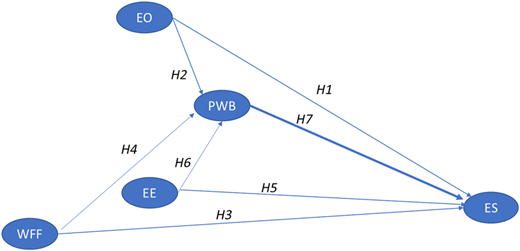
A positive relationship has been found between entrepreneurial orientation and entrepreneurs' psychological well-being (Foo et al., 2009; Hahn et al., 2012), as well as with objective business success (Lumpkin and Dess, 2001; Garcés-Galdeano et al., 2016). In the subjective domain, entrepreneurial orientation is proposed to positively influence job and life satisfaction (Sriprasert, 2013; Manzano-García and Ayala-Calvo, 2020). Therefore, this study hypothesizes the following:

H1.

Entrepreneurial orientation is positively related to entrepreneur satisfaction.

H2.

Entrepreneurial orientation is positively related to the psychological well-being of the entrepreneur.

The work-family fit (WFF) was defined by Grzywacz and Bass (2003) as “the combination of work-family conflict and enrichment”. An owner-manager can experience conflict when their expectations for work-life balance aren't met, or enrichment when they perceive their work positively contributes to their family life. Work-family conflict arises when participation in work and family roles becomes mutually incompatible (Carlson et al., 2000). Previous research has shown that work-family conflict reduces job satisfaction among owner-managers (Kwan et al., 2012), diminishes business success (Shepherd and Haynie, 2009; Cooper et al., 2013), increases emotional exhaustion (Jensen, 2014; Sardeshmukh et al., 2021), and lowers psychological well-being (Matthews et al., 2014). On the other hand, prior studies have also shown that work-family enrichment can enhance the psychological well-being of owner-managers (Rothausen, 2009; Khandelwal and Sehgal, 2018). In family firms, this relationship is unique due to the blurring of boundaries between family and business systems. Rather than a conflict, the family domain often acts as a strategic resource—frequently termed 'familiness'—where family-to-business enrichment fosters a supportive environment that mitigates stress and promotes owner-manager satisfaction (Pascucci et al., 2022; Powell and Eddleston, 2013). As proposed by Ediriweera et al. (2016), to successfully explore the relationship between work-family fit and entrepreneurial success, it would be interesting to use a construct that takes into consideration both work-family conflict and work-family enrichment. Based on this, the following hypotheses are proposed:

H3.

Work-family fit is positively related to entrepreneur satisfaction.

H4.

Work-family fit is positively related to the psychological well-being of the entrepreneur.

Regarding emotional exhaustion, running your own business can be an exciting yet draining experience. The work of owner-managers is associated with endless workdays and significant job demands, which often lead to a high degree of stress (OECD, 2017; Stephan, 2018; Mäkiniemi et al., 2021). According to Sardeshmukh et al. (2021), under these working conditions, it's not surprising that business owner-managers suffer from emotional exhaustion. In employee samples, previous research has shown that emotional exhaustion negatively impacts psychological well-being (Sonnentag and Fritz, 2015) and has been associated with low feelings of job satisfaction and poor work performance (Borritz et al., 2006; Bolton, 2012; Sardeshmukh et al., 2021).

Based on this, our studio proposes the following hypotheses:

H5.

Emotional exhaustion is negatively related to entrepreneur satisfaction.

H6.

Emotional exhaustion is negatively related to the psychological well-being of the entrepreneur.

Psychological well-being (PWB) encompasses concepts like maturity (Allport, 1961), full functionality (Rogers, 1961) and self-actualization (Maslow, 1968). It's a core concept in positive psychology, advocating for the importance of positive emotions in achieving optimal individual functioning (Ryan and Deci, 2001). The role of psychological well-being in explaining employee performance has been extensively studied (Ediriweera et al., 2016). However, there's a dearth of research exploring this relationship in samples of owner-managers (Ediriweera et al., 2016; Wiklund et al., 2019). While Stephan (2018) showed that entrepreneurs with greater psychological well-being led higher-performing companies, only one study measured performance as perceived success (Ayala and Manzano, 2014). Therefore, it's clear there's a need for deeper investigation into the relationship between psychological well-being and the subjective success of entrepreneurs.

As we have previously stated, based on previous research findings, psychological well-being is an outcome of entrepreneurial orientation, emotional exhaustion, and entrepreneurial work-family fit. Pairing this with the argument that psychological well-being directly and positively influences entrepreneur satisfaction, this study proposes that PWB mediates the relationships between the analyzed factors and entrepreneur satisfaction:

H7.

Psychological well-being mediates the relationships between entrepreneurial orientation, work-family fit, and emotional exhaustion with entrepreneur satisfaction.

This research addresses a gap in the literature by examining how entrepreneurial orientation, work-family fit, emotional exhaustion, and psychological well-being jointly contribute to the subjective success of family SMEs. This work makes two main contributions to the field of knowledge. First, drawing on discrepancy theory (Higgins, 1987), we propose using satisfaction as a measure of success, which broadens the current perspective on approaching subjective entrepreneurial success (Park et al., 2025; Pattnaik et al., 2024). According to Cooper and Artz (1995), satisfaction is key to understanding the entrepreneur's subjective success. Second, a multidimensional measure of satisfaction is adopted which, in line with the demands of previous literature (Dijkhuizen et al., 2016; Manzano-García and Ayala-Calvo, 2020), integrates both personal and economic-financial aspects. The present study expands on Manzano-García and Ayala-Calvo's (2020) research on the relationship between entrepreneurial orientation and satisfaction by proposing a comprehensive model where psychological well-being mediates the effect of entrepreneurial orientation, work-family fit, and emotional exhaustion on entrepreneur satisfaction. This holistic approach overcomes the limitations of previous studies by explaining underlying mechanisms and incorporating crucial personal and contextual factors, beyond entrepreneurial orientation, to explain subjective success. Furthermore, methodologically, the application of a time-lag design allows for a more rigorous elucidation of the underlying causal mechanisms.

The study involved 180 entrepreneurs who founded or inherited a private Spanish company more than four years ago. These companies, active in 2020, had 10 to 50 employees. After four years of managing a business, routine management tasks develop, though uncertainties regarding markets, growth policies, and work-life balance persist. A four-year period is deemed sufficient for entrepreneurs to assess satisfaction with their business activities based on their experiences (Manzano-García and Ayala-Calvo, 2020).

The sample was drawn from the database provided by the Instituto de la Empresa Familiar (IEF). This sampling frame is recognized as the gold standard for identifying family firms in Spain, as it follows rigorous classification criteria based on ownership and management participation (Casillas et al., 2024). Recent methodological advances, such as the SAFER methodology, validate the use of IEF directories to capture the heterogeneity of family SMEs, ensuring that the study population strictly adheres to the definition of a family-owned enterprise (Casillas et al., 2024). This sampling frame was specifically chosen to ensure that our entire study population consists of family businesses, allowing for a focused analysis of the unique dynamics, such as the emotional load mentioned by Rovelli et al. (2022), inherent to this type of organization. The database comprises 113,546 firms, 90% of which are owner-managed.

Researchers contacted potential participants via territorial associations, and volunteers were surveyed online in 2021 (March–June) and once more in 2022. Confidentiality was guaranteed. Data collection covered entrepreneurial orientation (T1, March), work-family fit (T2, April), emotional exhaustion (T3, May), and psychological well-being (T4, June). Of 397 entrepreneurs surveyed, 191 (48.1%) provided valid responses. In October 2022 (T5), the same 191 were surveyed about satisfaction, yielding 181 valid responses—sufficient to test the proposed model (Thomson et al., 1995).

A one-year gap was used to avoid significant dropout and because prior studies indicate that entrepreneurial orientation, work-family fit, emotional exhaustion, and psychological well-being remain stable over time (McCrae et al., 2000; Kim et al., 2021; Schaufeli and Salanova, 2011; Davern et al., 2007). Changes in company ownership, growth policies, or family dynamics could affect the study's constructs. To account for this, a 6-item questionnaire assessed significant organizational changes in 2022. Of the 180 respondents, 179 reported no major changes, while one respondent, who indicated changes, was excluded from the study.

By comparing the characteristics of the final sample (180 individuals) with the characteristics of the group of individuals who were lost from 2021 (11 individuals), we observed that there were no significant differences between them. More specifically, we saw that there were no statistically significant differences in gender (1.24 vs. 1.27; t[189] = −0.21, p = 0.83), age (48.84 vs. 50.09; t[189] = −44; p = 0.66), life-partner (1.92 vs. 1.91; t[189] = 0.09; p = 0.93), children (1.38 vs. 1.27; t[189] = 0.35; p = 0.73), years of experience (16.88 vs. 17.83; t[189] = - 0.58, p = 0.56), working hours per week (49.23 vs. 49.27; t[189] = −0.02, p = 0.99), the three components of entrepreneurial orientation [innovativeness (11.73 vs. 11.73; t[189] = 0.01, p = 0.99), risk-taking (11.87 vs. 11.09; t[189] = 1.78, p = 0.08) and proactiveness (11.06 vs. 10.91; t[189] = 0.28, p = 0.78)], the two components of work-family fit [work-family conflict (14.27 vs. 15.82; t[189] = −0.88, p = 0.38) and work-family enrichment (10.82 vs. 11.36; t[189] = −1.87, p = 0.06)], emotional exhaustion (22.86 vs. 20.18; t[189] = 1.34, p = 0.18) and psychological well-being (31.12 vs. 32.45; t[189] + = −1.58, p = 0.12).These results show that there was no response bias. As suggested by Podsakoff et al. (2003), we have made use of Harman's one-factor to test the common method bias. The findings of exploratory factor analysis showed five factors with eigenvalues >1.0, which explained 54,13% of the variance, providing evidence that common method bias was not a problem in this study.

75.6% of the participants in the study were men; 91.7% of the individuals in the sample lived with their significant other. Respondents, on average, were 48.84 years old (SD = 9.41, range 25–73 years), worked 49.23 h/week (SD = 9.32; range 30–70 h/week), had 16.88 years of experience in their current workplace (SD = 10.26; range 2–42 years), and had 1.38 children (SD = 1.04; range 0–3 children). The average number of employees of each firm was 23.14 (SD = 13.64; range 10–50 employees).

Five self-reporting scales have been used to measure the model variables, which means that common method biases can influence our results. Since it has not been possible to obtain data from different sources, to minimize the potential impact of common method variance, we have assessed the predictors and dependent variable at distinct time periods. In addition, based on recommendations from Podsakoff et al. (2003), all participants were anonymous and were requested to answer the questions as honestly as possible because in the survey there was no right or wrong answers.

Entrepreneurial orientation. This study includes 3 dimensions of entrepreneurial orientation (risk-taking; innovativeness and proactiveness). Entrepreneurial orientation was measured using the items proposed by Shan et al. (2016), and was used in its Spanish version by Manzano-García and Ayala-Calvo (2020): 3 items to measure risk-taking (e.g. “I am predisposed to take calculated risks and new ideas”); 3 for innovativeness (e.g. “I am a person predisposed to innovate in the way of doing things in my company”); 3 for proactiveness (e.g. “I consider myself particularly efficient in identifying new opportunities”). We used a Likert-type scale ranging from 1 ″strongly disagree” to 5 ″strongly agree” to identify the extent to which the items defined the characteristics of respondents' entrepreneurial orientation. Cronbach's alpha for each of the scales was: 0.77 for risk-taking, 0.73 for innovativeness, 0.77 for proactiveness, respectively.

Entrepreneur satisfaction. Entrepreneur satisfaction was measured with a construct of 4 dimensions, each of which, following the recommendation of Boes et al. (2010), was measured by a single item. Using single-item indicators for constructs like satisfaction, especially when they're conceptually clear, has been defended and employed in the literature (Bergkvist and Rossiter, 2007; Cheung and Lucas, 2014; Dijkhuizen et al., 2016; Jovanović, 2016; Park et al., 2025; Van Doorn et al., 2013). These items are considered appropriate for capturing an individual's overall evaluation of a specific domain. Studies in organizational psychology and large-scale surveys have shown they can possess comparable criterion validity to longer multi-item scales when the construct is unidimensional and well-defined (e.g. Wanous et al., 1997). Furthermore, this approach minimizes participant cognitive load and response time, which is crucial in the context of longitudinal or time-lag studies with multiple waves of data collection like ours. For a sample of busy professionals such as SME owner-managers, measurement efficiency helps reduce respondent fatigue, which can significantly improve retention rates and the overall quality of data over time. We used the questionnaire proposed by Manzano-García and Ayala-Calvo (2020) that uses a single item to assess satisfaction with entrepreneurial activity (“Compared to my expectations, as of today, I am satisfied with my entrepreneurial activity”), one item to measure satisfaction with life (“Compared to my expectations, as of today, I am satisfied with my life”), one item to measure satisfaction with the organization (“Compared to my expectations, at the present time, I am satisfied with my organization”) and one item to measure satisfaction with the growth of the company (“Compared to my expectations, at the present time, I am satisfied with the growth of my company”). Answer categories range from (1) ''strongly disagree” to (5) “strongly agree”. Cronbach's alpha of the entrepreneur satisfaction construct was 0.78.

Emotional exhaustion. We measured emotional exhaustion using the 5-item measure of the Spanish version of Esteve et al. (2007) (e.g. “Working all day is stressful for me”). Participants responded using a 5-point Likert-type response scale (1 = strongly disagree to 5 = strongly agree). The Cronbach's alpha of the scale was 0.88.

Psychological well-being. We used the Diener et al. (2009) scale, which consists of 8 items (e.g. “I am engaged and interested in my daily activities”). Each item is measured with a Likert-type scale ranging from 1 to 7 where 1 means “strongly disagree” and 7 means “strongly agree”. An owner-manager, fluent in Spanish and English translated the survey. After this translation, five bilingual Spanish owner-managers completed the survey. The owner-managers were then asked to compare the Spanish translation with the English translation. The scale showed an adequate internal consistency (α = 0.86) in Diener et al. (2009). In our research, the instrument achieved a Cronbach's alpha and a composite reliability of 0.72 and 0.82, respectively.

Work-family fit. It was measured using 7 items: 4 items to measure work-family conflict (e.g. “I achieve the right balance between the demands of my professional, personal and family life”) and 3 to measure work-family enrichment (e.g. “When I experience frustrating situations at work, someone in my family tries to understand me”). Each item was measured with a Likert-type scale where 1 is “strongly disagree” and 5 is “strongly agree”. The items used in the study were adapted based on those proposed by Powell and Eddleston (2013) and Kwan et al. (2012). An owner-manager, fluent in Spanish and English translated the survey. After this translation, five bilingual Spanish entrepreneurs completed the survey. The owner-managers were then asked to compare the Spanish translation with the English translation. The Cronbach's alpha for the work-family conflict scale was 0.75 and for the work-family enrichment scale was 0.88.

Control variables. Based on the previous literature on entrepreneur satisfaction (Muniandy, 2017; Manzano-García and Ayala-Calvo, 2020), the control variables considered were: age, education (1 = primary studies; 2 = secondary studies; 3 = university degree), life-partner (with (1) or without (2) a significant other), number of children, years of experience in their current workplace, number of employees and working hours per week.

The study was conducted according to the guidelines of the Declaration of Helsinki, and approved by the Institutional Review Board (or Ethics Committee), protocol code CE-10–2020; October 21, 2020. Informed consent was obtained from all participants for being included in the study.

Prior to evaluating the hypothesised model, we first carried out mean comparison tests in order to check whether entrepreneurial orientation, emotional exhaustion, work-family fit, psychological well-being and entrepreneur satisfaction differ according to education or life-partner. The results showed that there were no significant differences. We then correlated age, number of children, years of experience and working hours per week with entrepreneurial orientation, emotional exhaustion, work-family fit, psychological well-being and entrepreneur satisfaction.

To ensure methodological transparency and minimize the risk of omitted variable bias, we initially evaluated several potential control variables, including age, gender, education, and years of experience. However, preliminary correlation and mean comparison tests revealed no significant relationship between these variables and the core constructs. There were only two statistically significant correlations: working hours per week-emotional exhaustion (r = −0.193; p = 0.009) and working hours per week-entrepreneur satisfaction (r = −0.196; p = 0.008). Consequently, to maintain model parsimony and maximize statistical power in our PLS-SEM analysis (N = 180), we decided to retain only working hours per week (control variable) in further analyses in order to achieve the maximum power for the following tests (Edwards, 2008).

We used partial least squares structural equation modeling (PLS-SEM) to test the hypothesized model (Figure 1). Previous research has advised the use of PLS-SEM when: (1) “The research is an incremental study, which is initially based on a prior model but new measures and structural paths are then introduced into it” (Chin, 2010); (2) the number of observations is small, lower than 250 (Reinartz et al., 2009); (3) the hypothesised model includes constructs of the first and second order, and in the hypothesised relationships they appear direct and mediated effects; (4) the study uses latent variables scores in the subsequent analysis for a predictive relevance (Hair et al., 2011). In order to carry out the PLS analysis, we used Smart PLS 3.0 software.

All constructs have been designed as reflective. Entrepreneurial orientation and work-family fit were designed as multidimensional constructs (second-order constructs). We followed a two-step approach (Chin, 2010) to operationalise the multidimensional superordinate constructs. First, we estimated the scores for each of the first order constructs. Next, we used these scores as observed indicators of the second-order constructs.

Following previously established guidelines (Henseler et al., 2016), the path analysis model was evaluated with the subsequent criteria: the index or normed fit index (NFI) being greater than 0.9, and the standardised root mean square residual (SRMR) being less than 0.08. As it is usual in this type of analysis, the hypotheses included in the model were accepted or rejected on the basis of three criteria: that the value of the R2 of the dependent constructs is greater than 10%, that the standardized path coefficients (β) are statistically significant and that the predictive significance of the model is positive (Q2 statistics obtained by blindfolding above zero). We used bootstrapping (5,000 samples) to generate standard errors and t values of the parameters and the bias-corrected 95% bootstrap confidence intervals.

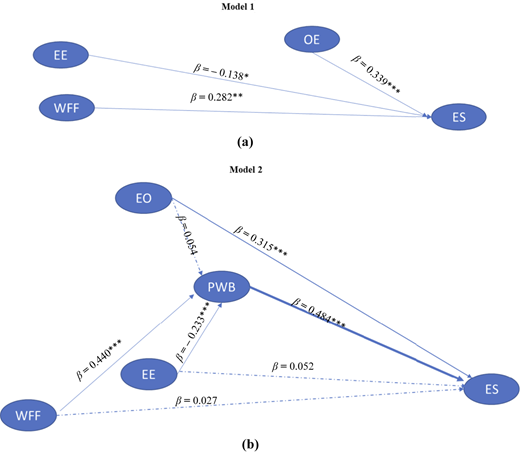
To determine how entrepreneurial orientation, emotional exhaustion and work-family fit influence the explanation of entrepreneur satisfaction, we proceeded in two steps. In the first step (Model 1), we measured the total direct effect of entrepreneurial orientation, emotional exhaustion and work-family fit on entrepreneur satisfaction. In the second step (Model 2), we introduced psychological well-being as a mediator in the relationships of entrepreneurial orientation, emotional exhaustion and work-family fit with entrepreneur satisfaction.

Table 1 presents the means, standard deviations, and correlations for all the variables included in the study.

The main results of the measurement model are presented in Table 2. Based on the Hair et al. (2021) criterion, the items with an individual reliability value below 0.4 were eliminated. The items with an individual reliability above 0.4 and below 0.7 were removed, but only if their removal had a significant effect on the rise of the construct's average variance extracted (AVE). The measurement model, according to the results, is good: a) the individual reliability of each item was sufficient (>0.55); b) the composite reliability of each construct was greater than 0.70; c) the convergent validity of these latent variables, measured using the average variance extracted (AVE), was higher than 0.50. Furthermore, as shown in Table 3, the model displayed discriminant validity: the correlations between the constructs were significantly smaller than the square root of the average variance extracted (the diagonal elements).

Table 4 and Figure 2a show that there is a direct and positive effect of entrepreneurial orientation and work-family fit on entrepreneur satisfaction; and there is a direct and negative effect of emotional exhaustion on entrepreneur satisfaction. When we introduce psychological well-being as a mediator between the relationships of entrepreneurial orientation, emotional exhaustion and work-family fit with entrepreneur satisfaction, the relationships between emotional exhaustion and entrepreneur satisfaction, and work-family fit and entrepreneur satisfaction become non-significant. On the other hand, the relationship between entrepreneurial orientation and psychological well-being was non-significant (Figure 2b). In accordance with Chen and Hung (2016) and Hair et al. (2014), we can say that psychological well-being fully mediates the relationship between emotional exhaustion and entrepreneur satisfaction and also the relationship between work-family fit and entrepreneur satisfaction. The results further showed that there is no indirect effect of entrepreneurial orientation on entrepreneur satisfaction through psychological well-being. Introducing the mediating variable PWB increased the R2 for the ES variable from 0.279 to 0.418. The overall effect size for the mediation effect, calculated as ƒ2 = (R2included − R2excluded)/(1 − R2included), was 0.24. According to Cohen's (1988) criteria, this represents a moderate effect. This suggests that PWB's mediation makes a relevant contribution to explaining ES.

In Figures 1 and 2, for the sake of simplicity, we omitted to draw the control variable. However, paths from the control variable to emotional exhaustion and satisfaction were specified in each one of the steps followed in order to test the hypothetical model.

In model 2, the criteria examined to evaluate the fit of the model were met (SRMR = 0.06; NFI = 0.91), suggesting that this theorised model offers an acceptable representation of the relationships between these variables. R2 for the dependent variables were higher than the cutoff level of 10% (R2 PWB = 0.331, R2 ES = 0.418) Q2 statistics tests (Q2 PWB = 0.259; Q2 ES = 0.220) were also higher than zero, demonstrating the predictive significance of the model.

The primary objective of this study was to examine the roles of entrepreneurial orientation, emotional exhaustion, work-family fit, and psychological well-being in explaining entrepreneur satisfaction within the family SMEs. Our results confirm that for family owner-managers, subjective success is not merely financial; it is a multidimensional construct where satisfaction is deeply linked to the fulfillment of Socioemotional Wealth (SEW) goals, such as maintaining family identity and ensuring firm survival for future generations (Aparicio de Castro et al., 2021). The findings reveal that entrepreneurial orientation and work-family fit positively impact entrepreneur satisfaction, while emotional exhaustion has a negative effect. Notably, no prior research has explored the relationship between entrepreneurial orientation and entrepreneur satisfaction, specifically within family SMEs. Our findings are consistent with Lian and Yen (2017) and Manzano-García and Ayala-Calvo (2020), who demonstrated that entrepreneurial orientation positively affects satisfaction, particularly in small business owner-managers. Extending this line of research, our results indicate that for family owner-managers, Individual Entrepreneurial Orientation (IEO) constitutes a key predictor of long-term sustainability (Bičo and Knezović, 2023). In this context, satisfaction transcends financial performance and is deeply embedded in the preservation of family legacy and the fulfillment of the emotional and affective dimensions associated with socioemotional wealth (SEW) (Radu-Lefebvre et al., 2024; Aparicio de Castro et al., 2021).

As proposed by Ediriweera et al. (2016), work-family fit encompasses two opposing components: work-family conflict and work-family enrichment. This study confirms a direct, significant relationship between work-family fit and entrepreneur satisfaction (H3). Among the sampled entrepreneurs, work-family enrichment appears to outweigh conflict, providing them with greater psychological and physiological resources to manage family and business roles effectively (Obrenovic et al., 2020). In the context of family firms, this 'familiness' resource provides owner-managers with a unique support system that facilitates the integration of business and family life. This enrichment is vital for the preservation of the family legacy, as it allows leaders to view the family not as a source of stress, but as a strategic asset for firm resilience (Pascucci et al., 2022; Radu-Lefebvre et al., 2024). Furthermore, emotional exhaustion negatively influences entrepreneur satisfaction, as hypothesized in H5, supporting prior findings (Schaufeli and Bakker, 2004; Sardeshmukh et al., 2021). Emotionally exhausted owner-managers report reduced enthusiasm, motivation, and depleted emotional reserves, leading to dissatisfaction and unmet expectations (Zhao and Nuangjamnong, 2023).

The results highlight significant effects of emotional exhaustion and work-family fit on entrepreneur satisfaction. However, when psychological well-being is introduced as a mediator, these effects diminish, partially confirming H7. This supports prior research (Drnovšek and Gomezel, 2022), which identifies psychological well-being as a mediator between emotional exhaustion and entrepreneurial success. Interpretation of these findings requires caution, as subjective success—relating expectations to perceived results—differs from objective success, which emphasizes measurable outcomes.

Contrary to H2, this study does not find a direct, significant relationship between entrepreneurial orientation and psychological well-being. This discrepancy with earlier research highlights the need for further investigation into mechanisms linking entrepreneurial orientation to psychological well-being. Sample characteristics and measurement approaches may account for this divergence. Unlike prior studies focusing on employees (Kraus et al., 2019), students (Anwar et al., 2022), or novice entrepreneurs (Shir et al., 2019), this research examines owner-managers with over four years of experience. For this group, the initial phase of “momentum” and the novelty of entrepreneurial orientation may have given way to a different dynamic. It's plausible that, in more mature stages of entrepreneurship, psychological well-being doesn't depend linearly on mere “orientation” toward innovation and proactivity, but rather on more tangible and immediate factors. These could include the perception of success in achieving goals, the ability to manage inherent operational business challenges, or the effectiveness of stress coping strategies. For experienced entrepreneurs, well-being might be more closely tied to the 'execution' and 'results' of their entrepreneurial orientation, rather than the orientation itself.

Our findings also suggest that the relationship between entrepreneurial orientation and psychological well-being could be more complex, potentially operating through mediating mechanisms or being influenced by moderating factors not yet explored in our model. For example, it's conceivable that a high entrepreneurial orientation might push individuals to invest more time and energy. Without proper management, this could deteriorate work-family fit and increase emotional exhaustion. In this sense, concepts like work-family fit and emotional exhaustion could act as mediators, indirectly transmitting the impact of entrepreneurial orientation on psychological well-being, which might mask a direct effect. In addition, factors such as perceived social support, personal entrepreneur resilience, favourable macroeconomic conditions, the institutional environment (Wang et al., 2021), the business life-cycle stage (Lumpkin and Dess, 2001), coping strategies (Baldacchino and Sassetti, 2025), or psychological capital (Mahfud et al., 2020; Tisu et al., 2023), among others, could moderate the relationship, meaning entrepreneurial orientation only leads to greater psychological well-being under specific circumstances. Therefore, the absence of a significant direct effect shouldn't be interpreted as a lack of relationship. Instead, it serves as an invitation for future research to explore these more intricate pathways. A deeper analysis is needed to understand the contextual and personal factors that can modulate the complex interaction between entrepreneurial orientation and psychological well-being in experienced entrepreneur populations, unraveling the potential indirect and conditional effects our study suggests.

Finally, entrepreneurial orientation is analyzed as an individual-level concept rather than firm-level behaviors (Abd Rahman et al., 2016). This study also employs an integrative approach to measure well-being, incorporating both general and work-contextual dimensions (Uy et al., 2017; Wiklund et al., 2019). The control variable analysis reveals noteworthy insights. Weekly working hours positively correlate with emotional exhaustion and negatively with entrepreneur satisfaction. Long work hours impose significant physical and psychological strain, often yielding limited returns. This imbalance heightens emotional fatigue, adversely affecting health and perceived achievement of goals (Omrane et al., 2018).

This study has several limitations. First, while we conducted a rigorous evaluation of potential control variables, ultimately retaining only 'weekly working hours' due to its statistical significance, this parsimonious approach could be viewed as a limitation. The exclusion of other potential control variables, such as the entrepreneur's gender, educational level, age, or the industry sector of the family SMEs, might imply that some of the observed effects are not fully adjusted for these individual or business characteristics. Although our preliminary correlation analysis did not support their inclusion, we cannot entirely rule out that these variables may subtly influence the relationships between our core constructs. Future research could benefit from exploring a broader set of control variables, perhaps employing methodologies that allow for the examination of their potential moderating roles, which could offer an even more nuanced view of the dynamics studied. A second limitation pertains to the sample, which consists of owner-managers of family SMEs in Spain. This focus might limit the generalizability of our findings to other cultural, institutional entrepreneurial or economic contexts. Therefore, future research should replicate this model in different settings. Such cross-cultural studies could explore how different cultural norms regarding work hours or the role of the extended family moderate the relationships observed. Additionally, future research should investigate moderating variables not explored in this model, such as personal resilience, social support, or the specific business life-cycle stage, as these factors could provide a more robust and universal understanding of the factors driving subjective entrepreneurial success. Third, our study did not differentiate between different entrepreneurial entry paths. Future research should explore how the journey into entrepreneurship—whether as a founder starting a business from scratch, a successor inheriting a family firm, or an individual acquiring an existing business—shapes entrepreneur satisfaction. It is plausible that the expectations, challenges, available resources, and pressures differ significantly across these paths.

Despite these limitations, the study presents notable strengths. To the best of our knowledge, it is the first to investigate the combined effects of entrepreneurial orientation, emotional exhaustion, work-family fit, and psychological well-being on subjective success, specifically satisfaction, in owner-managers of family SMEs. Moreover, the study employs a discrepancy theory-based measure of satisfaction, capturing the gap between expectations and outcomes. Its time-lagged design, featuring five data collection points, minimizes potential biases from common method variance (Podsakoff et al., 2003). Although causality cannot be established, this approach rigorously tests the hypothesized relationships.

The findings of this study offer several concrete implications for family firm managers, educational institutions, support organizations, and policymakers, aimed at fostering not just business success, but sustainable entrepreneurial well-being.

Our findings highlight the critical role of psychological well-being. Entrepreneurs must proactively manage stressors and actively seek work-life balance, a challenge that becomes particularly salient in family firms, where the overlap of family and business roles blurs the boundaries between work and private life (Memili et al., 2023). Crucially, business schools must integrate specific, mandatory modules focused on emotional intelligence, stress management, and psychological resilience into entrepreneurship programs. This includes practical training (e.g. mindfulness and setting clear boundaries) to equip founders with tools for entrepreneurial sustainability, ensuring they can maintain their well-being throughout their journey.

Family business support organizations must recognize the critical role of psychological well-being for sustained success. We recommend that family governance structures, such as Family Councils and Family Protocols, explicitly integrate well-being and mental health components. Addressing internal stressors, particularly emotional exhaustion, is essential for effective succession planning; as highlighted by PwC (2025), the absence of generationally diverse governance structures and adequate emotional support can impede innovation and leadership transitions. Consequently, subsidized stress-management workshops tailored to the dual “boss and parent” role (Cooper et al., 2013) are crucial to ensuring that the family system functions as a source of sustainability rather than burnout. This represents a valuable investment in the health of the entire entrepreneurial ecosystem.

Our findings, highlighting the negative relationship between weekly working hours, emotional exhaustion, and entrepreneur satisfaction, carry important implications for public policy. Policymakers must look beyond purely economic incentives and address the human costs of work overload. Governments should explore fiscal incentives or grants to enable entrepreneurs to hire support staff (e.g. administrative assistants) or access affordable childcare. This would facilitate task delegation and better schedule management, thereby reducing pressure and exhaustion. Ultimately, policies should aim to safeguard the well-being of family entrepreneurs, who manage 92.4% of the Spanish business fabric (IEF, 2025). Governments should provide specific grants for family SMEs to professionalize their governance and facilitate task delegation. By protecting the psychological well-being of the founder or successor, public policy not only supports individual health but also ensures the long-term survival of firms that are essential for national economic stability and the preservation of the country's entrepreneurial legacy (IEF, 2025).

This study provides empirical evidence that psychological well-being mediates the relationships between emotional exhaustion, work-family fit, and owner-manager satisfaction in small and medium-sized firms. While further research is needed to explore mechanisms linking entrepreneurial orientation to well-being, these findings highlight critical factors for enhancing entrepreneur satisfaction and success.
Abd Rahman
,
N.H.
,
Md Sahiq
,
A.N.
,
Ismail
,
S.
,
Bakri
,
M.H.
and
Husin
,
A.
(
2016
), “
Antecedents of a successful business venture for young entrepreneurs
”,
Advanced Science Letters
, Vol. 
22
No. 
12
, pp. 
4485
-
4488
, doi: .
Aldrich
,
H.E.
and
Cliff
,
J.E.
(
2003
), “
The pervasive effects of family on entrepreneurship: toward a family embeddedness perspective
”,
Journal of Business Venturing
, Vol. 
18
No. 
5
, pp. 
573
-
596
, doi: .
Allport
,
G.W.
(
1961
),
Pattern and Growth in Personality
,
Holt, Reinhart & Winston
,
Nueva York, NY
.
Anwar
,
I.
,
Thoudam
,
P.
and
Saleem
,
I.
(
2022
), “
Role of entrepreneurial education in shaping entrepreneurial intention among university students: testing the hypotheses using mediation and moderation approach
”,
The Journal of Education for Business
, Vol. 
97
No. 
1
, pp. 
8
-
20
, doi: .
Aparicio de Castro
,
M.G.
,
Iturralde Jainaga
,
T.
,
Ramos Hidalgo
,
E.
and
Casillas
,
J.C.
(
2021
), “
Family business research in the last decade. A bibliometric review
”,
European Journal of Family Business
, Vol. 
11
No. 
1
, doi: ,
available at:
 http://hdl.handle.net/10810/70619
Ayala
,
J.C.
and
Manzano
,
G.
(
2014
), “
The resilience of the entrepreneur. Influence on the success of the business. A longitudinal analysis
”,
Journal of Economic Psychology
, Vol. 
42
, pp. 
126
-
135
, doi: .
Ayrancı
,
A.E.
and
Ayrancı
,
E.
(
2015
), “
A research on job satisfaction factors of private entrepreneurs: the case of Beylikduzu organized industrial zone
”,
Procedia-Social and Behavioral Sciences
, Vol. 
195
, pp. 
268
-
277
, doi: .
Baldacchino
,
L.
and
Sassetti
,
S.
(
2025
), “
The effects of coping strategies on entrepreneurs' psychological well‐being under uncertainty
”,
Strategic Change
, Vol. 
34
No. 
2
, pp. 
253
-
265
, doi: .
Beck
,
T.
,
Demirguc-Kunt
,
A.
and
Levine
,
R.
(
2005
), “
SMEs, growth, and poverty: cross-country evidence
”,
Journal of Economic Growth
, Vol. 
10
No. 
3
, pp. 
199
-
229
, doi: ,
available at:
 https://www.jstor.org/stable/40216076
Bergkvist
,
L.
and
Rossiter
,
J.R.
(
2007
), “
The predictive validity of multiple-item versus single-item measures of the same constructs
”,
Journal of Marketing Research
, Vol. 
44
No. 
2
, pp. 
175
-
184
, doi: .
Bičo
,
A.
and
Knezović
,
E.
(
2023
), “
Assessing the entrepreneurial and intrapreneurial intentions of current and future labor forces: the role of entrepreneurial orientation
”,
European Journal of Management and Business Economics
, Vol. 
34
No. 
3
, pp. 
265
-
281
, doi: .
Blanchflower
,
D.G.
and
Oswald
,
A.
(
2009
), “What makes a young entrepreneur?”, in
Handbook of Youth and Young Adulthood
,
Routledge
, pp. 
204
-
216
.
Boes
,
S.
,
Staub
,
K.
and
Winkelmann
,
R.
(
2010
), “
Relative status and satisfaction
”,
Economics Letters
, Vol. 
109
No. 
3
, pp. 
168
-
170
, doi: .
Bolton
,
D.L.
(
2012
), “
Individual entrepreneurial orientation: further investigation of a measurement instrument
”,
Academy of Entrepreneurship Journal
, Vol. 
54
Nos
2-3
, pp. 
219
-
233
, doi: .
Borritz
,
M.
,
Rugulies
,
R.
,
Bjorner
,
J.B.
,
Villadsen
,
E.
,
Mikkelsen
,
O.A.
and
Kristensen
,
T.S.
(
2006
), “
Burnout among employees in human service work: design and baseline findings of the PUMA study
”,
Scandinavian Journal of Public Health
, Vol. 
34
No. 
1
, pp. 
49
-
58
, doi: .
Carlson
,
D.S.
,
Kacmar
,
K.M.
and
Williams
,
L.J.
(
2000
), “
Construction and initial validation of a multidimensional measure of work–family conflict
”,
Journal of Vocational Behavior
, Vol. 
56
No. 
2
, pp. 
249
-
276
, doi: .
Carree
,
M.A.
and
Verheul
,
I.
(
2012
), “
What makes entrepreneurs happy? Determinants of satisfaction among founders
”,
Journal of Happiness Studies
, Vol. 
13
No. 
2
, pp. 
371
-
387
, doi: .
Casillas
,
J.C.
,
Escribá-Esteve
,
A.
,
Gómez-Miranda
,
M.E.
,
López-Fernández
,
M.C.
,
Lorenzo-Gómez
,
D.
,
Requejo
,
I.
and
Rojo-Ramírez
,
A.A.
(
2024
), “
SAFER methodology: a proposal for the identification of family firms in Spain based on the SABI database
”,
European Journal of Family Business
, Vol. 
14
No. 
1
, pp. 
85
-
97
,
available at:
 https://hdl.handle.net/10550/105197
Chen
,
L.J.
and
Hung
,
H.C.
(
2016
), “
The indirect effect in multiple mediators model by structural equation modeling
”,
European Journal of Business, Economics and Accountancy
, Vol. 
4
No. 
3
, pp. 
36
-
43
.
Cheung
,
F.
and
Lucas
,
R.E.
(
2014
), “
Assessing the validity of single-item life satisfaction measures: results from three large samples
”,
Quality of Life Research
, Vol. 
23
No. 
10
, pp. 
2809
-
2818
, doi: .
Chiao
,
Y.C.
,
Yang
,
K.P.
and
Yu
,
C.M.J.
(
2006
), “
Performance, internationalization, and firm-specific advantages of SMEs in a newly-industrialized economy
”,
Small Business Economics
, Vol. 
26
No. 
5
, pp. 
475
-
492
, doi: ,
available at:
 https://www.jstor.org/stable/40229483
Chin
,
W.W.
(
2010
), “How to write up and report PLS analyses”, in
Vinzi
,
V.E.
,
Chin
,
W.W.
,
Henseler
,
J.
and
Wang
,
H.
(Eds),
Handbook of Partial Least Squares: Concepts, Methods and Applications in Marketing and Related Fields
,
Springer
, pp. 
655
-
690
.
Clark
,
D.R.
,
Pidduck
,
R.J.
,
Lumpkin
,
G.T.
and
Covin
,
J.G.
(
2024
), “
Is it okay to study entrepreneurial orientation (EO) at the individual level? Yes
”,
Entrepreneurship Theory and Practice
, Vol. 
48
No. 
1
, pp. 
349
-
391
, doi: .
Cohen
,
J.
(
1988
),
Statistical Power Analysis for the Behavioural Sciences. Second Edition
,
LEA
,
Hillsdate, NJ
.
Cooper
,
A.C.
and
Artz
,
K.W.
(
1995
), “
Determinants of satisfaction for entrepreneurs
”,
Journal of Business Venturing
, Vol. 
10
No. 
6
, pp. 
439
-
457
, doi: .
Cooper
,
J.T.
,
Kidwell
,
R.E.
and
Eddleston
,
K.A.
(
2013
), “
Boss and parent, employee and child: work‐family roles and deviant behavior in the family firm
”,
Family Relations
, Vol. 
62
No. 
3
, pp. 
457
-
471
, doi: .
Davern
,
M.T.
,
Cummins
,
R.A.
and
Stokes
,
M.A.
(
2007
), “
Subjective well-being as an affective-cognitive construct
”,
Journal of Happiness Studies
, Vol. 
8
No. 
4
, pp. 
429
-
449
, doi: .
Dej
,
D.
(
2010
), “
Defining and measuring entrepreneurial success
”, in
Šera
,
B.
,
Šerychová
,
J.
and
Dej
,
D.
(Eds)
,
Entrepreneurship — A Psychological Approach
,
Dresden University of Technology
,
Dresden
, pp.
89
-
102
.
Diener
,
E.
,
Wirtz
,
D.
,
Biswas-Diener
,
R.
,
Tov
,
W.
,
Kim-Prieto
,
C.
,
Choi
,
D.W.
and
Oishi
,
S.
(
2009
), “New measures of well-being”, in
Assessing Well-Being
,
Springer
,
Dordrecht
, pp. 
247
-
266
, doi: .
Dijkhuizen
,
J.
,
Gorgievski
,
M.
,
van Veldhoven
,
M.
and
Schalk
,
R.
(
2016
), “
Feeling successful as an entrepreneur: a job demands—resources approach
”,
International Entrepreneurship and Management Journal
, Vol. 
12
No. 
2
, pp. 
555
-
573
, doi: .
Drnovšek
,
M.
and
Gomezel
,
A.S.
(
2022
), “
Keep it positive: exploring the relationship between stress, positive affect, wellbeing, and success of entrepreneurs
”,
Frontiers in Psychology
, Vol. 
13
, doi: .
Ediriweera
,
A.
,
Armstrong
,
A.
and
Heenetigala
,
K.
(
2016
), “
Impact of work-family interface on family involvement in business: a review
”,
Kelaniya Journal of Human Resource Management
, Vol. 
11
No. 
2
, p.
87
, doi: .
Edwards
,
J.R.
(
2008
), “
To prosper, organizational psychology should… overcome methodological barriers to progress
”,
Journal of Organizational Behavior: The International Journal of Industrial, Occupational and Organizational Psychology and Behavior
, Vol. 
29
No. 
4
, pp. 
469
-
491
, doi: .
Edwards-Schachter
,
M.
,
García-Granero
,
A.
,
Sánchez-Barrioluengo
,
M.
,
Quesada-Pineda
,
H.
and
Amara
,
N.
(
2015
), “
Disentangling competences: interrelationships on creativity, innovation and entrepreneurship
”,
Thinking Skills and Creativity
, Vol. 
16
, pp. 
27
-
39
, doi: .
Esteve
,
E.B.
,
Salanova
,
M.
,
Schaufeli
,
W.
and
Nogareda
,
C.
(
2007
), “
NTP 732: Síndrome de estar quemado por el trabajo ‘Burnout’(III): Instrumento de medición [Burnout Syndrome (III): Measurement Instrument] Obtenido de
”,
available at:
 http://www.prlsectoreducativo.es/documentos/documentacion/bibliiograf
EY Insights
(
2025
),
El impacto económico de las empresas familiares: Global 500 Family Business Index 2025, Resumen Ejecutivo España
,
Ernst & Young
,
Madrid
.
Fisher
,
R.
,
Maritz
,
A.
and
Lobo
,
A.
(
2014
), “
Evaluating entrepreneurs’ perception of success: development of a measurement scale
”,
International Journal of Entrepreneurial Behavior and Research
, Vol. 
20
No. 
5
, pp. 
478
-
492
, doi: .
Foo
,
M.-D.
,
Uy
,
M.A.
and
Baron
,
R.A.
(
2009
), “
How do feelings influence effort? An empirical study of entrepreneurs’ affect and venture effort
”,
Journal of Applied Psychology
, Vol. 
94
No. 
4
, pp. 
1086
-
1094
, doi: .
Garcés-Galdeano
,
L.
,
Larraza-Kintana
,
M.
,
García-Olaverri
,
C.
and
Makri
,
M.
(
2016
), “
Entrepreneurial orientation in family firms: the moderating role of technological intensity and performance
”,
International Entrepreneurship and Management Journal
, Vol. 
12
No. 
1
, pp. 
27
-
45
, doi: .
Grzywacz
,
J.G.
and
Bass
,
B.L.
(
2003
), “
Work, family, and mental health: testing different models of work‐family fit
”,
Journal of Marriage and Family
, Vol. 
65
No. 
1
, pp. 
248
-
262
, doi: .
Hahn
,
V.C.
,
Frese
,
M.
,
Binnewies
,
C.
and
Schmitt
,
A.
(
2012
), “
Happy and proactive? The role of hedonic and eudaimonic well–being in business owners' personal initiative
”,
Entrepreneurship theory and practice
, Vol. 
36
No. 
1
, pp. 
97
-
114
, doi: .
Hair
,
J.F.
,
Ringle
,
C.M.
and
Sarstedt
,
M.
(
2011
), “
PLS-SEM: indeed a silver bullet
”,
Journal of Marketing Theory and Practice
, Vol. 
19
No. 
2
, pp. 
139
-
151
, doi: .
Hair
,
J.F.
,
Hult
,
G.T.M.
,
Ringle
,
C.M.
and
Sarstedt
,
M.
(
2014
),
A Primer on Partial Least Squares Structural Equation Modeling (PLS-SEM)
,
Sage
,
Thousand Oaks, CA
.
Hair
,
J.F.
,
Hult
,
G.T.M.
,
Ringle
,
C.M.
,
Sarstedt
,
M.
,
Danks
,
N.P.
and
Ray
,
S.
(
2021
),
Partial Least Squares Structural Equation Modeling (PLS-SEM) Using R
,
Springer International Publishing
, doi: .
Henseler
,
J.
,
Hubona
,
G.
and
Ray
,
P.A.
(
2016
), “
Using PLS path modeling in new technology research: updated guidelines
”,
Industrial Management & Data Systems
, Vol. 
116
No. 
1
, pp. 
2
-
20
, doi: .
Higgins
,
E.T.
(
1987
), “
Self-discrepancy: a theory relating self and affect
”,
Psychological Review
, Vol. 
94
No. 
3
, pp. 
319
-
340
, doi: .
Instituto de la Empresa Familiar (IEF)
(
2025
), “
Relevancia y supervivencia de la empresa familiar: la empresa familiar en españa 2025
”.
Janssen
,
O.
and
Van Yperen
,
N.W.
(
2004
), “
Employees' goal orientations, the quality of leader-member exchange, and the outcomes of job performance and job satisfaction
”,
Academy of Management Journal
, Vol. 
47
No. 
3
, pp. 
368
-
384
, doi: .
Jensen
,
M.T.
(
2014
), “
Exploring business travel with work–family conflict and the emotional exhaustion component of burnout as outcome variables: the job demands–resources perspective
”,
European Journal of Work and Organizational Psychology
, Vol. 
23
No. 
4
, pp. 
497
-
510
, doi: .
Jovanović
,
V.
(
2016
), “
The validity of the satisfaction with Life Scale in adolescents and a comparison with single-item life satisfaction measures: a preliminary study
”,
Quality of Life Research
, Vol. 
25
No. 
12
, pp. 
3173
-
3180
, doi: .
Khandelwal
,
P.
and
Sehgal
,
A.
(
2018
), “
Exploring work-family interface for Indian women entrepreneurs
”,
Gender in Management
, Vol. 
33
No. 
1
, pp. 
23
-
32
, doi: .
Kim
,
S.Y.
,
Shigemoto
,
Y.
,
Neduvelil
,
A.
and
Grzywacz
,
J.G.
(
2021
), “
Longitudinal stability of work–family enrichment and its association with well-being and personality traits
”,
The Counseling Psychologist
, Vol. 
49
No. 
6
, pp. 
907
-
939
, doi: .
Koe
,
W.L.
(
2016
), “
The relationship between individual entrepreneurial orientation (IEO) and entrepreneurial intention
”,
Journal of Global Entrepreneurship Research
, Vol. 
6
, pp. 
1
-
11
, doi: .
Kraus
,
S.
,
Breier
,
M.
,
Jones
,
P.
and
Hughes
,
M.
(
2019
), “
Individual entrepreneurial orientation and intrapreneurship in the public sector
”,
International Entrepreneurship and Management Journal
, Vol. 
15
, pp.
1247
-
1268
, doi: .
Krauss
,
S.I.
,
Frese
,
M.
,
Friedrich
,
C.
and
Unger
,
J.M.
(
2005
), “
Entrepreneurial orientation: a psychological model of success among southern African small business owners
”,
European Journal of Work and Organizational Psychology
, Vol. 
14
No. 
3
, pp. 
315
-
344
, doi: .
Krueger
,
N.F.
(
2009
), “Entrepreneurial intentions are dead: long live entrepreneurial intentions”, in
Carsrud
,
A.L.
and
Brännback
,
M.
(Eds),
Understanding the Entrepreneurial Mind
,
Springer
, pp. 
51
-
72
, doi: .
Kwan
,
H.K.
,
Lau
,
V.P.
and
Au
,
K.
(
2012
), “
Effects of family-to-work conflict on business owners: the role of family business
”,
Family Business Review
, Vol. 
25
No. 
2
, pp. 
178
-
190
, doi: .
Lian
,
J.W.
and
Yen
,
D.C.
(
2017
), “
Understanding the relationships between online entrepreneurs' personal innovativeness, risk taking, and satisfaction: comparison of pure-play and click-and-mortar
”,
Journal of Organizational Computing and Electronic Commerce
, Vol. 
27
No. 
2
, pp. 
135
-
151
, doi: .
Lloret
,
J.T.
(
2017
), “
Empresa familiar: algunos mitos [Family business: some myths]
”,
Harvard Deusto Business Review
, No. 
272
, pp. 
26
-
35
,
available at:
 http://rightsstatements.org/vocab/InC/1.0/
Lumpkin
,
G.T.
and
Dess
,
G.G.
(
2001
), “
Linking two dimensions of entrepreneurial orientation to firm performance: the moderating role of environment and industry life cycle
”,
Journal of Business Venturing
, Vol. 
16
No. 
5
, pp. 
429
-
451
, doi: .
Mahfud
,
T.
,
Triyono
,
M.B.
,
Sudira
,
P.
and
Mulyani
,
Y.
(
2020
), “
The influence of social capital and entrepreneurial attitude orientation on entrepreneurial intentions: the mediating role of psychological capital
”,
European Research on Management and Business Economics
, Vol. 
26
No. 
1
, pp. 
33
-
39
, doi: .
Mäkiniemi
,
J.P.
,
Ahola
,
S.
,
Nuutinen
,
S.
,
Laitinen
,
J.
and
Oksanen
,
T.
(
2021
), “
Factors associated with job burnout, job satisfaction and work engagement among entrepreneurs. A systematic qualitative review
”,
Journal of Small Business and Entrepreneurship
, Vol. 
33
No. 
2
, pp. 
219
-
247
, doi: .
Manzano-García
,
G.
and
Ayala-Calvo
,
J.C.
(
2020
), “
Entrepreneurial orientation: its relationship with the entrepreneur's subjective success in SMEs
”,
Sustainability
, Vol. 
12
No. 
11
, 4547, doi: .
Maslow
,
A.H.
(
1968
),
Toward a Psychology of Being
,
Van Norstrand
,
New York
.
Matthews
,
R.A.
,
Wayne
,
J.H.
and
Ford
,
M.T.
(
2014
), “
A work–family conflict/subjective well-being process model: a test of competing theories of longitudinal effects
”,
Journal of Applied Psychology
, Vol. 
99
No. 
6
, pp. 
1173
-
1187
, doi: .
McCrae
,
R.R.
,
Costa
,
P.T.
, Jr
,
Ostendorf
,
F.
,
Angleitner
,
A.
,
Hrebícková
,
M.
,
Avia
,
M.D.
,
Sanz
,
J.
,
Sánchez-Bernardos
,
M.L.
,
Kusdil
,
M.E.
,
Woodfield
,
R.
,
Saunders
,
P.R.
and
Smith
,
P.B.
(
2000
), “
Nature over nurture: temperament, personality, and life span development
”,
Journal of Personality and Social Psychology
, Vol. 
78
No. 
1
, pp. 
173
-
186
, doi: .
Memili
,
E.
,
Patel
,
P.C.
,
Holt
,
D.T.
and
Swab
,
R.G.
(
2023
), “
Family-friendly work practices in family firms: a study investigating job satisfaction
”,
Journal of Business Research
, Vol. 
164
, 114023, doi: .
Mory
,
E.D.C.
,
Ángeles
,
R.M.F.
,
Linares
,
S.V.
,
Eleta
,
A.A.
and
Agarwala
,
T.
(
2011
), “
Balance trabajo-familia: Cultura, nivel de conflicto y voluntad de permanencia en la empresa [Family-work balance: culture, level of conflict and willingness to stay in the company]
”,
Journal of Business, Universidad del Pacífico (Lima, Peru)
, Vol. 
3
No. 
1
, pp. 
3
-
14
, doi: .
Muniandy
,
J.
(
2017
), “
An investigation on English teachers' psychological well-being and their job satisfaction
”,
International Journal of Novel Research in Humanity and Social Sciences
, Vol. 
4
No. 
2
, pp. 
20
-
31
, doi: .
Obrenovic
,
B.
,
Jianguo
,
D.
,
Khudaykulov
,
A.
and
Khan
,
M.A.S.
(
2020
), “
Work-family conflict impact on psychological safety and psychological well-being: a job performance model
”,
Frontiers in Psychology
, Vol. 
11
, 475, doi: .
OECD
(
2017
),
The Missing Entrepreneurs 2017: Policies for Inclusive Entrepreneurship
,
OECD Publishing
,
Paris
, doi: .
Omrane
,
A.
,
Kammoun
,
A.
and
Seaman
,
C.
(
2018
), “
Entrepreneurial burnout: causes, consequences and way out
”,
FIIB Business Review
, Vol. 
7
No. 
1
, pp. 
28
-
42
, doi: .
Park
,
B.
,
Lee
,
H.-H.
,
Park
,
S.R.
and
Kim
,
D.G.
(
2025
), “
Pathways to entrepreneurial satisfaction: unpacking the contributions of self-leadership, self-efficacy, and customer interaction in Korean startups
”,
Sage Open
, Vol. 
15
No. 
1
, doi: .
Pascucci
,
T.
,
Hernández Sánchez
,
B.
and
Sánchez García
,
J.C.
(
2022
), “
Being stressed in the family or married with work? A literature review and clustering of work-family conflict
”,
European Journal of Management and Business Economics
, Vol. 
31
No. 
2
, pp. 
239
-
265
, doi: .
Pattnaik
,
S.
,
Mmbaga
,
N.
,
White
,
T.D.
and
Reger
,
R.K.
(
2024
), “
To entrepreneur or not to entrepreneur? How identity discrepancies influence enthusiasm for academic entrepreneurship
”,
The Journal of Technology Transfer
, Vol. 
49
No. 
4
, pp. 
1444
-
1470
, doi: .
Pérez
,
P.F.
and
Colli
,
A.
(
2013
),
The Endurance of Family Businesses: A Global Overview
,
Cambridge University Press
,
Cambridge
.
Podsakoff
,
P.M.
,
MacKenzie
,
S.B.
,
Lee
,
Y.
and
Podsakoff
,
N.P.
(
2003
), “
Common method biases in behavioural research: a critical review of the literature and recommended remedies
”,
Journal of Applied Psychology
, Vol. 
88
No. 
5
, pp. 
879
-
903
, doi: .
Powell
,
G.N.
and
Eddleston
,
K.A.
(
2013
), “
Linking family-to-business enrichment and support to entrepreneurial success: do female and male entrepreneurs experience different outcomes?
”,
Journal of Business Venturing
, Vol. 
28
No. 
2
, pp. 
261
-
280
, doi: .
Poza
,
E.J.
,
Hanlon
,
S.
and
Kishida
,
R.
(
2004
), “
Does the family business interaction factor represent a resource or a cost?
”,
Family Business Review
, Vol. 
17
No. 
2
, pp. 
99
-
118
, doi: .
PwC
(
2025
),
PwC’s 12th Family Business Survey: Reclaiming Advantage. Report in collaboration with Northwestern Kellogg
,
PwC
,
London
.
Radu-Lefebvre
,
M.
,
Davis
,
J.H.
and
Gartner
,
W.B.
(
2024
), “
Legacy in family business: a systematic literature review and future research agenda
”,
Family Business Review
, Vol. 
37
No. 
1
, pp. 
18
-
59
, doi: .
Reinartz
,
W.
,
Haenlein
,
M.
and
Henseler
,
J.
(
2009
), “
An empirical comparison of the efficacy of covariance-based and variance-based SEM
”,
International Journal of Research in Marketing
, Vol. 
26
No. 
4
, pp. 
332
-
344
, doi: .
Rogers
,
C.R.
(
1961
),
On Becoming a Person: A Therapist’s View of Psychotherapy
,
Houghton Mifflin
,
Boston, MA
.
Rothausen
,
T.J.
(
2009
), “
Management work—family research and work—family fit: implications for building family capital in family business
”,
Family Business Review
, Vol. 
22
No. 
3
, pp. 
220
-
234
, doi: .
Rovelli
,
P.
,
Ferasso
,
M.
,
De Massis
,
A.
and
Kraus
,
S.
(
2022
), “
Thirty years of research in family business journals: status quo and future directions
”,
Journal of Family Business Strategy
, Vol. 
13
No. 
3
, 100422, doi: .
Ryan
,
R.M.
and
Deci
,
E.L.
(
2001
), “
On happiness and human potentials: a review of research on hedonic and eudaimonic well-being
”,
Annual Review of Psychology
, Vol. 
52
No. 
1
, pp. 
141
-
166
, doi: .
Sardeshmukh
,
S.R.
,
Goldsby
,
M.
and
Smith
,
R.M.
(
2021
), “
Are work stressors and emotional exhaustion driving exit intentions among business owners?
”,
Journal of Small Business Management
, Vol. 
59
No. 
4
, pp. 
544
-
574
, doi: .
Schaufeli
,
W.B.
and
Bakker
,
A.B.
(
2004
), “
Job demands, job resources, and their relationship with burnout and engagement: a multi‐sample study
”,
Journal of Organizational Behavior the International Journal of Industrial, Occupational and Organizational Psychology and Behavior
, Vol. 
25
No. 
3
, pp. 
293
-
315
, doi: .
Schaufeli
,
W.
and
Salanova
,
M.
(
2011
), “
Work engagement: on how to better catch a slippery concept
”,
European Journal of Work and Organizational Psychology
, Vol. 
20
No. 
1
, pp. 
39
-
46
, doi: .
Shan
,
P.
,
Song
,
M.
and
Ju
,
X.
(
2016
), “
Entrepreneurial orientation and performance: is innovation speed a missing link?
”,
Journal of Business Research
, Vol. 
69
No. 
2
, pp. 
683
-
690
, doi: .
Shepherd
,
D.
and
Haynie
,
J.M.
(
2009
), “
Family business, identity conflict, and an expedited entrepreneurial process: a process of resolving identity conflict
”,
Entrepreneurship Theory and Practice
, Vol. 
33
No. 
6
, pp. 
1245
-
1264
, doi: .
Shir
,
N.
,
Nikolaev
,
B.
and
Wincent
,
J.
(
2019
), “
Entrepreneurship and well-being: the role of psychological autonomy, competence, and relatedness
”,
Journal of Business Venturing
, Vol. 
34
No. 
5
, 105875, doi: .
Sonnentag
,
S.
and
Fritz
,
C.
(
2015
), “
Recovery from job stress: the stressor‐detachment model as an integrative framework
”,
Journal of Organizational Behavior
, Vol. 
36
No. 
S1
, pp. 
S72
-
S103
, doi: .
Sriprasert
,
P.
(
2013
), “
The effect of entrepreneurial orientation on the success of community enterprise: a study of nakhonsithammarat, Thailand
”,
International Proceedings of Economics
, Vol. 
59
No. 
33
, pp. 
158
-
162
.
Stephan
,
U.
(
2018
), “
Entrepreneurs' mental health and well-being: a review and research agenda
”,
Academy of Management Perspectives
, Vol. 
32
No. 
3
, pp. 
290
-
322
, doi: .
Stephan
,
U.
,
Rauch
,
A.
and
Hatak
,
I.
(
2023
), “
Happy entrepreneurs? Everywhere? A meta-analysis of entrepreneurship and wellbeing
”,
Entrepreneurship Theory and Practice
, Vol. 
47
No. 
2
, pp. 
553
-
593
, doi: .
Thomson
,
R.
,
Barclay
,
D.W.
and
Higgins
,
C.A.
(
1995
), “
The partial least squares approach to causal modeling: personal computer adoption and use as an illustration
”,
Technology Studies: Special Issue on Research Methodology
, Vol. 
2
No. 
2
, pp. 
284
-
324
.
Tisu
,
L.
,
Vîrgă
,
D.
and
Taris
,
T.
(
2023
), “
Entrepreneurial well-being and performance: antecedents and mediators
”,
Frontiers in Psychology
, Vol. 
14
, 1112397, doi: .
Uy
,
M.A.
,
Sun
,
S.
and
Foo
,
M.-D.
(
2017
), “
Affect spin, entrepreneurs' well-being, and venture goal progress: the moderating role of goal orientation
”,
Journal of Business Venturing
, Vol. 
32
No. 
4
, pp. 
443
-
460
, doi: .
Van Doorn
,
J.
,
Leeflang
,
P.S.
and
Tijs
,
M.
(
2013
), “
Satisfaction as a predictor of future performance: a replication
”,
International Journal of Research in Marketing
, Vol. 
30
No. 
3
, pp. 
314
-
318
, doi: .
Wach
,
D.
,
Stephan
,
U.
,
Weinberger
,
E.
and
Wegge
,
J.
(
2021
), “
Entrepreneurs' stressors and well-being: a recovery perspective and diary study
”,
Journal of Business Venturing
, Vol. 
36
No. 
5
, 106016, doi: .
Wang
,
L.
,
Ali
,
M.
,
Kim
,
H.J.
,
Lee
,
S.
and
Hernandez Perlines
,
F.
(
2021
), “
Individual entrepreneurial orientation, value congruence, and individual outcomes: does the institutional entrepreneurial environment matter?
”,
Business Strategy and the Environment
, Vol. 
30
No. 
5
, pp. 
2293
-
2312
, doi: .
Wanous
,
J.P.
,
Reichers
,
A.E.
and
Hudy
,
M.J.
(
1997
), “
Overall job satisfaction: how good are single-item measures?
”,
Journal of Applied Psychology
, Vol. 
82
No. 
2
, pp. 
247
-
252
, doi: .
Wei
,
X.
,
Cang
,
S.
and
Hisrich
,
R.D.
(
2015
), “
Entrepreneurial stressors as predictors of entrepreneurial burnout
”,
Psychological Reports
, Vol. 
116
No. 
1
, pp. 
74
-
88
, doi: .
Wiklund
,
J.
,
Nikolaev
,
B.
,
Shir
,
N.
,
Foo
,
M.D.
and
Bradley
,
S.
(
2019
), “
Entrepreneurship and well-being: past, present, and future
”,
Journal of Business Venturing
, Vol. 
34
No. 
4
, pp. 
579
-
588
, doi: .
Williamson
,
A.J.
,
Gish
,
J.J.
and
Stephan
,
U.
(
2021
), “
Let's focus on solutions to entrepreneurial ill-being! Recovery interventions to enhance entrepreneurial well-being
”,
Entrepreneurship Theory and Practice
, Vol. 
45
No. 
6
, pp. 
1307
-
1338
, doi: .
Wright
,
T.A.
and
Bonett
,
D.G.
(
2007
), “
Job satisfaction and psychological well-being as nonadditive predictors of workplace turnover
”,
Journal of Management
, Vol. 
33
No. 
2
, pp. 
141
-
160
, doi: .
Zhao
,
W.
and
Nuangjamnong
,
C.
(
2023
), “
The effects of work-family conflict, emotional exhaustion, job performance on job satisfaction and (emotional) affective commitment among small business in China
”,
International Journal of Social Sciences and Humanities Invention
, Vol. 
10
No. 
1
, pp. 
7660
-
7685
, doi: .
Miller
,
D.
(
2011
), “
Miller (1983) revisited: a reflection on EO research and some suggestions for the future
”,
Entrepreneurship Theory and Practice
, Vol. 
35
No. 
5
, pp. 
873
-
894
, doi: .
Published in European Journal of Management and Business Economics. Published by Emerald Publishing Limited. This article is published under the Creative Commons Attribution (CC BY 4.0) licence. Anyone may reproduce, distribute, translate and create derivative works of this article (for both commercial and non commercial purposes), subject to full attribution to the original publication and authors. The full terms of this licence may be seen at Link to the terms of the CC BY 4.0 licence.

Data & Figures

Figure 1
A conceptual model shows E O, W F F, and E E influencing P W B and E S with labeled hypotheses.The conceptual model shows oval nodes connected by directional arrows labeled with hypotheses. At the top center, an oval labeled “E O” is positioned. From “E O”, an arrow labeled “H 1” extends diagonally toward the rightmost oval labeled “E S”. A second downward arrow labeled “H 2” points from “E O” to a central oval labeled “P W B”. At the bottom left, an oval labeled “W F F” is positioned. From “W F F”, an arrow labeled “H 3” points directly to “E S”. Another upward diagonal arrow labeled “H 4” points from “W F F” to “P W B”. Slightly above “W F F” and left of center, an oval labeled “E E” is positioned. From “E E”, an arrow labeled “H 5” points toward “E S”. Another upward arrow labeled “H 6” points from “E E” to “P W B”. From the central oval “P W B”, a rightward arrow labeled “H 7” points to “E S”.

Research model

Figure 1
A conceptual model shows E O, W F F, and E E influencing P W B and E S with labeled hypotheses.The conceptual model shows oval nodes connected by directional arrows labeled with hypotheses. At the top center, an oval labeled “E O” is positioned. From “E O”, an arrow labeled “H 1” extends diagonally toward the rightmost oval labeled “E S”. A second downward arrow labeled “H 2” points from “E O” to a central oval labeled “P W B”. At the bottom left, an oval labeled “W F F” is positioned. From “W F F”, an arrow labeled “H 3” points directly to “E S”. Another upward diagonal arrow labeled “H 4” points from “W F F” to “P W B”. Slightly above “W F F” and left of center, an oval labeled “E E” is positioned. From “E E”, an arrow labeled “H 5” points toward “E S”. Another upward arrow labeled “H 6” points from “E E” to “P W B”. From the central oval “P W B”, a rightward arrow labeled “H 7” points to “E S”.

Research model

Close Figure 1
Figure 2
Two conceptual models link E E, W F F, O E, E O, and P W B to E S with coefficients and dashed and solid arrows.In the top model, three ovals labeled “E E”, “W F F”, and “O E” are positioned on the left and upper right, with a single oval labeled “E S” on the right. A horizontal arrow from “E E” to “E S” is labeled “beta equals negative 0.138 asterisk”. A horizontal arrow from “W F F” to “E S” is labeled “beta equals 0.282 double asterisk”. A downward arrow from “O E” to “E S” is labeled “beta equals 0.339 triple asterisk”. In the lower model, an oval labeled “E O” is positioned at the upper left, an oval labeled “W F F” at the lower left, an oval labeled “E E” slightly above “W F F”, a central oval labeled “P W B”, and a rightmost oval labeled “E S”. A dashed arrow from “E O” to “P W B” is labeled “beta equals 0.054”. A solid arrow from “E O” to “E S” is labeled “beta equals 0.315 triple asterisk”. A solid arrow from “W F F” to “P W B” is labeled “beta equals 0.440 triple asterisk”. A dashed arrow from “W F F” to “E S” is labeled “beta equals 0.027”. A solid arrow from “E E” to “P W B” is labeled “beta equals negative 0.233 triple asterisk”. A dashed arrow from “E E” to “E S” is labeled “beta equals 0.052”. From the central oval “P W B”, a solid arrow extends to “E S” labeled “beta equals 0.484 triple asterisk”.

Summary of the test of the indirect effect of the proposed model

Figure 2
Two conceptual models link E E, W F F, O E, E O, and P W B to E S with coefficients and dashed and solid arrows.In the top model, three ovals labeled “E E”, “W F F”, and “O E” are positioned on the left and upper right, with a single oval labeled “E S” on the right. A horizontal arrow from “E E” to “E S” is labeled “beta equals negative 0.138 asterisk”. A horizontal arrow from “W F F” to “E S” is labeled “beta equals 0.282 double asterisk”. A downward arrow from “O E” to “E S” is labeled “beta equals 0.339 triple asterisk”. In the lower model, an oval labeled “E O” is positioned at the upper left, an oval labeled “W F F” at the lower left, an oval labeled “E E” slightly above “W F F”, a central oval labeled “P W B”, and a rightmost oval labeled “E S”. A dashed arrow from “E O” to “P W B” is labeled “beta equals 0.054”. A solid arrow from “E O” to “E S” is labeled “beta equals 0.315 triple asterisk”. A solid arrow from “W F F” to “P W B” is labeled “beta equals 0.440 triple asterisk”. A dashed arrow from “W F F” to “E S” is labeled “beta equals 0.027”. A solid arrow from “E E” to “P W B” is labeled “beta equals negative 0.233 triple asterisk”. A dashed arrow from “E E” to “E S” is labeled “beta equals 0.052”. From the central oval “P W B”, a solid arrow extends to “E S” labeled “beta equals 0.484 triple asterisk”.

Summary of the test of the indirect effect of the proposed model

Close Figure 2
Table 1

Means, standard deviations, and correlations

MSD123456789101112
1.-Age48.849.411           
2.- Education2.490.64−0.208**1          
3.- Life-partner1.920.28−0.0760.0111         
4.- Children1.381.04−0.101−0.0990.364**1        
5.- Years of experience16.8810.260.629**−0.270**−0.041−0.0091       
6.- Employees23.1413.640.0720.0310.117−0.026−0.1351      
7.- Hours worked weekly49.239.32−0.143−0.155*−0.058−0.1080.181*−0.0921     
8.- Entrepreneur orientation34.663.67−0.054−0.0620.0270.011−0.1120.0040.0751    
9.- Work-family fit25.083.840.134−0.0510.064−0.1440.1260.050−0.0170.254**1   
10.- Emotional exhaustion14.264.470.139−0.087−0.105−0.1380.132−0.0240.193**0.048−0.289**1  
11.- Psychological well-being31.122.74−0.0240.0010.135−0.050−0.0050.078−0.1100.1660.529**−0.341**1 
12.- Entrepreneur's satisfaction14.902.19−0.0700.0660.139−0.049−0.1250.077−0.196**0.354**0.274**−0.176*0.561**1

Note(s): N = 180; **p < 0.01, *p < 0.05

Table 2

Measurement model: loadings, construct reliability and convergent validity

Construct/dimension/indicatorLoadingComposite reliabilityAVE
Entrepreneurial orientation 0.8110.598
Risk Taking0.548  
Innovativeness0.867  
Proactiveness0.862  
Emotional Exaustion (EE) 0.9120.676
EE10.864  
EE20.738  
EE30.858  
EE40.802  
EE50.840  
Work-family fit 0.7830.644
Work-family conflicto (WFC)0.750  
Work-family enrichment (WFE)0.852  
Psychological well-being (PWB) 0.8240.543
PWB10.831  
PWB20.710  
PWB30.806  
PWB40.573  
Entrepreneur's satisfaction 0.8570.601
Satisfaction with the entrepreneurial activity (SEA)0.820  
Satisfaction with the growth (SG)0.703  
Satisfaction with the organization (SO)0.761  
Satisfaction with life (SL)0.809  
Table 3

Measurement model: discriminant validity

Variable12345
1.- Entrepreneurial orientation (EO)(0.773)    
2.- Work-family fit (WFF)0.250**(0.803)   
3.- Emotional Exhaustion (EE)0.063−0.342**(0.822)  
4.- Psychological well-being (PWB)0.1490.534**−0.380**(0.737) 
5.- Entrepreneur's satisfaction (ES)0.386**0.367**−0.174*0.553**(0.775)

Note(s): Square root of Average Variance Extracted (AVE) are presented in parentheses along the diagonal. Off-diagonal elements are the correlations among constructs. ** significant at p < 0.01, * significant at p < 0.05

Table 4

Structural model results: summary of direct effects

RelationshipsModel 1Model 2
 R2 ES = 0.279R2 PWB = 0.331
Q2 PWB = 0.259
Q2 ES = 0.234R2 ES = 0.418
Q2 ES = 0.220
HWS → ES−0.165 (0.003)−0.140 (0.019)
HWS → EE0.211 (0.004)0.199 (0.010)
E0 → ES0.339 (0.000)0.315 (0.000)
EE → ES−0.138 (0.041)0.052 (0.402)
WFF → ES0.282 (0.001)0.027 (0.703)
EO → PWB 0.054 (0.367)
EE → PWB −0.233 (000)
WFF → PWB 0.440 (000)
PWB → ES 0.484 (0.000)

Note(s): HWS = hours worked weekly, EO = Entrepreneurial orientation; EE = Emotional exhaustion; WFF = Work-family fit; PWB = Psychological well-being; ES = Entrepreneur's satisfaction. Los p valores de los coeficientes β se presentan entre paréntesis

Supplements

References

Abd Rahman
,
N.H.
,
Md Sahiq
,
A.N.
,
Ismail
,
S.
,
Bakri
,
M.H.
and
Husin
,
A.
(
2016
), “
Antecedents of a successful business venture for young entrepreneurs
”,
Advanced Science Letters
, Vol. 
22
No. 
12
, pp. 
4485
-
4488
, doi: .
Aldrich
,
H.E.
and
Cliff
,
J.E.
(
2003
), “
The pervasive effects of family on entrepreneurship: toward a family embeddedness perspective
”,
Journal of Business Venturing
, Vol. 
18
No. 
5
, pp. 
573
-
596
, doi: .
Allport
,
G.W.
(
1961
),
Pattern and Growth in Personality
,
Holt, Reinhart & Winston
,
Nueva York, NY
.
Anwar
,
I.
,
Thoudam
,
P.
and
Saleem
,
I.
(
2022
), “
Role of entrepreneurial education in shaping entrepreneurial intention among university students: testing the hypotheses using mediation and moderation approach
”,
The Journal of Education for Business
, Vol. 
97
No. 
1
, pp. 
8
-
20
, doi: .
Aparicio de Castro
,
M.G.
,
Iturralde Jainaga
,
T.
,
Ramos Hidalgo
,
E.
and
Casillas
,
J.C.
(
2021
), “
Family business research in the last decade. A bibliometric review
”,
European Journal of Family Business
, Vol. 
11
No. 
1
, doi: ,
available at:
 http://hdl.handle.net/10810/70619
Ayala
,
J.C.
and
Manzano
,
G.
(
2014
), “
The resilience of the entrepreneur. Influence on the success of the business. A longitudinal analysis
”,
Journal of Economic Psychology
, Vol. 
42
, pp. 
126
-
135
, doi: .
Ayrancı
,
A.E.
and
Ayrancı
,
E.
(
2015
), “
A research on job satisfaction factors of private entrepreneurs: the case of Beylikduzu organized industrial zone
”,
Procedia-Social and Behavioral Sciences
, Vol. 
195
, pp. 
268
-
277
, doi: .
Baldacchino
,
L.
and
Sassetti
,
S.
(
2025
), “
The effects of coping strategies on entrepreneurs' psychological well‐being under uncertainty
”,
Strategic Change
, Vol. 
34
No. 
2
, pp. 
253
-
265
, doi: .
Beck
,
T.
,
Demirguc-Kunt
,
A.
and
Levine
,
R.
(
2005
), “
SMEs, growth, and poverty: cross-country evidence
”,
Journal of Economic Growth
, Vol. 
10
No. 
3
, pp. 
199
-
229
, doi: ,
available at:
 https://www.jstor.org/stable/40216076
Bergkvist
,
L.
and
Rossiter
,
J.R.
(
2007
), “
The predictive validity of multiple-item versus single-item measures of the same constructs
”,
Journal of Marketing Research
, Vol. 
44
No. 
2
, pp. 
175
-
184
, doi: .
Bičo
,
A.
and
Knezović
,
E.
(
2023
), “
Assessing the entrepreneurial and intrapreneurial intentions of current and future labor forces: the role of entrepreneurial orientation
”,
European Journal of Management and Business Economics
, Vol. 
34
No. 
3
, pp. 
265
-
281
, doi: .
Blanchflower
,
D.G.
and
Oswald
,
A.
(
2009
), “What makes a young entrepreneur?”, in
Handbook of Youth and Young Adulthood
,
Routledge
, pp. 
204
-
216
.
Boes
,
S.
,
Staub
,
K.
and
Winkelmann
,
R.
(
2010
), “
Relative status and satisfaction
”,
Economics Letters
, Vol. 
109
No. 
3
, pp. 
168
-
170
, doi: .
Bolton
,
D.L.
(
2012
), “
Individual entrepreneurial orientation: further investigation of a measurement instrument
”,
Academy of Entrepreneurship Journal
, Vol. 
54
Nos
2-3
, pp. 
219
-
233
, doi: .
Borritz
,
M.
,
Rugulies
,
R.
,
Bjorner
,
J.B.
,
Villadsen
,
E.
,
Mikkelsen
,
O.A.
and
Kristensen
,
T.S.
(
2006
), “
Burnout among employees in human service work: design and baseline findings of the PUMA study
”,
Scandinavian Journal of Public Health
, Vol. 
34
No. 
1
, pp. 
49
-
58
, doi: .
Carlson
,
D.S.
,
Kacmar
,
K.M.
and
Williams
,
L.J.
(
2000
), “
Construction and initial validation of a multidimensional measure of work–family conflict
”,
Journal of Vocational Behavior
, Vol. 
56
No. 
2
, pp. 
249
-
276
, doi: .
Carree
,
M.A.
and
Verheul
,
I.
(
2012
), “
What makes entrepreneurs happy? Determinants of satisfaction among founders
”,
Journal of Happiness Studies
, Vol. 
13
No. 
2
, pp. 
371
-
387
, doi: .
Casillas
,
J.C.
,
Escribá-Esteve
,
A.
,
Gómez-Miranda
,
M.E.
,
López-Fernández
,
M.C.
,
Lorenzo-Gómez
,
D.
,
Requejo
,
I.
and
Rojo-Ramírez
,
A.A.
(
2024
), “
SAFER methodology: a proposal for the identification of family firms in Spain based on the SABI database
”,
European Journal of Family Business
, Vol. 
14
No. 
1
, pp. 
85
-
97
,
available at:
 https://hdl.handle.net/10550/105197
Chen
,
L.J.
and
Hung
,
H.C.
(
2016
), “
The indirect effect in multiple mediators model by structural equation modeling
”,
European Journal of Business, Economics and Accountancy
, Vol. 
4
No. 
3
, pp. 
36
-
43
.
Cheung
,
F.
and
Lucas
,
R.E.
(
2014
), “
Assessing the validity of single-item life satisfaction measures: results from three large samples
”,
Quality of Life Research
, Vol. 
23
No. 
10
, pp. 
2809
-
2818
, doi: .
Chiao
,
Y.C.
,
Yang
,
K.P.
and
Yu
,
C.M.J.
(
2006
), “
Performance, internationalization, and firm-specific advantages of SMEs in a newly-industrialized economy
”,
Small Business Economics
, Vol. 
26
No. 
5
, pp. 
475
-
492
, doi: ,
available at:
 https://www.jstor.org/stable/40229483
Chin
,
W.W.
(
2010
), “How to write up and report PLS analyses”, in
Vinzi
,
V.E.
,
Chin
,
W.W.
,
Henseler
,
J.
and
Wang
,
H.
(Eds),
Handbook of Partial Least Squares: Concepts, Methods and Applications in Marketing and Related Fields
,
Springer
, pp. 
655
-
690
.
Clark
,
D.R.
,
Pidduck
,
R.J.
,
Lumpkin
,
G.T.
and
Covin
,
J.G.
(
2024
), “
Is it okay to study entrepreneurial orientation (EO) at the individual level? Yes
”,
Entrepreneurship Theory and Practice
, Vol. 
48
No. 
1
, pp. 
349
-
391
, doi: .
Cohen
,
J.
(
1988
),
Statistical Power Analysis for the Behavioural Sciences. Second Edition
,
LEA
,
Hillsdate, NJ
.
Cooper
,
A.C.
and
Artz
,
K.W.
(
1995
), “
Determinants of satisfaction for entrepreneurs
”,
Journal of Business Venturing
, Vol. 
10
No. 
6
, pp. 
439
-
457
, doi: .
Cooper
,
J.T.
,
Kidwell
,
R.E.
and
Eddleston
,
K.A.
(
2013
), “
Boss and parent, employee and child: work‐family roles and deviant behavior in the family firm
”,
Family Relations
, Vol. 
62
No. 
3
, pp. 
457
-
471
, doi: .
Davern
,
M.T.
,
Cummins
,
R.A.
and
Stokes
,
M.A.
(
2007
), “
Subjective well-being as an affective-cognitive construct
”,
Journal of Happiness Studies
, Vol. 
8
No. 
4
, pp. 
429
-
449
, doi: .
Dej
,
D.
(
2010
), “
Defining and measuring entrepreneurial success
”, in
Šera
,
B.
,
Šerychová
,
J.
and
Dej
,
D.
(Eds)
,
Entrepreneurship — A Psychological Approach
,
Dresden University of Technology
,
Dresden
, pp.
89
-
102
.
Diener
,
E.
,
Wirtz
,
D.
,
Biswas-Diener
,
R.
,
Tov
,
W.
,
Kim-Prieto
,
C.
,
Choi
,
D.W.
and
Oishi
,
S.
(
2009
), “New measures of well-being”, in
Assessing Well-Being
,
Springer
,
Dordrecht
, pp. 
247
-
266
, doi: .
Dijkhuizen
,
J.
,
Gorgievski
,
M.
,
van Veldhoven
,
M.
and
Schalk
,
R.
(
2016
), “
Feeling successful as an entrepreneur: a job demands—resources approach
”,
International Entrepreneurship and Management Journal
, Vol. 
12
No. 
2
, pp. 
555
-
573
, doi: .
Drnovšek
,
M.
and
Gomezel
,
A.S.
(
2022
), “
Keep it positive: exploring the relationship between stress, positive affect, wellbeing, and success of entrepreneurs
”,
Frontiers in Psychology
, Vol. 
13
, doi: .
Ediriweera
,
A.
,
Armstrong
,
A.
and
Heenetigala
,
K.
(
2016
), “
Impact of work-family interface on family involvement in business: a review
”,
Kelaniya Journal of Human Resource Management
, Vol. 
11
No. 
2
, p.
87
, doi: .
Edwards
,
J.R.
(
2008
), “
To prosper, organizational psychology should… overcome methodological barriers to progress
”,
Journal of Organizational Behavior: The International Journal of Industrial, Occupational and Organizational Psychology and Behavior
, Vol. 
29
No. 
4
, pp. 
469
-
491
, doi: .
Edwards-Schachter
,
M.
,
García-Granero
,
A.
,
Sánchez-Barrioluengo
,
M.
,
Quesada-Pineda
,
H.
and
Amara
,
N.
(
2015
), “
Disentangling competences: interrelationships on creativity, innovation and entrepreneurship
”,
Thinking Skills and Creativity
, Vol. 
16
, pp. 
27
-
39
, doi: .
Esteve
,
E.B.
,
Salanova
,
M.
,
Schaufeli
,
W.
and
Nogareda
,
C.
(
2007
), “
NTP 732: Síndrome de estar quemado por el trabajo ‘Burnout’(III): Instrumento de medición [Burnout Syndrome (III): Measurement Instrument] Obtenido de
”,
available at:
 http://www.prlsectoreducativo.es/documentos/documentacion/bibliiograf
EY Insights
(
2025
),
El impacto económico de las empresas familiares: Global 500 Family Business Index 2025, Resumen Ejecutivo España
,
Ernst & Young
,
Madrid
.
Fisher
,
R.
,
Maritz
,
A.
and
Lobo
,
A.
(
2014
), “
Evaluating entrepreneurs’ perception of success: development of a measurement scale
”,
International Journal of Entrepreneurial Behavior and Research
, Vol. 
20
No. 
5
, pp. 
478
-
492
, doi: .
Foo
,
M.-D.
,
Uy
,
M.A.
and
Baron
,
R.A.
(
2009
), “
How do feelings influence effort? An empirical study of entrepreneurs’ affect and venture effort
”,
Journal of Applied Psychology
, Vol. 
94
No. 
4
, pp. 
1086
-
1094
, doi: .
Garcés-Galdeano
,
L.
,
Larraza-Kintana
,
M.
,
García-Olaverri
,
C.
and
Makri
,
M.
(
2016
), “
Entrepreneurial orientation in family firms: the moderating role of technological intensity and performance
”,
International Entrepreneurship and Management Journal
, Vol. 
12
No. 
1
, pp. 
27
-
45
, doi: .
Grzywacz
,
J.G.
and
Bass
,
B.L.
(
2003
), “
Work, family, and mental health: testing different models of work‐family fit
”,
Journal of Marriage and Family
, Vol. 
65
No. 
1
, pp. 
248
-
262
, doi: .
Hahn
,
V.C.
,
Frese
,
M.
,
Binnewies
,
C.
and
Schmitt
,
A.
(
2012
), “
Happy and proactive? The role of hedonic and eudaimonic well–being in business owners' personal initiative
”,
Entrepreneurship theory and practice
, Vol. 
36
No. 
1
, pp. 
97
-
114
, doi: .
Hair
,
J.F.
,
Ringle
,
C.M.
and
Sarstedt
,
M.
(
2011
), “
PLS-SEM: indeed a silver bullet
”,
Journal of Marketing Theory and Practice
, Vol. 
19
No. 
2
, pp. 
139
-
151
, doi: .
Hair
,
J.F.
,
Hult
,
G.T.M.
,
Ringle
,
C.M.
and
Sarstedt
,
M.
(
2014
),
A Primer on Partial Least Squares Structural Equation Modeling (PLS-SEM)
,
Sage
,
Thousand Oaks, CA
.
Hair
,
J.F.
,
Hult
,
G.T.M.
,
Ringle
,
C.M.
,
Sarstedt
,
M.
,
Danks
,
N.P.
and
Ray
,
S.
(
2021
),
Partial Least Squares Structural Equation Modeling (PLS-SEM) Using R
,
Springer International Publishing
, doi: .
Henseler
,
J.
,
Hubona
,
G.
and
Ray
,
P.A.
(
2016
), “
Using PLS path modeling in new technology research: updated guidelines
”,
Industrial Management & Data Systems
, Vol. 
116
No. 
1
, pp. 
2
-
20
, doi: .
Higgins
,
E.T.
(
1987
), “
Self-discrepancy: a theory relating self and affect
”,
Psychological Review
, Vol. 
94
No. 
3
, pp. 
319
-
340
, doi: .
Instituto de la Empresa Familiar (IEF)
(
2025
), “
Relevancia y supervivencia de la empresa familiar: la empresa familiar en españa 2025
”.
Janssen
,
O.
and
Van Yperen
,
N.W.
(
2004
), “
Employees' goal orientations, the quality of leader-member exchange, and the outcomes of job performance and job satisfaction
”,
Academy of Management Journal
, Vol. 
47
No. 
3
, pp. 
368
-
384
, doi: .
Jensen
,
M.T.
(
2014
), “
Exploring business travel with work–family conflict and the emotional exhaustion component of burnout as outcome variables: the job demands–resources perspective
”,
European Journal of Work and Organizational Psychology
, Vol. 
23
No. 
4
, pp. 
497
-
510
, doi: .
Jovanović
,
V.
(
2016
), “
The validity of the satisfaction with Life Scale in adolescents and a comparison with single-item life satisfaction measures: a preliminary study
”,
Quality of Life Research
, Vol. 
25
No. 
12
, pp. 
3173
-
3180
, doi: .
Khandelwal
,
P.
and
Sehgal
,
A.
(
2018
), “
Exploring work-family interface for Indian women entrepreneurs
”,
Gender in Management
, Vol. 
33
No. 
1
, pp. 
23
-
32
, doi: .
Kim
,
S.Y.
,
Shigemoto
,
Y.
,
Neduvelil
,
A.
and
Grzywacz
,
J.G.
(
2021
), “
Longitudinal stability of work–family enrichment and its association with well-being and personality traits
”,
The Counseling Psychologist
, Vol. 
49
No. 
6
, pp. 
907
-
939
, doi: .
Koe
,
W.L.
(
2016
), “
The relationship between individual entrepreneurial orientation (IEO) and entrepreneurial intention
”,
Journal of Global Entrepreneurship Research
, Vol. 
6
, pp. 
1
-
11
, doi: .
Kraus
,
S.
,
Breier
,
M.
,
Jones
,
P.
and
Hughes
,
M.
(
2019
), “
Individual entrepreneurial orientation and intrapreneurship in the public sector
”,
International Entrepreneurship and Management Journal
, Vol. 
15
, pp.
1247
-
1268
, doi: .
Krauss
,
S.I.
,
Frese
,
M.
,
Friedrich
,
C.
and
Unger
,
J.M.
(
2005
), “
Entrepreneurial orientation: a psychological model of success among southern African small business owners
”,
European Journal of Work and Organizational Psychology
, Vol. 
14
No. 
3
, pp. 
315
-
344
, doi: .
Krueger
,
N.F.
(
2009
), “Entrepreneurial intentions are dead: long live entrepreneurial intentions”, in
Carsrud
,
A.L.
and
Brännback
,
M.
(Eds),
Understanding the Entrepreneurial Mind
,
Springer
, pp. 
51
-
72
, doi: .
Kwan
,
H.K.
,
Lau
,
V.P.
and
Au
,
K.
(
2012
), “
Effects of family-to-work conflict on business owners: the role of family business
”,
Family Business Review
, Vol. 
25
No. 
2
, pp. 
178
-
190
, doi: .
Lian
,
J.W.
and
Yen
,
D.C.
(
2017
), “
Understanding the relationships between online entrepreneurs' personal innovativeness, risk taking, and satisfaction: comparison of pure-play and click-and-mortar
”,
Journal of Organizational Computing and Electronic Commerce
, Vol. 
27
No. 
2
, pp. 
135
-
151
, doi: .
Lloret
,
J.T.
(
2017
), “
Empresa familiar: algunos mitos [Family business: some myths]
”,
Harvard Deusto Business Review
, No. 
272
, pp. 
26
-
35
,
available at:
 http://rightsstatements.org/vocab/InC/1.0/
Lumpkin
,
G.T.
and
Dess
,
G.G.
(
2001
), “
Linking two dimensions of entrepreneurial orientation to firm performance: the moderating role of environment and industry life cycle
”,
Journal of Business Venturing
, Vol. 
16
No. 
5
, pp. 
429
-
451
, doi: .
Mahfud
,
T.
,
Triyono
,
M.B.
,
Sudira
,
P.
and
Mulyani
,
Y.
(
2020
), “
The influence of social capital and entrepreneurial attitude orientation on entrepreneurial intentions: the mediating role of psychological capital
”,
European Research on Management and Business Economics
, Vol. 
26
No. 
1
, pp. 
33
-
39
, doi: .
Mäkiniemi
,
J.P.
,
Ahola
,
S.
,
Nuutinen
,
S.
,
Laitinen
,
J.
and
Oksanen
,
T.
(
2021
), “
Factors associated with job burnout, job satisfaction and work engagement among entrepreneurs. A systematic qualitative review
”,
Journal of Small Business and Entrepreneurship
, Vol. 
33
No. 
2
, pp. 
219
-
247
, doi: .
Manzano-García
,
G.
and
Ayala-Calvo
,
J.C.
(
2020
), “
Entrepreneurial orientation: its relationship with the entrepreneur's subjective success in SMEs
”,
Sustainability
, Vol. 
12
No. 
11
, 4547, doi: .
Maslow
,
A.H.
(
1968
),
Toward a Psychology of Being
,
Van Norstrand
,
New York
.
Matthews
,
R.A.
,
Wayne
,
J.H.
and
Ford
,
M.T.
(
2014
), “
A work–family conflict/subjective well-being process model: a test of competing theories of longitudinal effects
”,
Journal of Applied Psychology
, Vol. 
99
No. 
6
, pp. 
1173
-
1187
, doi: .
McCrae
,
R.R.
,
Costa
,
P.T.
, Jr
,
Ostendorf
,
F.
,
Angleitner
,
A.
,
Hrebícková
,
M.
,
Avia
,
M.D.
,
Sanz
,
J.
,
Sánchez-Bernardos
,
M.L.
,
Kusdil
,
M.E.
,
Woodfield
,
R.
,
Saunders
,
P.R.
and
Smith
,
P.B.
(
2000
), “
Nature over nurture: temperament, personality, and life span development
”,
Journal of Personality and Social Psychology
, Vol. 
78
No. 
1
, pp. 
173
-
186
, doi: .
Memili
,
E.
,
Patel
,
P.C.
,
Holt
,
D.T.
and
Swab
,
R.G.
(
2023
), “
Family-friendly work practices in family firms: a study investigating job satisfaction
”,
Journal of Business Research
, Vol. 
164
, 114023, doi: .
Mory
,
E.D.C.
,
Ángeles
,
R.M.F.
,
Linares
,
S.V.
,
Eleta
,
A.A.
and
Agarwala
,
T.
(
2011
), “
Balance trabajo-familia: Cultura, nivel de conflicto y voluntad de permanencia en la empresa [Family-work balance: culture, level of conflict and willingness to stay in the company]
”,
Journal of Business, Universidad del Pacífico (Lima, Peru)
, Vol. 
3
No. 
1
, pp. 
3
-
14
, doi: .
Muniandy
,
J.
(
2017
), “
An investigation on English teachers' psychological well-being and their job satisfaction
”,
International Journal of Novel Research in Humanity and Social Sciences
, Vol. 
4
No. 
2
, pp. 
20
-
31
, doi: .
Obrenovic
,
B.
,
Jianguo
,
D.
,
Khudaykulov
,
A.
and
Khan
,
M.A.S.
(
2020
), “
Work-family conflict impact on psychological safety and psychological well-being: a job performance model
”,
Frontiers in Psychology
, Vol. 
11
, 475, doi: .
OECD
(
2017
),
The Missing Entrepreneurs 2017: Policies for Inclusive Entrepreneurship
,
OECD Publishing
,
Paris
, doi: .
Omrane
,
A.
,
Kammoun
,
A.
and
Seaman
,
C.
(
2018
), “
Entrepreneurial burnout: causes, consequences and way out
”,
FIIB Business Review
, Vol. 
7
No. 
1
, pp. 
28
-
42
, doi: .
Park
,
B.
,
Lee
,
H.-H.
,
Park
,
S.R.
and
Kim
,
D.G.
(
2025
), “
Pathways to entrepreneurial satisfaction: unpacking the contributions of self-leadership, self-efficacy, and customer interaction in Korean startups
”,
Sage Open
, Vol. 
15
No. 
1
, doi: .
Pascucci
,
T.
,
Hernández Sánchez
,
B.
and
Sánchez García
,
J.C.
(
2022
), “
Being stressed in the family or married with work? A literature review and clustering of work-family conflict
”,
European Journal of Management and Business Economics
, Vol. 
31
No. 
2
, pp. 
239
-
265
, doi: .
Pattnaik
,
S.
,
Mmbaga
,
N.
,
White
,
T.D.
and
Reger
,
R.K.
(
2024
), “
To entrepreneur or not to entrepreneur? How identity discrepancies influence enthusiasm for academic entrepreneurship
”,
The Journal of Technology Transfer
, Vol. 
49
No. 
4
, pp. 
1444
-
1470
, doi: .
Pérez
,
P.F.
and
Colli
,
A.
(
2013
),
The Endurance of Family Businesses: A Global Overview
,
Cambridge University Press
,
Cambridge
.
Podsakoff
,
P.M.
,
MacKenzie
,
S.B.
,
Lee
,
Y.
and
Podsakoff
,
N.P.
(
2003
), “
Common method biases in behavioural research: a critical review of the literature and recommended remedies
”,
Journal of Applied Psychology
, Vol. 
88
No. 
5
, pp. 
879
-
903
, doi: .
Powell
,
G.N.
and
Eddleston
,
K.A.
(
2013
), “
Linking family-to-business enrichment and support to entrepreneurial success: do female and male entrepreneurs experience different outcomes?
”,
Journal of Business Venturing
, Vol. 
28
No. 
2
, pp. 
261
-
280
, doi: .
Poza
,
E.J.
,
Hanlon
,
S.
and
Kishida
,
R.
(
2004
), “
Does the family business interaction factor represent a resource or a cost?
”,
Family Business Review
, Vol. 
17
No. 
2
, pp. 
99
-
118
, doi: .
PwC
(
2025
),
PwC’s 12th Family Business Survey: Reclaiming Advantage. Report in collaboration with Northwestern Kellogg
,
PwC
,
London
.
Radu-Lefebvre
,
M.
,
Davis
,
J.H.
and
Gartner
,
W.B.
(
2024
), “
Legacy in family business: a systematic literature review and future research agenda
”,
Family Business Review
, Vol. 
37
No. 
1
, pp. 
18
-
59
, doi: .
Reinartz
,
W.
,
Haenlein
,
M.
and
Henseler
,
J.
(
2009
), “
An empirical comparison of the efficacy of covariance-based and variance-based SEM
”,
International Journal of Research in Marketing
, Vol. 
26
No. 
4
, pp. 
332
-
344
, doi: .
Rogers
,
C.R.
(
1961
),
On Becoming a Person: A Therapist’s View of Psychotherapy
,
Houghton Mifflin
,
Boston, MA
.
Rothausen
,
T.J.
(
2009
), “
Management work—family research and work—family fit: implications for building family capital in family business
”,
Family Business Review
, Vol. 
22
No. 
3
, pp. 
220
-
234
, doi: .
Rovelli
,
P.
,
Ferasso
,
M.
,
De Massis
,
A.
and
Kraus
,
S.
(
2022
), “
Thirty years of research in family business journals: status quo and future directions
”,
Journal of Family Business Strategy
, Vol. 
13
No. 
3
, 100422, doi: .
Ryan
,
R.M.
and
Deci
,
E.L.
(
2001
), “
On happiness and human potentials: a review of research on hedonic and eudaimonic well-being
”,
Annual Review of Psychology
, Vol. 
52
No. 
1
, pp. 
141
-
166
, doi: .
Sardeshmukh
,
S.R.
,
Goldsby
,
M.
and
Smith
,
R.M.
(
2021
), “
Are work stressors and emotional exhaustion driving exit intentions among business owners?
”,
Journal of Small Business Management
, Vol. 
59
No. 
4
, pp. 
544
-
574
, doi: .
Schaufeli
,
W.B.
and
Bakker
,
A.B.
(
2004
), “
Job demands, job resources, and their relationship with burnout and engagement: a multi‐sample study
”,
Journal of Organizational Behavior the International Journal of Industrial, Occupational and Organizational Psychology and Behavior
, Vol. 
25
No. 
3
, pp. 
293
-
315
, doi: .
Schaufeli
,
W.
and
Salanova
,
M.
(
2011
), “
Work engagement: on how to better catch a slippery concept
”,
European Journal of Work and Organizational Psychology
, Vol. 
20
No. 
1
, pp. 
39
-
46
, doi: .
Shan
,
P.
,
Song
,
M.
and
Ju
,
X.
(
2016
), “
Entrepreneurial orientation and performance: is innovation speed a missing link?
”,
Journal of Business Research
, Vol. 
69
No. 
2
, pp. 
683
-
690
, doi: .
Shepherd
,
D.
and
Haynie
,
J.M.
(
2009
), “
Family business, identity conflict, and an expedited entrepreneurial process: a process of resolving identity conflict
”,
Entrepreneurship Theory and Practice
, Vol. 
33
No. 
6
, pp. 
1245
-
1264
, doi: .
Shir
,
N.
,
Nikolaev
,
B.
and
Wincent
,
J.
(
2019
), “
Entrepreneurship and well-being: the role of psychological autonomy, competence, and relatedness
”,
Journal of Business Venturing
, Vol. 
34
No. 
5
, 105875, doi: .
Sonnentag
,
S.
and
Fritz
,
C.
(
2015
), “
Recovery from job stress: the stressor‐detachment model as an integrative framework
”,
Journal of Organizational Behavior
, Vol. 
36
No. 
S1
, pp. 
S72
-
S103
, doi: .
Sriprasert
,
P.
(
2013
), “
The effect of entrepreneurial orientation on the success of community enterprise: a study of nakhonsithammarat, Thailand
”,
International Proceedings of Economics
, Vol. 
59
No. 
33
, pp. 
158
-
162
.
Stephan
,
U.
(
2018
), “
Entrepreneurs' mental health and well-being: a review and research agenda
”,
Academy of Management Perspectives
, Vol. 
32
No. 
3
, pp. 
290
-
322
, doi: .
Stephan
,
U.
,
Rauch
,
A.
and
Hatak
,
I.
(
2023
), “
Happy entrepreneurs? Everywhere? A meta-analysis of entrepreneurship and wellbeing
”,
Entrepreneurship Theory and Practice
, Vol. 
47
No. 
2
, pp. 
553
-
593
, doi: .
Thomson
,
R.
,
Barclay
,
D.W.
and
Higgins
,
C.A.
(
1995
), “
The partial least squares approach to causal modeling: personal computer adoption and use as an illustration
”,
Technology Studies: Special Issue on Research Methodology
, Vol. 
2
No. 
2
, pp. 
284
-
324
.
Tisu
,
L.
,
Vîrgă
,
D.
and
Taris
,
T.
(
2023
), “
Entrepreneurial well-being and performance: antecedents and mediators
”,
Frontiers in Psychology
, Vol. 
14
, 1112397, doi: .
Uy
,
M.A.
,
Sun
,
S.
and
Foo
,
M.-D.
(
2017
), “
Affect spin, entrepreneurs' well-being, and venture goal progress: the moderating role of goal orientation
”,
Journal of Business Venturing
, Vol. 
32
No. 
4
, pp. 
443
-
460
, doi: .
Van Doorn
,
J.
,
Leeflang
,
P.S.
and
Tijs
,
M.
(
2013
), “
Satisfaction as a predictor of future performance: a replication
”,
International Journal of Research in Marketing
, Vol. 
30
No. 
3
, pp. 
314
-
318
, doi: .
Wach
,
D.
,
Stephan
,
U.
,
Weinberger
,
E.
and
Wegge
,
J.
(
2021
), “
Entrepreneurs' stressors and well-being: a recovery perspective and diary study
”,
Journal of Business Venturing
, Vol. 
36
No. 
5
, 106016, doi: .
Wang
,
L.
,
Ali
,
M.
,
Kim
,
H.J.
,
Lee
,
S.
and
Hernandez Perlines
,
F.
(
2021
), “
Individual entrepreneurial orientation, value congruence, and individual outcomes: does the institutional entrepreneurial environment matter?
”,
Business Strategy and the Environment
, Vol. 
30
No. 
5
, pp. 
2293
-
2312
, doi: .
Wanous
,
J.P.
,
Reichers
,
A.E.
and
Hudy
,
M.J.
(
1997
), “
Overall job satisfaction: how good are single-item measures?
”,
Journal of Applied Psychology
, Vol. 
82
No. 
2
, pp. 
247
-
252
, doi: .
Wei
,
X.
,
Cang
,
S.
and
Hisrich
,
R.D.
(
2015
), “
Entrepreneurial stressors as predictors of entrepreneurial burnout
”,
Psychological Reports
, Vol. 
116
No. 
1
, pp. 
74
-
88
, doi: .
Wiklund
,
J.
,
Nikolaev
,
B.
,
Shir
,
N.
,
Foo
,
M.D.
and
Bradley
,
S.
(
2019
), “
Entrepreneurship and well-being: past, present, and future
”,
Journal of Business Venturing
, Vol. 
34
No. 
4
, pp. 
579
-
588
, doi: .
Williamson
,
A.J.
,
Gish
,
J.J.
and
Stephan
,
U.
(
2021
), “
Let's focus on solutions to entrepreneurial ill-being! Recovery interventions to enhance entrepreneurial well-being
”,
Entrepreneurship Theory and Practice
, Vol. 
45
No. 
6
, pp. 
1307
-
1338
, doi: .
Wright
,
T.A.
and
Bonett
,
D.G.
(
2007
), “
Job satisfaction and psychological well-being as nonadditive predictors of workplace turnover
”,
Journal of Management
, Vol. 
33
No. 
2
, pp. 
141
-
160
, doi: .
Zhao
,
W.
and
Nuangjamnong
,
C.
(
2023
), “
The effects of work-family conflict, emotional exhaustion, job performance on job satisfaction and (emotional) affective commitment among small business in China
”,
International Journal of Social Sciences and Humanities Invention
, Vol. 
10
No. 
1
, pp. 
7660
-
7685
, doi: .
Miller
,
D.
(
2011
), “
Miller (1983) revisited: a reflection on EO research and some suggestions for the future
”,
Entrepreneurship Theory and Practice
, Vol. 
35
No. 
5
, pp. 
873
-
894
, doi: .

Languages

or Create an Account

Close subscription notice
Close access options
