


This study investigates the relationship between leaders' ethical behaviors and internal whistleblowing among hotel employees through the mediation role of organizational virtuousness. According to the conceptual framework, ethical leadership creates a virtuous workplace and encourages whistleblowing.
A survey approach with responses of 442 employees from Egyptian five-star hotels was used. Structural equation modeling (SEM) was used to test the hypotheses proposed based on leader–member exchange (LMX) and ethical leadership theories.
Ethical leadership has a favorable impact on organizational virtuousness and, as a result, has a significant impact on whistleblowing intention. The ethical leaders–subordinates' intents to whistleblow association partially mediated organizational virtuousness. To assist them in reporting ethics violations, most hotel employees require organizational characteristics, such as organizational climate and psychological empowerment, in addition to individual characteristics, such as moral bravery and ethical efficacy.
The conceptual framework of this paper adds a new guide for future research related to the hospitality literature, which is how employees' intent to internal whistleblowing. As such, senior management should serve as a moral role model for hotel employees, inspiring them to be moral and allowing them to participate in decision-making.
本研究擬透過組織德行所扮演的仲介角色,去探討領導者的道德行為與酒店員工間內部舉報的相互關係。根據有關的概念框架,領導倫理會為機構創造一個富有道德的工作場所,以及鼓勵員工互相舉報不當的行為。
研究採用調查方法進行,數據來自442名於埃及五星級酒店工作的僱員的回覆。研究人員以結構方程模型來測試研究的假設 - 研究的假設乃根據領導者-成員交換理論和倫理型領導理論而提出的。
領導倫理會給組織美德帶來積極的影響,因此,領導倫理也會給舉報動機帶來重要的影響。領袖-下屬舉報合夥人合乎道德的動機,對組織美德起著仲介作用。若要酒店僱員舉報違反道德規範的行為,除了僱員須有個人特質、如道德勇氣和倫理效能等之外,酒店亦須具備一些組織特徵、如組織氛圍和心理賦權等。
本研究的概念框架,給探討僱員作內部舉報行為的動機的學者提供新的指引,為餐旅業的研究提供方向。組織的高級管理人員應以身作則,為僱員建立道德典範,鼓勵他們遵循道德規範而行事,並容許他們參與決策。
Introduction
The need to understand the reasons for whistleblowing's existence within hotel organizations motivates recent efforts to investigate some related whistleblowing activities (Yu et al., 2019). Furthermore, they have argued that a lack of organizational and contextual clarity creates a virtuous workplace for whistleblowers (Nisar et al., 2019); unless they believe management is enabling these acts (Farooqi et al., 2017). The growing prevalence of this phenomenon, as documented in worldwide evidence in many organizations (Cheng et al., 2019), contributes to a risky condition, which threatens their employees' psychological health (May-Amy et al., 2020). Whistleblowing is very important, particularly in the hospitality industry (Rabiul et al., 2021), where many tourists and travel agents cannot disregard unethical issues that may occur during their workplace or entertainment (Nicolaides, 2019), especially in developing countries.
In Egypt, the tourism industry is considered a key engine for economic and employment growth (Elbaz and Haddoud, 2017). Recently, official government regulations and practices have mandated that organizations evidence whistleblowing in routine activities (Elhoushy and El-Said, 2020), encourage their employees to report wrongs (Farooqi et al., 2017) and implement daily activities in order to correct mistakes quickly and effectively (Sobaih, 2018). As such, trust in leaders is crucial in persuading employees that there will be no repercussions if they report problems, which is compatible with typical Arab cultural qualities (Hassan et al., 2020). Thus, rather than individual attributes such as moral courage and ethical efficacy, Arab hotel employees require organizational features, such as organizational climate and psychological empowerment, to aid them in reporting ethics transgressions (Cheng et al., 2019).
The factors of cultural differences have confirmed the role of enhancing the understanding of this difference during the reporting of whistleblowing in different cultural contexts (Tavakoli et al., 2003). The literature has also confirmed the importance of considering seriously the cultural influences and effects on an individual's tendency to whistleblow. Furthermore, cross-cultural differences and ethical whistleblowing perceptions influence whistleblowing proclivity (Chiu, 2003). It is common for leaders to consider their followers to be in-group members, and the social exchange connection between them is marked by mutual trust as well as support and respect. A low-quality leader–member exchange (LMX) regards followers as “out-group members” (Tran et al., 2021), so the connection is diametrically opposed (Eşitti and Kasap, 2020). The primary goal of recent research was to investigate the antecedents of people's behavior in relation to the relationship and effect of whistleblowing with moderating factors on an individual's ethics (May-Amy et al., 2020), as well as to support the main predictors in the workplace that influence whistleblowing intentions.
Similarly, addressing the relationship between some of these constructs has taken great concern from them (Park and Blenkinsopp, 2009), which also discussed the relationship between ethical leadership, whistleblowing and organizational virtuousness. It is necessary to have ethical leaders in various organizations, especially after the psychological feelings of hotel employees have been destroyed due to the COVID-19 outbreak (Fu, 2020). These leaders motivate their subordinates to do the right things and to be goodwill ambassadors in the workplace (Elhoushy and El-Said, 2020; Rabiul et al., 2021). Although such complex issues have been studied in advanced countries, little research has been conducted in a context with different cultural differences in the developing countries (e.g. Egypt) (see Elbaz and Haddoud, 2017; Zaim et al., 2021), which this implies as a further research gap. Hence, this reduces the risks associated with organizational interactions with direct leaders (Tran et al., 2021). Thus, it is based on LMX theory, that is, an exchange relationship between leaders and their subordinates (Graen and Uhl-Bien, 1995). This theory addresses mainly the differences in nature between the different groups, which in turn relate to the likely organizational outcomes, such as effectiveness.
Further, the essence of this theory is also its focus on the quality of leader–member relationships to gain favorable results for subordinates and the organization (Bauer and Erdogan, 2015). This theory discusses critical leadership issues and provides debates on this concept, which is a process that is concerned with communication between the leaders and their followers that also gives critical value to this relationship over leadership studies. The previous empirical studies examined some critical and integrated contemporary concepts across different industries and both developed and developing contexts. They have also addressed an integrative model as the suggested conceptual model in this research (e.g. Afsar et al., 2020; Sun and Yoon, 2020; Tarkang-Mary and Ozturen, 2019). Mostly, these studies provided future direction for potential future work to integrate new applications as well as construct new ones that would help to fulfill the existing research gap in this area.
The management practices of the hotels are interested in running business-honest operations, and they strive to avoid unlikely behaviors (Kalemci et al., 2019). Hotel employees are also expected to handle ethical leadership practices (Nazarian et al., 2021; Wood et al., 2021), which also promote a supportive organizational culture to do the right things during the course of actions while respecting the different factors that might promote a justification of unethical practices (Nicolaides, 2019; Simões et al., 2019). Therefore, the current research intends to bridge a new and different complex association that has been conceptualized into a unique single model to identify the effects of ethical leadership on organizational virtuousness, hence the effect of the last factor on the intention to engage in internal whistleblowing acts. The findings of these studies also showed significant impact among the respective variables (Rabiul et al., 2021), but still lack the ability to incorporate new concepts with different roles, e.g. mediating or moderating, particularly in the hotel industry. Hence, the research question that triggered this work is as follows: what constitutes the role of organizational virtuousness in the relationship between ethical leadership and internal whistleblowing in a different contextual setting in the hospitality industry in Egypt?
The possible contributions of this research study further include a moderating effect of a term (moral courage) that was not examined in this role with the different determined variables such as internal whistleblowing and organizational virtuousness. In this relationship, the moral courage variable can offer new additional valuable insights and beneficial outcomes that can help in a better understanding of this relationship in a complex business setting and match with the previous results to enrich the limited findings in this field. Moreover, the theories addressed in the study model also expand the poor understanding of variables' effects on each other and provide a clear and deep grasp of individuals and organizational practices. The structure of the paper includes a section of literature review to develop the hypothesis and then the method used to conduct this work and a section of analysis to provide the key findings, which include measurement model analysis and structural model analysis. After that, the study discusses the key findings for implications and concludes with a conclusion with future suggestions for new studies, with a mention of the limitation of the current study.
Literature review
Leader–member exchange and ethical leadership theories
LMX is considered one of the intrinsic theories for studying leader–subordinate relationships in business organizations (Eşitti and Kasap, 2020) and is favored among various leadership theories for four main reasons. First, LMX is the only theory that focuses on the individual dyadic relationship between each leader and follower (Graen and Uhl-Bien, 1995), thus suggesting that the same leader can develop various types of relationships with different followers (Dansereau et al., 1975). Second, this theory provides a powerful and meaningful explanation of the hypothesized relationship between leadership antecedents and outcomes (Chang et al., 2020). Third, its usefulness has been tested in a variety of cultural contexts (Rockstuhl et al., 2012; Magnini et al., 2013; Kim et al., 2017). Fourth, this theory is “particularly relevant to the hospitality and tourism industry due to its labor-intensive and service-focused nature” (Chang et al., 2020, p. 2,155). Finally, official government regulations and practices have mandated that organizations demonstrate whistleblowing in routine activities in Egypt (Elhoushy and El-Said, 2020), encourage their employees to report wrongdoing (Sobaih, 2018) and implement daily activities to quickly and effectively correct mistakes (Wood et al., 2021).
LMX theory is based on the idea that differential in-role definitions in exchanges between leaders and subordinates inevitably result in role development (Graen and Uhl-Bien, 1995). As a result, it is vital to analyze the nature of the roles inside organizations, as well as the processes by which they are defined and evolve as members participate in decision-making (Schriesheim et al., 1999). Focusing on this theory, we investigate the behavior of ethical leaders that influences internal whistleblowing among hotel employees through applying moral courage and virtuousness in the workplace. The development of LMX relationships is based on physical and intangible exchanges between the leader and the follower (Tran et al., 2021). For example, a leader may offer knowledge and assistance to a follower in exchange for the follower's doing well and demonstrating devotion to the leader.
Ethical leadership refers to the presentation of normatively proper behavior through personal acts and interpersonal interactions (Nazarian et al., 2021), as well as the encouragement of such behavior by followers through two-way communication, reinforcement and decision-making (Fan et al., 2021). This is called ethical leadership theory (ELT) (Brown et al., 2005). This concept includes two key components: demonstrating ethical behavior and promoting ethical behavior (Dhar, 2016). According to the first component, ethical conduct is not confined to display (Khliefat et al., 2021), but there is an essence of sharing and distributing beyond the manifestation of attitudes, values and behavior centered on moral and ethical elements. The second component discusses leaders' proactive roles in encouraging ethical conduct among their subordinates. Hence, a leader is supposed to diffuse such behavior through effective communication, encouraging followers through positive and negative reinforcement mechanisms, decision-making and personal example (Hassan et al., 2020).
In recent years, the growth of ethical principles in organizations has stimulated greater attention to the impact of morality in business environments (Wood et al., 2021). Moreover, the characteristics of dominant organizational leadership practices shape leaders' goals and behaviors (Newstead et al., 2021), which could have a significant effect on certain organizational outcomes, such as followers' behaviors (Suifan et al., 2020). There are fundamental characteristics of ethical conduct in the concept of a moral leader (Schwepker and Dimitriou, 2021), which are consistent across leadership and organizational behavior studies (Sharma et al., 2019). Initially, leaders appear to exhibit normative ethical behavior and are considered role models for their followers (Fan et al., 2021). However, they also support ethical behaviors related to their followers through developing appropriate values, practices and norms (Schwepker and Dimitriou, 2021).
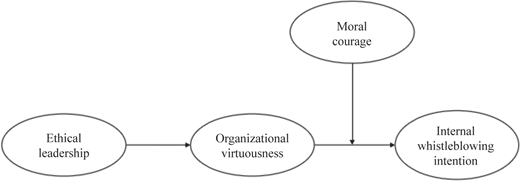
Otherwise, leadership styles do not only focus on leaders' personalities but also have an ethical focus on the consequences of particular behaviors or actions (Javed et al., 2017). Moreover, vastly different leadership styles have not dealt with the main description of virtuous subordinates' personalities (Paniccia et al., 2020). Figure 1 presents the conceptual framework for the assumed relationships from the lenses of both the LMX and ELT theories.
Organizational virtuousness
Being virtuous refers to striving to be the greatest possible version of oneself or business (Khasawneh et al., 2020). Virtuousness in organizations is unique to humans, and it reflects circumstances of thriving, ennobling, vitality and personal flourishing, which contributes to health, happiness and resilience in the face of hardship (Cameron et al., 2004). Organizational virtues are considered a vital element in organizational outcomes and improved performance in contemporary business settings (Searle and Barbuto, 2011). Thus, characteristics are connected with virtues because good ethics are established by moral practices and habits (Kurian and Nafukho, 2021; Newstead et al., 2021). Nowadays, the virtues are appreciated in the behaviors of individuals in relation to their attitudes in different work environments (Simões et al., 2019). Organizational virtuousness was examined with intervening factors in the daily work routine (Berry, 2004).
Despite the key role of ethical leadership and organizational virtuousness in many leadership practices and outcomes (see Gukiina et al., 2018; Hur et al., 2017; Peng and Kim, 2020; Sun and Yoon, 2020; Wood et al., 2021; Zaim et al., 2021), few studies have addressed the positive relationship between ethical leadership and organizational virtuousness (e.g. Zhang and Liu, 2019). This most likely results from the fact that these concepts remain only loosely defined (Khasawneh et al., 2020). Therefore, studies need to address virtues and their extended traits and examine their influence and outcomes in business settings (Nazarian et al., 2021). Otherwise, recent studies have focused on ethical leadership in the hospitality sector in different countries. For instance, Javed et al. (2016) addressed the moderating role of ethical leadership between Islamic work ethics and adaptive performance among Pakistani hotel employees. Bhatti et al. (2020) linked ethical leadership with knowledge sharing between supervisors and subordinates in Pakistani hotels.
Otherwise, ethical leadership is linked to employee performance in Pakistani tourist companies (Shafique et al., 2018) and among Egyptian travel agents (Elbaz and Haddoud, 2017). Gürlek (2021) focused on Machiavellianism's role in unethical behaviors among managers and employees in Turkish hotels. Besides, Erkutlu and Chafra (2017) investigated the moderating role of behavioral integrity between leader narcissism and subordinate embeddedness among Turkish hotel employees, suggesting that the creation of a supportive context is crucial to organizational practices and activities in the Egyptian hospitality sector. Hence, this paper assumes that
Ethical leadership has a positive effect on organizational virtuousness.
Internal whistleblowing intention
Internal whistleblowing intention is defined as the actions an individual takes to report unethical behavior to higher management in their organization (Nisar et al., 2019). These actions mainly depend on the legal principles applied in hotel organizations (Yu et al., 2019), which allow employees to disclose these negative behaviors (Oelrich, 2021). However, highlighting whistleblowing presents a revenge risk in organizations (Rabie and Abdul Malek, 2020). Employees may only be willing to take this risk once they feel sufficiently confident that they can safely disclose whistleblowing (Park and Blenkinsopp, 2009) or when they trust in the management's ability to tackle this issue seriously and confidentially (Wood et al., 2021).
Ethical principles are close to organizational virtuousness (Nazarian et al., 2021; Schwepker and Dimitriou, 2021). These principles were practiced within service organizations to create a positive organizational image (Farooqi et al., 2017; May-Amy et al., 2020). Therefore, one may predict that ethics influences the reporting of wrongdoing in organizations (Ahmad et al., 2014), enabling whistleblowers to spot disruptive acts that threaten corporations' competitiveness and sustainability (Tarkang-Mary and Ozturen, 2019). Furthermore, it has been indicated that people are particularly interested in detecting any kinds of ethical issues in an organization that has supportive leadership practices (Hur et al., 2017) and provides principles that govern both the work and group environment. Besides, internal whistleblowing intention is related to worthy practices and leader traits, possibly affecting employees' abilities to report violations to top management that would affect the workplace's reputation (Khliefat et al., 2021).
Several predictors can also affect internal whistleblowing intention, especially related to personal and organizational factors (Oelrich, 2021). In recent years, it has been reported that ethical leaders are able to develop a principle-based organizational environment that can support and facilitate whistleblowing (Dinc et al., 2018), through guaranteeing that hotel employees will be protected against retaliation (Fan et al., 2021). Many studies have indicated that organizational virtuousness plays an important role in improving and developing moral leadership within service organizations, encouraging employees to engage in internal whistleblowing (Ahmad et al., 2014; Bhal and Dadhich, 2011). A supportive organizational environment can help to maintain a completely ethical context (Gukiina et al., 2018) and encourage whistleblowers to respond to the ethical issues that can emerge in corporations (Farooqi et al., 2017), potentially diminishing the likelihood of retaliation (Nisar et al., 2019). Compared to Cheng et al. (2019), this study relies on organizational virtuousness as a mediator between ethical leadership and internal whistleblowing intention, thus assuming that
Organizational virtuousness has a positive effect on internal whistleblowing intention.
Organizational virtuousness mediates the relationship between ethical leadership and internal whistleblowing intention.
The moderating role of moral courage
Moral courage is defined as the possibility to adapt and use internal ethics and principles to do right towards others, regardless of the risk of another person retaliating (Sekerka et al., 2009; Sekerka and Bagozzi, 2007). Moral courage refers to the efforts made to cultivate organizational outcomes (Kurian and Nafukho, 2021) that would facilitate positive thinking and reduce the negative aspects of an organization's culture, including gossip and hypocrite (Ugwu, 2012). It also bridges solid organizational values (Kalemci et al., 2019). Moreover, moral courage leads to moral and organizational values that can enable sustainable success (Tarkang-Mary and Ozturen, 2019). Similar debates suggest that organizational politics has a significant impact on individual behaviors, such as internal whistleblowing intentions (Oelrich, 2021). Thus, this effect can extend to changes in organizational virtuousness (Paniccia et al., 2020). More generally, this concept offers meaningful insights (Newstead et al., 2021). Additionally, it emphasizes a person's courage to tackle the challenges and concerns associated with following an organization's policies (Comer and Schwartz, 2017).
Some empirical research has revealed that an organization's internal practices influence many organizational aspects (Fan et al., 2021; Kalemci et al., 2019). Thus, an organization's outcomes will be superior or inferior based on an individual's confidence and moral courage with respect to their organization's leaders and values (May et al., 2014; Kurian and Nafukho, 2021). Accordingly, this study proposes to examine the moderating effects of moral courage, which could represent important individual traits related to organizational virtuousness and internal whistleblowing intention. Thus, this research assumes that
Moral courage moderates the relationship between organizational virtuousness and internal whistleblowing intention.
Method
Survey development
All constructs were adopted using multiple items from the existing literature. A seven-point Likert scale ranging from (1 = strongly disagree to 7 = strongly agree) was used for the scales.
Ethical leadership was measured on a ten-item scale adapted from Brown et al. (2005) to assess employees' perceptions regarding ethical behavior of their leaders. One of its sample items stated: “My leader disciplines employees who violate ethical standards.” This scale was shown to be reliable by recent studies (see Bhatti et al., 2020; Fan et al., 2021; Schwepker and Dimitriou, 2021).
Organizational virtuousness was measured by using a 15-item scale adopted from Cameron et al. (2004), consisting of five pillars: optimism, trust, compassion, integrity and forgiveness. Each of the sub-dimensions of this construct includes three items. Employees were presented with statements like “We are optimistic that we will succeed, even when faced with major challenges.” In earlier research studies of Gukiina et al. (2018) and Sun and Yoon (2020), this scale has shown strong dependability and reliability in the hospitality literature.
Moral courage was measured with four items developed from May et al. (2014). Sample items stated “I would only consider joining a just or rightful cause if it is popular with my co-employees and supported by important others.” This scale has demonstrated high reliability and validity (Cheng et al., 2019; Comer and Schwartz, 2017).
Internal whistleblowing intention was measured with four items derived from Park and Blenkinsopp (2009). One of its sample items stated: “I use the reporting channels inside of the hotel.” Recent research (e.g. May-Amy et al., 2020; Yu et al., 2019) confirmed the reliability and validity of this scale.
Sampling
A nonprobability convenience sampling technique was applied chiefly in defining the sampling stages and selecting the respondents (Aaker et al., 1995). The participants were selected from employees of five-star hotels in Egypt. This is due to the various barriers that employees in Egypt's hospitality business confront that prevent them from reporting internal whistleblowing intents to their bosses, for instance, gender discrimination, cultural friction and workplace relationships (Sobaih, 2018). As such, confidence in leaders is critical in convincing employees that they will not suffer consequences if they report irregularities, which is consistent with typical Arab cultural traits (Hassan et al., 2020). Thus, Arab hotel personnel require organizational characteristics, such as organizational climate and psychological empowerment, to assist them in reporting ethics infractions rather than individual characteristics, such as moral bravery and ethical effectiveness (Wood et al., 2021). This study population was restricted to employees in vital main departments (i.e. room division, sales and marketing, food and beverages, etc.), since they have high emotional demands, long working hours and excessive workloads (Khliefat et al., 2021). These employees were chosen from 30 five-star hotels located in Sharm El-Sheikh, Greater Cairo and Luxor, which are equivalent to 13, 11 and 6 hotels, respectively. According to the Egyptian Ministry of Tourism and Antiquities (EMTA), these cities have the most hotels, resorts and tourist attractions in Egypt.
Procedures
An analytical approach was used given that the scope of this study was hotel employees' perceptions of ethical leadership and its impact on internal whistleblowing intentions. A reverse-translation approach was used, with a series of stages (Brislin, 1970). The survey questionnaire was translated from English to Arabic, including all measurement questions to suit the bulk of the study population. To avoid translation errors, the translated version was compared to the original text. Seven proofreaders retranslated the statements from Arabic to English to assess the survey content. Therefore, the survey included 33 items, as well as a section on the sample's characteristics and a brief introduction to the research. As a result, a pilot test was conducted on 50 staff from five-star hotels in Egypt prior to the major data gathering procedure. As a result, 36 people responded, representing a response rate of 72%.
Four members of the Egyptian Hotels Association (EHA) regional office and two human resource (HR) managers from the targeted hotels aided the authors in reaching these employees. Using the Google Form platform, a brief link with the specified questionnaire purpose and contents was created and delivered to them. As a result, participants suggested making minor changes to some items in this questionnaire, such as reformulating items 4, 6 and 7 to make the ethical leadership construct clearer and placing 6 months to 1 year within the professional experience category, and their suggestions were taken into consideration.
Data collection
Due to the COVID-19 outbreak and most hotels' taking precautionary measures in response, the questionnaires were distributed over a prolonged period on Google Form. As such, 930 copies of the intended questionnaire were distributed, an average of 31 copies per target hotel from mid-February to late June 2021. Hence, 634 of them were received, but after processing the collected data and removing responses with significant outliers, the final sample reached 442 responses, with a response rate of 48%. When the given population size reaches one million as a maximum threshold, the appropriate sample size is 384 responses (Krejcie and Morgan, 1970). Accordingly, the sample size of this study could be considered sufficient for conducting various statistical methods.
Common method variance
Since all responses were given by the same respondent, as well as using self-reported measures of some constructs, we used a set of procedural and statistical remedies to address the possibility of common method variance (CMV) (Podsakoff et al., 2012). Procedurally, the questionnaire is pretested to avoid ambiguous items and complex grammatical structures. All items were simple and concise. All respondents were assured that there was no right or wrong answers. All constructs were randomly entered into the survey to prevent respondents from inferring a cause–effect relationship among the items and constructs in the survey. Considering the statistical remedy, exploratory factor analysis (EFA) was performed using SPSS v.25. The results for Harman's one-factor test reflected a good model fit in which all the items were pooled into a single factor (48.15%) of total variance. Based on these arguments, CMV is not a great issue in this study.
Results
Demographics of respondents
Respondents' profiles are presented in Table 1. Of the respondents, 91.6% were male, and 77.6% were single, this result might interpret in light of the men most likely to participate in the studies than women and share their perceptions toward the issues (Elhoushy and El-Said, 2020). In terms of age, 51.1% of the respondents were under 30 years, followed by 23.5% were 30 to <39 years. The respondents' educational levels were as follows: 49.8% had a bachelor's degree, and 34.8% had completed high school. Moreover, 34.6% of them had 3 to <5 years of professional experience and 34.2% had 6 months to <1 year. The respondents were working in the following departments: 38.5% in food and beverages, 23.8% in sales and marketing and 21.9% in the room division.
Respondents profile (n = 442)
| Categories | Frequency | % | |
|---|---|---|---|
| Gender | Male | 405 | 91.6 |
| Female | 37 | 8.4 | |
| Marital status | Single | 343 | 77.6 |
| Married | 99 | 22.4 | |
| Age | <30 | 226 | 51.1 |
| 30 to <40 | 104 | 23.5 | |
| 40 to <50 | 71 | 16.1 | |
| ≥50 | 41 | 9.3 | |
| Educational level | M.Sc./Ph.D | 9 | 2.0 |
| Diploma | 44 | 10.0 | |
| Bachelor | 220 | 49.8 | |
| High school | 154 | 34.8 | |
| Preparatory school | 11 | 2.5 | |
| Other | 4 | 0.9 | |
| Professional experience | 6 months to <1 year | 151 | 34.2 |
| 1 to <3 years | 70 | 15.8 | |
| 3 to <5 years | 153 | 34.6 | |
| ≥5 years | 68 | 15.4 | |
| Department | Room division | 97 | 21.9 |
| Food and beverages | 170 | 38.5 | |
| Sales and marketing | 105 | 23.8 | |
| Other | 70 | 15.8 | |
Measurement model
Construct validity was evaluated using confirmatory factor analysis (CFA). In the factor analysis, varimax rotation and principal component analysis (PCA) were used to determine the key components with their respective indicators from the 33 items, comprising ethical leadership, internal whistleblowing intention and moral courage (first-order constructs), and organizational virtuousness (second order, with five sub-constructs). The organizational virtuousness construct included five dimensions, namely optimism, trust, compassion, integrity and forgiveness, each containing three items, as presented in Table 2.
Constructs and respective indicators
| Constructs | Statements | Factor loadings | Alpha | CR | AVE |
|---|---|---|---|---|---|
| Ethical leadership | Conducts personal life in an ethical manner | 0.62 | 0.93 | 0.93 | 0.57 |
| Defines success not just by results but also the way that they are obtained | 0.75 | ||||
| Listens to what employees have to say | 0.75 | ||||
| Disciplines employees who violate ethical standards | 0.73 | ||||
| Makes fair and balanced decisions | 0.71 | ||||
| Can be trusted | 0.76 | ||||
| Discusses business ethics or values with employees | 0.84 | ||||
| Sets an example of how to do things the right way in terms of ethics | 0.80 | ||||
| Has the best interests of employees in mind | 0.78 | ||||
| When making decisions, asks what is the right thing to do | 0.78 | ||||
| Optimism | A sense of profound purpose is associated with what I do this hotel | 0.90 | 0.97 | 0.97 | 0.78 |
| In this hotel, I am dedicated to doing good in addition to doing well | 0.95 | ||||
| I am optimistic that I will succeed, even when faced with major challenges | 0.90 | ||||
| Trust | Employees trust one another in this hotel | 0.83 | |||
| We are treated with courtesy, consideration, and respect in this hotel | 0.86 | ||||
| We trust the leadership of this hotel | 0.92 | ||||
| Compassion | Acts of compassion are common this hotel | 0.84 | |||
| This hotel is characterized by many acts of concern and caring for employees | 0.85 | ||||
| Many stories of compassion and concern circulate among hotel members | 0.93 | ||||
| Integrity | Honesty and trustworthiness are hallmarks of this hotel | 0.82 | |||
| This hotel demonstrates the highest levels of integrity | 0.95 | ||||
| This hotel would be described as virtuous and honorable | 0.88 | ||||
| Forgiveness | We try to learn from our mistakes in this hotel, consequently, missteps are quickly forgiven | 0.96 | |||
| This is a forgiving, compassionate hotel in which to work | 0.94 | ||||
| We have very high standards of performance, yet we forgive mistakes when they are acknowledged and corrected | 0.88 | ||||
| Internal whistleblowing intention | I report it to the appropriate persons within the hotel | 0.82 | 0.92 | 0.96 | 0.86 |
| I use the reporting channels inside of the hotel | 0.97 | ||||
| I let upper level of management know about it | 0.97 | ||||
| I tell my supervisor about it | 0.94 | ||||
| Moral courage | I would stand up for a just or rightful cause, even if the cause is unpopular and it would mean criticizing important others | 0.89 | 0.95 | 0.93 | 0.77 |
| I will defend someone who is being taunted or talked about unfairly, even if the victim is only an acquaintance | 0.95 | ||||
| I would only consider joining a just or rightful cause if it is popular with my co-workers and supported by important others | 0.94 | ||||
| I would prefer to remain in the background even if a co-worker is being taunted or talked about unfairly | 0.72 |
The factor loadings for all measurements achieved acceptable and satisfactory levels (greater than 0.60), according to the Kaiser–Meyer–Olkin (KMO) test (0.83–0.96, p < 0.001). In addition, the reliability of the measurement scale was satisfactory according to the Cronbach's alpha test, which revealed satisfactory and acceptable results, ranging from 0.92 to 0.97. Thus, the values of skewness and kurtosis ranged between 2 and 5. The normality test showed a normal distribution of data, in which the skewness values for each measurement were less than the threshold absolute values (Blanca et al., 2013). Hence, the test results confirmed that the data were normally distributed.
The CFA results and reliability were checked for all latent constructs. No items showed factor loadings lower than 0.6 at a significance level of p < 0.001, requiring elimination from further analysis. The convergent validity through two main tests, namely composite reliability (CR) and average variance extracted (AVE), was evaluated for all latent constructs, as presented in Table 3. The CR values of the four latent constructs of ethical leadership, organizational virtuousness, internal whistleblowing intention and moral courage were 0.93, 0.96, 0.96 and 0.92, respectively. Thus, all values of CR exceeded the suggested minimum value of 0.6. The values of AVE were also checked and were found to range between 0.92 and 0.93, making them acceptable because the ideal values of this test should be greater than 0.5 (Fornell and Larcker, 1981). Thus, all latent constructs of the model had acceptable convergent validity. Moreover, all the values of the square root of AVE in bold were greater than the construct correlations; thus, discriminant validity was achieved.
Correlations, validity and items reliability
| Construct | 1 | 2 | 3 | 4 |
|---|---|---|---|---|
| 1. Ethical leadership | 0.75 | |||
| 2. Organizational virtuousness | 0.44 | 0.93 | ||
| 3. Moral courage | 0.37 | 0.69 | 0.87 | |
| 4. Internal whistleblowing intention | 0.23 | 0.60 | 0.70 | 0.92 |
| CR | 0.93 | 0.96 | 0.92 | 0.96 |
| AVE | 0.57 | 0.84 | 0.76 | 0.85 |
| Mean | 5.19 | 4.64 | 4.87 | 5.51 |
| SD | 0.932 | 1.449 | 1.408 | 1.399 |
| Model fit | Data χ2/dx = 3.301 (<5), RMSEA = 0.068 (≤0.08), CFI = 0.946 (>0.9), TLI = 0.933 (>0.9), GFI = 0.848 (<0.9), AGFI = 0.817 (<0.9) | |||
Structural model
The results showed that the proposed structural model fit the dataset (χ2/dx = 3.301 (<5), RMSEA = 0.068 (≤0.08), CFI = 0.946 (>0.9), TLI = 0.933 (>0.9), GFI = 0.848 (<0.9), AGFI = 0.817 (<0.98)). Only the last two indices did not reach the lower cut-off, which was acceptable in the newly developed model, thus the model did not need to be modified. The other indices of the model results confirmed the model fitness, as they indicated that it was acceptable and satisfactory (Awang et al., 2015). All important indices that needed to be assessed are presented in Table 3.
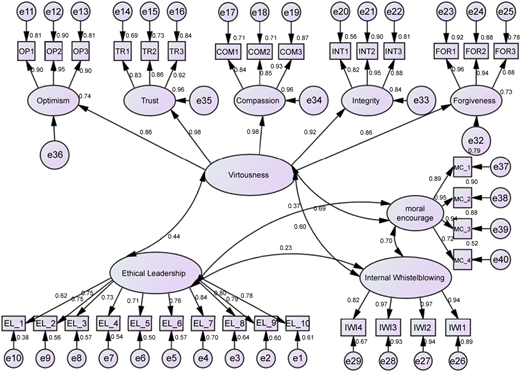
Structural equation modeling (SEM) was adopted to test the hypothesized structural model, as illustrated in Figure 2. Table 4 shows the results of the structural model, which included standardized estimates of the path coefficients. Ethical leadership (β = 0.600, t = 8.528, p < 0.001) was found to have positive effects on organizational virtuousness, in support of H1. Furthermore, organizational virtuousness (β = 0.587, t = 12.709, p < 0.001) had positive effects on internal whistleblowing intention, in support of H2. The structural model explained R2's 36% variance in internal whistleblowing intention. According to Hayes and Rockwood (2017), the effect size of mediation is used to estimate the significance and magnitude of indirect effects. Thus, the results showed significant paths for direct and indirect effects, and AMOS's outputs provided the standardized coefficients for paths 1 and 2, as presented in Table 4.
Hypothesis testing results
| H | Path | Coefficients | SE | t-value | p-value | Result |
|---|---|---|---|---|---|---|
| H1 | Ethical leadership → Organizational virtuousness | 0.598 | 0.070 | 8.527 | 0.000 | Supported |
| H2 | Organizational virtuousness → Internal whistleblowing intention | 0.590 | 0.047 | 12.679 | 0.000 | Supported |
| H3 | Ethical leadership → Organizational virtuousness → Internal whistleblowing intention | Path 1 = 0.600 | Path 1 = 0.070 | Path 1 = 8.528 | Path 1 = 0.000 | Supported |
| Path 2 = 0.578 | Path 2 = 0.046 | Path 2 = 12.709 | Path 2 = 0.000 |
According to covariance-based-SEM, there were two types of mediation, namely partial and full. If only the indirect effect path is significant, full mediation has occurred, whereas if both direct and indirect paths are significant, partial mediation has occurred (Nitzl et al., 2016). Therefore, the path analysis's results present the relationship between ethical leadership and internal whistleblowing intention through organizational virtuousness (β1 = 0.600, p < 0.001 and β2 = 0.578, p < 0.001). Accordingly, H3 was supported. Thus, this result indicates that organizational virtuousness partially mediates the relationship between ethical leadership and internal whistleblowing.
Regarding testing, the moderation effect of moral courage in the organizational virtuousness–internal whistleblowing intention relationship revealed a chi-square difference of 1.549 between the constrained and unconstrained models. To attain the moderation role of moral courage, the difference value should be greater than the chi-square value at one degree of freedom (3.84). Thus, H4 was not supported. This is due to differences in these studies compared to previous similar studies (see Comer and Schwartz, 2017; May et al., 2014), which provide respondents' diverse perceptions of the measuring factors and issue being addressed.
Discussion
To the best of our knowledge, this is the first study to investigate the mediating effect of organizational virtuousness in the relationship between ethical leadership and internal whistleblowing. It also examined the moderating role of moral courage in the relationship between organizational virtuousness and internal whistleblowing. The associated results revealed that when the leaders controlled for internal whistleblowing, workplace virtues mediated this relationship, and moral courage moderated this relationship as well. Providing psychological support to subordinates, as part of ethics, may promote ethical practices and improve workplace virtues by establishing a bridge to understanding.
The findings of this study and its theoretical contributions to the behavioral sciences literature are addressed based on the hypothesized model with comparisons to existing research. In addition, the managerial contributions of these results, limitations and recommendations for further research are discussed below. Our results also demonstrated that the followers would have intentions as well as the ability to detect wrongdoings when their leaders play the role of model, and they positively support the ethical practices and behaviors. The results indicated that ethical leadership is significantly associated with organizational virtuousness in hotel settings. Organizational virtuousness is a significant element of organizational outcomes and improved performance in contemporary business settings (Searle and Barbuto, 2011; Sun and Yoon, 2020). In response, the results of this research have confirmed a positive relationship in this regard. This finding indicates that ethics represents one of the cornerstones of a compatible and virtuous work environment. Several predictors can also affect internal whistleblowing intention, especially related to personal and organizational factors in business organizations (Chiu, 2003).
This study's results have confirmed that organizational virtuousness is significantly associated with internal whistleblowing intention in the hotel context (Cheng et al., 2019). Therefore, it is likely that organizational ethics affects employees' willingness to report wrongdoing (Ahmad et al., 2014; Tavakoli et al., 2003). Furthermore, the results have revealed that organizational virtuousness partially mediates the relationship between ethical leadership and internal whistleblowing intention. This is consistent with previous studies that have indicated that organizational virtuousness plays an important role in improving and developing moral leadership within organizations, facilitating hotel employees' internal whistleblowing intentions (Bhal and Dadhich, 2011).
This paper has also attained a result that completely differs from previous studies that moral courage cannot moderate the relationship between organizational virtuousness and whistleblowing intention. Many studies have confirmed that moral courage depends on employees' ethics and principles with respect to doing the right thing, regardless of the risk of retaliation (e.g. Kurian and Nafukho, 2021; Wood et al., 2021). A number of reasons, including employees' fear of being personally targeted by their supervisors or co-workers, can explain this study's distinctive result. This is consistent with other studies that have claimed that whistleblowing is tedious in conflict situations (Pianalto, 2012). Our findings are in line with empirical studies (e.g. Cheng et al., 2019), which revealed a moderating role of moral courage and its effect on internal whistleblowing and had an indirect effect on the relationship between ethical leadership and whistleblowing, but with a different mediation effect of the employee-perceived organizational politics. In addition, other findings support the role of organizational ethics in supporting moral courage as a leadership practice (Sekerka et al., 2009).
In addition, previous studies have investigated the moderating role of moral courage in other contexts than the hotel setting (Comer and Schwartz, 2017; May et al., 2014). This result can also be interpreted as evidence that the availability of organizational virtuousness does not require moral courage among employees for them to report violations in the workplace (Kurian and Nafukho, 2021). Consequently, trust in leaders plays a key role in assuring employees that they will not face issues if they report violations, consistent with typical Arab cultural characteristics (Farooqi et al., 2017; Hassan et al., 2020). Hence, Arab hotel employees need organizational traits, like organizational climate and psychological empowerment, to support them in reporting ethics violations more than individual traits, like moral courage and ethical efficacy.
Conclusion
Ethical leadership is one of the behavioral trends that many businesses aim to follow in order to respect others' ideas and moral ideals, as well as their dignity and rights. Individuals' safety and motivations are fundamental to ethical behaviors. The lack of regulatory clarity fosters an environment where breaches are common and individuals are scared to report them. Through the mediation role of organizational virtuousness, this study analyzes the link between leaders' ethical actions and internal whistleblowing among hotel employees in Egypt. The conceptual framework states that ethical leadership fosters a virtuous environment and promotes whistleblowing. Ethical leadership improves organizational virtuousness. As a result, it has a considerable influence on whistleblowing intentions. As such, most hotel employees require organizational factors, such as organizational culture and psychological empowerment, as well as individual attributes, such as moral boldness and ethical efficacy, to aid them in reporting ethical transgressions.
Theoretical implications
These findings add important contributions to the literature regarding the crucial role of ethical leadership in employees' whistleblowing intentions in the following ways. First, this research has demonstrated how ethical behavior among leaders can act as a powerful catalyst for employees to whistleblow to their managers or supervisors (Cheng et al., 2019; Zhang and Liu, 2019). The impact of ethical leadership on several employee outcomes has also been discussed in past studies, including employee creativity (Javed et al., 2017), knowledge sharing (Bhatti et al., 2020), job performance (Simões et al., 2019) and organizational identification (Sharma et al., 2019). However, the impact of this leadership style on internal whistleblowing intention has not been discussed separately in the business context (Kurian and Nafukho, 2021; Tran et al., 2021).
Moreover, internal whistleblowing intentions from external sources are radically different in terms of motives and circumstances. Therefore, it was necessary to discuss internal whistleblowing intentions separately, specifically in the hotel sector. Consequently, this research used an advanced field design to consider the beneficial effects of ethical leadership on internal whistleblowing intention, drawing on ELT and LMX theories. Second, the past five years have witnessed a remarkable interest in leadership patterns and internal whistleblowing intentions. However, most scholars have not discussed the intermediary mechanisms that translate the focal role of ethical leadership as an enabler of employees' internal whistleblowing intentions. Ethical leadership has been shown to influence internal whistleblowing intention through collective moral potency and personal identification (Peng and Kim, 2020), turnover intention through organizational identification (Suifan et al., 2020), while whistleblowing has been measured through job stress (Rabie and Abdul Malek, 2020) and through organizational politics (Cheng et al., 2019).
Given the above, it is suggested that organizational virtuousness can act as a mediator between ethical leadership and internal whistleblowing intention. To the authors' knowledge, no similar research has yet been conducted on how organizational virtuousness affects this dynamic. Hence, we can regard organizational virtuousness as the degree to which an employee perceives an individual that allows for the generalization and preservation of virtuous behavior and cultural traits in the workplace (Chiu, 2003). By tracking field survey data, organizational virtuousness should be deemed a critical influence on internal whistleblowing intention. Finally, the integrative mediation model test provides strong evidence of the extent to which organizational virtuousness mediates the relationship between ethical leadership and internal whistleblowing intention. Internal whistleblowing intention is a purposeful behavior to avoid the risk of harming a virtuous workplace (Farooqi et al., 2017).
Managerial implications
The findings imply several managerial contributions to promoting internal whistleblowing intentions (May-Amy et al., 2020). First, hotel organizations' management should adopt ethical leadership traits, such as listening to what subordinates have to say, making fair and balanced decisions, being trustworthy and discussing work ethics with subordinates. Second, the results can assist the Egyptian Hotel Board of Directors with developing management systems by preventing violations that may harm an organization's reputation. Hence, it is evident that providing a virtuous workplace dominated by optimism, trust, compassion, integrity and forgiveness will play a critical role in maintaining violation-free work environments where any violations will be reported ethically.
Third, it is necessary to focus on leaders' ethical behavior and virtues in the workplace (Kurian and Nafukho, 2021) rather than on individual traits to report internal violations in hotel settings. Therefore, senior management should act as a moral role model to inspire employees to be virtuous. Finally, hotels can make concerted efforts to adopt measures for creating virtuous work environments (Rabiul et al., 2021). For instance, hotel management should encourage employees to participate in the organizational hierarchy.
Limitations and future research directions
Despite the fact that this paper offers useful theoretical and practical contributions, it has several limitations. First, the data analysis relied on a representative sample drawn from employees of five-star hotels in Egypt, which may reduce the results' generalizability. Future researchers could use a multi-level approach with regard to reporting internal violations. It can also be used in more than one developing country throughout the world to broaden the reach of the study findings to the widest potential audience, for instance, the Middle East and North Africa (MENA) countries. Besides, these results are extrapolable to other areas with similar economies, such as Morocco and Tunisia.
Second, emphasis was placed on hotel employees in the front office, food and beverages, marketing and sales, without addressing human resources, finances, and so forth. Future researchers should keep various administrative levels like chief executive officers, senior managers and supervisors in mind. This is congruent with Hofstede's theory, which gives a comprehensive framework for recognizing cultural variations across groups, which may aid in predicting whistleblowers' behavioral intentions (Chiu, 2003; Tavakoli et al., 2003). Third, the current study relied on a questionnaire-based quantitative approach and did not address depth-interviews and focus groups as qualitative approaches. Therefore, future researchers should perform mixed-methods research. Finally, the authors did not consider the negative impact of the variables affecting employees' psychological health. In the coming research, variables related to hotel employees' negative qualities should be measured with ethical leadership acting as a predictor for fear of COVID-19, employee depression and workplace hazing.

