


The purpose of this study is to understand the impact that Corporate Social Responsibility (CSR) practices have on the perceived attractiveness of companies in the eyes of their employees and potential candidates. Moreover, this study assesses the mediation role that Extrinsic (EA) and Intrinsic Attributions (IA) about Corporate Volunteering (CV) have on this relationship.
Three hundred and five responses were collected in an online questionnaire and a Structural Equation Modelling model was designed to explain the proposed relationships of the variables under study.
The authors found that the IA that employees/candidates make about CV programs have a direct and positive impact on the company’s attractiveness; it was not possible to conclude the same about EA.
Unlike studies already existing in the area of corporate attractiveness that focus on the perspective of companies and customers, with a high focus on the organizational implementation of CSR and organizational benefits, this study has adopted a different perspective that focuses on the opinion of company employees, as well as the perspective of possible candidates. By not limiting participation to anyone, it covers a wide range of participants, allowing a broader knowledge of the labor market.
本研究的目的是理解“公司社会责任实践项目”(CSR)对员工及潜在员工构成的公司吸引力的影响。其次, 本研究评估“公司志愿服务”(CV)外在归因(EA)与内在归因(IA)在此关系上的中介作用。
线上问卷收集了305份回复, 并设计了一个结构方程模型来解释研究中变量之间的所设想的关系。
我们发现员工或潜在员工对公司志愿服务项目的内在归因对公司吸引力有直接、积极的影响; 外在归因则不可能。
与之前在公司吸引力领域已经存在的研究不同, 之前的研究专注于公司和顾客的角度, 尤其关注“公司社会责任实践项目”的组织实施和组织效益。本研究采用了一个不同的角度, 聚焦于公司员工以及未来的员工的看法。本研究不限制任何人的参与, 覆盖了大范围的参与者, 因此有助于对劳动力市场更广泛的了解。
1. Introduction
Corporate citizenship is introduced in companies through Corporate Social Responsibility (CSR), which represents a set of good citizenship practices that companies have toward society with the ultimate goal of creating value, mainly for society and later for themselves (Glavas and Kelley, 2014; Jones et al., 2014). One way of implementing CSR practices in companies is through Corporate Volunteering (CV) programs. This type of company involvement in society represents a set of actions organized and developed by companies in order to promote their employees’ involvement in society through volunteering activities (Allen, 2000; Kotler and Lee, 2004; Pajo and Lee, 2011). The involvement between companies and their employees contributes to the construction of a favorable working environment, which in turn is positive for companies in terms of competitive advantage and image improvement. In this sense, one of the essential factors to attract and retain the best employees is through the branding and corporate reputation (Saz-Gil et al., 2020).
Defined as a long-term strategy to manage the awareness and perceptions of current employees, potential candidates and other stakeholders about an organization (Backhaus and Tikoo, 2004), Employer Branding (EB) allows companies to distinguish themselves from other competitors and develop a recognizable and desired identity (Backhaus and Tikoo, 2004; Jiang and Iles, 2011; Lievens et al., 2007). Likewise, Employer Attractiveness (EmpAt) is related to the affective assessment of an organization by candidates and, therefore, it is considered an important factor in the recruitment attraction stage (Duarte et al., 2015). Corporate image and reputation are mechanisms that mediate the relationship between the perception of CSR and EmpAt.
As the study of this social aspect of a company is extremely relevant to the Human Resource Management (HRM) of companies, it also proves to be important for management and for the academia since most studies have been carried out from the perspective of companies (Dreesbach-Bundy and Scheck, 2017; Ellen et al., 2006; Gatignon-Turnau and Mignonac, 2015; Gilder et al., 2005), with few studies (Ahmad et al., 2019; Berthon et al., 2005; Gatignon-Turnau and Mignonac, 2015; Vlachos et al., 2013) taking into account the perspective of potential candidates and current employees [1] when evaluating a company’s social strategy and its contribution to their attractiveness. In this study, we intend to focus on the micro level of analysis, considering the employees/candidates’ attributions on CSR practices, in particular CV programs. We aim to evaluate the impact of CV programs on EmpAt. Additionally, we will assess whether internal attributions toward these practices, such as recognizing a company’s genuine motivations for creating social value, intensify this relationship.
2. Literature review and hypotheses development
2.1 Corporate social responsibility, corporate volunteering and employer attractiveness
Companies use CSR in their corporate strategies to increase their competitiveness and strengthen their positioning, improving the psychological involvement of employees (Aguinis and Glavas, 2012; Greening and Turban, 2000; McWilliams and Siegel, 2001; Vanhamme and Grobben, 2008). As countries have experienced job and work crises during the pandemic, issues like jobs, work, workplace locations, and health care are topics that should be part of the corporations’ CSR agenda, being that companies’ commitment to CSR must become more strategic and solid in the future (Carroll, 2021). CSR is, on the one hand, a management philosophy seen as a form of pure profit maximization, improving reputation, creating competitive advantage and generating win-win-win situations through value creation (Carroll and Shabana, 2010). On the other hand, CSR is a philanthropic initiative in which the focus is on the corporate environment and its stakeholders, paying attention not only to maximizing the value of the shares and the economic benefit but also orienting toward a wide range of pro-social activities and policies (Sekar and Dyaram, 2017).
CV may be considered as a branch and a strategic CSR activity (Mozes et al., 2011), and one of the most used instruments by companies to contribute to a fairer and more sustainable global development (Mozes et al., 2011; Peloza et al., 2009). It constitutes an increasingly salient CSR activity that demonstrates proactive corporate citizenship (Maignan and Ferrell, 2001) and engages internal and external stakeholders (Plewa et al., 2015), allowing companies to become more socially responsible by integrating social, environmental, ethical, consumer and human rights concerns into their strategy (European Commission, 2019). CV refers to volunteer activities that employees perform in the community with some form of assistance or encouragement from their employer (Mayer and Silva, 2017), it can be formal or informal (more flexible relationships where there is no commitment to a particular organization) or formal (relationships that are established with specific organizations and joint CV programs are developed) (Magalhães and Ferreira, 2014).
CV provides new sources of talent to solve community problems and encourage corporate citizenship (Pajo and Lee, 2011) allowing employees to share their knowledge and skills with society as part of the employer’s community service (Gilder et al., 2005; Rodell, 2013). These programs are often described as win-win-win situations, since there are gains for employees, for companies and for society (Caligiuri et al., 2013; Peloza and Hassay, 2006).
Since CV is an important CSR activity strongly related to a company’s reputation and brand image (Coombs and Holladay, 2013; Gatignon-Turnau and Mignonac, 2015; Houghton et al., 2009; Kumari and Saini, 2018; Peloza and Hassay, 2006), it is expected that when a company has successful CV programs, it becomes more attractive to potential candidates, as well as to their own employees (Peterson, 2004; Tuffrey, 1995; Padhi and Joshi, 2022). In this sense, we can expect a strong relationship between the possibility of involvement in a CV program and the attractiveness of a company.
For employees/candidates, the opportunity to participate in a CV program is positively related with the perceived employer attractiveness.
EmpAt, Perceived Organizational Attractiveness or Organizational Attractiveness (Aiman-Smith et al., 2001) can be defined as the advantages that candidates perceive, and might influence the beginning of a relationship with an organization (Aiman-Smith et al., 2001; Berthon et al., 2005; Jiang and Iles, 2011; Pingle and Sharma, 2013). EmpAt is seen as the benefits that candidates perceive in a company with which they potentially want to work (Berthon et al., 2005), which is positively related to a company’s brand equity, because the more attractive the company is, the greater the company’s brand equity (Berthon et al., 2005).
Researchers have found different ways to classify and measure a company’s attractiveness attributes (Alnıaçık and Alnıaçık, 2012; Berthon et al., 2005; Cable and Turban, 2003; Lievens and Highhouse, 2003; Srivastava and Bhatnagar, 2010; Tanwar and Prasad, 2017). Ambler and Barrow (1996) proposed a three-party model where they highlighted the benefits the EB offers to employees, which include instrumental and symbolic attributes of the company and work perceived by employees (Charbonnier-Voirin et al., 2016; Lievens and Highhouse, 2003).
It was based on this study by Ambler and Barrow (1996) that Berthon et al. (2005) developed and validated a scale that is currently the most used to measure the attractiveness of the employer, from the perspective of employees/candidates (Tanwar and Prasad, 2017). The Employer Attractiveness Scale, also known as “EmpAt Scale” (Berthon et al., 2005), is a multi-item scale that operationalizes the dimensions of EmpAt (Santiago, 2019). According to these authors, the attractiveness of an employer’s brand is measured by five core values: Social value, Economic value, Interest value, Application value and Development value.
The EmpAt Scale results from the combination of the previous values and allows companies to understand what attracts employees in the labor market, giving them the opportunity to compete fiercely in attracting new and quality employees in the labor market (Kumari and Saini, 2018).
2.2 Perceptions about organizations’ CSR programs
When a company implements a CSR program, it is likely that the stakeholders will look for the meaning of that company’s action, often speculating on the company’s real reasons and motivations behind these programs (Fein, 1996; Gilbert and Malone, 1995; Nishimura and Tristán, 2011; Parcha, 2017; Roeck and Delobbe, 2012). These assessments of the company’s true intentions behind the implementation of social programs in its corporate strategy are known as attributions.
Most of the papers show that CSR–employee research has been dominated by focuses on the organizational implementation of CSR and organizational benefits, and employees are generally seen as implementers of top-down sustainability policies and as mediators regarding organizational CSR-related benefits. The focus has been placed on how employees can contribute to CSR within their employing organizations (Onkila and Sarna, 2022). In this sense, individuals’ attributions regarding their companies’ CSR initiatives are vital to understanding when the perceived CSR generates favorable employee outcomes (Donia et al., 2017). CSR attributions provide important information about an organization’s character (Donia et al., 2019). In this way, it is postulated that employees’ attributions have significant implications for their work-related motivation (Martinko et al., 2011), as well as in the CSR communication process (Buil et al., 2012; Parcha, 2017). Based on the Attribution Theory, Gatignon-Turnau and Mignonac (2015) anticipated that corporate volunteers’ responses to CV and commitment to the company depend not only on the amount of support for CV but also on their perceptions and attributions about the company’s objective in the implementation of the volunteer program (Gatignon-Turnau and Mignonac, 2015).
From the general point of view, the organization’s intentions behind the implementation of CV programs and, consequently, employees’ attributions in relation to them, can be of two types: “intrinsic” (Ahmad et al., 2019; Vlachos et al., 2013) also known as public-serving (Gatignon-Turnau and Mignonac, 2015) or altruistic (de Groot and Steg, 2008): seen as sincere practices of solidarity, in which employees believe that the organization is genuinely involved in the cause in question (Choi et al., 2016; Donia et al., 2017; Jong and Meer, 2017). For the company, the objective is to help and contribute socially, focusing on the potential benefit for the community (Haski-Leventhal, 2009). The other attribution is “extrinsic” (Ahmad et al., 2019; Vlachos et al., 2013) also known as self-serving (Gatignon-Turnau and Mignonac, 2015) or egoistic (de Groot and Steg, 2008): when CSR is used only as a marketing tool with no substantial contribution to doing good (Jahdi and Acikdilli, 2009). CSR activities are believed to mainly benefit the company and the company is focused only on making profits (Barone et al., 2000; Choi et al., 2016; Donia et al., 2017; Jong and Meer, 2017). Thus, it is proposed that
The opportunity to participate in a CV program is positively related with the employees/candidates’ intrinsic attributions of the intentions of the company with CV programs.
The opportunity to participate in a CV program is negatively related with the employees/candidates’ extrinsic attributions of the intentions of the company with CV programs.
Different stakeholders perceive CSR practices differently (Lee and Seo, 2017). As suggested by the Fairness Theory (Cropanzano et al., 2001), the attitudes and behaviors of employees are highly influenced by how fair employees consider their organization’s actions. They hope their organization meets the standard of morality and value they expect, interpreting this as a sign that the company will treat them equally by responding positively in terms of behavior (Glavas and Kelley, 2014; Lee and Seo, 2017). When expectations are not met, people start to focus on why companies are carrying out social initiatives rather than what those initiatives are doing because the lack of information about companies generates a climate of distrust about their true motives behind their CSR practices (Gilbert and Malone, 1995; Nishii et al., 2008; Parcha, 2017). Some authors (Gilbert and Malone, 1995; Glavas and Godwin, 2013) argue that the perception of a company’s socially responsible behavior may be more important than the actual behavior itself; therefore, it is important for organizations to engage in an extensive communication program to provide the information needed to help shape employees’ views on CSR. Therefore, it is expected that
The employees/candidates’ intrinsic attributions of the companies’ intentions with the CV programs are positively related with the perceived employer attractiveness.
The employees/candidates’ extrinsic attributions of the companies’ intentions with the CV programs are negatively related with the perceived employer attractiveness.
Intrinsic motives are said to be more altruistic and reflect good citizenship, extrinsic motives tend to be more instrumental and motivated by more materialistic gains, which is also known as social washing practices (Troje and Gluch, 2020). Intrinsic attributions (IA) are associated with evaluations that the organization treats its external stakeholders fairly, which leads employees to expect the same fair treatment for them, as stated by the Fairness Theory (Cropanzano et al., 2001). Extrinsic attributions (EA) use CSR only as a marketing tool with no substantial contribution to doing good (Jahdi and Acikdilli, 2009). They are practices with specific intentions, generally related to reputation improvement objectives (Coombs and Holladay, 2013; Gatignon-Turnau and Mignonac, 2015; Houghton et al., 2009; Kumari and Saini, 2018; Peloza and Hassay, 2006). Therefore, we propose the following hypotheses:
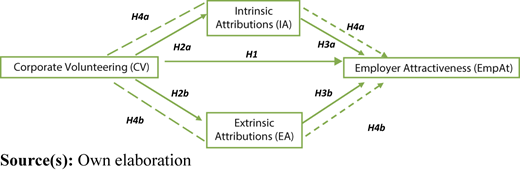
The relationship between the opportunity to participate in a CV program and the perceived employer attractiveness is positively mediated by intrinsic attributions about the company’s intentions with the CV programs.
The relationship between the opportunity to participate in a CV program and the perceived employer attractiveness is negatively mediated by extrinsic attributions about the company’s intentions with the CV programs.
So, our hypotheses are presented in Figure 1.
3. Methodology, measures and data collection
The questionnaire consisted of 50 questions divided into four sections: Sociodemographic Information, Attributes of Employer Attractiveness, Corporate Volunteering and Corporate Social Responsibility Attributions.
In the first section, respondents would have to provide their sociodemographic information such as gender, age, education, professional status, sector activity and nationality. In the second section, entitled “Attributes of Employer Attractiveness”, we assessed the respondents’ attributions in relation to EmpAt, which was our dependent variable. Also in this section, we asked the respondents six questions regarding their knowledge of CSR, CV and Traditional Volunteering. They were asked if their company had CSR practices, if they were familiar with the concept of CV and if they ever did traditional volunteering and the answers were coded in a dummy variable (0 = No, 1 = Yes). If they responded positively to the practice of traditional volunteering, they were asked to say how many initiatives were involved, in an open and nonmandatory answer. Table 1 shows all the questions used.
Employer attractiveness scale
| Value | Question | Bibliographic source |
|---|---|---|
| Development Value | Recognition/appreciation from management | Berthon et al. (2005) |
| A springboard for future employment | ||
| Feeling good about yourself as a result of working for a particular organization | ||
| Feeling more self-confident as a result of working for a particular organization | ||
| Gaining career-enhancing experience | ||
| Social Value | A fun working environment | |
| Having a good relationship with your superiors | ||
| Having a good relationship with your colleagues | ||
| Supportive and encouraging colleagues | ||
| Happy work environment | ||
| Interest Value | Working in an exciting environment | |
| Innovative employer – novel work practices/forward-thinking | ||
| The organization both values and makes use of your creativity | ||
| The organization produces high-quality products and services | ||
| The organization produces innovative products and services | ||
| Economic Value | Good promotion opportunities within the organization | |
| Job security within the organization | ||
| Hands-on interdepartmental experience | ||
| An above-average basic salary | ||
| An attractive overall compensation package | ||
| Application Value | Humanitarian organization – gives back to society | |
| Opportunity to apply what was learned at a tertiary institution | ||
| Opportunity to teach others what you have learned | ||
| Acceptance and belonging | ||
| The organization is customer-orientated |
Source(s): Own Elaboration
In the third section designated, we questioned respondents about their interest in CV programs, our independent variable. Table 2 shows all the questions used.
Questions regarding corporate volunteering programs
| Question | Bibliographic source |
|---|---|
| I would be interested in enrolling in a corporate volunteering program | Oliveira et al. (2021) |
| I would be interested in learning more about corporate volunteering programs | |
| Corporate volunteering programs are a viable way for me to get involved with volunteering |
Source(s): Own Elaboration
In the last part of the questionnaire, we asked respondents to rate their agreement on nine statements related to the CSR attributions they made about a company. Table 3 shows all the questions used.
Questions regarding corporate social responsibility attributions
| CSR attributions | Question | Bibliographic source |
|---|---|---|
| Public Relations Attributions | Companies use their volunteer programs to strengthen their reputation with the general public | Ahmad et al. (2019) |
| Companies expect that employees’ volunteering activities will have positive spin-off in terms of their external image | ||
| Companies communicate to the outside world about their volunteering activities in order to show that they are concerned by social matters | ||
| Intrinsic Attributions | Companies are genuinely concerned about being socially responsible | Gatignon-Turnau and Mignonac (2015) |
| Companies engage in socially responsible initiatives because they feel morally obligated to help | ||
| Companies engage in socially responsible initiatives in order to give back something to the community | ||
| Extrinsic Attributions | Companies engage in socially responsible initiatives in order to get more customers | |
| Companies engage in socially responsible initiatives because they feel competitive pressures to engage in such activities | ||
| Companies hope to increase their profits by engaging in socially responsible initiatives |
Source(s): Own Elaboration
The questionnaire was aimed at a very broad spectrum of people, since we seek people who are already in the labor market such as current employees and unemployed, but also those who are not yet in the labor market, such as students. We excluded retired individuals from our study since they have already exited the labor market. Data were collected during the COVID-19 pandemic period from March to May 2020, and therefore, caution should be exercised when interpreting the results. To focus solely on the Portuguese case, we conducted the questionnaire in Portuguese. The survey was made available online via a Google Forms link and was disseminated through social media platforms such as Facebook, Instagram and LinkedIn, as well as email.
Our questionnaire had a total of 305 valid responses, of which about 57% were women and 43% were men. The average age was 27.61 years and the respondents had higher education, of which 55.1% were from the areas of Legal Social Sciences; most of the participants were also employed (more details in Appendix – Table A1).
Sociodemographic characterization of the sample
| Sociodemographic characteristics | Items | Frequency | Percentage |
|---|---|---|---|
| Gender | Female | 174 | 57% |
| Male | 131 | 43% | |
| Age | <20 | 38 | 12.5% |
| 20–40 years | 230 | 75.4% | |
| 40–60 years | 37 | 12.1% | |
| Nationality | Portuguese | 296 | 97% |
| Others | 9 | 3% | |
| Employment Status | Student | 93 | 30.5% |
| Unemployed | 18 | 5.9% | |
| Intern | 27 | 8.9% | |
| Employed | 143 | 46.9% | |
| Independent employee | 24 | 7.9% | |
| Activity Sector | Financial and Insurance Activities | 28 | 9.2% |
| Retail Trade | 40 | 13.1% | |
| Consulting, Scientific, Technical and Similar | 77 | 25.2% | |
| Education | 36 | 11.8% | |
| Manufacturing Industries | 31 | 10.2% | |
| Human Health and Social Support Activities | 25 | 8.2% | |
| Accommodation, Catering and Similar | 14 | 4.6% | |
| Logistics | 14 | 4.6% | |
| Information and Communication Activities | 19 | 6.2% | |
| Artistic Activities, Shows, Sports and Recreational | 5 | 1.6% | |
| Others | 16 | 5.2% | |
| Academic Degree | Secondary Education | 56 | 18.4% |
| Higher Education (Bachelor) | 136 | 44.6% | |
| Higher Education (Master/Ph.D.) | 113 | 37% | |
| Study Area | Social Sciences and Law | 168 | 55.1% |
| Engineering, Sciences and Environment | 47 | 15.4% | |
| ICT | 31 | 10.2% | |
| Arts and Sports | 11 | 3.6% | |
| Health, Humanities and Education | 33 | 10.8% | |
| No Answer | 15 | 4.9% |
Source(s): Own Elaboration
4. Results and discussions
4.1 Results
The attributions that employees/candidates make about companies’ intentions behind CV programs constitute an improved measure that is a junction of two scales previously elaborated upon and, as such, an Exploratory Factor Analysis (EFA) for this scale was conducted and its internal consistency proven. Subsequently, a Confirmatory Factor Analysis (CFA) was performed in order to validate the scale. From the EFA it was possible to extract two factors that make up the variable attributions: Factor 1 called “Extrinsic Attributions (EA)” and Factor 2 called “Intrinsic Attributions (IA)”. First, item EA3 was eliminated because it was causing too many correlations between factors and according to Marôco (2014) this item must be eliminated. Next, the modification indexes were analyzed and this allowed for an improvement in the adjustment of the model.
For the EmpAt variable, we only did a CFA since the scale already existed. The model reliability was confirmed with Cronbach’s Alpha and composite reliability values greater than 0.6. We also made a second-order CFA in order to confirm the good adjustment of the model.
After the factorial analysis, an analysis was made of the descriptive statistics and the correlations of the model variables between them and with the sociodemographic variables based on the Pearson correlations (see Table 4). It is important to highlight the CV variable that has positive relationships with the EmpAt, the IA and with each of the values of the EmpAt scale and it just does not show any correlation with the EA. It is also interesting to note that the variables in the model are practically all statistically significant and that they are all positively related to each other, except for the relationship between IA and EA which is negative (−0.007) and between CV and EA (0.045) which is in line with what was seen in the CFA of the attributions.
Descriptive statistics and Pearson correlations
| Variables | Descriptive statistics | Pearson correlations | ||||||||||||
|---|---|---|---|---|---|---|---|---|---|---|---|---|---|---|
| Mean | SD | 1 | 2 | 3 | 4 | 5 | 6 | 7 | 8 | 9 | 10 | 11 | 12 | |
| 1. Gender | 0.57 | 0.496 | 1 | – | – | – | – | – | – | – | – | – | – | |
| 2. Age | 27.61 | 9.090 | −0.033 | 1 | – | – | – | – | – | – | – | – | – | |
| 3. Academic Degree | 2.19 | 0.722 | −0.133* | 0.057 | 1 | – | – | – | – | – | – | – | – | |
| 4. CV | 3.568 | 0.924 | 0.202** | −0.007 | −0.028 | 1 | – | – | – | – | – | – | – | |
| 5. EmpAt | 4.416 | 0.352 | 0.201** | 0.033 | −0.151** | 0.294** | 1 | – | – | – | – | – | – | |
| 6. IA | 3.349 | 0.659 | 0.124* | 0.021 | 0.107* | 0.181** | 0.268** | 1 | – | – | – | – | – | |
| 7. EA | 3.939 | 0.655 | 0.056 | 0.067 | −0.004 | 0.045 | 0.166** | −0.007 | 1 | – | – | – | – | |
| 8. DV | 4.597 | 0.373 | 0.195* | −0.109 | −0.037 | 0.156** | 0.716** | 0.204** | 0.169** | 1 | – | – | – | |
| 9. SV | 4.554 | 0.420 | 0.110 | 0.005 | −0.124* | 0.150** | 0.744** | 0.144* | 0.162** | 0.515** | 1 | – | – | |
| 10. IV | 4.378 | 0.473 | 0.103 | 0.107 | −0.158** | 0.245** | 0.801** | 0.143* | 0.090 | 0.449** | 0.488** | 1 | – | |
| 11. AV | 4.192 | 0.528 | 0.193** | 0.116* | −0.089 | 0.300** | 0.812** | 0.269** | 0.090 | 0.403** | 0.480** | 0.627** | 1 | |
| 12. EV | 4.359 | 0.480 | 0.174** | −0.032 | −0.162** | 0.257** | 0.779** | 0.263** | 0.149** | 0.515** | 0.448** | 0.489** | 0.530** | 1 |
Note(s): Gender: 0 = Male, 1 = Female; Academic Degree: 0 = Basic Education, 1 = Secondary Education; 2 = Bachelor; 3 = Master/Ph.D.
*Correlation is significant at the 0.05 level (2-tailed)
**Correlation is significant at the 0.01 level (2-tailed)
Source(s): Own Elaboration
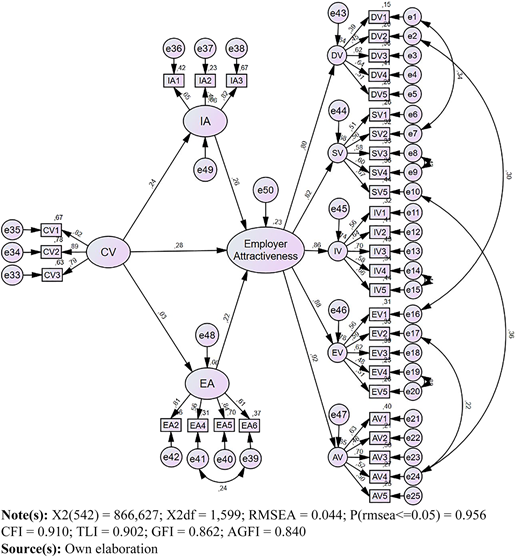
Through Structural Equation Modelling (SEM), which resulted from the previous steps, we were able to conclude that the model was well adjusted, and we were able to analyze the relationships between variables, proposed in the study hypotheses (see Figure 2). By testing the hypotheses, it was possible to conclude the direct relationships between the variables: CV-IA, CV-EmpAt, IA-EmpAt and EA-EmpAt; and the indirect effect of CV in the EmpAt, mediated by IA. Thus, it was possible to prove the hypotheses H1, H2a, H3a, H3b and H4a, while hypotheses H2b and H4b were not supported (see Table 5).
Hypotheses
| Hypotheses | Empirical evidence |
|---|---|
| H1) For employees/candidates, the opportunity to participate in a CV program is positively related with the perceived EA | Yes |
| H2a) The opportunity to participate in a CV program is positively related with the employees/candidates’ intrinsic attributions of the intentions of the company with CV programs | Yes |
| H2b) The opportunity to participate in a CV program is negatively related with the employees/candidates’ extrinsic attributions of the intentions of the company with CV programs | No |
| H3a) The employees/candidates’ intrinsic attributions of the companies’ intentions with the CV programs are positively related with the perceived EA | Yes |
| H3b) The employees/candidates’ extrinsic attributions of the companies’ intentions with the CV programs are negatively related with the perceived EA | No |
| H4a) The relationship between the opportunity to participate in a CV program and the perceived EA is positively mediated by intrinsic attributions about the company’s intentions with the CV programs | Yes |
| H4b) The relationship between the opportunity to participate in a CV program and the perceived EA is negatively mediated by extrinsic attributions about the company’s intentions with the CV programs | No |
Source(s): Own Elaboration
As seen previously, in recent decades, companies have been betting on CSR programs as an attraction strategy, since several studies (Donia et al., 2017; Turban and Greening, 1997) have shown that both candidates and employees are more attracted to a company that has a strong social impact. Thus, in this study, the relationship between CSR and EmpAt was evaluated through the CV programs, where it was attempted to understand if this relationship actually exists and if its impact is direct and positive.
Based on the validation of H1 (which evaluated this direct relationship) and since the results prove that this relationship is positive and statistically significant, it is concluded that, in fact, the CV programs have an impact on the attractiveness of a company. The relationship between the CV programs and the candidates/employees’ attribution results was more apportioned since the direct relationship between CV and IA has been proven through H2a, this relationship being positive and statistically significant (0.181). On the other hand, the H2b that hypothesized the relationship between the CV and the EA has not been proven, since this was not statistically significant (ρ = 0.649). Additionally, there was also no statistically significant correlation between the two variables, and therefore, this hypothesis has not been proven.
As we have seen, both types of attributions presented mean values close to four, with the extrinsic (3.939) having a slightly higher value than the intrinsic (3.349), which means that both types of attributions have a high importance for employees/candidates. This can be useful to companies as they realize that they should pay more attention to the attributions that employees/candidates make about them. According to this, H3a and H3b were assessed, respectively, the direct relationship between IA and EA with the EmpAt. H3a was confirmed, and H3b was rejected, as the relationship is not negative. On the contrary, it is positive. These relationships are also explicit with significant correlations observed between the IA (0.268) and the EA (0.166) with EmpAt. Hence, this proves that IA does in fact have a positive and direct impact on the attractiveness of companies, while EA also influences this attractiveness, but to a lesser extent. Through the analysis of the direct and indirect effects of the variables, we could conclude that there was an indirect relationship between CV and EmpAt through IA, and therefore H4a was proven. On the other hand, and due to the lack of a relationship between CV and EA that resulted in H2b not being validated, H4b was also not validated since there was no indirect effect of EA between CV and EmpAt.
4.2 Discussion
Looking at the sociodemographic data of our study, we can see some interesting correlations. Regarding gender, we highlight the positive correlations with CV (0.202), EmpAt (0.201) and IA (0.124), which shows that, on average, it is the women who give the most importance to CV programs and to EmpAt. It is also interesting to note the negative correlation between Academic Degree and EmpAt (−0.151), which turned out to be an interesting and curious fact. We also find it interesting to analyze the correlations between the EmpAt scale values individually with the other variables. Thus, we saw that they are all correlated between them, as we expected. It was also noted that all values are positively and significantly correlated with the model variables, with the exception of IV and AV values with EA, what turned out to be curious and interesting.
As seen previously, in recent decades, companies have been betting on CSR programs as an attraction strategy, since several studies (Donia et al., 2017; Kim et al., 2010; Turban and Greening, 1997) have shown that both candidates and employees are more attracted to a company that has a strong social impact. Thus, in this study, the relationship between CSR and EmpAt was evaluated through the CV programs, where it was attempted to understand if this relationship actually exists and if its impact is direct and positive. Based on the validation of H1 (which evaluated this direct relationship), it is concluded that CV programs have an impact on the attractiveness of a company, which is in line with what is stated in the literature (Oliveira et al., 2021; Tuffrey, 1995; Turban and Greening, 1997).
For companies, this relationship represents a valuable contribution as they can use these results to engage more in these initiatives, improving and developing them so that they bring the best possible results. As this is still a recent practice in the business world and, particularly in Portugal (Magalhães and Ferreira, 2014), the assessment of its status for employees/candidates is important for companies. We can see that this variable demonstrated an average value close to four (3.568), which reveals that the study participants attach significant importance to CV and show interest in these programs. The results also show what was previously mentioned in the literature (Donia et al., 2017; Klimkiewicz and Oltra, 2017) regarding the importance given by young people in relation to CSR since the average age of the respondents was around 27 years.
Before assessing the indirect impact of attributions on the relationship between CV programs and EmpAt, we analyzed the direct relationship that programs have on IA and EA. We have already seen that the general public is often suspicious of companies’ intentions with CV programs (Nishii et al., 2008; Parcha, 2017; Roeck and Delobbe, 2012) and that they often evaluate these intentions as being illegitimate, self-promoting and social washing (Gatignon-Turnau and Mignonac, 2015; Lange and Washburn, 2012; Troje and Gluch, 2020). It was proposed by Gatignon-Turnau and Mignonac (2015) that CV programs grow not only by the support that companies give to these programs but also by the evaluations made about them by the stakeholders. This idea has been analyzed in this study, and we tried to understand these attributions from the perspective of employees/candidates.
The direct relationship between CV and IA was proven through H2a, this relationship being positive and statistically significant (0.181), as the literature predicted (Gatignon-Turnau and Mignonac, 2015). On the other hand, the H2b that hypothesized the relationship between the CV and the EA has not been proven, since this was not statistically significant. So, the willingness to participate in CV programs within firms is related with IA but is not related with EA.
Another important direct relationship analyzed in this study was between the attributions and EmpAt. As we have seen, both types of attributions presented mean values close to four, with the extrinsic (3.939) having a slightly higher value than the intrinsic (3.349), which means that both types of attributions have a high importance for employees/candidates. Moreover, H3a and H3b assessed, respectively, the direct relationship between IA and EA with EmpAt. Both relationships are also corroborated by the significant correlations observed between the IA (0.268) and the EA (0.166) with EmpAt. Hence, this proves that IA does in fact have a positive and direct impact on the attractiveness of companies as predicted in the literature (Bhattacharya et al., 2008; Clary and Snyder, 2002; Cui et al., 2003; Strahilevitz, 2003; Yoon et al., 2006). Moreover, EA also has a positive impact on the attractiveness of companies, contrary to what was initially envisaged. A detailed analysis of the EA scale items reveals that the respondents consider it appropriate for a company to use volunteering initiatives as a way of responding to competition and strengthening its reputation and thus attracting more customers and more profits. We can consider that the respondents consider these motivations legitimate since they also explain the attractiveness of the company for them. For a negative relationship to be more expectable, some more illegitimate motivation on the part of the company would have to be attributed, namely, motivations that can damage the image of the company that happens to be seen as manipulative and self-promoting (Allen et al., 2011; Campbell and Kirmani, 2000; Holt, 2002; Yoon et al., 2006).
These results are important for companies as they get to know the perspectives of employees/candidates about them, allowing them to modify and develop efforts to improve their image and attractiveness, in the eyes of these stakeholders.
The main relationships that this study intended to analyze had to do with the relationship between the CV and EmpAt, mediated by the attributions, from the perspective of employees/candidates. With H4a, the effect of IA mediation was analyzed, while with H4b, we analyzed the mediation effect of EA. Through the analysis of the direct and indirect effects of the variables, we could conclude that there was an indirect relationship between CV and EmpAt through IA, and therefore H4a was proven. On the other hand, and due to the lack of relationship between CV and EA that resulted in H2b not being validated, H4b was also not validated since there was no indirect effect of EA between CV and EmpAt. These results open the way for the need for further investigations about these relationships.
4.2.1 Theoretical contributions and research implications
The main contribution of our research is to the HRM department. The labor market is increasingly facing a war for talent, so in order to compete fiercely against its competition and to gain a competitive advantage, HRM has to be aware of what happens in the job market and the preferences of potential candidates for companies.
At the same time, progressively more today than ever before, the younger workforce – generation Z and millennials – not only want but expect their employers to offer distinctive workplace environments, where rewarding, engaging and meaningful as well as proportionately positive workplace experiences exist. For the companies that offer possibilities of CV, some benefits may arise, such as attracting and retaining talent, increasing productivity, introducing a sense of purpose, generally satisfying the employee engagement challenge.
Since the concept of CV is relatively recent in the Portuguese business environment (Magalhães and Ferreira, 2014), this study provides important information for companies wishing to have this type of program and allows companies that already have them, to improve and to adapt them. In theoretical and methodological terms, this study has allowed for an improvement in scale resulting from the joining of items from two previously validated scales associated with the EA and IA that employees make about the companies’ actions.
5. Conclusions, contributions and limitations
A significant limitation of this study has to do with the fact that the study sample is a convenience sample that, despite having its advantages, also has the disadvantage that it may not be representative of reality and therefore it is necessary to be cautious in generalizing the results. Another major limitation is the fact that the questionnaire was applied only online and through social networks, which limited our sample as many people do not have social networks, which prevented them from participating in the study. As for the sample, the fact that most respondents (55.1%) belonged to the areas of Social Sciences and Law greatly limited the generalization of our study since, in reality, many people belong to other areas of study. For future research, it is advisable to analyze these limitations and adapt them to other studies. It is also suggested that other possibilities of approach be considered, for example, in terms of time, as this study was limited to a short period of time. Thus, it may be interesting to do it from a longitudinal perspective.
It is also recommended that different approaches to CV be considered, for example, it would be interesting to see how companies integrate these practices and programs in their strategies. It would also be interesting to change the focus of the study and focus only on companies that already have these programs, in order to accurately evaluate the results of these and the opinions of their stakeholders.
Literature has proved the strong relationship that a company’s image has with its social aspect through the positive impact that these programs have on the company’s image and its attractiveness (Duarte et al., 2015; Greening and Turban, 2000; Klimkiewicz and Oltra, 2017). In summary, in addition to the proof of the relationship between CV and EmpAt supported in the literature, it has been possible to conclude that the IA that employees/candidates make about companies’ intentions with CV programs positively influence their attractiveness; the same was not possible to prove regarding EA.
This study aims to reinforce this relationship, analyzing the influence that the CV programs have an impact on the attractiveness of companies, this relationship being mediated by the attributions that employees/candidates make about the true intentions of companies, that is, whether the intentions of companies with the implementation of these programs are extrinsic or intrinsic, showing the importance of respondents recognizing genuine or intrinsic motivations of social responsibility on the part of organizations.
Marisa R. Ferreira gratefully acknowledges financial support from FCT—Fundação para a Ciência e Tecnologia (Portugal), national funding through project UIDB/04728/2020.
Note
Henceforth, employees/candidates.

