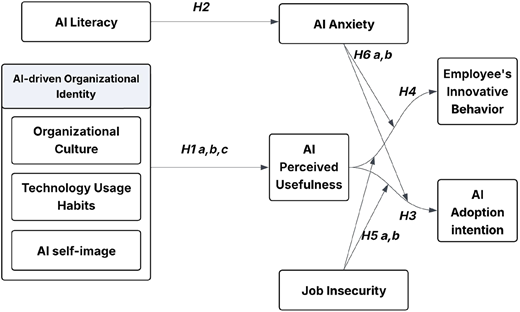
This research aims to identify the key organisational, cognitive, and psychological predictors of perceived usefulness of artificial intelligence (AI) and to evaluate their influence on the AI adoption intention and innovative behavior of employees in the Jordanian setting.
A strict quantitative research design was adopted in the current study in which a structured online questionnaire was conducted among employees working in various industries in Jordan, mainly IT, retail, and banking. Quantitative data comprising 388 valid responses were then analyzed using partial least squares structural equation modeling to assess both the direct effects as well as moderating relationships between the constructs of interest.
The results show that organizational culture (β = 0.216), technology usage habits (β = 0.278), and AI self-image (β = 0.195) positively influence AI perceived usefulness, while AI literacy significantly reduces AI anxiety (β = −0.482). AI perceived usefulness strongly predicts employee innovative behavior (β = 0.608) and AI adoption intention (β = 0.657). Job insecurity weakens the relationship between perceived usefulness and adoption intention (β = −0.234), but its moderating effect on innovative behavior is insignificant. AI anxiety also weakens the effects of perceived usefulness on adoption intention (β = −0.208) and innovative behavior (β = −0.180).
A socio-psychological approach is used in this investigation, highlighting the significance of identity congruence and the importance of affective processes in the adoption of AI. It anticipates psychological and emotional engagement of employees in AI, breaking the false belief that acceptance is dictated by technical or rational factors only.
Introduction
Artificial intelligence, commonly referred to as AI, is currently experiencing a fast transformation in the context of organizational functions, decision-making, and the overall value creation process. When exploring modern organizational dynamics, one will notice that AI applications, specifically, predictive analytics, conversational interfaces, and intelligent automation tools, are radically transforming the workflow of procedures in a wide array of industries. These technologies simplify the daily processes and at the same time enable more informed and strategically sound decision-making (Kaggwa et al., 2024). In developing countries, like Jordan, AI implementation has become a national focus, with government-led digital transformation policies and changes in regulations supporting it (Al-Tarawneh and Khalaf, 2025). The promised outcomes of these developments are significant improvements in the efficiency of operations, the reduction of costs, and an increase in the level of innovation; however, they also bring with them major challenges related to workforce preparedness, emotional employee acceptance, and overall organizational alignment.
As technological infrastructure keeps improving, the involvement of employees in AI programs is often behind schedule. Implementing AI systems into daily workflows requires more than technical skills. It also involves cognitive adaptation, attitudinal change, and adjustments to professional identity. Employees may be required to interact with autonomous and self-directed systems, adapt to new digital processes, and assume new roles associated with hybrid human technology collaboration. These changes can create uncertainty, skills gaps, and psychological discomfort. Such challenges may be particularly pronounced in environments where digital literacy and change management capabilities are unevenly developed (World Economic Forum, 2024). Organizations that fail to address these human aspects face the risk of low adoption, misuse of AI systems, and low returns on their investment in technology.
Despite this, most existing research continues to focus on cognitive models of technology acceptance, such as the Technology Acceptance Model (TAM) and the Unified Theory of Acceptance and Use of Technology (UTAUT), which emphasize perceived usefulness and ease of use as primary drivers of adoption intention (Davis, 1989; Venkatesh et al., 2003; Choi et al., 2023). While these frameworks have proven robust in predicting general technology use, they underrepresent the emotional and identity-based processes that are critical to understanding employee engagement with AI systems (Tambe et al., 2022; Li et al., 2024). AI differs from previous digital technologies in its ability to learn, adapt, and act autonomously, features that can generate heightened emotional responses such as anxiety, fear of obsolescence, and job insecurity (Kim and Kim, 2024; Wu et al., 2024). These reactions can potentially disrupt the nexus between positive cognitive evaluation and real behavior, which leads to disengagement or opposition, even in those employees who realize the usefulness of AI.
To address this gap, the present study develops and tests a socio-psychological model of AI adoption in Jordan as a representative emerging economy. The model introduces AI adoption identity, defined as the extent to which employees internalize AI as consistent with their self-concept and their organization's AI-related environment. Conceptually, this construct differs from organizational readiness because it does not merely capture whether an organization possesses favorable conditions for technological change. Rather, it reflects the psychological congruence between employees' self-image and their organization's AI-related culture, technology-use habits, and expectations. Accordingly, these dimensions are theorized as interrelated foundations of an identity-based mechanism, rather than as a simple aggregation of existing constructs. This identity mechanism explains how organizational and behavioral cues become internalized and shape employees' evaluations of AI, particularly perceived usefulness (Tambe et al., 2022; Li et al., 2024).
The model further proposes that perceived usefulness influences both intention to use AI and employee innovative behavior, thereby extending technology adoption research beyond conventional acceptance outcomes toward discretionary and future-oriented engagement with AI (Sharma et al., 2025a). In addition, the study identifies important psychological boundary conditions by incorporating AI anxiety and job insecurity, which may weaken the positive effects of perceived usefulness on behavioral outcomes (Huang and Gursoy, 2024; Song and Tan, 2025). Finally, AI literacy is positioned as a key psychological resource that can reduce anxiety and strengthen employees' readiness to engage effectively with AI (Kaewsawad and Duda, 2025; Gao et al., 2025). Together, these relationships advance an identity-based explanation of AI adoption that integrates self-concept, organizational context, perceived utility, and psychological constraints within a unified framework.
This study contributes substantially to the knowledge on the adoption of AI in organizations. It assumes that AI-driven organizational identity is a key antecedent which influences how employees perceive the usefulness of AI and thus offers an identity based perspective to technology-adoption theory. The research also shows that perceived usefulness not only influences the intention to use AI but also innovative behavior, hence broadening the conceptual framework of the notion of acceptance to the proactive use of AI. In addition, it makes clear that moderating effects of AI anxiety and job insecurity may dampen positive adoption effects, and AI literacy can become a critical variable that eliminates anxiety and strengthens preparedness. By combining various theoretical viewpoints, the present research would aim at offering an in-depth analysis of the interplay between technological change and employee psychological reaction in the setting of an emerging economy.
Literature review and hypotheses development
Theoretical background
A nuanced understanding of how employees will react to AI in organisational settings requires a theoretical framework that distils mechanisms of cognition, affect, and identity. Despite the fact that the TAM model (Davis, 1989) provides a decent base by predicting the perceived usefulness and ease of use, its cognitive focus is not enough to describe the more complex psychological landscape that encloses the adoption of AI. AI systems diverge radically with previous digital tools: autonomous, adaptive, and sometimes opaque in nature bring about ambiguity and deprive people of a sense of control, which leads to stress, resistance, and uncertainty (Pulido-Martos et al., 2024; Kim and Kim, 2024). At the same time, AI presents a serious issue of professional identity and possible deprivation of employment (Gao et al., 2025). These facts highlight the need to expand traditional frameworks with the integration of affective and identity-based dynamics that represent better the manner in which employees perceive and react to AI in modern workplaces.
The proposed research model builds on the Technology Acceptance Model by absorbing theoretical contributions of Identity Theory (Ashforth and Mael, 1989) and Affective Events Theory (Weiss and Cropanzano, 1996) (See Figure 1). It theorises an AI-driven organisational identity, supported by organisational culture, habitual technology use, and an internal image of AI, as a relevant antecedent of perceived AI usefulness. As assumed in Tambe et al. (2022) and Li et al. (2024) employees are expected to have a higher tendency to use technologies that appeal to their professional self-concept and institutional values. In turn, perceived usefulness triggers the intentions to adopt AI and displays innovative behaviour. In line with this logical course of action, the Affective Events Theory prefigures the injection of emotion, namely AI anxiety, in hampering the process of positive perceptions of usefulness to actual behaviour. As Huang and Gursoy (2024) show, increased anxiety may trigger avoidance or withdrawal, despite the positive implications of AI being realized by employees. In this context, AI literacy is introduced as the prerequisite of emotional preparedness: increased technical knowledge reduces anxiety and reinforces the feeling of control, according to Na et al. (2023). Besides, the perceived job insecurity due to AI is theorized as the other emotional obstacle that neutralizes the impact of the perceived usefulness on behavioral consequences. The study advances an extended socio-psychological AI adoption model that enriches TAM by incorporating identity alignment, affective factors, and skill readiness to explain employee engagement with AI in complex organizational contexts.
AI adoption identity and perceived usefulness
According to the identity theory, individuals will assess workplace technologies in terms of their self-concept, thus matching their behaviour with organisational values and professional identity (Ashforth and Mael, 1989). This correspondence occurs as AI adoption identity, a multidimensional construct that involves the perceptions of an AI-friendly organisational culture, habitual digital usage, and a self-confident image about AI (Tambe et al., 2022; Li et al., 2024). These aspects collectively constitute the cognitive evaluations among employees of the applicability and usefulness of AI in their professional activities.
The organisational culture, which actively promotes experimentation, constant learning, and digital transformation, is an essential aspect to legitimize the need to adopt artificial intelligence. Once employees perceive the environment in this way, they are more likely to view AI as an effective and compatible tool rather than as a threat (Khan et al., 2025; Al Wael et al., 2024). On the individual level, the established technology usage habits lessen cognitive friction, and AI integration becomes the extension of the already existing behaviors (Evans and Stanovich, 2013; Wang et al., 2023). In addition, those employees who developed a high AI self-image, including the confidence with their technical skills and adaptability, were more likely to consider AI as a way to improve job performance and professional value (Patel and Singh, 2023; Rahman et al., 2023). Together, these elements of identity help to generate positive cognitive appraisals, particularly, an increase in perceptions of AI usefulness.
AI adoption identity comprising (a) perceived AI-supportive organizational culture, (b) technology usage habits, and (c) AI self-image—positively influences employees' perceived usefulness of AI.
AI literacy and AI anxiety
AI has significant potential to optimize and simplify professional work. However, its use is often accompanied by AI anxiety, a psychological state characterized by fear, unease, or resistance when interacting with AI systems. It is a fear to a great degree caused by the impressions of technological non-transparency, a lack of transparency in algorithms, and fears of job loss (Kim and Kim, 2024; Wu et al., 2024). These emotion-related reactions may serve as very strong obstacles to adoption, undermining the trust in the institution and increasing the perceived risk of adopting AI into workplace practices.
Recent studies have shown that AI literacy is a crucial variable in the mitigation of anxiety and the promotion of confidence in AI-penetrated workplaces. It is described as the formal knowledge of employees about the concept of interacting with AI, and their practical skills (Khan et al., 2025). Increased expertise in this area strengthens the sense of control, uncertainty management and development of more accurate expectations, all of which variables are empirically related to less anxiety in technology-mediated settings (Li et al., 2024; Zhang et al., 2023). As employees become more AI literate and perceive AI as increasingly compatible with their work, their affective responses are more likely to shift from anxiety or uncertainty toward confidence and curiosity.
From an organizational psychology perspective, the increased AI literacy creates a more psychologically safe environment to adopt. Employees with a more profound understanding of AI will have more chances to view it as an enhancement tool instead of a threat and develop more positive affective reactions and increased confidence in using AI (Liu et al., 2025). In its turn, AI literacy is a psychological buffer that helps to neutralize the negative responses and engage with technological change in an adaptive manner.
AI literacy negatively influences employees' AI anxiety.
AI perceived usefulness and adoption intention
Perceived usefulness (PU) which is a belief that a system can help in job performance is another strong predictor of technology adoption (Davis, 1989). In the context of AI, where the systems become autonomous and adaptive, PU plays a particularly crucial role in shaping the desire of employees to embrace, adopt, and rely on such technologies. As it is in line with TAM model and its further derivations, PU has a direct effect on the behavioral intentions towards using AI (Venkatesh et al., 2003). Employees in modern AI enabled workplaces who perceive AI as useful are more likely to develop strong intentions to use and rely on it for decision making, task automation, and more sophisticated analysis. The practical utility of AI-related benefits, including enhanced precision, faster processing, and improved service quality, can reduce resistance and promote the sustained use of AI tools (Dwivedi et al., 2023). On the other hand, the advanced AI systems are prone to disregard or rejection when perceived usefulness reduces. Further, the perceived usefulness is the central cognitive channel by which the organisational readiness, personal competence, and alignment of roles are converted into intentions to use new technologies. When employees believe in the digital goals of their organization as well as consider that they are competent enough to communicate with AI, they find the technology more advantageous hence strengthening their intention to use AI (Kumar et al., 2025). This mechanism is especially consequential when it comes to voluntary adoption situations, where perceived usefulness often decides whether the implementation in the end is successful.
Perceived usefulness of AI positively influences employees' AI adoption intention.
AI perceived usefulness and employees' innovative behavior
Innovative behavior refers to employees' efforts to identify workplace problems, develop and promote new ideas, and implement practical solutions (Liu et al., 2026). In AI-enabled work contexts, innovative behavior involves employees generating and implementing novel and useful ideas through their interaction with AI. In the current AI-driven organisational environment, PU takes on increased salience, as a critical indicator of not only the incremental improvement in operational efficiency and diagnostic accuracy but also the hidden possibility of increasing creativity and developing substantive value creation (Sharma et al., 2025a, b). Individuals who believe that AI can significantly improve the quality of decisions, accelerate the routine working process, or support the emergence of new solutions demonstrate a significantly higher tendency to pursue the experimental approach and demonstrate new behaviour patterns (Dwivedi et al., 2023; Wu et al., 2024).
Simply stated, the connection between PU and innovation is more than mere raw instrumental value; it is a complex expression of underlying motivational forces. In line with the componential theory of creativity, opinions of utility add to intrinsic motivation, which drives innovative performance (Amabile and Pratt, 2016). In this regard, once employees perceive AI as helpful, they are more willing to put effort into its creative implementation, the trend that can be observed across various sectors where AI implementation predicts proactive innovation beyond the use of the systems (Sharma et al., 2025a). In addition, the identity alignment and organisational values are actualized by means of PU. In the case where employees believe that AI fits their professional identities and organisational missions, PU becomes a driver of exploratory behaviour and innovative exploitation (Tambe et al., 2022; Choi et al., 2023). Instead of just actively adhering to prescriptive use requirements, these people are creative in their application of AI beyond the norms. As a result, PU is not only an engine behind the use of technology but also a critical facilitator of innovation in AI-powered workplaces.
Perceived usefulness of AI positively influences employees' innovative behavior.
AI job insecurity as moderator
Along with the growing interest in AI as a productivity and organizational efficiency driver, the increasing integration of AI in the workplace has also increased employee fears about job loss, loss professional roles, and the devaluation of the remaining skills (Khan et al., 2025). These fears are summarized in the AI job insecurity construct, which is a conceptualization that refers to dread of automation and intelligent systems reducing professional know-how or eventually replacing human labor (Liu et al., 2025). Relying on a vast amount of literature on technological change and work disruption, AI-related insecurity was associated with negative effects, such as weaker organizational commitment, a greater level of psychological distress, and a greater reluctance to adopt new practices (Jafar et al., 2026).
Job insecurity is an effective psychological moat that diminishes the effect of perceived usefulness in the modern AI-based work environment. The threat perception may suppress the development of these appraisals into behaviour intentions or behaviors even in instances where employees have recognized the beneficial aspects of AI. In line with the threat-rigidity theory, defensive responding, i.e. avoidance or resistance, but not proactive participation is supported by salience of risk (Huang and Gursoy, 2024; Lee and Park, 2023). In turn, the motivational continuum between the perceived usefulness and the adoption of AI and innovative behavior is weakened.
Since the innovation is conditional upon the psychological safety, the sense of control, and risk-taking (Amabile and Pratt, 2016; James et al., 2024), job insecurity undermines the conditions that provoke the employees to translate the positive evaluation of AI into practice. The fear of being displaced will produce resistance, delay adoption, reduce exploration, even when the use of AI is perceived as helpful. Thus, the relationship between perceived usefulness and resultant behavioral intentions will be expected to be mitigated by the phenomenon of AI-related job insecurity.
AI job insecurity negatively moderates the relationship between perceived usefulness and employee outcomes. Specifically, higher levels of AI job insecurity weaken the positive effects of perceived usefulness on (a) AI adoption intention and (b) innovative behaviour.
AI anxiety as moderator
Even though it is generally accepted that PU is a strong predictor of both technology adoption and innovative behaviour (Park et al., 2025; Kumar et al., 2025), the implementation of this idea may be undermined by the affective attitudes of the employees, in particular, the fear of AI. This type of anxiety refers to the feeling of unease or discomfort people have towards AI systems, which is often caused by the fear of its complexity, absence of transparency, or even malfunction (Kim and Kim, 2024; Wu et al., 2024). Consequently, employees will be mindful of the advantage of AI but will be reluctant to use it, which leads to a disparity between the perceived value and behaviour.
Using the theory of Affective Events (Weiss and Cropanzano, 1996) to support the argument, emotions in the workplace mediate attitudes and behaviors by strengthening or derailing the generally rational decision-making processes. Such negative affective states as anxiety can narrow attention bandwidth, decrease the desire to take risks, and increase avoidance behavior, thus reducing the motivational effectiveness of the cognitive assessment process including perceived usefulness (Pulido-Martos et al., 2024; Huang and Gursoy, 2024). The reverse is also true since employees are more likely to act when anxiety is reduced and work with AI tools more confidently and naturally integrate the latter into their daily activities and creative problem-solving processes.
Empirical evidence that has been provided lately supports the importance of this moderating effect. It has been proven that AI anxiety leads to reduced adoption intention as well as the inhibition of experimentation and innovative behavior, even in employees who do not refute the usefulness of AI (Song and Tan, 2025; Yu et al., 2026). Psychological safety needed to explore new tools and adopt emerging technologies in a positive way is lost in such situations because of anxiety. Based on this, AI anxiety shall have an adverse moderating effect on the connection between perceived usefulness and key behavioral outcomes.
AI anxiety negatively moderates the relationship between perceived usefulness and employee outcomes. Specifically, higher levels of AI anxiety weaken the positive effects of perceived usefulness on (a) AI adoption intention and (b) innovative behaviour.
Methodology
The sample used in the present study was acquired through an online questionnaire that was distributed on different social media platforms in the period between September and December 2025. Ethical approval of the study was obtained at the lead author's university (BUS-2025-AUG-ETHics-315). The involvement was voluntary; all participants were informed about the purpose of the study and guaranteed that their confidentiality would be ensured. The inclusion criteria required two inclusion criteria: (a) a minimum of six months of residency in Jordan, and (b) the age of eighteen years. The sample size was 388 valid responses, which were chosen among employees who work in different professional fields in Jordan. The necessary sample size was determined with the help of G*Power software, which provided 146 responses with a statistical power of 0.95, an alpha value of 0.05, and an expected effect size of 0.15. Of the 523 responses received, 37 did not meet the study's inclusion criteria, while 98 were excluded because at least 80% of the questionnaire items were incomplete. This resulted in a final valid sample of 388 responses, which still exceeded the minimum required sample size and was considered adequate for the analysis. The questionnaire was separated into two sections. The first section collected respondents' sociodemographic characteristics of the participants enumerating the variables (age, gender, educational attainment, and occupational status). The operationalised and quantified theorized constructs in the research model were contained in the following section and therefore, enabled a rigorous empirical analysis.
The demographic characteristics of the respondents show that most of them were males (71%, n = 275), and females were 29% (n = 113) out of 388 valid responses. In terms of age, 32% (n = 124) of the participants were aged 18–28, 25% (n = 97) aged 29–39, 22% (n = 85) aged 40–50 and 21% (n = 82) aged above 51. Regarding employment sector, the respondents were mostly employed in IT (24%, n = 93) and retailing (21%, n = 81) with the next ones being banking (18%, n = 70) and education (13%, n = 50). Smaller shares were employed in healthcare (10% n = 39), tourism (9% n = 35) and other (5% n = 20). Regarding education, most of the participants had an undergraduate degree (76% n = 295), and 24% (n = 93) had a postgraduate degree.
The measurement items used in this research were based on well-established antecedent research studies and were measured using a five-point Likert scale (see Appendix1). The questionnaire was assessed using two procedures. To begin with, the instrument was evaluated by a panel of four experts in human resources and information systems in terms of content relevance and readability. Second, thirty respondents (chosen to reflect the entire range of sociodemographic variables) were pre-tested to assess the clarity of the questions as well as to determine the average response time, which was approximately ten minutes. According to the feedback received after these two processes, some small language improvements were made.
The analysis of the research model was conducted using SmartPLS (version 4) with the Partial Least Squares (PLS) algorithm. PLS is a flexible statistical modeling system that is used extensively in the analysis of multivariate data as well as in the deconstruction of complex relationships between latent constructs. PLS eliminates the requirement of normal data distribution by combining the multiple linear regression with the principal component analysis (Hair et al., 2022). The empirical evaluation of skewness and kurtosis revealed that the data did not follow a normal distribution; hence, the use of the PLS method is methodologically justifiable.
Results
Preliminary data analysis
Before starting the data analysis, we checked the possibility of multicollinearity and common method bias (CMB). To conduct the multicollinearity test, the variance inflation factor (VIF) criterion was used, according to which VIF values should not exceed 3 (Hair et al., 2022). Based on this, there was no sign of multicollinearity, and the values of VIF were between 1.499 and 1.022 (see Table 2). Harman single-factor method was used in order to assess the existence of CMB, the total variance of all items of measurement was 37%, which is less than 50%, thus demonstrating that there was no CMB (Podsakoff et al., 2003).
Measurement model evaluation
In order to test the measurement model, we initially tested its reliability and its validity. The standardized loadings of each indicator were higher than the traditional threshold of.708, thus validating the indicators (see Table 1). Additionally, composite reliability (CR) values of over 0.80 were used to support internal consistency across all constructs (Hair et al., 2019).
The convergent validity of the instrument was satisfactorily proven (see Table 1), since the calculated average variance extracted (AVE) scores were above the set minimum of 0.50 of all reflective constructs, which is in line with the recommendations of Hair et al. (2022). In addition, the discriminant validity was established by using both the Fornell-Larcker criterion and the heterotrait-monotrait (HTMT) ratio; the estimates of the HTMT were always less than the conservative cut-off of 0.85 (see Table 1). Combined, these findings suggest that the measurement model has the psychometric strength required by Hair et al. (2019).
Structural model results
The structure model was carefully assessed by examining path coefficients (β), the percentage of variance explained (R2), effect sizes (f2) and statistical significance of the hypothesized relationships, using 10,000 bootstrap resampling runs (Hair et al., 2022). In line with hypothesis H1a-c, our empirical results show that organizational identity variables associated with AI have a positive effect on the perceived usefulness of AI. These findings (see Table 2) also determine three salient variables that reinforce perceptions of AI utility: a positive organizational culture (β = 0.216, p < 0.001), a common habit of using technology (β = 0.278, p < 0.001), and a positive AI self-image (β = 0.195, p < 0.001). It is also determined in the analysis that AI literacy has a statistically significant negative correlation with AI anxiety (β = −0.482, p < 0.001). In turn, the increased amounts of knowledge in the field of AI seem to mitigate the fears of employees about AI technologies, thus providing empirical support to hypothesis H2. As hypothesized, the perceived usefulness of AI has a strong positive effect on the innovative behaviour of employees (β = 0.608, p < 0.001), thus supporting H3. Similarly, the perceived usefulness of AI is a strong predictor of AI adoption intention (β = 0.657, p < 0.001), which supports H4. All these findings confirm that perceived usefulness is the main driving force behind the two observed behavioral outcomes.
In terms of the moderating impact of job insecurity, our empirical evidence indicates a negative and statistically significant moderating impact on the relationship between the perceived usefulness of AI and intention to adopt AI (β = −0.234, p < 0.001), thus supporting hypothesis H5a. On the other hand, the moderating role of job insecurity on the relationship between the perceived usefulness of AI and employee innovative behaviour was not statistically significant (β = −0.030, p > 0.5), thus not supporting hypothesis H5b. On the other hand, the two relationships under examination had significant negative moderating effects of AI anxiety. In particular, AI anxiety intensity moderated the positive influence of AI perceived usefulness on AI adoption intention (β = − 0.208, p < 0.001), which supports hypothesis H6a. The same negative moderation was observed in the case of employee innovative behavior (β = −0.180, p < 0.001), which supports hypothesis H6b. The combination of these results indicates that anxiety lowers the degree to which perceived usefulness is translated into positive behavioral results. The strong effect of perceived usefulness on innovative behaviour (β = 0.811, p < 0.001) may raise concerns about construct overlap or common method bias. However, Table 2 shows no problematic multicollinearity, supporting construct distinctiveness; where full-collinearity VIFs are within acceptable thresholds, CMB is also unlikely to explain the result. Thus, the coefficient likely reflects the central role of perceived usefulness in driving AI-related innovative behaviour.
The model has a moderate explanatory power (Henseler et al., 2009). In particular, AI adoption intention, employee innovative behavior, AI perceived usefulness, and AI anxiety were identified to have R2 of 0.519, 0.479, 0.323, and 0.232, respectively. These statistical findings clearly show that the suggested framework explains a significant fraction of the variance in the main endogenous constructs. Besides, the calculated effect size indices (f2) are distributed in the traditional range of small to large magnitudes. The strongest effect was produced by the correlation between perceived usefulness of AI and innovative behavior of employees, and this was f2 of 0.811.
Finally, the indirect effects show that technology use habits, organisational culture, and self-conceptions about AI all have an influence on employee outcomes through the perceived usefulness of AI, and all four pathways are positive and statistically significant (see Appendix 2). Digitally engaged employees, with strong cultural support, or with a self-confident concept of AI would be more likely to regard AI as helpful, thus the perceived usefulness increases their desire to use AI and their innovative behaviour. In general, perceived usefulness turns out to be the key driver that connects the aspects of identity to the behavioral reaction.
Discussion
The current research offers solid empirical evidence to a holistic model that explains employee AI adoption and innovative behavior in organizational settings. The results highlight the critical importance of the perceived usefulness of AI as the most common explanatory factor that drives the intention to use AI and innovative behavior of employees, which is consistent with the existing theories of technology acceptance and diffusion of innovations.
First, the AI-based organizational identity, which is reflected in a supportive culture, habitual use of technology, and positive AI self-image, claims itself as a strong positive predictor of perceived usefulness of AI. This observation suggests that organizational milieu does shape the cognitive appraisals of employees towards AI, and thus, identity-based explanatory models can be applied to the wider context of AI acceptance. Previous studies find that a supportive organisational culture is critical in enhancing the perceived usefulness of AI. Organizational readiness, along with organizational policies that encourage AI, can enable its adoption by reducing the barriers to implementation and enhancing the perceived usefulness (Huynh and Khoa, 2025; Al Wael et al., 2024). In the same vein, the organisational culture of data-driven technology use has a positive effect on the perception of AI usefulness, particularly when it is supported by the practices that encourage the frequent engagement with AI systems (Park et al., 2025; Dabbous et al., 2022). Moreover, a positive AI self-image can strengthen perceived usefulness, as employees who trust AI and view it as compatible with their professional capabilities are more likely to recognize its practical value. While this link may vary across contexts, its importance lies in shaping whether AI capabilities are perceived as genuinely useful in practice (Güven et al., 2024; Nakash and Bolisani, 2025).
Second, the results demonstrate that AI literacy significantly reduces AI anxiety, highlighting the importance of employee competence and understanding in mitigating technology-related fears. This finding reinforces the argument that knowledge-based interventions are critical for fostering psychologically safe environments in AI-enabled workplaces. Empirical studies show that high level of AI literacy is associated with a decrease in AI anxiety (Khan et al., 2025). Such literacy helps reduce the fear that people may experience due to uncertainty and misunderstandings, particularly, fears about losing their jobs and becoming dependent on the technologies (Uygungil-Erdogan et al., 2025; Dhilipan et al., 2025). This increased understanding can be used to reduce anxiety over job security and over-reliance on technology and thus produce a quantifiable reduction in the levels of anxiety (Gao et al., 2025).
Thirdly, the perceived usefulness of AI proves to be a potent predictor of the adoption intention and innovative behavior, thus, supporting its pivotal role in the transformation of technological value cognitions into tangible behavioral expressions. More importantly, the explanatory power of the model is beyond recommended levels, hence demonstrating strong predictive validity. Empirical studies have revealed that the perceived usefulness is a central variable when it comes to shaping the attitude and behavioral intentions of the employees towards the adoption of AI (Kumar et al., 2025). Similarly, perceived usefulness becomes a key predictor of the intention of individuals to integrate AI-based systems into a continuum of organisational environments (Huynh and Khoa, 2025). Additionally, the available empirical evidence suggests that the perceived usefulness of AI is a critical force behind the adoption and innovations made in various fields. In the field of heavy manufacturing, an organisational culture of data use that enhances the perceived usefulness strengthens intention of adopters and contributes to innovative behaviour (Park et al., 2025). Likewise, in the digital entrepreneurship and tourism contexts, increased perceived usefulness increases adoption intentions and drives innovativeness and innovative practices (Sharma et al., 2025a, b).
The moderation analyses also indicate essential boundary conditions. The positive influence of perceived usefulness on adoption intention and innovative behavior is always undermined by AI anxiety, which indicates that emotional reactions may interfere with rational consideration of the benefits of AI. Although the literature on AI anxiety as a moderating factor in the nexus of perceived usefulness, adoption intention, and innovative behaviour is relatively under-explored, the available empirical evidence suggests that its inhibitory effect is both theoretically and practically important. AI anxiety increases the lack of trust in and perceived usefulness of the technology, thus dampening the willingness of employees to embrace AI and limiting their participation in innovative practices, as reported in literature (Song and Tan, 2025; Yu et al., 2026). Furthermore, high AI anxiety is predisposed to reduce experimentation with and active use of AI, thus restricting innovation even in situations where the attitude towards the technology is assumed to be positive (Frenkenberg and Hochman, 2025).
In the same manner, job insecurity has a negative moderating effect on the usefulness-adoption relationship, which implies that the threats associated with employment suppress behavioral intentions despite the perceived benefits of AI. Job insecurity is a strong moderator, which dilutes the relationship between the perceived usefulness of artificial intelligence and its future adoption. As a result, despite the fact that employees recognize the advantages of AI, the fear of losing a job lowers their desire to adopt such technologies (Chung et al., 2025; Kim and Kim, 2024). The threat of mass layoffs increases occupational stress and insecurity, which undermine the desire of employees to interact with AI solutions (Kang et al., 2024; Kim and Lee, 2025). Nonetheless, job insecurity is not a significant condition of innovative behavior, which means that the actions related to innovation can be motivated more by intrinsic or professional motives rather than by the employment security concerns. Nonetheless, previous literature indicated that job insecurity has its effects on innovative behaviour through a dual-channel process. It can stimulate innovation by motivating some employees to engage in proactive work behaviors in a bid to safeguard their jobs, and it can inhibit innovation by prompting withdrawal behaviors in others whose behaviour is motivated by fear and increased stress (Li and Li, 2022).
Theoretical implications
This study has made a great contribution to the academic debate around the adoption of technology and human-AI interaction. First, it provides an extension of existing acceptance models, including the TAM and UTAUT, by incorporating identity-related and emotional variables, namely AI adoption identity, AI anxiety and job insecurity as antecedents and moderating variables influencing perceived usefulness and subsequent behaviors. Even though these classic models have been found to be effective in explaining adoption intentions in diverse digital environments, they are found to underestimate the affective and self-conceptual factors that gain increased validity in the autonomous and adaptive technologies like AI (Kim and Kim, 2024; Wu et al., 2024).
Second, the research advances the field by identifying and empirically proving the construct AI-driven organizational identity, which can be described as the extent to which employees perceive alignment between their self-concept and the organization's AI culture, the current digital practices, and their perceived competence in AI (Tambe et al., 2022; Li et al., 2024). This way, it generalizes identity theory (Ashforth and Mael, 1989) to the contemporary digital work environment, which also provides the evidence that the interplay of individual and technological identities has a substantive impact on perceived usefulness. In turn, it adds a new explanatory context in which organisational culture and personal preparedness come together to shape cognitive appraisals about the value of AI.
Third, the current investigation broadens the scope of the scholarly research on AI adoption by shifting the traditional emphasis on use intention and integrating the innovative behaviour of employees as a fundamental variable. This kind of extension follows the recent academic calls to match AI implementation with discretionary, creative, and prospective organisational results (Pulido-Martos et al., 2024). Empirical evidence indicates that the perceived usefulness mediates between identity congruence and innovation, which adds to our understanding of the socio-psychological processes that give rise to innovative behavior in AI-based workplaces (Choi et al., 2023; Sharma et al., 2025a).
Lastly, this study will significantly contribute to the growing body of knowledge on information systems that are being developed in developing economies by carrying out the study in Jordan. In that regard, the rate of digital transformation is increasing faster, but the degree of institutional readiness and the competent capabilities of the labor force are quite heterogeneous (World Economic Forum, 2024; UNDP, 2024). The results highlight the importance of contextual determinants such as the issue of job insecurity and inequality in AI literacy levels impacting the adoption paths far more than in high-income and resource-abundant environments. As a result, the article provides a more globally and context-sensitive way of looking at AI integration.
Practical implications
The findings of this study provide several practical implications that are particularly relevant to the Jordanian context. The strong effects of organisational culture, habitual technology use, and AI self-image on perceived utilitarian value suggest that Jordanian organizations should approach AI adoption as a socio-organisational transformation rather than merely a technological investment. Managers, particularly in public-sector organizations, large service firms, and SMEs, should introduce AI gradually through familiar digital systems, task-specific pilot projects, and departmental AI champions. This approach is especially appropriate in Jordan, where many SMEs face financial, technical, and infrastructural constraints that can limit large-scale AI implementation.
The positive effect of AI self-image also indicates that Jordanian HR professionals should position AI competence as part of employees' professional development and career progression. Organizations could incorporate AI skills into development plans, recognize employees who use AI effectively, and provide role-specific training. Because AI literacy was negatively associated with AI-related anxiety, training should focus on practical applications rather than general awareness. For example, employees in Jordan's banking, education, healthcare, logistics, and public-service sectors could receive hands-on training tailored to AI applications within their specific work settings.
The significant effect of perceived usefulness on adoption intention and innovative behaviour further suggests that Jordanian managers should demonstrate the immediate benefits of AI before expecting broad employee acceptance. Pilot projects could target common organisational challenges, such as reducing administrative workload, improving customer-service response times, enhancing document processing, or supporting data analysis. Managers should communicate measurable outcomes, including time savings, improved accuracy, and service-quality improvements, to make AI's value visible to employees.
The moderating role of job insecurity is particularly important in Jordan, where employment opportunities and labor-market pressures may heighten employee concerns about automation. Managers and HR departments should therefore communicate clearly how AI will affect existing roles, provide reskilling opportunities, conduct skills-gap assessments, and prioritize internal redeployment where possible. Similarly, given the moderating role of AI anxiety, organizations should provide psychologically safe opportunities for employees to experiment with AI through supervised trials, clear usage guidelines, and accessible technical support.
At the policy level, Jordanian government agencies, universities, vocational institutions, and industry associations could collaborate to develop sector-specific AI competency frameworks and short certification programs. Policymakers could further support SMEs through subsidized AI training, advisory services, shared digital infrastructure, and grants for small-scale AI pilots. Overall, successful AI adoption in Jordan requires coordinated organisational and policy interventions that strengthen skills, demonstrate practical value, reduce employment insecurity, and support responsible experimentation.
Conclusion
The current study highlights that implementing AI in the workplace and encouraging employee-led innovation in Jordanian organizations are inherently human-oriented endeavors rather than purely technological ventures. The empirical data support the argument that the perceived usefulness of AI develops as the dominant antecedent of the adoption intention and innovative behaviour. At the same time, organisational culture, habit, use of technology, and self-image of AI shape these perceptions. Furthermore, AI literacy also plays a central role in reducing the anxiety caused by AI, and the insufficiently coped job insecurity can undermine the readiness of employees to embrace AI. The results, therefore, highlight the necessity of aligning the cultural, psychological, and skill-based factors in the application of AI in the emerging economies like Jordan.
However, the research is limited in several ways. The cross-sectional design does not allow causal interpretation, while self-reported data may introduce response bias. The study is also conducted within a single national setting, which may limit the generalisability of the findings. Although some parallels may be drawn with AI adoption and sustainability practices in other countries, differences in regulatory, institutional, and organisational environments should be considered when interpreting the results internationally. Future research could therefore employ longitudinal and cross-country designs to capture changes in AI adoption over time and improve external validity. A further limitation is the use of convenience sampling via social media, which may limit sample representativeness and the generalisability of the findings. Future research should adopt more representative sampling techniques. Future studies could also examine additional organisational and contextual factors, such as leadership, ethical issues, and regulatory conditions, to provide a more comprehensive understanding of sustainable AI implementation.
The supplementary material for this article can be found online.