


This study examines the relationship between emotional intelligence, self-efficacy and organizational commitment, focusing on the mediating role of self-efficacy in the relationship between emotional intelligence and organizational commitment.
The authors used an online survey to collect data for this purpose. The sample consisted of 145 employees of different organizations in Kosovo. To test the hypothetical model, a mediation analysis was conducted using PROCESS Model Type 4.
The results show that emotional intelligence is positively related to self-efficacy and that self-efficacy is positively related to organizational commitment. Furthermore, the results of the mediation analysis confirm that the relationship between emotional intelligence and organizational commitment is mediated by self-efficacy.
For future research, the authors recommend using the sub-dimensions of the above variables to test this model, and multiple models could be formulated. At the same time, the survey can be applied to managers to examine their emotional intelligence and to determine whether emotional intelligence influences their organizational commitment through self-efficacy. Consistent with the findings of this study, managers and executives in organizations should consider the emotional intelligence of their employees and that the employees with higher emotional intelligence have higher self-efficacy and can perform better.
This study extends the current literature in organizational behavior and provides a comprehensive understanding of the relationship between emotional intelligence, self-efficacy and organizational commitment. This study was also conducted in a developing country context, which can always lead to different results than studies conducted in developed countries.
1. Introduction
Emotional intelligence has been largely discussed by various researchers as a cause that influences personal performance and job-related outcomes (Prentice, 2019). Emotional intelligence is proving to be the most critical component for higher performance at every level, from low-level occupations to top managerial positions (Watking, 2000), because it is not just about being nice to others, but also about behaving as effectively as possible when a problem arises (Smigla and Pastoria, 2000). Not surprisingly, emotional intelligence is positively related to the quality of relationships with friends, as shown by Lopes et al. (2004), because it focuses on understanding and using one's own and others' emotional states to solve problems and control behaviors (Salovey and Mayer, 1990). Employees who are able to effectively perceive the emotions of others and manage their own emotions can easily recognize the rules of presentation and adjust their emotions accordingly (Lee, 2013). Emotional intelligence can improve interpersonal communication, facilitate constructive conflict resolution and develop a culture of professionalism (Roth et al., 2018).
Self-efficacy theory states that the key determinants of behavior change are individual mastery expectations (Sherer et al., 1982). Self-efficacy has been described as a miscible quality based on individual perceptions of ability in specific situations and has been repeatedly correlated with performance improvements and other positive organizational outcomes (Gundlach et al., 2003). Perceived self-efficacy is about an individual's assessment of his or her ability to make the most of his or her overall performance (Bandura, 1984). People perform tasks with varying degrees of self-efficacy depending on their values, knowledge and social support. They know how good they are when they work on tasks (Schunk, 1995). On the other hand, commitment is a process of identifying with the objectives of an organization rather than with constituencies. These specific groups may be top management, customers, unions and/or the public in general (Reichers, 1985). Organizational commitment is critical to organizational effectiveness because it successfully predicts organizational outcomes and willingness to stay in an organization (Gamble and Huang, 2008).
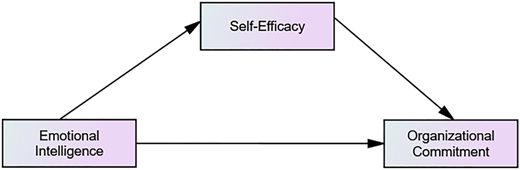
This study aims to probe the relationship between emotional intelligence, self-efficacy and organizational commitment. We argue that emotional intelligence and self-efficacy are positively related. Specifically, we seek to test the mediating effect of self-efficacy and how it influences the relationship between emotional intelligence and self-efficacy. We hypothesize that employees with higher self-efficacy have a significant and stronger relationship between emotional intelligence and organizational commitment. Based on the following literature review and hypotheses, we formulate the research model as shown in Figure 1 (p. 7).
2. Literature review
2.1 Emotional intelligence
The best known definition of emotional intelligence is that of Salovey and Mayer (1990, p. 189), who define emotional intelligence as “the subset of social intelligence that involves the ability to monitor one's own and other's feelings and emotions, to discriminate among them, and to use this information to guide one's thinking and actions.” Emotional intelligence can be described as a capability that explains significant differences in a person's problem solving and social relationships (Mayer et al., 2008). Mayer and Salovey (1993) show that emotional intelligence is similar ability to general intelligence, but may differ in terms of mechanisms and manifestations. Emotionality, emotion management and neurological substrates are the underlying mechanisms, while manifestations may include greater verbal fluency in emotional domains and overall better transmission of information during emotional attacks.
Emotional intelligence depicts how individuals differ in their ability to choose, attend to and process emotionally important information (Gundlach et al., 2003). Emotional intelligence can be classified as awareness of self and awareness of other emotions (Ordun and Acar, 2014), and these traits along with self-regulation, motivation, empathy and social skills are all enticing qualities for individuals and groups within the knowledge-based organization (Hess and Bacigalupo, 2010). Mayer and Cobb (2000) proposed four broad ability classes of emotional intelligence: perception, integration, understanding and emotion management. The first skill, perception of emotion, involves sensing and recognizing feelings. Integrating emotions into thinking involves using individual emotions in thinking and communication. Understanding emotions involves thinking with feelings. Emotion management refers to regulating emotions to better cope with circumstances.
Emotional intelligence has shown to promote various organizational outcomes. Emotional intelligence has a significant direct impact on job satisfaction (Wen et al., 2019), motivation (Christie et al., 2007), individual performance (Lam and Kirby, 2002), and predicts job adaptability (Coetzee and Beukes, 2010; Parmentier et al., 2019). Emotional intelligence significantly moderates the relationship between salespeople's customer orientation and customer-related organizational performance (Kearney et al., 2017). Zysberg (2012) found a significant relationship between emotional intelligence and loneliness, where loneliness was defined as the difference between desired and actual interpersonal relationships.
2.2 Self-efficacy
Self-efficacy refers to one's personal assessment of one's ability to organize and execute actions in specific situations (Schunk, 1984). It is the perceived ability based on performance (Zimmerman, 2000). Individuals with high self-efficacy believe that they can perform a particular task well. In contrast, individuals with low self-efficacy appear to question whether they can perform a particular task (Griffin and Moorhead, 2014). A person who has a positive belief about himself becomes confident in his job (Saleem et al., 2012). The assumption that these are beliefs about one's perceived abilities is common to self-efficacy and other expectancy beliefs; they differ in that self-efficacy is characterized by the individual's perceived capabilities to perform assigned types of task and achieve specific outcomes (Pajares, 1996). As Maddux (2002) pointed out, self-efficacy is not what you want, but what you believe you can do under certain circumstances. This conviction plays a central role in psychological adjustment, mental and physical health, and competent and self-directed behavior change strategies.
Self-efficacy is more specific and clearly delineated than self-confidence or self-esteem; it is generally better developed than either of these (Heslin and Klehe, 2006). Self-efficacy is often task-specific, but it can also be more general. People have general self-efficacy when they believe they can succeed in range of situations. People with greater self-efficacy generally, have better self-evaluation (McShane and Glinow, 2018). In addition to task-specific and generalized self-efficacy, Lee (2000) also mentioned the mid-ranged self-efficacy as an area between task-specific and generalized self-efficacy, such as academic or political self-efficacy.
Many researchers have studied the effects of self-efficacy on students' academic achievement (Lent et al., 1986; Schunk, 1991; Bandura et al., 1996; Pajares, 1996; Lane and Lane, 2001; DeTure, 2004; Lane et al., 2004; Zajacova et al., 2005; Majer, 2009; Vuong et al., 2010; Yazıcı et al., 2011; Honicke and Broadbent, 2016), and others on task performance (Bouffard-Bouchard, 1990; Lunenburg, 2011), sales performance (Barling and Beattie, 1983), health-related issues (Desmond and Price, 1988; Hevey et al., 1998; Nigg et al., 2009), etc.
Sherer et al. (1982) constructed and assessed the dimensions of self-efficacy using a sample consisting of college students and created a two-factor self-efficacy scale consisting of general self-efficacy focusing on three areas: (a) willingness to initiate a behavior, (b) willingness to exert effort to complete the behavior and (c) persistence in the face of adversity; and social self-efficacy, which reflects expectations of efficacy in social situations.
2.3 Organizational commitment
The literature on organizational commitment is numerous and complex. Organizational commitment has been conceptualized in a variety of ways, and its relationship to other behavioral variables has been examined.
Organizational commitment describes an employee's desire and need for the organization (Novitasari et al., 2020). It expresses the degree to which an individual identifies with the organization in various ways (Tanrıverdi, 2008). This commitment is seen as an identity power between an employee and the organization (Doan et al., 2020). Allen and Meyer’s (1990, 1996) study, the best known among organizational commitment studies, identifies three components of organizational commitment: affective, continuance and normative: (1) the affective aspect refers to workers' emotional attachment to, identification with and involvement in the organization; (2) the continuance aspects alludes to commitment based on the costs workers associate with leaving the organization; and (3) the normative aspect alludes to workers' sense of commitment to stay with the organization.
An employee is bound to varying degrees of commitment by different aspects of the work environment: the value of work, the work itself, co-workers, the organization and the profession (Randall and Cote, 1991). Gunlu et al. (2010) found that hotel managers' normative and affective commitments are influenced by extrinsic, intrinsic and overall job satisfaction. From the literature, organizational commitment is an outcome of several behavioral variables. Organizational commitment is influenced by leadership behaviors (Perryer and Jordan, 2005; Yiing and Ahmad, 2008), Big Five personality constructs (Erdheim et al., 2006), corporate social responsibility (Brammer et al., 2007; Turker, 2009), perceived organizational support (Aube, 2007; Panaccio and Vadenberghe, 2009), workplace spirituality (Rego and Cunha, 2008), emotional intelligence (Salami, 2007; Anari, 2012) and demographic factors such as age, marital status, tenure and education level (Salami, 2007), career development (Weng et al., 2010), job satisfaction (Anari, 2012; Yücel, 2012; Ismail and Razak, 2016; Cherif, 2020), organizational justice (Rahman et al., 2016), organizational climate (Berberoglu, 2018), etc.
In a few cases, organizational commitment is a precursor to employee motivation (Nguyen et al., 2020), job performance (Ahmad et al., 2010; Rafiei et al., 2014; Suharto and Hendri, 2019), in-role behaviors and organizational citizenship behavior (Huang and You, 2011). Ahmad et al. (2010) showed that employees who have outstanding organizational commitment perform well in an organization.
2.4 Hypotheses development
Most researchers have examined the relationship between emotional intelligence and academic self-efficacy. Mouton et al. (2013) reported that emotional intelligence and self-efficacy were positively correlated in physical education teachers, but neither age nor teaching experience was related to emotional intelligence or self-efficacy. Chan (2008) found that teachers' overall self-efficacy was significantly and substantially related to intrapersonal and interpersonal emotional intelligence. Rastegar and Memarpour (2009) also reported similar findings of a positive and significant relationship between emotional intelligence and self-efficacy among Iranian teachers. Ordun and Akün (2017) investigated the effects of emotional intelligence and self-actualization on self-efficacy. They found that both emotional intelligence and self-actualization have a significant and positive effect on self-efficacy in college students. Rathi and Rastogi (2009) found that emotional intelligence significantly predicted self-efficacy in the workplace, such that workers with higher levels of emotional intelligence had higher levels of self-efficacy.
Emotional intelligence influences belief in task accomplishment. Schutte et al. (2001) have shown that individuals with higher emotional intelligence are more successful in performing a cognitive task. Furthermore, when emotionally intelligent individuals have difficulty completing a cognitive task, they are more likely to avoid the destructive emotional influences and stay on task. Mortan et al. (2014) found that emotion use and emotion regulation were positively correlated with entrepreneurial self-efficacy. These two dimensions of emotional intelligence predicted entrepreneurial self-efficacy even after controlling for the effects of demographic characteristics such as gender, age, country and personality traits. Tabatabaei et al. (2013) also demonstrated the positive correlation between emotional intelligence and self-efficacy in the manufacturing workers. Fitzgerald and Schute (2010) showed that managers with higher emotional intelligence also have significantly higher self-efficacy in transformational leadership. On the other hand, Tsarenko and Strizhakova (2013) indicated that customers with higher emotional intelligence have higher levels of self-efficacy beliefs. Focusing on the academic environment, the relationship between emotional intelligence and self-efficacy has been studied and found to be significant by many other researchers (Chan, 2004; Villanueva and Sánchez, 2007; Fabio and Palazzeschi, 2008; Kirk et al., 2009; Abdolvahabi et al., 2012; El-Sayed et al., 2014; Akomolafe and Ogunmakin, 2014). Therefore, we formulate our first hypothesis as follows:
Emotional intelligence is positively related to self-efficacy.
Coladarci (1992) suggested that general and personal self-efficacy are strong predictors of teacher engagement, with teachers who demonstrate both higher general and personal efficacy tending to demonstrate greater teacher engagement. Tsai et al. (2011) found that self-efficacy has a significant positive influence on organizational commitment among employees in the banking sector. This finding is also recently confirmed by Syabarrudin et al. (2020) that self-efficacy has a significant influence on employees' organizational commitment. Consequently, employees who have a sense of certainty that they can perform a task are more likely to stay within the organization. Liu and Huang (2019) have shown that occupational self-efficacy has a direct impact on organizational commitment. Theodoraki (1996) examined the relationship between the influence of goals, commitment, self-efficacy and self-satisfaction on motor performance. The results proved that there is a direct and indirect effect of self-efficacy on performance. Rathi and Rastogi (2009) demonstrated a significant relationship, albeit weak, between self-efficacy and organizational commitment.
The relationship between these two variables is also supported in the literature by other studies focusing on nursing (Kang and Kim, 2014; Oh and Wee, 2016; Orgambídez et al., 2019). Based on these findings, we believe in a positive relationship between self-efficacy and organizational commitment. This is because when employees are confident in performing a particular task, they are more committed to their job. We formulate our second hypothesis as follows:
Self-efficacy is positively related to organizational commitment.
Regarding the relationship between emotional intelligence and organizational commitment, there are few studies showing that there is no direct relationship between these two variables. However, a descriptive study by Baba (2017) suggests that emotional intelligence and organizational commitment are positively related, where emotional intelligence was measured using Hyde et al.'s (2002) scale consisting of 34 items. In line with this study, Mohamadkhani and Lalardi (2012) confirmed the positive relationship between emotional intelligence and organizational commitment components of hotel staff in Iran in their descriptive study. In contrast, Aghdasi et al. (2011) concluded that emotional intelligence has no direct or indirect effect on organizational commitment related to job stress and job satisfaction. Consequently, these results suggest that emotional intelligence and organizational commitment may be related through a mediator.
Salami (2007) has shown that emotional intelligence and self-efficacy have significant correlations with attitude toward work. Colomeischi and Colomeischi (2014) found that teachers with higher levels of emotional intelligence have higher levels of self-efficacy, more positive attitudes toward work and higher satisfaction about their work (the way it is organized, the social climate). Chesnut and Cullen (2014) demonstrated strong relationships between prospective teachers' self-efficacy, emotional intelligence and perceived satisfaction with an individual-level commitment. Carmeli (2003) examined the importance of emotional intelligence for positive attitudes and contextual and task-related success among senior managers and found that emotionally intelligent senior managers develop emotional attachment and loyalty to their organizations. He also indicated that emotionally intelligent executives appear to be more satisfied with their jobs.
Kirk et al. (2009) examined the relationships among emotional intelligence, emotional self-efficacy, workplace incivility, positive and negative affect and job satisfaction in the workplace and showed that emotional intelligence is successfully predicted by emotional self-efficacy, which in turn is a significant predictor of respondents' positive and negative affect. Individuals with higher levels of negative affect were more likely to engage in workplace incivility than those with lower levels of negative affect. From an academic perspective, Anari (2012) found a significant relationship between emotional intelligence and organizational commitment. In other words, higher levels of emotional intelligence are associated with higher levels of organizational commitment.
Mortan et al. (2014) showed that self-efficacy successfully mediates the relationship between emotional intelligence and intention to become an entrepreneur. Wong and Law (2002) found that the relationship between emotional intelligence and organizational commitment is significantly moderated by the amount of emotional labor the job requires, but there is no direct relationship between them. Abraham (1999) indicated that emotional intelligence was a strong predictor of organizational commitment. 15% of the variance was explained by emotional intelligence alone. Villegas-Puyod and Charoensukmongkol (2019) demonstrated that call center representatives with higher emotional intelligence tended to have higher interaction involvement with customers. Emotional intelligence can also contribute to job performance by enabling people to regulate their emotions to effectively manage stress, perform well under pressure and adapt to organizational change (Kushwaha, 2012). Given these findings, we hypothesize that emotional intelligence and organizational commitment are related in the way that a third variable mediates this relationship. Self-efficacy acts as a mediator variable in many different situations, linking an independent and dependent variable. We propose that self-efficacy mediates the relationship between emotional intelligence and organizational commitment as in our third hypothesis:
Self-efficacy is a successful mediator of the relationship between emotional intelligence and organizational commitment.
3. Methodology and data
3.1 Subjects and procedures
To test the above hypotheses, a survey was conducted among workers from Kosovo. The questionnaire used is listed at the end of this article. The questionnaire was translated into Albanian and people from different cities in Kosovo were asked to complete the questionnaire through a link shared on social media. A total of 255 questionnaires were collected, but 110 questionnaires were removed because they were not suitable for analysis. These participants belonged to the trade, service, construction and tourism sectors and some were freelancers. Since these employees have a short length of stay in the company, this would affect organizational commitment. For this reason, it was deemed appropriate to remove these questionnaires from the analysis. Data were collected between November 30 and December 6, 2019.
3.2 Measures
3.2.1 Emotional intelligence
Emotional intelligence was assessed using the EI scale developed by Wong and Law (2002). This is a 16-item scale with four dimensions. The four dimensions are self-emotion appraisal, other's emotion appraisal, use of emotion and regulation of emotion. Self-emotion appraisal (SEA) concerns the ability of the person to understand and communicate his or her deep emotions in a natural manner, e.g. those who can feel and perceive their feelings in this area well before others. The other's emotion appraisal (OEA) involves the capability of an individual to read and interpret the emotions of people around them, and those high in this capacity will also be much more sensitive to and read the minds and feelings of other people. Use of emotion (UOE) refers to individuals' ability to utilize their emotions by leading them to positive tasks and personal performance concerns people's ability to regulate their emotions (ROE), thus facilitating faster recovery from mental distress (Wong and Law, 2002). Participants were asked to respond on a 5-point Likert scale ranging from 1 for “strongly disagree” to 5 for “strongly agree.” The Cronbach's alpha reliability coefficient of the scale for our data was reported as 0.795.
3.2.2 Self-efficacy
Self-efficacy was assessed using the scale developed by Sherer et al. (1982). This scale consists of 23 items with two dimensions. The two dimensions of self-efficacy are general self-efficacy and social self-efficacy. Participants were asked to rate each item using a 5-point Likert scale ranging from 1 for “strongly disagree” to 5 for “strongly agree”. The Cronbach's alpha reliability coefficient of the scale for our data was reported as 0.832.
3.2.3 Organizational commitment
To measure organizational commitment, the scale developed by Allen and Meyer (1990) was used. This scale includes 24 items and three dimensions: affective, continuous and normative commitment. Participants were asked to respond on a 5-point Likert scale ranging from 1 for “strongly disagree” to 5 for “strongly agree.” The Cronbach's alpha reliability coefficient of the scale for our data was reported as 0.844.
3.3 Data analysis
Our conceptual model proposes that self-efficacy mediates the relationship between emotional intelligence and organizational commitment, such that the mediated relationship is higher when self-efficacy is high and lower when self-efficacy is low. We employed Model 4 of PROCESS developed by Hayes (2013) to test mediation. First, we reported the descriptive data of the sample and then performed the correlation analysis to test the linear relationship between the variables. SPSS 25 was used to perform these analyses.
4. Results
4.1 Descriptive statistics and correlations
Table 1 provides some demographic statistics about the sample. A total of 80 men (55.2%) and 65 women (44.8%) participated in the survey. Most participants (36.6%) are in the 26–35 age group. Around 46.2% of the participants have a bachelor's degree, while 37.2% have a master's degree. Most of the participants (36.6%) work in education and another 20.7% work in public administration. Most of the participants (39.3%) hold salaried positions in the companies. 37.9% of them have 0–2 years of work experience, 23.4% 3–5 years, 22.8% more than 9 years and the rest 6–8 years. The frequency of monthly income is distributed differently in each category and the highest frequency of monthly income (30.3%) falls in the 301–600 euro category.
Demographic data of the sample (n = 145)
| Frequency | Percent | ||
|---|---|---|---|
| Gender | Male | 80 | 55.2 |
| Female | 65 | 44.8 | |
| Age | Less than 25 | 47 | 32.4 |
| 26–35 | 53 | 36.6 | |
| 36–45 | 28 | 19.3 | |
| 46–55 | 17 | 11.7 | |
| Education | Primary school | 12 | 8.3 |
| High school | 12 | 8.3 | |
| Undergraduate | 67 | 46.2 | |
| Graduate | 54 | 37.2 | |
| Working Sector | Education | 53 | 36.6 |
| Public administration | 30 | 20.7 | |
| Production | 27 | 18.6 | |
| Health | 14 | 9.7 | |
| Other* | 21 | 14.4 | |
| Position | Worker | 31 | 21.4 |
| Employee | 57 | 39.3 | |
| Executive | 24 | 16.6 | |
| Manager | 17 | 11.7 | |
| Other** | 16 | 11.0 | |
| Tenure | 0–2 years | 55 | 37.9 |
| 3–5 years | 34 | 23.4 | |
| 6–8 years | 23 | 15.9 | |
| 9 + | 33 | 22.8 | |
| Monthly incomes | <300 euro | 23 | 15.9 |
| 301–600 euro | 44 | 30.3 | |
| 601–900 euro | 33 | 22.8 | |
| 901–1,200 euro | 16 | 11.0 | |
| Over 1,200 euro | 29 | 20.0 |
Note(s): *People that selected “other” worked as bankers (9), journalists (7), media (3) and architects (2)
**People that selected “other” were lecturers (13), translator (1) and nurse (1), all of whom could not be assigned themselves in any of the categories of position
Table 2 presents descriptive statistics (means and standard deviations) and the correlations between emotional intelligence, self-efficacy, and organizational commitment and demographic questions. According to the correlation results, emotional intelligence is positively correlated with self-efficacy (r = 0.538, p < 0.01) and organizational commitment (r = 0.371, p < 0.01). Self-efficacy is positively related to organizational commitment (r = 0.501, p < 0.01). In addition, there is a significant correlation between emotional intelligence and job position (r = 0.184, p < 0.05). Self-efficacy shows a significant correlation with age (r = 0.258, p < 0.01). Organizational commitment has a significant correlation with age (r = 0.403, p < 0.01) and job tenure (r = 0.317, p < 0.01).
Descriptive statistics and associated measures
| Variable | Mean | SD | 1 | 2 | 3 | 4 | 5 | 6 | 7 | 8 | 9 | 10 |
|---|---|---|---|---|---|---|---|---|---|---|---|---|
| 1. EI | 4.003 | 0.415 | 1 | |||||||||
| 2. SE | 3.810 | 0.446 | 0.538** | 1 | ||||||||
| 3. OC | 3.571 | 0.517 | 0.371** | 0.501** | 1 | |||||||
| 4. Gender | 1.45 | 0.499 | 0.147 | 0.081 | 0.119 | 1 | ||||||
| 5. Age | 2.11 | 1.008 | 0.089 | 0.258** | 0.403** | ‒0.099 | 1 | |||||
| 6. Educ | 3.12 | 0.881 | 0.144 | 0.087 | ‒0.053 | 0.157 | 0.125 | 1 | ||||
| 7. Sector | 2.72 | 1.714 | ‒0.098 | ‒0.054 | ‒0.071 | ‒0.260** | ‒0.215** | ‒0.566** | 1 | |||
| 8. Position | 2.52 | 1.259 | 0.184* | ‒0.048 | 0.013 | 0.048 | 0.064 | 0.236** | ‒0.075 | 1 | ||
| 9. Tenure | 2.23 | 1.184 | 0.005 | 0.155 | 0.317** | ‒0.144 | 0.729** | ‒0.021 | 0.036 | 0.160 | 1 | |
| 10. Income | 2.89 | 1.360 | 0.137 | 0.126 | 0.126 | ‒0.080 | 0.262** | 0.064 | 0.038 | 0.147 | 0.417** | 1 |
Note(s): EI – Emotional Intelligence; SE – Self-Efficacy, and OC – Organizational Commitment. Level of significance: *p < 0.05, **p < 0.01
4.2 Regression analysis
Table 3 reports the results of the regression analysis performed with PROCESS model type 4. Both models are significant and provide an acceptable fit based on R2 values (R2 = 0.289, p < 0.001 and R2 = 0.265, p < 0.001). The first model shows that emotional intelligence explains 28.9% of the change in self-efficacy. The second model shows that emotional intelligence and self-efficacy together explain 26.5% of the change in organizational commitment.
Model summaries for regression analyses of organizational commitment (PROCESS model type 4)
| Outcome | R | R2 | MSE | F | df1 | df2 | p-value |
|---|---|---|---|---|---|---|---|
| SE | 0.537 | 0.289 | 0.142 | 58.137 | 1.000 | 143.000 | <0.001 |
| OC | 0.515 | 0.265 | 0.199 | 25.677 | 2.000 | 142.000 | <0.001 |
Note(s): EI – Emotional Intelligence, SE – Self-Efficacy, and OC – Organizational Commitment
4.3 Mediation analysis
Table 4 shows the direct and indirect effects of the mediation analysis. We will analyze each section separately.
Results of mediation analysis on organizational commitment
| Direct effect on SE | Coeff. | SE | t-value | p-value | LLCI | ULCI |
| EI | 0.577 | 0.075 | 7.624 | 0.001 | 0.897 | 2.102 |
| Direct effects on OC | Coeff. | SE | t-value | p-value | LLCI | ULCI |
| EI | 0.178 | 0.106 | 1.681 | 0.094 | ‒0.031 | 0.388 |
| SE | 0.491 | 0.098 | 4.969 | 0.001 | 0.296 | 0.686 |
| Indirect effects on OC | Effect | BootSE | Significance | BootLLCI | BootULCI | |
| EI → OC | 0.283 | 0.073 | sig | 0.157 | 0.443 | |
| Total effect of EI on OC | Effect | SE | t-value | p-value | LLCI | ULCI |
| Total effect | 0.462 | 0.096 | 4.782 | 0.001 | 0.2711 | 0.653 |
Note(s): EI – emotional intelligence, SE – self-efficacy, and OC – organizational commitment. Level of significance: *p < 0.05, **p < 0.01 and ***p < 0.001. Bootstrapped standard errors and 95% confidence are based on 5,000 replicates. Intercepts are omitted in the table
4.3.1 Direct effects
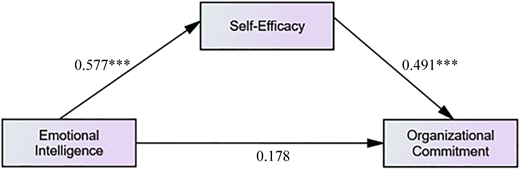
The first part of the table indicates the effect of emotional intelligence on self-efficacy. The direct effect of emotional intelligence on self-efficacy is positive and significant (β = 0.577, p < 0.001), supporting H1. The direct effect of self-efficacy on organizational commitment is positive and significant (β = 0.491, p < 0.001), supporting H2. However, the direct effect of emotional intelligence on organizational commitment is not significant (β = 0.178, p > 0.094). This coefficient is the first predictor of mediation, so we need to explore the indirect effect as well as the overall of effect of emotional intelligence on organizational commitment. Figure 2 shows the direct effects examined in the postulated model.
4.3.2 Indirect effect
The results of the mediation analysis show that emotional intelligence has an indirect effect on organizational commitment (β = 0.283) and this effect is significant (bootstrapped 95% confidence interval LLCI = 0.157 and ULCI = 0.443 does not include zero), supporting our third hypothesis. Finally, the overall effect of emotional intelligence on organizational commitment is positive and significant (β = 0.462, p < 0.001).
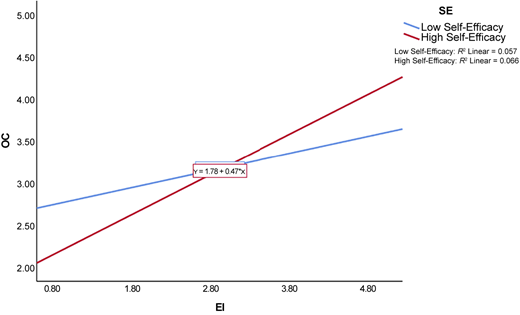
In Figure 3, we have shown the interaction between the variables. We converted the self-efficacy variable into a categorical variable, with 1 representing low self-efficacy and 2 representing high self-efficacy. People with low emotional intelligence have lower self-efficacy and are less committed to work, whereas people with higher emotional intelligence have higher self-efficacy and organizational commitment.
5. Discussion and conclusion
This study sought to assess the relationship between emotional intelligence, self-efficacy and organizational commitment, focusing on the mediating effect of self-efficacy on the relationship between emotional intelligence and organizational commitment. As hypothesized, the results showed that emotional intelligence (the mean of self-emotions appraisal, regulation of emotions, use of emotion and other-emotions appraisal) has a significant impact on self-efficacy (the mean of general self-efficacy and social self-efficacy). As expected, the results showed that self-efficacy has a significant impact on organizational commitment (the mean of affective, continuance and normative commitment). Similarly, self-efficacy was found to mediate the relationship between emotional intelligence and organizational commitment.
As hypothesized, the results of the first hypothesis showed that emotional intelligence has a positive effect on self-efficacy. More specifically, the results showed that emotional intelligence accounted for 57.7% of the variance in self-efficacy in the regression analysis. This finding is consistent with the findings of Black et al. (2019) that positive emotional intelligence also results in positive self-efficacy. Ordun and Akun (2015) emphasized that it is understandable that people's ability to use their emotions is significantly and positively related to their efficacy, goal achievement, discipline and diligence. Mortan et al. (2014) found that emotion regulation and utilization were good predictors of entrepreneurial self-efficacy. Amirian and Behshad (2016) argued that people with high emotional intelligence are more likely to perceive emotions, manage their own emotions, manage the emotions of others and, use those emotions. Tsai et al. (2011) found that leaders with high emotional intelligence who also maintain an excellent leadership style, can improve self-efficacy. Emotional intelligence, then, is likely to lead employees to develop their self-efficacy in performing their tasks in the organization.
We confirmed a strong and positive relationship between self-efficacy and organizational commitment, which supported our second hypothesis. Self-efficacy explained 49.1% of the variance in organizational commitment in regression analysis. This result confirms findings in the literature. Yoon et al. (2018), Liu and Huang (2019) and Demir (2020) confirmed that self-efficacy has a positive effect on organizational commitment. Dagher et al. (2015) argued that employee engagement is demonstrated when employees believe in their abilities. When employees have strong talents and skills relevant to their assigned tasks, they will perform more effectively than their counterparts with low self-confidence (Saleem et al., 2012). In short, this study shows that the higher employees' self-efficacy, the higher their engagement at work.
Finally, this study has sought to comprehend the process that links emotional intelligence to organizational commitment. We have demonstrated the indirect effect of emotional intelligence on organizational commitment when self-efficacy plays the role of a mediator variable. This means that emotional intelligence has no direct effect on employees' organizational commitment. But when employees' self-efficacy is enhanced by emotional intelligence, their organizational commitment also emerges. These findings are consistent with those of Wong and Law (2002), who showed that emotional intelligence is positively correlated with organizational commitment only when emotional labor is moderated. Emotional intelligence has a desirable effect on organizational commitment in jobs that require high emotional labor, whereas the effect is undesirable in jobs that require low emotional labor. Yoon et al. (2018) also confirmed that self-efficacy has a full mediation effect on the relationship between informal learning and organizational commitment. Udayar et al. (2020) indicated that self-efficacy fully mediates the relationship between emotional intelligence and performance (objective and subjective). Zhu et al. (2016) tested the mediating effect of self-efficacy in the relationship between emotional intelligence and communication competence in nurses. Black et al. (2019) showed that self-efficacy is an important mediator of the relationship between emotional intelligence and team cohesion. These studies demonstrate that there is no direct relationship between emotional intelligence and organizational commitment, but these variables correlate when a third variable is used as a mediator.
5.1 Theoretical implications
The current study confirms the existence of a significant and positive relationship between emotional intelligence, self-efficacy and organizational commitment. The relationship between emotional intelligence and self-efficacy confirms what has already been proven by several studies in different fields. However, studies in academia are more numerous than in any other field. For example, Nikoopour et al. (2012), Mouton et al. (2013), Sarkhosh and Rezaee (2014) and Wu et al. (2019) studied teachers' emotional intelligence and self-efficacy, while Salami (2010), Pool and Qualter (2012), Andonian (2013), Hen and Goroshit (2012), Gharetepeh et al. (2015) and Salavera et al. (2017) studied students' emotional intelligence and academic self-efficacy. Consistent with previous studies, we found that the relationship between self-efficacy and organizational commitment is significant and positive. Consistent with this finding, Chesnut and Burley (2015), Malik and Malik (2016) suggest that teachers' self-efficacy beliefs influence their commitment to the teaching profession. Mahesar et al. (2020) report that self-efficacy has a positive influence on bank employees' organizational commitment. The Caleb et al.’s (2020) study suggest that employees with higher levels of self-efficacy are likely to be more committed than employees with lower levels of self-efficacy. Finally, we found that self-efficacy is a successful mediator of emotional intelligence and organizational commitment. Many studies have used self-efficacy as a mediator between emotional intelligence and various behavioral variables, but its effects on organizational commitment have not been examined in this context. Specifically in Kosovo, no study was found on these factors. The direct effect of emotional intelligence on organizational commitment is not significant, but the indirect effect is positive and significant, showing that people with higher self-efficacy have higher levels of emotional intelligence and organizational commitment. This is the most important contribution of this study to the literature. First, it confirmed the positive relationships between emotional intelligence and self-efficacy and the positive relationship between self-efficacy and organizational commitment, and then added to the literature that self-efficacy mediates this relationship.
5.2 Practical implications
One of the strengths of this study is that it demonstrates the existence of a mediation effect of self-efficacy in the relationship between emotional intelligence and organizational commitment. Evidence of this effect means that managers should consider the emotional intelligence of their employees when seeking to increase organizational commitment because it specifically promotes employee self-efficacy. The results of this study will help managers understand the desperate need to recognize the inner worlds of their employees, which are reflected in the external environment and, consequently, in their work performance. It should be remembered that the labor force in developing countries such as Kosovo, is constantly looking to emigrate. Therefore, owners and HR managers should foster a friendly environment that take into account their emotional intelligence and self-efficacy to promote organizational commitment. Employees' emotional intelligence boosts their self-confidence and belief that they are capable of performing a particular task, which in turn leads to a higher level of commitment to the job.
5.3 Limitations and suggestions for future study
There are some limitations to this study. First, participants completed the survey online and data collection is limited to only those who could access the link. Second, the results of this study are limited only to the sample we used for analysis. Therefore, we cannot generalize. In addition, 37.9% of the participants in the sample have employment tenure of 0–2 years, which may call into question their organizational commitment.
Another limitation is that the present study used the overall mean scores of emotional intelligence, self-efficacy and organizational commitment to test the hypotheses. Emotional intelligence has four subdimensions, self-efficacy has two subdimensions and organizational commitment has three subdimensions. Therefore, we did not examine the effects of each subdimension on the other dependent subdimensions. It would be interesting to examine each effect individually, but that would produce multiple models. Future studies may also focus on differences in emotional intelligence, self-efficacy and organizational commitment across different employee hierarchies, highlighting differences between managers and low-level employees.
Data Availability Statement: The authors confirm that the data supporting the findings of this study are available within the article [and/or] its supplementary materials.
References
Further reading
Appendix
Emotional Intelligence Scale
Self-emotions appraisal (SEA)
SEA1. I have a good sense of why I feel certain feelings most of the time.
SEA2. I have a good understanding of my own emotions.
SEA3. I really understand what I feel.
SEA4. I always know whether I am happy or not.
Regulation of Emotions (ROE)
ROE1. I always know my friends' emotions from their behavior.
ROE2. I am a good observer of others' emotions.
ROE3. I am sensitive to the feelings and emotions of others.
ROE4. I have a good understanding of the emotions of people around me.
Use of Emotion (UOE)
UOE1. I always set goals for myself and then try my best to achieve them.
UOE2. I always tell myself I am a competent person.
UOE3. I am a self-motivating person.
UOE4. I would always encourage myself to try my best.
Others-Emotion Appraisal (OEA)
OEA1. I am able to control my temper so that I can handle difficulties rationally.
OEA2. I am quite capable of controlling my own emotions.
OEA3. I can always calm down quickly when I am very angry.
OEA4. I have good control of my emotions.
Self-Efficacy Scale
General Self-efficacy (GSE)
GSE1: When I make plans, I am certain I can make them work.
GSE2: One of my problems is that I cannot get down to work when I should. (R)
GSE3 If I can't do a job the first time. I keep trying until I can.
GSE4: When I set important goals for myself, I rarely achieve them. (R)
GSE5: I give up on things before completing them. (R)
GSE6: I avoid facing difficulties. (R)
GSE7: If something looks too complicated, I will not even bother to try it. (R)
GSE8: When I have something unpleasant to do, I stick to it until I finish it.
GSE9: When I decide to do something, I go right to work on it.
GSE10: When trying to learn something new, I soon give up if I am not initially successful. (R)
GSE11: When unexpected problems occur, I do not handle them well. (R)
GSE12: I avoid trying to learn new things when they look too difficult for me. (R)
GSE13: Failure just makes me try harder.
GSE14: I feel insecure about my ability to do things. (R)
GSE15: I am a self-reliant person.
GSE16: I give up easily. (R)
GSE17: I do not seem capable of dealing with most problems that come up in life. (R)
Social Self-Efficacy (SSE)
SSE1: It is difficult for me to make new friends. (R)
SSE2: If I see someone I would like to meet, I go to that person instead of waiting for him or her to come to me.
SSE3: If I meet someone interesting who is hard to make friends with. I'll soon stop trying to make friends with that person. (R)
SSE4: When I'm trying to become friends with someone who seems uninterested at first, I do not give up easily.
SSE5: I do not handle myself well in social gatherings. (R)
SSE6: I have acquired my friends through my personal abilities at making friends.
Commitment Scale
Affective Commitment (AC)
AC1. I would be very happy to spend the rest of my career with this organization.
AC2. I enjoy discussing my organization with people outside it.
AC3. I really feel as if this organization's problems are my own.
AC4. I think that I could easily become as attached to another organization as I am to this one. (R)
AC5. I do not feel like “part of the family” at my organization. (R)
AC6. I do not feel “emotionally attached” to this organization. (R)
AC7. This organization has a great deal of personal meaning for me.
AC8. I do not feel a strong sense of belonging to my organization. (R)
Continuance Commitment (CC)
CC1. I am not afraid of what might happen if I quit my job without having another one lined up. (R)
CC2. It would be very hard for me to leave my organization right now, even if I wanted to.
CC3. Too much in my life would be disrupted if I decided I wanted to leave my organization now.
CC4. It would not be too costly for me to leave my organization now. (R)
CC5. Right now, staying with my organization is a matter of necessity as much as desire.
CC6. I feel that I have too few options to consider leaving this organization. (R)
CC7. One of the few serious consequences of leaving this organization would be the scarcity of available alternatives.
CC8. One of the major reasons I continue to work for this organization is that leaving would require considerable personal sacrifice—another organization may not match the overall benefits I have.
Normative Commitment (NC)
NC1. I think that people these days move from company to company too often.
NC2. I do not believe that a person must always be loyal to his or her organization. (R)
NC3. Jumping from organization to organization does not seem at all unethical to me. (R)
NC4. One of the major reasons I continue to work for this organization is that I believe that loyalty is important and therefore feel a sense of moral obligation to remain.
NC5. If I got another offer for a better job elsewhere I would not feel it was right to leave my organization.
NC6. I was taught to believe in the value of remaining loyal to one organization.
NC7. Things were better in the days when people stayed with one organization for most of their careers.
NC8. I do not think that wanting to be a “company man” or “company woman” is sensible anymore. (R)

