The “dual” model of vocational training is well established in many German companies, enabling them to train young talent to meet their existing and future demand for skilled labour. However, Germany’s system is unusual: most other countries organise training in an entirely different way. Over the past few decades, the accelerating pace of globalisation has prompted many foreign companies to set up in Germany, but the academic literature does not consider this group specifically, so it is unclear how subsidiaries of foreign companies meet their requirements for skilled labour. Training cultures are very different in their respective home countries, making this an interesting and beneficial issue to investigate. This study therefore explores how foreign companies with different training cultures manage recruitment and training when they set up in Germany with its dominant dual vocational training system.
On the basis of 77 qualitative interviews, the study describes the recruitment and training practices of Chinese, French, Japanese, UK and US companies and the factors influencing their adaptation to operating within a German environment.
This study finds that companies frequently adapt their training activities to local German practices. This is also the case where it is not possible to make an exact comparison of the extent to which training is provided and whether training behaviours really are identical with those of comparable German companies. It is clear that if training activities are offered to young future employees in the form of initial training, this training is likely to rely on the German dual apprenticeship or dual study programme model. The ultimate decision on training activities is dominated by influences from the German operating environment at the cost of country-of-origin influences. Against the backdrop of statutory requirements, dual apprenticeships and dual study programmes are often seen as the only solution.
One limitation of this study is that the sample is too small to enable wide-ranging conclusions to be drawn, for example, in relation to the differences between individual countries of origin. A wider sample and comparison with German companies could enable more a detailed analysis of the differences between company practices and produce a more differentiated picture of the influences from Germany and from the respective home country.
Nevertheless, the findings of this study help to improve understanding of corporate strategy – and they have potential uses at a practical level. For example, chambers of industry and commerce could target and support foreign companies. Meanwhile, organisations promoting business could draw the attention of foreign companies newly setting up in Germany to the provision of dual apprenticeships.
Although the study has not identified clear differences between different countries of origin in how decisions are made concerning training, discussion and negotiations with the parent company in a range of countries of origin clearly reveal the influences and associated issues and concerns related to the respective country of origin.
By contrast with Pudelko and Harzing’s (2007) study, this study suggests that training therefore needs to rely substantially on local adaptation. Also, in opposition to studies on German companies operating outside Germany, comprehensive training is not imported and training outside the German system is provided in only a few individual cases. In other studies on different HR practices, there is a greater adaptation of strategy to the two environments in solutions that sometimes include hybrid elements. This study does not find hybrid solutions of this kind. However, this does not mean that there is no influence from the home country. A closer scrutiny of the influences on this decision-making shows, indeed, that although the majority use the dual system of vocational training as their training model, subsidiaries do not “act like German companies” in their internal decision-making and that some home-country influences are evident in intensive negotiation processes with the parent company.
1. Introduction
The “dual” model of vocational training is well established in many German companies, enabling them to train young talent to meet their existing and future demand for skilled labour. However, most other countries organise training in an entirely different way. Over the past few decades, the accelerating pace of globalisation has prompted many foreign companies to set up in Germany, but the academic literature does not consider this group specifically, so it is unclear how subsidiaries of foreign companies meet their requirements for skilled labour. Training cultures are very different in their respective home countries, making this an interesting and beneficial issue to investigate. This article, therefore, explores how foreign companies with different training cultures manage recruitment and training when they set up in Germany with its dominant dual vocational training system. On the basis of 77 qualitative interviews, the article describes the recruitment and training practices of Chinese, French, Japanese, UK and US companies and the factors influencing their adaptation to operating within a German environment.
Germany has long used its dual vocational training system as a way of developing the skills of younger workers and meeting companies’ requirements for skilled labour. The model is popular with companies, with around 1.22 million young people enrolled in 2023 on a (dual) apprenticeship. A further 122,000 or so young people are enrolled on a dual academic study programme, spending part of their time training within a company and the remainder in a university of applied sciences or a vocational academy (Federal Institute for Vocational Education and Training, 2024; Statistisches Bundesamt, 2024). We have included this second option because, in many dual academic study programmes, it is also possible to complete an apprenticeship under the Vocational Training Act (Federal Institute for Vocational Education and Training, 2017). In addition, the two programmes are very similar or even identical in terms of their vocational orientation and many structural elements, such as the company training plan (Deißinger et al., 2013).
Globalisation has seen foreign companies across a wide range of sectors set up subsidiaries in Germany, where these companies employ around 3.8 million people (as of 2021; GTAI Germany Trade and Invest, 2022). This represents a substantial investment on their part, so they require workers with an intermediate skills level. These skilled workers – most of whom receive training within Germany’s dual vocational training system – should be distinguished both from unskilled and semi-skilled labour and from academically trained specialists (Ryan, 1991).
There is an academic literature on the export by German multinationals of the German skills training model (inter alia, Pilz and Wiemann, 2021; Röhrer et al., 2024; Pilz and Li, 2014) but little, if any, research into the export of other training models to subsidiaries in Germany: most academic studies and statistical data pay only marginal attention to this issue (see Fuchs et al., 2021). Much of the literature focuses on other areas of human resource management (HRM). There are, for example, individual studies on the HRM practices of US companies that show that some adapt their practices – for example, by providing their own training – but that others bring HRM practices with them from the USA (Meuer et al., 2019).
The few studies relevant here are also quite old. For example, one study examined multinational companies from the UK and the USA in Germany (Muller, 1998). The study concluded that although the German framework conditions in the HR sector are strong, especially for large companies, small and medium-sized companies also take advantage of the opportunity to transfer practices from their home country. The study distinguishes between three types of companies among the 12 companies included. Three companies do not adapt to the local context. Six companies adapt partially and use their freedom to find individual solutions that meet both the global strategy from their home country and the requirements in Germany. The last three companies adapt in such a way that there is hardly any noticeable difference between them and German companies. However, regardless of their classification into the different types, most companies offer training themselves, especially in the area of vocational training (Muller, 1998).
Muehlemann (2014) analysed the participation of foreign subsidiaries, especially from the USA and Great Britain in training measures in the quite similar training system (in comparison to Germany) of Switzerland. The results suggested that small foreign companies (<50 employees) in particular were less involved in training than Swiss companies. This difference did not appear to exist for larger companies, nor was there any clear differentiation between the three countries of origin (Muehlemann, 2014).
Beck et al. (2009) also addressed the question of the extent to which vocational training in a company’s country of origin and host country influences the training behaviour of its branches. To this end, they surveyed the number of training days and distinguished between four different levels: managerial, professional, clerical and manual. Further details, such as the type of training, were not included. In addition, the countries of origin were divided into two groups: continuing vocational education and training (e.g. Japan, USA) and initial vocational education and training (e.g. Austria, Germany, The Netherlands). The study showed the influence of the country of origin on the import of certain practices, as companies did not fully adapt to the local vocational training system.
This gap in the research into how foreign subsidiaries meet their requirements for skilled labour therefore forms the focus of this article, which will consider specifically how foreign companies from different training cultures behave when they set up in Germany with its prominent dual vocational training system (Busemeyer and Trampusch, 2012; Deißinger and Gonon, 2021). It will investigate whether these companies adapt to the German skills development strategy or import their home country’s practices. It will also seek to identify the factors that influence their decision-making in this area.
2. Theoretical basis
The context within which multinational companies operate is unusual in that it is not defined by a single country but is determined by the range of contexts in which their subsidiaries operate. The impact of differing national influences on strategy has been widely explored (Kostova and Roth, 2002). There is an important distinction here between the standardisation required by multinational companies and the simultaneous localisation of individual subsidiaries (Dowling et al., 2013; Festing et al., 2007; Pudelko and Harzing, 2007). In this context, the focus is usually on the influence of country-of-origin and host-country effects (Edwards and Kuruvilla, 2004; Pudelko and Harzing, 2007). The existence of this range of influences means that companies either operate like local businesses, follow the model set by their parent company or adopt a “best practice” approach globally – that is, adopting neither the practices of their home country nor the practices of the environment in which they operate (Pudelko and Harzing, 2007).
It can be assumed that multinational companies are influenced by the training culture of their home country when it comes to designing training programmes (Pilz, 2009). Training culture encompasses relevant aspects at the macro level, such as government regulations, financing, learning venues and certification and at the meso and micro levels, such as curriculum design, teaching methods and examination rules (Pilz and Wiemann, 2021; Pilz et al., 2023). But companies also occupy a space between the local context in which they operate and the context of their home country. They therefore adopt a training strategy that is locally acceptable and gives them legitimacy in the environment in which they operate (DiMaggio and Powell, 1983). The decision whether – and how – to train skilled workers is, therefore, not made independently of the operating environment but is instead influenced by the values, standards and ideals of good practice within the environment that shapes their cultural framework (Winterton, 2009).
These factors can be described as social rules and are expressed in a range of ways. They define companies’ institutional framework and determine the benefits, the roles and the formal structure of organisations (including companies) operating within any given environment (Scott and Meyer, 1994). Scott identifies three dimensions or three pillars of an institution: the regulatory pillar; the normative pillar; and the cultural-cognitive pillar. Every institution is based on these three pillars, but all three dimensions are not present in all situations, and in any case, they may be given different weights. Indeed, it is possible for these three dimensions to conflict with each other (Scott, 2014). Elements of these three dimensions can also be found in the area of vocational training, where they shape individual institutions and constitute the institutional environment. The regulatory pillar lays down explicit and enforceable rules – for example, legislation with which companies must comply in relation to training. Germany closely regulates the curriculum and skills that companies must include in any training or apprenticeships they provide, including the status of trainees as learners and not regular employees (BIBB, 2017). The normative pillar includes norm- and values-based role behaviour along with moral obligations deriving from these norms and values. These social obligations are reflected, for example, in views of how training should be designed and the ‘right’ way for stakeholders to behave: this may, for instance, include the fact that committing to training provides companies with a reputational boost, among other things (Fürstenau et al., 2014). The cultural-cognitive pillar, finally, is determined by values and ideals. For example, it may determine the relative importance of specific qualifications and the value attached to them. In Germany, a vocational training certificate that is recognised across companies is seen as a symbol of a completed apprenticeship and has high status (Pilz, 2025).
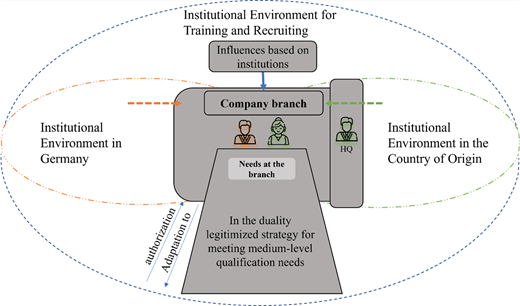
To sum up, these companies have one foot in the German environment in which they operate and the other in their home country: practices that are customary in the home country influence subsidiaries via the practices of the parent company. The influences arising from both the social environments of which organisations – in this study, companies – form a part are described as “institutional duality” (Kostova and Roth, 2002; Saka-Helmhout et al., 2016). Figure 1 illustrates this conceptual framework. This study therefore starts by focusing on an exploration of the strategies that subsidiaries of foreign companies adopt to meet their requirements for workers with an intermediate skills level.
3. Design and methodology
The study focuses on companies from home countries with substantial investments in Germany (EUROSTAT, 2017). The study took a most different approach (Pilz, 2012, pp. 566–568) to selecting companies to ensure not only that the training system in the respective home country was different from Germany’s dual vocational training system but also that the countries selected differed from each other. The study therefore focuses on China, France, Japan, the UK and the USA. Specifically, countries were chosen using the typology established by Pilz (2016). ‘Anglo-Saxon’ countries (the UK and the USA) can be categorised as liberal because they organise their vocational training decentral and on an individual basis within the private sector (Pilz, 2009, pp. 57–74). In the USA, training is very practically oriented and focuses on the specific skills needed for particular roles, so teaching and learning processes in the USA can be described mostly as “learning by doing” (Barabasch and Rauner, 2012; Zenner‐Höffkes et al., 2021). Employees themselves are usually responsible for paying for further and continuing training, usually arranged by private providers. Similar practices are also common in the UK, where school-leavers are usually trained on the job and without certification (Ryan, 2003; Pilz, 2009). In Japan, too, individual companies organise their own training programmes without involvement by the state – and at their own expense: training in Japan is therefore company-specific but is also wide-ranging and not exclusively situation-oriented (Pilz and Alexander, 2020). In France and China, by contrast, training approaches are mostly state-regulated and state-financed and are standardised within a system of vocational schools; most programmes have little specific relevance to practice (Busemeyer and Trampusch, 2012).
Subsidiaries of foreign companies, therefore, make a transition from the training culture of their home country to the German training culture (Pilz, 2009). In Germany, with its dual model of vocational training, young people spend around two-thirds of their total apprenticeship – usually 2.5–3.5 years – in the company that employs them. The curriculum for this in-company training is integrated with that taught in vocational schools, where apprentices spend the remainder of their training. Responsibility for the system lies with the state, but there is also input from chambers of industry and commerce, employers’ bodies and trade unions in terms of funding, organisation, certification, curriculum design and qualifications of tutors/instructors (Busemeyer and Trampusch, 2012; Bosch and Charest, 2008). Dual degree-level study programmes also involve close cooperation between companies and universities, for example, through consultation on curriculum content but also on the timescale for study programmes. This very rudimentary overview illustrates the complexity of the German vocational training system and the significant extent to which it diverges from the system in place in companies’ home countries (see in detail Busemeyer and Trampusch, 2012; Pilz, 2016).
The study described here focuses primarily on companies with a track record of greenfield investment because it can be assumed that the German vocational training system was new to these companies when they first arrived in Germany. In the companies included in the study that had already acquired existing German subsidiaries, the study consciously looked back for possible changes and focused on the current decision-making structures.
The sample included small-, medium- and large-sized companies, mostly employing over 20 people and with a maximum workforce of 1,500. The sample also included both younger and more established companies to reflect differing levels of familiarity with the German training system. Finally, the approach to selecting sectors was open but with a focus on primary sectors, as these are reliant on workers with intermediate skill levels.
Companies were selected using a number of specific approaches. The first tranche was selected from a database containing information on direct investment (the fDi Markets database). Online research then enabled further companies to be identified. These two approaches meant that smaller, unknown companies could be selected as well as major foreign companies operating as large and well-known employers in Germany.
To tackle this unresearched issue and establish company case studies, semi-structured expert interviews were conducted (Döringer, 2020) with experts responsible for the training and/or recruitment of skilled staff: depending on the structure of the company in question, these included subsidiary managers, HR managers, training managers or equivalent staff. Except two interviewees all others had been socialised in Germany. The interview guidelines included questions on the company’s requirements for skilled labour, training of younger workers, measures taken to recruit skilled workers and decision-making and collaboration with the parent company. The interview guidelines were tested in a pilot study (Fuchs et al., 2021) and subsequently adapted.
The study is based on a total of 77 interviews conducted between 2020 and 2022 (see Table 1).
Most of the interviews lasted for around one hour, and the full transcriptions were evaluated using Kuckartz’s (2014) model of qualitative content analysis. On the basis of the conceptual assumptions and of inductive categorisation based on the material, the companies’ range of activities was then typified.
4. Findings and discussion
The following section begins by describing the practices adopted by the sample companies and then uses these findings to discuss the various influences on training and recruitment.
4.1 The practices adopted by foreign subsidiaries
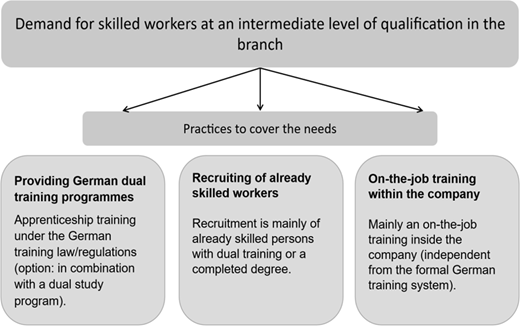
Analysis of the data illustrates the relevance of three distinct practices adopted by foreign subsidiaries to meet their requirements for skilled labour (see Figure 2). Each company adopts one of these three practices in the majority of cases.
4.1.1 Providing their own dual training programmes.
One practice is provision of a dual training programme. These companies therefore offer apprenticeships that complies with German regulations (Vocational Training Act) and is therefore identical to the corresponding offers in German companies (Fürstenau et al., 2014). In the context of dual study programmes, a first university degree is also integrated, as is the case with German companies (Deißinger et al., 2013).
Many companies report that there is no alternative to providing their own training if they are to meet their wider-ranging workforce requirements: “I must say, we deliver well – we are successful at what we do. But to maintain that position, I need more staff, so I train them.” (11/F):
Of course, it is also very good for us when we […] have trainees. They get to know the company from the ground up. I think it’s a good thing. (5/C).
A number of companies see the German dual vocational training model as the only appropriate solution. One interviewee stressed that their company’s approach is entirely German:
While the parent company issues instructions and guidance, this relates to other operational aspects and not to how we train and recruit workers. So we are completely German in the way we operate in these areas, and therefore it seemed the obvious thing to do to adopt the German model of dual training. (64/F).
One interviewee’s concept of training is so influenced by the German model that he fundamentally denied there could be any alternative to dual training practices. And one interviewee from a Japanese company that had been acquired said:
Well, I have to say that the Japanese have not changed anything about the concept of vocational training or dual training in Germany. The Japanese know that they can’t just force their system on us. They know that doesn’t work. (7/J).
Although many companies have been running their own training programmes for many years, many of them still plan on a yearly basis, taking into account both current and future staffing requirements. One interviewee from a British company reported:
The decision is made in England, but the proposals come from Germany, because we are located there, and we say we need so many training places. This means that we have to provide apprenticeships on the basis of investment alone, but also in line with demand, so that more apprenticeships are provided on top. (1/UK).
Depending on the nature of the subsidiary, the companies provide training in craft/technical occupations and/or commercial occupations. In the majority of companies providing their own training, these programmes have been running for many years, but many companies report that they still plan shortly on an annual basis to reflect both their current and their future needs for skilled staff. Adjustments from year to year reflect both the number of training places available for apprenticeships and the occupations and courses available to those doing a dual study programme. One interviewee reported: “[…] Before, [we] only trained mechatronics engineers […] but a few years ago, we also needed machine and plant operators.” (4/US). In some cases, companies had also previously switched to another training occupation because they could no longer meet the formal training criteria for the occupation they had previously been offering. Some companies make no distinction between a dual training programme and a dual academic study programme when it comes to their long-term workforce planning. One interviewee saw these two routes into skilled occupations as different but of equal value over the long term and described the planning the company engaged in: “I think after about five or six years, they all end up at the same level.” (5/F). In other companies, by contrast, an explicit distinction was made between apprentices and students on a dual academic study programme.
4.1.2 Recruiting skilled workers.
Other companies follow the practice of not providing their own initial training of skilled workers and instead meeting their requirements for such workers by recruiting from various groups of applicants. These skilled workers have already received training – either via a dual apprenticeship or on the basis of an academic qualification (often a bachelor’s degree) – and can then be employed directly at entry level in skilled roles following an induction process. Some companies emphasise how close a match those with a dual apprenticeship are for the roles, so they have no interest in employing graduates for these roles. A Chinese interviewee reported, for example:
We are already very satisfied with our colleagues here, because they have already had a reasonable education and that is already enough for our tasks. They don’t need a university education; […] for service technicians it is more manual and also this knowledge in mechatronics is important for the tasks in the company. (4/C).
For some companies in this category, providing their own training or a dual study programme is an option for the future. Most companies with such plans are considering initial training to meet wide-ranging demand, either current or future. In some cases, their plans include an orientation phase, only after which they would consider taking responsibility for implementing their own training programme where appropriate.
4.1.3 On-the-job training within the company.
Individual interviews also revealed a further practice used by some companies – providing their own comprehensive initial training in an on-the-job mode. This training does not form part of the German vocational training system, so trainees completing such a programme do not receive a formal qualification. And although the practice of providing their own on-the-job training takes different forms within different companies, training activities are not restricted solely to onboarding processes, such as initial training or short product familiarisation courses of the kind that all new staff undergo. In these individual cases, wide-ranging and company-specific on-the-job training is provided. This comprehensive training, sometimes over a number of years, takes place solely within the company. And from the perspective of the companies involved, it is irrelevant what prior education and training applicants have: in fact, the companies prefer their junior staff not to have extensive prior knowledge or experience, as one interviewee made clear: “Ultimately, we just have to consider who will fit in best and who we know we can train, even though they don’t already have all the skills.” (2/UK).
This training is wider ranging in that participants either receive intensive training in one specific area or deliberate undergo familiarisation with different areas. It is in these companies’ interests to keep all the trainees within the company and to offer them long-term career perspectives. For example, one company also offers unskilled workers training, giving them the opportunity to move into skilled roles. In fact, regardless of their prior training status, internal candidates are given priority when it comes to filling vacancies and when internal training for new roles and jobs is available: “We don’t demand a linear CV because we don’t want to employ linear workers.” (2/UK).
4.1.4 Overview of practices.
It has not been possible to identify any significant differences between home countries on the basis of the findings from this study. As explained above, differences are evident in terms of participation in training, but it was not possible to associate individual aspects – for example, wide-ranging training of inexperienced junior staff in a Japanese company or on-the-job learning in a British company – with practices in the home country. The small sample size does not, however, enable more detailed conclusions to be drawn on the significance of this aspect.
Overall, the companies in the study could be associated with one particular practice despite specific differences of detailed implementation (see Table 2).
The wide-ranging adaptation to the German training culture to offer apprenticeships and in some cases also dual study programmes identified in this study suggests a marked influence from the local environment. In this context, it should be noted that also not all German companies rely exclusively on dual training programmes to meet their demand for skilled workers. However, dual training is defined here as the ideal type of classic German training programme (Pilz, 2016).
The next section considers the environmental influences that may bear on this adaptation.
4.2 The impact of institutional influences on adaptation
Analysis of the data reveals three different areas in which influences operate. The first of these areas is the general framework within which each specific company operates; the second is the influence exerted by the German environment; and the third is the influence exerted by the home country. Alongside these three aspects, interviewees repeatedly cited the specific role of operational managers as facilitators or promoters of the dual model of training (Gessler, 2017; Pilz and Wiemann, 2021).
4.2.1 The general framework.
One major influence explicitly identified by almost all the companies in the study was their subsidiary’s current and future requirements for skilled labour. One interviewee put it very succinctly: “When you come down to it, it’s always about what we need.” (37/US). Current and future demand for skilled labour is a major driver. In many cases, this demand is assessed regularly and in a structured way so that management is able to make long-term plans on the basis of specific data. One interviewee from a French company reported:
Well, there is also a very new process to assess demand as part of human resource planning, and we want to be able to approach it strategically to assess where young talent is needed and where we need to choose between an apprentice and a student on a dual degree/training programme. (59/F).
This response illustrates that two aspects are important in the choice between apprentices and students on a dual study programme: the scale of the demand (the number of junior staff required); and the skills the company needs. This demand-oriented planning has also very recently been rolled out in other companies:
Well, a few years ago – seven years or so – we realised that we wanted to focus our training solely on what we needed by way of junior staff. This means that we plan to keep on the apprentices and the dual students we train and employ them in the company – ideally, on a permanent contract. (25/F).
One further factor cited by almost all interviewees is the current situation on the German labour market, which is currently being impacted by demographic change. As one interviewee put it: “It’s a seller’s market.” (37/US). Overall, it is evident that the difficult labour market for companies is a further driver in their decision to provide their own training. As one company interviewee emphasised: “There aren’t many workers specialised in this area […] so it is very important to us to train our own skilled workers.” (10/US). Another interviewee also saw providing their own training as a solution:
We need around a further 50 skilled workers and have been desperately trying to recruit them for over a year now. At the moment, we are trying to convince management locally and the group management in France that we can only do that in Germany if we actually train more people. (64/F).
A third element of the framework is the feasibility of the various strategies. One interviewee summed up the subsidiary’s situation:
We could think about it at some point in the future […] but I can’t see it happening yet. We’re still in the development phase, so the conditions and the processes aren’t yet in place for us to implement something like that. (43/J).
Interviewees cited the size of the company, how long the subsidiary has been operating and the stage the company has reached in its development as key indicators. Some interviewees emphasised only individual aspects, while others saw certain connections, such as the expansion of business activities associated with the length of presence in Germany and the corresponding increase in personnel. Other companies reported being in a growth phase, alluding to the fact that certain activities, including running their own training, was not yet a realistic option. This aspect is also described by an HR manager in the subsidiary of a Chinese company that has been operating in Germany for more than 10 years:
After settling here, we first had to make sure that we established ourselves, gained market share and made ourselves known in general. And then that meant hard work for each individual. And you didn’t have the time, or haven’t had the time yet, to really train as a trainer. (2/C).
One interviewee reflected back on his company’s relationship with its parent company:
I could imagine that a few years ago, when we were quite a lot smaller, […] we felt the impact of our parent company’s requirements back in the home country. If you want to grow, you need to find out who you are first […] but now, we’re a training company or a company just like many other German companies. (3/UK).
4.2.2 Influences from the German institutional environment.
The dual training environment in Germany is a further influence on the way subsidiaries make their decisions. As set out above in the theoretical overview, influences from the German institutional environment are evident in the areas of vocational training and recruitment at skilled worker level (Fortwengel and Jackson, 2016; Scott, 2014), and this also emerged in many of the interview responses.
Regulatory influences reported by interviewees are statutory labour market provisions and the statutory requirements of the dual system. These are, therefore, major influences on corporate decision-making when it comes to meeting the demand for skilled labour. Some companies, for example, opt not to provide their own training because they are unable to comply with the statutory requirements or else because these requirements seem too expensive or cumbersome to comply with. These requirements are based for the most part on Germany’s Vocational Training Act and relate to qualifications trainers and instructors must have, training content and other requirements, such as the format of reporting or contractual partners. Some companies did not go so far as to describe these requirements as an obstacle but did explicitly cite them as a factor in their decision-making:
Of course, we have to make sure that we meet the requirements for having the right instructors in-house and be able to demonstrate that we meet the criteria to be able to train. (4/F).
In some cases, a company needs a training workshop to be able to deliver the training curriculum in-house. One company referred to investing in a workshop of this kind or using external providers to comply with this aspect of the training curriculum:
Our wood mechanics are trained in the development workshop. But if we want to train electricians, we need another training workshop and the relevant equipment for that training. Otherwise, we have to use the local industrial training workshop. And that means more investment, because of course we have to pay to use their facilities to train our apprentices. So these are all issues that have to be discussed and decided in France. (60/F).
One interviewee also reported that these formal training requirements sometimes meet with a lack of comprehension among managers in the German subsidiary:
[…] it’s sometimes the case that many of those making the decisions have absolutely no idea about the dual training system. They are all graduates and then they say, “We need an energy electronics technician specialising in plant and an information electronics technician.’ But those are profiles that we cannot easily train up, so we have to pick up on that, explain in detail again how the training system works, that we have requirements we need to meet in terms of curriculum, the training framework, planning and so on. But then most of them understand and say ‘Okay, if that’s what’s needed, then that’s what we’ll do’.” (42/US).
Many interviews referred to the dual system as an appropriate solution if not the only solution for training new skilled labour, and this is reflected in the perceived value of skilled workers trained within the dual system. For example, one company emphasised that German training is of a high quality and performs very well in international comparisons: “[…] German hospitality staff are so well trained that they can work anywhere in the world.” (4/F). This means the next generation of skilled workers are able to join the company at a very young age. One interviewee from a US company described the ideal:
A company needs its own DNA, and I think if I have people who start here at the bottom and stay with us, this company’s DNA will be better than if I buy people in. Basically, those are the reasons why we took the decision to train our own people here. (11/F).
The higher quality of skilled workers trained in-house is also something US companies alluded to:
Having your own skilled workers who can immediately slot into a job following their training because they already know everything they need to know; you might be able to fill office management roles in some other way, but the quality is higher. (41/US).
Many interviewees alluded to the fact that participating in training practices generates pride and social recognition of the company’s commitment to high-quality training. A Japanese company, for example referred to its pride in the training it provides in-house: “Our goal, our philosophy is actually to generate our own successors by training them ourselves. And we’re proud of that.” (19/J). This pride companies feel derives from recognition both of the training itself they deliver and of their commitment to training as something good, something that many HR managers describe as “the right thing to do” and that is rewarded in social reputational terms. This reflects the fact that training provision in a company is also seen as part of the company’s corporate social responsibility: “When we train people, we then employ them on a permanent contract, and that fits in with our corporate social responsibility.” (25/F). Similarly, an interviewee from another French company reported recruiting young workers with unusual CVs as part of their corporate social responsibility:
Well, in the best-case scenario – and this is my personal stance – we fulfil our corporate social responsibility, so I have fought for us to recruit at least two [people] and stuck with the aim of just giving people a chance even if they have a more unusual CV or other opportunities. (12/F).
In fact, some interviewees expressed regret that their company was not training its own staff: “It’s a shame that we don’t follow the traditional German approach to apprentices; I really regret that.” (18/J).
Some HR managers also referred to an enhanced image based on positive external perceptions of their company’s participation in the dual training system as an influence. One interviewee from a US company, for example, described the positive impact of training: “Well, training is always positive, […] that’s always a feel-good topic. And it always gets us good press. I’d be stupid not to acknowledge that.” (37/US).
One further influence cited regularly by interviewees both as the aim of training and a factor in the recruitment of skilled labour is the relevance of formal qualifications. This also includes the notion that a course of vocational training and, hence, a recognised occupational qualification forms the basis of an individual’s working life and is more significant than merely skills training for a specific role in the company. This is related to the fact that apprentices gain insight into different areas of the company’s work:
My mission is that I ensure that all our apprentices, regardless of the way they train with us, get to see all the nooks and crannies in the company. And that’s something I personally want every single employee to have had the chance to do. (62/F).
The high level of recognition of vocational training and the chances for advancement it creates is something that one interviewee emphasised:
All career paths are open, and anyone with a two and a half-year chamber of industry and commerce training under their belt can become a superstar or a manager or end up in a senior position in consultancy. You won’t hear us saying, “Well, we can see you’ve got talent, but unfortunately, you don’t have a degree”. (45/US).
4.2.3 Influences from the home country environment.
The data shows that the environment in the home country also influences the decisions made by subsidiaries in Germany, in particular requirements on the part of the parent company that are binding on their subsidiary in Germany. These requirements are often couched in very general terms:
Well, of course we already have an HR strategy set by the parent company, and of course the budget is always set in consultation with, or on the instructions of, the parent company, but there are no requirements for the way in which we train or how we recruit. How we do that is left up to us. (64/F).
In some cases, this leads to questions from headquarters about the details of training costs in the budget. One interviewee’s comments were typical of responses on a divergent understanding of initial training activities in home countries:
The only thing I can say is they have no concept of vocational training and that whenever we need to discuss budgets, we have to fight, because the French aren’t aware that although vocational training costs money up-front, it pays off later on. (38/F).
On the other hand, some parent companies approve of or even admire the training provided in German subsidiaries. It is clear that in some companies, training is recognised at headquarters despite differing views of how that training should be organised:
It’s true that France has to approve the headcounts, but at the end of the day, they approve every additional place we want to offer. They do that, at least. (23/F).
Many interviewees reported that investment in future generations of staff is approved and training is supported once any misunderstandings have been clarified: “It’s taken a while for them to really understand. But ultimately, they are really enthusiastic.” (19/J). And there is real admiration in many cases.
Alongside general requirements, some companies also specify requirements for additional training. This training also relates to younger staff in Germany in some cases: for example, it may be managed centrally from France, as one interviewee reported, and relate to specific issues, such as safety provisions: “We have safety rules. So I would say you find this in the case of general issues.” (44/F).
The findings also document the differing perceptions of the value of university degrees and vocational qualifications in many headquarters and in Germany. For example, this is reflected in the fact that in Japan, the target group for recruiting in-company apprenticeships is usually graduates. This lack of understanding was described by one interviewee reporting on an exchange with colleagues from the Japanese parent company:
It took quite a while for them to understand how it works and to grasp that these people were doing an apprenticeship rather than a degree and were attending a vocational school rather than a university. (19/J).
4.2.4 The role of facilitators.
Alongside a range of organisations, individuals from the German environment also wield an influence. In some cases, there was explicit reference to the personal motivation of individuals socialised in Germany in the HR and training area, with accounts of personal experience. There was also reference in some cases to managers – some of whom were also interviewed as HR managers – as playing a facilitative role in relation to decisions on providing their own apprenticeships. For example, one interviewee had just joined the company and had raised the issue of expanding its dual apprenticeship scheme: “And I knew about the issue of training from my earlier work. And I was able to convince management that we should expand our training.” (060/F). The HR managers interviewed often emphasised their personal fascination with training and their resulting motivation to drive the issue forward: “Yes, it’s really fun: since I did my own training, it’s an issue I think about a lot. I became a training supervisor; it’s something dear to my heart.” (7/J).
Alongside the influence from local facilitators, the data also reveal a distinct but markedly smaller influence from foreign parent companies. Interviewees reported not only on direct operational intervention in training strategy but also, in some cases, on exchanges with headquarters staff in relation to their fundamental strategy for training future generations of skilled workers. In some US companies, managers had not been socialised in Germany and in some cases were not even based in Germany. In one company, the relevant manager was based in the UK (0029/USA), while in another company, a range of different country nationals took responsibility for the whole of Europe (37/USA). In these cases, managers were familiar with a different format of vocational training, German colleagues had to provide additional explanations and influences from other environments – not solely the USA – reached the subsidiary via facilitators.
4.2.5 Summary of influences.
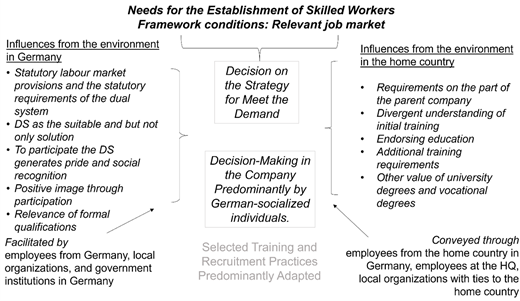
An aggregated picture of the findings on the framework, influences and facilitators (Figure 3) illustrates the extent to which subsidiaries of the selected companies adapt to German practices in the area of initial vocational training and recruitment of skilled workers, based on attribution of the various practices to different companies (Table 2). The data reveal a clear host country effect as discussed also in the existing literature already (Edwards and Kuruvilla, 2004; Pudelko and Harzing, 2007).
As set out above, the framework forms the basis for decision-making on appropriate practices when it comes to meeting the demand for skilled workers (for comparison with the conceptual assumptions at the beginning, see Figure 1 again). Depending on the nature of the framework, subsidiaries have a range of options. Influences also originate in the dual training environment, where most decision-makers have been socialised in Germany and promote the apprenticeship system. Influences are evident both from the local German institutional environment and, albeit to a much smaller extent, from the home country environment. Although it was not possible to measure the intensity of individual influences and, therefore, to draw specific conclusions about them, it is nevertheless clear that the local environment in Germany has a considerable influence on the practices adopted by companies. Alongside the local statutory framework, subsidiaries are also considerably influenced by local cultural/cognitive and normative assumptions on training and recruitment as discussed in the approach by Scott (2014). The influences from the home country environment, by contrast, tend to focus either on budgetary targets or more general requirements imposed by headquarters.
Referring back to the institutional approach described above (Scott, 2014), this finding can be interpreted at a more abstract level: the German dual vocational training system is embedded within a very distinctive and extensive institutional setting (Busemeyer and Trampusch, 2012; Deißinger and Gonon, 2021). It is very common for larger subsidiaries of foreign companies in Germany to adapt their training strategy over the long term in line with this specific “skills ecosystem” (Finegold, 1999) and its far-reaching statutory elements, including Germany’s Vocational Training Act but also the balance of power between chambers of industry and commerce and state stakeholders. This could be seen as a form of “institutional stickiness” (Boettke et al., 2008) and is something that foreign companies cannot circumvent. German training culture (Pilz, 2009; Pilz et al., 2023), therefore, colours the operation of subsidiaries of foreign multinationals quite considerably.
It is interesting in this regard that a number of studies demonstrate that German companies are, by contrast, much more likely to impose German training practices on their foreign subsidiaries (Pilz and Wiemann, 2021; Vogelsang and Pilz, 2021; Pilz and Vogelsang, 2025). One possible explanation is that “institutional stickiness” (Boettke et al., 2008) is considerably weaker in other countries than it is in Germany. This is the case, for example, with liberal training systems (Busemeyer and Trampusch, 2012; Pilz, 2016). Alternatively, the initial vocational training system may have less relation to company practice, as is the case where the vocational training system is dominated by full-time vocational school models (Busemeyer and Trampusch, 2012) and is therefore largely immune to cooperation arrangements.
5. Conclusions
This study finds that companies frequently adapt their training activities to local German practices. This is also the case where it is not possible to make an exact comparison of the extent to which training is provided and whether training behaviours really are identical with those of comparable German companies (Pilz et al., 2023). It is clear that if training activities are offered to young future employees in the form of initial training, this training is likely to rely on the German dual apprenticeship or dual study programme model. By contrast with Pudelko and Harzing’s (2007) study, this study suggests that training therefore needs to rely substantially on local adaptation. The ultimate decision on training activities is dominated by influences from the German operating environment at the cost of country-of-origin influences. Against the backdrop of statutory requirements, dual apprenticeships and dual study programmes are often seen as the only solution.
In opposition to studies on German companies operating outside Germany, comprehensive training is not imported and training outside the German system is provided in only a few individual cases. In other studies on different HR practices, there is a greater adaptation of strategy to the two environments in solutions that sometimes include hybrid elements (Stavrou et al., 2021). This study does not find hybrid solutions of this kind. However, this does not mean that there is no influence from the home country. A closer scrutiny of the influences on this decision-making shows, indeed, that although the majority use the dual system of vocational training as their training model, subsidiaries do not “act like German companies” in their internal decision-making and that some home-country influences are evident in intensive negotiation processes with the parent company. For example, the different systems with their underlying and institutionally embedded rules, norms and cultural practices are the result of discussion and exchanges with the parent company. The existence of this institutional duality has previously been identified by Kostova and Roth (2002).
One limitation of this study is that the sample is too small to enable wide-ranging conclusions to be drawn, for example in relation to the differences between individual countries of origin. A wider sample and comparison with German companies could enable more a detailed analysis of the differences between company practices and produce a more differentiated picture of the influences from Germany and from the respective home country. Another aspect concerns the global transferability of our findings. As the institutional stickiness of the German skills ecosystem, discussed in detail above, is much more pronounced than in many other countries (Wrana and Diez, 2016; Vogelsang and Pilz, 2021), the findings can only be transferred to other countries to a limited extent or not without careful consideration. Other research activities would therefore need to be launched in this area.
Nevertheless, the findings of this study help to improve understanding of corporate strategy – and they have potential uses at a practical level. For example, chambers of industry and commerce could target and support foreign companies to develop a training strategy in line with the German skills ecosystem. Meanwhile, organisations promoting business in Germany could draw the attention of foreign companies newly setting up in Germany to the provision of dual apprenticeships. This also includes promoting foreign investment in Germany, which can highlight the opportunity to participate in the excellent vocational education system as an asset for Germany as a business location.
And although the study has not identified clear differences between different countries of origin in how decisions are made concerning training, discussion and negotiations with the parent company in a range of countries of origin clearly reveal the influences and associated issues and concerns of the respective country of origin.
The data presented here are embedded in a research project funded by the German Research Foundation (DFG) under the title “Multinational companies and local knowledge base–an evolutionary perspective: Regional variants of initial vocational education and training activities in Germany”. The authors thank their project partners Prof Dr Martina Fuchs and Johannes Westermeyer (University of Cologne) for raw data collection and many valuable insights and suggestions.