This study aims to examine how human resource development impacts Africa’s structural transformation and the role of world uncertainty in influencing this relationship.
The study is based on a sample of forty-seven African countries over the period 2010–2022. The adopted empirical strategies are Fixed Effects Regression, Driscoll–Kraay Fixed Effects with Standard Errors, and the Generalized Method of Moments for robustness checks. The robust estimation approach was strategically designed to include valid model selection, control for variable omission bias and avoid instrument proliferation.
The following key findings are established. First, human resource development, measured through educational outcome and health quality, exerts a positive and significant unconditional effect on Africa’s structural transformation; (ii) world uncertainty negatively impacts the positive effect of human resource development on Africa’s structural transformation; (iii) the study identifies the world uncertainty thresholds that Africa must avoid to maintain the positive effect of human resource development on structural transformation. Furthermore, the robustness checks validate the findings, particularly when accounting for economic factors such as technological innovations, resource endowment and infrastructural development. The study concludes by outlining policy implications that contribute to advancing the objectives of the African Union’s Agenda 2063 and the United Nations Sustainable Development Goals.
This study contributes to the literature on African structural transformation by ascertaining the world uncertainty thresholds to be avoided to maintain a positive relationship between human resource development and structural transformation.
1. Introduction
The intensification of global uncertainties continues to expose critical structural vulnerabilities in the world economy, underscoring the pressing need for coordinated and adaptive policy responses (World Bank, 2024a, 2024b). For Africa, regional conflicts, deepening geopolitical fragmentation and emerging trade policies in several countries further constrain the region’s economic growth. As evident in the literature, despite Africa’s immense regional potential, the region remains more susceptible to external shocks than any other region. This vulnerability stems from factors such as overreliance on primary commodity exports (Ngassam et al., 2025), inadequate infrastructural adaptation (Emeka et al., 2024a; Begazo et al., 2023), poor educational quality (Emeka and Asongu, 2025) and weak institutional and governance frameworks (Asongu et al., 2024a; Ogbuabor et al., 2023a). These challenges have undermined not only the region’s economic growth but also stagnated its structural transformation, which in this study is understood as, a shift in sectoral composition from agriculture to industry and services. To put Africa’s structural stagnation into perspective, the United Nations Industrial Development Organization (2024) UNIDO report that, in terms of value added, manufacturing is the predominant industrial sector in Asia (81.0% of industrial value added in 2023), Europe (80.8%), Northern America (77.5%) and Latin America and the Caribbean (72.4%). By contrast, Sub-Saharan Africa records only 55.7%, reflecting a much weaker structural base.
Against this backdrop, the relationship between human resource development (HRD) and structural transformation presents a critical area for analysis, particularly within the context of globalization. While global integration through trade, capital flows and technological progress has generated socioeconomic advancements (World Trade Organization, WTO, 2025), progress in many developing regions, especially Africa, has been constrained by limited investments in education, health and skills formation. Empirical evidence noted that individual capabilities (Capriati, 2022; Ali et al., 2018; Hartog, 2001), the quality of education (Emeka and Asongu, 2025; Jerome and Ajakaiye, 2019) and supportive institutional frameworks (Effiom and Uche, 2022) play decisive roles in enabling human resources to drive productivity. Weaknesses in these areas limit labor mobility across sectors and prevent workers from moving into higher-productivity industries. Conversely, improvements in HRD have been found to accelerate industrialization and enhance growth prospects, with studies estimating significant contributions to national and global GDP when effectively leveraged (Zhao and Zhang, 2025; Emeka et al., 2026; Bykova et al., 2024).
From the foregoing, several dispositions become apparent. First, HRD holds strong potential to enhance Africa’s structural transformation by improving labor productivity and facilitating industrialization. Second, heightened levels of world uncertainty pose significant risks to Africa’s structural pursuits, often undermining progress through volatility in trade, finance and investment flows. However, there has been little empirical investigation into how global uncertainty interacts with human resource development to influence Africa’s structural transformation. This gap is crucial to address for the following reasons: First, understanding this nexus will provide evidence-based insights for policymakers to design strategies that harness HRD as a buffer against destabilizing global forces. Second, it can highlight how investments in HRD improve Africa’s industrial competitiveness by diversifying production and strengthening value chains. Thirdly, this investigation can clarify how HRD fosters inclusive growth, ensuring that structural change benefits broader segments of society. Fourth, it will provide evidence-based insights to guide policies aimed at enhancing resilience in Africa’s transformation agenda and align regional development strategies with global frameworks such as the African Union’s Agenda 2063 and the United Nations Sustainable Development Goals (SDGs).
It therefore implies that the research objectives guiding this study are as follows: (i) understand the unconditional impact of HRD on Africa’s structural transformation and (ii) assess how world uncertainty impacts the relationship between HRD and Africa’s structural transformation. To assess these objectives, the study examines the thresholds of world uncertainty that shape the relationship between HRD and structural transformation. These thresholds are particularly valuable for policymakers (i.e. individuals or groups in government who formulate, implement and enforce policies or rules that govern a nation), as they can highlight critical levels of world uncertainty that should be avoided if Africa is to fully sustain a positive role of HRD in driving structural transformation. Going forward, this study employs both static and dynamic estimation techniques to achieve its objectives. The static methodologies adopted include: (i) the traditional fixed effects method and (ii) the Driscoll–Kraay fixed effects standard error estimator. The adopted dynamic estimation is the system generalized method of moments (SGMM) technique. While the fixed effects methods help to control for country-specific unobserved heterogeneity and potential biases arising from omitted variables, the SGMM approach is adopted to address endogeneity concerns, correcting for biases associated with difference estimators, and accounting for cross-country variations. In addition, time-invariant heterogeneity is addressed, and instrument collapsing is applied to enhance the robustness and validity of the results. The findings of the study are broadly consistent with previous works such as Asongu et al. (2024b) and Saba et al. (2024), but they advance the literature by clarifying both the unconditional and net effects of HRD and world uncertainty on structural transformation, underscoring that these effects should not be interpreted as simple linear relationships. The scope of this study covers 47 African economies over the period 2010–2022. The closest study in the extant literature to the present study is Emeka et al. (2025), which has examined the conditional role of human resource development in the link between economic policy uncertainty and structural transformation. The study has established human development thresholds that are necessary to mitigate the negative impact of economic policy uncertainty on structural transformation. Meanwhile, the present study assesses avoidable world uncertainty thresholds to maintain the positive effect of human resource development on structural transformation.
The study is structured as follows: Section 2 offers a concise overview of the link between world uncertainty, human resources development and structural transformation, along with theoretical foundations. Section 3 discusses the data and methodology, followed by Section 4, which presents empirical findings and discussions. Finally, Section 5 wraps up with suggestions for future research.
2. Literature review
2.1 Human resource development and structural transformation
A growing body of literature underscores the centrality of HRD in advancing Africa’s structural transformation. For instance, Emeka et al. (2026) provide one of the most comprehensive contributions on HRD and structural transformation. Their study adopted fixed effects regression, Driscoll–Kraay fixed effects with robust standard errors, and the bias-corrected least squares dummy variable (LSDV) estimator to examine the moderating impact of HRD on the effects of aggregated and disaggregated anti-globalization dynamics on Africa’s structural transformation. The findings indicate that while anti-globalization dynamics have a negative unconditional impact on Africa’s structural transformation, human capital development positively moderates these adverse effects, with critical threshold levels identified for the moderating influence. Similarly, Mabasa and Makondo (2024) presented that skill development, particularly vocational and adaptive skills such as problem-solving, critical thinking and creativity, offer a mechanism to reduce vulnerability to external shocks by diversifying the economic base. Nkamnebe Edith et al. (2023) emphasize a holistic approach to HRD that prioritizes technological literacy, critical thinking and sector-specific capabilities relevant to emerging industries. Their study underscores that without strong human capital foundations, Africa’s labor force struggles to transition into higher-productivity sectors, thereby slowing structural transformation. Rastgar et al. (2022) examine smart human resources in the context of digital transformation, highlighting the role of transformative technologies in enhancing knowledge management, adaptability and organizational innovation. Their findings show that digital transformation fosters smart HR architectures that improve structural performance and sustain competitiveness. Drawing on data from 181 private universities and using SmartPLS for structural analysis, Purwanto et al. (2023) analyzed the effect of transformational leadership on organizational citizenship behavior, university performance and innovative work behavior, as well as the role of leader–member exchange, organizational commitment and quality of work life. Conclusively, the study highlights the importance of HR-related factors such as leadership, commitment and quality of work life in driving organizational outcomes, while showing that digital transformation requires complementary mechanisms to translate into performance improvements. Mamanazarov et al. (2025) explore how AI-driven platforms and e-learning systems are reshaping legal education and human capital development in post-Soviet contexts. Their study finds that while digital platforms enhance accessibility and efficiency, they expose gaps in ethical training, digital competencies and cultural alignment. To address these, the authors propose a framework for digitally mediated legal human capital development that integrates sociocultural, technological and ethical dimensions. In addition, Obiakor and Newman (2022) and Hunduma and Mekuria (2023) highlight the persistent challenge of skills mismatch in Africa. Their findings reveal a sharp disconnect between educational outcomes and labor market demands, with technological sectors, advanced manufacturing and knowledge-based services being most affected. This misalignment creates a significant barrier to economic diversification, innovation and ultimately, structural transformation. In sum, the literature makes it clear that HRD, through education, adaptive skills, technological literacy, leadership and digital readiness, is not only central to Africa’s structural transformation but also essential for overcoming vulnerabilities, aligning with global shifts, and achieving structural transformation.
2.2 World uncertainty and structural transformation
Emeka et al. (2026) found that global triggers of anti-globalization, such as the 2016 BREXIT vote and the US–China trade conflict, negatively impact Africa’s structural transformation by driving trade policy reversals, reducing foreign direct investment (FDI), and limiting technology transfer. This aligns with broader evidence showing that uncertainty discourages long-term investment in high-value sectors such as manufacturing and technology, while reinforcing dependence on primary commodities like oil, minerals and agriculture (Hanson, 2024; Nchofoung, 2024; Ogbuabor et al., 2023a, 2023b). Similarly, Löscher and Kaltenbrunner (2023) argue that developing economies, particularly in Africa are disproportionately affected by the adverse consequences of anti-globalization, as they face structural constraints including limited productive capacities and underdeveloped human capital. The overreliance on a narrow set of export commodities and the lack of economic diversification further exacerbates their vulnerability, as highlighted by Chingono and Mbohwa (2023). Ekeocha et al. (2023) further emphasize that countries reliant on primary commodity exports experience heightened exposure to the destabilizing effects of anti-globalization.
The COVID-19 pandemic provides a practical example of how heightened uncertainty undermines structural transformation by disrupting economic integration and altering global systems. The crisis destabilized supply chains, constrained the operations of multinational enterprises, and affected FDI and trade patterns, often prompting protectionist and border-focused policies. Ghazalian (2025) posited that the pandemic forced governments to reassess globalization strategies, balancing global engagement with regional retrenchment and national seclusion, developments that slowed structural transformation. While some positive outcomes, such as digital transformation and supply chain reconfiguration, emerged, these were largely reactive rather than transformative. Danowski and Park (2025) add that rising trade protectionism, a key aspect of deglobalization, is also associated with political polarization, increased protest activity, and heightened digital authoritarian measures. In a related study, Ogbuabor et al. (2023a) examined how uncertainty, particularly terrorism and economic policy, affects economic complexity in Africa. Using data from 33 African countries spanning 2010–2021 and employing pooled OLS and dynamic system GMM estimators, they showed that economic policy uncertainty significantly inhibits Africa’s economic complexity. Similarly, William and Fengrong (2022) found, through analysis of World Bank Enterprise Survey data, that heightened policy uncertainty adversely affects medium and large enterprises, limiting their capacity to enhance economic complexity. Chisadza et al. (2022) also demonstrated through panel analyses that economic uncertainty reduces global tourism, underscoring the wide-ranging disruptions of anti-globalization forces across multiple sectors. Finally, Abukari (2025) analyzed the Trump administration’s trade policies, including tariffs on Chinese imports and the renegotiation of NAFTA, and concluded that such measures, reflecting a shift toward economic nationalism, create uneven economic outcomes by prioritizing domestic interests over global cooperation. Collectively, these findings demonstrate that economic and policy uncertainties, whether through global shocks, health crises or nationalist trade strategies, impede structural transformation by destabilizing key sectors, discouraging long-term investments, and undermining sustainable development prospects.
2.3 Theoretical underpinnings and hypothesis development
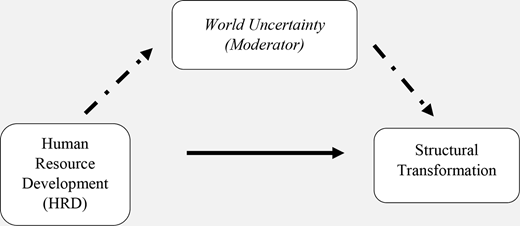
The theoretical underpinning of this study lies in human capital theory, which explains how investments in education and training enhance economic resilience, adaptability and productivity. Becker’s (1964) seminal work established that systematic development of human capital through structured learning experiences yields substantial economic returns. Contemporary scholarship has expanded this foundation, showing how HRD shapes national economic outcomes by creating adaptable, innovation-capable workforces (Swanson, 2022; Atmaja et al., 2022). Economies that invest heavily in human capital build stronger buffers against uncertainty while accelerating structural transformation (Obeidat et al., 2023). This expanded perspective highlights the role of human resources not only in boosting productivity but also in fostering knowledge spillovers that drive technological advancement and industrial diversification (Sart and Yildiz, 2022; Oosthuizen, 2022). Advanced economies, such as those in the G7, illustrate this trajectory: sustained investment in technical education and research enabled them to excel in high-value fields like advanced manufacturing, biotechnology and artificial intelligence, thereby consolidating their structural transformation (Yorks et al., 2022; Goldin, 2024). The transformative role of human resources is further demonstrated by country-specific experiences. South Korea’s evolution from a labor-intensive manufacturing hub to a knowledge-based powerhouse was achieved through strategic investment in technical education and research capacity, enabling mastery of complex technologies in semiconductors, electronics and digital industries. Similarly, Finland’s shift from a resource-dependent economy to an innovation-driven one reflects how HRD builds new competitive advantages and industrial capabilities. These cases underscore that HRD is most effective when combined with other critical drivers of transformation: robust institutions that ensure efficient resource allocation, technological capabilities that enhance productivity, and market integration that supports specialization and economies of scale. However, these drivers achieve their full potential only when powered by skilled human capital capable of deploying and adapting innovations to local contexts. Hence, even advanced technologies or expanded markets yield limited benefits without a workforce capable of leveraging them. Building on this reasoning, the present study hypothesizes that world uncertainty interacts negatively with HRD, thereby diminishing its positive effect on Africa’s structural transformation. Narrowing the above insights into the testable hypothesis, in Figure 1 below, the horizontal arrow represents the direct nexus between HRD and structural transformation, while the broken arrows denote the moderation role of world uncertainty, such that there are levels of world uncertainty that should be avoided in the order to maintain the positive nexus between HRD and structural transformation.
3. Methods
3.1 Variables
The purpose of this study is to investigate two objectives: first, the unconditional impact of human resource development on Africa’s structural transformation (i.e. the horizontal arrow in Figure 1); and second, the moderating impact of world uncertainty on the effect of human resource development on Africa’s structural transformation (i.e. the broken arrows in Figure 1). The analysis is based on secondary data from a sample of 47 [1] African countries between 2010 and 2022. The sample size and study period were based on the following criteria: (i) availability of data in public databases and (ii) absence of breaks in the adopted data series. These criteria ensured both the reliability and consistency of the data used in the analysis. Structural transformation serves as the outcome or dependent variable in this study and is proxied by both manufacturing value added (% of GDP) and industrial value added (% of GDP). The selection of these indicators aligns with the conceptual definition of structural transformation outlined in the introductory section of this study and is consistent with previous studies, including Emeka et al. (2026), Asongu et al. (2024a, 2024b) and Asongu and Odhiambo (2020). The core independent variable of this study is HRD. To ensure robust policy insights and capture the multidimensional nature of HRD, it is examined in terms of educational quality and health quality. Accordingly, HRD is proxied by average years of schooling and life expectancy, aligning with Denis et al. (2025).
The moderating variable in this study is World Uncertainty, measured using the World Uncertainty Index (WUI) developed by Ahir et al. (2018). Unlike a previous study by Ogbuabor et al. (2023a), which relied on the Economic Policy Uncertainty (EPU) index, the WUI offers several advantages. It overcomes the limitations of being restricted to developed economies or depending on a single variable, which may not fully capture the multifaceted nature of uncertainty. Covering 143 economies, the WUI provides a more comprehensive and global measure of uncertainty. It is constructed based on economic and political events related to uncertainty, with data sourced from the Economist Intelligence Unit (EIU). The WUI has been employed in recent studies, including Ogbonna et al. (2022), Ho and Gan (2021) and Avom et al. (2020), further validating its utility in assessing uncertainty.
The selection of control variables is consistent with the existing literature on structural transformation, uncertainty and human resources (Haruna and Baek, 2025; Afolabi, 2023; Emeka et al., 2024; Asongu et al., 2024a; Appiah et al., 2022), as well as with the theoretical underpinnings of Schumpeter’s theory of innovative economic development and endogenous growth theory. While Schumpeter’s theory emphasizes innovation as a catalyst for transformation, endogenous growth theory highlights the importance of domestic factors, such as infrastructure, in driving structural transformation. The first control variable is technological innovation, measured using the newly constructed Technological Innovation Index developed by the United Nations Conference on Trade and Development (UNCTAD). This index provides a comprehensive assessment of the adoption, diffusion and impact of technology across economies, ensuring consistency, comparability and reliability in evaluating the role of technological advancements. In general, technological innovation is expected to enhance Africa’s structural transformation by improving production efficiency, fostering industrial diversification, and increasing overall economic output. Other control variables in this study include: natural resource rent (NRR) and infrastructural development (INFR), with the latter measured as a composite indicator of ICT infrastructure, electricity infrastructure, transport infrastructure and water infrastructure. Infrastructure is expected to positively influence structural transformation by facilitating efficient production, enabling connectivity and supporting industrial development. NRR is included as a control because many African countries depend heavily on revenues from the extraction and export of natural resources. While NRR represents a significant source of government revenue, it is also associated with the resource curse phenomenon in Sub-Saharan Africa, as overreliance on natural resources can impede economic diversification and reduce the prospects for structural transformation. The careful selection of control variables ensures that the model remains both theoretically sound and empirically reliable, while enhancing the credibility of the results by accounting for potential confounding factors without introducing unnecessary complexity. The data collection for this study was sourced from the World Bank (2024a, 2024b), Africa Infrastructure Development Index (AIDI) and the UNCTAD.
3.2 Model specification
3.2.1 Static specification with the Fixed-Effect regression.
Recall that the objective of this study is dual: first, to investigate the unconditional impact of HRD on Africa’s structural transformation; and second, to examine the moderating effect of world uncertainty on the relationship between HRD and Africa’s structural transformation. However, to model these objectives using the static methodology, they are represented as follows:
where: the variables remain as defined in Table 1; where is the country-specific effect. In equation (1), denotes the country fixed effect, capturing unobservable heterogeneities. The indices (i) and (t) refer to the cross-sectional and time dimensions, respectively. In equation (2), the overall incidence of HDR, moderated by world uncertainty, is ascertained by summing the coefficients of HRD and the interaction between HRD and WUI, which is given as () as well as testing for the significance of their combined effects. It is important to recall that STRUC represents structural transformation proxied by both manufacturing value added (% of GDP) and industrial value added (% of GDP). Also, HRD is proxied by education outcome and the quality of health. To estimate the above equation, two versions of the fixed effects methodology are adopted: (1) the traditional fixed effects model, which controls for unobservable heterogeneity, and (2) the Driscoll and Kraay fixed effects model, which additionally accounts for cross-sectional dependence and heteroskedasticity. The adoption of these two static methodologies ensures robust estimation by addressing potential biases arising from unobserved factors and contemporaneous correlation across countries.
3.2.2 Dynamic specification with the system Generalized Method of Moments.
Motivated by findings from the literature, particularly from Emeka et al. (2024) and Ogbuabor et al. (2023a, 2023b), the objectives of this study are modeled dynamically as presented below:
where all variables remain as already defined; is the constant; represents the vector of control variables (technological innovation, infrastructure and natural resource rent); denotes the unit indicator of auto-regression given that a one year is enough to capture previous information in the outcome variable; is the time-specific constant; represents the country-specific effect and represents the error term. The above dynamic specification is estimated using the dynamic system GMM methodology. This estimation technique helps to address potential endogeneity, control for unobserved country-specific effects, and account for the dynamic nature of the dependent variable, thereby providing consistent and efficient parameter estimates. Following Roodman (2009), this study applies the GMM method using forward orthogonal deviations. This technique builds on the Arellano and Bover (1995) estimator and offers enhanced reliability compared with standard system and difference GMM approaches (Tchamyou et al., 2019). Time effects are also incorporated to mitigate cross-sectional dependence, as neglecting such dependence can lead to seriously biased coefficient estimates (Dossou et al., 2023a, 2023b).
3.2.3 Exclusion restrictions, simultaneity and identification.
In applying GMM, three methodological issues must be carefully addressed: the validity of exclusion restrictions, the problem of simultaneity (endogeneity), and the identification of variables. The first issue, exclusion restrictions, concerns whether the instruments influence the dependent variable only through the endogenous regressors. In this study, exclusion restrictions are validated through the Difference-in-Hansen Test (DHT), which assesses the orthogonality between instruments and the error term. Consistent with established GMM practices, the Hansen and Sargan statistics are also employed to verify that the selected instruments explain the dependent variable solely through the identified transmission channels (Tchamyou et al., 2018). To further reduce the risk of instrument proliferation, only suitably lagged values of predetermined and endogenous variables are used, while the instrument set is kept parsimonious. The relatively high variation, as indicated by the standard deviation of structural transformation and HRD-related moderating variables, ensures that the estimation draws upon sufficient heterogeneity, thereby improving the credibility of the results.
The second issue is simultaneity and reverse causality. To address this, the study adopts forward orthogonal deviations, also known as the Helmert transformation. This procedure eliminates country-specific fixed effects while maintaining orthogonality between transformed variables and their lagged values. As a result, it allows the construction of valid internal instruments and prevents bias that could arise when fixed effects are correlated with lagged dependent variables. The third issue is identification, which involves categorizing variables into outcome, predetermined and strictly exogenous instruments. In this context, structural transformation, proxied by manufacturing value added and industrial value added, serves as the outcome variable. The explanatory variables that are treated as predetermined or endogenous include the main variables of interest (HRD and WUI) and a set of controls (TECH, NNR, INFR). In line with Roodman (2009), the time dimension (years) is regarded as strictly exogenous and is excluded from the list of potentially endogenous regressors.
4. Presentation of findings and discussions
4.1 Summary statistics and overview of the key variables
The study presents an overview of the summary statistics in Table 2, with the descriptive results offering several important insights. First, the two proxies for structural transformation, namely, manufacturing value added and industrial value added, record mean values of 10.391 and 27.968 across African economies during the study period. These values are relatively low compared to other regions, such as Asia (13.3968) and Europe (13.2296), over the same period. The comparatively weak performance of Africa’s manufacturing and industrial sectors highlights persistent structural challenges, including limited industrialization, inadequate investment and continued dependence on primary commodities and agriculture (Moyo, 2020; Bhorat et al., 2019). These disparities emphasize the urgency of targeted policy interventions and investments to stimulate industrial growth, upgrade infrastructure, foster innovation and strengthen human capital to enhance Africa’s structural transformation. Furthermore, the analysis shows that during the study period, world uncertainty recorded a mean value of 24487.722 and reached a maximum value of 40648.574, indicating a persistently high level of world uncertainty. As highlighted in the introductory section, Africa remains particularly vulnerable to such uncertainty due to its structural fragilities, heavy dependence on external markets and limited resilience mechanisms. In terms of education attainment and health quality, which constitute key components of HRD, the region’s performance remains notably low. The mean value for average years of schooling is 10.426, while life expectancy stands at 62.072. These low values reflect the region’s persistent developmental challenges, which can be attributed to inadequate investment in education and healthcare, and broader economic constraints such as widespread poverty and limited employment opportunities (Ogbuabor et al., 2025). Addressing these deficiencies is crucial for strengthening HRD and enabling Africa to build a more productive and resilient workforce. Overall, the model’s variables exhibit considerable variation, pointing to significant diversity among them. The correlation analysis, presented in Table 3, confirms no significant multicollinearity issues, thereby validating the suitability of the variables for inclusion in the regression analysis. In essence, while some correlation issues can be apparent, concerns surrounding multicollinearity are not taken into account in interactive regressions (Brambor et al., 2006), in so far, the potential collinearity between the independent variables of interest are taken into account through the computation of net effects and thresholds. These net effects and thresholds are computed to address the concern of multicollinearity among the independent variables. Accordingly, the main policy implications are based on the computed net effects of HRD and thresholds of world uncertainty.
4.2 Presentation of results
This section presents the empirical findings from the estimated models addressing the study’s objectives, as reported in Tables 4 and 5. Table 4 presents the results using education as a measure of human capital, while Table 5 reports the results using health as a measure of human capital. As explained in Section 3.1, both manufacturing value added and industrial value added are employed as proxies for structural transformation, a choice that is consistent with the existing literature. Each of the two tables is organized into three panels, with each panel displaying results from a different estimation technique. Specifically, Panel 1 reports estimates from the traditional Fixed Effects model, Panel 2 presents results from the Driscoll–Kraay Fixed Effects model, and Panel 3 displays the robust results obtained using the System GMM methodology. Prior to discussing how the investigated hypothesis is assessed, it is worthwhile to highlight the testable hypothesis that is motivated in Section 2 for the interest of readability and flow. Accordingly, to recall, the main hypothesis being assessed within the remit of the present exposition is stated as follows: WUI moderates HRD to negatively influence structural transformation in the sampled countries. To assess the investigated hypothesis, the following two conditions should be met in the empirical results section of the study: (i) HRD, proxied by education outcomes and health quality, should have a positive unconditional incidence on structural transformation, such that improvements in education enhance the skills and productivity of the labor force to support manufacturing growth, while better health outcomes increase labor efficiency and reduce productivity losses, thereby fostering higher industrial value added across Africa, while (ii) WUI should interact with the corresponding HRD to exert a negative incidence on structural transformation, implying that periods of heightened global uncertainty can undermine the effectiveness of investments in education and health. This occurs because uncertainty weakens external demand, discourages foreign and domestic investment, and reduces policy space, thereby limiting the ability of a more educated and healthier workforce to translate into higher manufacturing and industrial value added in Africa. It follows that the unconditional effect of HRD on structural transformation is expected to be positive, whereas the conditional effect of world uncertainty is expected to be negative. A logical implication of these opposing signs is that, although HRD promotes structural transformation, heightened levels of world uncertainty can erode its benefits. Therefore, certain thresholds of world uncertainty must be avoided for the positive impact of HRD on structural transformation to remain both significant and sustainable.
Building on the foregoing discussions and to address the concerns about interactive regressions highlighted in Brambor et al. (2006), this study evaluates the hypothesis by incorporating both unconditional and conditional estimates of HRD when examining its overall impact on structural transformation. To ensure accuracy in interpretation, the analysis computes both the thresholds of world uncertainty (WUI) and the net effects of HRD, thereby avoiding the misrepresentation of coefficients typical in linear additive models. Particular attention is given to the threshold values of WUI, as surpassing these values would undermine the positive influence of HRD on structural transformation. In line with the derivation of thresholds, Emeka et al. (2026) and Asongu and Odhiambo (2020) emphasize two guiding principles: (i) thresholds should only be calculated when the coefficients used in their estimation are statistically significant; and (ii) for policy relevance, any computed threshold must fall within the statistical distribution of the corresponding variable, as reflected in the summary statistics. Within this framework, the WUI thresholds associated with HRD reported in Tables 4 and 5 are both economically meaningful and policy-relevant since they lie within the permissible statistical range. For instance, the threshold values corresponding to Panels 1 and 3 in Table 4 are derived as follows in absolute values: and such that the conditional coefficient is divided by the unconditional coefficient. Following the established decision rules for threshold derivation, we did not calculate the threshold values in Panels 4–6 of Table 5 because these panels did not meet the required criteria. In cases where threshold values could not be determined, the term “nsa” (not specifically applicable) was used, alongside “na” (not applicable) for instances where the calculation of the net effect was not feasible. The findings of this study can be summarized as follows: (i) HRD exerts a significant positive impact on structural transformation in Africa; (ii) world uncertainty interacts negatively with HRD, thereby constraining structural transformation; and (iii) beyond certain derived thresholds of world uncertainty, the effect of HRD on structural transformation turns negative. Accordingly, this study underscores the need for policies that prevent these threshold levels from being exceeded to sustain a positive relationship between HRD and structural transformation in Africa.
4.3 Further discussion of findings
It is important to emphasize that the findings are characterized by some notable specificities. First, technological innovation and its adoption have not significantly influenced manufacturing and industrial transformation within Africa. Second, the region’s poor level of infrastructural development exerts negative implications for structural transformation. Third, consistent with the resource-curse hypothesis, natural resource rents are found to hinder Africa’s structural transformation, suggesting that excessive dependence on natural resources undermines the capacity of economies to diversify and industrialize.
In line with the relevant theoretical and empirical literature discussed in Section 2, these findings offer nuanced insights. To avoid repetition and ensure flow, the attendant literature is broadly summarized. On the empirical front, the results are consistent with studies (see Awode and Oduola, 2025; Jegede and Ncube, 2021; Sampath and Sampath, 2014) highlighting the limited role of technological innovation in driving Africa’s industrial progress, as well as with literature emphasizing the critical role of infrastructure in supporting economic transformation. Equally, the negative relationship between natural resource rents and structural transformation aligns with empirical evidence (see Afolabi and Raifu, 2025; Afolabi, 2023) underpinning the resource-curse hypothesis. Thus, the findings of this study extend prior literature by showing that the pathway to structural transformation in Africa remains fragile when technological adoption is weak, infrastructure is deficient, and resource dependence is excessive.
On the theoretical front, the findings also broadly confirm the expositions discussed in Section 2. They align with Schumpeter’s theory of innovative economic development, in which innovation serves as a catalyst for transformation, although in Africa’s case, the weak uptake of technological innovation limits its impact, especially in the light of uncertainty. Similarly, endogenous growth theory is validated insofar as it stresses the importance of domestic factors such as infrastructure in driving structural transformation (Hasan and Bousrih, 2020). At the same time, the evidence in support of the resource-curse hypothesis highlights the structural impediments posed by natural resource rents, reinforcing the theoretical understanding that resource dependence, when not properly managed, undermines long-term development trajectories. The findings of the study are broadly consistent with previous works such as Asongu et al., (2024b) and Saba et al. (2024), but they advance the literature by clarifying both the unconditional and net effects of HRD and world uncertainty on structural transformation, underscoring that these effects should not be interpreted as simple linear relationships.
5. Concluding remarks and policy recommendations
The purpose of this study is to investigate two objectives: first, the unconditional impact of human resource development on Africa’s structural transformation; and second, the moderating impact of world uncertainty on the effect of human resource development on Africa’s structural transformation. The analysis draws on a sample of 47 African countries over the period 2010–2022. The adopted empirical strategies for the study are Fixed Effects Regression, Driscoll–Kraay Fixed Effects with Standard Errors, and the GMM for robustness checks. The robust estimation approach was strategically designed to include valid model selection, control for variable omission bias, and avoid instrument proliferation. For robust policy formulation, structural transformation is examined in terms of manufacturing value added and industrial value added, while human resource development is examined in terms of education attainment and health quality. The key findings are as follows: (i) human resource development has a positive and significant unconditional effect on structural transformation in Africa, (ii) world uncertainty exerts a negative influence on the effect of human resource development on structural transformation, and (iii) beyond certain provided thresholds of world uncertainty, the positive effect of human resource development becomes negative on structural transformation in Africa. The study further delineates that, in line with the region’s economic reality, the level of technological adoption and infrastructure has not yet positively influenced the region’s structural transformation. Finally, aligning with the resource curse hypothesis, natural resource rent remains detrimental to the region’s structural transformation. The robustness of these findings is largely confirmed, particularly with respect to the additional variables included in the analysis.
The study’s findings offer several key policy implications for accelerating Africa’s structural transformation in alignment with the African Union’s Agenda 2063 and the United Nations SDGs. To mitigate the adverse effects of world uncertainty and support structural transformation, governments should focus on four main policy actions: (1) prioritizing policy stability through long-term industrial development strategies to reduce regulatory volatility and strengthen investor confidence; (2) enhancing transparency and predictability in policymaking by engaging with stakeholders, including the private sector; (3) establishing robust legal frameworks to protect intellectual property rights, foster innovation and attract foreign investment and (4) investing in infrastructure, particularly energy and transportation, to lower production costs and improve competitiveness in the manufacturing sector. These measures will help reduce the negative effect of global uncertainty and create a more favorable environment for Africa’s industrial growth and job creation (Agenda 2063 Aspirations 1 and 2; SDG 8, 9, 11, 16, and 17).
To leverage the positive impact of human resource development on structural transformation, African governments should prioritize policies that expand education, vocational training and healthcare to build a skilled and resilient workforce. Key policy recommendations include: (1) increasing public spending on education to strengthen quality and expand access to technical and vocational training; (2) fostering public private partnerships to align skills development with labor market demands and encourage innovation; (3) investing in healthcare infrastructure to enhance workforce productivity and reduce absenteeism and (4) creating an enabling environment for job creation by supporting SMEs, improving access to finance, and upgrading critical infrastructure such as energy and transport. These measures will harness Africa’s human capital to drive sustainable economic growth and structural transformation (Agenda 2063 Aspiration 1; SDG 3, 4, 8, and 9).
Finally, the study highlights important avenues for further research. Future work should examine how the identified relationships interact with other macroeconomic factors in Africa and in developing economies more broadly. Scholars may also benefit from employing alternative estimation techniques, particularly those capable of addressing missing data and nonlinearities, such as the Panel Threshold Regression method (Hansen, 1999) and the Panel Smooth Transition Regression approaches (Gonzalez et al., 2005, 2017). Moreover, incorporating data beyond 2022 as it becomes available will offer deeper insights into these dynamics. Importantly, when applying GMM estimation, researchers must balance the trade-off between model robustness and the risk of instrument proliferation, ensuring stability and reliability when including additional conditioning variables.
The authors are indebted to the editor and reviewers for constructive comments.
Funding
This research received no specific grant from any funding agency or the commercial or not-for-profit sector.
Authors’ contributions
Ekene ThankGod Emeka conceptualization, data curation, writing – original draft, visualization, validation, formal analysis, methodology; Simplice A. Asongu conceptualization, writing – original draft, formal analysis, visualization, validation, supervision; Anthony C. Ajah conceptualization, writing – original draft, formal analysis, visualization, validation.
Note
Algeria, Angola, Benin, Botswana, Burkina Faso, Burundi, Cabo Verde, Cameroon, Central African Republic, Chad, Congo (Democratic Republic), Congo (Republic), Côte d’Ivoire, Djibouti, Egypt (Arab Republic), Equatorial Guinea, Eswatini, Ethiopia, Gabon, The Gambia, Ghana, Guinea, Guinea-Bissau, Kenya, Lesotho, Libya, Madagascar, Mali, Mauritania, Mauritius, Morocco, Mozambique, Namibia, Niger, Nigeria, Rwanda, Senegal, Sierra Leone, South Africa, South Sudan, Sudan, Tanzania, Togo, Tunisia, Uganda, Zambia, and Zimbabwe.