
1-20 of 6782
Keywords: COR
Close
Follow your search
Access your saved searches in your account
Would you like to receive an alert when new items match your search?
Journal

Provides ideas news research findings case examples and discussion on training and development.
Journal Articles
European Journal of Training and Development 1–28.
Published: 25 September 2026
Includes: Supplementary data
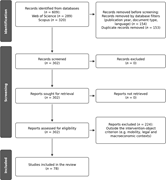
in From emergency telework to hybrid workplace learning: a systematic review of digital upskilling, organisational support and performance
> European Journal of Training and Development
Published: 25 September 2026
Figure 1. Research protocol A PRISMA flowchart traces 609 identified records through screening and eligibility to 78 studies included in the review. The PRISMA flowchart progresses through identification, screening and inclusion. Identification begins with 609 records from databases, comprisin... More about this image found in Research protocol A PRISMA flowchart traces 609 identified records throu...
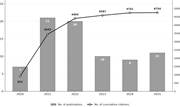
in From emergency telework to hybrid workplace learning: a systematic review of digital upskilling, organisational support and performance
> European Journal of Training and Development
Published: 25 September 2026
Figure 2. Publication and citation trends A combined bar and line graph records annual publications and cumulative citations from 2020 to 2025. The combined bar and line graph records the number of publications and cumulative citations from 2020 to 2025. The horizontal axis lists the years. Th... More about this image found in Publication and citation trends A combined bar and line graph records an...
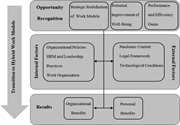
in From emergency telework to hybrid workplace learning: a systematic review of digital upskilling, organisational support and performance
> European Journal of Training and Development
Published: 25 September 2026
Figure 3. A conceptual model of the transition to hybrid work models A conceptual model traces the transition to hybrid work models through opportunity recognition, internal and external factors, and results. The conceptual model traces a downward transition to hybrid work models through oppor... More about this image found in A conceptual model of the transition to hybrid work models A conceptual ...
Journal Articles
European Journal of Training and Development 1–16.
Published: 24 September 2026
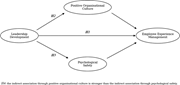
in Leadership development and employee experience management: comparing cultural and psychological pathways
> European Journal of Training and Development
Published: 24 September 2026
Figure 1. Conceptual model Note: H1 concerns the total LD–EXM association. H4 compares the two specific indirect associations through POC and PS A conceptual model links leadership development with employee experience management through organisational culture and psychological safety. The conceptual model presents leadership development, positive organisational culture, psychological safety and employee experience management. Leadership development connects directly to employee experience management through H 1. Leadership development connects to positive organisational culture through H 2, and positive organisational culture then connects to employee experience management. Leadership development connects to psychological safety through H 3, and psychological safety then connects to employee experience management. H 4 states that the indirect association through positive organisational culture is stronger than the indirect association through psychological safety. More about this image found in Conceptual model Note: H1 concerns the total LD–EXM asso...
in Employee silence and voice in AI-driven workplace learning: an integrative literature review
> European Journal of Training and Development
Published: 22 September 2026
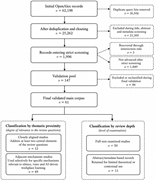
Figure 1. Literature search and screening process Source: Author’s own work A flow diagram traces Open Alex records from 62,198 initial records to 61 validated studies, followed by classification by thematic proximity and review depth. The flow diagram begins with initial Open Alex records,... More about this image found in Literature search and screening process Source: Author’s own work A f...
in Employee silence and voice in AI-driven workplace learning: an integrative literature review
> European Journal of Training and Development
Published: 22 September 2026
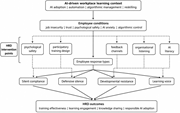
Figure 2. Silence–voice–learning framework in AI-driven workplace learning Source: Author’s own work A flow diagram links the AI-driven workplace learning context and employee conditions to employee response types, HRD intervention points and HRD outcomes. The flow diagram begins with A I d... More about this image found in Silence–voice–learning framework in AI-driven workplace learning Source: ...
Journal Articles
European Journal of Training and Development 1–23.
Published: 22 September 2026
Journal Articles
European Journal of Training and Development 1–12.
Published: 21 September 2026
Includes: Supplementary data
in Training transfer of cross-cultural capabilities: an interactionist study of capability–climate substitutability
> European Journal of Training and Development
Published: 21 September 2026
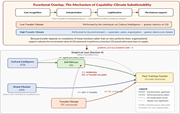
Figure 1. Capability–climate substitutability model. The upper panel shows the theoretical mechanism, and the lower panel shows the statistical test of that mechanism (Section 4). Solid lines represent tested significant paths, the dashed gray line represents a tested but nonsignificant path, and the dotted red line represents the moderation path (H3) A conceptual framework links four transfer-enabling functions with cultural intelligence, global mindset, transfer climate, self-efficacy, and post-training transfer. The upper section is titled Functional Overlap: The Mechanism of Capability Climate Substitutability. Four connected boxes progress from Cue recognition to Interpretation, Legitimation, and Persistence support. A note states that these are four transfer-enabling functions and that who performs them varies by climate. Under Low Transfer Climate, the functions are performed by the individual via Cultural Intelligence, with greater reliance on C Q. Under High Transfer Climate, the functions are performed by the environment, including supervisor, peers, and organisation, with greater reliance on climate. A statement below says that transfer depends on completion of these functions rather than on who performs them, and that organisational support reduces the incremental value of C Q when it performs a function C Q would otherwise supply. A downward arrow labelled predicts, and is consistent with, leads to the lower section titled Empirical test, Section 4. Cultural Intelligence, C Q, connects to Self-Efficacy, S E, through H 4, labelled significant indirect effect. Self-efficacy connects to Post Training Transfer, labelled Transfer Outcome. A dashed curved path from Cultural Intelligence to Post Training Transfer is labelled Direct C Q effect, n s. Global Mindset, G M, connects directly to Post Training Transfer through H 1, labelled G M to Transfer. Transfer Climate, T C, measured, connects directly to Post Training Transfer through H 2, labelled T C to Transfer. A dashed moderation arrow from Transfer Climate points towards Self-Efficacy and is labelled H 3, moderates C Q to Transfer, n s path. A note beneath Global Mindset states distinct role, not tested as complementary. The legend identifies H 1 and H 2 as tested and significant, H 4 as a tested indirect effect, H 3 as a moderation arrow, and dashed paths as tested and non-significant. It also states that V C o P s represent informal support, discussed in Section 5.4 and not modelled here. More about this image found in Capability–climate substitutability model. The upper panel shows the theore...
Journal Articles
European Journal of Training and Development 1–14.
Published: 16 September 2026
in Behavioural capability in leadership development: from individual enactment to collective consequence
> European Journal of Training and Development
Published: 16 September 2026
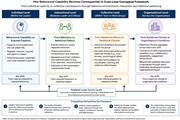
Figure 1. A cross-level conceptual model of behavioural capability in leadership development Source: Author’s conceptual framework A multilevel framework traces behavioural capability from individual enacted capacity through relational patterns and climate to organisational conditions, with ... More about this image found in A cross-level conceptual model of behavioural capability in leadership deve...
Journal Articles
European Journal of Training and Development 1–26.
Published: 11 September 2026
in Individual learning of entrepreneurs: what we know and challenges in times of disruption and volatility
> European Journal of Training and Development
Published: 11 September 2026
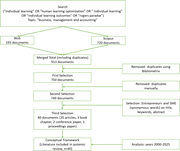
Figure 1. Literature search process Source: Adapted from Page et al. (2021) A literature-selection flowchart narrows 913 records from Web of Science and Scopus to 40 studies for a conceptual framework on individual learning in business, management and accounting. The search uses the terms Individual learning, human learning optimization, individual learning, individual learning outcomes and Rogers paradox within the topic business, management and accounting. Web of Science returns 193 documents and Scopus returns 720 documents. The merged total is 913 documents, including duplicates. Duplicates are removed using Bibliometrix, producing a first selection of 750 documents. Additional duplicates are removed manually, producing a second selection of 749 documents. Records are then selected using entrepreneur and small and medium-sized enterprise terms, including synonymous words, in the title, keywords and abstract. This produces a third selection of 40 documents, comprising 35 articles, 3 book chapters, 2 conference papers and 1 proceedings paper. The final conceptual framework includes 40 studies in the systematic review. The analysis covers the years 2000 to 2025. More about this image found in Literature search process Source: Adapted from Page et al....
in Individual learning of entrepreneurs: what we know and challenges in times of disruption and volatility
> European Journal of Training and Development
Published: 11 September 2026
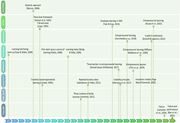
Figure 2. Topics over the years: findings from the authors Source: Author’s own work A timeline from 2000 to 2025 maps research on entrepreneurial learning across systemic, level, dimension, pathway, barriers, creativity, family business and failure themes. The timeline spans 2000 to 2025 a... More about this image found in Topics over the years: findings from the authors Source: Author’s own wo...
in Individual learning of entrepreneurs: what we know and challenges in times of disruption and volatility
> European Journal of Training and Development
Published: 11 September 2026
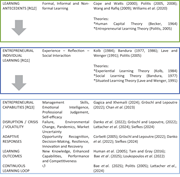
Figure 3. Main findings of individual learning for entrepreneurs in times of disruption and volatility Source: Author’s own work A conceptual framework links learning antecedents and entrepreneurial individual learning to capabilities, disruption, adaptive responses, outcomes and a continuou... More about this image found in Main findings of individual learning for entrepreneurs in times of disrupti...
Journal Articles
European Journal of Training and Development 1–23.
Published: 07 September 2026
in From training to transformation: considering the importance of the post-training environment as a catalyst for sustained behaviour change
> European Journal of Training and Development
Published: 07 September 2026
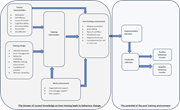
Figure 1. Conceptual framework of transfer including implementation intentions and productive reflection A Flowchart shows how trainee characteristics, training design, and work environment lead through training and reflection to behaviour transfer. The flowchart has two broad sections. The fi... More about this image found in Conceptual framework of transfer including implementation intentions and pr...

