This study analyzes the propensity of Italian olive oil producers to adopt blockchain in order to protect the Made in Italy origin of the product.
An expanded version of the Unified Theory of Acceptance and Use of Technology (UTAUT) is applied, which also includes trust, personal innovativeness (PI) and willingness to pay. The data are analyzed using Partial Least Squares Structural Equation Modeling.
The findings indicate that effort expectancy, facilitating conditions and PI serve as key drivers for blockchain adoption. Furthermore, individuals interested in adopting blockchain are also willing to invest in its implementation.
In this study, the UTAUT is extended with new constructs, considering a strategic sector of Made in Italy agri-food.
1. Introduction
Italy is the second-largest producer of olive oil in the world, after Spain. In 2024, it produced about 248,000 tons (ISMEA, 2025). The Italian olive oil sector stands out for its strong focus on origin and quality, particularly in the extra virgin olive oil (EVOO) segment. The Made in Italy EVOO category includes 50 products with geographical indications, with a production value of €115 million and an export value of €86 million (ISMEA, 2024a). Despite this strong quality orientation, the sector faces persistent challenges related to the authenticity of origin claims. With domestic consumption reaching about 440,000 tons, the highest worldwide, and exports totaling 387,000 tons, concerns regarding fraud and mislabeling increasingly undermine the reputation of Italian EVOO in both domestic and international markets (Casadei et al., 2021; Yan et al., 2020). This issue is particularly critical as consumers are becoming more discerning and increasingly demand verifiable guarantees of origin and quality (Staffolani et al., 2025).
To address these challenges, the European Union has established traceability as a mandatory requirement, defined as the ability to track food products along all stages of the supply chain (European Parliament, 2002). However, due to past failures that have eroded consumer trust, traditional traceability tools appear insufficient to fully restore confidence in origin certification. In this context, digital technologies, and blockchain in particular, have attracted growing attention for their potential to enhance transparency, data integrity and trust in agri-food supply chains (Compagnucci et al., 2022; Antonucci et al., 2019). A blockchain is a decentralized and tamper-resistant ledger in which each transaction is permanently recorded and shared among network participants, removing the need for a central authority (Nakamoto, 2008). This structure enables producers, processors and consumers to access verified and immutable information on product origin, production methods and quality attributes. In agri-food chains, where information asymmetries and trust deficits often persist, blockchain offers the possibility to create a shared, transparent record of activities across all stages of production and distribution (Zonneveld et al., 2025; Chiaraluce et al., 2024). Different configurations of blockchain exist, namely public, private or consortium, allowing agri-food businesses to select systems that best balance transparency, privacy and governance needs (Tripoli and Schmidhuber, 2018). Smart contracts can further streamline business operations, automatically executing agreements when predefined conditions are met (Marchesi et al., 2022).
These functionalities are particularly relevant for small and medium-sized enterprises operating in the olive oil sector, where efficiency, quality certification and trust among stakeholders are critical (Chiaraluce et al., 2024; Jellason et al., 2024). Blockchain could represent not only a technological innovation but also a potential organizational and relational shift, whose adoption depends on producers’ perceptions, resources and readiness for digital transformation (Sunmola et al., 2021; Clohessy and Acton, 2019). Blockchain-based systems depend on trust not just in the technology itself but also in the people who are sharing information (Casati et al., 2024). For this reason, the human component plays a fundamental role in the adoption of such systems, especially in traditional and family-run sectors such as Italian EVOO production (Vitaskos et al., 2024).
However, along with blockchain’s advantages, there are some significant challenges. Blockchain networks can be slow and inefficient due to the high computational requirements needed to validate transactions (Pappalardo et al., 2018). Another challenge is related to energy consumption, as blockchain networks require a lot of computing power, which in turn requires a lot of energy (Lv et al., 2023). Furthermore, it requires a high level of technical expertise to implement and maintain, and tech challenges may slow down widespread adoption and discourage potential users and developers from engaging with it (Hübschke et al., 2025). This fragmentation can hinder collaboration and innovation and prevent the seamless exchange of data and value between stakeholders.
Nonetheless, Italian EVOO producers should consider that the digital transformation facilitated by blockchain adoption is essential for enhancing business management and improving the efficiency of food supply chains (Vitaskos et al., 2024). Additionally, blockchain has the potential to provide a competitive advantage in the marketplace (Vahdanjoo et al., 2025). This advantage is particularly relevant in international markets, where Italian EVOO increasingly competes with major global players that primarily emphasize volume and cost efficiency (ISMEA, 2024b). In contrast, the Italian olive oil sector is characterized by small-scale, quality-oriented productions (CREA, 2022). In this context, blockchain can become a strategic tool to support the international valorization of Italian EVOO by facilitating producer aggregation and enhancing transparency, credibility and product differentiation. This role becomes even more critical in a phase of growing uncertainty in international agri-food trade, characterized by increasing regulatory and trade barriers that may also affect high-quality products, reinforcing the need for reliable and transparent tools to support market differentiation.
To date, blockchain diffusion in the Italian olive oil sector has been largely fragmented and limited to individual initiatives. To build on these experiences, it is essential to encourage a broader diffusion of blockchain-based systems and their integration into quality assurance mechanisms for EVOO.
Current scientific research has primarily concentrated on the potential of blockchain technology in the agri-food sector, examining its advantages, disadvantages and limitations. Existing case studies predominantly focus on large companies that possess the financial and organizational resources required for implementation and management. As a result, small and medium-sized enterprises, as well as traditional sectors such as olive oil production, remain theoretically underexplored. Moreover, the perspectives of producers and supply chain stakeholders are still insufficiently represented in the literature, despite their central role in determining the actual feasibility and sustainability of blockchain adoption. EVOO represents an Italian excellence characterized by fragmented, small, family-run businesses, which often lack both the economic and political power to emerge in the market at national and international level. Blockchain could offer a tool to make visible, in a transparent and verifiable manner, the efforts of these small producers who invest their time and capital, while also addressing issues such as origin fraud. This represents not only an empirical gap but also a theoretical one. The literature still lacks a structured understanding of how blockchain adoption processes operate in traditional and fragmented agri-food systems, where innovation is mediated by family business structures, local production cultures and strong origin-based value logics. Given that small and medium-sized enterprises constitute most of the Italian olive oil entrepreneurial fabric (CREA, 2022), there is still limited empirical evidence on the factors that effectively influence or hinder blockchain adoption in this specific context.
Addressing these gaps, this study investigates the determinants driving Italian EVOO producers’ intention to adopt blockchain technology. This study employs an extended version of the Unified Theory of Acceptance and Use of Technology (UTAUT), incorporating trust within the blockchain network, personal innovativeness (PI) and willingness to pay (WTP), and empirically tests the model using Partial Least Squares Structural Equation Modeling (PLS-SEM). From a theoretical perspective, the study contributes to the literature on blockchain adoption by offering a context-sensitive extension of UTAUT tailored to the EVOO system, highlighting the role of individual and organizational factors in shaping adoption processes. From a practical perspective, the findings provide actionable insights for policymakers, technology providers and industry stakeholders aiming to promote blockchain adoption as a tool for strengthening the international competitiveness and valorization of Italian EVOO.
2. Research background
The present work builds upon the well-established UTAUT introduced by Venkatesh et al., 2003. UTAUT is a model that explains and predicts user acceptance and use of technologies. The four main factors that influence the intention to use a technology (BINT) are effort expectancy (EEXP), facilitating conditions (FCON), performance expectancy (PEXP) and social influence (SINF). According to Venkatesh et al. (2003), and shifting the discussion to blockchain technology, EEXP refers to the degree of ease associated with using blockchain technology. FCON pertains to individuals’ understanding of the resources available within the organization to support blockchain implementation. PEXP indicates the extent to which individuals believe that using blockchain technology will enhance their productivity and performance. Lastly, SINF relates to how individuals influence one another’s behavior regarding the adoption of blockchain technology.
This model has been applied to assess the acceptance of various technologies within the agri-food supply chain, including the internet of things and e-commerce platforms (Shi et al., 2022; Sun et al., 2021). It has also been utilized to evaluate the implementation of blockchain for enhancing food traceability systems (Bentivoglio et al., 2025; Cricelli et al., 2025; Shukla et al., 2024; Toader et al., 2024; Sharma et al., 2023).
Based on the stability of the UTAUT framework demonstrated by scientific literature, the model we adopted aims to verify the four main hypotheses of the model:
Effort expectancy positively influences the behavioral intention of Italian EVOO producers to adopt blockchain.
Facilitating conditions positively influence the behavioral intention of Italian EVOO producers to adopt blockchain.
Performance expectancy positively influences the behavioral intention of Italian EVOO producers to adopt blockchain.
Social influence positively influences the behavioral intention of Italian EVOO producers to adopt blockchain.
If we consider the scientific studies investigating blockchain using UTAUT, we can observe that these works expand the basis of the UTAUT model by adding innovative elements that are fundamentally important when discussing blockchain (Venkatesh et al., 2016). Bentivoglio et al. (2025) analyze the case of Italian wine producers and, based on the model proposed by Queiroz et al. (2021) and Queiroz and Wamba (2019), they introduce the concept of trust into the research framework. Here, trust refers to the willingness to engage in relationships and share data within the blockchain network, rather than simply trusting the technology itself. The work of Bentivoglio and colleagues identifies trust and PEXP as the determining factors that influence the BINT. Their findings indicate that individuals who opt to adopt blockchain do so primarily to boost productivity and enhance business performance. Additionally, wine producers have confidence in the network of stakeholders participating in data sharing, which contributes to the improvement of their traceability systems. Cricelli et al. (2025) also focused on the wine supply chain. They expand the UTAUT framework in their study by including the market dynamics variable. This addition considers factors such as regulatory evolution, shifts in consumer preferences and competitive dynamics, aiming to capture the impact of various changes within the wine supply chain that may influence the BINT. They found that PEXP and SINF had a positive impact on the BINT. In contrast, EEXP, FCON and particularly market dynamics did not significantly influence this intention. Therefore, the introduction of a new element into the basic UTAUT model by Cricelli and colleagues did not produce significant results, despite the theoretical importance of market dynamics in influencing a company’s decision to adopt blockchain. Conversely, Shukla et al. (2024) confirmed the positive effect on BINT of additional constructs when considering the extension of the basic UTAUT model. In their study, three of the four fundamental factors of the UTAUT model, namely PEXP, EEXP and SINF, were assessed alongside additional factors: hedonic motivation, habit and PI. Their results indicate that all the additional constructs have a positive influence together, confirming the authors’ initial hypotheses. The authors further expand the model to offer greater clarity regarding the factors that can promote technology adoption. Their study reveals that trust in technology serves as a mediator between intention and actual blockchain usage. In contrast, the perception of risk, influenced by uncertainty surrounding the technology, does not significantly affect its actual use. Toader et al. (2024) aimed to investigate the determinants affecting both the BINT and the actual usage of blockchain-driven platforms in agri-food supply chains. They developed an expanded and adapted conceptual model based on the UTAUT framework, retaining only EEXP and PEXP from the original version. In addition, they proposed that agri-food supply chain partner preparedness and perceived trust positively influence BINT. The second factor pertains to the concept of unreserved acceptance of technology, which arises from a system’s ability to foster trust. In contrast, agri-food supply chain preparedness refers to the extent of readiness demonstrated by business partners when adopting innovative technologies. Their results indicate that the factors added to the model have reliably influenced the BINT. This outcome supports the expansion of a well-structured analytical model tailored to the specific characteristics of the technology. Lastly, Sharma et al. (2023), in their study about the Indian agri-food supply chain, similarly confirmed that additional constructs positively affect the expansion of the basic UTAUT model. The researchers added interfirm trust and transparency, specifically linking transparency to the nature of blockchain. Transparency is also reflected in the creation of inter-firm trust, ensuring lasting relationships between the various actors in the supply chain who do not feel threatened by the actions of other stakeholders. All constructs tested in their model, according to their results, positively influence the BINT. This conclusion suggests that stakeholders are significantly inclined to embrace this new technology, which has the potential to enhance the efficiency of the agri-food supply chain.
In our analysis, we aim to expand the UTAUT model to enhance research on the factors influencing the adoption of blockchain in the agri-food supply chain, while considering existing studies on the topic. This expansion will include constructs related not only to blockchain in its strict sense but also to its adoption in small and medium-sized enterprises producing EVOO in Italy.
As shown by the studies by Bentivoglio et al. (2025), Toader et al. (2024), and Sharma et al. (2023), the trust factor (TRUS) plays a key role in promoting the adoption of blockchain technology in the agri-food sector. While it is possible to talk about trust in technology itself as well as in the network of stakeholders involved in data sharing, we can observe that those who decide to adopt blockchain must necessarily trust the system that has been established (González-Puetate et al., 2022; Saurabh and Dey, 2021). In the case of the Italian olive oil sector, there are often questions about the veracity of information regarding production, particularly concerning the origin of the raw material (Staffolani et al., 2025; Bimbo et al., 2020). Therefore, building trusting and lasting relationships becomes vital, especially when small and medium-sized enterprises scattered throughout the national territory are involved, both with supply chain actors and the final consumer (Fiore et al., 2024). Thereby, blockchain could help strengthen these long-standing, informal family ties, which need reliable, up-to-date tools to expand into the global market (Alkhudary et al., 2022). Therefore, in the case of the EVOO sector, trust is understood as “the willingness of a party to be vulnerable to the actions of another party based on the expectation that the other will perform a particular action important to the trustor, irrespective of the ability to monitor or control that other party” (Queiroz et al., 2021). From here, the following hypothesis develops:
Trust positively influences the behavioral intention of Italian EVOO producers to adopt blockchain.
In the Italian olive oil supply chain, which is mostly seen as traditional and family-run, entrepreneurs’ PI should be closely linked to their use of technology to improve business management (Cosentino et al., 2020; D'Adamo et al., 2019). Innovativeness is described as “the degree to which an individual is relatively earlier in adopting new ideas than the average member of his social system” (Rogers, 1962). An innovative entrepreneurial mindset drives individuals who demonstrate foresight, adopt industry innovations and are resolute in enhancing their agribusiness (Finco et al., 2018). Adopting digital systems requires time, study, the acquisition of specific technical skills, highly qualified personnel and significant costs to be borne, particularly for small and medium-sized enterprises (Del Baldo, 2022). It is crucial to have confidence in your abilities and to acknowledge that technology, particularly blockchain, serves as a valuable tool for achieving a competitive advantage (Cricelli et al., 2024). Therefore, the following hypothesis is proposed:
Personal innovativeness positively influences the behavioral intention of Italian EVOO producers to adopt blockchain.
Finally, an entrepreneur must consider economic sustainability to support their business activities and carefully assess the risks associated with the investments they intend to make. In this framework, an agri-food company must overcome the significant costs associated with digital technology investment to introduce new technologies (Saha et al., 2025). Small and medium-sized enterprises find such expenses to be an even more limiting factor in production management (Pellegrini et al., 2022). In the case of blockchain, substantial investments are necessary, and the required amount largely depends on the type of system implemented and its intended future applications (Romeo et al., 2025; Virmani and Singh, 2024). This investment should be reflected in a fair final consumer price that considers both the transparency of the supply chain and the expected return on investment (Giannini et al., 2025). Therefore, Italian EVOO producers who are motivated to adopt blockchain will certainly consider, explicitly or implicitly, the cost to be incurred, and thus their WTP for this system. WTP can be defined as the maximum amount of money a person is prepared to pay for a good or service (Hanemann, 1991). It reflects the subjective value that an individual places on an item, influenced by factors such as income, perceived value, alternatives and personal preferences. Therefore, the following hypothesis is presented:
The behavioral intention to adopt blockchain positively affects the willingness to pay for a blockchain annual service by Italian EVOO producers.
3. Methodology
An online questionnaire was developed in Google Forms to investigate the factors that influence the adoption of blockchain in small and medium-sized EVOO-producing companies in Italy. Before starting the questionnaire, participants were informed about the study procedures, and informed consent was obtained from all participating EVOO producers. The questionnaire was divided into two sections. In the first section, after providing respondents with a definition of blockchain, items used to assess the validity of our hypotheses were presented. The items utilized in the analysis are detailed in supplementary materials – Table A1. A total of 31 items were selected and assessed utilizing a five-point Likert scale, spanning from 1 (“strongly disagree”) to 5 (“strongly agree”). The basic theoretical framework used is the expanded version of UTAUT derived from the study by Queiroz et al. (2021), which includes trust as an additional element. Additionally, to incorporate elements of PI and WTP, the items were derived from the studies by Kasilingam and Krishna (2022) and Shi et al. (2022) on IoT technologies. To ensure that the original meaning of each construct was preserved, all items were translated into Italian by a professional translator.
In the second section, Italian EVOO producers were asked to unveil the technical and economic characteristics of their production system, along with the socio-demographic details of the respondents, such as their age, gender and educational level.
To confirm the validity of the questionnaire, a pretest was conducted with experts and producers to gather feedback on its overall clarity.
The sample size was initially determined using the 10-time rule (Hair et al., 2013); considering the maximum number of direct structural paths to a latent variable (7), we established a minimum sample size of 70 observations. To validate this estimate through a more stringent methodology, we performed a priori power analysis using GPower 3.1.9.7 (f2 = 0.15, α = 0.05, 1−β = 0.80, predictors = 7), yielding a minimum requirement of 103 observations.
Then, the questionnaire was randomly distributed to Italian EVOO producers via a mailing list with the assistance of the Italian Olive Growers Consortium (Consorzio Olivicolo Italiano). Data collection occurred between May and October 2024. In total, 113 responses were collected, of which 6 responses were discarded due to being incomplete; so, the final sample was 107 respondents.
The hypotheses were assessed using PLS-SEM, which is an integrated modeling technique that allows researchers to evaluate the relationships between variables while also assessing the reliability and validity of the research framework (Hair et al., 2019). This method is advantageous for both empirical and exploratory studies, especially when working with non-normal data and small sample sizes (Guenther et al., 2023). PLS-SEM has proven effective in analyzing data on emerging topics, such as comprehending producers’ behaviors regarding blockchain adoption in EVOO production. The measurement model was evaluated for reliability and validity through various metrics, including Cronbach’s alpha, average variance extracted (AVE), Dillon–Goldstein’s coefficient (DG), relative goodness-of-fit (GoF), the Fornell–Larcker criterion and the heterotrait–monotrait (HTMT) ratio. The structural model was assessed using SmartPLS 4 (Cheah et al., 2024).
4. Results
4.1 Descriptive statistics of the sample
The characteristics of the sampled olive oil producers are consistent with the average characteristics observed in the Italian olive oil sector (Olioofficina, 2024). The main gender of the surveyed farmers was male (90%), with 59% falling within the 41–60 age bracket. Fifty-one percent had attained a high school diploma, while 51% had secured a university degree. The olive oil farms represented were predominantly micro-enterprises (56%), employing either organic (46%) or conventional (43%) farming systems. Most of the farms have a crop area ranging from 0 to 15 ha (71%). Fewer than 50% of the sampled farms have an on-farm oil mill (47%). The majority employ a three-phase oil mill (54%), with cold extraction being the predominant method (92%). Olive oil companies were located primarily in Southern Italy (51%), followed by Central Italy (48%), in line with the Italian average (ISMEA, 2025).
4.2 Model fit and predictive model
The validity of the latent constructs was assessed via descriptive analysis of their values and the factor loadings ( supplementary materials – Table A2) and the calculation of key metrics for validity and reliability (Table 1).
Based on the results of these indices, the model shows good internal reliability, with Cronbach’s alpha above 0.70, and excellent convergent validity, with AVE above 0.50 (Hair et al., 2019). Furthermore, DG values above the threshold of 0.70 indicate that the manifest variables unidimensionally represent their latent variables (Henseler et al., 2009).
The GoF value was 0.70, indicating a strong fit of the model to the data. Discriminant validity was initially evaluated through the Fornell–Larcker criterion (Fornell and Larcker, 1981), which involves comparing the interfactor correlations to the AVE values square root. All constructs exhibited sufficient discriminant validity, with AVE square root values for each construct exceeding the respective interfactor correlations ( supplementary materials – Table A3). Subsequently, a second check of discriminant validity was conducted through the HTMT ratio (Table 2).
The table reveals values above the 0.90 threshold (Henseler et al., 2015), particularly between constructs such as PI, FCON and EEXP. While these values suggest a lack of discriminant validity in a strict statistical sense, they provide a meaningful reflection of the specific research context. In fact, in line with the literature (Altamore et al., 2024), agriculture is a poorly digitized sector where technological and digital skills are not widely spread. In this context, blockchain represents an innovative technology that remains largely unfamiliar to farmers (Bentivoglio et al., 2025).
This aspect results in a high level of uncertainty regarding this technology, which may have led to a conceptual overlap between the constructs in the minds of the respondents. Therefore, while acknowledging these statistical limitations, we believe these results authentically represent the farmers’ cognitive perception, as supported by the excellent convergent validity and internal reliability previously demonstrated.
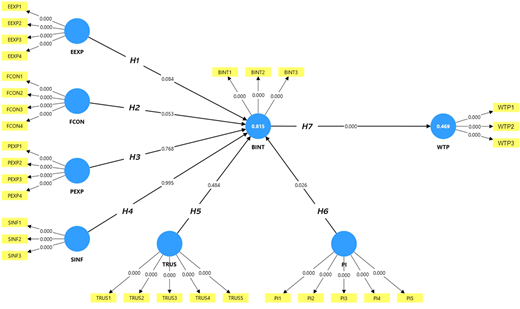
After establishing the validity of the latent constructs, the predictive model was estimated with a bootstrapping procedure using 10,000 sub-samples ( supplementary materials – Table A4) (Figure 1).
The model accounts for 80.30% of the variance in BINT (adjusted R-squared = 0.803), indicating that the predictors used are comprehensive. In contrast, 46.4% of the variance in WTP for blockchain is explained. This suggests that while BINT is a key factor, other attributes also influence WTP.
EEXP (β = 0.251, p = 0.084), FCON (β = 0.251, p = 0.053) and PI (β = 0.294, p = 0.026) demonstrated a significant positive influence on the BINT. Consequently, hypotheses H1, H2 and H6 are supported. Other constructs, such as PEXP, SINF and TRUS, did not demonstrate a statistically significant impact on the BINT. As a result, hypotheses H3, H4 and H5 are deemed invalid. The BINT significantly and positively influences the WTP for the blockchain (β = 0.658, p = 0.092). Thus, H7 is supported.
5. Discussion and conclusions
Based on the results obtained, four hypotheses are verified through PLS-SEM. Firstly, EEXP positively influences the intention of Italian EVOO producers to adopt blockchain, as also found in the studies of Shukla et al. (2024), Toader et al. (2024) and Sharma et al. (2023) related to the blockchain implementation in the agri-food supply chain. Italian producers are willing to adopt blockchain not because they believe it will transform the sector but because they find it user-friendly, requiring minimal effort and simplifying supply chain management operations. This perspective is consistent with the current structure of the olive oil supply chain in Italy, which is often regarded as traditional and fragmented, relying heavily on family-run businesses. In this context, implementing an automated digital system could significantly improve daily operations both in the field and at the mill, especially through features such as automatic lot registration and enhanced traceability (Vitaskos et al., 2024). This improvement could lead farmers to understand what needs to be done and when, during transformation processes, feeling confident in managing the technology without relying on intermediaries (Ktari et al., 2022; Violino et al., 2020). This aligns with the second hypothesis tested, which posits that those who choose to adopt blockchain do so because they recognize that their company possesses the necessary facilitating conditions for its implementation (Sharma et al., 2023).
Considering the results of the model, Italian EVOO producers who opt to adopt blockchain do so because they believe their companies are well structured, despite being viewed as a traditional sector. This includes having robust operating systems and infrastructure, skilled digital personnel and effective organizational procedures. They recognize their capacity to integrate the digital system into everyday operations and do not see significant internal organizational obstacles or risks associated with adoption (Romeo et al., 2025). As a result, they perceive themselves as more innovative, and PI could play a positive role in influencing the intention to adopt blockchain (Shukla et al., 2024). In the context of Italian EVOO, PI represents a critical factor, as the sector is characterized, as mentioned, by being traditional, family-run and with little generational turnover. If the entrepreneur embraces innovation, the company evolves; if not, the company continues to operate in a traditional manner (Pulighe, 2023). This makes the variable even more relevant compared to other more structured industrial sectors. Blockchain is not an immediate or mandatory technology; rather, it requires a forward-thinking vision. Individuals with a more innovative mindset often seek tools that set their products apart from competitors; they strive to enhance their olive oil by implementing more transparent traceability measures and are generally more open to experimentation, which ultimately reduces the perceived risks associated with adoption (Martino et al., 2017). PI has the potential to address concerns regarding technical barriers within the company: by analyzing potential challenges and perceiving blockchain as a forward-looking resource (Consolaro et al., 2025; Virmani and Singh, 2024).
The latest verified hypothesis concerns the BINT and the WTP: those who intend to adopt blockchain are also willing to pay for the service offered. This willingness among entrepreneurs to adopt and invest in the technology suggests that manufacturers are not turning to blockchain out of necessity; rather, they believe it will enhance their company’s value. This is because they perceive that investing in technology can bring significant economic returns, facilitating the product’s distribution in both the national and international markets (Habashneh et al., 2023). Despite Italy being a major player in the global olive oil market, it must compete with other industry leaders like Spain. Italian EVOO effectively establishes itself in the market as a symbol of Made in Italy excellence by strongly emphasizing the origin and quality of the product. Therefore, blockchain, with its transparent system, can significantly enhance customer loyalty (Frikha et al., 2022). This transparency can also justify a higher market price, thereby supporting the return on investment in the digital traceability system. When entrepreneurs perceive technology as simple, sustainable and useful, their intention transforms into a tangible economic commitment (Fernandes et al., 2022).
Compared to other studies regarding the adoption of blockchain in the agri-food sector, PEXP (Bentivoglio et al., 2025; Cricelli et al., 2025; Shukla et al., 2024; Toader et al., 2024; Sharma et al., 2023), SINF (Cricelli et al., 2025; Shukla et al., 2024; Sharma et al., 2023) and TRUS (Bentivoglio et al., 2025; Toader et al., 2024) do not positively affect the intention of Italian EVOO producers to adopt blockchain. In the Italian olive oil sector, producers do not perceive blockchain as necessary per se, making performance expectancy a weak driver of adoption intention. The adoption of blockchain is not influenced by imitation or social pressure, as there are no key figures acting as technological opinion leaders within the supply chain. Furthermore, local networks prioritize personal relationships over embracing digital innovations. Trust in the blockchain network does not appear to be a significant factor because producers, who are used to maintaining direct control over their information, are hesitant to share sensitive data with other stakeholders. This distrust of inter-organizational transparency, rather than any shortcomings of the technology itself, limits the potential for trust to serve as a driver of adoption.
5.1 Theoretical implications
From a theoretical perspective, this study contributes to the literature on blockchain adoption in agri-food systems by extending the UTAUT framework to include TRUS, PI and WTP, specifically within the underexplored and structurally distinctive context of the Italian EVOO sector. First, the results provide theoretical refinement of UTAUT-based blockchain adoption models by showing that, in the traditional and fragmented Italian EVOO sector, adoption is not primarily driven by performance-oriented expectations or social influence but rather by perceived usability, organizational readiness and individual-level innovativeness. This finding challenges the dominant technocentric perspective in blockchain adoption studies, which often emphasizes productivity gains and efficiency as core drivers, and instead supports a more human-centered interpretation of digital transformation in small and medium-sized enterprises. The significance of PI highlights the relevance of entrepreneurial cognition as a theoretical framework for understanding digital adoption processes in traditional sectors. Our study suggests that psychological and cultural traits of the entrepreneurs function as structural drivers of technological change, especially in family-run and heritage-based production systems. Third, by addressing the WTP of EVOO producers for blockchain adoption, the study introduces an economic dimension rarely included in UTAUT-based frameworks. This extension contributes to the literature by linking technology acceptance not only to intention formation but also to concrete investment readiness, thus bridging adoption theory and economic commitment. Finally, the application of an extended UTAUT model to the Italian EVOO sector contributes to the contextualization of digital adoption theory, demonstrating the relevance of sector-specific characteristics. This concept reinforces the theoretical argument that technology acceptance models should be tailored to specific contexts rather than applied universally, especially in traditional agri-food systems. Lastly, the lack of discriminant validity for some latent variables is a key implication of this study, as it suggests that in a sector that is poorly digitalized and fragmented, like the Italian EVOO one, models such as UTAUT might not be ideal for the behavioral analysis of producers, as they are too conceptually complex.
5.2 Practical and political implications
The findings suggest that effective strategies to promote blockchain adoption in the Italian EVOO sector should focus on usability, organizational readiness, entrepreneurial mindset and investment sustainability. Given the central role of EEXP, adoption policies should prioritize the development of user-friendly blockchain platforms specifically tailored to small and medium-sized olive oil producers, reducing technical complexity and minimizing the perceived operational burden. From an educational perspective, targeted training programs and digital extension services should focus on practical skills, operational integration and everyday usability rather than abstract technological principles, enabling producers to perceive blockchain as a manageable tool rather than a disruptive innovation. The significance of FCON emphasizes the need to develop infrastructural and organizational support mechanisms. Policy interventions should therefore move beyond generic digitalization incentives and promote integrated support schemes combining financial subsidies, technical assistance and access to specialized digital competences tailored for blockchain adoption. At the same time, the relevance of PI indicates that innovation-oriented entrepreneurs can act as catalysts of diffusion within the sector, and also triggering the social influence that our results showed was uninfluential. Lastly, the positive link between the intention to adopt and the WTP shows that blockchain adoption can be economically viable if it is part of a coherent valorization strategy. This calls for policy frameworks that connect digital traceability systems with origin certification, quality schemes and market differentiation policies, allowing producers to translate technological investment into price premiums and long-term competitiveness. In this perspective, blockchain should not be promoted as a standalone technology but as a strategic infrastructure for the valorization and protection of Italian EVOO in domestic and international markets. The societal implications are equally significant. Applying this technology means addressing issues such as fraud prevention, the protection of a high-quality Italian product and the reinforcement of consumer trust, all of which can enhance credibility and safeguard the economic and cultural value of “Made in Italy”.
5.3 Limitations and future research
For future research, some limitations of this study can be identified. Firstly, a small sample limited to a single geographical area limits the generalizability of the results. For this reason, it would be desirable in the future to expand the research territory, involving other leading olive oil–producing countries. Furthermore, the study is purely theoretical, when it would be important to also consider actual behavior in adopting blockchain. Furthermore, although the analysis already includes more factors than the standard UTAUT, future studies could expand the basic model by incorporating additional factors; specifically, they could broaden the range of factors influencing WTP. The absence of discriminant validity could make the interpretation of the results of this study more difficult; it is recommended that future studies apply conceptually simpler alternative models for agricultural producers. This way, a more complete picture would be obtained, which could lead to the widespread adoption of blockchain in the Italian EVOO sector.
The authors would like to thank all the partners of the PRIN 2020 project “WEBEST” and the involved EVOO producers for their support to the research.