The purpose of this study is to investigate the challenges of pricing quantity surveying (QS) professional services to enhance the understanding of practitioners in developing strategies for the determination of fees for their services.
The paper adopts the quantitative approach by administering 150 survey questionnaires QS professionals out of which 79 questionnaires were retrieved for analysis using the mean, standard deviation, standard error and the Chi-Square test.
The study identified the challenges that continue to hamper the successful pricing of QS services as the inability to respond to changing contractual arrangements; lack of appropriate response to emerging services; slow response to changes in information and communication technology.
This paper focused on QS professionals. Hence, a future study to encompass other professionals in the built environment will be novel.
The findings of this paper have the potential to motivate QS firms to develop solutions that address the challenges identified to improve the efficiency of their service delivery to clients. The paper also has the practical importance of opening up new frontiers of research that focus on pricing of professional services in the built environment in general.
The paper contributes to the awareness and understanding of QS professionals about the challenges that continue to hamper effective pricing of their services.
1. Introduction
Uncertainties in the construction industry have the potential to create challenges for the pricing of quantity surveying (QS) professional services (Assaad et al., 2020). However, few studies focus on pricing in the construction industry without much attention to the pricing of QS professional services. For instance, Danso et al. (2021) investigate the pricing of selected construction materials in the Ghanaian construction industry from 2011 to 2016 without considering the pricing of QS professional services. Similarly, Kissi et al. (2019) examined key economic indicators that influence tender price prediction in the building construction industry of Ghana with less attention on QS professional services pricing.
QS professionals play vital roles in the construction industry, as their services ensure successful project delivery to clients (Spellacy et al., 2021). The delivery of QS professional services requires knowledge-intensity. The training of employees in QS firms enhances the knowledge intensity required for the delivery of efficient professional services to the satisfaction of clients (Mara et al., 2020). Investigations in most management disciplines do not also focus on the pricing of professional services in the construction industry. For instance, Töytäri et al. (2015) investigate pricing management as a foundation for developing pricing capabilities in the manufacturing industry.
Also, professional service pricing is complex leading to pricing challenges in professional service firms. Thus, this study explores the specific challenges that hinder the pricing of QS professional services in developing countries. The identification of the challenges pertaining to the pricing of QS professional services has the potential to spur on QS professional service firms to formulate pricing strategies that address the challenges identified in this paper to enhance their revenue generation. Also, this study has the potential to provide QS practitioners with a holistic understanding of the factors that adversely affect the pricing of their professional services.
Pricing strategies such as cost-based pricing, competitor pricing and value-based pricing adopted by organisations have not addressed the existing challenges confronting the determination of appropriate price levels for services provided to clients (Raja et al., 2020). Similarly, QS firms tend to treat the pricing of their services as an event instead of a process for generating revenue.
Existing studies like Ofori and Toor (2009) focus on challenges facing the QS profession with less attention on the specific factors that hinder the pricing of QS services. Again, a study undertaken by Kissi et al. (2019) focus on the pricing of construction materials and not QS professional services. Similarly, Burnside and Westcott (1999) examined market trends and development of QS services without considering the challenges confronting the pricing of QS professional services. Considering the gaps in existing QS studies, this study aims to investigate the factors that pose challenges to the pricing of QS professional services in Ghana.
The structure of this paper consists of a literature review, research methodology, analysis of results, discussion of results and conclusion.
2. Literature review
This section of the paper focuses on the review of the factors that pose challenges to the pricing of QS professional services and the concept of professional service.
2.1 Concept of professional service
The interest in professional service continues to increase due to their ability to create employment and generate revenue for firms (Nyadzayo et al., 2020). A professional service is defined as an interaction between a practitioner and a client, which enables the latter to evaluate the quality of the services provided (Ahuja et al., 2020). According to Aluko et al. (2021), the provision of professional services depends on the knowledge and skill of human resources in firms. A clearer understanding of professional services provided to clients enhance pricing management. Professional service firms that improve the expertise of their professionals through continuous professional training deliver satisfactory services to clients. QS firms must rely on knowledge creation enablers to improve the expertise of their professionals deliver satisfactory services to clients. Thus, Yap and Toh (2020) found the drivers of knowledge creation as continuous individual improvement, challenging barrier, review session, brainstorming discussion, memorable experience and information communication technology.
The features used to distinguish professional services from products include intangibility, heterogeneity and inseparability. Inseparability refers to situations where the services once provided cannot be stored while heterogeneity focuses on variations in professional services provided to clients due to the use of different professionals (Helmold, 2020). Professional services are also characterised by a high degree of knowledge intensity (Anand et al., 2008). Therefore, professional service firms must recruit people who are knowledgeable in their fields. In explaining professional services, von Nordenflycht (2010) used knowledge intensity to portray the two main attributes of professionalism, which are ideology and self-regulation. To address the issue of ideology and self-regulation, professional bodies must license and must license and regulate the activities of their members. Professional membership ensures the protection of clients against unfair treatment, and misconduct.
A previous study by Reihlen and Apel (2007) demonstrates three key elements that are integral to professional service delivery which are sophistication of services, knowledge-based expertise and relationships. The relationship between the client and the practitioner provides the medium for knowledge transfer to solve the client's problems. However, Vacanas and Danezis (2021) in their recent investigation found that inadequate consultants experience delay the completion of construction projects. The delay in completion of construction projects has adverse impacts on the pricing of QS professional services, leading cash flow problems.
2.2 The challenges of pricing professional service
Despite the importance of professional services in creating employment; income and contribution to gross domestic products, it is confronted by several challenges, which are discussed in this paper. The pricing of services is an important task that the top management in most business organisations must undertake (Fan et al., 2021). Similarly, Dudu and Agwu (2014) note that pricing is a major pressure point during managerial decision making. In addition, existing studies perceive pricing challenges as environmental issues linked to currency fluctuation and inflation (Yazdanifard and Danbala, 2011).
2.2.1 Inability to respond to changing contractual arrangements
Changes in contractual arrangements for the procurement of construction projects subsequently affect the services provided by QS firms. Traditional QS services consist of the preparation of bills of quantities, preparation of preliminary cost estimates, cost planning, tender documentation, preparation of accounts and contract administration (Ranasinghe et al., 2019). According to Ramdav and Harinarain (2020), the traditional QS services such as tender appraisal, preparation of tender documents, valuation of works and preparation of final account have changed over the decade due to evolving procurement strategies. The traditional QS services are important to the survival of QS firms, as they provide a lot of financial support to them. Thus, a change in contractual arrangements adversely impact the opportunities and revenue of QS firms. To create more opportunities, QS firms must respond to changes in contractual arrangements with agility by developing services that address the demands of clients during the delivery of construction projects (Horgan, 2021). QS firms in Ghana must address the challenge of cultural shift in order to adopt contemporary contractual arrangements and procurement systems. For instance, Buertey et al. (2021) in their study note that the Ghanaian construction industry is not ready for a cultural shift to adopt new procurement strategies.
2.2.2 Slow response to information and communication technology (ICT)
ICT tools such as building information modelling (BIM) have the potential to reduce the duration for project delivery consequently reducing the fees of QS firms that adopt time-based pricing (Chen et al., 2021). The three main threats posed by the increasing use of information technology include lack of accessibility to the requisite knowledge; reduction of QS roles and easy access to cost information by professionals outside the QS profession (Frei et al., 2013). These threats negatively impact the pricing structure of QS professional service firms.
2.2.3 Inability to integrate applied research outputs into practice
Research and development play important roles in knowledge acquisition and innovation. Large professional service firms can initiate research and implement the findings while smaller professional service firms are unable to conduct research that improves their knowledge-base and capacity to innovate. Though QS professional service firms are knowledge-intensive organisations (Ofori and Toor, 2009), there is a dearth of research regarding the integration of research findings into delivery of services for competitive advantage in QS firms.
2.2.4 Changes in clients' demand and increasing competition
The QS profession has experienced a major change in the demand for their services due to emerging services such as risk management, value management, legal and environmental services (Preece et al., 2008). The expectations of clients about the delivery of QS services have changed due to the adoption of project financing approaches such as competitive tendering and private finance initiative (Keung et al., 2022). Another critical change is clients’ demand for improved business relationship with their consultants. Five key areas experiencing changes in the client-consultant relationship are price, value, time, quality, suitability, responsibility and confidence (Beaudoin et al., 2022). Despite these changes, QS professional service firms have not been able to respond appropriately due to their inability to understand the pricing challenges confronting them. Thus, this study highlights the critical factors underpinning the QS services pricing challenges and how to address them.
According to Perera et al. (2021), competition is one of the factors that affect bid-mark in the construction industry. Stiff competition in the construction industry has the potential to affect the pricing of QS services, as several QS firms compete to win a particular consulting opportunity. Over the years, the nature of clients' demand has led to increasing competition among QS practitioners leading a precarious state of their income and survival. Competition among practitioners is one of the challenges of professional services pricing. High level of pricing competition among consultants leads to unnecessary discounts that affect profit margins (Karimi et al., 2022).
Competition from allied professions poses threat to QS firms due to a reduction in their share of market opportunities (Frei, 2009). The increasing competition caused by globalisation has removed the barriers of entry into both international and local markets (Preece et al., 2008). One of the impacts of competition is reducing fees below profit margin to win clients (Cruywagen and Snyman, 2006).
2.2.5 Complexity of construction projects and exposure to risks
Construction projects are becoming more complex, and requiring state-of-the-art technology to deliver. The increasing complexity of construction projects is driven by factors such as diversity and sophistication of project stakeholders with different backgrounds and perceptions (Ofori and Toor, 2009). The complexity of construction projects has implications for the pricing of QS services because practitioners need to train their employees and acquire new technologies to address the requirements of clients. Construction projects are more complex in contemporary times because the obstacles to constructability continue to increase. For instance, a recent study by Jadidoleslami et al. (2021) found several obstacles of constructability, which are categorised as organisational, managerial, technical, contractual and environmental. Construction project complexity has increased the number of failed and abandoned projects that have negatively affected the pricing of QS professional services.
Construction firms operate in disruptive environments, which expose them to risks (Perlman et al., 2014). The three main types of risks that can affect the pricing of QS services include location risk, corporate external risks, and corporate internal risk (Owusu-Manu et al., 2015). Corporate internal risks encompass the financial, logistical and managerial unknowns that are within the internal environment. Corporate external risks involve the legal, social and regulatory requirements that pose challenges to the pricing of professional services. The geographical locations have inherent uncertainties that prevent the successful delivery of construction projects. These uncertainties within the geographical locations of construction projects impact the activities and operations of sectors within the industry, including the delivery and pricing of QS services.
2.2.6 Fluctuations in construction output and unstable professional fees
Fluctuations in the volume of construction output affect the performance of related sectors (Pheng and Hou, 2019). The domino theory posits that if a region is under the influence of a particular phenomenon, then the surrounding areas of that region would also be predisposed to that phenomenon (Leeson and Dean, 2009). Though the domino theory has been applied in the study of how democracy or communism spreads, and accident causation (Porch, 2020), it has been sparingly applied in studies focussing on the impact of construction output fluctuation on the pricing of professional service. Thus, this study postulates a hypothesis in the methodology that seeks to establish a relationship between the fluctuations in construction project output and the pricing of QS professional service.
Diverse methods have been adopted for the pricing of QS professional services; however, practitioners continue to experience fluctuations of fees due to imperfections within the pricing strategies adopted (Dolgui and Proth, 2010). Though there are different pricing strategies, the percentage fee determination method is widely used for pricing professional services by assigning percentages to services provided at various stages of the construction project (Cruywagen and Snyman, 2006). In addition to the pricing strategies, professional service firms have considered factors such as cost, schedule, scope and nature of the project without considering emerging issues such as digitisation and application of disruptive technologies in the delivery of services to clients. This implies that the pricing of QS services requires a holistic approach to avert the effects of pricing challenges. For instance, Snyman (2004) identified other factors which influence the determination of fees for QS professional services as the prospects of follow-up work, client credibility, ability to pay, contract type and competition. Similarly, personnel available for the job, project location, workload, project complexity and level of client involvement have the potential to cause fluctuations in the price of professional service (Bayer and Gann, 2006).
3. Methodology
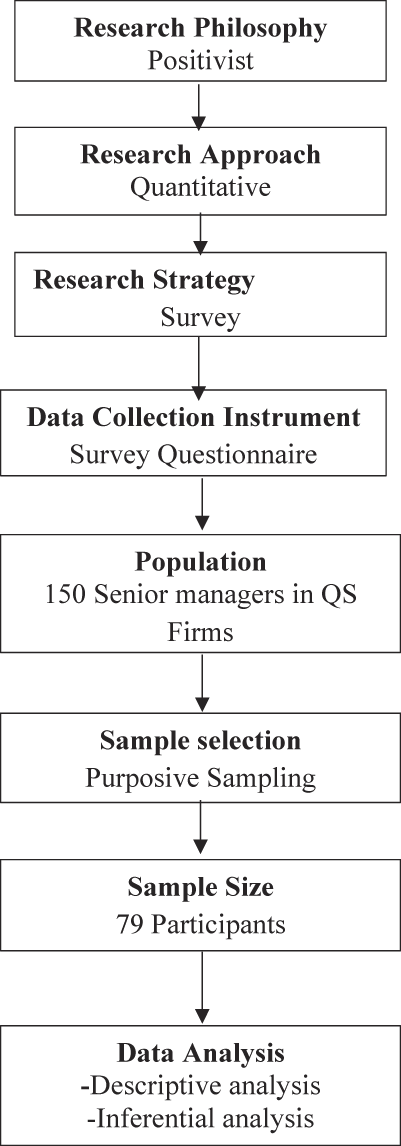
This study is entrenched in the positivist philosophical stance, and research methods which are shown in a flow chart in the supplements file appended to this paper.
Consistent with the positivist tradition, this paper adopted the quantitative approach. A closed-ended survey questionnaire was developed and distributed to respondents. The Likert scale of measurement was used to ascertain the severity of the QS professional services pricing challenges. In this respect, a 5-point Likert scale of measurement was adopted.
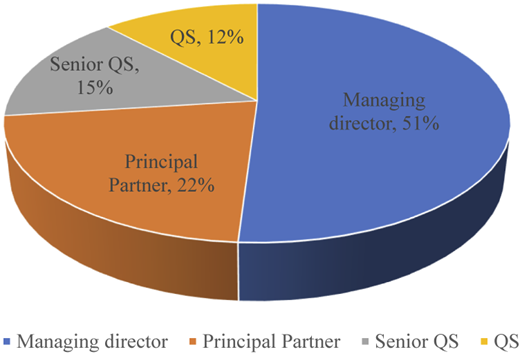
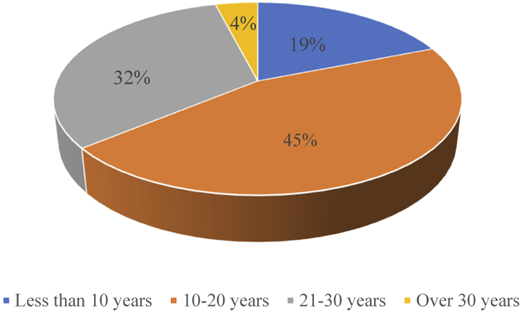
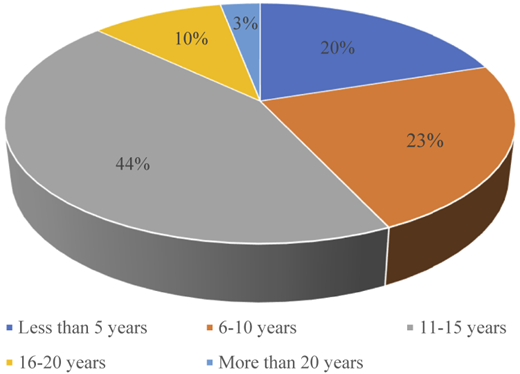
The target population for the study consists of senior managers in QS firms who are professional members of the QS division of Ghana institution of surveyors. The profile of respondents focused on position, years of experience and age of QS firms in which the results pertaining to them have been shown in the supplements file appended to this paper. The purposive sampling technique was used to administer the survey questionnaire to 150 professional QS in which 79 questionnaires were returned for analysis. The statistical tools used for analysis include the mean, standard deviation (SD) and standard error (SE). In terms of inferential analysis, the Chi Square test was used to test the hypothesis formulated using the variables adapted from the review of relevant literature. Drawing from the literature review and the variables adapted for pricing challenges, the null hypothesis in this paper is that
There is no significant relationship between the pricing of QS professional services and the following pricing challenges:
Inability to response to changing contractual arrangements
Lack of appropriate response strategies to emerging services
Slow response to ICT
Inability to integrate applied research outputs into practice
Changing nature of clients' demand
Impact of competition
Reducing fees below the profit margin
The complexity of modern construction projects
Exposure to risks
The volatility of construction project output
Fluctuation in professional fees
4. Analysis of results
This section of the paper focuses on the analysis of the results and testing of the hypothesis formulated. The descriptive analysis of the paper focused on the profile of participants and the challenges of pricing QS services. The results show respondents' position, years of experience and age of their firms. Regarding the position of respondents, the results show that majority of them are managing directors.
The involvement of managing directors in this study ensures that the results collected are valid since major pricing decision are going to be taken by top management. Also, the result on respondents' profile pertaining to the years of experience of participants shows that that most respondents involved in the study have work experience between 10 and 20 years.
With regards to the age of the firms, this study shows that most of the participants work in firms that have been in existence between 11 and 15 years.
The results on QS pricing challenges are presented in Table 1 showing the mean, SD and SE of the data collected from participants.
The use of descriptive statistics in this paper is supported by Hart (2004) that mean, SD and SE are common ways to avoid ambiguity in data presentation. The SD is “an index for measuring how closely individual data points cluster around the mean” (Hassani et al., 2010, p. 109). According to Webster and Merry (1997), the SD determines the variability in the sample of a study while the SE shows the accuracy and how a study sample represents the target population of an investigation. Also, the SD shows whether individual responses are close or deviate from the mean, thereby indicating respondents' consistency in rating the variables being studied. Large SD shows that the data points are significantly variable and differ from the mean while smaller SD demonstrates less variability in the data points. Drawing from Table 1, the results show that the SDs of all the variables representing the QS services pricing challenges are less than zero except in the case of two variables namely, reducing fees below profit margin and fluctuation in professional tariff of fees, which have SD of 1.010 and 1.214, respectively. Considering all the SD in Table 1, the results show that there is less variability in the data, hence the respondents were consistent in rating the challenges of pricing QS services.
It is also necessary to ascertain the accuracy of the result by focussing on the SE in Table 1. Smaller SE demonstrates less variability in the data, indicating that the mean value is an accurate reflection of the phenomenon measured within a given population (Hassani et al., 2010). In Table 1, the SE of all the QS pricing challenges are less than zero indicating the accuracy of the mean, hence its reliability is appropriate for the discussion of the results. Therefore, the results pertaining to the QS services pricing challenges in this paper are reliable, consistent and accurate.
Table 2 demonstrates the results of the Chi-Square test for the null hypothesis (H0) postulated in the methodology section of this paper.
From Table 2, the χ2cal was determined by using the statistical packages for social science software while χ2 α was derived from the Chi-Square distribution table using the degrees of freedom (df) and a significance level of 0.05 for each QS services pricing challenges. The decision rule is that, if χ2cal > χ2α at p < 0.05, the null hypothesis is rejected. Regarding the results in Table 2, all the QS services pricing challenges examined in this study have their χ2cal > χ2α at p < 0.05. Hence, the null hypothesis is rejected, demonstrating that there is a significant relationship between the pricing of QS professional services and the challenges shown in Table 2. Since, all the pricing challenges in Table 2 have their p < 0.001, except fluctuation in professional tariff of fees, it is appropriate to conclude that there is a significant relationship between the pricing of QS services and the pricing challenges in Table 2.
5. Discussion of the results
The result in Table 1 shows that the inability of QS firms to respond to changing contractual arrangements hampers their ability to effectively price their services. This result is consistent with the findings of Preece et al. (2008) regarding the changes in procurement strategies, which affect QS services such as preparation of tender documents, valuation of works and preparation of final accounts.
In addition to responding to contractual arrangements, the result in Table 1 indicates that the lack of QS firms' response to emerging services in the construction industry poses a challenge to the pricing of their services. Nontraditional services have emerged in the construction industry; however, it appears QS firms have not been able to respond appropriately by capturing the markets associated with the emerging services.
Information technology has brought changes to the work environment and how organisations provide services to their clients. Organisations such as QS firms in the construction industry are slow to the uptake of information technologies, which negatively affect their ability to provide quality services to clients. Thus, investigation by Oke et al. (2018) highlights the importance of information technology in QS firms. The application of information technology improves client relationship management (CRM) of QS firms, which enhances the satisfaction of clients. However, the result in Table 1 shows that QS firms are not able to harness the benefits of information technologies due to their slow response to them. Research and development promote the application of knowledge and innovation in QS firms, which strengthens their ability to negotiate during the pricing of their services.
The inferential statistics in Table 2 also supports the descriptive result by demonstrating that there is a strong statistical evidence to suggest that the changing nature of clients is a challenge to the pricing of QS professional services. This result is consistent with an earlier study by Beaudoin et al. (2022), which indicates that changes in clients' demand are driven by value, time, quality, suitability, responsibility and confidence.
The impact of competition poses a challenge to the pricing of QS services as evident in Tables 1 and 2. Competition has the potential to influence QS firms to reduce their prices by offering discounts that do not sustain the profitability of their business. This assertion is supported by Smith (2004) that QS firms reduce their fees to very low levels to attract clients because of intense competition from rival firms.
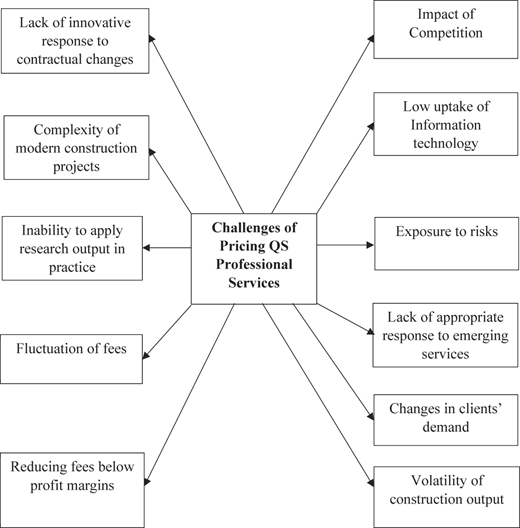
The results show that project complexity poses a challenge to the pricing of QS services due to the risks emanating from the interaction of stakeholders. A prior investigation by Owusu-Manu et al. (2015) shows that the pricing of QS services is exposed to risks in the internal and external environments of projects. Risks associated with the external environment of QS firms include legal risk and societal risk while the risks within the internal environment of QS firms consist of financial risk, logistical risk and managerial risk. Adafin et al. (2020) emphasise the need for the accuracy of estimates prepared by quantity surveyors to mitigate the risks associated with their services and went further to identify risk factors such as changes in owner's requirements, expertise of consultants and quality of design information. In addition to the risks, the volatility of construction project output and the effect of unstable levels of prices for QS professional services including other challenges confronting QS professional services pricing are shown in Figure 1 below.
QS firms can address the challenges identified in this paper by developing their pricing capabilities; service differentiation and digitisation of the service delivery process. QS firms must not neglect the roles of pricing capability driven by a well-crafted strategy. The pricing capabilities enable the QS firms to effectively generate revenues that enhance their profitability. Resources are also essential to the development of strategic pricing capabilities especially in an environment where the demands of clients continue to change due to increasing competition. Thus, the resource base of QS firms must be improved by investing in digital technologies that ensure the delivery of services to clients within the agreed duration. It is also important to consider the success factors for digital technologies adoption in QS firms. For instance, Evans et al. (2021) identify cost estimation and quantity take off as one of the reasons for the adoption of BIM. The adoption of digital technologies enable QS firms to prepare accurate cost estimates for clients as Dandan et al. (2020) note that accurate estimation of building construction project cost is a challenge to many designers. The findings of this study regarding the use of digital technologies to address pricing challenges discussed in this paper is supported by the earlier findings of Oke et al. (2018) that information technology skills including research and development are important to developing the skills of quantity surveyors.
To effectively address the QS services pricing challenges analysed in this paper. QS firms must diversify into unsaturated markets to offer emerging services such as facilities management, arbitration, construction law, value management, construction management and project management to clients (Harun and Torrance, 2006). Within the context of differentiating services, QS firms need to identify and target the appropriate market for professional services. Adesi et al. (2019) found three main market segments that QS firms can target.
6. Conclusion
The purpose of this study was to examine the complex factors that inhibit the effective pricing of QS professional services to suggest measures for mitigating their negative impacts. The identification of QS services pricing challenges such as lack of appropriate response strategies; the changing nature of clients' demand; the complexity of modern construction; and the impact of competition enable QS firms to develop solutions that address the challenges confronting effective pricing of their services. It is also necessary to state that the findings of this study and the suggestions for implementation to address the QS services pricings challenges applies to other geographical locations and not only Ghana. The reason is that pricing is a universal task for organisations hence, the findings of this study may be useful to firms in other sectors and different geographical locations. The paper has the potential to open new areas of further investigations about the strategies for improving the pricing of professional services.
This is study adopted the quantitative approach for data collection, which limits it as far as the benefits of qualitative research is concerned. Also, the results presented and analysed in this paper are limited to only QS professionals. As a result of these limitations, future studies undertaken using the qualitative approach would be necessary to complement the results of this study in terms of the depth of investigation. It is also necessary to undertake a future study using the mixed method approach to explore the strategies that should be adopted for addressing the challenges of QS professional services pricing identified in this paper.