


This study aims to identify the location of regional growth poles in Vietnam.
A potential gravity model is constructed to estimate how attractive a location is in relation to other locations within a specifically defined region using spatial interpolation tools.
We present the calculated and visualized potential gravitational energy (or attractiveness) for every province showcasing regional growth poles in Vietnam.
Graphical evidence need to be supported by statistical analysis to establish causal effects of driving factors on growth measures.
This is the first study to use a potential gravity model to study growth poles in Vietnam.
1. Introduction
Since the Đổi Mới economic reforms in 1986, Vietnam has succeeded in transforming into one of the middle-income economies with stable economic growth and improved social welfare. Annual GDP per capita growth rate averaged at 5.5% since 1990, and the share of people living in extreme poverty reduced from 50% in the 1990s to 3% in 2016 (World Bank and Ministry of Planning and Investment of Vietnam, 2016). An extensive urbanization process and an evolving urban system have also been recognized as both a feature and a lever of that successful economic transformation (World Bank, 2020). Yet, existing literature tends to agree on a polarizing urban landscape in Vietnam. On one hand, the urban network is extensive and continues to grow but most cities are small and lower tiered (Le, 2020b). On the other hand, Ho Chi Minh City (HCMC) and Hanoi has maintained a dominant role in the urban network as the two primate cities for many years (World Bank, 2011, 2020; Asian Development Bank, 2012).
In fact, the Communist Party of Vietnam passed Resolution No. 6 in 2022 recognizing Hanoi and HCMC as two “economic growth poles and centers of innovation” in Vietnam. Subsequently, Vietnam National Assembly passed Resolution No. 81 in 2023. This resolution called for more focus on “growth poles” as economic propellers for regional and national development [1]. By 2030, four growth poles are emphasized: Hanoi (Northern), HCMC (Southern), Da Nang (Central Coast), and Can Tho (Mekong Delta River).
While the discussion of growth poles or, in a broader sense, the notion of “cities as engines of growth” is not new, it has been addressed rather conservatively in Vietnam until recently. This gradual change in urban development perception is a positive indicator that the ruling Communist Party of Vietnam may be open to change (World Bank, 2011). It is perhaps safe to say that Resolution No. 6 in 2022—the very first thematic Resolution of its kind—has shifted the paradigm and allowed decision-makers to see large urban centers as drivers of economic growth, both locally and nationally.
The primary purpose of this study, given the contemporary context, is to present an original attempt at identifying and exploring the location of regional growth poles in Vietnam. To do so, a combined approach is employed: a potential gravity model is configured to estimate how attractive a location is in relation to others. Then, we use GIS spatial interpolation tools to identify and visualize growth poles. As of yet, researchers have not used the potential gravity model to study growth poles for the case of Vietnam.
This paper is structured as follows. Chapter 2 provides an overview of growth pole literature and explores gravity models within the context in Vietnam. We also discuss existing research gaps and present a theoretical framework for our study. Chapter 3 further elaborates on our methodology. Chapter 4 outlines areas for additional research and includes both a discussion of policy implications and a summary of our findings. Concluding remarks are presented in Chapter 5.
2. Literature review
2.1 Growth poles and the Vietnamese context
The concept of “growth poles” has often been attributed to François Perroux who proposed the idea that:
economic space consists of centres (or poles or foci) from which centrifugal forces emanate and to which centripetal forces are attracted. Each centre being a centre of attraction and repulsion, has its proper field, which is set in the fields of other centres (Perroux, 1950).
which was reaffirmed in a later work via the well-known passage:
growth does not appear everywhere at the same time: it becomes manifest at points or poles of growth, with variable intensity; it spreads through different channels, with variable terminal effects on the whole of the economy (Perroux, 1955) [2].
There are two aspects of a growth pole in space: a center—or core—from which growth radiates and a system of channels via which growth is spread throughout the economic system. Growth pole theory emerged during a time when academics were also researching theories on uneven development (Friedmann, 1966; Hirschman, 1958; Myrdal, 1957), city-regional or metropolitan-scale development (Bogue, 1949; Dickinson, 1947; McKenzie, 1933), the emergence of monocentric urban economic models (Alonso, 1960; Mills, 1967; Muth, 1969).
Few studies have specifically explored growth poles in Vietnam. Existing research has focused mainly on large cities such as Hanoi and HCMC as drivers of national economic growth (Tran, 2015; Truong, 2005). A pioneering work in identifying growth poles was the post-Đổi Mới study by Auriac and Đồng (1997), which illustrated urban system in Vietnam in terms of economic size and attraction, on which 71 cities are bubble plotted and colored in accordant to their size and seven specific classifications. Hanoi and HCMC are accentuated as major economic centers with long ranging influence in the North and the South respectively, as shown by their large size and highest position in the urban hierarchy (Figure 1).

Size, classification and influence of major urban centers in Vietnam. (a) Classification of major cities based on economic activities and equipments; (b) Attraction of Hanoi and Ho Chi Minh city
Size, classification and influence of major urban centers in Vietnam. (a) Classification of major cities based on economic activities and equipments; (b) Attraction of Hanoi and Ho Chi Minh city
Reports by the World Bank (2011, 2020) and World Bank and Ministry of Planning and Investment of Vietnam (2016) also assumed the leading role of Hanoi and HCMC in the Vietnam urban system, but with more evidence-based arguments aided by GIS applications and illustrations. An in-house investigation by the World Bank and Ministry of Planning and Investment of Vietnam (2016) showed that respectively Hanoi, Da Nang, HCMC are powerhouse in the Northern, Central and Southern regions in various aspects, such as industrial output per kilometer square, FDI distribution, and concentration of employment.
Not all researchers agree that Ha Noi, Da Nang, and HCMC are the biggest drivers of growth. JICA (2013) used the published data from the General Statistics Office of Vietnam (hereby “GSO”) on economic performance, economic and industrial zones, and transport infrastructure to analyze 25 cities in Vietnam. They identified three cities as having comparative advantages, namely, Hai Phong, Da Nang, and Ba Ria – Vung Tau respective to Northern, Central, and Southern Vietnam.
In the policy-making sphere in Vietnam, while the term “growth poles” has only appeared in official documents as of late, other terms [3] such as “leading territory”, “dynamic center”, “growth spearhead” have been used to describe the same phenomena since as early as the 1990s (Le & Le, 2023). Yet, core orientations for key urban centers have remained somewhat fixated in three decades: only a handful of cities, specifically Hanoi, HCMC, and Da Nang have been consistently designated the role of growth poles. From the bottom-up, Vietnamese localities are also aspiring to become engines of growth in the national economic landscape, and outside of the regulation framework, Vietnamese media are actively hailing for new growth poles (or even new centrally-managed cities) [4]. These ongoing trends are beyond the usual staged ascension promulgated by the urban classification system policy.
2.2 Gravity and potential models
The gravity model is based on Newton’s law of universal gravitation (1687) with the following form:
in which, refers to the gravitational force acting between two objects and , is the distance between the centers of their masses, and is the gravitational constant. When applied to studying regional economies, the main assumption of the gravity model is that there exist attractive forces between human settlements similar to gravitational forces between masses in space. This gravitational force, or attractive force, is proportional to the size of the respective areas—i.e. proxied by a measurement of size such as population—and disproportional to the friction between them—i.e. measured by the distance between them. In research, the gravity model has taken various names such as “social physics” and “demographic gravitation”, as in Stewart (1948a, b) or Stewart and Warntz (1958).
Supposing there are particles of mass —located at point —and mass that are at distance from each other, Newton’s law of gravitation can be expressed in any one of three different formulas:
in which is a force that acts on each mass, is the mutual energy of the two masses in the gravitational field and is the gravitational potential produced by mass at point A; is the universal gravitational constant. When this is applied to social sciences, the model turns to the size of human settlements and their hypothetical interaction. For instance, there are people at location 1, people at location 2, which are at distance from each other, formulas (2.4), (2.5) and (2.6) correspondingly take the forms:
with , represents demographic force, demographic energy and , are population potentials; i.e. refers to the population potential which the population produces at the location of point 1 and vice versa, refers to the population potential that the produces at the location of point 2.
2.3 Research gaps and rationale for the selected methodology
Literature regarding growth poles in Vietnam may be limited due to the top-down, politically-guided policy-making of the Party-State when it comes to urban development issues which has historically been unwelcoming of relevant research; or it might be due to the lack of available data from the GSO – the official source for statistical data in Vietnam – to study the subject of growth poles. Le (2020a) identified gravity models as one of the three viable methodologies to study city-regions in Vietnam [5], and regional science in a broader sense. The other two methodologies mentioned are density functions and flow analysis, both of which have been applied to study some urban issues in Vietnam with varying success. A notable exhibition of density function research in Vietnam is a report by the World Bank and Ministry of Planning and Investment of Vietnam (2016) which displayed the density in Hanoi and HCMC (measured in inhabitants per squared kilometer) against increasing distance from their respective city centers, via which the shape of their respective metropolitan areas can be erected.
On the other hand, it is difficult to apply flow analysis to Vietnam due to the lack of observable flow-type data, like commuting pattern, capital flow, and the flow of goods and services between human settlement areas. Existing data is very limited and thus is unreliable, which makes it unsuitable to use in research [6]. For example, migration reports in Vietnam (GSO and United Nations Population Fund, 2016; GSO, 2020) only track net migration data at the regional level (i.e. data is unavailable at provincial level). Detailed information like where residents are migrating to and from is not available making it difficult to track migration flow. Similarly, GSO transportation data at the provincial level [7] primarily focuses on things like the number of passengers or volume of goods carried within an administrative boundary—again, lacking detailed information such as origins and destinations.
Regarding gravity models, in a later work, Le (2023) explored their application in delineating city-regional boundaries using the “Can Tho City-region” as an experimental case study. A gravity model was configured with the form:
in which and are provinces in the Mekong Delta Region; and refer to the predicted urban population of those provinces in 2030; refers to a frictional constant between and and is a distance parameter whose values were assumed. Then, a 13x13 interaction matrix (corresponding to 13 provinces in the Mekong Delta Region) showcasing the interaction force was constructed, from which an interaction diagram was also erected. Provinces with the strongest interactions with each other were grouped together to make a hypothetical Can Tho City-region. Via the emphasis on city-regions, Le’s (2023) primary idea is to use the estimated as a proxy for the interaction between and ; from which the comprehensive interaction force can be calculated for every province. Ultimately the one administrative unit harnessing the strongest comprehensive interaction force is to be assigned the central growth pole (i.e. Can Tho). This approach worked around the absence of flow-type data in Vietnam. To be precise, the calculated is only hypothetical interactive force. The actual - interaction, however, remains uncaptured.
What if rather than trying to measure, or find a proxy for the mutual interactive forces between all the locations (i.e. provinces), we attempt to measure how attractive a location is as compared to others instead? The potential gravity model would allow us to explore this. In this study, we apply the data that are already utilized in the conventional gravity model such as population or market size (measurement for and ), distance () to the potential gravity model to calculate the potential gravitational energy of each individual location (i.e. or how attractive a location is). would illustrate the intensity and “reach” of a location onto its surrounding region. This visualization is more intuitive than the conventional “bubbles” approach (Figure 1) which treats locations as isolated islands and are plotted based on sheer size only because takes into consideration the size of locations but also connectivity, or friction, between them as well. In the absence of reliable flow-type data suitable for analysis, perhaps it is more efficient to reutilize the data we have with extra tools and techniques employed.
3. Methodology and results
3.1 Research areas
The paper examines six official socio-economic regions in Vietnam that are also statistical regions: (1) Northern Midlands and Mountainous Area; (2) Red River Delta; (3) Northern-central and Central Coastal Area; (4) Central Highlands; (5) Southeast; and (6) Mekong River Delta. For further analysis, adjacent regions are grouped together to form three large “combined” regions: the Combined Northern Region, the Combined Central Region, and the Combined Southern Region (Figure 2).

There is increasing attention given to city-regions recently as officially endorsed in the National Assembly Resolution No. 81 (2023) as well as in contemporary literature (Tran, 2015; Le, 2020a, 2022). Therefore, we also examine two city-regions: the Hanoi Capital Region and the Ho Chi Minh City Metropolitan Area (hereby “HCMC Metropolitan Area”). A nationwide model is also employed.
3.2 Indicators and data sources
This research calculates three types of gravitational potential: population potentials, income-weighted population potentials, and centrality-weighted market size potentials. Two alternative measurements of distance are used: road kilometers and minutes traveled between provinces.
First, we adapt the gravitational equations introduced by Stewart (1948a, b), and Stewart and Warntz (1958):
In which , , and represent demographic force, demographic energy, and population potentials between and ; and refers to populations of and as proxies for size, is a gravitational constant, and is the population potential at of the population in location . The interpretation of population potentials of a location may be thought of as a measure of the influence of that location at a distance (Stewart, 1948a); or as the accessibility of such location (Stewart & Warntz, 1958). Like Carrothers (1956), we consider population potential to be a measure of the “intensity of the possibility of interaction”. Precisely, formula (3.3) can be understood as: at a location , the intensity of the possibility of interaction (i.e. in the case that interaction occurs) to an individual to an individual at , will be larger if the population at is larger and will be smaller if the distance increases.
To account for the comprehensive population potential of all units = exerting on (including itself, i.e. ) we turn formula (3.3) into the summation form:
in formula (3.4) refers to total population potential at location . In our study, is and js are provinces so there is no possibility to collide or interaction with each other in spatial or geographical sense. would imply an omnidirectional pulling power of a province relative to all other provinces , hence its attractiveness. A higher indicates a stronger attractiveness [8] of province as compared to all surrounding provinces s and is taken as an indication that province should be considered a growth pole.
Stewart (1948b) proposed that some “molecular weight” be applied to population mass. When such weight is applied, equation (2.5) is turned to:
In other words, formula (3.5) is a more general case of formula (2.5) when values of are not 1. Molecular weight in this context is interpreted as individual’s (within a population) capability to interact (Stewart & Warntz, 1958), similar to molecular weight affecting gravitational force between masses in physical analogy. Again, as stated, there is no possibility for administrative units to collide or interact in a spatial or geographical sense. A weight such as applied to the measurement of size such as can be considered a stricter modification of the model. Due to different socio-economic circumstances and/or demographic characteristics, population at one settlement may exerts population potential – or influence – stronger or weaker than implied in original formulations (formulas 3.1, 3.2, 3.3), and this is accounted for through the use of a molecular weight. The weighting factor selected in our formulation is the per capita income, similar to research by Stewart and Warntz (1958) but also because such data is readily available in Vietnam. When an income weight is applied, we turn formulas (3.1), (3.2) and (3.3) to obtain:
If we use the summation form, formula (3.8) appears as:
Another measurement of size for provinces is based on the market size – proxied by the value of retail sales of goods and services at current prices. Just like the population, market sizes are not distributed uniformly in Vietnam. Due to this, we derive our market size data from retail sales. The data is collected and calculated from GSO database for current prices in 2022. The selection of commercial market size instead of the Gross Regional Domestic Product data is due to issues with regard to local data consistency and reliability (Hoang, 2007), particularly with urban and spatial planning data [9] (World Bank and Ministry of Planning and Investment of Vietnam, 2016). We obtain formula (3.9) by substituting retail sales for population as a proxy for provincial size, and adding a “centrality” weight :
The centrality weight indicates the most attractive place in term of market (Harris, 1954; Reilly, 1929). For discussion and estimation of and see Appendix A. For a summary of spatial interpolation procedures and associated assumptions, see Figure C1 in Appendix C. Lastly, a third indicator is derived by replacing distance with travel time .
Assuming the values [10] of = 1, six calculations of attractiveness are as followed:
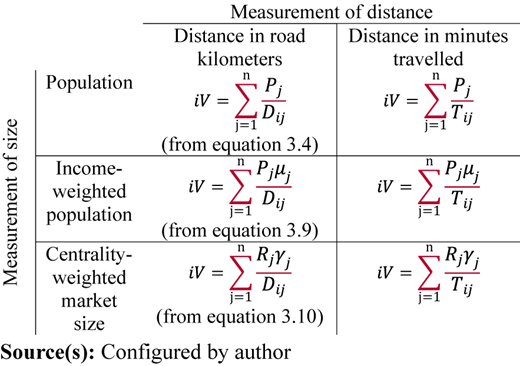
4. Analysis and policy discussion
4.1 Findings and observations
The results for the calculated are displayed in Tables 1–6 accordingly to the six indicators. The far-left column lists out all 63 administrative units of Vietnam. To the right, values are calculated for every one of them and are arranged in their corresponding regions. Additionally, spatial outcomes are shown in Figures 3–11.


Results for northern regions and city-regions; distance measured in road kilometer
Results for northern regions and city-regions; distance measured in road kilometer

Results for northern regions and city-regions; distance measured in minute traveled
Results for northern regions and city-regions; distance measured in minute traveled

Results for north-central and central regions and the highlands; distance measured in road kilometer
Results for north-central and central regions and the highlands; distance measured in road kilometer

Results for north-central and central regions and the highlands; distance measured in minute traveled
Results for north-central and central regions and the highlands; distance measured in minute traveled

Results for southern regions and city-regions; distance measured in road kilometer
Results for southern regions and city-regions; distance measured in road kilometer

Results for southern regions and city-regions; distance measured in minute traveled
Results for southern regions and city-regions; distance measured in minute traveled

Results for combined northern, central and southern regions; distance measured in road kilometer
Results for combined northern, central and southern regions; distance measured in road kilometer

Results for combined northern, central and southern regions; distance measured in minute traveled
Results for combined northern, central and southern regions; distance measured in minute traveled

In total, 72 maps were generated: 48 for an 8-region classification, 18 for a 3-region system, and 6 for nationwide tests.
We find evidence reaffirming the dominant position of Hanoi and HCMC in the urban network. In the north, Hanoi has the highest influence in its adjacent regions which are the Red River Delta, Hanoi Capital Area, and the Combined North. In the south, HCMC shows the highest influence in the Southeast, Ho Chi Minh Metropolitan Area, and the Combined South. However, values for HCMC are lower than Dong Nai, Binh Duong, and Ba Ria–Vung Tau (Table 2 and Table 6). This might be due to higher average income per capita in Binh Duong (see Table A1, Appendix A); a slightly more advantageous position for transportation in Binh Duong, Dong Nai and Ba Ria – Vung Tau (shown by higher estimates – see Table A2, Appendix A); and higher distance and travel time in HCMC that outweighs its larger population or market size (see Appendix B).
The government designated Da Nang and Can Tho to be growth poles for the Central and Mekong Delta region, yet the result for their destined role is rather mixed. For the Northern-Central and Central Coast as well as the Combined Central region, Thanh Hoa province consistently leads with the highest values. If we restrict the data to two smaller subregions—the North-Central Coast and South-Central Coast, Da Nang appears to be the growth pole of the South-Central Coast. Looking at the Mekong Delta region, the values of the Long An, Tien Giang, and Ben Tre provinces are generally higher than that of Can Tho, except when it comes to the centrality-weighted market size potential (Table 3). If we exclude Long An and Tien Giang – the two provinces belonging to the HCMC Metropolitan Area – then Ben Tre becomes the growth pole of the Mekong Delta, while Can Tho would be the growth pole in the second place after Ben Tre.
When we expand the regional boundary limits from combined regions (Figures 9 and 10) to the nationwide level (Figure 11), there are no longer visible growth poles in the central regions. It is as if Hanoi and HCMC wash away these growth poles. Similarly, for the Northern Midlands and Mountainous Area, the provinces with the highest values are Thai Nguyen, Bac Giang, and Phu Tho. This is likely due to their proximity to Hanoi and eastward provinces in the Red River Delta ( Figure 3A, 3B, and 3C; 4A, 4B, 4C). However, within the boundary of the Hanoi Capital Region and the Combined North, we observe that Thai Nguyen, Bac Giang, and Phu Tho have less influence. For the Central Highlands, Dak Lak is the most dominant growth pole. Yet, it becomes less relevant in the Combined Central region because much influence is diverted to Thanh Hoa, Da Nang, and other coastal provinces ( Figures 9D, 9E, 9F, 10D, 10E, and 10F).
4.2 Policy implications
The Prime Minister Decision No. 10 released in 1998 served as the pioneering document governing urban issues in Vietnam up until 2010. The document initiated an urban masterplan for the country by 2020, but its viewpoint was conservative with priorities focused on order, discipline, and state management on urban development. A new plan was released in 2009 under the Prime Minister Decision No. 445, which updated the masterplan and extended the vision by 2025. The new masterplan aimed for establishing a nationwide network of cities as the backbone of both local and national economy. With this viewpoint, it offered more flexibility than the previous one in allowing the formation new cities at local level, and in approving of large and very large cities in the whole network.
While past policies focused on building up the urban network, newer policies seem to recognize that large cities and new forms of urban development may play an important role in revitalizing the network and economic development. We can see this in the text of these documents. While the 1998 masterplan had no mention of “growth poles” [11], the 2009 version included 5. The National Assembly Resolution No. 81 in 2023 resolution mentioned growth poles 13 times. Furthermore, if we look at the term “engine of growth” – interchangeable with “growth poles” – we find that the 2023 resolution mentions the term 43 times.
In other words, the orientation for growth poles in Vietnam has undergone a long-term readjustment since the 1990s from conservatism to proactive endorsement (Table 7). In modern times, major cities like Hanoi, HCMC, Da Nang, and Can Tho have been designated as growth poles in respective economic regions in Vietnam. This shift indicates that the Vietnamese government is and has been willing to invest in and promote the formation of large urban centers.
National and regional centers identified in documents regulating urban development in Vietnam in various periods
| Prime minister decision no. 10 (1998) | Prime minister decision no. 445 (2009) | National assembly resolution no. 81 (2023) | |
|---|---|---|---|
| National centers | Hanoi; Ho Chi Minh City; Hai Phong; Da Nang; Hue | Hanoi; Ho Chi Minh City; Hai Phong; Da Nang; Hue | Specifically assigned four growth poles in accodance with four newly-defined “dynamic zones”
|
| Regional centers |
|
| |
| City-regions | No specific assignments | Specifically assigned four city-regions encompassing four major cities
| |
Based on our current findings, we propose some recommendations to develop growth poles as follows:
First, development priorities should be given to the North-Central and Central Coast and the Mekong Delta Region. Our study reaffirms that Hanoi and HCMC play leading roles in both regional and national economic development. This is consistent with other previous literature (Auriac & Đồng, 1997; World Bank, 2020). Given the historical and political context, it is certain that Hanoi and HCMC would likely maintain their leading positions in the future. Therefore, to balance the development on the spatial dimension, Da Nang and Can Tho should be prioritized. It is worth noting that even in developed countries, narrowing the division between regions is also a hotly debated subject. With localities already aspiring to become growth poles, shifting the government mentality from a highly prescriptive model of central control to a more adaptive, decentralized one is an important mechanism to unlock the potential of economic growth (Albrecht, Hocquard, & Papin, 2010; DiGregorio et al., 2016; Le, 2020b).
Second, travel time is a better measurement of infrastructure improvement than travel distance. The distribution of is less positively skewed than the distribution of making it slightly more preferred (see Appendix B). The implication here is that designing infrastructure and investment policies to improve connecting time between provinces is as important as closing the distance gap between them, especially for regions with already well-established infrastructure network. With regards to the measurement of distance, future studies may consider the approach described by Wu, Fang, Huang, and Wang (2012) which computes a comprehensive integrated measurement of distance including both economic distance as well as psychological distance.
Third, regional boundaries play an important role in identifying growth poles. There are debates on the very topic of regions in Vietnam: what constitute a region, how many regions should be, which province belongs to which region, and what the purposes of deciding regional boundaries are [12]. The definition of regions has been changed and updated in official documents over time. For example, the National Master Plan 2021–2030 reassigned the Quang Ninh province to the Red River Delta. The Northeast and Northwest regions are now merged under the name “Northern Midlands and Mountainous Area.” How a region is defined is a factor in determining growth poles. Therefore, future National Master Plans should consider the dynamics and interactions of provinces for the most optimal grouping arrangement so that re-defining regional boundaries, if needed, are an informed process. For example, consider the case of the Ho Chi Minh Metropolitan Area. It is technically in the Southeast region, which includes two provinces (Long An and Tien Giang, see Figures 7 and 8). But for the Mekong Delta Region, the growth poles are positioned northeastward around the area of Long An, Tien Giang, and Ben Tre. These three provinces are in closer proximity to HCMC than Can Tho. One might wonder if they should be in the Southeast region, and if so, is the Ho Chi Minh Metropolitan Area still necessary.
5. Concluding remarks
This study attempts to determine regional growth poles in Vietnam based on a potential gravity model. We have identified growth poles from different measures of potential gravitational energy as proxies for attractiveness. Based on graphical analysis and qualitative reasoning, we make several important policy recommendations in urban development in the context of the National Master Plan in Vietnam for the period 2021–2030, with vision up to 2050.
In the future, this study could be improved when flow-type data becomes available. A limitation of this study is that the patterns of growth poles are the product of spatial interpolation and that the results are restricted to economic and demographic indicators with significant data limitations. In the long term, the availability of province-to-province flow-type data, for example, the transportation of goods between provinces, could help identify growth poles with better accuracy. More comprehensive indices that measure socio-economic performance could be used. For example, Wang et al. (2014) and Pan and Liu (2014), respectively, have constructed the “urban influence index” and “urban nodality index” from multiple indicators, which allows for a more comprehensive depiction of development for administrative units.
Notes
According to National Assembly Resolution No. 81, some other spatial forms are “dynamic zones” [vùng động lực], “economic corridors” [hành lang kinh tế]”.
Original text in French, adopted translation from work by Wojnicka-Sycz (2013, p. 18).
Some phrases listed include: “leading territory” [lãnh thổ đầu tàu], “development center” [trung tâm phát triển], “dynamic center” [trung tâm động lực], “key territory” [lãnh thổ trọng điểm], “growth spearhead” [mũi nhọn tăng trưởng], “growth nucleus” [hạt nhân tăng trưởng], “key region” [vùng trọng điểm], etc. which were used with intention referring to growth poles.
Some provinces or cities are promoting to be growth poles or to be centrally-managed (for instance, Khanh Hoa, Hue, Bac Ninh, Ha Nam). Local governments often promote themselves to be growth poles of the country.
An urban form in its early development stage in Vietnam which Le’s (2020a) argued for more academic attention in the future.
Indeed, flow-type data is one of multiple types of data in shortage at provincial level in Vietnam, this has been reaffirmed in a report by The World Bank (2015, p. 139) which was referred as “the absence of supplementary information at this scale (such as commuting patterns, job locations, industrial location, and the like)”.
Online access at GSO website at: https://www.gso.gov.vn/en/trade-and-services/
It is worth noting that there are various names conferring potential gravity model such as ‘urban field’ or ‘field modeling’ (Friedmann & Miller, 1965; Deng, Liu, Wang, Ma, & Wang, 2010), ‘sphere[s] of influence’ (Huff, 1973; Wang, Deng, Liu, & Wang, 2011, 2014). In this paper, the name “potential gravity model” is selected to align with Stewart (1948a, b) and Stewart & Warntz (1958) whose works also discussed relevant terms such as ‘influence’ or ‘accessibility’.
In Chapter 4 “Managing Urbanization for Greater Economic Efficiency” of the Vietnam 2035 Report - the World Bank has criticized “inconsistent data” as one of the hindering factors to the optimization and synchronization of urban and spatial planning in Vietnam.
Conventionally and are assumed to take values of 1 and 2 respectively (Isard, 1960), yet there is no common agreement on how to estimate them or which values they should take.
In Vietnamese: “cực tăng trưởng” [growth poles], “động lực” [dynamic].
For more information, see for example: https://vnexpress.net/hai-phuong-an-phan-vung-den-nam-2030-4111088.html
Disclaimer: The boundaries, colors, denominations, and other information shown on any map, figure, illustration, in this paper do not imply any judgment by the author concerning the legal status of any territory or endorsement or acceptance of such boundaries.
Declaration: This author declares that there are no conflicts of interest.
References
Appendix
The supplementary material for this article can be found online.

