This study aims to investigate how women internalize the belief that networking is a legitimate avenue for career advancement, a process the authors term “the networking myth.” The authors also investigate how women navigate this myth while unknowingly reinforcing the very practices that inherently disadvantage them and sustain male dominance in corporate hierarchies.
The authors use a mixed methods approach involving the design of an implicit association test to uncover women's implicit attitudes women toward the legitimacy of networking. The authors then engage in reflective discussions, through in-depth interviews, about how networking practices tend to disadvantage women and how women navigate this arena.
The authors find a paradox. While networking is seen as illegitimate for professional advancement due to the “old boys’ networks,” and the “subordinate trap” that marginalizes women, networking is also seen as a widely accepted practice that women try to navigate. Through “casuistic self-justification,” women rationalize their involvement in networking despite having ethical concerns, and through “self-imposed higher standards,” women try to overcome perceived personal networking deficiencies.
To the best of the authors’ knowledge, this is the first study to investigate how relying on networking prowess for reaching top positions may result in women embracing and even legitimizing the same practices that marginalize them. This study is also pioneering because it relies on social dominance theory to conceptualize networking as a legitimizing myth, normalizing and perpetuating the belief that networking success is the result of personal merit and competence, ignoring the structural barriers inherently disadvantaging women in corporate hierarchies.
1. Introduction
Women’s underrepresentation in top management remains an important societal challenge (Allemand et al., 2022). Central to this issue is networking’s gatekeeping role in filling these positions. Networking consists of building and maintaining relationships that offer career-related assistance, including both formal and informal interactions (Forret and Dougherty, 2004). While networking is widely recognized as essential for career success (Gibson et al., 2014), it can also reinforce gender biases overshadowing merit and competency (Melé, 2009). If women internalize networking’s legitimacy for career advancement, they may unknowingly reinforce the very practices marginalizing them, where access to opportunities is governed by power structures rather than individual merit. While this problem may be more pronounced in male-dominated contexts, like top management (Woehler et al., 2021), it also persists in gender-balanced sectors (Diehl et al., 2022). Recent developments, such as the pushback against diversity, equity and inclusion (DEI) initiatives in regions like the USA (Post, 2025), highlight the fragility of progress in addressing systemic inequalities. In addition, online networking, which gained prominence after COVID, mirrors the power structures of traditional networking (Contreras et al., 2024). These factors underscore the urgency of understanding how networking-based hiring practices perpetuate power structures and hierarchies. This paper investigates how women in management navigate the internalization and legitimization of networking as they strive for top management positions.
Shoulder tapping, a prevalent method for filling top management positions, relies on networks rather than on open and competitive recruitment (Burzynska and Contreras, 2020; Harrison et al., 2023). Consequently, networking-based selection processes are often marked by favoritism, resulting in a limited candidate pool, i.e. constrained optimum, where better-qualified candidates outside of these networks are overlooked (Shwed and Kalev, 2013). These practices, while undermining merit and fairness, can ultimately affect the quality and effectiveness of corporate leadership. Since women are typically less integrated into the predominantly male networks dominating corporate hierarchies, they face disadvantages (Cullen and Perez-Truglia, 2023; Woehler et al., 2021). Therefore, networking-based selection processes can perpetuate gender inequalities and social hierarchies in management.
Women’s systematic disadvantage in networking-based selection processes create a gendered status-quo where stereotypes like “women […] suck at networking” (Comstock, 2010) shape societal and corporate discourses. These narratives are misleading and reductionist. For example, suggesting that women avoid networking to balance family and paid employment (Hakim, 2000) ignores the structural barriers shaping women’s choices (McRae, 2003). Also, women’s networks, often proposed as solutions to improve women’s access to top management (Singh et al., 2006), tend to be limited in their ability to influence decision-making processes and create tangible career opportunities (Choi, 2019; O’Neil et al., 2011). Furthermore, these networks can unintentionally reinforce hierarchies by placing disproportionate individual responsibility on women to overcome systemic barriers (Benschop, 2009; Bierema, 2005). For women’s networks to successfully address the structural factors perpetuating gender inequality in organizations, they must integrate into broader organizational strategies, be supported by senior leadership, and align with initiatives to dismantle systemic biases (Gabaldon et al., 2016). Otherwise, they risk becoming symbolic efforts (O’Neil et al., 2011). Thus, these discourses oversimplify the problem and its solutions. Advice to “improve networking skills” (Forret and Dougherty, 2004) ignores the interaction between individual choices and systemic constraints, perpetuating the belief that networking success is bias-free. This advice justifies women’s exclusion from top management by attributing their underrepresentation to a lack of networking prowess rather than systemic barriers.
To investigate whether and how women internalize and navigate the belief that networking is a legitimate avenue for career advancement, we apply social dominance theory (SDT). Specifically, we conceptualize networking prowess as a legitimizing myth, a set of socially accepted “attitudes, values, beliefs” justifying systemic practices that distribute social value (Sidanius and Pratto, 1999, p. 45). Such myths naturalize privileges by framing them as common-sense views rather than systemic bias. In our context, the networking myth perpetuates the notion that networking prowess stems from personal merit and competence, while ignoring the structural barriers disproportionately benefiting men (Burzynska and Contreras, 2020; Woehler et al., 2021). This myth can unintentionally frame women’s lack of networking prowess as a personal deficiency, reinforcing their subordinate status within corporate hierarchies (Ridgeway, 2001).
Despite its unequal benefits for men and women, networking remains deeply ingrained in organizational career management practices (Kirsch, 2018). Viewed as a marker of suitability for top management, it is rarely questioned as a normalized business practice. Women, as active corporate participants, may internalize this myth through organizational socialization, inadvertently sustaining systems disadvantaging them. Acknowledging these disadvantages, we examine how the networking myth shapes women’s perceptions and experiences in corporate hierarchies.
Theoretically, our study contributes to the gender in management literature by conceptualizing, as a legitimizing myth, the notion that networking prowess, as an indicator of personal merit and competence, is a valid path for reaching top management. This myth obscures the structural barriers in networking practices inherently disadvantaging women. While theories like social identity theory (SIT) (Tajfel, 1978) and homophily (Ibarra, 1992) explore how women engage with systems not designed for them, SDT offers a critical lens to examine legitimizing myths. These myths perpetuate the status quo and can be upheld by members of the subordinate group (De Oliveira et al., 2012), women managers in our case. Hence, we extend SDT’s relevance to gender in management, offering a system’s justification perspective complementing existing theories and deepening our understanding of how normalized corporate practices reinforce gender inequality.
To delve beyond women’s ingrained social conditioning surrounding networking as a normalized corporate practice, we use a novel methodology. Specifically, we use a mixed-methods approach centered on an implicit association test (IAT) as an innovative tool to uncover women’s subconscious attitudes toward networking’s legitimacy. The IAT serves as a pre-interview intervention, stimulating critical reflections on implicit perceptions beyond socially accepted narratives (Marn and Wolgemuth, 2016). Our study focuses on women in management – Spaniards living in Spain – pursuing top management positions. This approach facilitates conducting reflective interviews to understand how myths, like the networking myth, perpetuate corporate hierarchies, offering a deeper understanding of women’s navigational challenges in these contexts.
We find that women, often relegated to subordinate roles within hierarchies, face a dichotomy in their perception of networking. On the one hand, they reject the networking myth due to its exclusionary nature, dominated by the old boys’ network and the subordinate trap, where efforts to engage in networking reinforce their subordinate role, in line with SDT. On the other hand, women embrace the networking myth, navigating this space through two strategies: casuistic self-justification, reconciling networking with personal, ethical values and self-imposed higher standards, as women strive to overcome their perceived shortcomings in networking. Despite these efforts, power dynamics persist, reinforcing women’s subordinate status and perpetuating gender disparities in corporate hierarchies.
Practically, our research highlights the need for a counter-narrative to networking as a dominant career management practice, reinforcing male dominance in corporate hierarchies. Rooted in DEI principles, this narrative should challenge conventional perceptions of networking and establish an attenuating myth to address gender disparities within organizations.
2. Theoretical background
2.1 Social dominance theory
SDT posits that societies are structured hierarchically, with dominant groups holding more power and resources than subordinate groups (Pratto, 1999; Sidanius et al., 2004). Along the gender dimension, women tend to have less power and status than men and tend to be placed within the subordinate group (Fitzsimmons and Callan, 2020). These gender disparities manifest in various ways, with men typically having higher-status occupations and greater influence (Ridgeway, 2001). In corporate hierarchies, women often occupy subordinate positions due to persistent disadvantages hindering their careers (Gabaldon et al., 2016). Particularly, women face disproportionate caregiving responsibilities resulting in work-family conflicts (Eby et al., 2005). Societal gender role expectations can further limit their aspirations for top management roles by shaping their self-perceptions and professional decisions (Eddleston et al., 2006). Moreover, gender discrimination consistently undervalues women’s skills and potential (Bertrand et al., 2005). Tokenism marginalizes women by reducing them to representatives of their gender (Kanter, 1977). Network exclusion compounds these barriers, restricting women’s visibility and career opportunities (Ibarra, 1992). Together, these interconnected disadvantages sustain the glass ceiling (Powell and Butterfield, 1994), keeping women in subordinate positions within corporate hierarchies. These barriers are deeply rooted in organizational structures and reflect SDT’s patterns of dominance and subordination. The central premise underlying SDT is that dominant groups, mainly men in corporate elites in our context, rely on these exclusionary practices and barriers often perceived as innate rather than socially constructed to maintain their social, economic and political advantages over subordinate groups.
According to SDT, social hierarchies are maintained through widely shared narratives and beliefs, known as legitimizing myths (Sidanius and Pratto, 1999). These myths include gendered workplace backlash by portraying resistance to equity efforts as rational or justified (Lee, 2023); corporate purpose framing markets as balancing diverse interests (Boersma, 2022); or meritocratic beliefs masking structural inequality by framing success as fair outcomes of individual effort (McCoy and Major, 2007). These myths naturalize privileges, presenting them as common-sense views, rather than systemic biases. When embraced by both dominant and subordinate groups, legitimizing myths reinforce hierarchies and inequalities (Pratto, 1999), contributing to the stability of social systems across groups.
Building on SDT, we contend that networking prowess as indicative of suitability for top positions functions as a legitimizing myth. This perspective overlooks the structural barriers disproportionately relegating women to subordinate roles within corporate hierarchies. While SIT (Tajfel, 1978) and homophily (Ibarra, 1992) explain women’s exclusion in networking through group dynamics (SIT) or affinity (homophily), SDT goes beyond structural exclusion to explain why women, despite being marginalized, may internalize and even uphold legitimizing myths. This internalization is not fully captured by SIT or homophily. Thus, SDT allows us to delve into women’s potentially legitimizing narratives surrounding networking as a pathway to advancement. Therefore, by conceptualizing networking success as a legitimizing myth upheld by structurally disadvantaged groups, SDT deepens our understanding of gender inequality in top management.
2.2 Networking for reaching top management positions: a legitimizing myth
“Shoulder tapping” is a common networking-based practice for filling top management roles (Burzynska and Contreras, 2020; Harrison et al., 2023). Managers identify and personally approach potential candidates within their networks (family, colleagues and acquaintances), bypassing advertised and competitive processes. From an SDT perspective, networking prowess functions as a legitimizing myth, a narrative framing networking as merit-based while overlooking structural barriers favoring mostly men. Men’s greater access to networks enhances their eligibility for top management roles (Allemand et al., 2022), limiting women’s advancement and perpetuating their underrepresentation.
“Old boys’ networks” exemplify this legitimizing myth and how networking hampers women’s career advancement. These men-dominated networks grant privileged access to decision-makers, reinforcing the idea that networking is essential for success (Kankkunen, 2014). Women’s exclusion from these spaces can impede their career progression (Linehan and Scullion, 2008). Yet, when included, women often face marginalization and are expected to conform to gendered norms, such as masculine humor or caregiving topics (Papafilippou et al., 2022). These tendencies can perpetuate gender stereotypes, entrench male-centric perspectives and limit women’s ability to benefit from networking (Dashper, 2018).
Despite these barriers, networking is often touted as essential for career advancement (Shwed and Kalev, 2013). Framing networking prowess as legitimate for reaching top management positions supports the belief that successful networkers, typically men, have earned their roles through leadership potential and women’s lack of social success reflects undeserving potential. This creates the networking myth, a narrative that legitimizes and reinforces corporate hierarchies by portraying networking success as merit-based but ignoring the structural barriers limiting women’s access to networking opportunities.
The networking myth is reinforced through organizational socialization, leading women to accept it despite its exclusionary barriers. Women who succeed may endorse merit-based narratives, perceiving advancement rules as fair despite systemic disadvantages (Cech and Blair-Loy, 2010). Criticizing these barriers openly can result in negative repercussions, such as being perceived as incompetent or self-centered. This process suppresses criticisms of discriminatory practices, perpetuating the networking myth and reinforcing barriers to women’s advancement in corporate hierarchies.
Given the prevalence of the networking myth, we developed and validated an IAT to challenge social conditioning. The IAT helps uncover women’s subconscious beliefs about networking as legitimate for career advancement. As a pre-interview intervention, the IAT stimulates reflective conversations behind such attitudes, recognizing inclusion as consistently partial (Dobusch, 2021).
3. Methods
We used a mixed-method approach, combining an IAT with in-depth interviews among women managers in Spain. This design offered three benefits. First, it revealed how social conditioning and organizational expectations shape implicit attitudes toward networking (Ely and Meyerson, 2000; Greenwald et al., 1998). Second, the IAT, as a pre-interview intervention tool, uncovered implicit attitudes toward networking, shedding light on women’s networking experiences when pursuing top management positions (Marn and Wolgemuth, 2016; Nardon et al., 2021). Third, focusing on women managers in Spain provided unique insights beyond general population studies (Kirsch, 2018). As white, native Spaniards, participants did not face ethnicity-related barriers, allowing us to isolate gender-specific challenges in networking and career advancement. Ethics approval was obtained, and all data was processed in compliance with GDPR.
3.1 The implicit association test
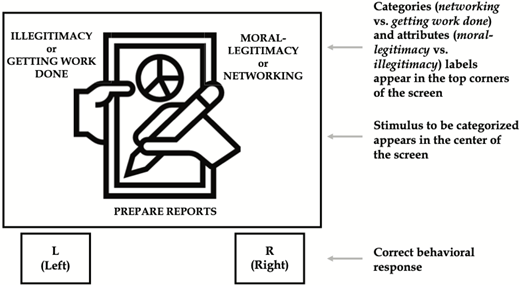
The first phase of our mixed-methods approach involved designing, administering and validating an IAT (Zlotnick et al., 2015; Bar-Anan, 2020). Widely used in psychology to detect implicit biases (Pritlove et al., 2019), our IAT assessed whether networking was perceived as illegitimate. Participants classified two categories – networking and getting work done (Table 1) – and two attributes – legitimacy and illegitimacy (Table 2). Faster response times indicated implicit associations toward networking’s legitimacy. Thus, an implicit association between networking and illegitimacy is inferred if participants classify these elements more quickly when paired together than when networking is paired with legitimacy.
The IAT consisted of seven stages (Table 3). In the first two stages, participants became familiar with stimuli and attributes, and classifying stimulus into left or right responses. Stages three and four combined categories and attributes, requiring participants to classify stimuli by sorting them into left or right responses (Figure 1). In stage five, the left-right positions were reversed and stages six and seven mirrored the earlier combined tasks with the new configuration. Response times in stages four and seven were analyzed to measure implicit associations.
We recruited 59 women managers through LinkedIn, based on their managerial background and demonstrated interest in leadership development, evidenced by their participation in women’s leadership programs (Martínez-Martínez et al., 2021). We identified these participants using a targeted hashtag search. Our participants are relatively homogeneous in terms of age, experience and organizational roles (Table 5).
Participants completed the IAT, starting with instructions to avoid distractions and to complete it in one session. They answered a seven-point Likert scale on explicit networking preferences before completing the IAT. We validated the IAT following Greenwald et al. (2003), analyzing effects, effect sizes and correlations between implicit and explicit measures, see Supplementary material. The validation aligned with prior studies (Greenwald et al., 1998; Talaska et al., 2008).
The IAT results (Table 4) show that 64% of participants had an implicit illegitimate attitude toward networking, 31% showed implicit neutrality, and only 5% displayed implicit legitimacy. Comparing implicit and explicit attitudes, four groups emerged. The first (31%) showed ambivalent attitude: explicit preference for networking but implicitly associating it with illegitimacy, implying an alignment between internalized organizational narratives with the networking myth as predicted by SDT. Eight women from this group participated in interviews. The second group (34%) displayed congruent explicit and implicit attitudes, associating networking with illegitimacy and expressing aversion toward it; five of them participated in interviews. The third group (31%) expressed explicit aversion toward networking but neutral implicit attitudes, with three joining the interviews. The final group (5%) displayed both explicit and implicit legitimacy toward networking but declined interview participation. Importantly, eight of the 16 interviewees displayed explicit preference toward networking and the other eight displayed explicit aversion toward networking.
3.2 In-depth interviews
In the second phase, we conducted post-IAT interviews aimed at engaging in reflective discussions about our interviewees’ perceptions and navigational challenges with networking prowess as a vehicle for reaching top management positions. The interview guide, developed through a literature review and team discussions, allowed for exploratory flexibility (Patton, 2014).
We conducted 16 virtual interviews via Microsoft Teams between November and December 2022 among a group of participants who completed the IAT. Participants, aged 39–52, work at both multinational and domestic organizations across industries, including male-dominated sectors like construction and IT and gender-balanced sectors like education. See Table 5. The sample reflected heterogeneity in attitudes toward networking, regardless of industry, suggesting that systemic inequalities persist throughout sectors within professional environments (Diehl et al., 2022).
Participants provided informed consent before participating. Each interview began with an explanation of the project’s objectives and the opportunity to raise any concerns. Interviews lasted between 45 and 80 min. Participants were then presented with their IAT results and explicit attitudes toward networking. Two authors transcribed the interviews, and the research team iteratively reviewed transcripts to identify and refine codes using thematic analysis (Braun and Clarke, 2012). These were collated into themes, ensuring alignment with the data through collaborative discussions. The analysis identified two overarching themes: delegitimizing networking (including the old boys’ network and the subordinate trap) and legitimizing networking (including casuistic self-justification and self-imposed higher standards; see Table 4 in Supplementary material). Table 6 summarizes the emerging sub-themes from the interviews, contextualized by the IAT results. The IAT results were not intended to be used as definitive results but as a tool to facilitate reflective discussions about implicit perceptions toward networking. Thus, even those who had an explicit preference for networking had the space to reflect critically on their implicit results and their networking experiences. Section 4 presents the different sub-themes.
4. Findings
Our findings support the theoretical argument that the networking myth is reinforced through organizational socialization processes, with women in management navigating between delegitimizing and legitimizing it. Next, we delve into these two navigational narratives.
4.1 Delegitimizing the networking myth: the exclusionary old boys’ networks and the subordinate trap
Interviewees described networking as a “non-merit-based pathway” (W13), underscoring its role in perpetuating inequities: “It’s not always who works the hardest who gets promoted” (W15). Interviewees actively challenge the networking myth: “I refuse to believe someone will get promoted just because they play golf with their boss” (W11). This challenge is informed by women’s recognition, in line with SDT, of their subordinate status within the corporate hierarchy.
Interviewees emphasized the exclusionary nature of the old boys’ networks as critical in questioning the legitimacy of the networking myth. Women tend to be completely unaware of these networks: “they meet for lunch once a month, but we had no idea this was happening, no one ever invited us to those lunches” (W16). They happen to know about their existence “by chance” (W2). When women are finally invited, their invitations lack sincerity or specificity: “‘whenever you want you can come,’ but it’s the typical vague invitation, nothing concrete” (W15).
Women are often excluded from these old boys’ networks due to entrenched gender biases and stereotypes. As W12 describes, there is an implicit assumption among men that women are not interested in participating: “[They say to each other] we’re meeting at the bar later to watch the match, and they don’t invite you. It’s as though the possibility of you being interested doesn’t even cross their minds.” These networks are typically informal and centered around traditionally masculine talk and activities, such as soccer (W16), biking (W5), running (W1), clubbing (W5) and even bullfighting (W1). “When they start talking about gaming, I inevitably find myself wondering, ’What can I add to this conversation?’” (W6). And, as W16 says, “these masculine topics create a sense of camaraderie among them and don’t necessarily make you feel included.” While exclusion can sometimes be subtle, at other times it is done quite overtly: “‘it’s a man’s business’, there is no place for you in there’” (W2).
Exclusion from the old boys’ networks denies women access to privileged information and influential colleagues, crucial for career progression (Socratous, 2018). “I’ve had several colleagues who went cycling with the CEO every Saturday, they keep talking about work. You miss out on a lot of information, which results in an uneven playing field” (W8). Similarly, W15 shared: “They go to the gym, they go for a beer, they engage in networking, and that leads to closed-door conversations about promotions. These men become more visible for such roles. In contrast, we, who aren’t present, tend to be overlooked or not considered for these opportunities.” W10 further explains the impact of this exclusion: “That guy is in cahoots with the president, so the president is not likely to place his bets on me.”
Interviewees reveal a striking ambiguity: when women engage in networking, they often pay a high price, as cross-gender networking requires them to adapt their behavior to male norms, leading to social costs such as being stereotyped, excluded or facing rumors and innuendos (Ng and Hau-siu Chow, 2009; Rua-Gomez et al., 2023). However, adherence to traditional gender roles solidifies women's subordinate position, too. We term this conflicting situation the subordinate trap. Although the subordinate trap resembles a double bind, the former focuses on external organizational practices and power structures systematically reinforcing women’s subordinate status, while the latter focuses on internal conflict arising from cultural expectations about how women should behave.
Women’s efforts in networking are not always valued, leading to professional stagnation: “When I asked for a promotion, my boss told me, ‘I want you here with me’” (W15). Moreover, when women attempted to network, they were relegated to fulfilling gender-stereotypical tasks, such as office housework involving taking notes or serving coffee (W8). These actions effectively place and maintain women in a subordinate status within the corporate hierarchy. Moreover, women often endure sexism when participating in networking activities such as being manterrupted (i.e. men interrupting women while speaking) and bropriating (i.e. their ideas co-opted by their male colleagues): “they constantly interrupt you, and once you manage to present a topic or idea, it’s as if they didn’t even hear you. Then, someone else repeats it, and he gets the credit instead of you.” (W8). “If you don’t speak as if you were super angry, no one pays attention to you, but if I raise my voice even slightly because they’re not listening to me, then I’m labeled hysterical. Or phrases like ‘you acted like a woman and not like a manager,’ which make you feel incredibly uncomfortable” (W13). In addition, women frequently face belittling language (e.g., “Martita” [1], W15) and even sexual harassment (e.g. “what a hottie! (when referring to a waitress),” W5); “you end up hearing inappropriate comments about your clothing or physical appearance” (W8). This language undermines women’s professional identity, erodes their sense of belonging and respect, fostering a hostile networking environment.
Women are often expected to stay in the office rather than participate in networking events, epitomizing the office-bound “worker bee” role (W5). As W15 was told “I need you to stay here, getting the work done.” This can be seen as a mechanism to “put women back in their place,” ensuring they remain occupied with tasks, preventing them from challenging existing hierarchical structures, under the expectation that women should be accommodating, helpful and focused on supportive tasks. Indeed, some felt entrapped “doing ant work” (W15), managing excessive menial tasks assigned to them. Women then navigate these challenges by working tirelessly: “We endure this out of a deep sense of duty in an experience akin to Stockholm syndrome” (W8). Yet, trying to “escape” these low-value tasks risks women being labeled as “prima donnas,” asked “not [to] complain,” and instead to “count [their] blessings” (W15). Furthermore, women’s dedication to their job and company is scrutinized if they contemplate leaving work early for a networking event. As W8 notes, “A man’s commitment remains intact if he leaves work early to attend a networking event. Yet, a woman’s commitment to the job is questioned for doing the same.” W4 faced stigmatization and was labeled an “opportunistic person” for her desire to engage in networking activities.
The subordinate trap is also experienced through the expectation of women prioritizing their personal life commitments. Particularly, women experience motherhood as a liability in the workplace in general: “Just because you have a baby, I never assumed you’d be interested in a promotion” (W14); and when engaging in networking in particular: “I had a woman colleague [with] three young children and they (men) didn’t count on her for anything” (W15). But if women try to decouple from motherhood, they face backlash: “the company penalizes you for being a mother, yet if you stay in an after-work, you are labeled a ‘bad mom.’ It’s a lose-lose situation” (W14). Another interviewee (W8) recounted a situation where her male colleagues were rewarded with a luxurious week-long yacht trip to Ibiza for their performance, while she, despite being the top performer, received a modest weekend retreat “with her kiddos”.
Our findings indicate that organizations contribute to the subordinate trap by endorsing gender-biased networking practices. Women’s contributions can be overlooked, even when they have done most of the preparatory work. W1 shared an experience where, despite doing all the groundwork, the final credit went to her male colleague who attended the networking events: “Many agreements were finalized at networking events where I was not allowed to attend and since I wasn’t present for those final moments, the credit didn’t go to me.”
By not being able to partake in networking events, women’s long-term opportunities for reaching top positions can be negatively impacted. Two of our interviewees reflect on this issue: “Suddenly, a man is appointed to a top management position, and you wonder: how did this happen? There wasn’t an open call, nor was the position advertised for people to apply” (W15). “Those more aligned with ‘the system’ had privileged access to information and, interestingly, it was them [men] who earned promotions with fewer merits than myself, or any other female colleague” (W8).
4.2 Legitimizing the networking myth: casuistic self-justification and self-imposed higher standards
Despite perceiving networking prowess as non-merit-based, riddled with gender biases, our interviewees pragmatically acknowledge the importance of engaging in networking as vital for professional advancement. In line with SDT, women – as members of the subordinate group – while aware of the systemic biases against them, may still participate in and uphold the networking myth to attempt achieving professional success within the constraints of the existing corporate hierarchy. Women’s legitimization of the networking myth is not an endorsement of its fairness but a recognition of its importance. This duality represents a subtle yet significant form of legitimization. Our research has uncovered that women’s endorsement of the networking myth is underpinned by casuistic self-justification and self-imposed higher standards.
Our interviewees articulate a process we term casuistic self-justification, key in reconciling their ethical concerns about networking with its strategic importance for career advancement. “It is difficult for me to engage in networking, but in the end, you have to force yourself to do it” (W4). Casuistic self-justification involves engaging in an internal dialogue to rationalize intention to participate in networking. “Talent does not have to do with hard skills, it has to do with networking” (W4). In addition, W3 notes that “over 70% of graduating students find employment through family or friendship contacts.” Official figures are closer to 56% (Instituto Nacional de Estadística, 2019). This internal negotiation helps women resolve the cognitive dissonance arising from participating in a system inherently unfair to them. “I’ve always seen networking as something negative, but I need to work on it […] I have to make a conscious effort to view it in a positive light because, deep down, I still associate it with opportunism […] But in reality, networking can be positive or negative depending on how it is used” (W9). Similarly, W14 expresses both skepticism and acknowledgment of networking’s value: “unconsciously I think networking does not add value to the company. But my conscious part says you must do it. It’s positive. It’s good for you, it’s good for the company, it’s good for everyone.” These shifts in perspective are not just a change of opinion, but a rationalization process encouraging women to engage in networking despite their initial misgivings about its fairness.
We also find some of our interviewees internalizing blame for their networking challenges, a phenomenon we term self-imposed higher standards. This reflects women’s propensity to attribute networking obstacles to personal shortcomings rather than to systematic barriers, inadvertently reinforcing the hierarchical status quo. “Sometimes I find it hard to make connections […] Clearly, it’s a personal issue of mine” (W13). W15 also mentions “[we] don’t consider networking as important; we don’t make room for it in our schedules or daily lives like men do […] we are victims of our own beliefs and roles” (W15). Faced with systemic obstacles in networking, women often shift the responsibility onto themselves, fostering a belief that their lack of success is due to not investing enough effort or not being good at networking: “in performance evaluations, my biggest weakness was always my difficulty in expanding my network, but the truth is, it’s just something I’m not good at” (W10). Consequently, they impose higher standards on themselves, believing that more rigorous effort and refined strategies are key to being successful in networking. This mindset leads women to proactively set more stringent personal standards to offset their own perceived deficiencies. For instance, one participant described “adopting a networking discipline, for example, by meeting someone for lunch every week” (W12).
This internalization inadvertently legitimizes the networking myth. Women tend to focus on individual efforts to “make the effort to be present and become visible, and actively ask for invitations” (W14), and “it’s important for senior management and the CEO to know you and for you to build relationships with them” (W5). In this manner, they endorse the notion that success in networking, and consequently in attaining top positions, is predominantly a matter of personal endeavor. Importantly, these self-imposed higher standards are not framed in comparison to male peers but rather emerge as an internal benchmark. “There’s a shift in mindset I know I need to make, but it’s something I struggle with. Networking isn’t just about building connections; it’s also about promoting yourself, creating your personal brand, and talking about your achievements. It’s not that I’m comparing myself to others. It’s about the expectations I place on myself, the feeling that I need to work harder, push myself more. It feels like an internal hurdle I need to overcome” (W15). Women view these self-imposed standards as necessary compensatory efforts to navigate a system systematically restricting their access to meaningful networking opportunities. By focusing on self-improvement in networking, women contribute to legitimizing the networking myth.
5. Discussion
In corporate hierarchies, women managers often occupy subordinate roles, navigating systemic barriers hindering their networking and thus, their professional growth (Greguletz et al., 2019). We conceptualize the reliance on networking prowess for obtaining top management positions, despite entrenched gender barriers, as a legitimizing myth: the networking myth. This practice undermines fairness and merit, threatening DEI in professional advancement.
This study makes theoretical, empirical and methodological contributions. Theoretically, it applies SDT to explain how women can legitimize corporate practices sustaining hierarchies. It conceptualizes networking prowess as a legitimizing myth and extends theories on networking as a gendered social practice embedded in norms and structures (Papafilippou et al., 2022). In addition, it highlights the value of examining subconscious attitudes in power relations and shifts the narrative from women’s personal deficiencies to systemic barriers (Bierema, 2005; Cullen-Lester et al., 2016). We also broaden SDT’s relevance beyond fields like education, sexual orientation and sports (Wells and Kerwin, 2017).
Methodologically, this study designs and uses an IAT as a pre-interview intervention (Marn and Wolgemuth, 2016), followed by reflective interviews (Nardon et al., 2021). This mixed-methods approach enabled discussions moving beyond conventional narratives to uncover systemic disadvantages women face as subordinate group members. By focusing on women managers, the study amplifies marginalized voices and provides a detailed exploration of gendered power structures in networking.
Empirically, our study shows that women tend to legitimize practices sustaining their subordinate roles through organizational socialization, as posited by SDT. Women hold dual perceptions of networking: rejecting it as exclusionary due to the old boys’ networks and subordinate trap yet internalizing it via casuistic self-justification and self-imposed higher standards. Despite these strategies, the networking myth perpetuates gender imbalances in top management by constraining women’s agency and career advancement.
Finally, we call for reevaluating networking’s role by formulating an attenuating myth, as proposed by SDT (Pratto et al., 2006). This step is vital to fostering ethical, equitable and inclusive corporate environments and detailed in the next section.
6. Practical implications
Given the challenges women face in navigating networking, eliminating networking-based practices altogether might seem ideal, but its ubiquity in top management makes it impractical (Allemand et al., 2022; Cullen and Perez-Truglia, 2023). More feasible is to gradually reduce reliance on networking through incremental steps, from objective, merit-based promotion criteria to transformative measures, like quotas. These strategies address both the structural barriers and the organizational practices underpinning the networking myth, paving the way for more equitable and transparent career advancement.
SDT proposes attenuating myths to counter legitimizing myths (Pratto et al., 2006). Thus, our attenuating myth is based on a DEI framework to address structural barriers in networking. By emphasizing ethical concerns about networking’s exclusionary effects, this framework can transform organizational practices toward greater inclusivity (Waples and Botsford-Morgan, 2023). This can be achieved by replacing the belief that networking success equals merit with a narrative prioritizing fairness, transparency and equity.
First, we propose dismantling women’s subordinate roles within workplace interactions. Organizations should establish protocols ensuring equitable participation and visibility, such as enforcing clear guidelines to prevent women from being categorized as office housekeepers, overlooked and interrupted during meetings (Heath and Wensil, 2019). Strengthening leadership identity, as proposed by Ely et al. (2011), can help women articulate their contributions more confidently, but this must occur in environments where those contributions are equally valued and heard. These measures can help create more inclusive environments, mitigating the subordinate trap.
Second, steps should address systemic barriers in performance evaluations, leadership criteria, and information flows. Human resource managers should ensure that evaluation systems do not penalize modesty or collaborative language, and that diverse communication styles are equally rewarded (Greguletz et al., 2019). Simultaneously, formal information-sharing channels must be established to ensure equitable access to strategic knowledge, reducing reliance on informal networking.
Next, mentoring programs and leadership development initiatives should not place the responsibility for change on women. Instead, they should focus on helping participants interpret their experiences as shaped by systemic barriers, not personal deficits; reflect critically on internalized obstacles such as self-imposed high standards; and negotiate leadership identities that align with their values, not merely organizational expectations (Ely et al., 2011). Practical modules, like role-playing for male-dominated spaces or workshops on sponsor relationships, can contribute to building alternative, inclusive networking narratives that challenge, rather than reinforce, dominant norms.
Gender barriers, particularly those tied to power dynamics and the negotiation of authority, are politically sensitive issues (Prasad and Sliwa, 2024) requiring careful consideration when designing attenuating myths. While DEI initiatives are compelling, they often face resistance, especially from conservative leadership (Foss and Klein, 2023). Apfelbaum et al. (2012) highlighted a paradox: ignoring group differences perpetuates systemic barriers, yet some subordinate groups members can resist DEI policies fearing seen as tokens (Watkins et al., 2019). Transparent, merit-based selection processes can replace networking-based hiring practices. However, while meritocracy can counteract the networking myth and social capital-based inequalities, it risks becoming a legitimizing myth itself, masking structural barriers such as economic inequities and discrimination, reinforcing the illusion of equal opportunity (Clarke et al., 2024).
To tackle entrenched biases and promote gender equity, organizations must ensure transparent promotion processes are documented and systematically enforced through accountability mechanisms. Managers should justify promotion decisions via structured reporting, reducing the risk of informal biases (Ibarra et al., 2013). External audits and anonymous employee surveys can uncover gaps between policy intentions and realities. Delegating hiring and promotion decisions to independent teams or recruitment agencies can further minimize the role of the old boys’ networks.
Finally, the most transformative step includes regulatory measures to eliminate reliance on networking. Board gender quotas, for example, mandate gender-balanced representation with enforceable penalties like financial sanctions, annulment of non-compliant appointments or stock market delistings (Mateos de Cabo et al., 2019). For fairness, quotas should also limit the number of positions directors can hold, preventing the golden skirts or golden trousers phenomenon, where a few women or men occupy multiple board seats (Seierstad and Opsahl, 2011).
7. Limitations and future research
This study provided insights into the networking myth and its implications for women in management, but certain limitations remain. First, our study approached the networking myth as a framework to understand how women experience and navigate corporate hierarchies, but it did not empirically validate or disprove the myth itself. Future research could complement ours through longitudinal studies testing networking’s structural impacts and applicability across contexts.
Second, the IAT’s validity in measuring implicit biases versus broader cultural factors is debated (Hillard et al., 2013). In this study, we used the IAT as a pre-interview intervention, rather than as a measure of bias, to stimulate reflections on women’s perceptions toward networking (Nardon et al., 2021). Future research could apply this methodology to other contexts where social conditioning shapes behaviors and attitudes, providing insights into inclusion and exclusion mechanisms.
Third, our participants, women managers enrolled in a leadership program, were actively engaged in networking activities, offering valuable insights. Future research could explore the experiences of women who exited the corporate ladder or did not advance to top management, enriching our understanding of the barriers and opportunities in career progression.
Fourth, while we used SDT to conceptualize power structures in networking, its focus on gender dominant and subordinate groups (Sidanius and Pratto, 1999) may oversimplify power’s multifaceted nature. Corporate hierarchies also involve relational, symbolic, and intersectional dimensions (Dennissen et al., 2020). Future research could explore how identity recategorization (Contreras et al., 2024) enables women leaders to navigate, challenge and reshape networking norms within corporate hierarchies.
Finally, while we focus on women’s perspectives, future research should also examine dominant group viewpoints, particularly men’s, to better understand how the networking myth sustains gender disparities. This includes analyzing how men network and how dominant informal norms uphold exclusionary systems. Social dominance orientation (SDO) (Ho et al., 2015), reflecting preferences for hierarchical structures, could explain resistance to diversifying networking opportunities. Research might use SDO measures to explore whether high-SDO individuals in power perceive women’s inclusion in networking as a threat to their status.
Note
Martita can be translated as little Marta.
References
Further reading
Supplementary material
The supplementary material for this article can be found online.