The purpose of this paper is to examine whether reputation element affects the decision relative performance of trust, bonus and incentive contracts using social laboratory experiments.
The study conducts the following lab experiments bonus–incentive treatment without reputation, bonus–incentive treatment with reputation and trust–incentive treatment with reputation.
The study finds that the reputation and fairness concerns, in contrast to self-interest, may have a decisive impact on the actual and optimal choices in the reciprocity-based contracts. The principal pays higher salaries in the bonus contract as compared to an incentive contract.
The study contributes to the behavioral economic literature in the following dimensions. The existing literature on lab experiments considers a bonus contract as better than the debt contract; however, it does not consider the trust contract better than the debt contract.
Introduction
Self-interest is the basic instinct of human being that is developed in the very first year of life. A child in the first year is characterized by basic needs, such as food, hydration, sleep and security that are pursued due to self-interest (DeLisi and Vaughn, 2016). However, according to DeLisi and Vaughn (2016), with the passage of time, the language and receptive skills enable the child to communicate sophistically and in an appropriate way. The sense and responsibility that a cooperation mitigates much of the anger and aggressive behavior are adopted in the early childhood. It turns into the more sophisticated idea of rewarding a fair behavior and punishing unfair behavior, defined as reciprocity (Alexander, 1987)[1]. According to (Gouldner, 1960, p. 161), reciprocity exists in all societies both at the micro- and macro-levels, for instance, at collective level people vote for parties that promise to transfer a fraction of income from better off to the less well-off. Likewise, the influence of reciprocity and fairness in the market is recognized. In fact, the notion of whether the reciprocity and fairness can influence the market outcomes dates back to some prominent economist (Hicks, 1932; Marshall, 1890; Slichter, 1929) and the recent researchers (Falk et al., 2006; Fehr et al., 2007). The existence of reciprocity can have important implications, such as in the labor market the minimum wage or the involuntary unemployment (Akerlof, 1982; Akerlof and Yellen, 1990; Falk et al., 2006). According to Fehr et al. (2007), the reciprocity has important implications for the financial contracts.
According to the literature, the characteristics of fairness, reciprocity and reputation prevails in a considerable proportion of the society (Fehr et al., 2002, 2007; Fehr and Gächter, 2000; Gintis et al., 2008). Therefore, the theory of self-interest alone cannot be relied on in explaining situations where the decision makers believe and act reciprocally (Bowles and Gintis, 2000; Dellarocas et al., 2004; Halali et al., 2014; Walgrave, 2013). For instance, according to Bowles and Gintis (2000) and Fong (2001), the existence of welfare state in which the wealth from the wealthy individuals is transferred to individuals with fewer resources is based on the existence of reciprocity. Otherwise, if it were for the self-interested individuals – the political parties that endorse the policies of collecting wealth from the better off and distributing it among less well-off – would never have acquired a chance in government.
The reciprocity is excelled in the presence of reputation. The importance of reputation is realized in the debt contract literature, in which banks as delegated monitors screen out bad borrowers (Diamond, 1984, 1989). However, it has not been explored yet in the equity contract. According to debt advocates, the borrowers in the debt contract avoid moral hazard and cheating because of the borrower’s care about their reputation in the market. Keeping in view the banks as delegated monitors, the borrowers in need of funds would care about their reputation in the equity contracts as well. In the context of lab experiments and for the purpose of comparison, the bonus and trust contracts are used as a proxy for the equity contracts, whereas the incentive contract is used as a proxy for the debt contract.
It is true that bonus and trust contracts are widely used for examining the employer–employee relationship; however, the commonality of themes such as agency and moral hazard problems makes the contracts appropriate for the financial contracts too. For instance, the employer requires the employee to work at his best, whereas the employee by putting higher effort and time has to forego the leisure. Thus, the employee gets involved in shirking. The inability of employer in catching shirking brings agency problems and moral hazards in the picture. This is exactly what happens in the financial contracts. The incentive contract represents debt contract perfectly. For instance, in the incentive contract, the employer induces employee toward higher effort by imposing fine in the case of failing to choose required or higher effort. Likewise, in the debt contract, the lender legally obliges the borrower to ensure interest payments regardless of the financial position to the extent that in case of cheating, the lender gets hold of the project and may impose fine or penalty on the borrower.
The equity contract is, however, a little complicated in nature. For instance, in the equity contract, the lender or equity holder cannot impose fine or penalty for inducing borrower toward required level of effort. Therefore, the lender appeals borrower’s reciprocity by sharing risk. The trust contract ideally represents equity contract such that the principal in the trust contract offers higher wages and expects the highest effort level; however, at the same time the principal submits to accept any effort level. This is but half of the story because in the equity contract the borrower appeals lender’s reciprocity by putting the highest effort and desires to be chosen again in the future. This idea is incorporated in the bonus contract in which the lender promises bonus to borrower in reward for choosing the effort level above required level. Thus, in the trust contract, the lender appeals borrower’s reciprocity, whereas in the bonus contract, the borrower appeals lenders reciprocity. It would be interesting to see how the incentive, trust and bonus contracts perform in the repeated interactions or in the presence of reputation.
This study is based on the experiment setup of Fehr et al. (2007) who examined and demonstrated the reciprocal behavior by comparing trust and bonus contracts with the incentive contract. Fehr et al. (2007) conducted two separate treatments, that is, the bonus–incentive and trust–incentive treatment. According to Fehr et al. (2007), the bonus contract performs better than the incentive contract in the bonus–incentive treatment. However, the incentive contract performs better than the trust contract in the trust–incentive treatment. Fehr et al. (2007) performed the experiments without reputation, for instance, the participants were interacting randomly. However, what if, the participant were to interact with the same partner throughout the experiment such that they retain the information about the previous choices. According to Diamond (1989, 1991), reputation formation over time mitigates the conflict of interest between borrowers and lenders. In the presence of reputation, borrowers choose safe projects. Diamond’s (1989, 1991) implications are for the incentive contract and are particularly relevant to monitoring issue. The reputation mitigates the conflict of interest between borrowers and lenders and improves monitoring; therefore, it could be of interest in the bonus–incentive and trust–incentive treatment.
In order to investigate the role of a reputation for the bonus–incentive and trust–incentive, we conducted the following lab experiments: bonus–incentive treatment without reputation, bonus–incentive treatment with reputation and trust–incentive treatment with reputation.
The results are interesting, for instance, in contrast to Fehr et al. (2007), both the bonus and trust contract outperform incentive contract in the bonus–incentive and trust–incentive treatments, respectively. Moreover, all the three contracts (i.e. bonus, incentive and trust contracts) performed better in all aspects that include average demanded effort and wages paid to the employee.
This study generally contributes to both the existing literature of employing laboratory experiment to measure reciprocal, reputation and fairness elements in the contract and the literature of equity–debt contracts. The current paper innovates by examining the relationship between equity contract and the agency and moral hazard problems using laboratory experiments. The current research extends the seminal work of Fehr et al. (2007) by exploring the role of reputation in the incentive, bonus and trust contracts. Finally, we contribute to the debate on equity–debt contracts in the Islamic finance. The advocates of Mudarabah contract consider it to be better for welfare as compared to debt contract (Chapra, 1992, 2009; Siddiqi, 2006). However, the fairness and reciprocity in solving the agency problems in the financial contract have not received the due attention. The results can help in enforcing banks to choose safe and reliable entrepreneurs. For this purpose, the Islamic banks are expected to enhance their abilities as delegated monitors.
Methodology
Experiment setup
The term laboratory experiments have always been taken in one breathe with basic sciences. In the past two decades, the concept of using laboratory experiments in the social science has emerged, particularly in the psychology. Likewise, laboratory experiments have accelerated in the economics particularly in understanding the characteristics of fairness, reciprocity, public goods and electoral process (Falk and Heckman, 2010). There is, however, a criticism that the students selected for the social experiments may be based on the biased preferences or the students who choose not to participate may reveal different results if they choose to participate. Nevertheless, Falk et al. (2013) concluded that such problems are not a major issue in the laboratory experiments. Moreover, the motive to maximize profit and unrevealed identity as observed in these experiments mitigate these concerns.
The lab experiment involve undergraduate students from the various fields of studies who interact through interaction forms used in a variety of situations (Ben-Ner et al., 2004; Berg et al., 1995; De Cremer and Van Lange, 2001; Fehr and Gächter, 2002; Halali et al., 2014; Milinski et al., 2006; Walker and Ostrom, 2009).
A fixed amount of money is distributed among the students in the form of tokens, where 1 Token=0.20 cents. The experiment involves ten trials and in each trial, the lender in the first step choose a bonus (or trust) or the incentive contract and choose a demanded level of effort. In the second step, the entrepreneur (or borrower) either accepts or rejects the contract. In case of accepting the contract, the borrower chooses an effort level in response to lender’s demanded effort level. For instance, the agent consumes effort , he/she generates a gross profit of v(e) for the principal following (Fehr et al., 2007). However, the agent incurs a private cost “c(e)” measured in monetary terms with c(e)=0, c'(e)>0, and c''(e)⩾0. Let denote the unique first best efficient effort level that maximizes v(e)–c(e). According to Fehr et al. (2007), gross profits and effort costs cannot be contracted upon. Both parties observe the agent’s effort level, but to contract on effort, it has to be verified by the courts. At Date 0, before the agent chooses “e,” the principal can invest in a verification technology at a fixed cost “k” that permits partial verification of effort. However, the verification is not perfect, even if the agent is involved in cheating, the court is able to catch the cheating with the probability of “p=1/3” and a fine of “f” can be imposed in this case. It is profitable for the a risk neutral agent to shirk such that the provided that the . In this case, the expected punishment is less than the cost of effort that is c(e). The expressions for expected monetary payoffs of principal and agents are borrowed from Fehr et al. (2007), see Table II, p. 128.
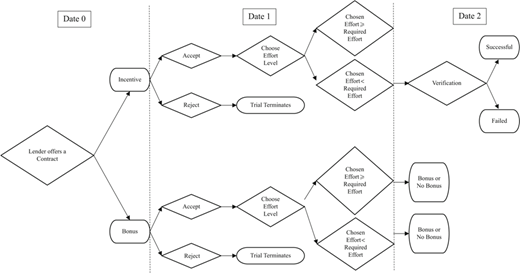
In our experiment, the timing of the experiments is as follows. At Date 0, as shown in Figure 1, the principal decides whether to offer an incentive contract or bonus (trust) contract by using interaction form. The interaction form at Date 1 is then given to an agent who either accepts or rejects the contract. In case of rejection, the trial ends and both the principal and agent wait for the next trial, whereas, in case of acceptance, the agent chooses an effort level. At Date 2, the interaction form is brought back to the principal. In case of the incentive contract, the principal has a choice of verifying the entrepreneur’s shirking if the entrepreneur is observed to have cheated. In the trust contract, the principal has no choice but to accept, whereas, in the bonus contract, the principal has a choice of either not to fulfill the promise or to fulfill the promise.
Results and discussion
Trust–incentive treatment
The reputation in the trust–incentive treatment affects the outcomes, and the results are different from the trust–incentive treatment without reputation. In order to examine whether the reputation affects the performance of trust and/or incentive contract, we conducted trust–incentive treatment in which principal choose between a trust contract (w, e*) and an incentive contract (w, e*, f) by keeping the interacting pair constant in all trials. There were a total of 100 contracts in 10 trials. Of 100 contracts, 24 contracts were rejected in a total of which the trust contracts were 15, whereas the incentive contracts were 8. The results indicate that trust contract performs better than the incentive contract in terms of share of a contract, average payoff to principal, average demanded effort, average effort, average paid bonuses, number of acceptance, number of non-shirking cases and average maximal fines. This result is opposite to the only study of Fehr et al. (2007) without reputation who found incentive contract is better in terms of characteristics as previously mentioned.
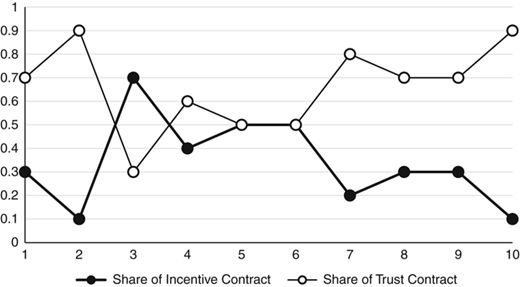
Figure 2 illustrates that a clear majority of the contracts are trusted contracts. For instance, as in Figure 2 – that depict the share of trust and incentive contracts from Trail 1 to Trail 10 – the share of trust contract is higher in the first two trials before falling in the third trial as shown in Figure 2. However, due to the reputation, the principals start offering trust contract again that increases substantially over time. To the extent that in the tenth trial the share of trust contracts is 90 percent, whereas the incentive contracts’ share remains 10 percent. This result is in contrast to Fehr et al. (2007) trust–incentive treatment without reputation.
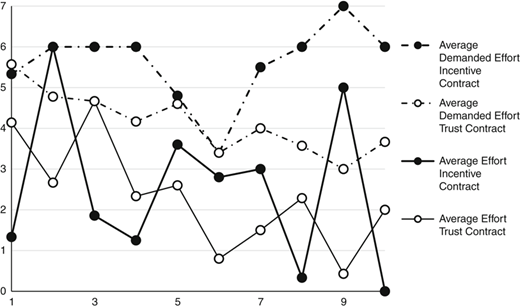
The dominance of the trust contract or incentive contract can further be assessed by observing the average effort and average principal payoffs. We found that the average demanded effort in the trust contract with reputation contract decreases over time. To the extent that in the last trials the demanded effort, e* is less than 4, which shows improvement in the trust contract because demanded effort less than 4 is convenient for the agents. As previously mentioned, demanded effort 4 is an apprehensible effort in the self-interest model. However, in the case of incentive contract, the demanded effort increases over time that suggests that overtime, principal fails to realize the apprehensible effort. In contrast, Fehr et al. (2007) found that the average demanded effort in the trust contract without reputation increases over time. This implies that trust contract without reputation performs poorly as it leads to rejection of contract by entrepreneurs.
Table I compares the trust and incentive contracts in terms of average principal payoff, no-shirking cases, number of rejections and the association between wages and principal payoffs in order to evaluate their performance further. Panel “A” in the third column indicates that the average principal payoff under trust contract is higher than the average principal’s payoff in the incentive contract at low 2.32 (0.75), medium 10.5 (9.25) and high 27.31 (11.5) wage levels. This implies that as the wage increases, the increase in principal’s payoff in the trust contract is higher than the principal’s payoff in the incentive contract. The principal’s payoff is a function of effort chosen by agents; therefore, higher efforts chosen by agents are associated with higher payoffs to the principal. The agents in the trust contract choose higher effort that increases the principal’s payoff. This indicates that a considerable portion of the subjects possesses reciprocity and fairness.
Our results are different from Fehr et al. trust–incentive treatment without reputation in which the principal payoffs are not only negative but decrease with the increase in wages. For instance, the principal’s payoff in the trust contract for the low, medium and high wages are 3.7, −1.0 and −6.4, respectively. Likewise, in the incentive contract, the principal’s payoffs for low, medium and high wages are 8.5, 9.8 and −20, respectively. This suggests that in absence of reputation or in the single-shot game in which the subjects interact once the incentive and trust contracts fail. This is because in the incentive contract given that the probability of catching shirking is low; therefore, the agents have the incentive to cheat, whereas, in a single-shot trust contract, the agents who do not believe in reciprocity affect results and, thus, induce agents toward shirking.
Focusing on the shirking and no-shirking cases, Columns 4 and 5 indicate the number of cases in which the entrepreneur shirks or does not shirk. In case of shirking, the agents choose the lowest effort level 1 for which the cost is 0. Generally, in the trust contract, the agents shirk less with the increase in the wages, whereas, in the incentive contract, the agent shirk more with the increase in the wages. For instance, the number of shirking for the low and high wages in the trust contracts (incentive contract) are 8 (4) and 3 (8), respectively. This indicates that there exists a considerable population of individuals who believe in the reciprocity. The reputation makes it possible for them to act reciprocally by reducing the strength of individuals who do not believe in reciprocity.
The number of rejections for the trust and incentive contracts are given in the Columns 6 and 11. In the case of trust contract, the number of rejections declines with respect to increase in wages, whereas, for the incentive contract, the number of rejections increases with respect to increase in the wages. Intuitively, the increase in wages should increase employment because labors tradeoff leisure for a higher wage. In contrast, in the case of an incentive contract, the entrepreneurs prefer trust contract.
In addition, the trust contract supersedes the incentive contract in trust–incentive treatment with a reputation in the following ways. In the trust contract, the higher the wage rate offered by the principal or the lender, the lower the rejection rate by the entrepreneurs. However, in the incentive contract, the higher the wage rate the higher the rejection rate.
Intuitively, higher wages induce labors to tradeoff leisure for the job; however, in the case of incentive contracts, the higher wages induce labors toward more leisure. This could be due to undue pressure of fine or penalty.
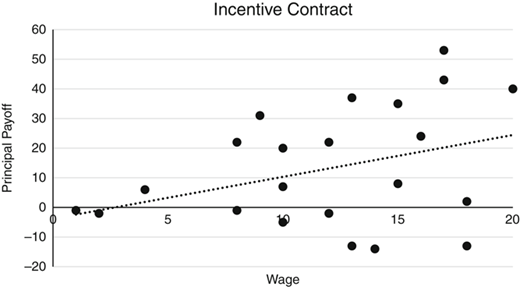
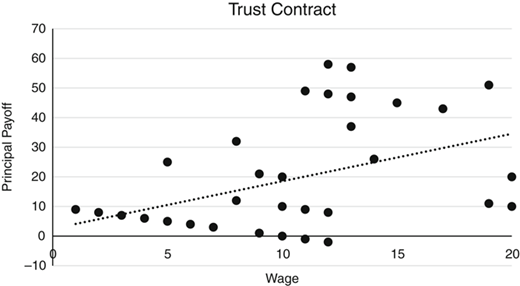
Finally, we focus on the wages, the principal’s payoffs and their relationship. First, the collective payoff to principal in the trust contract is 40.13 compared to 20.75 in the incentive contract. In contrast to Fehr et al. trust–incentive treatment without reputation, in our experiment the principal payoff is higher in the trust–incentive treatment with reputation. This implies that both the trust and incentive contracts perform better with the reputation. Second, there is a positive relationship between wage level and principal payoff as shown in Figures 3 and 4. In order to confirm the relationship, the regression results are shown in Table II.
Now, we turn to self-interest model that predicts the principal payoff MP to be 26. However, the principal’s payoff in the incentive contracts for a low, medium and high wages is 0.75, 9.25 and 11.5, respectively. This contradicts the self-interest model, which implies that incentive contract with a reputation does not comply with the self-interest model predictions. This implies that in the individual trials the individuals might follow the self-interest model but in a series of trials the individuals deviate from the self-interest model. Moreover, the self-interest model predicts the maximal fine to be closer to 13; however, we observed the maximal fine to be 7.63. As for the trust contract, the average principal payoffs for the low, medium and high wages are 2.32, 10.5 and 40.13, respectively. This is consistent with the reciprocity that implies that the entrepreneur with reciprocity characteristic responds by higher effort level that directly increases the principal payoff.
Figure 5 shows the average demanded effort and average effort in incentive and trust contracts. The average demanded effort for the incentive contract exceeds the maximal enforceable effort e*=4. However, the average demanded effort for the trust contract decreases overtime to the extent that it decreases below than 4 (i.e. e*=4)[2]. This is because in the incentive contract, there is a fine. With reputation, if the principal demands higher effort level from the entrepreneur with fine, the entrepreneurs or agents tend to cheat. This is because with the low probability of catching shirking, entrepreneurs have the incentive to cheat. In contrast, the trust contract has no fine. Hence, with reputation, when the principals demand lower effort level with no fine, this appeals to the reciprocity of entrepreneurs or agents. In other words, the agents reciprocate by choosing the effort demanded by the principal.
Bonus–incentive treatment
The bonus–incentive treatment differs from the trust–incentive treatment due to an additional option. In bonus contract, the principals announce a (non-binding) bonus. The principals, if satisfied, pay the agents a pre-announced bonus. However, it is noticed worthy that for the principals may not pay the bonus even though chosen effort might be higher than the demanded effort. In this sense, a bonus contract is a special form of trust contract in which the bonus is zero. For instance, in a bonus contract if the bonus is zero, the lender’s reciprocity is not appealed as in the trust contract.
In a bonus–incentive treatment without reputation, there were a total of 100 contracts in which 15 were incentive contracts and the remaining 85 were bonus contracts. Out of 15 incentive contracts, 8 were rejected by the entrepreneur and out of 85 bonus contracts, 13 were rejected[3]. In the bonus–incentive treatment with a reputation, a total of 120 contracts were offered. Out of which, the incentive contracts were 30 and the remaining 90 were bonus contracts.
The results show that in all the case, the share of bonus contracts is in clear majority. However, in the interest of space, the figures are omitted. The difference is, however, the stability in the bonus–incentive treatment with reputation compares to bonus–incentive without reputation given in the Panel A. In the bonus–incentive treatment with the reputation, the principals start offering bonus contacts after Trail 4 and the share of contract at the highest level consistently, whereas, in the bonus–incentive treatment without reputation, although the share of bonus contract never decreases below incentive contract, the share of bonus contract keeps changing till the last trial. This implies that reputation helps in stabilizing the principal–agent relationship.
Table III contains results for bonus and incentive contract with and without reputation in terms of average principal payoff, no-shirking cases, number of rejections, the association between wages and principal (see Footnote 3). In the without reputation case, Panel A, in the third column, indicates that average principal payoff under bonus contract is higher than the average principal’s payoff in the incentive contract as low 6.73 (2.5), medium 8.31 (−0.11) and high 21.14 (−6) wage levels. This implies that in bonus–incentive treatment without reputation with the increase in wage level the principal payoff in bonus contract increases, whereas the principal payoff in incentive contract decreases with the increase in wage. As the principal’s payoff is a function of effort chosen by agents, higher efforts chosen by agents are associated with higher payoffs to the principal. The higher principal payoff for the bonus contracts indicates that the agents in bonus contract choose higher effort that increases the principal’s payoff. The incentive contract contradicts the macroeconomic wisdom because with the increase in wages not only the labors who chose not to work enter the market, but the existing labors work more efficiently. Furthermore, in the 15 incentive contracts, the collective principal payoff is negative that is −3.61. Thus, due to reciprocity the market returns, sum of wages and profits to lenders are higher in the bonus contract as compared to an incentive contract that is not based on reciprocity.
Focusing on the number of shirking cases, the fourth and fifth columns show the number of shirking and non-shirking cases. The only caveat in the results for the bonus contract is that the number of shirking cases is considerably higher for the low and medium wage levels. One of the reason could be the fact that the bonus–incentive without reputation was conducted in two sessions due unavailability of students in one session. In the first session, we conducted the experiment with ten students and again advertised for the experiment for the second session. The number of shirking cases for the low and medium wage levels is 22 and 37 that are more than the 50 percent contracts offered for the low and medium wage levels. However, for the higher wage level, the number shirking cases declined to only three cases that implies and strengthens the argument that with higher wages the number of shirking decreases if there exist a considerable number of individuals who believe and act reciprocally. For the incentive contract, although the number of shirking is less, the trend of initially increasing and then declining mimics the bonus contract. Moreover, the number of rejections decreases with the increase in wage levels. However, the number of rejections is more than 50 percent of the total offered contracts.
Although the bonus contract supersedes incentive contract in bonus–incentive treatment without reputation, the bonus contract performs even better in the bonus–incentive treatment with reputation. For instance, the third column of Panel A indicates that average principal payoff in the bonus contract increases with the increase in wage levels such as 3.79, 18.84 and 25.62 for a low, medium and high-level wage, whereas the increase in average principal payoff for low, medium and high wage levels for the incentive contract are 0, 10.67 and 11.2, respectively. Clearly, the increase in bonus contract in treatment with a reputation not only supersedes incentive contract but also the bonus contract in treatment without reputation. This is because in a bonus–incentive treatment with reputation, the principal and agent remain the same and they retain the memory of previous trials. A kind or hostile action is replied instantly in the following trials. As discussed earlier, the principal’s payoff is a function of effort chosen by agents; therefore, higher efforts chosen by agents are associated with higher payoffs to the principal. Moreover, in a single-shot game, the payoff to principal and agent might not be relevant in a trial; however, in a treatment with reputation, the decision is conditional upon the previous choices. Finally, the collective payoff in bonus–incentive treatment with a reputation (69.72) is more than twice the collective payoff in the bonus–incentive treatment without reputation (32.58).
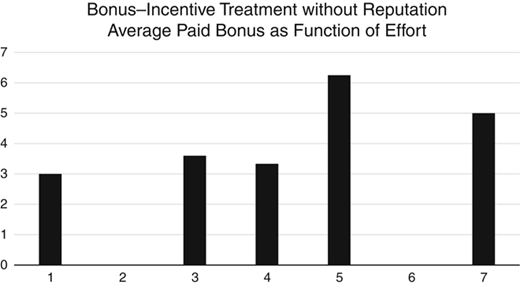
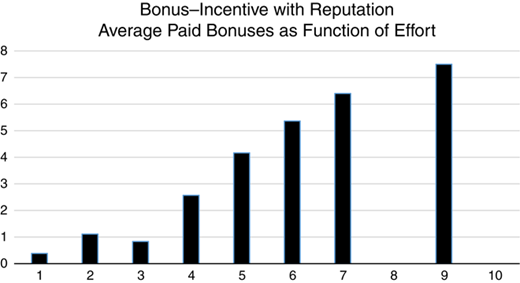
The bonus–incentive treatment with reputation performs better than bonus–incentive treatment without reputation in terms of shirking cases. The shirking and non-shirking cases are given in the fourth and fifth columns of Table III. Although the number bonus contract in the reputation treatment increases from low to medium levels, unlike the bonus contract in treatment without reputation, the number non-shirking cases increase with the increase in the wage level. The non-shirking cases in the incentive contract, on the contrary, decrease with the increase in wages. Collectively, the number of rejections is higher in the incentive contract as compared to a bonus contract. Finally, as shown in Figures 6 and 7, the paid bonuses increase with the increase in effort in the case of bonus–incentive treatment with reputation, whereas, in the bonus–incentive treatment without reputation, the relationship is not clear.
Conclusions
Reciprocity plays an important role in the contracts in the presence of players that are fair-minded and believe in reciprocal actions. The two contracts, bonus and trust contracts are based on reciprocity, and therefore, they should be optimal in the presence of fair-minded players. In the seminal work of Fehr et al. (2007), it is shown that bonus performs better than the incentive contract; however, the trust contract does not perform well. In this study, we examined and compared the bonus and trust contract with the incentive contract in both with and without reputation treatments. The results for the without reputation are consistent with the earlier study. However, the results for treatment with reputation show improvement in the following aspects. First, in all the three contracts, the average effort level, average wage, averagely paid bonus and principal payoff are higher. Second, the trust contract outperforms incentive contract in all the mentioned aspects. Finally, the bonus contract performs better than the incentive contract.
The authors gratefully acknowledge Universiti Kebangsaan Malaysia for the research grant GUP-2016-002 and the use of facilities of the Department of Economics.
Notes
For instance, in the toddler example, the mother who nurses is an ideal example of reciprocity (Kurzban et al., 2015).
The induction of effort level above e=4 is not profitable in incentive contract because the percentage of fair agents is too small to render this profitable.
The bonus–incentive treatment was conducted in two sessions on different dates because of the unavailability of the students. The first session was conducted on June 2, 2017, whereas the second session was conducted on June 11, 2017.