


An increasingly digitized banking market needs agentic consumers. Although many customers intend to switch banks, annual churn rates are considered low by policymakers. A possible explanation for this intention–behavior gap is that customers lack the necessary mastery beliefs when switching banks becomes a digital-only process. This article examines the effects of customer satisfaction, bank-switching intention, and bank-switching self-efficacy enhancement in relation to bank-switching behavior in a digitized market.
A longitudinal study that uses moderated mediation analyses and logistic regression analyses to examine how satisfaction, bank-switching intention, and self-efficacy enhancement may explain and predict mortgage bank-switching behavior 12 months ahead (n = 272).
Customer satisfaction was significantly associated with bank-switching intention. Intention significantly predicted bank-switching behavior with a large effect (Cohen's d = 1.21). Self-efficacy enhancement increased switching behavior 12 months ahead among consumers with weak switching intentions. Consumers with moderate to strong intentions were less affected. The effect of satisfaction on behavior operated indirectly through intention. Increasing self-efficacy enhancement dampened the mechanism through which satisfaction impacted switching behavior through intention.
Customers with strong switching intentions had a higher predicted churn rate than customers with weak switching intentions did. However, among consumers with weak switching intentions, the model predicted an annual churn rate of 5.4% if they also had a high score on bank-switching self-efficacy enhancement, compared with a meagre 0.5% if they had a low score on this index. These findings suggest that increased churn in the banking market can be achieved through two distinct policy approaches: Measures that strengthen consumers' switching intentions and initiatives that contribute to enhancing consumers' self-efficacy when switching banks.
This article contributes to the literature by employing a longitudinal design to examine the effects of satisfaction, intention, and self-efficacy enhancement on partial switching behavior in banking, utilizing a sample representative of the adult population in a highly digitized market.
Abbreviations
1. Introduction
Many banking customers report that they intend to switch banks, yet annual switching rates remain low across European markets (Bortne et al., 2024; European Commission et al., 2020; Steinkjer, 2024). This discrepancy between what customers say they will do and what they actually do represents an intention–behavior gap (Conner and Norman, 2022; Sheeran and Webb, 2016).
Meta-analytic evidence indicates that intentions account for merely 28% of the variance in behavior (Sheeran, 2002), and the gap appears pronounced in banking, where customers frequently remain with their current providers despite the availability of better alternatives (Howorth et al., 2003; Panther and Farquhar, 2004).
Understanding why this gap persists is important for both theory and practice: Policymakers rely on active consumer switching to promote competition, and an increasingly digitized banking market requires agentic consumers capable of navigating new digital platforms and services (Mende et al., 2024; Wünsch et al., 2023).
Important methodological gaps further motivate the present study. Most bank-switching studies rely on cross-sectional designs, which cannot establish temporal precedence or rule out reverse causality (Andreß, 2017), and calls for longitudinal panel studies in consumer behavior research have gone largely unanswered (Chintagunta and Labroo, 2020; Mende et al., 2024). This article addresses these gaps by testing the above hypotheses using a longitudinal panel design. We employ a moderated mediation model in which satisfaction indirectly predicts behavior through intention, and in which self-efficacy enhancement moderates the intention-to-behavior path. Using data from a representative sample of Norwegian mortgage customers (n = 272) surveyed at two time points 12 months apart, we use moderated mediation analysis (Hayes, 2018) and logistic regression to estimate the predicted switching probabilities.
The study makes three contributions to the bank-switching literature. First, by measuring both intention and behavior across time, we provide a direct longitudinal test of the intention–behavior gap in banking, an area where such evidence remains scarce. Second, by testing whether self-efficacy enhancement moderates the intention–behavior link, we move beyond examining the direct effects of mastery beliefs on intention (Bortne et al., 2024, 2025) to examine their moderating role in translating intentions into action. Third, we examine these processes in a highly digitized market, where the shift from interpersonal to intrapersonal skills makes self-efficacy beliefs particularly relevant for understanding consumer agency in banking. Hence, we contribute to the integration of a self-efficacy perspective into mainstream banking and marketing research (Leong et al., 2025).
2. Theoretical background and hypothesis development
Previous research has identified customer satisfaction and switching intention as central variables in explaining bank-switching decisions. The expectancy–disconfirmation paradigm suggests that satisfaction results from a comparison between expectations and experienced service quality (Oliver, 2010). A dissatisfied customer may seek a new provider, whereas a satisfied customer is more likely to stay (Oliva et al., 1992). Satisfaction is a well-established predictor of reduced bank-switching intention (Bansal and Taylor, 1999; Ladeira et al., 2016; Ngau et al., 2023) and operates as a reactional trigger within broader frameworks of switching determinants (Ngau et al., 2023; Roos et al., 2004). In terms of switching behavior, satisfied customers may still switch because of various inducements (Chuah et al., 2017; Reichheld, 1996), but satisfaction is generally expected to reduce the likelihood of switching, although its ability to predict switching rates is modest (Dawes, 2026). We hypothesize the following:
Customer satisfaction negatively predicts bank-switching behavior 12 months later.
A high score on customer satisfaction is associated with a lower bank-switching intention.
An intention is a mental representation of the will to take action (Antusch et al., 2019). When measured on a scale, it resembles the concept of motivation (Conner and Norman, 2022). Strong intentions are more stable over time, more persistent in the presence of obstacles, and more strongly associated with subsequent behavior, thereby reducing the intention‒behavior gap (Conner and Norman, 2022). Early bank-switching research established a positive connection between intention and behavior in longitudinal designs (Bansal and Taylor, 1999, 2002), although studies directly examining this link remain scarce (van der Cruijsen and Diepstraten, 2017; Zhao, 2025). We expect:
The intention to switch banks predicts switching behavior 12 months later.
If the effect of satisfaction on switching behavior operates indirectly through intention, the following question arises: What factors moderate the strength of the intention-to-behavior path? Much of the bank-switching literature has focused on functional motivations such as pricing, services, and switching costs (Roux and Lappeman, 2025). To advance switching research, higher-order motivations beyond functional triggers may constitute a fertile trajectory (Roux and Lappeman, 2025).
A social cognitive perspective (Bandura, 1997) addresses the beliefs that consumers hold about their ability to act. Self-efficacy, a person's judgment of their capability to perform a certain activity to achieve a certain outcome (Zulkosky, 2009), is an essential component of motivation with documented effects on health behavior (Strecher et al., 1986), financial behavior (Qi et al., 2025), technology adoption (Balapour et al., 2019; Kulviwat et al., 2014), and consumers' continuance intentions (Thakur, 2018).
Perceived behavioral control (PBC) from the theory of planned behavior (Ajzen, 1991) is a construct related to self-efficacy. Bansal and Taylor (2002) found that the interaction between intentions and PBC influenced bank-switching behavior. Other studies of PBC and switching intentions have shown mixed results (Farah, 2017; Georgiou et al., 2023). As banking processes become digital, internal mastery beliefs, captured by self-efficacy rather than the broader PBC construct, become particularly relevant because customers must navigate new platforms and applications rather than rely on face-to-face interactions with bank employees (Bortne et al., 2025; Parkinson et al., 2017; Wünderlich et al., 2013).
According to Bandura (1997), self-efficacy beliefs are constructed from four principal informational sources: enactive mastery experiences, vicarious experiences (observational learning), verbal persuasion from significant others, and physiological and affective states. These sources have been widely studied in educational psychology (Phan, 2012a, b; Usher and Pajares, 2008, 2009) and were recently examined in the context of bank switching, where persuasion and affective states were associated with switching intention in a cross-sectional design (Bortne et al., 2024).
We conceptualize these four sources as forming a self-efficacy enhancement index, a formative construct (Coltman et al., 2008; Jarvis et al., 2003) in which the sources define the construct rather than reflect it. A consumer with a high score on this index is embedded in a social–cognitive environment where significant others share experiences and encouragement about switching, where the consumer has positive past switching experiences, and where thinking about switching generates positive affect (Archer, 2003). Being embedded in such an environment may facilitate the translation of intentions into action, particularly when individual intentions are weak or moderate. Although the direct associations between informational sources and switching intention have been examined (Bortne et al., 2024), the moderating role of self-efficacy enhancement on the relationship between intention and behavior remains untested. We predict that self-efficacy enhancement may lower the threshold required for intentions to translate into behavior, enabling action even when intentions are only moderate. The intention–behavior link may be less dependent on the strength of intention when self-efficacy enhancement is high, as consumers possess the necessary experiential and social resources to act. Conversely, when self-efficacy enhancement is low, stronger intentions may be required for behavior to occur, as consumers lack the support and confidence needed to follow through. We therefore hypothesize the following:
Self-efficacy enhancement moderates the relationship between bank-switching intention and behavior such that the effect of intention on behavior is weaker when self-efficacy enhancement is high and stronger when it is low.
Our conceptual model with hypothesized relationships is illustrated in Figure 1.
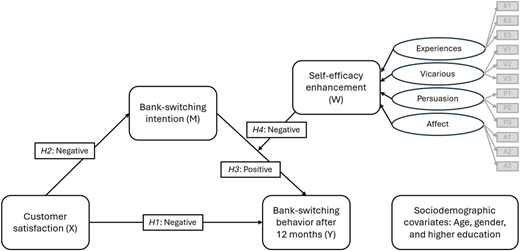
Conceptual model with hypothesized relationships. The gray items are theoretical indicators not included in the present study. Source(s): Authors' own work
Conceptual model with hypothesized relationships. The gray items are theoretical indicators not included in the present study. Source(s): Authors' own work
3. Methods
3.1 Procedure
In October 2022, the market research agency Kantar surveyed 1,368 adult Norwegians about mortgages and personal finance on behalf of the banking alliance SpareBank 1 (SpareBank 1, 2023) using the invitation-only GallupPanel.
The panel consists of 40,000 adults aged 15 years and older, with strict quality procedures to ensure the representativeness of the general population (Kantar, n.d.a, b). It is renowned for its quality and is often used for research purposes (see, e.g. Norwegian Directorate of Health, 2023; Norwegian Human Rights Institution, 2022; Norwegian Research Council, 2022). Nonrepresentative sampling procedures may constitute a serious limitation (LeBaron and Kelley, 2021). Our sampling procedure ensured the maximization of external validity (Morling, 2021) with a sample consisting of respondents with various bank-switching experiences and socioeconomic backgrounds (Schunk and DiBenedetto, 2021).
In the 2022 survey, 1,133 (82.8%) consented to be reinterviewed within a year about the same topic, and 465 (41.0%) answered a follow-up study in October 2023. We chose a 12-month lag to compare switching rates with those of other sources reporting annual switching rates (Steinkjer, 2024). In the present study, the 272 respondents (19.9%) who answered both surveys and had a mortgage on both occasions were included.
3.2 Measures
Customer satisfaction with the mortgage bank in 2022 was measured with an item from the TRI*M model developed by Kantar (Huber and Pallas, 2006): “Generally, how satisfied are you with [name of mortgage bank inserted]?” with response options on a bipolar scale from “extremely satisfied” (5) to “dissatisfied” (1) in addition to a “do not know” option (missing) (coding in parentheses; see the Appendix for details). As this item by default is presented on a descending scale, all scales in the survey were presented accordingly, as mixing directionality is not recommended (Maeda, 2015).
Self-efficacy enhancement was measured using four items sourced and adapted from the literature (Bortne et al., 2024): Enactive mastery experience: “I have successful experiences from past bank switches” (Experience).
Vicarious experience: “People around me have reported that they have switched banks” (Vicarious).
Verbal persuasion: “People around me are encouraging me to switch banks” (Persuasion).
Physiological and affective states: “I notice that switching banks engages me” (Affect). These four items were measured on a five-point Likert scale, from “strongly agree” (5) to “strongly disagree” (1) (coding in parentheses; see the Appendix for details).
Bank-switching intention was measured with “I intend to switch mortgage banks within the next 12 months” This item was measured on a five-point Likert scale, from “strongly agree” (5) to “strongly disagree” (1) (coding in parentheses; see the Appendix for details).
To measure bank-switching behavior in the 2023 follow-up study, respondents were asked if they had switched mortgage banks over the past 12 months, with response options “yes” (1), “no” (0), and “do not know” (missing) (coding in parentheses; see the Appendix for details).
Age (in whole years), gender (1 = male, 0 otherwise), and level of education (1 = more than four years of university education, 0 otherwise), were compiled and extracted from the GallupPanel database in 2023 and used as sociodemographic covariates.
3.3 Statistical analyses
The data were analyzed using IBM SPSS version 31. To check whether the four items measuring self-efficacy enhancement could be used as a formative index we checked variance inflation factors (VIFs) and condition indices in a linear regression model (Coltman et al., 2008). Testing for reliability, such as Cronbach's alpha, factor loadings and average variance extracted (AVE), was not performed, as such testing should be reserved for reflective models (Coltman et al., 2008). We constructed the self-efficacy enhancement index as the mean of Experiences, Vicarious, Persuasion, and Affect (Jarvis et al., 2003). We used chi-square tests and independent samples t tests to assess differences between switchers and nonswitchers.
To test the four hypotheses from the literature review we used a moderated mediation model with customer satisfaction with the mortgage bank (X), bank-switching intention (M), self-efficacy enhancement (W), and bank-switching behavior (having switched banks [1] or not [0]) after 12 months as the dependent variable (Y), using the PROCESS macro (Hayes, 2018). We used mean centering of the product components for the moderation. The results are presented in Figure 2. Other models, including models with sociodemographic covariates, are summarized in the text.
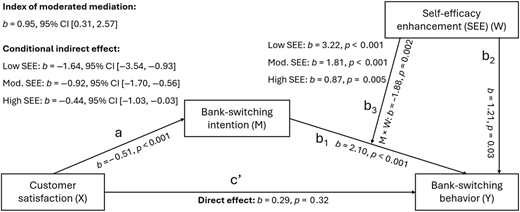
Moderated mediation analysis of the effect of customer satisfaction (X) on bank-switching behavior (Y) via bank-switching intention (M), conditional on bank-switching self-efficacy enhancement (SEE) (W) at low (−0.59), moderate (0.16), and high (0.66) levels (n = 268). The components of the products are mean centered. Source(s): Authors' own work
Moderated mediation analysis of the effect of customer satisfaction (X) on bank-switching behavior (Y) via bank-switching intention (M), conditional on bank-switching self-efficacy enhancement (SEE) (W) at low (−0.59), moderate (0.16), and high (0.66) levels (n = 268). The components of the products are mean centered. Source(s): Authors' own work
Based on the results of the moderated mediation analysis, we used logistic regression analysis to predict the switching probabilities (0–1) based on a model with switching intention, the self-efficacy enhancement index, and their interaction based on mean-centered variables (Berrington et al., 2006; Field, 2018; Iacobucci et al., 2017; Zeger and Liang, 1992). We refer to this model as the standard model. Other models, including models with sociodemographic covariates, are summarized in the text. We used the Nagelkerke pseudo-R2 and overall percentage correct classification of cases (OPCC) for model assessment (Szopinski, 2021).
To inspect the significant interaction from the standard model, we recoded bank-switching intention and the self-efficacy enhancement index into “high” and “low” relative to variable means, with four categories to visualize the mean differences in the predicted switching probabilities (Mize, 2019). To test whether the predicted switching probabilities from the standard model differed significantly across the four groups, we performed a one-way omnibus Welch ANOVA with a Games–Howell post hoc test. This test does not assume equal variances and is accurate and powerful when sample sizes are unequal and small (Field, 2018). The results are presented in Figure 3.
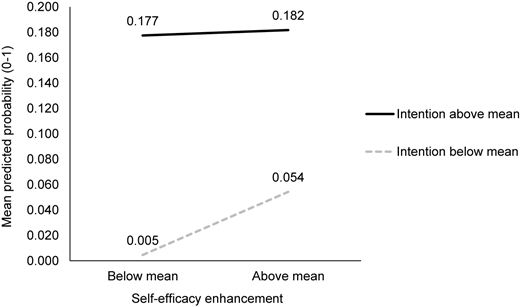
Mean predicted probability (0–1) of switching banks 12 months ahead by bank-switching intention and self-efficacy enhancement in 2022 (n = 270). Source(s): Authors' own work
Mean predicted probability (0–1) of switching banks 12 months ahead by bank-switching intention and self-efficacy enhancement in 2022 (n = 270). Source(s): Authors' own work
4. Results
The study sample (n = 272) consisted of 60.7% males, with MAGE = 46.9 years (SD = 13.4, range = 22–78), and 28.7% reported having higher education. The original sample (n = 1,368) consisted of 50.1% males, with MAGE = 46.4 years (SD = 15.8, range 18–86 years), and 29.0% had higher education. Apart from slightly overrepresenting males, the study sample accurately represented the original sample.
A hazard when reinterviewing banking customers is that active and engaged customers become overrepresented. To mitigate this risk, neither the recruitment and consent text in 2022 nor the introduction to the follow-up survey in 2023 disclosed our research question related to mortgage bank switching. The texts stated that we examined mortgages and personal finance.
A non-peer-reviewed national study conducted among Norwegian banking customers in January 2024 (n = 1,010) suggested that 7.2% of mortgage customers had found a new mortgage bank during 2023 (Steinkjer, 2024). In contrast, our study reported a prevalence of 9.9%. We used an online z score calculator for two population proportions to compare the prevalence of switching behavior in the two samples (“Social Science Statistics”, n.d.). We concluded that the prevalence of mortgage switching behavior was similar and that our study did not overrepresent active and engaged banking customers as the reported z value was nonsignificant (z = −1.49, p = 0.136).
There were no significant differences in gender (p = 0.567) or higher education (p = 0.144) between switchers and nonswitchers. However, switchers (MAGE = 41.4 years) were younger than nonswitchers were (MAGE = 47.5 years), p = 0.024, Cohen's d = 0.46.
In a linear regression analysis the variance inflation factors (VIFs) for the four informational sources of self-efficacy varied from 1.17 (Experiences) to 1.81 (Persuasion). The largest condition index was 11.29. This finding suggests that multicollinearity was not present (Coltman et al., 2008; Field, 2018).
The formative self-efficacy enhancement index had MENHANCEMENT = 2.85, SD = 0.75. Switchers had MENHANCEMENT = 3.15, as opposed to nonswitchers, who had MENHANCEMENT = 2.81 (p = 0.026, Cohen's d = 0.45). Switchers also had a stronger bank-switching intention one year before (MINTENTION = 3.52 vs. MINTENTION = 2.34, p < 0.001) and a large effect; Cohen's d = 1.21 (Field, 2018). Switchers in 2023 had lower customer satisfaction in 2022 (MSATISFACTION = 3.26) than nonswitchers did (MSATISFACTION = 3.53). A one-tailed test was used due to having a hypothesized direction (switchers were less satisfied than non-switchers were) and showed that the difference was statistically significant (p = 0.049, d = 0.34).
The results from the moderated mediation analysis are shown in Figure 2. Customer satisfaction was significantly and negatively associated with bank-switching intention (a path) (b = −0.51, SE = 0.07, p < 0.001, 95% CI [−0.65, −0.37]), supporting H2. The main effect of bank-switching intention on switching behavior (b1 path) was significant (b = 2.10, SE = 0.46, p < 0.001, 95% CI [1.21, 3.00]), supporting H3.
The main effect of the self-efficacy enhancement index (b2 path) (b = 1.21, SE = 0.54, p = 0.03, 95% CI [0.15, 2.27]) was significant. There was a significant negative interaction between switching intention and the self-efficacy enhancement index (b = −1.88, SE = 0.59, p = 0.002, 95% CI [−3.04, −0.71]), indicating that the effect of bank-switching intention on switching behavior was moderated by the self-efficacy enhancement index. When self-efficacy enhancement was low (−0.59), the impact of switching intention on behavior was strong and positive (b = 3.22, SE = 0.76, p < 0.001, 95% CI [1.73, 4.70]). When self-efficacy enhancement was moderate (0.16), the impact was reduced (b = 1.81, SE = 0.39, p < 0.001, 95% CI [1.04, 2.58]). When self-efficacy enhancement was high (0.66), the impact was further reduced (b = 0.87, SE = 0.31, p = 0.005, 95% CI [0.27, 1.48]). All the effects were significant. Hence, at lower self-efficacy enhancement levels, intention impacted behavior more, whereas at higher self-efficacy enhancement levels, intention impacted behavior less. This finding supports H4.
The index of moderated mediation was significant (b = 0.95, BootSE = 0.60, 95% CI [0.31, 2.57]). This finding indicates that the conditional indirect effect of customer satisfaction on switching behavior through intention varied across self-efficacy enhancement levels. When self-efficacy enhancement was low (−0.59), the indirect effect of satisfaction was strong and negative (b = −1.64, BootSE = 0.68, 95% CI [−3.54, −0.93]). When self-efficacy enhancement was moderate (0.16), the indirect effect was reduced (b = −0.92, BootSE = 0.29, 95% CI [−1.70, −0.56]). When self-efficacy enhancement was high (0.66), the indirect effect was further reduced (b = −0.44, BootSE = 0.25, 95% CI [−1.03, −0.03]). All the effects were significant. Hence, the mediation effect was dependent on self-efficacy enhancement levels.
When predicting switching behavior, a nonsignificant direct effect of satisfaction on behavior (c’ path) was detected when controlling for switching intention (b = 0.29, SE = 0.29, p = 0.32, 95% CI [−0.28, 0.86]). Hence, we found no evidence of a direct effect of customer satisfaction on reduced switching behavior, as stated in H1. The effect of satisfaction was instead indirect: Specifically, bank-switching intention mediated the relationship between satisfaction and switching behavior so that satisfaction did not directly impact behavior but transmitted its effect indirectly through switching intention. As self-efficacy enhancement increased, it weakened the mechanism through which satisfaction affected bank-switching behavior through switching intention.
The sociodemographic covariates were not significant predictors of switching behavior when they were added to the model (not shown). However, age negatively affected switching intention (b = −0.01, p = 0.01), which is in line with previous research (van der Cruijsen and Diepstraten, 2017). Finally, as a robustness check, we allowed moderation at both stages of the mediation. The moderation of the satisfaction-to-intention path was not significant, whereas the results for the intention-to-behavior path were unchanged (not shown).
In summary, the moderated mediation analysis revealed that customer satisfaction operated primarily through bank-switching intention. The effect of switching intention on switching behavior was dependent on self-efficacy enhancement. When self-efficacy enhancement was low, switching intentions had a strong positive impact on behavior. As self-efficacy enhancement increased, the impact of switching intentions on behavior was reduced.
Next, we used logistic regression analysis to calculate the predicted switching probabilities. Based on the results of the moderated mediation analysis shown in Figure 2, we first used bank-switching intention, the self-efficacy enhancement index, and their interaction as predictors. The results revealed that the switching intention in 2022 significantly impacted switching behavior in 2023; OR = 7.23, 95% CI [3.13, 16.65], p < 0.001, as did the self-efficacy enhancement index; OR = 3.36, 95% CI [1.19, 9.52], p = 0.022, and the interaction term; OR = 0.16, 95% CI [0.05, 0.50], p = 0.002. This standard model had a Nagelkerke R2 of 0.334 and an OPCC of 92.6% (n = 270).
Several other logistic regression models were also tested before we finally concluded that we should use the standard model to predict switching probabilities: When we tested a model with satisfaction, self-efficacy enhancement, and their interaction, satisfaction (OR = 0.55, 95% CI [0.31, 0.97], p = 0.038) and self-efficacy enhancement (OR = 1.89, 95% CI [1.08, 3.32], p = 0.027) were significant, whereas the interaction term was not (OR = 1.86, 95% CI [0.94, 3.67], p = 0.074) (Nagelkerke R2 = 0.079, OPCC = 89.6%, n = 270).
With respect to the testing of intention, satisfaction, and their interaction, intention was significant (OR = 3.32, 95% CI [2.05, 5.40], p < 0.001, whereas satisfaction (OR = 1.04, 95% CI [0.49, 2.22], p = 0.924) and the intention × satisfaction interaction were not (OR = 1.11, 95% CI [0.71, 1.75], p = 0.651) (Nagelkerke R2 = 0.233, OPCC = 91.8%, n = 268).
When six predictors (intention, self-efficacy enhancement, satisfaction, and three interaction terms [enhancement × intention, enhancement × satisfaction, and satisfaction × intention]) were used, only intention, self-efficacy enhancement, and the enhancement × intention interaction were significant, i.e. the three items in the standard model (Nagelkerke R2 = 0.35, OPCC = 92.5% n = 268). When the standard model was rerun with the satisfaction item, the three original variables in the standard model retained their significance, whereas satisfaction was nonsignificant (p = 0.32; Nagelkerke R2 = 0.343; OPCC = 92.2% n = 268). When the standard model was rerun with the three sociodemographic covariates, all three covariates were nonsignificant (Nagelkerke R2 = 0.35, OPCC = 92.6%, n = 270).
We concluded that the standard model from the logistic regression analyses was parsimonious and robust. We examined the interaction between bank-switching intention and self-efficacy enhancement using the recoded variables and predicted probabilities from the standard model in Figure 3.
As shown in Figure 3, in the group with a switching intention level above the mean, self-efficacy enhancement one year before had a limited effect: When the values of both predictors were above the mean (n = 94), the standard model predicted an annual churn rate of 18.2%, whereas when self-efficacy enhancement was below the mean and intention above the mean (n = 40), the expected churn rate was virtually identical (17.7%). When the values of both predictors were below the mean (n = 92), the predicted churn rate was a meagre half percent. In contrast, with intention below the mean but self-efficacy enhancement above the mean, the expected churn rate increased to 5.4% (n = 44).
Welch ANOVA indicated significant differences between group means (F(3, 84.17) = 64.86, p <. 001). Pairwise post hoc comparisons indicated that except for the difference between the two high-intention groups (p = 0.999), the other differences were significant (p = 0.003 or lower).
This finding implies that self-efficacy enhancement increased the likelihood of switching behavior primarily for customers with weak switching intentions. For customers with stronger switching intentions, self-efficacy enhancement had less of an additional impact. Hence, the results displayed in Figures 2 and 3 were consistent. The study findings concerning the four hypotheses with additional comments where necessary are summarized in Table 1.
Summary of hypothesis tests with additional comments
| Hypothesis (direction) | Decision | Additional comments | |
|---|---|---|---|
| H1 | Satisfaction → Switching behavior (−) | Direct effect not supported | Indirect effect: Intention mediates the effect of satisfaction on behavior. Increasing self-efficacy enhancement weakens this mechanism |
| H2 | Satisfaction → Switching intention (−) | Supported | |
| H3 | Switching intention → Switching behavior (+) | Supported | |
| H4 | Intention × self-efficacy enhancement → behavior (−) | Supported | The effect of intention on behavior is stronger when self-efficacy enhancement is low and weaker when self-efficacy enhancement is high |
5. Discussion
5.1 Main findings
In line with previous research, we found conclusive evidence in support of H2: There is a negative association between customer satisfaction and bank-switching intention. The data also supported H3: There is a positive effect of intention on switching behavior 12 months later.
We found intriguing evidence for the effect of the interaction of self-efficacy enhancement and switching intention on switching behavior (H4): High self-efficacy enhancement increases switching behavior 12 months ahead among consumers with weak or absent switching intentions. As a result, self-efficacy enhancement helps consumers with weak intentions. In contrast, when switching intentions are strong, increased self-efficacy enhancement has a limited effect.
The interaction between self-efficacy enhancement and bank-switching intention echoes a previous finding that showed a significant interaction between perceived behavioral control (PBC) and switching intentions (Bansal and Taylor, 2002). However, Bansal and Taylor (2002) found that high PBC increased switching behavior among consumers with a high switching intention, but that it had no effect among customers with a low switching intention.
In contrast, our findings suggest that self-efficacy enhancement helps low-intending consumers more. A possible explanation is that PBC emphasizes behavioral controllability (Ajzen, 2002) and that increased PBC thus fortifies an existing intention. In contrast, self-efficacy enhancement may provide mental and social support to low-intending customers in a digitized market (Kulviwat et al., 2014).
We also found insightful evidence for the role of customer satisfaction leading to a bank switch. Satisfaction did not impact switching behavior directly; hence, we rejected H1. However, satisfaction affects switching behavior indirectly through bank-switching intention. The conditional indirect effect suggests that increasing self-efficacy enhancement diminishes the mechanism through which satisfaction affects behavior through intention. As a result, satisfaction matters more for switching behavior through intention when self-efficacy enhancement is low and less when self-efficacy enhancement is high.
5.2 Theoretical implications
The study findings have implications for theoretical development. The prominent role of switching intention when explaining behavior suggests that this measure must be further disentangled to understand switching behavior (Morwitz and Munz, 2021). The robust association between satisfaction and intention underscores that it is important to consider intentions as motivational or behavioral commitments influenced by evaluative judgments such as customer satisfaction.
The interaction between bank-switching intention and self-efficacy enhancement calls for reflection and theory development on the role of self-efficacy in switching research (Leong et al., 2025). The significant moderation demonstrated that with high self-efficacy enhancement, intention is less necessary to enable the customer to switch banks. Previous experiences, the role of significant others, and emotional affect can partly compensate for a lack of intention. Therefore, being part of a social and mental bank-switching conversation is useful for becoming an agentic consumer.
In addition, customer satisfaction plays an important indirect role. Dissatisfied customers may have reasons to remain (Howorth et al., 2003; Panther and Farquhar, 2004), and satisfied customers may leave (Reichheld, 1996). This discrepancy is due to numerous reasons. Although expectations are met (Oliver, 2010), satisfied customers may be attracted to or attractive to competitors (Howorth et al., 2003; Zhao et al., 2023) or may evaluate switching costs to be low (Brunetti et al., 2020; Wathne et al., 2001). In corporate markets, if a competitor's price is significantly better, the likelihood of switching will increase, even more than managers anticipate (Wathne et al., 2001).
In contrast, dissatisfied customers may remain with the bank because of switching barriers (Colgate and Lang, 2001; Fornell, 1992), cost involvement (Oliva et al., 1992), or high levels of trust (Kabadayi, 2016). They may also remain because they are informationally captured (Howorth et al., 2003) or because they are emotionally attached to the bank brand (Levy and Hino, 2016), although the impact of interpersonal relationships may be limited (Wathne et al., 2001).
The strong mediating effect of bank-switching intention challenges the assumption that consumers' behavioral decisions stem only from evaluative judgments such as satisfaction. Our findings indicate that satisfaction influences behavior through intention. If satisfaction does not automatically imply behavioral loyalty (Chuah et al., 2017; Huber and Scharioth, 2006), the importance of adopting a broader perspective on customer relationships with subsequent measurements of customer loyalty (Bourdeau et al., 2024; Oliver, 1999) or customer retention (Huber and Scharioth, 2006) is substantially increased.
In addition, we should not forget what most customer satisfaction items are, in fact, measuring. From a service provider perspective, satisfaction is a retrospective deliverance to the customer, whereas conative and action loyalty, or the absence of switching intentions, is a prospective behavioral commitment from the customer (Oliver, 1999). Consequently, switching intention may be a stronger predictor of actual switching behavior than satisfaction is, as the former is prospective and more strongly connected to consumer agency than the latter is. This point has also been noted in previous research. Surveys should include variables that are closer to behavior and not only “[…] simply ask the respondents for their overall satisfaction.” (Oliva et al., 1992, p. 92). Over a period of 12 months, various incidents can affect a customer's satisfaction with the bank (Oliva et al., 1992).
5.3 Managerial implications
For managers, market researchers, and marketing professionals, the study findings underscore the importance of understanding how to mitigate the lack of consumer self-efficacy to create resilient consumers (Mende et al., 2024). When switching banks becomes a digital-only process, vulnerable consumers may be excluded (Weber et al., 2024). If consumers feel powerless when facing digital banking and digital-only switching processes, this experience may impact their preference for banking as it used to be (Bi et al., 2024). If banks are implementing artificial intelligence to ease onboarding processes (Shastri and Khandelwal, 2024), managers must understand whether this choice can impact future consumer behavior in a way that is detrimental to the banks (Kim et al., 2023).
Customer retention is a priority across sectors (Gao et al., 2023), and banks generate and lose revenues from customers staying or leaving rather than from customers being satisfied or dissatisfied per se. Increased satisfaction with a bank could also indicate that dissatisfied customers are leaving, thereby reducing the bank's market share. For managers, the nonsignificant direct effect of customer satisfaction highlights that monitoring satisfaction alone may be insufficient for predicting churn; understanding and addressing the drivers of switching intentions may be far more critical for developing effective retention strategies. Customer surveys should therefore include a direct question about switching intentions 12 months ahead or use a broader measurement of customer retention (Huber and Scharioth, 2006).
For marketing professionals, the significant role of self-efficacy enhancement, i.e. participating in a social and mental bank-switching conversation, suggests that existing customers may be important for attracting new customers. Word of mouth from existing customers is a powerful force (Choudhury, 2014). Among existing customers, social media influencers influence behavioral intentions among young clients and strengthen trust and image among non-clients (Dean et al., 2021). In addition, influencers and celebrities are integral to modern marketing strategies (Mogaji and Nguyen, 2024). The successful onboarding of new customers should go beyond compliance with regulatory demands and create a moment worth sharing.
5.4 Implications for policymakers
Policymakers are eager to increase churn and competition. However, assuming that dissatisfied banking customers will do the job for them may not suffice. Addressing self-efficacy enhancement, such as the mental activation required when making decisions under uncertainty (Li et al., 2021) and the affective component of customer experience (Gao et al., 2023), is crucial. First, policymakers should understand how customers' intentions related to being an agentic consumer are formed. Next, it is necessary to address how intentions are translated into adequate behavior, thus irrevocably bridging the gap between intention and behavior. An important question is the following: How can new policy interventions contribute to the social and mental discourse of switching banks?
Policymakers and customers alike should be aware of the difference between “being” a bank switcher and “doing” a bank switch (Faries, 2016). If “being a switcher” seems too ambitious, the customer can engage in doing tasks that may increase their intention, such as engaging in bank-switching discussions physically and online (Lappeman et al., 2022), critically evaluate financial terms and the service level in the current bank, as these are influential switching triggers (Hati et al., 2020; Zhao et al., 2022), and imagine the perceived benefits of switching (van der Cruijsen and Diepstraten, 2017) and the costs of switching (Zhao, 2025).
Thus, addressing and engaging in more doable tasks can make the customer more aware of the benefits of becoming more agentic. Forming implementation intentions (Gollwitzer, 1999; Sheeran et al., 2024), for instance, thinking through how one will react if an obstacle arises in the bank-switching process, can help consumers. Hence, new policies making bank-switching behavior less of a giant leap in digital solitude and more of an aided and gradual switch along several stepping stones are warranted.
5.5 Strengths and limitations
A significant strength of the present study is its longitudinal design, enabling examination of the intention-to-behavior path over time at an individual level, according to current recommendations (Andreß, 2017; Chintagunta and Labroo, 2020; Morwitz and Munz, 2021). Second, the present study aligns with a recommendation from Ngau and colleagues (2023) to study partial switching behavior, as the propensity to switch banks varies across products (van der Cruijsen and Diepstraten, 2017).
Third, using the GallupPanel ensures generalizability to the adult Norwegian population (Kantar, n.d.a, b) and cross-study comparisons indicate that our sample was not heavily biased toward heavy switchers but reflected the average mortgage bank-switching consumer. Fourth, as banking in Norway is already heavily digitized (Statista, 2024), generalizable consumer research may provide insight into how agentic consumers operate in a digitized market. This situation will also necessitate a new perspective on the role of technology in self-efficacy, as social cognitive theory has primarily been researched in face-to-face contexts (Schunk and DiBenedetto, 2021; Wünderlich et al., 2013).
Moreover, we treated self-efficacy enhancement as a formative construct. Four indicators from previous research were adapted and included (Bortne et al., 2024). However, each of the four sources may be latent factors poorly represented by single items (Bollen, 2002). Constraints on survey length prevented this study from including reflective first-order items measuring the four informational sources of self-efficacy (illustrated with gray items in Figure 1), which has been referred to as a “reflective first-order, formative second-order” specification (Jarvis et al., 2003, p. 205). This issue should be addressed in future research.
In a complete causal chain, items measuring bank-switching self-efficacy (Bortne et al., 2025) should also be included in future research. These items were not included in the present study because of constraints related to survey length. If future research addresses this issue, a self-efficacy enhancement composite can be constructed based on standardized regression coefficients as weights. Here, the self-efficacy enhancement index was constructed based on a simple mean of the four indicators. Future research should consider multiple waves of interviews so that data on the informational sources of self-efficacy, self-efficacy beliefs, and behavioral outcomes can be collected at different time points (Phan, 2012a, b).
Second, we measured customer satisfaction and switching intention with single items, making them vulnerable to errors. Composite measures of the total customer relationship and switching intentions may yield different results (Szymanski and Henard, 2001). For instance, instead of using a single-item satisfaction question, asking the respondents how the bank performs against competitors could provide a more nuanced perspective of the direct effect of customer satisfaction (Oliva et al., 1992), which was nonsignificant in our study.
However, single-item measures also have predictive validity (Bergkvist and Rossiter, 2007), and they can be used when the item is single-faceted and straightforward (Petrescu, 2013). The low number of missing responses indicated that all the items were easy to answer.
A third limitation is that compared with the original sample, the sample is relatively small and slightly overrepresents males. We chose not to weight the follow-up sample according to the first sample, as it may not be sufficient to evaluate potential nonresponse bias, given that it is uncertain whether the variables used for weighing the sample are the variables that generate bias (Dixon and Tucker, 2010). This choice could influence the validity of our study (Groves and Peytcheva, 2008). Testing the hypotheses in a larger sample may increase statistical power, as the sample size was close to being considered small, i.e. n ≤ 250 (Hu and Bentler, 1999).
Fourth, given that we rely on self-reported bank-switching behavior in the follow-up study, social desirability bias cannot be ruled out (Morwitz and Munz, 2021), in addition to misunderstandings or misremembering (Robins, 2016; Schober et al., 2004). Using actual churn data from a bank's customer registry would eliminate the risk of social desirability and misremembering when examining behavior. However, GallupPanel members are experienced and motivated respondents when they are invited to participate in the panel (Kantar, n.d.a, b), suggesting that the error rate should be low.
Finally, future studies could consider using a shorter time frame than 12 months, although this time frame would limit the number of switchers when annual churn rates are approximately 10%. A longer time frame increases the risk of misremembering.
6. Conclusion
This longitudinal study demonstrated a clear link between bank-switching intention and behavior 12 months ahead. Customers with a weak switching intention benefited more from a high score on bank-switching self-efficacy enhancement than did customers with a robust switching intention. The effect of customer satisfaction was indirect: switching intention mediated the effect of satisfaction on switching behavior, and the effect was also dependent on self-efficacy enhancement. Future research should aim to understand more of the complex interplay between self-efficacy and its enhancement, satisfaction, and intention when explaining bank-switching behavior.
The relevance of intention in this study makes the very formation of a bank-switching intention a highly relevant topic for future research. One avenue is to investigate at which level of satisfaction switching intentions start to form—and why. A second avenue is to examine when and how switching intentions form within the four phases of loyalty (Bourdeau et al., 2024; Oliver, 1999). A third possible research trajectory is to investigate whether and how switching intentions based on, for instance, self-efficacy beliefs differ from switching intentions resulting from banks' failure to meet customer expectations. The former may constitute a category of positive-based switching intentions, in contrast to negative-based switching intentions emerging from customer dissatisfaction and unmet expectations.
Our findings suggest that increased mobility in the banking market can be achieved through two distinct policy interventions. First, increasing intention impacts behavior; thus, interventions designed to strengthen switching intentions are vital. Second, increasing self-efficacy enhancement helps consumers with weak switching intentions. The standard model suggested that the annual churn rates among customers with weak switching intentions would increase from 0.5% to 5.4% if they are in an environment that contributes to enhancing their self-efficacy when switching banks. Hence, to increase market mobility, it is essential to address policies and measures designed to enhance consumer mastery and agency beliefs.
The study findings suggest that using longitudinal data to measure behavior after having measured intention is a crucial step toward understanding the intention–behavior gap (Conner and Norman, 2022; Sheeran and Webb, 2016) and thus can contribute to efficacious policy recommendations. Longitudinal studies are necessary to demonstrate temporal precedence and elucidate plausible causal mechanisms. Thus, for future bank-switching research, basing policy recommendations on cross-sectional studies of intentions without measuring subsequent behavior may not suffice (Andreß, 2017).
Compliance with ethical standards
All respondents consented to being reinterviewed and having their data linked by Kantar according to Kantar quality procedures.
Kantar never shares data that could compromise individual identities (Pettersen, 2023). Kantar's clients (in this case SpareBank 1) are not involved in personal data processing as Kantar handles all general categories of personal data (Sikt - Norwegian Agency for Shared Services in Education and Research, n.d.) when surveys are conducted from internal respondent sources such as the GallupPanel (Kantar, 2019).
Hence, the authors had no access to information that could identify individual participants at any stage of the data collection process.
SpareBank 1 provided the data, which the authors are grateful for allowing them to use for this study. SpareBank 1 owns and reserves all rights to the data.
Appendix
Description of measures and descriptive statistics
| Item | Scale | % | M | SD | Valid n |
|---|---|---|---|---|---|
| 2022 survey | |||||
| Customer satisfaction: Generally, how satisfied are you with [name of mortgage bank]? | 3.50 | 0.81 | 270 | ||
| Extremely satisfied (5) | 8.8 | ||||
| Very satisfied (4) | 42.3 | ||||
| Satisfied (3) | 39.3 | ||||
| Slightly satisfied (2) | 7.7 | ||||
| Dissatisfied (1) | 1.1 | ||||
| Don't know/missing | 0.7 | ||||
| Introduction to self-efficacy enhancement items: Some banking customers are concerned with switching banks, while other banking customers are more focused on developing a relationship with the bank they already use. Below are some statements about switching banks, and we ask you to choose the response option that suits you best | |||||
| The self-efficacy enhancement items were randomized for each respondent to avoid order effects | |||||
| Experience: I have successful experiences from past bank switches | 3.27 | 0.97 | 272 | ||
| Strongly agree (5) | 8.8 | ||||
| Agree (4) | 31.6 | ||||
| Neither agree nor disagree (3) | 43.4 | ||||
| Disagree (2) | 9.9 | ||||
| Strongly disagree (1) | 6.3 | ||||
| Missing | 0.0 | ||||
| Vicarious: People around me have reported that they have switched banks | 3.00 | 1.09 | 270 | ||
| Strongly agree (5) | 5.1 | ||||
| Agree (4) | 32.0 | ||||
| Neither agree nor disagree (3) | 31.3 | ||||
| Disagree (2) | 19.5 | ||||
| Strongly disagree (1) | 11.4 | ||||
| Missing | 0.7 | ||||
| Persuasion: People around me are encouraging me to switch banks | 2.39 | 1.05 | 272 | ||
| Strongly agree (5) | 2.9 | ||||
| Agree (4) | 11.8 | ||||
| Neither agree nor disagree (3) | 29.0 | ||||
| Disagree (2) | 33.5 | ||||
| Strongly disagree (1) | 22.8 | ||||
| Missing | 0.0 | ||||
| Affect: I notice that switching banks engages me | 2.73 | 1.04 | 272 | ||
| Strongly agree (5) | 2.9 | ||||
| Agree (4) | 23.2 | ||||
| Neither agree nor disagree (3) | 30.1 | ||||
| Disagree (2) | 31.3 | ||||
| Strongly disagree (1) | 12.5 | ||||
| Missing | 0.0 | ||||
| Bank-switching intention: Reconsidering what you have stated about your mortgage, how much do you agree or disagree with the following statement: I intend to switch mortgage banks within the next 12 months | 2.46 | 1.04 | 270 | ||
| Strongly agree (5) | 4.4 | ||||
| Agree (4) | 7.4 | ||||
| Neither agree nor disagree (3) | 37.5 | ||||
| Disagree (2) | 29.8 | ||||
| Strongly disagree (1) | 20.2 | ||||
| Missing | 0.7 | ||||
| 2023 follow-up survey | |||||
| Bank-switching behavior: Have you or your household switched mortgage banks over the past 12 months? | 272 | ||||
| Yes (1) | 9.9 | ||||
| No (0) | 90.1 | ||||
| Don't know | 0.0 | ||||
Note(s): The customer satisfaction item is sourced from Kantar's TRI*M model (Huber and Pallas, 2006) and used with permission from Kantar Norway. The self-efficacy enhancement items are sourced and adapted from Bortne and colleagues (2024). The bank-switching intention and behavior items are constructed by the first author and Kantar experts. Numerical values are in parentheses. Valid n listwise = 266

