Understanding the barriers to behavioral change that can mitigate climate change is essential for achieving the goals of the Paris Agreement. While this issue has been extensively studied in Western contexts, research in other geographical regions remains limited. This study aims to identify and categorize the barriers to climate change mitigation behaviors among residents of Taipei, Taiwan, and compare these findings with those from Western countries.
This study uses a mixed-methods approach, combining qualitative interviews and quantitative analysis. Through in-depth interviews, 21 distinct barriers to mitigation behaviors were identified. These barriers were then categorized using principal component analysis into four groups: lack of perceived necessity, cost, efficacy and lack of opportunity. Regression analysis was conducted to examine the extent to which these barriers predict individuals’ mitigation behavioral intentions.
Results indicate that the identified barriers significantly influence individuals’ intentions to engage in climate change mitigation behaviors. The study highlights key differences between the barriers observed in Taiwan, an East Asian cultural and geographical context, and those reported in Western countries such as the UK and the USA.
This study contributes to the literature by providing empirical evidence on climate change mitigation barriers in a non-Western context, addressing a significant gap in cross-cultural research. By comparing findings from Taipei with those from Western studies, the research offers valuable insights into the cultural and regional factors shaping climate change mitigation behaviors, which can inform more effective policy and intervention strategies.
1. Introduction
In February 2023, the Climate Change Response Act, an amended version of the Greenhouse Gas Reduction and Management Act, formalized Taiwan’s goal of achieving net-zero emissions by 2050 and demonstrated the Taiwanese government’s commitment to mitigating climate change. Nevertheless, a 2023 survey of Taiwanese residents (Lee et al., 2024) indicated that although over 80% of respondents were concerned about climate change, approximately 40% were unfamiliar with the concepts of net zero or carbon neutrality. Additionally, approximately 40% of respondents opposed increasing water and electricity prices to achieve climate change goals. In addition, the results indicated that the public perceives the Taiwanese government and enterprises to have made insufficient efforts to address climate change. Another survey study, conducted by Hung and Bayrak (2022), found that age is positively correlated with motivation to alter behavior to mitigate climate change, suggesting that younger generations in Taiwan are less willing to engage with climate change issues. Overall, although the Taiwanese public demonstrates high awareness of climate change, public understanding of its implications and specific mitigation strategies remains limited. Therefore, continued public education and communication efforts are essential to drive the societal transformation necessary to achieve net-zero emissions in Taiwan.
Before national and local governments formulate and implement strategies for climate change mitigation, variations in public behavior must be understood to ensure that these strategies closely connect climate change with daily life and are therefore appropriate and feasible. Mitigation strategies aligned with widely held values, beliefs and cultural norms are more likely to be adopted and effectively implemented (IPCC, 2023). The considerable potential of individual-level efforts in mitigating climate change underscores the importance of understanding individuals’ perceptions of such mitigation (Brügger et al., 2015; Sinclair et al., 2025). Engagement in ecofriendly behaviors is widely recognized as a strategy for mitigating the adverse effects of climate change on human life (Bergquist et al., 2023). However, transitioning to adopting such behaviors is often hindered by barriers such as the value-action gap and attitude-behavior gap (Blake, 1999; Lorenzoni et al., 2007).
When individuals have limited knowledge about the causes or consequences of climate change, they may perceive it as a nonissue and fail to take action (Gifford, 2011; Lorenzoni et al., 2007). Even among individuals who recognize the effects of climate change, psychological distance can influence behavior. Many people view climate change as a spatially and temporally distant threat, which diminishes its perceived urgency (Geiger et al., 2024; Gifford, 2011; Semenza et al., 2008). Additionally, uncertainty regarding how climate change will personally affect one’s life or the magnitude of its effects reduces the likelihood that an individual will engage in proactive behavior (Freeston et al., 2024). Climate change skepticism represents another major barrier to mitigation. Such skepticism extends beyond questioning the existence of climate change to distrust in information and policies, which can further discourage engagement (Semenza et al., 2008). Furthermore, even when individuals understand which behaviors can mitigate climate change, a perceived lack of response efficacy – the sense that one’s actions are comparable to “a drop in the ocean” – can serve as a barrier to the adoption of mitigation behaviors (Lorenzoni et al., 2007).
Time and money are major practical factors that influence the decision to engage in climate change mitigation. People are often discouraged to engage in mitigation behaviors because they are perceived to require expenditure of temporal and financial resources (Blake, 1999; Gifford, 2011). Even individuals with considerable financial means may hesitate to adopt mitigation behaviors because of the associated costs, and economically disadvantaged groups are even less likely to adopt such behaviors (Semenza et al., 2008). For instance, the high upfront cost of solar panels often leads individuals to perceive themselves as incapable of contributing to climate change mitigation, resulting in a lack of self-efficacy (Geiger et al., 2024). Additionally, individuals who have made substantial financial investments to achieve their current lifestyles are often reluctant to change their behavior for the sake of climate action (Gifford, 2011). For example, with respect to car ownership, if an individual has purchased a car, paid maintenance costs and secured insurance, then they are less likely to switch to using bikes or public transportation (Bissel and Becker, 2024).
Individuals may justify the effects of their behaviors on climate change by applying the reasoning that the current status quo is meant to be (Gifford, 2011). Additionally, when mitigation behaviors are perceived to potentially reduce quality of life and convenience, disrupt the comfort of their current lifestyle, or increase time and financial costs, people are generally resistant with respect to adopting such behaviors (Lorenzoni et al., 2007; Rodríguez-Barillas et al., 2024). Habit also considerably influences individual behavior. Gifford (2011) described the persistent effects of established habits as “behavioral momentum.” For example, transitioning from private car to public transportation use is highly challenging because this change requires both substantial effort and a long-term commitment (Verplanken and Whitmarsh, 2021).
In addition to individual-level barriers, structural and institutional barriers at the social level can impede the adoption of climate change mitigation behaviors. A lack of infrastructure to support green living often limits the mitigation behaviors certain individuals are capable of adopting (Tazzie et al., 2024). For instance, Blake (1999) reported that inadequate public transportation facilities can prevent individuals from using green transportation. Similarly, Semenza et al. (2008) observed that differences in public transportation infrastructure have caused Portland residents to participate more actively in climate change initiatives than Houston residents do. However, even when structural barriers are addressed, social norms continue to influence behavioral choices. When ownership and consumption are regarded as symbols of social status, individuals may deprioritize climate change in pursuit of these social expectations (Lorenzoni et al., 2007). Furthermore, Gifford (2011) noted that humans often rely on social comparison to determine appropriate behaviors. When individuals perceive inequity in mitigation behaviors, with others not having made similar changes, they are less likely to engage in collective mitigation.
The belief that large-scale climate and environmental challenges can only be mitigated through collective action involving all of humanity is widespread. However, a lack of collective efficacy can substantially reduce individuals’ willingness to participate in mitigation efforts (Blake, 1999; Geiger et al., 2024). Because climate change is global, individuals frequently externalize responsibility to others, perceiving environmental protection and climate change mitigation to be the sole responsibility of governments or corporations (Kalch et al., 2021).
In addition to barriers, the adoption of climate change mitigation behaviors is influenced by risk perception and environmental attitudes. Brody et al. (2012) defined climate change risk perception as an individual’s assessment of the ongoing adverse effects of climate change on ecological systems and the perceived threat to oneself, one’s family and the environment. The authors’ examination of the relationship between climate change risk perception and individual mitigation behaviors revealed that individuals who perceive higher risks to be associated with climate change are more likely to engage in mitigation behaviors.
Attitudes toward environmental concerns are traditionally conceptualized as involving cognitive, affective and conative dimensions. The cognitive dimension encompasses an individual’s environmental understanding, thoughts and evaluations; the affective dimension encompasses emotional responses to the environment; and the conative dimension encompasses environmental behaviors and intentions (Gifford and Sussman, 2012; Schultz et al., 2004). Numerous studies have suggested a strong correlation between environmental concern and ecofriendly behavior (Gansser and Reich, 2023; Gifford and Sussman, 2012; Steg and Vlek, 2009). Engagement in or reduction of environmentally impactful behaviors is frequently influenced by environmental attitudes, which are, in turn, shaped by current events, age, gender, knowledge and other factors (Gifford and Sussman, 2012). Generally, individuals with more positive environmental attitudes are more willing to engage in and perceive fewer barriers to engaging in mitigation behaviors (Brügger et al., 2015; Whitmarsh, 2011). Although certain frameworks, such as the theory of planned behavior and value-belief-norms theory, have demonstrated that environmental attitudes can predict environmental behavior, these attitudes do not always translate into ecofriendly actions. This may be because the presence of barriers or other moderating factors shape the relationship between attitudes and behaviors (Gifford and Sussman, 2012).
In sum, the barriers to the adoption of climate change mitigation behaviors must be understood to ensure these obstacles can be overcome, which can facilitate changes in personal lifestyles and behaviors and the development of effective climate change mitigation strategies. Notably, most research on this topic has focused on developed, high-emission, English-speaking countries, such as the UK (Blake, 1999; Lorenzoni et al., 2007), the USA (Geiger et al., 2024; Semenza et al., 2008) and Canada (Gifford and Chen, 2017; Lacroix and Gifford, 2017; Lacroix et al., 2019). Given the key role of culture in individuals’ adoption of ecofriendly behaviors (Jakučionytė-Skodienė and Liobikienė, 2021), the barriers identified in the aforementioned studies may differ from those present in contexts such as Taiwan; thus, numerous academics have called for research on barriers to climate change mitigation across cultural contexts (Geiger et al., 2024; van der Linden, 2015). In the Asian context, there are only a few studies, such as Alvi and Khayyam (2020), that report on individuals’ obstacles to engaging in climate change behaviors.
Compared to its population size, Taiwan’s carbon emissions are substantial, highlighting the importance of studying climate change mitigation-related issues in Taiwan (Chou, 2013; Hwang and Chang, 2011; Liu and Chao, 2023). Although barriers to climate change mitigation in Taiwan have been investigated in several studies, these studies have primarily focused on specific groups, such as students (Di Giusto et al., 2018; Yu et al., 2020), and therefore, the understanding of this topic in terms of the broader population remains limited. We addressed this gap through an examination of how Taiwanese adults aged 20 years and older perceive behavioral barriers to climate change mitigation, providing insights into the general public’s views on this critical topic.
2. Methods
In this study, barriers to climate change mitigation behaviors and the underlying factors shaping perceptions of these barriers among Taipei residents were assessed through a mixed-methods research approach with an exploratory sequential design. An inductive approach was adopted for this study, as cultural influences on barriers between Taiwanese individuals and widely studied Western cases were anticipated. Therefore, no hypothesis was formulated.
The study targeted adults aged 20 years and older with household registration in Taipei City. Data collection was conducted in two stages. The first (qualitative) stage involved one-on-one semistructured interviews conducted to identify barriers preventing individuals from engaging in mitigation behaviors. In the second (quantitative) stage, a survey was developed on the basis of the interview findings. This survey assessed participants’ willingness to engage in mitigation behaviors across several sociodemographic variables to facilitate analysis of the relationships between the identified barriers and other potential influencing factors.
2.1 Interview
Interviewees were selected based on the population distribution across the districts in Taipei City. A total of 32 individuals were interviewed between April 1 and July 5, 2023. The area of household registration and gender distribution of the participants were aligned with the demographic characteristics of Taipei as of March 2023. However, the age of sample skewed slightly younger than that of Taipei residents in general, with approximately 70% of the interviewees aged between 20 and 50 years. Further details regarding the interviewees are provided in Appendix.
The interviews were semistructured, comprising questions developed with reference to the literature. The questions focused on participants’ climate change risk perception, environmental attitudes and barriers to climate change mitigation. Part 1 of the interview incorporated research by Blake (1999), Nicholson-Cole (2004) and van der Linden (2015). The questions assessed interviewees’ perceptions of the environment in their area of residence and their views on the effects of climate change. Part 2 evaluated interviewees’ environmental attitudes through the five components of the New Ecological Paradigm scale (Dunlap et al., 2000). Part 3 included open-ended questions examining participants’ experiences and opinions regarding actions to mitigate climate change and their motivations for and barriers to adopting mitigation behaviors.
The interview transcripts were analyzed and coded after all the interviews were completed, and the barriers to mitigation identified through the interviews were categorized by the authors into two levels, individual and social levels, according to the classification proposed by Lorenzoni et al. (2007). The individual-level barriers included limited cognition, perceived risk sunk costs and reluctance to change lifestyles. The social barriers encompassed comparison with others and perceived program inadequacy. On the basis of the qualitative data provided by the 32 interviewees, 21 barriers (Table 1) were identified and subsequently developed into questionnaire items for the subsequent stage of the study.
2.2 Questionnaire
Regarding the distribution of the questionnaire, a stratified sampling method was used, with administrative districts considered sampling units. A standard estimation formula was applied, and the required sample size was determined to be at least 385, which would ensure a 95% confidence level and allow for a 5% margin of error. The survey was distributed online from November 8 to December 18, 2023, with 387 valid responses collected. The IP addresses of the respondents were verified, and two duplicate samples were identified and removed, resulting in a final data set of 385 valid samples for analysis. The socio-demographic variables of the participants were shown in Appendix. Chi-square test results revealed no significant gender differences between the sample and the population of Taipei (x2 = 3.28, df = 1, p = 0.07). The district-level population distribution of the sample differed significantly from that of Taipei (x2 = 49.92, df = 11, p < 0.05). Specifically, Neihu, Songshan and Nangang districts were overrepresented in the sample, whereas Zhongshan, Wanhua, Wenshan, Shilin and Beitou districts were underrepresented. Additionally, the age distribution differed significantly between the sample and the population of Taipei (x2 = 333.36, df = 2, p < 0.05). Younger participants were overrepresented, whereas older participants were considerably underrepresented. This result is consistent with the anticipated limitations of online surveys, where younger individuals are more likely to respond than older individuals are.
The survey questions collected data through five sections regarding personal background, climate change risk perception, environmental attitudes, barriers to climate change mitigation behavior and mitigation intention. Before being distributed, the questionnaire was reviewed by two experts to ensure its validity and relevance.
The questions regarding climate change risk perception were revised from those developed by van der Linden (2015), comprising eight questions addressing individual and global (societal) risk levels across temporal and spatial dimensions. These questions assessed respondents’ cognition of climate change and ability to evaluate climate-related threats.
Environmental attitudes were evaluated using the New Ecological Paradigm scale (Dunlap et al., 2000). This scale assesses perceptions of the relationship between humans and the environment, encompassing five components: the reality of limits to growth, antianthropocentrism, the fragility of nature’s balance, rejection of exemptionalism and the possibility of an ecocrisis. Notably, seven of the even-numbered questions are reverse questions.
The questionnaire also investigated participants’ perceptions of the 21 barriers to climate change mitigation behaviors identified during the qualitative interviews. Each item described scenarios that individuals might encounter when engaging in mitigation behaviors and respondents indicated their level of agreement with the existence of these barriers under various circumstances.
Questions regarding the intention to engage in climate change mitigation behaviors involved both general and specific intentions (Abrahamse and Shwom, 2018; Brody et al., 2012; Habib et al., 2021; Lacroix, 2018), such as adopting sustainable diets, using public transportation, reducing air conditioner usage, choosing energy-efficient appliances and purchasing green products. The final part of the questionnaire gathered sociodemographic information, including district of household registration, gender, age and education level. This section was also used to obtain information regarding family status, for example, marriage and having children or not and life habits to provide a more comprehensive understanding of respondents’ living contexts.
2.3 Analytical methods
For the qualitative analysis, the authors reviewed the transcriptions, identified emerging themes and selected representative conversations to support the thematic discussion (Hung, 2018). For the quantitative analysis, principal component analysis (PCA) was conducted to examine the underlying structure of the variables (Linscott et al., 2022), followed by multiple hierarchical regression analyses to explore the relationships between the extracted components (i.e. barriers) and behavioral intentions (Ferguson and Snell, 2024; Hoogendoorn et al., 2020). Because many aspects of the quantitative analysis were informed by the findings of the qualitative analysis, further details of the quantitative procedures are presented in the Results Section 3.2. The survey data were managed and analyzed using SPSS version 23.
3. Results and discussion
3.1 Qualitative results
On the basis of the interview results, this study identified 21 barriers to the adoption of climate change mitigation behaviors (Table 1). For the ease of discussion, these barriers were divided into individual and social levels according to the framework developed by Lorenzoni et al. (2007). The individual level primarily encompassed personal values, attitudes toward life, risk perception and cognition of climate change. The social level included limitations in infrastructure or appliances, interpersonal networks and societal, government, and enterprise action or inaction. These barriers were further classified according to the climate change psychological barriers referred to as the “Dragons of Inaction” by Gifford (2011). The naming and conceptualization of each category was informed by Blake (1999), Geiger et al. (2024), Gifford (2011), Lorenzoni et al. (2007) and Semenza et al. (2008).
3.1.1 Individual-level barriers.
Fifteen individual-level barriers to mitigation behaviors were grouped into four categories: limited cognition, perceived risk, reluctance to change lifestyles and sunk costs. Limited awareness of how climate change affects daily life often prevented participants from acting, with many perceiving these effects to be distant or irrelevant. Even among participants who acknowledged climate change as an immediate problem, knowledge gaps – such as uncertainty regarding the effectiveness of mitigation behaviors – hindered willingness to act. For instance, some interviewees doubted whether using reusable products or limiting their use of disposable items would genuinely mitigate climate change. Skepticism regarding the efficacy of widely promoted solutions, such as the concern that green product manufacture might generate considerable emissions, contributed to this hesitation. As can be observed in a statement by Interviewee 01, these cognitive, informational and motivational barriers underscore the challenges individuals face in transitioning to more sustainable behaviors:
Do you mean plant-based meat? […] I think plant-based food is also a type of processed food, and I’m not sure if its production process might result in higher carbon emissions (Interviewee 01).
If mitigation behaviors posed risks to daily life, required additional time and money, or caused lifestyle disruptions, participants often expressed reluctance to take action against climate change. Sunk costs also played a major role in discouraging mitigation efforts. Some participants who already owned conventional vehicles or appliances viewed switching to electric vehicles or energy-efficient appliances as wasteful, as expressed by Interviewee 23:
We haven’t replaced the old appliances, so there are some, like electric water heaters, that are inefficient and waste more electricity, we still haven’t […] [replaced them] (Interviewee 23).
Many interviewees reported barriers related to hedonic preferences, including the desire to adjust the temperature with air conditioners to quickly relieve weather-related discomfort and the desire to travel abroad. These participants often felt that this was the status quo and was meant to be. Additionally, some participants prioritized health and cleanliness over climate change, particularly after concern for public health became widespread following the COVID-19 pandemic. Some participants were reluctant to make lifestyle changes, particularly when mitigation behaviors required a large-scale transformation of their daily routines. Others reported that they did not care for the environment or nonhuman animals and prioritized their own lives. Even for participants who expressed willingness to change, the convenience of mitigation behaviors considerably affected their decisions. Similar to what Interviewee 20 stated, some participants described themselves as being unwilling rather than unable to take action:
Because washing items is inconvenient in certain places, bringing your own ecofriendly tableware is not very convenient. Therefore, I mostly choose disposable tableware when eating out (Interviewee 20).
3.1.2 Societal-level barriers.
Although individual factors play a crucial role in the decision to engage in mitigation behaviors, social factors are also influential. At the social level, two categories of six total barriers to mitigation behaviors were identified: comparison with others and perceived institutional inadequacy. Societal-level barriers involve members of an individual’s network, such as family and friends, and broader influences from society, the government and enterprises. These individuals and institutions shape willingness to engage in mitigation behaviors. In his “Dragons of Inaction” article, Gifford (2011) described humans as “very social animals,” which leads to social norms and networks considerably influencing people. Interviewee 14 noted that she would not take action against climate change unless others did as well. In addition to social networks, infrastructural factors, such as the availability of electric vehicle charging stations and the widespread presence of nonpackaging stores, also affected individual decision-making:
[Even if] I don’t turn on the air conditioner, others still do. The weather is so hot, I have to turn it on (Interviewee 14).
Everyone says that people nowadays should use electric cars, but for that to happen, they need places to charge them. [Charging an electric vehicle at home] is difficult for people like us who live in an apartment. Even if you want to make the change, the conditions make it difficult (Interviewee 21).
Many interviewees mentioned a need to align their lifestyle with that of other important people in their lives, which presented an obstacle to engaging in mitigation behaviors, such as those related to dietary habits and air conditioner use. Some participants mentioned being affected by the actions of others and wondered whether their mitigation efforts would be useless if only a few people took similar action rather than all of society. Externalizing responsibility was also a major barrier. Some participants viewed environmental conservation and climate change mitigation as the responsibility of the government or enterprises rather than individuals. Others expressed an intention to engage in climate change mitigation behaviors but being hindered by a lack of infrastructure or opportunities. For example, participants reported being prevented from acting by an absence of convenient public transportation options or a limited number of nonpackaging stores.
3.1.3 Relationship and hierarchy between barriers.
Correlations may exist among the 21 barriers described by the study participants. For example, individuals may perceive carbon reduction efforts to be ineffective in mitigating climate change because of uncertainty regarding whether these actions will reduce or increase carbon emissions, which suggests this barrier is related to those stemming from uncertainty regarding behavioral effects and a lack of response efficacy. In other words, people may feel that they do not have response efficacy and believe individual mitigation behaviors will not substantially reduce carbon emissions because they are unsure of whether these behaviors will actually contribute to carbon reduction:
Is there any data proving that plastic use would decrease if people use fewer plastics from the source [consumption]? I think I need stronger evidence, such as the data behind this, to be convinced. Otherwise, I might think that even if I don’t use this straw now, this plastic product will be used elsewhere (Interviewee 12).
At the social level, interviewees reported a lack of government and enterprise action as a major barrier, with the government failing to implement specific policies encouraging widespread climate action from individuals or enterprises or these policies being insufficiently strict to effectively limit carbon dioxide emissions. By using the example of policies aimed at reducing plastic straw use, Interviewee 15 proposed that laws and regulations are more powerful than individual actions. This perspective also reflects the barrier of a lack of collective efficacy, wherein individuals feel their minor efforts cannot considerably mitigate climate change in isolation, which prevents them from acting:
A person who has never used straws in their entire life might save thousands of them, but once the government adopts a policy, millions of straws are saved (Interviewee 15).
For individuals to engage in certain mitigation behaviors, they must first overcome a different barrier. For example, if the infrastructure required for mitigation behaviors is lacking – such as mass rapid transit (MRT) routes being insufficient or bus schedules being limited – individuals may be required to use vehicles with higher carbon emissions, such as their own cars, for the sake of convenience or to avoid time costs. Furthermore, nonpackaging stores, which promote low-carbon consumption, are not widespread in Taipei at the time of interviews were conducted, and therefore, residents perceive themselves to lack opportunities to use such stores and opt for more convenient stores. In summary, when infrastructure or opportunities to engage in mitigation behaviors are lacking, factors such as inconvenience or temporal risk influence decision-making. Interviewee 19 mentioned being required to travel to Sanchong, a city outside Taipei, to engage in green purchasing by visiting a nonpackaging store. This demonstrates how a lack of opportunities can coincide with inconvenience or temporal risk:
For a [nonpackaging] store like this, you need to take transportation from Taipei to Sanchong, where one of these stores is located. You cannot go to Sanchong every day—maybe just once a week. This limits your ability to visit the store (Interviewee 19).
“Circular cups” are an emerging decarbonization measure designed to reduce the use of disposable cups and provide people who forget to carry ecofriendly cups with an accessible option. This service was defined under the regulations of Taiwan’s Ministry of the Environment in 2022. Before these regulations were announced, few people were aware that circular cups could become a part of their daily carbon reduction efforts. Those familiar with the service were often hesitant to use it because of concerns related to cleanliness and sanitation. For wider adoption of this new carbon reduction service to be achieved, the public must be aware that circular cups are an available option. After, relevant authorities can address other concerns, such as those regarding cleanliness and sanitation. In this study, interviewee responses indicated a need to first overcome the barrier of a lack of behavioral knowledge before other, more central concerns, are addressed for circular cups to be more widely used:
Is there such a service [circular cups]? I don’t know anything about it. Can this service be used now? (Interviewee 31).
I would like to use [circular cups], but I’m concerned about cleanliness. From an environmental perspective, I’d like to use it, but I would have to think about the cleanliness problem (Interviewee 18).
3.1.4 Differences in perceived barriers across cultural contexts.
Overall, many of the 21 barriers identified in this study are similar to the barriers identified in previous studies conducted in western contexts. For example, uncertainty regarding behavioral effects and perceived risks (financial and temporal) have been discussed in Gifford (2011), while lack of behavioral knowledge, other things are more important, reluctance to change lifestyles and lack of political action have been discussed in (Lorenzoni et al., 2007). In addition, several barriers identified in this study correspond to constructs in well-established behavioral models. For instance, lack of opportunity aligns with the concept of perceived behavioral control in the Theory of Planned Behavior (Ajzen, 1991), while the effects are far away is related to threat appraisals in Protection Motivation Theory (Rogers, 1983).
However, because of differences in time, space and cultural context, the meaning underlying the barriers identified in previous studies differ from those identified through the interviews in the current study. For instance, Lorenzoni et al. (2007) discussed the barrier of social norms and expectations in the British context, where people who are dedicated to green living are often seen as “weird” or “hippies.” By contrast, in the present study, Taipei residents often viewed efforts toward mitigating climate change as noble or even extraordinary. In the past, people may have perceived giving attention to environmental concerns as being disconnected from reality. However, as social values have evolved, and awareness of climate change has grown, mitigation behaviors have increasingly been viewed as positive social contributions. This suggests that public perceptions have changed considerably as time has passed and concern for sustainable development and environmental protection has increased:
I think [mitigation behavior] is great […] Don’t feel like you’re insignificant. You should gradually participate on your own and spread awareness to the people around you (Interviewee 18).
Socioeconomic status is often associated with sociostructural and worldview-related barriers to public engagement in climate change mitigation. Geiger et al. (2024) noted that in the USA, certain green behaviors, such as public transportation use, are associated with low socioeconomic status. Consequently, individuals with higher socioeconomic status often prefer using personal vehicles. However, this perception is unlikely to be prevalent in Taiwan, where decisions regarding public transportation use are primarily influenced by time and convenience rather than socioeconomic status. Public transportation use is not stigmatized in this context. Additionally, as an example of “social normative barriers (injunctive norms),” Geiger et al. (2024) reported that some Americans viewed using ecofriendly bags as “feminine” or “gay,” leading heterosexual men to avoid such behaviors. By contrast, the Taipei residents interviewed in this study reported avoiding green practices and recycling products because of inconvenience, unwillingness or concerns regarding health and cleanliness.
The 21 barriers to engagement in climate change mitigation behaviors identified during this study’s qualitative interviews were subsequently integrated into a questionnaire, which encompassed respondents’ climate change risk perception and environmental attitudes to measure behavioral intention. Through quantitative analysis, we examined the factors influencing engagement in climate change mitigation behaviors and identified which barriers most affect these behaviors, controlling for climate change risk perceptions, environmental attitudes and sociodemographic variables.
3.2 Quantitative results
After cleaning the survey data, first, principal component analysis (PCA) was conducted to determine the underlying structure of the 21 barriers. The barriers were then categorized into four groups through PCA: lack of perceived necessity, cost, efficacy and lack of opportunity. The Cronbach’s alpha values for these factors were 0.89, 0.83, 0.88 and 0.70, respectively, indicating good or acceptable reliability. The PCA results are presented in Table 2.
Lack of perceived necessity encompasses underestimation of climate change threats and the belief that its effects are either temporally or spatially distant and thus irrelevant to oneself. This factor also includes a lack of concern for nature and other living beings, prioritization of oneself and unwillingness to change behavior. Cost includes substantial investment of time and money, waste caused by replacing functional appliances and sacrifices related to personal health, hygiene, convenience or emotional satisfaction, all of which can hinder engagement in climate change mitigation behaviors. Efficacy comprises barriers to response efficacy (e.g. the belief that mitigation behaviors are ineffective against climate change), collective efficacy (e.g. the belief that efforts by only a few individuals are insufficient to create large-scale change), externalization of responsibility and uncertainty. Finally, lack of opportunity encompasses structural barriers, including inadequate infrastructure, insufficient opportunity, lack of information on mitigation behaviors and the need to coordinate with others.
3.2.1 Factors influencing intention to engage in climate change mitigation behaviors.
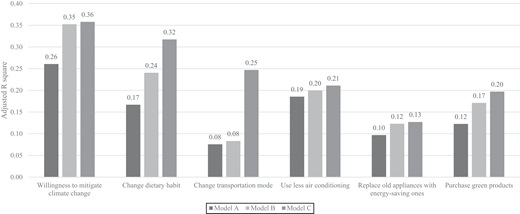
To investigate the relationship between barriers to mitigation behaviors and behavioral intention, multiple hierarchical regression analysis was conducted to predict the factors influencing behavioral intention. Model A included four barrier factors as predictors of behavioral intention. In Model B, climate change risk perception and environmental attitudes were added to the analysis, and Model C further included sociodemographic variables. Results were shown in Table 3. Figure 1 illustrates the results of multiple hierarchical regression analyses.
3.2.2 Correlation between fewer opportunities and higher intention to engage in mitigation behaviors.
Model A incorporated the four barrier factors to predict intentions to engage in climate change mitigation behaviors. As anticipated, barriers related to cost, efficacy and views of mitigation behavior as unnecessary were discovered to significantly and negatively influence mitigation behavioral intention. However, contrary to our expectations, barriers stemming from a lack of opportunity significantly and positively affected both the general intention to engage in mitigation behaviors and the intention to replace old appliances with energy-saving appliances (0.12 and 0.15, respectively). These results indicate that fewer opportunities correlated with higher mitigation behavioral intention. Specifically, fewer opportunities to replace existing appliances with energy-saving devices was associated with a greater willingness to do so. The possible reasons for this counterintuitive phenomenon may be the effects of social desirability bias, or it may reflect the structural characteristics of limited mitigation opportunities, which are typically beyond the control of individuals and depend on the decisions and actions of other stakeholders, such as governments, enterprises or nongovernmental organizations. When social and structural factors fail to facilitate mitigation behaviors, individuals may feel a heightened sense of responsibility or be motivated by other factors, which may increase behavioral intention (Steg, 2023). According to the A–B–C behavior-changing model (Guagnano et al., 1995), when external conditions (such as underdeveloped infrastructure) remain consistent, a positive attitude will increase behavior frequency. In other words, external factors that restrict mitigation behavior opportunities may increase willingness to engage in such behaviors because of individuals’ internal attitudes.
3.2.3 Effect of climate change risk perception on behavioral intention.
Model B incorporated the four barrier categories, risk perception and environmental attitudes to predict intentions to engage in climate change mitigation behaviors. Climate change risk perception explained the most variance in multiple predictive models of mitigation behaviors, highlighting the role of this crucial explanatory variable.
In Model B, risk perception replaced lack of perceived necessity as the significant predictor of general intention to engage in mitigation behavior. The standardized regression coefficient for this barrier shifted to −0.09 , rendering the predictions nonsignificant. A similar pattern was observed in models predicting mitigation behavioral intentions related to using less air conditioning, replacing old appliances with energy-saving ones and purchasing green products.
Lack of perceived necessity reflects low risk perception, suggesting that individuals who believe the effects of climate change are neither immediate nor local may deem mitigation behaviors unnecessary. Similarly, a previous study highlighted denial as the greatest barrier to individuals’ willingness to engage in climate change mitigation (Gifford and Chen, 2017). When individuals denied the existence of climate change as a problem or perceived mitigation to be unnecessary, they were unlikely to take any action against climate change. Lacroix and Gifford (2017) also reported that among various factors, only risk perception and conflicting goals and aspirations were significant predictors of energy-saving behavior.
3.2.4 Effect of individual attributes on behavioral intention.
Model C incorporated barriers, risk perception, environmental attitudes and sociodemographic variables (i.e. age, gender, education level, marital status and parental status) to predict climate change mitigation behavioral intentions. Where appropriate, transportation use and dietary habits were included among these variables to determine how existing behaviors affect barriers to climate change mitigation.
Several sociodemographic variables, including age, marital status and parental status, significantly predicted the intention to purchase green products. Age was the most significant predictor in Model C. Compared with older adults, younger (aged 20–29) and middle-aged (aged 30–49) adults were more willing to purchase green products. Additionally, marital and parental status were significant predictors, with a higher willingness to purchase green products observed among unmarried individuals and those without children. This may be because the process of recycling and reusing green products can be perceived to be inconvenient, especially among parents, because additional time is required to wash the products. Consequently, parents may prefer disposable products to reduce the time and costs associated with cleaning.
Whether respondents’ use of transportation was environmentally friendly significantly influenced the intention to engage in climate change mitigation behaviors, such as driving less and increasing public transportation use, walking or biking. Individuals who relied on nonelectric personal cars or scooters as their primary mode of transportation reported greater challenges in changing their behavior, which reduced their intention to use greener transportation methods relative to that of respondents who already used public transportation or other green transportation methods.
Whether respondents adopted a vegetarian diet also significantly influenced willingness to reduce meat consumption and transition to a plant-based diet. Nonvegetarians may view animal protein as essential for nutritional balance or struggle to give up the enjoyment they derive from eating meat. Additionally, gender affected the behavioral intention to change dietary habits, with women exhibiting greater willingness than men to adopt a vegetarian diet to mitigate climate change, which aligns with the findings of Gifford and Chen (2017).
3.2.5 Dependence of barrier effects on behavior difficulty.
As mitigation behaviors became more specific, the explanatory power of the barriers decreased. For instance, in Model A, which examines how barriers influence general intentions to mitigate climate change, the explanatory power of the four barriers on general intentions was 0.26. However, for more specific mitigation behaviors, such as reducing meat consumption, increasing public transportation use, limiting air conditioner usage, adopting energy-saving appliances and purchasing green products, the explanatory power of the four barriers on specific behavioral intentions decreased to 0.17, 0.08, 0.19, 0.10, and 0.12, respectively. A similar pattern was observed for climate change risk perception and environmental attitudes in Model B and for individual attributes in Model C. These findings suggest that when respondents were asked to consider a broader range of factors, the increased number of considerations created more perceived barriers to engagement in mitigation behaviors.
Research has suggested that the effects of certain barriers on mitigation intention vary with the difficulty of the behavior (Lacroix and Gifford, 2017; Lacroix et al., 2019). In the current study, the participants exhibited the lowest willingness to reduce meat consumption and switch to a plant-based diet. The most significant barrier to this behavioral change was cost, which encompassed hedonic preference, convenience, health-related sacrifices, and concerns regarding the investment of time and money. Similarly, in a study on Canada, Lacroix et al. (2019) classified reducing meat consumption as a high-difficulty behavior and identified conflicting goals and aspirations – including time, habit and life goals – as the most influential barrier. These findings indicate that regardless of geographical context, changing dietary habits remains a challenging mitigation behavior because of the higher cost of plant-based diets and the inconvenience associated with limited vegetarian food options.
The results of this study differ from those of Lacroix et al. (2019) in terms of the barriers influencing the willingness to purchase green products. In Lacroix et al. (2019), purchasing green products was seen as a low-difficulty behavior, with lack of knowledge being the most significant barrier, stemming from limited understanding and confusion about the accuracy of information. However, in this study, the most significant barrier to purchasing green products was a lack of perceived necessity, which included underestimating the threat of climate change, indifference toward nature and other species, and reluctance to change. These findings indicate that the factors influencing the willingness to purchase green products in this study differ from those identified by Lacroix et al. (2019).
3.2.6 Limitations of this study.
The skewed sample limits the generalizability of our findings. Nevertheless, because the primary aim of this study was to examine the associations between barriers and climate change engagement, the medium-sized sample (n = 385) provides adequate statistical power to detect such relationships. Future research should use more representative sampling strategies to enhance the external validity of the results. To our knowledge, there are no studies examining how climate change engagement differs across districts within Taipei, making it difficult to assess the impact of the skewed district representation. Previous research has suggested that older Taiwanese adults exhibit stronger motivation to alter their behavior to mitigate climate change compared to younger adults (Hung and Bayrak, 2022). Given that research on barriers to climate change mitigation is still emerging, investigating how the inclusion of more older adults might influence the patterns of barriers and their associations with climate change engagement represents an important direction for future research. In addition, the literature on “barriers” generally lacks investigation from gender, class and norm perspectives, which represents an important direction for future research.
4. Conclusion
Strategies to mitigate climate change are diverse, and the United Nations Climate Change Conference (COP) emphasizes a need to balance economic development and environmental sustainability. Climate change risk perception, environmental attitudes and willingness to engage in mitigation and adaptation behaviors are widely recognized as considerably influencing the development and effectiveness of strategies to combat climate change. This area of research can be enriched by developing a greater understanding of why individuals are reluctant to adopt low-carbon behaviors and of the factors hindering such actions.
In this mixed-methods study, we explored barriers that contribute to the attitude-behavior gap regarding climate change among residents of Taipei and examined the relationships between these barriers and mitigation behavioral intention. Qualitative interview results revealed 21 barriers that inhibit Taipei residents from engaging in mitigation behaviors. Through statistical analysis, these 21 barriers were classified into four categories: lack of perceived necessity, cost, efficacy and lack of opportunity. Regression results indicated that these barriers were major predictors of mitigation behavioral intention, with the exception of the intention to purchase green products. We also discussed how the barriers identified in Taiwan, an East Asian cultural and geographical context, differ from those reported in Western contexts, such as the UK and the USA.
For practitioners, the results of this study suggest that a multifaceted approach must be used to promote climate change mitigation behaviors. Improving climate change education and awareness to raise both climate change risk perception and environmental attitudes is a crucial first step. After this step, the barriers at both the individual and social levels that inhibit climate change mitigation behaviors must be addressed. These barriers can be classified as a lack of perceived necessity, cost, efficacy and a lack of opportunity. Strategies for removing the barriers include the implementation of effective policies that create an environment in which both the public and businesses support sustainable development. Furthermore, promoting the use of innovative mitigation technologies and increasing the availability and accessibility of related infrastructure are crucial. Through greater understanding of the most influential barriers to different mitigation behaviors, efforts can be made to increase intentions to engage in such behaviors. Through these combined efforts, individuals may be more willing to take tangible action to mitigate climate change at the individual level.
Because this study targets individuals aged 20 and above, future research could benefit from investigating barriers to climate change mitigation behaviors among those under the age of 20. Minors are not only important stakeholders in climate change issues, but they can also influence adults’ engagement with climate change (Lawson et al., 2019).