The practice of a company acting contrary to public corporate social responsibility (CSR) messages, known as “CSR decoupling,” poses considerable challenges to true sustainability. To help reduce decoupling and bridge the research gaps regarding individual and cross-level investigation, the purpose of this paper is to explore the antecedents of employee “green” or environmental hypocrisy and its relation to organizational CSR decoupling. Employee green hypocrisy denotes the misalignment between an employee’s pro-environmental discourse and their actual environmental behavior within the organizational context, irrespective of intent.
This paper uses a government climate change survey in Taiwan and applies the structural equation modeling technique with AMOS 20.0 to analyze the 1,524 valid responses.
The results of this study show that whereas organizational immediacy, climate change management self-efficacy and anticipatory advocacy are positively associated with employee green hypocrisy, individual psychological immediacy, climate change knowledge proficiency and participative advocacy are negatively correlated with employee green hypocrisy. Additionally, green hypocrisy is positively associated with organizational CSR decoupling.
This study contributes to the CSR(-washing), hypocrisy and climate change literature by adopting rarely seen employee- and multi-level approaches.
Introduction
A vast body of literature in multiple management disciplines finds that “doing well by doing good (Sun and Govind, 2020) as the world’s corporate citizens” has become a global branding theme (Bolton et al., 2011) and a risk management instrument (Husted, 2005; Story and Price, 2006). Corporate social responsibility (CSR) entails corporations striving for economic gains while furthering social good and environmental sustainability beyond legal obligations (Attig et al., 2016; Miska et al., 2018). Good CSR performance earns enterprises social approval and thereby contributes to corporate legitimacy (Bolton et al., 2011; Jiang et al., 2020) and reputation (Hartmann et al., 2023). It also bolsters brand image (Sun and Govind, 2020) and increases profitability (Tang et al., 2012). Furthermore, it strengthens supplier alliances (Pizzetti et al., 2021), improves talent recruitment (Bhattacharya et al., 2008) and increases employee job satisfaction (Aguinis and Glavas, 2019; Koseoglu et al., 2021) among many other benefits. Consequently, because of various stakeholders’ expectations and pressure to look good, CSR’s nature of voluntary disclosure (Ferrón‐Vílchez et al., 2021) of enterprises’ voluntary betterment of society activities (Clementino and Perkins, 2021) opens the door for CSR-washing or hypocrisy.
CSR-washing is a cause of CSR decoupling, that is, discord between an organization’s CSR communications and CSR actions (Talpur et al., 2023). Many large, multinational organizations have engaged in CSR-washing by using CSR reporting or other means of communication to portray themselves as more socially or environmentally responsible than they are. When CSR washing is committed concerning environmental causes, it is generally termed “greenwashing” and refers to a company presenting itself as providing eco-friendly products or services or committing to environmental sustainability (Al Mamun et al., 2024; Ginder et al., 2021; Pope and Wæraas, 2016). Therefore, greenwashing is a form of corporate hypocrisy (Antonetti et al., 2020). Famous examples include Volkswagen’s $77m marketing campaign for allegedly eco-friendly diesel cars in 2015 that turned out to be software-manipulated deceit (Ginder et al., 2021) and the origin of the word “greenwashing” by Jay Westerverld in 1986 for depicting the hotel industry’s advocacy for towel re-use to “save the environment,” while they embrace unfriendly environmental practices in other aspects of their business (Pizzetti et al., 2021). In this paper, to distinguish the organizational level of CSR hypocrisy from the individual level of green hypocrisy (i.e. regarding only environmental concerns), we use the term “employee green hypocrisy” to refer to an employee’s incongruence between his/her green talks and green actions instead of greenwash(ing), which is often used to refer to hypocrisy at the organizational level.
In the literature, greenwashing still lacks a universal definition (Ferrón‐Vílchez et al., 2021). However, the literature commonly regards greenwashing as happening when an “organization” is not walking its green talk (i.e. more symbolic communications but less substantive actions) or selectively announcing positive green information (Gatti et al., 2021; Li et al., 2023; Pizzetti et al., 2021). Namely, it is possible that although an organization does not meet its proclamations later in time, it does not necessarily mean that the organization possessed some deceptive intent at the beginning. Our employee green hypocrisy, thus, follows the same logic, referring to an individual inclination that captures the difference between an employee’s symbolic green communications and substantive green actions (which may or may not be on purpose). Concerning multi-level or person–organization fit is essential because an individual’s ethical values can enhance their organization’s promotion of sustainable development (Zhao et al., 2021). In the same vein, employee (green) hypocrisy can sabotage an organization’s CSR development or help an organization increase organizational hypocrisy.
Empirical research on the circumstances under which companies may become engaged in green hypocrisy remains limited (Yu et al., 2020). Moreover, the literature has focused primarily on outside-in and top-down perspectives (Aguinis and Glavas, 2019). Employees have been treated as mere implementers of top-down sustainability policies or mediators of relevant organizational benefits (Onkila and Sarna, 2022), rather than as individuals who may sense, make sense and respond to their environments by taking the initiative or sabotaging corporate practices. Indeed, individual- and multi-level CSR (including hypocrisy) research is lacking (Onkila and Sarna, 2022; Yang et al., 2020; Zhang et al., 2021). Furthermore, the literature concentrates on Western backgrounds (Aguinis and Glavas, 2019) or developed countries (Li et al., 2023), under-addressing emerging economy contexts. Taiwan is a non-Western emerging economy but an essential supplier in the current global value chain. It serves as a suitable research context to bridge the academic gap because sustainable supply chain management is claimed key to achieving true sustainability (Pizzetti et al., 2021).
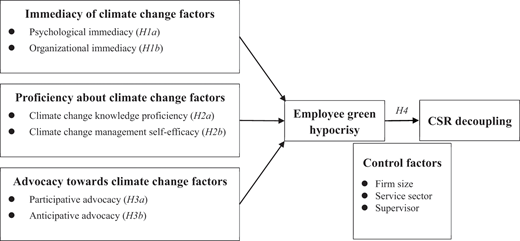
As climate change is deemed the most severe environmental challenge of our time (Hartmann et al., 2023) and as not every company is rated for their CSR or environmental, social and governance (ESG) performance, this paper uses the Taiwanese Government’s official survey of corporate employee status quo regarding climate change to identify employee green hypocrisy factors and subsequent organizational decoupling inclination to help achieve genuine sustainability. The proposed conceptual framework and hypothesized relationships are illustrated in Figure 1.
Literature
Regarding CSR-relevant topics, including hypocrisy, individual-level analysis has been overlooked (Babu et al., 2020; Zhang et al., 2021). Additionally, when it comes to employees, prior research has focused on how CSR contributes to job satisfaction, organizational commitment and performance among other positive parameters (Aguinis and Glavas, 2019; Bolton et al., 2011) much more than it examines negative ones (Brieger et al., 2020). Concerning negative hypocrisy, the literature primarily examines how it affects employees’ and job seekers’ attitudes toward hypocritical companies (Pizzetti et al., 2021). Consequently, research has neglected how individuals as internal stakeholders in companies can be active agents that not only implement orders and are affected but also can shape ecological performance (Aguinis and Glavas, 2019; Onkila and Sarna, 2022) and act negatively. This paper instead examines the antecedents of employee green hypocrisy and the association between individual green hypocrisy and organizational decoupling. By “employee,” this paper adopts Collins English Dictionary’s definition and means any internal person who is paid to work for an organization or another person.
Theoretical foundation: Hypocrisy and sensemaking
Following Aguinis and Glavas (2019), we used a person-centric understanding of hypocrisy in which sensemaking is considered an underlying and unifying mechanism through which individuals are proactive and agents whose levels of hypocrisy may vary. Sensemaking is the general process through which individuals confronting complexity and ambiguity assign meaning to ongoing experiences (Weick, 1995). CSR in the workplace requires sensemaking because CSR often leads to tension between pro-environmental goals or beliefs and financial logic, social dilemmas or broader social influences (Aguinis and Glavas, 2019). The literature on sensemaking typically considers upper-level management to be a sense-maker that becomes a sense-giver when they turn to subordinates for CSR/ESG propaganda. The present study concurs with Aguinis and Glavas (2019) in that it considers employees to be both sense-receivers and sense-makers who have the power to influence or be influenced by organizational CSR and hypocrisy.
CSR hypocrisy and CSR-washing are terms often used to describe a company’s successful use of false CSR claims to improve its competitive standing (Pope and Wæraas, 2016). The term greenwashing describes misleading claims made by organizations about environmental endeavors (Talpur et al., 2023). Delmas and Burbano (2011) defined greenwashing as the intersection of positive green communication and poor environmental performance. Li et al. (2023) defined green communication as public environmental statements or policies that do not necessarily translate into actions in a firm’s everyday business. Several studies have used this definition to identify organizational greenwashing by analyzing the extent to which a firm’s green communication exaggerates its green practice (Li et al., 2023). Talpur et al. (2023) reviewed the literature and discovered that greenwashing was the most common term used to describe this phenomenon. Other similar terms include misleading CSR communication, CSR talk and walk and CSR decoupling. We follow Talpur et al. (2023) in using the term CSR decoupling in our organization-level analysis because of its broad scope. At the individual level, we follow philosophical and psychological conventions and use the term green hypocrisy to neutrally describe a difference between an employee’s environment-related words and conduct.
Immediacy of climate change
Scientists and governments worldwide launched a Climate Emergency Declaration campaign in 2016. The awareness of environmental issues has also escalated among employees, and organizations’ environmental performance is significantly affected by employees’ perceptions and attitudes regarding the environment (Tahir et al., 2020). When it comes to sensing and sensemaking of an issue’s immediacy, according to construal level theory (Trope and Liberman, 2010), there is a bi-directional relationship between psychological distance and construal level in a person’s cognition of a certain object, person, concept or choice (OPCC). The hypothetical psychological distance suggests that when people perceive the likelihood of an event’s occurrence is high, it leads to low-level construal and closer psychological distance. The way individuals construe a certain OPCC impacts their risk estimation (Lermer et al., 2016) and actions (Lee, 2019). Therefore, if employees perceive climate change is really occurring, then they may feel the immediacy of climate change psychologically (Jones et al., 2017). With the sensemaking and estimation of higher climate change risks, their intentions and actions to reduce risks associated with the climate crisis should increase. This psychological mechanism would thereby decrease the likelihood of employee green hypocrisy:
The perceived psychological immediacy of climate change is negatively correlated with employee green hypocrisy.
Nonetheless, previous studies seem to suggest a different situation when climate change is affecting a company. Although employees may not be fond of corporate and personal hypocrisy, they could normally behave just like their managers and exhibit typical human behaviors. Thus, they may have the following cognitive inclinations, bringing hypocrisy at both levels. Delmas and Burbano (2011) observed three individual-level drivers of greenwashing: narrow decision framing, hyperbolic intertemporal discounting and optimistic bias. Narrow decision framing (Kahneman and Lovallo, 1993) occurs when a person decides today to communicate and support greenness without adequately considering what is required to implement it in the future or when a decision-maker focuses on short-term gains without adequately weighing associated long-term costs. Hyperbolic intertemporal discounting refers to the human tendency to show a relatively high discount rate (impatience) and yield to instant gratification over short horizons but a relatively low discount rate (patience) over long horizons (Delmas and Burbano, 2011). That is, an individual today conveys environmental sustainability with the intention to bear the costs in the future, but when the future becomes today, the individual acts impatiently and incurs green hypocrisy. Optimistic bias also takes place because people tend to overestimate the likelihood of positive events and underestimate the likelihood of negative events. This is because forecasts of future outcomes are often anchored on plans and scenarios of success (Delmas and Burbano, 2011; Kahneman and Lovallo, 1993). This paper reasons that when employees think possible negative CSR consequences manifest quicker than negative climate change consequences do, they are likely to become shortsighted and involve hypocrisy. Therefore, this paper argues and examines that when employees face climate changes impacting their company, these sensemaking tendencies contrastingly link employees to green hypocrisy rather than confrontation with it:
The perceived immediacy of climate change affecting an organization is positively correlated with employee green hypocrisy.
Proficiency in climate change
The climate change theme is attracting more attention globally, and during the past two decades, disciplines such as science education and public policy have begun to delve into relevant research. Previous efforts tended to revolve around climate science and highlight comprehension and transmission of climate lore or mindsets, namely, climate change literacy, climate literacy or climate science literacy, all terms that are used interchangeably (Harker-Schuch and Watson, 2019; Libarkin et al., 2018). Continuing a tradition of environmental literacy, these have sometimes included education and application methodologies considering affection, attitude, skill, behavior or disposition, in addition to the core dimension of knowledge (Jan et al., 2020; Klein et al., 2021). Progressively, scholars seek to redress the science-oriented imbalance of climate literacy literature and encourage research to add perspectives related to policy, social science and anthropogenic causes (Widener and Rowe, 2018). This paper contributes by echoing this goal and filling the gaps.
Still, knowledge proficiency, a foundation for sensemaking, is examined alone for two reasons. Firstly, climate (change) literacy is tackled incongruently by prior studies. Some focused on knowledge (Di Giusto et al., 2018), some added awareness, attitude and behavior (Yu et al., 2021) and still others put climate awareness in parallel with climate literacy, believing both factors would lead to attitude and behavior (UNESCO, 2014). To be precise, this paper uses the phrase “climate change knowledge proficiency” instead of “climate (change) literacy.” Secondly, climate change literacy, awareness, attitude, behavior, etc., are generally believed to be essential for successful climate change measures (Jan et al., 2020). Earlier evidence showed that knowledge of global warming was correlated with intended behavior (O'Connor et al., 1999). Yet, there is also inconsistent evidence that shows a knowledge–behavior gap and suggests other affective factors such as politics (Mittenzwei et al., 2019) and self-efficacy (Kuthe et al., 2019) as more determining of pro-environmental behavior than knowledge alone.
Based on the assumption that people with climate change knowledge proficiency know better how and why to take care of the environment and incur learning costs less than those lacking climate change knowledge, we propose the following hypothesis:
Climate change knowledge proficiency is negatively correlated with employee green hypocrisy.
Self-efficacy (Bandura, 1982) has been long believed to play a vital role in an individual’s decisions of action and intention. It refers to the confidence level of an individual to successfully follow recommended measures (Rogers, 1983). Some scholars suggest that self-efficacy is more determining than knowledge regarding pro-environmental behaviors (Kuthe et al., 2019). When it comes to the lack of substantive actions, some individuals may feel incompetent and impotent relative to a global scale issue like climate change and transfer responsibility to collective action (Olson, 1971). Individual inaction either stems from a perceived lack of control over the contemplated action’s results (Ajzen, 1991) or is rooted in a perceived insignificance of one’s deeds (Ajzen, 2002). In contrast, this paper inspects that if an employee during sensemaking is confident in perceived control and thinks he/she can manage the occupational opportunities and threats brought about by climate change, then the resulting self-efficacy and drive to save face internally and externally are likely to increase hypocrisy:
Climate change management self-efficacy is positively correlated with employee green hypocrisy.
Advocacy related to climate change
One’s self-concept determines what one finds to be meaningful during sensemaking (Aguinis and Glavas, 2019). A moral identity applies one’s own standards of behavior or beliefs regarding what is and is not acceptable to define oneself (Aquino and Reed II, 2002). Only when a person recognizes the importance of ethics and social responsibility can their decision-making process be ethical and socially responsible (Zhao et al., 2021). People with low ethical and social responsibility consider that environmental concerns have little or no relevance to them, whereas those with high ethical and social responsibility care about impacts on the organization and society when making personnel decisions (Zhao et al., 2021). When a person has a higher awareness of public value that considers a larger social unit (such as their nation or the world) and their needs, the emotional-motivational forces within the individual perform an integral role in that individual’s evaluative, sensemaking and identity-shaping mechanisms (Brieger et al., 2020). Sonenshein et al. (2014) noticed that through sensemaking, employees resolve the tension between economic and social logics through issue selling, which is the attempt to change the narrative within their organization by influencing others (Aguinis and Glavas, 2019). Evidence shows that employee perceptions and behaviors can be affected by coworkers’ green behavior and advocacy (Shah et al., 2021). While prior studies concentrated on the receptive results and an increase in green actions, this paper proposes an active result and a decrease in misconduct, examining that once a person is active in compelling other people around them to join a green movement for public value, such advocacy out of inner emotional-motivational forces may decrease personal green hypocrisy:
Participative advocacy is negatively correlated with employee green hypocrisy.
Even if a person recognizes the importance of environmental ethics as part of self-identity, given that there are occasions in which people attribute climate change to a global issue and collective action (Olson, 1971), this paper examines two situations. Whereas participatory advocacy actively involves others for collective action, anticipatory advocacy suggests a possible dilution of activism by the sense of collectivism. There is a human tendency known as an egocentric anchor, meaning psychological distance is determined mentally as the experienced self in the here and now (Liberman and Förster, 2009). When an OPCC is construed as global or collective (i.e. high construal level), the enlarged psychological distance shall negatively affect pro-environmental intentions and actions.
Moreover, Yang et al. (2020) observed that when an employee anticipates that, despite personal inaction, some other colleague or the organization will do the job (such as turning off lights to save energy), they exhibit reduced pro-environmental behaviors. Laziness also leads to a compromised normative goal of pro-environmental behaviors and increases employee hypocrisy (Yang et al., 2020). As a higher construal level, non-personal locus of responsibility and laziness may distance the issue or render perceived triviality of one’s deeds, we expect an increase in individual hypocrisy:
Anticipative advocacy is positively correlated with employee green hypocrisy.
Employee green hypocrisy and organizational corporate social responsibility decoupling
Although behavioral hypocrisy or decoupling may not be out of the organization’s intention, the stakeholders and the organization shall prefer some mechanism to help prevent it. Attributions and judgments of hypocrisy will become even more critical, given that the future expects more transparency and accountability to the extent that scholars promote individual social responsibility, as organizations are made up of individuals (Antonetti et al., 2020). Employee green hypocrisy is adverse to individual social responsibility and CSR and, thus, should be discouraged beforehand.
Hypocrisy studies at the employee or multi level are still scarce (Antonetti et al., 2020; Babu et al., 2020; Yang et al., 2020). Nejati and Shafaei (2023) suggested that substantive CSR is positively associated with employee affective commitment and mediated by meaningfulness in work, whereas symbolic CSR is not. Babu et al. (2020) demonstrated the adverse effects of corporate hypocrisy on employees’ voluntary contributions to their organization’s CSR program. Yang et al. (2020) found that locus of responsibility and employee–organization alignments of interests and actions are two critical factors impacting hypocrisy at the employee level. Interestingly, they noticed a mismatch between employee- and organizational-level expectations regarding who should be more responsible for promoting and implementing green initiatives. Overall, previous evidence reflects that organizational- and employee-level pro-environmental behaviors can interact with and impact each other (Yang et al., 2020). Following the same line of thought, the paper proposes and investigates a positive association between employee green hypocrisy and corporate green hypocrisy:
Employee green hypocrisy is positively correlated with organizational corporate social responsibility decoupling.
Methodology
Data and sample collection
The Climate Change Literacy Database (CCLD) data used in the current investigation were collected using a proportional stratified random sampling method and questionnaires mailed to corporate employees. The proportional stratified random sampling was based on the percentage of the total number of enterprises in different industrial sectors of Taiwan’s 1,548,835 enterprises, as reported by Taiwan’s Ministry of Economic Affairs in 2020; the samples were stratified by industry as follows: agricultural sector: 0.8%, manufacturing sector: 19.2% and service sector: 80.0%.
The survey on the Taiwan CCLD for 2022, which was compiled by Taiwan’s Environmental Protection Administration (EPA), obtained 1,524 valid questionnaire responses from deidentified enterprises. Questionnaires were distributed at the end of August 2022, and data collection by the EPA continued until October 2022.
According to equation (1) (Cochran, 1977), at least 1,500 valid questionnaires were required to provide a buffer against a 2.83% margin of error:
where n is the sample size, z is the z-score corresponding to a 95% confidence level, e is the margin of error, N is the population size and p (set at 0.5) is the population to which the enterprises’ employees who completed the questionnaire belonged. Of the employees in different industrial sectors of Taiwan’s enterprises surveyed, 14 (0.9%) worked in the agricultural sector, 373 (24.5%) worked in the manufacturing sector and 1,137 (74.6%) worked in the service sector.
Statistical methods
Structural equation modeling was used to determine causal links between constructs. Analysis was conducted using SPSS 25.0 and AMOS 20.0 to determine the reliability, internal consistency and construct validity. For reliability and internal consistency to be adequate, Cronbach’s alpha reached the acceptable threshold of 0.6 (Hair et al., 2006). Subsequently, a measurement model of construct validity was developed using confirmatory factor analysis (CFA), and bootstrapping was applied.
Empirical model design and measures
Our first model is presented in equation (2):
In this model, for the dependent variable, multiple regression was required to predict employee green hypocrisy. In the model, Y1i is used to estimate employee green hypocrisy for the ith observation; X1 is the vector of independent variables that capture the immediacy of climate change factors; X2 is the vector of variables that capture proficiency about climate change factors; and X3 is the vector of variables that capture advocacy regarding climate change factors. In addition, X4 is the vector of the control factors; α is the intercept; and β1, β2, β3 and β4 are estimated parameters.
The dependent variable captured employee inclination toward green hypocrisy, which was estimated as the difference between an individual’s green communication and green practice. Scores for each element of green communication and green practice collected from the EPA database were calculated using a five-point Likert scale, with endpoints ranging from 1 (strongly disagree) to 5 (strongly agree). In the EPA survey on the CCLD, the agreement scale for promoting or communicating actions to combat climate change was used as a proxy for green communication, and the agreement scale for individual climate-friendly actions was used as a proxy for green practices. Following Delmas and Burbano (2011) and Li et al. (2023), employee green hypocrisy was defined as an employee’s inclination to behave in a manner inconsistent with their speech regarding environmental sustainability and was captured as the difference between green communication and green practice. The formula used for calculating employee green hypocrisy was as follows: employee green hypocrisy = agreement scale score of individual green communication inclination − agreement scale score of individual green practice inclination. The model was used to assess four independent variables: immediacy of climate change factors, proficiency in climate change factors, advocacy regarding climate change factors and control factors. The immediacy of climate change factors, that is, psychological immediacy and organizational immediacy, were captured using a five-point Likert scale, with endpoints ranging from 5 (strongly agree) to 1 (strongly disagree). Psychological immediacy was measured using an agreement scale of individual sensitivity to the occurrence of climate change. Organizational immediacy was measured using an agreement scale of an individual’s sensitivity to the effects of climate change on their organization’s operations.
The factors contributing to climate change proficiencies that were assessed in the present study were climate change knowledge proficiency and climate change management self-efficacy. Climate change knowledge proficiency was scored as a simple sum of correct answers to two survey questions. One question asked whether the participant was knowledgeable regarding international climate change mitigation and adaptation strategies. The other question assessed knowledge of Taiwan’s laws related to climate change. The climate change management self-efficacy construct was assessed using the two-item measure scored on a five-point Likert scale that was described in Kuthe et al. (2019). Two forms of advocacy related to climate change were assessed: participative advocacy and anticipative advocacy. For participative advocacy, a three-item measure adapted from Shah et al. (2021) was used, and participants responded using a five-point scale. For anticipative advocacy, a two-item measure based on that in Yang et al. (2020) was used. Answers were scored using a five-point Likert scale, with endpoints ranging from 1 (strongly disagree) to 5 (strongly agree).
Three dummy control variables were added: firm size, service sector employment and supervisory role. According to Taiwan’s standards for identifying small and medium-sized enterprises that were published by the Ministry of Economic Affairs, a small and medium-sized enterprise is a firm with fewer than 200 employees. Firm size was coded as 1 for large firms (200 or more employees) and 0 for small and medium-sized firms (fewer than 200 employees). Delmas and Burbano (2011) indicated that firm size may influence hypocritical behavior, and Kim and Lyon (2015) discovered that large firms were more likely to engage in hypocritical behavior. Service sector was a dummy variable assigned a value of 1 if a firm belonged to the service sector and 0 if not. Michelon et al. (2013) argued that polluting and manufacturing industries, such as the oil, gas and consumer goods industries, face greater CSR pressures than other industries do because of their greater ability to affect society and the environment. The supervisory role variable was assigned a value of 1 if an employee was a supervisor-level executive and 0 if not. Kim and Lyon (2015) observed that managers often use greenwashing to gain stakeholder support for firm expansion.
The second model used in the present study is presented in equation (3):
Equation (3) was used to investigate the associations between employee green hypocrisy and CSR decoupling. In the model, Y2i is used to estimate the CSR decoupling inclination for the ith observation, and X2 − 1 is the vector of independent variables that capture employee green hypocrisy.
In the second model, the dependent variable in equation (3) is estimated as the difference between an organization’s CSR communication and CSR practice. CSR decoupling was coded as 1 for firms that externally communicated their formation of a sustainability committee and internally communicated a requirement for ESG or CSR (CSR communication) but did not offer any ESG or CSR training or courses (CSR practice) and 0 for those that did not. Cucari et al. (2018) empirically revealed that the presence of a sustainability committee is positively related to sustainability disclosure. Additionally, Rodrigue et al. (2013) observed that sustainability committees are often established as a symbolic means of managing stakeholder perceptions. Providing ethics courses and training renders this symbolism concrete because they involve educating employees about the risks of organizational greenwashing and can reduce the likelihood that greenwashing will occur (Delmas and Burbano, 2011).
Empirical results
Reliability and validity
Taiwan’s EPA has conducted a survey for the Taiwan CCLD annually since 2020. The collection process was divided into two stages to enhance data accuracy: the first stage involved sending the online questionnaire, and the second stage involved confirming and clarifying any questions with survey participants regarding their answers by telephone or email.
After factor analysis, items with loadings lower than 0.7 were eliminated. The climate change management self-efficacy, participative advocacy and anticipative advocacy constructs were consolidated to obtain two to three items each. Tests for internal consistency revealed that the composite reliability of all constructs exceeded the 0.7 cutoff value, and the average variance extracted (AVE) met the 0.5 benchmark (Bagozzi and Yi, 1988). The square root of the AVE for each construct was greater than the correlations of the constructs with other constructs (Fornell and Larcker, 1981). Table 1 presents the descriptive statistics and correlation matrix for the 1,524 analyzed responses.
Structural regression and a CFA model were used to assess our constructs. Each item was significantly correlated with its designated construct (p < 0.001), with standardized regression weights above 0.4. The CFA model had the following fit statistics values: root-mean-square error of approximation (RMSEA) = 0.027 (<0.080), goodness of fit index (GFI) = 0.996, Tucker–Lewis index (TLI) = 0.993 (>0.090) and comparative fit index (CFI) = 0.996 (>0.090); all values were within acceptable limits (Hair et al., 2006).
Hypothesis testing
Table 2 presents the results of the regression model. Both models were well-specified and had significant F values (all p < 0.05). Only the control variables were included in Model 1–1; Models 1–2–1–5; and Model 2 included all variables to investigate the hypothesized main effects.
The two immediacy of climate change factors were added to Model 1–2 to test their effects on employee green hypocrisy to investigate H1a and H1b. Specifically, perceived psychological immediacy of climate change was negatively associated with employee green hypocrisy, supporting H1a. As shown in Table 2, Model 1–2 results indicate a significant negative relationship (β1a = −0.274 and p < 0.01), supporting H1a and suggesting that heightened psychological immediacy enhances risk perception, thereby reducing green hypocrisy. Conversely, perceived organizational immediacy of climate change was positively associated with employee green hypocrisy, supporting H1b. As shown in Model 1–2, H1b (β1b = 0.181 and p < 0.01) suggests that when employees perceive the consequences of poor CSR to materialize more rapidly than the broader impacts of climate change, they may adopt a short-term perspective that fosters hypocritical behavior. In such cases, organizational sensemaking processes may inadvertently reinforce green hypocrisy, as employees prioritize immediate reputational concerns over genuine environmental engagement.
The two factors related to climate change knowledge proficiency were added to Model 1–3, where H2a and H2b were tested. Climate change knowledge proficiency was negatively associated with employee green hypocrisy, supporting H2a. As indicated in Model 1–3, H2a (β2a = −0.388 and p < 0.01) suggests that individuals with greater knowledge of climate change are more likely to understand the rationale and methods for environmental stewardship. Consequently, they are less prone to engage in green hypocrisy. In contrast, climate change management self-efficacy was positively associated with employee green hypocrisy. This implies that employees who are confident in their ability to manage climate-related issues may overestimate their contributions or intentions, potentially leading to a discrepancy between their stated values and actual behaviors. In Model 1–3, climate change management self-efficacy showed a significant and positive relationship with employee green hypocrisy, supporting H2b (β2b = 0.429 and p < 0.01). This finding suggests that employees confident in managing climate-related challenges may be more prone to green hypocrisy.
The factors related to participatory advocacy related to climate change were added to Model 1–4 to test their effects on employee green hypocrisy. The results of Model 1–4 reveal that participative advocacy was negatively associated with employee green hypocrisy, supporting H3a (β3a = −0.759 and p < 0.01). This suggests that when individuals actively encourage others to engage in pro-environmental efforts driven by intrinsic motivation, their own likelihood of green hypocrisy decreases. Contrastingly, in Model 1–4, anticipative advocacy was positively associated with the inclination toward hypocrisy, supporting H3b (β3b = 0.217 and p < 0.01). This suggests that a higher construal level, non-personal locus of responsibility and passivity may distance the issue or render one’s actions as trivial, thereby increasing individual hypocrisy.
In Model 1–1, the effects of the control factors were tested. The results indicate that the coefficients for the service sector (β4b = 0.384 and p < 0.01) were significant. However, the coefficients for firm size (β4a = −0.069 and p > 0.10) and supervisory role (β4c = 0.092 and p > 0.10) were not significant.
Employee green hypocrisy was added to Model 2 to test its effect on CSR decoupling to verify H4. Employee green hypocrisy was positively associated with organizational CSR decoupling, validating H4. As shown in Model 2, the significant effect (β4 = 0.024 and p < 0.01) indicates that pro-environmental behaviors at both the employee and organizational levels are correlated. This finding supports H4 by revealing a positive link between employee and corporate green hypocrisy, suggesting that individual-level inconsistencies may mirror or even amplify broader organizational CSR decoupling.
Implications and conclusion
Theoretical contributions
This study contributes to the CSR(-washing), hypocrisy and climate change literature by adopting a rarely seen multi-level analysis. It attends to the internal stakeholder, the employee, as an active sensemaking agent rather than a pure implementer of top-down sustainability policies or a mediator of relevant organizational benefits (Onkila and Sarna, 2022). It also sheds light on the less examined negative side of CSR by inspecting the antecedents of employee green hypocrisy that is associated with CSR decoupling. Furthermore, it resonates with the climate literature and examines anthropogenic causes from a social sciences perspective. These results indicate that all factors concerning climate change, including psychological immediacy, organizational immediacy, climate change knowledge proficiency, climate change management self-efficacy, participative advocacy and anticipative advocacy, are related to employee green hypocrisy. Moreover, there is a positive relationship between employee green hypocrisy and CSR decoupling. Additionally, the paper finds that whether an individual assumes a supervising role does not significantly affect CSR hypocrisy. Our findings echo the review article by Talpur et al. (2023) that suggested that CSR policies must be designed to mitigate causes of CSR decoupling, specifically employee actions in addition to management behavior, firm orientation and firm characteristics.
Managerial implications
Concerning the United Nations’ call to build back better from COVID-19 (UNCTAD, 2021), the post-COVID-19 era demands more and true sustainability efforts, making hypocrisy an even more pertinent theme for the future. Companies are found more likely to use symbolic CSR reporting strategies in response to the crisis (Khanchel et al., 2024). The organization should support employees to acquire the know-how needed during and beyond the pandemic (Hamouche, 2023). Training with proper compensation mechanisms to realize sustainability and reduce hypocrisy is one solution.
Provided the positive association between employee green hypocrisy and organizational CSR decoupling performance, the organization should tackle employee and organizational hypocrisy from not only the top down but also the bottom up to improve CSR performance. From the immediacy perspective, companies and policymakers should strive to shorten the psychological distance upon climate change within individuals by convincing the employees that climate change is truly occurring. To curb employee hypocrisy, they should highlight how the aftermath of climate change will affect those significant to them outside the company rather than fixing their attention on the company. Additionally, companies and policymakers should educate employees with the proper knowledge to let them know what to do and how to deal with the climate emergency. Companies and policymakers should also cultivate individuals with self-efficacy to contribute to pro-environmental performance, but not that they will be able to handle the chances and threats brought about by climate change alone. Companies should encourage and reward employees who invite and convince others to join green movements. They should identify and involve individuals who transfer responsibility to global collectivism. Motivation methods for employee participation in CSR/ESG programs should always be a significant topic for scholars and practitioners. Koep (2017) and Fontana (2020) argued that tension among employees regarding poorly communicated CSR policies by upper-level management was a major cause of CSR decoupling; we further highlight the need to address employees’ psychological states and behaviors. This is especially important, as prior evidence shows that parents and teachers play a more important role than the media in educating children about pro-environmentalism (Pearce et al., 2020); employees in the workplace are often parents and are teachers to their families. National policymakers should consider how to reward companies that become seeds of environmental education for the coming generations.
Limitations and directions for future research
Using Taiwan, an emerging economy, as the research context is meanwhile a limitation of this study. Future research is encouraged to use multiple countries and cultures for comparison. Another limitation is that the official government survey did not require participants to provide their company’s name. Although numerous published articles address CSR decoupling through CSR communication (Talpur et al., 2023), future studies can analyze records of CSR decoupling events, if available, as a proxy for CSR decoupling instead of hypocrisy. Longitudinal research is also encouraged to see how inter and intra levels affect one another throughout the employee or corporate hypocrisy processes. Future research can also investigate what other individual characteristics or macro-level social culture will likely lead to employee green hypocrisy and feasible countermeasures, such as time orientation and school education. Different types of CSR-washing besides green hypocrisy are also worthwhile topics that deserve research for potential precaution mechanisms. As a final remark, the hypocrisy or CSR decoupling field requires efforts from more than one force in society. Interdisciplinary research should also be encouraged for individual and organizational hypocrisy research. Therefore, collective efforts from multiple sources are another pertinent field for both scholars and practitioners to elucidate.
Competing interests
The authors declare none.