Food security issues have been a problem in sub-Saharan Africa (SSA). Despite the governments of SSA implementing various strategies to improve food availability and nutrition, the empirical evidence on the effects of climate change mitigation and adaptation practices on food security in SSA, as well as their heterogeneous effects across the region’s four sub-regions, is limited. Using panel data from 31 sub-Saharan African countries from 2000 to 2021, this study aims to examine the effects of climate change mitigation and adaptation practices on food security in SSA. It further investigates the channels through which climate change mitigation and adaptation practices can affect food security in SSA.
Data from the FAO, WDI, USDA and the Climate Change Knowledge Portal was used. This study used the fixed and random effects model for analyzing the effects of climate change mitigation and adaptation practices on food security in SSA and across its four sub-regions. The pooled mean group estimation technique was also applied for robustness.
The results indicate that climate change mitigation and adaptation practices (irrigation, crop diversification, forest cover area and organic fertilizer) improve food availability, measured by the average dietary energy supply adequacy and reduce stunting in SSA. Moreover, the findings demonstrate that climate change mitigation and adaptation practices impact food security in the four sub-regions of SSA. The results further demonstrate that climate change mitigation and adaptation practices positively affect channel variables prevalence of undernourishment and gross domestic product in purchasing power parity.
This study, to the best of the authors’ knowledge, is the first to investigate the effects of climate change mitigation and adaptation practices on food security in SSA and across its four sub-regions (East, West, Middle and Southern SSA) using panel data and the different pathways through which these practices affect food security. Based on the findings, the study thus proposes that the governments in SSA should improve irrigation facilities, encourage crop diversification and promote organic fertilizers, especially livestock manure and agroforestry farming systems.
1. Introduction
Food security has remained a critical global issue, as outlined in Sustainable Development Goals, goal number 2 of the 2030 agenda. Various interconnected variables such as climate change, population growth, conflict and land degradation have threatened global food security (Chandio et al., 2021; Abdi et al., 2022). This highlights how important it is to evaluate food security and, in turn, help monitor the risk of famine, shape the policies implemented and assess the population’s nutrition. According to the FAO (2023), the concentration and distribution of food insecurity by severity differ greatly across the world, with Asia having the highest level of severe food insecurity, followed by Africa, Latin America and the Caribbean, Northern America and Europe. The food security situation in the African continent, especially in the sub-Saharan African (SSA) region, has, however, been a growing major issue (The State of Food Security and Nutrition in the World, 2022), coupled with the increasing population in the region. Beyond the food insecurity challenges that Africa faces is its vulnerability to climate change, which has exacerbated the situation since the region is highly dependent on rainfed agriculture.
Climate change has emerged as a growing global threat that poses many challenges to different economic sectors worldwide, thereby increasing the world’s food insecurity status. The impact of climate change such as rising drought, new diseases, flooding, high temperatures and disrupted or infrequent rainfall have been disadvantageous for the agricultural sector thus reducing soil fertility, crop yields and food security (Field et al., 2014; Etienne et al., 2025). Without mitigation strategies, these issues will keep undermining the region’s agricultural productivity and economic stability. In line with resilience theory, these climate induced shocks weaken households’ adaptive capacity and increase exposure to long term food insecurity.
Climate change mitigation and adaptation practices (CCMAPs) offer a promising approach to addressing these challenges to enhance resilience and increase yields in the agricultural sector. Although climate-smart agriculture (CSA) was introduced by the FAO (2013) during the 2010 Hague Conference on Agriculture, Food Security and Climate Change with the aim to increase agricultural productivity, enhance adaptation and reduce greenhouse gas emissions, CCMAPs provide broader framework that emphasizes both mitigation and adaptation dimensions. Unlike CSA, which often focuses on household level adaptive practices, CCMAPs encompass landscape scale and policy-level mitigation measures such as forest cover expansion and emissions reducing agronomic practices. Additionally, while CSA have provided an important umbrella framework, it tends to treat responses to changes in climate as a unified package, which potentially obscure the distinct mechanism through which different types of interventions do operate. African governments have thus been called upon to cooperate so as not to be left behind. In recent years, climate and innovative agricultural practices such as precision farming, agroforestry and conservation agriculture have gained a lot of importance.
Despite the potential of CCMAPs, the agricultural sector in Africa is still marked by low investment productivity in modern farming methods and technology levels, which have further increased the risk associated with climate change (Sonwa et al., 2017). These limited investments and the continent’s vulnerability to climate change hinder the adoption of CCMAPs. SSA, for instance, has been characterized by poor and unsustainable agricultural practices that the farmers have used to mitigate or re-address the effects of climate change (Grabowski et al., 2014). However, the use of CSA practices in other parts of the region has increased the adaptation capacity to climate change and also increased the amount of phosphorus, nitrogen and potassium in the soil (Recha et al., 2022), reducing GHG emission from farms and enhance food security (Teklu et al., 2022). Nonetheless, the diffusion off these practices remains uneven due to financial, institutional and knowledge barriers.
According to the African Development Bank (2022) report, only North Africa and Southern Africa have exhibited the most resilience to shocks in climate change, while Central, East and Western Africa have remained highly vulnerable. This disparity shows the need to assess the role of CCMAPs on food security across SSA. Recent studies have demonstrated the effectiveness and, in some cases, the willingness of farmers to adopt CSA practices in places such as Ethiopia and Ghana (Yeleliere et al., 2023;Quarshie et al., 2023). However, while several studies have primarily focused on CSA (Tilahun et al., 2023; Wakweya, 2023;Belay et al., 2023), while others examine specific CCMAPs in single countries (Ndiritu and Muricho, 2021; Gebre et al., 2023;Diallo et al., 2020), as well as reviewed evidence on adaptation among poor households Castells-Quintana et al. (2018). Most of these studies do not integrate mitigation and adaptation jointly, nor do they examine multi-country regional dynamics. Thus, little is known about the region-wide quantitative effect of CCMAPs (irrigation, crop diversification, forest cover and organic fertilizer) on food security in SSA.
To address this gap, our study moves beyond the existing CSA literature, which is largely adaptation-focused and beyond country-specific studies on mitigation and adaptation by adopting CCMAPs as a broader framework that explicitly integrates both mitigation and adaptation dimensions. While the concept of CSA has been essential in bringing agricultural mitigation and adaptation together as a triple-win framework of productivity, reduction in emissions and resilience, existing literature has mostly treated mitigation and adaptation as separate, adaptation-focused outcomes with emphasis on country-specific analysis. We advanced this by investigating the broader effects of CCMAPs on food security in SSA. Additionally, to the best of our knowledge, this study is the first to examine the effects of CCMAPs across all four SSA sub-regions (East, West, Middle and Southern Africa) using panel data from 2000 to 2021, thereby capturing both temporal and spatial heterogeneity. This contribution is particularly important given that the [Intergovernmental Panel On Climate Change (Ipcc) (2023)] reports significant spatial heterogeneity in climate impacts and agricultural responses across African sub-regions. Our approach therefore provides a more comprehensive understanding of regional differences that previous country-specific or single-region studies on CSA, mitigation practices, adaptation practices or narrative reviews could not address. Furthermore, our study identifies three mechanism variables prevalence of undernourishment (POU), GDP per capita in PPP terms (GDPppp) and food supply variability (FSV) through which CCMAPs influence food security. This mechanism-based approach aligns with the multidimensional food security framework by linking CCMAPs to accessibility and stability pathways. This offers new empirical evidence on indirect pathways that have been largely overlooked in the literature. Therefore, our study also provides evidence on the different mechanisms through which CCMAPs can affect food security in the SSA region, thereby offering a deeper understanding as to how regional policies can achieve their effect. This study examines the effects of CCMAPs on food security in SSA. Using panel data spanning from 2000 to 2021 from sources such as the United States Department of Agriculture, Food and Agricultural Organization Statistics, World Development Indicators (WDI) and the Climate Change Knowledge Portal, we examine the effects of CCMAPs on food security in SSA and its four sub-regions. Moreover, we also underlying the possible channels through which CCMAPs can affect food security in the SSA, with gross domestic product per capita in purchasing power parity, the POU and FSV being considered.
This study contributes to the literature in two ways. First, we examine the effects of CCMAPs on food security in SSA and its four sub-regions, thus expanding on existing literature. Most previous studies examined determinants of CSA adoption or the impact of CSA on food security using smaller sample, specific crops or household level data, such as in Ethiopia (Tadesse and Ahmed, 2023; Tilahun et al., 2023; Bazzana et al., 2022;Bojago and Abrham, 2023; Belay et al., 2023), Ghana (Yeleliere et al., 2023), Malawi (Araya et al., 2023) and Congo (Mugisho et al., 2024). Other studies such as Kiratu et al. (2025) examine how irrigation influences dietary diversity in Kenya, with varying outcomes. All these has resulted in a fragmented understanding of the overall impact of CCMAPs on food security in SSA and its four sub-regions. Unlike previous studies, our study therefore provides a unified assessment of CCMAPs across the sub-Saharan African region using a large, multi-country panel data set, while capturing multiple dimensions of food security and also revealing regional differences (West, East, Middle and Southern), which is crucial for designing policies. Our findings demonstrates that irrigation, crop diversification and organic fertilizer increase food availability and reduces stunting and obesity in SSA. Moreover, the heterogeneous results demonstrate that the positive effects of irrigation, forest cover, organic fertilizer on food availability and stunting are more pronounced in Eastern and Southern SSA as compared to Western and middle SSA.
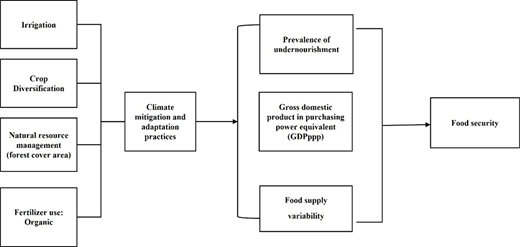
Second, we contributed to the literature by shedding light on the various mechanisms (POU, gross domestic product in purchasing power parity (GDPppp) and FSV through which CCMAPs affect food security. Malec et al. (2024) indicated that investments in agriculture increase food security (utilization) by increasing food productivity, where available resources are channeled toward improving foods with high nutrient contents. Building on this theoretical linkage, our mechanism analysis provides empirical evidence on how specific CCMAPs alter economic and nutritional outcomes across SSA. Our results indicate that irrigation, crop diversification, forest cover area and the use of organic fertilizer is reducing the POU in SSA, while increases in irrigation are improving the GDPppp. Figure 1 depicts the conceptual framework of the study.
The study is therefore organized as follows. The next section conducts a literature review. Section 3 gives an overview of the data and variables used. Section 4 depicts the empirical models used in the study. Section 5 presents the results and discussion, while Section 6 concludes the study.
2. Literature review
2.1 Theoretical basis of the study
Climate change adaptation and mitigation involve actions that enable societies to reduce adverse effects on health and well-being while leveraging opportunities provided by their climatic environment (Connolly-Boutin and Smit, 2016; UNFCCC, 2017). These practices aim to minimize negative impacts or capitalize on potential benefits of climate change. A central objective of climate change adaptation and mitigation is to strengthen the resilience of both populations and agri-food systems. Resilience, conceptualized across psychology, sociology and biological disciplines (Herrman et al., 2011), reflects a system’s capacity to absorb shocks, adapt through incremental adjustments and transform through structural changes (Lee et al., 2023). Accordingly, this study adopts resilience theory, which emphasizes how systems respond to and recover from shocks such as climate change. At the national level, strategies including irrigation, crop diversification, natural resource management and the use of organic fertilizers enhance resilience by improving soil fertility, stabilizing yields, conserving ecosystems and reducing vulnerability to climatic shocks (Ernest et al., 2024). This study integrates insights from adaptation economics and food systems resilience (Omokpariola et al., 2025), highlighting that resilience to climate shocks in SSA encompasses not only biophysical capacities but also economic mechanisms that influence how food systems respond. It further states that climate-resilient agricultural practices are associated with enhanced coping and adaptation, which in turn shape the multidimensional food security outcomes (availability, access, utilization and stability). Within this framework, adaptation-oriented practices such as crop diversification and irrigation primarily strengthen absorptive and adaptive resilience by addressing short- to medium-term climate stress, meanwhile mitigation-oriented practices such as organic fertilizer and forest conservation contribute to transformative resilience and the altering of long-term system dynamics. In addition, this study draws on the Food Security Dimensions Framework (FAO, 2008), which defines food security through four interconnected pillars: availability, access, utilization and stability. Climate change adaptation and mitigation practices influences food security by enhancing availability (through increased and stable production), access (via stable markets and reduced price volatility), utilization (through improved dietary quality and food safety) and stability (by reducing exposure to climate risks) (Bazzana et al., 2022; Hasan et al., 2018; Mihrete and Mihretu, 2025; Teklewold et al., 2019a). This framework allows the study to evaluate food security more comprehensively, beyond production alone. Furthermore, by mapping resilience capacities to these four pillars, the study offers a multidimensional framework that illustrates the mechanisms through which CCMAPs impact food security. This framework goes beyond traditional CSA-focused research by providing a system-level, regional nuanced understanding of how CCMAPs affect food security in SSA. Building on the resilience theory and the Food Security Dimensions Framework, this study empirically examines the effects of CCMAPs on food security in SSA and its four sub-regions.
2.2 Empirical literature review
Over the years, some studies have been conducted at different levels to evaluate the relationship between CSA and food security in different areas in SSA. Numerous studies have highlighted how CSA and different adaptation strategies improve food security at the country and household levels in different parts of SSA. For instance, if CSA practices are adopted they will improve food security (Tilahun et al., 2023; Wakweya, 2023), improve soil fertility status, increase crop yield, per capita nutrition consumption and dietary diversity, increase income of smallholder farmers, hence reducing poverty (Tadesse and Ahmed, 2023; Araya et al., 2023), small-scale irrigation improves livelihoods (Bojago and Abrham, 2023), CSA increases the food consumption score (Belay et al., 2023) and CSA practices provide higher average technical efficiency (Alemayehu et al., 2024). One exception is Muchuru and Nhamo (2017), who suggested that adaptation to changes in climate increase livestock production. By contrast, Oduniyi and Tekana (2019) found that awareness of climate change does not result in agroforestry adoption. Furthermore, some previous empirical studies have examined certain climate change adaptation strategies and their implications for food security in selected countries in Africa. For instance, Ndiritu and Muricho (2021) examined the impact of climate change adaptation strategies in the semi-arid region of Ethiopia and discovered that adaptation to climate significantly improves food security. Additionally, Gebre et al. (2023) indicated that the adoption of climate change adaptation practices such as early planting, cultivating drought-tolerant maize, income diversification, precautionary savings, growing early-maturing crops and selling assets increases the food security of farm households in Tanzania. Diallo et al. (2020), in a study conducted in Mali, indicated that adaptation increases productivity and, in turn, food security among the housing households. Subsequent studies, such as a review by Castells-Quintana et al. (2018), investigated climate change adaptation among poor households in SSA, highlighting key barriers such as lack of financial resources, access to information and migration and remittances as important coping strategies. More recently, a study by Kiratu et al. (2025) examined how different irrigation setups, that is, public and farmer-led, influence dietary diversity in Kenya, with the findings indicating that farmer- and public-led irrigation setups have a positive effect on dietary diversity and agricultural income. On another note, household-level studies from Liberia (Amadu and Miller, 2024) provide evidence that participation in the forest sector significantly reduces the number of months that households experience food insufficiency. Kabubo-Mariara and Mulwa (2019) noted that households that adapt to changes in climate by adopting technologies like early planting, crop diversification and improved crop varieties produce more food compared to the non-adapters. Beyond demographic, economic and institutional characteristics or factors, the effect of CCMAPs on food security, has increased greater attention in the context of SSA. These studies used different CCMAPs such as irrigation, crop diversification, forest cover area and organic fertilizer use because these practices enhance resilience to shocks in climate, help to stabilize food production, improve soil water management as a result improving food security and climate change conditions. Nevertheless, these studies remain limited in scope, with a focus on single countries or crops, which therefore leaves gaps in regional macro analyses that examine the broader effects of CCMAPs on food security in SSA. In summary, while CCMAPs differ conceptually and empirically from CSA by encompassing a broader range of strategies beyond techniques in agriculture alone, CSA focuses specifically on sustainable systems in farming that increase productivity, reduce greenhouse gas emissions and build resilience. CCMAPs encompass the wider climate change mitigation and adaptation measures that affect food security. By using a multi-regional panel data analysis across the four sub-regions, our study therefore investigates the broader effects of CCMAPs on food security in SSA and its sub-regions and goes further to examine the different pathways through which these practices affect food security.
3. Sample
3.1 Data sources
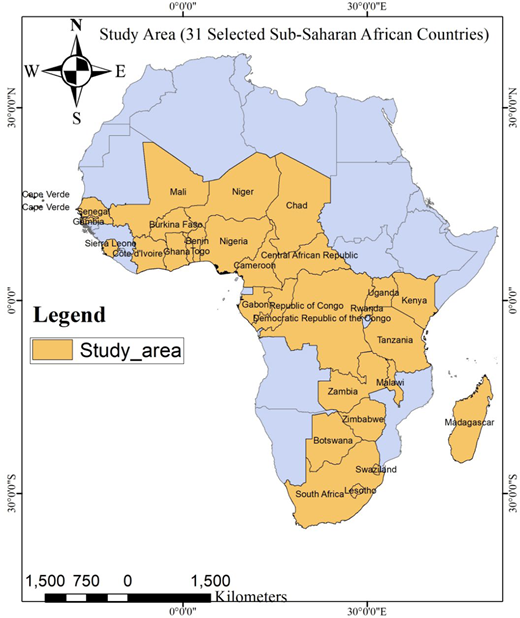
This study uses panel data spanning from 2000 to 2021, from sources such as FAO: www.fao.org/faostat/en/#data/FS; WDI: Link to the website of worldbank; USDA: www.usda.gov; Climate Change Knowledge Portal: Link to the website of climateknowledgeportal, which have been summarized in supplementary Table S.1 in supplementary. This study uses observed data that captures real changes over the study period for the selected variables of CCMAPs, thereby reflecting factual variations across the countries and time rather than assuming fixed trends. This, therefore, supports an accurate assessment of their effects on food security outcomes. The 31 SSA countries selected for the study consisted of Zimbabwe, Zambia, the United Republic of Tanzania, Uganda, Rwanda, Mauritius, Malawi, Madagascar, Kenya, Cameroon, Central African Republic, Chad, Congo, DR. Congo, Gabon, Botswana, Lesotho, South Africa, Eswatini (Swaziland), Benin, Burkina Faso, Cabo Verde, Cote d‘Ivoire, Gambia, Ghana, Mali, Niger, Senegal, Sierra Leone, Nigeria and Togo. The 31 SSA countries were chosen based on their food insecurity history and economic contribution to SSA’s growth, according to a report on “climate change and chronic food insecurity in SSA” by the International Monetary Fund (2022). The selected countries are then placed into four sub-regions: East, West, Middle and Southern SSA, based on the United Nations geo-scheme for Africa (2024). Figure 2 illustrates the selected countries.
3.2 Variables
3.2.1 Dependent variable.
The main dependent variable of our study is food security, measured by the ADESA, prevalence of obesity in adults and the percentage of children who are stunted.
Average dietary energy supply adequacy (ADESA) evaluates the extent to which the dietary energy supply in a given country meets the minimum dietary energy requirements. A value of 100% means the energy supply meets needs; above 100% indicates surplus and below 100% signifies insufficient supply. It is measured as a percentage, and this proxy represents the food availability with data sourced from the FAO. The descriptive statistics of the ADESA across the study period are illustrated in Table S.2 in supplementary material. SSA has a mean and standard deviation of 2.036 and 0.044, respectively. Additionally, the results from (Figure S.1 in supplementary) show that the ADESA rose steadily from 2000 (103.6) to 2011 (111.2), decline from 2012 (111.4) to 2013 (111.2) until 2015 (110.7). The ADESA then experienced a slow rise from 2016 to 2020 (111.5) followed by a slow decrease in 2021 (111.2).
Obesity. It measures the proportion of adults in a population with excessive body fat. It is measured as a percentage, with data sourced from FAO. This proxy represents food utilization. Descriptive statistics are illustrated in Table S.2 in supplementary material, with SSA having a mean and standard deviation of 0.843 and 0.288, respectively. Additionally, Figure S.2 in supplementary shows that SSA is experiencing a steady rise in obesity in adults from 2000 (5.4) to 2021 (11.99).
Stunting: It is the percentage of children between the ages of 0 and 59 months whose height for age is more than two standard deviations below the WHO’s median height for age. Stunting was measured in percentage and serves as a proxy for food utilization with data sourced from the FAO. The descriptive statistics of the percentage of children under five years of age who are stunted across the study period are presented in Table S.2 in supplementary material. SSA has a mean and standard deviation of 1.478 and 0.172, respectively. Trends as depicted in Figure S.3 in supplementary show a gradual decline in stunting from 2000 (37.4) to 2021 (25.5).
3.2.2 Independent variable.
To examine the effects of CCMAPs on food security, irrigation, crop diversification, natural resources management (proxy being forest cover area) and fertilizer use (organic fertilizer) are considered the main independent variables. The description and measurement of the variables are as follows.
Irrigation. It entails irrigation on small plots in which smallholder farmers control all the activities or its term as the total area equipped for irrigation. This is a CCMAPs because it creates a carbon sink and improves soil fertility. It is measured in 1,000 hectares with data sourced from the United States Department of Agriculture. The descriptive statistics are presented in Table S.2 in supplementary. It can be inferred from the table that SSA has a mean and standard deviation of 1.556 and 0.808, respectively. Additionally, the results from Figure S.4 in supplementary show that the area equipped for irrigation in SSA has been steadily increasing from 2000 (4,199.8) to 2021 (5,422.03).
Crop diversification. Crop diversification refers to planting a variety of crops of the same or different species on land. This study focuses on five main crops for use in constructing the crop diversification index: maize, sorghum, millet, rice and wheat, with data sourced from FAO. Our crop diversification is calculated with the use of the Simpson index of diversification, given by one minus the sum of squares of the proportion of land area allocated to each crop. Descriptive statistics are presented in Table S.2 in supplementary. It can be inferred from the table that SSA has a mean and standard deviation of 0.425 and 0.209. Trends in the crop diversification index as illustrated in Figure S.5 in supplementary show fluctuations with peaks in 2011 (13.18059) and 2016 (13.30567), and with some gradual increases and decreases across the study period.
Natural resources management (proxy forest cover area): Forestry is crucial in maintaining biodiversity, regulating the climate, protecting water resources and supporting livelihoods. It is measured as the percentage of land area with data obtained from the WDI. The descriptive statistics are presented in Table S.2 in supplementary. It can be inferred from the table that SSA has a mean and standard deviation of 1.358 and 0.400, respectively. The results from Figure S.6 in supplementary depicting trends show that the forest cover area in SSA has steadily decreased from 2000 (977.3924) to 2021 (873.7801).
Fertilizer use (organic fertilizer): It entails putting animal dung or manure on farmlands for soil fertility improvements. It is a CCMAPs because it reduces nitrous oxide and methane emissions. It is measured in kilograms, with data obtained from the FAO. Descriptive statistics are presented in Table S.2 in supplementary. SSA has a mean and standard deviation of 5.972 and 0.926. The results from Figure S.7 in supplementary depicting trends show that SSA is experiencing a steady rise in the use of organic fertilizer (livestock manure) from 2000 (70,664,769.21 kg) to 2021 (119,908,691.4 kg).
3.2.3 Channel variables.
The study uses three channel variables ranging from POU, GDPppp and FSV. First, POU: It measures the percentage of a given population that does not consume enough food to meet their minimum dietary energy requirements. Itis measured as a percentage of the population, and this data was obtained from the FAO. Descriptive statistics of POU are presented in Table S.2 in supplementary. It can be seen from Table S.2 in supplementary that SSA has a mean and standard deviation of 1.282 and 0.288, with Southern SSA having the highest mean value of 1.316, while Western SSA had the lowest mean value of 1.130. Second, GDPppp reflects an individual’s economic well-being and purchasing power, and it is measured in current international USD. The descriptive statistics of GDPppp are presented in Table S.2 in supplementary. It can be inferred from Table S.2 in supplementary that SSA has a mean and standard deviation of 3.435 and 0.375, with Southern SSA having the highest mean value of 4.008, while Western SSA had the lowest mean value of 3.367. POU and GDPppp all represent food accessibility. Finally, FSV measures the annual fluctuations in the per capita food supply available for human consumption within a given country over a given period and measured in Kcal/Cap/day. This proxy represents food stability. Descriptive statistics of FSV are presented in Table S.2 in supplementary. It can be seen from Table S.2 in supplementary that SSA has a mean and standard deviation of 1.445 and 0.307, respectively.
3.2.4 Control variables.
This study uses six control variables: population growth, individuals using the internet, precipitation, temperature, total maximum temperature and total minimum temperature. The data for the control variables was sourced from the WDI and the Climate Change Knowledge Portal. SSA has a mean value of 0.343, 0.620, 1.399, 1.557, 13.552 and 2.944 for population growth, individuals using the internet, temperature, total maximum temperature, total minimum temperature and precipitation. The selected variables with their units of measurement and the data sources are illustrated in Table S.1 in supplementary, while Table S.2 in supplementary portrays the descriptive statistics of the variables.
4. Empirical model
4.1 Effects of climate change mitigation and adaptation practices on food security in sub-Saharan Africa
The first objective of this study is to examine the effects of CCMAPs on food security in SSA and its four sub-regions using panel data from 2000 to 2021 and with the use of the fixed and random effects model as the benchmark model of the study. In other to achieve this, we followed the previous work (Sheytanova, 2015) to set up the fixed effects (FE) modeling, which is expressed in equation (1) as
The variables used in this study for the computation of the FE are expressed as:
The random effects model (RE) is represented as:
where y depicts the dependent variable, and x the independent variables as already defined above. α0 = constant term, t = time variable (2000–2021) and i = selected 31 sub-Saharan African countries.
4.2 Pooled mean group estimation
This study used the pooled mean group (PMG) estimation approach for dynamic heterogeneous panels (Pesaran et al., 1999) to also investigate the long-term effects of CCMAPs on food security in SSA. This methodology addresses the issues of endogeneity through the inclusion of lagged dependent variables depicted in the model as , which act as internal instruments that account for the dynamic feedback effects on food security. Pesaran et al. (1999) depicted that the bias and reverse causality resulting from missing dynamics are lessened when enough lags of the dependent and explanatory variables are being included. Furthermore, this approach also enhances estimation efficiency by allowing short-run dynamics to vary across countries while assuming long-run coefficients are the same, thus controlling for unobserved heterogeneity (Caporale et al., 2023). Despite the importance and the advantages of the PMG, this estimator has several limitations that need to be acknowledged. First, the PMG assumes that long-run coefficients are identical across all cross-sectional unit. Second, this estimator requires a long-time span for the data to be able to estimate the individual short-run dynamics that are reliable for each section. To ensure the validity of our estimations, we addressed the limitations by using appropriate diagnostic tests and panel data that covers a time frame from 2000 to 2021. The model is represented as follows:
FSit represents food security, Zi is the vector of regressors, captures unobserved country-specific effects and is the error term. represents the scalars and denotes the coefficient vectors.
4.3 Possible channels to explain the effects of climate change mitigation and adaptation practices on food security in sub-Saharan Africa
The second objective of this study was to investigate the effects of CCMAPs on food security in SSA through the channel variables POU, FSV and GDPppp. These channels were included to capture the indirect pathways through which CCMAPs affect food security. It can be expressed mathematically with the use of the FE as:
The selected variables are then converted to natural logarithms as follows:
5. Results and discussion
5.1 Effects of climate change mitigation and adaptation practices on food security in sub-Saharan Africa
In this section, we explore the effects of CCMAPs on food security (availability and utilization) in SSA. The estimations that are portrayed from equations (1) to (2) focused on measuring how CCMAPs affect food security in SSA. The FE and RE model were used in this stage as the benchmark model. The FE was considered after carrying out the estimation given that the p-values were less than 0.05. The results are represented in Table 1.
The findings in Table 1 demonstrated that irrigation increases food availability and decreases stunting. Particularly, a 1% increase in irrigation-cultivated land is correlated with a 0.032% rise in ADESA and a 0.031% increase in obesity, which is contrary to its expectations. A potential explanation is that increased agricultural output from irrigation may have an indirect effect on obesity trends by increasing household income, which may lead to greater consumption of processed and calorie-dense foods (Popkin, 2014). Our unexpected results may also be a result of some broader socio-economic dynamics where the dietary patterns of the household may change when they move from subsistence to more commercial farming and lifestyle, thereby promoting sedentary behaviors and increases in the consumption of fats and refined foods. Additionally, changing dietary patterns associated with higher income, socio-economic factors and urbanization may also contribute to these unintended outcomes (Ajayi et al., 2016). Our unexpected results can also be understood through the lens of the food security dimensions framework, which depicts that there exists a critical tension between availability and utilization. While irrigation successfully increases food availability, this framework suggests that food security is not achieved unless the available food is used effectively for health. Our results, therefore, indicate that utilization is compromised as dietary quality declines. Furthermore, resilience theory provides an explanation for this systematic change, in that irrigation is designed to make farming systems resilient to environmental shocks, but this can cause a fundamental transformation, as households may become more economically resilient through an increase in income, thus encouraging them to transition from carrying diverse subsistence farming to commercial agriculture. This change may introduce some vulnerabilities, as the households may transition nutritionally to more processed and calorie-dense foods, which may lead to obesity and undermine the health outcomes. This finding, therefore, carries policy implications for agriculture and nutrition. Our study therefore recommends the promotion of nutrition education when scaling up irrigation-based agricultural strategies. In addition, the finding shows that a 1% increase in irrigated land leads to a 0.102% reduction in stunting. This demonstrates that allocating land for irrigation improves the availability of foods and health outcomes by increasing agricultural yield while stabilizing food production. This concern was also raised in a review by Domènech (2015), who found that previous works have shown that irrigation improves yield and food security. This study supports Domènech (2015), who emphasizes the relevance of irrigation in improving food security and nutrition in SSA, where hunger remains a major issue. Irrigation could increase food availability, nutritional diversity and earnings. Similarly, Okyere and Ahene-Codjoe (2022) found that it boosts household food consumption in Southern Ghana. Adetoro et al. (2022) demonstrated that irrigation farming raised per capita food consumption by 44% in South African farm households. In addition, irrigated agriculture allows smallholders to harvest crops multiple times yearly, resulting in stable production, increased revenue and improved asset accumulation. Finally, Tesfay (2021) demonstrates that irrigation improves crop income and household consumption and boosts excess output, permitting better market integration.
Second, Table 1 also presents the impact estimates of crop diversification on food security outcomes (ADESA, stunting and obesity). Crop diversification improves food availability (ADESA) by reducing reliance on a single crop and improving resilience to climatic shocks at a 5% significance level. Cultivating one or more additional crops increases the ADESA by 0.034%. Crop diversity does not have a significant effect on stunting. This suggests that other interventions, such as changes in diet and food fortification, may be necessary to enhance child nutrition. In addition, crop diversification has a positive and significant influence on obesity at a 5% significance level, indicating that a 1% increase in the crop diversification index leads to a 0.071% reduction in adult obesity. The findings suggest that growing one extra crop or implementing a more diverse agricultural system reduces obesity prevalence. This could be attributed to the greater availability of various and better eating choices. Overall, the findings convey that SSA countries may enhance food supply and reduce obesity by producing more crops and distributing their land evenly among the products they grow. These results are consistent with the findings of Makate et al. (2016) and Teklewold et al. (2019); this makes crop diversification a more important option, as improving food security and diet options will help build smallholder farmers’ resilience to intensifying climate changes. A global systematic review (Mihrete and Mihretu, 2025) also confirmed that crop diversification at the farm level remains one of the most effective ways for improving food security and nutrition outcomes while also building resilience to climate change. Cross-regional evidence from South Asia has also confirmed the importance of agricultural diversification. In a meta-analysis of 116 studies from India, Tyagi and Haritash (2025) indicated that CSA practices, including diversified systems, increase productivity and soil health. This supports our finding that crop diversification increases resilience and, in turn, food security in the region. Furthermore, the results show that forest cover has no effect on food availability (ADESA) or stunting but significantly reduces adult obesity. This relationship could be related to reduced urbanization, as wooded areas frequently have less access to processed foods and harmful habits while simultaneously promoting traditional diets rich in natural foods, wild fruits and vegetables and protein sources. Furthermore, forest-rich areas could encourage healthier habits, including farming, fishing and collecting, as a result, diminishing obesity risks. These findings emphasize the significance of environmentally friendly forest management for preserving the environment and promoting better nutrition and lives (Araya et al., 2023). This work is consistent with earlier research on how forest-based food systems, dietary changes and shifts in land use influence nutrition outcomes (Ickowitz et al., 2014). Acharya et al. (2020) showed that forest cover reduction was connected with a slightly greater risk of obesity and stunting. Similarly, Rasolofoson et al. (2018) found that high exposure to forests enhances children’s dietary diversity by at least 25% compared to no exposure, implying that forests may play an important role in alleviating vitamin A and iron deficits. The positive effects of forests on obesity are also supported by evidence indicating that greater forestland per capita is associated with a decrease in the body mass index (BMI), likely due to increases in healthier diets (wild foods and diets involving fiber) and physical activity. A study in the USA found that countries that have more forest cover have a lower BMI, depicting forests as being valuable for reducing obesity-related health issues (Ghimire et al., 2017). Systematic reviews have also indicated that the availability of forests and greenspaces is highly associated with lower obesity rates across various populations (Teixeira et al., 2021;Luo et al., 2020). Our findings, therefore, contribute to this narrative by indicating a similar significant effect at the macro-level across SSA, thereby illustrating that forest cover is not just an environmental strategy but also a public health intervention.
Organic fertilizer usage, particularly livestock manure, has a positive and significant impact on ADESA, with each percentage increase in organic fertilizer use increasing food availability by 0.014%. This suggests that organic fertilizers improve agricultural output and food supply by enhancing soil fertility, increasing crop yields and promoting sustainable farming practices. Organic fertilizers improve soil structure, water retention and microbial activity, leading to better nutrient uptake and productivity (Aïhounton and Henningsen, 2024; Rogna, 2024). However, contrary to predictions, using natural fertilizers has a positive and significant impact on obesity, showing that greater agricultural productivity and food availability may lead to overconsumption of calorie-rich foods. This is consistent with research that shows that while agricultural intensification improves food security, it can also lead to dietary shifts toward energy-rich but nutrient-poor foods, increasing obesity risk (Pingali, 2007; Popkin, 2014). The findings highlight the importance of policies that improve food availability and dietary quality to achieve balanced nutrition while minimizing unintended health implications. The dual effect of organic fertilizer in improving food availability while contributing to obesity reflects the findings that indicated that agroecological practices can increase farm yields and diversity, but their nutritional impacts, however, depend on how the additional produce or income is used. If the income from increased output is spent on processed foods, the expected benefits could be lost, thereby indicating the need for nutrition-sensitive agricultural approaches which ensure that gains from production are translated to better dietary quality and health (Bezner Kerr et al., 2021;Van Zutphen et al., 2022).
5.2 Pooled mean group test
Our study also uses the PMG estimation approach to examine the long-term impacts of CCMAPs on food security in SSA. Diagnostic tests supported its use, with no multicollinearity concerns, mixed orders of integration and inconclusive Hausman comparisons with DFE (dynamic FE), thus making PMG to be retained as a complementary model to our study and the DFE results acting as its robustness test as shown in supplementary (Tables S5–S8 in supplementary). The results in Table 2 indicate that irrigation enhances ADESA while reducing stunting and obesity rates. Additionally, crop diversification decreases ADESA but increases obesity. Finally, forest cover area contributes to lowering the obesity rates, while increases in the use of organic fertilizers reduce both the ADESA and obesity in adults in SSA.
5.3 Heterogeneous effects
5.3.1 Effects of climate change mitigation and adaptation practices on food security in Eastern vs Western sub-Saharan Africa.
The study explores whether the impacts of CCMAPs varies by region. The estimation results are depicted in Table S.3 in supplementary. CCMAPs have diverse effects on the availability and utilization of food throughout Eastern and Western SSA, demonstrating regional disparities in ADESA, stunting and obesity. Irrigation, forest cover areas and organic fertilizers are improving the ADESA in Eastern SSA, with forest areas having the most impact. This suggests that a percentage increase in irrigated land, crop diversity, forest coverage and use of organic fertilizer enhances the ADESA by 0.171%, 0.039%, 0.451% and 0.030%, respectively. By contrast, irrigated agricultural land has no statistically significant effect on the ADESA in West SSA, whereas forest cover reduces the ADESA, indicating possible land use possibilities. Organically farmed fertilizers benefit both regions but have a bigger overall impact on the ADESA in Western SSA. This finding is similar to Asfaw Eshetu and Mekonen (2024) and Ebrahim and Toy (2024), who revealed that irrigation stabilizes food production in Eastern SSA because of its dry weather conditions. Additionally, Tambol et al. (2025) showed that land use conflicts may limit the benefits of CSA technologies.
Regarding the nutritional effects, CCMAPs affect stunting and obesity in different areas. Irrigation and crop diversification reduce stunting by 0.102% and 0.151%, respectively, in Western SSA, whereas the effects of CCMAPs such as irrigation, crop diversification and forest areas are weaker in Eastern SSA, possibly due to socioeconomic constraints that limit access to improved diets despite increased food supply (Khan and Akhtar, 2015). These findings are similar to Khan and Akhtar (2015), who showed that market inefficiencies in Western SSA limit food access.
In Eastern SSA, irrigation, crop diversification and forest cover area significantly improve obesity. This means that a percentage increase in land allocation for irrigation, crop diversification and forest area decreases the percentage of obesity by 0.164%, 0.141% and 0.727%, respectively. On the other hand, irrigation and crop diversification have a positive effect on obesity, indicating that obesity is more prevalent in Western SSA, where improved productivity in agriculture from climate mitigation methods is associated with greater consumption of calories and a shift into less nutritious diets. This pattern is consistent with FAO (2021) facts, which show that economic progress in Western SSA has resulted in higher obesity rates due to rising amounts of processed food products. As a result, Eastern SSA has a more balanced nutritional influence, most likely due to a more diverse agricultural economy. When comparing Eastern SSA to Western SSA, forest areas have the highest overall impact on ADESA, followed by stunting and obesity. Overall, the study’s findings emphasize the need for region-specific strategies that balance nutritional and food security outcomes while addressing the unforeseen consequences of agricultural intensification.
5.3.2 Effects of climate change mitigation and adaptation practices on food security in Middle vs Southern sub-Saharan Africa.
The study investigated the influence of CCMAPs on ADESA, stunting and obesity in the Middle and Southern SSA and found significant regional variation. The FE is considered except in the case of the outcome (obesity in adults) in Southern SSA with a p-value greater than 0.05 after computing the Hausman test. The results are illustrated in Table S.4 in supplementary.
First, in the Middle SSA, irrigation significantly increases food availability (ADESA). By contrast, other climate mitigation measures, such as crop diversification, forest cover area and organic fertilizer use, have a statistically significant negative impact on ADESA. This implies that a percentage increase in irrigated land enhances food availability by 0.856%, whereas crop diversity, forest areas and organic fertilizers decrease it by 0.194%, 0.267% and 0.077%, respectively. By contrast, in Southern SSA, both irrigation and forest areas increase food availability, implying that irrigation continues to enhance food availability (Okyere and Ahene-Codjoe, 2022; Tesfay, 2021).
Regarding nutritional outcomes, the impact of CCMAPs on stunting and obesity also differs across regions. As expected in Middle SSA forest areas, organic fertilizer significantly reduces stunting. A percentage increase in land cover by forests and the use of organic fertilizer decrease stunting by 0.535% and 0.099%, respectively. Similarly, irrigation and forest areas significantly reduce stunting in southern SSA. Increasing land cover by irrigation and forest area decreases stunting by 0.398% and 2.968%, respectively, suggesting potential dietary improvements. The study aligns with Ickowitz et al. (2014), who revealed that tree cover enhances dietary diversity and fruit and vegetable consumption in the Middle and Southern SSA. The study suggests that CCMAPs are more effective in reducing stunting in Southern SSA than in Middle SSA.
Surprisingly, irrigated land and crop diversification have been associated with increased obesity among people in both regions (Middle and Southern SSA), which is surprising and most likely related to changes in eating habits. In Southern SSA, a unit increase in irrigated land and crop diversification increases the likelihood of the adult being obsessed by 0.308% and 0.130%, respectively. One possible justification is that irrigation increases food production but does not always enhance nutritional results, potentially contributing to higher obesity rates by increasing access to calorie-dense foods. Applying the food security dimensions framework, our results show a critical disconnect between availability and utilization; while increases in irrigation increase food supply, dietary quality falls as households may shift toward the consumption of processed foods. The resilience theory further indicates that though irrigation enhances economic resilience by stabilizing production, it may trigger transformation in dietary systems by moving households from diverse subsistence farming toward commercial agriculture and sedentary lifestyles, thereby encouraging poor nutrition and vulnerabilities. Our findings therefore suggest that nutrition-sensitive approaches, such as healthy diet education and subsidies for the production of diverse and nutrient-rich foods, need to be integrated into our agricultural policies in the subregions so as to ensure that the gains that are made from agriculture are translated to the improvement of health rather than in unintended obesity outcomes.
However, forest area and organic fertilizers had inconsistent effects, reducing obesity in the Middle SSA but increasing obesity in the Southern SSA. This is similar to the findings of Asfaw Eshetu and Mekonen (2024), who hypothesize that agroecological and socioeconomic factors influence the success of CCMAPs. The findings underline the necessity for region-specific mitigation strategies to enhance their effectiveness.
5.4 Effects of climate change mitigation and adaptation practices on channel variables
This section focuses on the impact of CCMAPs on channel variables FSV, GDPppp and POU. The channel variables also serve as the food security dimensions (accessibility and stability). The estimations from equations (4) to (9) measure the effects of CCMAPs on the channel variables. The FE is considered except in the case of the FSV, as its p-value is greater than 0.05 after computing the Hausman test. The results are presented in Table 3.
First, the empirical results from Table 3 indicate that irrigation has a significantly positive effect on POU in the selected SSA countries, indicating that an increase in irrigation by 1% leads to a decrease in the POU by 0.0124%. Increases in irrigation may increase food production, thereby leading to an increase in diet diversity and enhancing resilience to shocks brought forth by climate change, thus leading to a decrease in the POU. This study is similar to that of Domènech (2015), who emphasizes the importance of irrigation in increasing food security and nutrition in SSA. Irrigation can increase food availability, nutritional diversity and farmers’ earnings, thus increasing food security. Additionally, given that POU reflects physical and economic access to food, increases in irrigation can reduce undernourishment by increasing income from farms, smoothing consumption across the seasons and stabilizing food prices. Through these access channels, lower POU therefore translates irrigation-driven productivity gains into sustained improvement in the overall food security of SSA. Our findings also align with a broader review, which illustrated that micro-irrigation technologies in Asia and Africa contribute to a decrease in poverty and help smallholders better manage constraints in food access and market fluctuations (Angom and Viswanathan, 2023).
Second, crop diversification reduced the POU in the population. This implies that an increase in crop diversification by 1% leads to a decrease in the POU by 0.179% in the SSA region, thus implying that the food produced is highly accessible. Crop diversification can reduce the POU by boosting households’ access to food through greater availability of diverse food items and reduced vulnerability to market and climate shocks. By decreasing the POU, crop diversification indirectly increases overall food security by enhancing more nutritional adequate food consumption. These results are similar to the findings of Makate et al. (2016) and Teklewold et al. (2019), who depicted that crop diversification improves food security and diet options. The study suggests that SSA countries should embrace crop diversification more because crop diversification can enhance accessibility and nutrition, thus decreasing the POU in the region. This strategy is very important in the context of SSA, where climate change and market volatility threaten food security in the region. The land covered by forest was observed to reduce the POU in the populations, with the findings showing that an increase in land covered by forest decreases the POU by 0.052% and, as a result, leads to a decrease in food security in the region. The results are, however, not statistically significant. Moreover, the use of organic fertilizers for the cultivation of crops has a weak relationship with the POU, suggesting that an increase in the use of organic fertilizers leads to a decrease in the POU by 0.051%. The reason for this decrease in POU is that the use of organic fertilizers may increase the fertility of the soil and boost food production, which will in turn increase household access to nutritious food, thereby increasing food security. Finally, the statistically significant positive relationship between irrigation and GDPppp, with the significance level being 10%, suggests that irrigating more farmlands for agricultural purposes is increasing the GDPppp of the population in SSA, thus leading to an increase in food security. The results of the study indicate that an increase in irrigation of farmlands for agriculture leads to a corresponding increase in the GDPppp of the population in the region by 0.044%. These results can be justified with respect to the fact that increases in irrigation in the SSA may be driving economic growth through the increases in agricultural productivity and food security, which directly increases the GDPppp of the population, thus reducing poverty and improving the livelihood of the population in the region. The results are similar to a review by Domènech (2015), who indicated that previous works have shown that irrigation improves agricultural yield and food security. This irrigation and GDPppp linkage also align with recent evidence from a systematic review by Ategeka et al. (2025), who conducted a meta-analysis of water sector interventions in multiple developing countries. They indicated, after analyzing 172 impact evaluation studies, that water-efficient irrigation systems significantly increase both income and crop yields. This evidence reinforces our findings that increases in irrigation can increase macroeconomic outcomes and, in turn, food security in SSA
6. Conclusion and policy recommendations
6.1 Conclusion
This study analyzes how CCMAPs affect food security in 31 SSA countries using panel data. Unlike much of the existing literature that examines CSA as a general and combined concept often using cross-sectional or single-country data, this study adopts a CCMAP-focused analytical framework that investigates how each practice affects food security and the different pathways through which these practices affect food security in the SSA region. The findings concluded that irrigation increases food availability and significantly minimizes stunting. Crop diversification and organic fertilizers improve the ADESA while lowering the prevalence of obesity. Forest conservation has no direct impact on ADESA or child nutrition, but it does significantly decrease obesity rates, perhaps due to healthier traditional diets in wooded areas. These results provide empirical support for the theoretical proposition that CCMAPs influence food security. Additionally, the results show that mitigation and adaptation related practices affect food security in different ways by strengthening different types of resilience. This important distinction often not clearly addresses in CSA focused studies. Moreover, this study examined how CCMAPs affect food security in the four sub-regions of SSA. In Eastern SSA, irrigation, forest areas and organic fertilizers increase food availability, whereas in Western SSA, irrigation has a low effect, and forest cover reduces food availability. Similarly, irrigation increases food availability in Middle SSA, but other CCMAPs measures have significantly and negatively affected food availability. In Southern SSA, both irrigation and forest areas increase food availability. Regarding stunting, CCMAPs (irrigation and forest cover areas) reduce child stunting in Southern SSA, whereas forests and organic fertilizers help to increase child nutrition in Middle SSA. However, irrigation and crop diversification increased obesity across the Western and Southern SSA. This outcome demonstrates that climate-related agricultural interventions do not yield uniform food security outcomes across SSA, thereby underscoring the drawbacks of one-size-fits-all CSA policies and highlighting the need for region specific mitigation and adaptation strategies.
6.2 Policy recommendations
Our study proposes that to decrease obesity and enhance food availability in the various regions of SSA, policymakers should prioritize nutritious foods, increase crop diversity, extend efficient irrigation and then incorporate environmental and socioeconomic aspects that can maximize the benefits of CCMAPs. These measures directly support SDG 2 (Zero Hunger) and SDG 13 (Climate action) while also supporting SDG 1 (No poverty) and SDG 3 (Good Health and Well-being), thus offering practical guidance for stakeholders and policy makers to advance CCMAPs. To transform these recommendations into actions, the governments in SSA should integrate them into existing extension programs and also make it possible for farmer field schools in the region to demonstrate the importance of irrigation practices and crop diversification techniques directly to the communities in all four subregions. The feasibility considerations that should be taken here include the tailoring of CCMAPs to specific agro-ecological zones so as to ensure that there is agronomic suitability, the prioritization of low-cost, labor-efficient technologies that can match the capacity of the smallholder farmers and building these practices on the existing knowledge of the indigenous people and existing social networks to enhance adoption and learning. Furthermore, policymakers should make sure that the economic feasibility of CCMAPs, with emphasis on operational costs and potential investments, is considered to ensure that the interventions are affordable and sustainable. Cost-effectiveness and cost–benefit analysis are also important in determining if the expected gains from food security and resilience justify the resources required, most especially in the resource constrained SSA region. This requires establishing partnerships with input suppliers and microfinance institutions to create accessible credit schemes and ensure that the farmers can afford to invest in these practices. The feasibility considerations taken here should involve assessing the capacity of farmers to repay loans, developing flexible loans that align with agricultural cycles and training smallholder farmers on how to effectively and efficiently use these agricultural loans to ensure financial sustainability.
Institutional and governance constraints, such as regulatory frameworks, stakeholder capacity and policy coordination, should also be considered to facilitate the effective implementation of these practices. The effective implementation of these practices will rely on strengthening the coordination between the ministries of agriculture in the region and health and environmental stakeholders to develop a unified policy framework that aligns nutritional goals with climate change mitigation and adaptation efforts. The feasibility considerations that can be taken into consideration here include the establishment of multi-stakeholder platforms for consultation, conducting audits at the level of every institution to identify gaps or shortages in technical expertise and piloting interventions at district levels to test their effectiveness before scaling them up nationally.
Finally, challenges related to governance, such as coordination across agencies, stakeholder engagements and other regulatory compliance, should be managed carefully so as to ensure that CCMAPs are scaled up successfully. These challenges can be managed by establishing a centralized coordination platform to align the efforts of the agencies, streamlining regulatory compliance by embarking on clear accountability mechanisms and capacity building initiatives and also adopting a participatory framework for meaningful stakeholder engagements. The feasibility considerations that can be taken into consideration include the assessment of institutional capacities, ensuring that the political environment is sound and sustainable and designing projects that begin with pilot programs before they are scaled up at the national level.
6.3 Limitations of the study
This study’s limitations are as follows: first, the study focuses on four CCMAPs: irrigation, crop diversification, organic fertilizer and the forest cover area without taking other variables like the technology adoption, improved seed variety and crop rotation due to limited data in the context of SSA. Future studies that examine the effects of the above-mentioned variables will also produce very reliable results that can guide policymakers in setting up and implementing good policies to counter the effects of climate change, thereby leading to food security. Finally, another limitation of this study is potential endogeneity arising from reverse causality, omitted variables and measurement error. Reverse causality may occur if countries with better food security are also more able to adopt CCMAPs, such as irrigation, crop diversification, forest cover and organic fertilizer use. In addition, time-varying unobserved factors, including governance, conflict, market integration and policy reforms, may affect both CCMAP adoption and food security outcomes. Although FE and PMG estimation help reduce these concerns, they may not fully remove bias from time-varying unobservable. Measurement constraints also remain. ADESA captures national food availability, not household access or distribution, while obesity and child stunting are influenced by other factors, such as health and sanitation. Likewise, the CCMAP indicators are broad proxies that may not fully reflect the intensity or effectiveness of actual practices. Therefore, the findings should be interpreted as country-level associations rather than definitive causal effects.
References
Supplementary material
The supplementary material for this article can be found online.