The purpose of this paper is to determine the extent to which an afforestation programme as spelt out in the Forestry II programme has checked the encroachment of desert in the arid and semi‐arid zone of northern Nigeria.
The study is carried out in the afforestation project states aimed at evaluating the success/failure of the program. Field observation and a site visit are conducted on some communities as well as policies relevant to forestry sector are reviewed.
The preliminary findings of this paper indicate that the afforestation projects had a positive impact on both biophysical and socioeconomic environment and contributed to the sustainability of the afforestation programme.
This paper is primarily focused on the various components of the Forestry II programme and the extent they have helped in combating desertification.
The paper addresses the need for sustainable afforestation projects and discusses on how the community effort and participation of women plays an important role during the afforestation programs.
Introduction
Today's arid and semi‐arid zones of the world are concerned about the phenomenon of desertification. Policies, strategies, projects and programmes have been formulated and implemented at both national and international level. At the same time, the role of afforestation in land use should become more important in order to restore degraded land, support agriculture, strengthen food security, safeguard water reserves, and enhance the well‐being of local populace. In response to rapid deforestation and desert encroachment, the federal and state governments of Nigeria, in collaboration with the World Bank, embarked on some afforestation programs to check desertification and further environmental deterioration, while attempting to reclaim some of its dislocated communities. An initial “Forestry I” was designed to last from 1979 to 1986. However, this first attempt was unsuccessful and consequently was aborted in 1984. Seedlings survivals rate was very low. Anderson (1987) documents that less than 5 per cent of over 50 million seedlings distributed free of charge during the five‐year period survived. Despite the regrettable termination of the “Forestry I” programme, there were useful lessons learned for future investments. For instance, it was learned that some farmers acquired the free potted seedlings in order to use the enriched potting soil as fertilizer for their millet, and not necessarily to plant the trees (Anderson, 1987). This practice‐alerted programme planners to farmers' concern for better food crop yields into feed their family. Insufficient protection of saplings from grazing livestock, inappropriate choice of trees species, conflicting scheduling times, poor transportation and insufficient distribution methods, etc. were some of the limiting factor that constrained this precursory tree – planting initiative. It was also learned that farmers had tree preferences and took pains to protect and nurture their fruit and shade trees such as cashew, mango, parkia, guava and neem.
The Forestry II project was undertaken in the period of 1987‐1996. The objectives of these nation‐wide programmes included:
strengthening the structural base of the forestry sector through improved policies, revenue collection system, training and research;
stabilizing soil conditions in threatened areas and improving the supply of fuel wood, poles and fodder, by supporting farm forestry and shelterbelt activities; and
increasing the supply of industrial wood by improving the management of existing high‐priority plantations and by establishing new plantations.
Thus, the programme has three components:
- 1.
programme management and institutional development, involving the coordinating units;
- 2.
afforestation programmes (covering nine northern states); and
- 3.
forestry management programme (covering four states) (APCU, 1989).
The problem
In northern Nigeria, there is widespread land degradation, mainly attributed to deforestation. Increasing agricultural intensity and livestock over‐grazing, combined with increasing demands for fuel‐wood have led to a rate of deforestation estimated to be 3.5 per cent per year, one of the highest in the world (Medugu, 2008). For example, in Jigawa State, the area of land used for intensive agriculture increased from 36.8 to 69 per cent and undisturbed forest decreased from approximately 1.1 to 0.01 per cent from 1978 to 1992 (Westaneys and Woodley, 1998). Livestock densities are high, the majority owned by the nomadic Fulani, who retain large herds for security. Soils in the region are ferruginous tropical soils, generally of poor structure and low fertility (Nasiru, 2007). The hot and dry climate causes bare, un‐vegetated soils to easily heat up, especially during the dry season resulting in soil baking coupled with high‐evaporation rates, the soil becomes powdery and easily blown away by the wind (Nasiru and Majid, 2007b). Thus, in the absence of vegetation, wind and water erosion on exposed soils have extremely detrimental effects, limiting plant growth and productivity. In the far northern areas, increasing sand dune formation is also evident.
Until the early 1980s, the forestry sector in Nigeria had been a low‐government priority, comprising only 2.4 per cent of the federal budget (APCU, 1996). There was an inadequate national forest policy and improper forestry management strategies, as manifested in over‐exploitation of forest resources and lack of inventory to ensure sustained yield (Nasiru and Majid, 2007a). Forest revenue systems were outdated, which tended to treat forest resources as free commodities, and state forestry departments had not been managing forest reserves systematically (Medugu, 2007). Despite attempts made by government and the international community at checking desert encroachment through afforestation, desertification still remains the most pressing environmental problem in the dry land parts of the country (Medugu and Rafee, 2007). It is in the light of the above, that the Federal Government of Nigeria, within the overall framework of protecting the Nigeria environment has given prominence to the twin problem of drought and desertification. Thus, the Nigerian Government has put in place various national policies, institutional and legislative framework, sectoral programmes, and partnership building to address the problem of drought and desertification. But it is sad to note that despite all these efforts at both the international, national and state levels, the problems of desertification in Nigeria still persist.
Overview of drought and desertification and afforestation
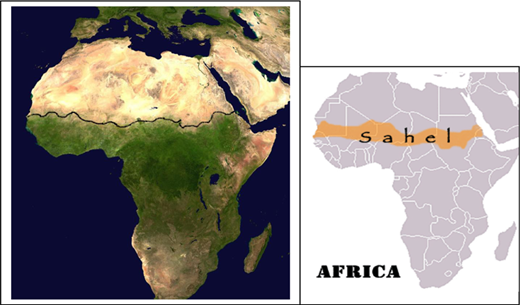
The Oxford Advanced Learner's Dictionary defines desertification as the process of becoming or making something a desert (OUP, 2005). Desertification is derived from the term desert which the Oxford Advanced Learner's Dictionary still defines as a large area of land that has very little water and very few plants growing on it. For example, the popular Sahara Desert in West Africa which the northern part of Nigeria neighbors with. Water and plants which are scarce in deserted areas are very crucial to human existence in an area. Drought and desertification are twin environment hazards that, since the catastrophic Sahelian droughts of 1968‐1973 have forced the international community to look more closely at development programmes in the arid and semi‐arid areas of the world. A recent analysis of NASA orbital photographs indicates that between the early 1960s and 1986 about 900,000 square kilometres (about the size of Nigeria) of former Savanna grass land in the Sahelian zone were displaced by desert or became severely degraded (Wells and Burke, 1990 in Cline‐Cole, 1998) (Figure 1). With the persistence of severe and devastating droughts since the 1980s in Africa (e.g. Ethiopia, Somalia and Sudan), the world is confronted with tragic reality of the frailty and fragility of human existence in these ecosystems (Oladipo, 1993). Desertification is caused by long hot by dry season with short rainy season.
The United Nations (UN) Food and Agricultural Organization (FAO) reported in 2001 that more than 100 countries covering 3.6 million hectares were seriously affected by desertification, which affects vegetative cover of croplands, pastures and woodlands, with its negative impact on biological diversity, soil fertility, often aggravated by increasingly recurrent droughts. It is no longer news in Nigeria that the Sahara desert is moving southwards at a rate of 0.6 kilometre yearly (Nasiru, 2007). What is news is that about 50 million people in northern Nigeria are suffering from the effects of desertification and the menace is posing a serious threat to the nation's economy, food security and employment. At least, 50,000 farmers in about 100 villages scattered along the desert fringes of the northern state of Yobe, one of the 11 state affected by desertification are currently at risk of abandoning this year's farming season due to sand dunes. The dunes have covered a large expanse of agricultural farmlands, oasis and ponds (Olori, 2002). The dunes are threatening life‐supporting oasis, burying water points and in some cases engulfing major roads in the affected areas. Trees planted by government as shelter belts to check the advancing dunes are withering due to lack of attention (Medugu et al., 2008). According to Yobe State Ministry of Environment; an aerial photograph taken indicate that productive and mass land occupied by the dunes has increased from 25,000 hectares to more than 30,000 hectares, with its negative impact on food and livestock production. Considering a conservative production of five bags of 100 kilograms of grain of millet or sorghum per hectare in the area, it means the 30,000 hectares destroyed by the dunes is capable of producing over 150,000 bags of millet. With an average grain requirement of one bag of 100 kilograms of millet per family of four per month, it then follows that 150,000 bags can support 12,500 families of four or 50,000 people per year (Olori, 2002). The big question is how these 50,000 people survive in this area? The reports from the other ten frontline states bordering the desert were not different either. The state commissioner for housing and environment in Borno State affirm that some bore holes dug by government to provide water have dried up due to acute drought aggravated by the effects of desertification in the state (Olori, 2002). It is in realization of this that governments of the world are making concerted efforts in combating desertification.
Desertification control (DC) is defined as an activity involving the integrated development of land in arid, semi‐arid and dry sub‐humid zones in a sustainable method, aimed at preventing and/or reducing land degradation, repairing partially degraded land, and at restoring decertified lands (Yafong, 1997, in FORMECU, 1999). People in arid zones have always applied elaborate types of land use such as stone‐built dykes. In 1973, Sahel countries set up a centre for DC. Since then, DC projects, programmes, policies and strategies have been actively formulated and implemented. In 1977, the UN conference on desertification led to the setting up of the UN Environmental Programme and to the formulation of a DC action plan. In June 1994, the UN convention on DC was adopted in countries seriously affected by drought and/or desertification, particularly in Africa. In 1994, the international community launched the Convention to Combat Desertification (CCD), which became operational in November 1997. Recently, more than 180 countries have ratified the convention, but only a few have implemented substantial programmes and policies that support the UNCCD (National Action Programme (NAP), 2000). Nigerian only began tackling desertification in 2001, when the then President Obasanjo launched a NAP (2000) on desertification, with a call for more concerted effort from all levels of government to check the menace of desertification. Obasanjo lamented that not much had been done in the past to combat the scourge, a situation he said, had given rise to the current problems:
With the country losing as much as 350,999 hectares of land yearly to desertification, it could not afford to watch while arable land is being lost to desert encroachment. It is because of this, that the government approved the establishment of a greenbelt across most of the northern parts of the country, spanning a length of 1,500 km and a width of one kilometre […]
Under the programme, the Federal Ministry of Environment is expected to plant about 150 million trees along the arid northern zone (Olori, 2002).
Past afforestation projects effort in northern Nigeria
In response to rapid deforestation and desert encroachment, a World Bank and Nigerian Government‐funded afforestation project and was implemented in northern Nigeria from 1988 to 1996. Although the UNCCD came into force in 1997, the Nigerian Government established a national committee on arid zone afforestation 20‐years earlier in 1977 to address the problem of desertification. Various other schemes were embarked upon since then to improve the arid zone eco‐system and human livelihood in these areas. In spite of these efforts, desertification is still very active (APCU, 1997).
Further concerned about the rapid rate of desertification and the attendant loss of biodiversity and human travails as well as suffering in the desertified areas were also embark upon when the former President Obasanjo directed the Federal Ministry of Environment in the year 2000 to establish a green belt stretching from Kebbi State in the North‐West to Borno State in the North‐East. The ministry has already prepared a national action plan to combat desertification in line with the UNCCD. Some nurseries were also established to raise seedlings towards the take‐off of the green belt project. In 2008, President Yar'adua was quoted as saying that climate was a major contributing factor to desert encroachment due to global warming, and urged Nigerians to plant trees in order to cool the earth. According to him, land degradation and desert encroachment have constituted a bottleneck in the development of the affected areas of the country. The president said the government was committed to sustainable afforestation programme for the mitigation of the effects of climate change.
In view of the magnitude of the problem of desertification, it becomes very necessary to commit both human and financial resources in order to rescue Nigerians from the scourge. In line with this resolve, a stakeholder's forum was held on 19 January 2004, involving the governors of the frontline states, relevant ministers, the military and representatives of the legislative bodies on the way forward in the establishment of the green belts like shelterbelt for afforestation. Shelterbelt development and management and erosion management and prevention have to be understood as holistic and consensual efforts, at promoting sustainable development in our degraded ecosystem. The council should develop programmes that will be packaged with other developmental schemes that will improve skills and family income, create jobs, provide social amenities, empower the vulnerable groups especially women, youths, the aged and even the destitute. More importantly, it should also aim at poverty reduction, in line with national economic empowerment and development strategy, which is the bedrock of the reform agenda of the Nigerian Government. This is also in line with the UN millennium development goals, which commit the international community to halve, by the year 2015, the proportion of people living in absolute poverty as well as the proportion of people suffering from hunger. Using an integrated, multi‐dimensional approach, the establishment of shelterbelts, windbreaks, woodlots, orchards and nurseries was combined with social forestry, which involved awareness raising campaigns, school forestry programme, forestry extension services and fuel wood conservation programme to address the environmental and socioeconomic problems in the region.
The afforestation projects approach in northern Nigeria
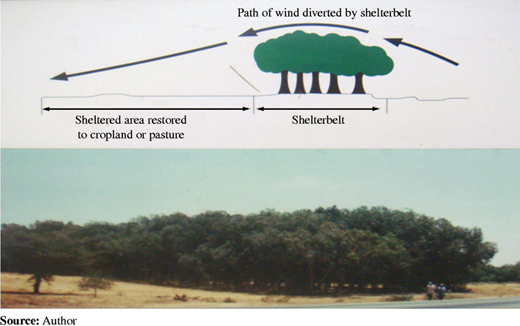
The major strategy used to control desertification was the planting of shelterbelts. Shelterbelts are long rows of trees aligned to break the impact of prevailing winds; in northern Nigeria, belts were aligned in a northeast/southwest direction to break the most damaging of winds, which occur in April‐May at the start of the rainy season (Figure 2). The main objectives of the shelterbelt establishment were:
to provide a source of fuel wood;
to provide a source of poles for building;
to prevent desert encroachment by stabilizing soils and reducing winds;
to increase crop productivity; and
to make marginal lands more arable.
The most common species used were the fast growing introduced species neem (Azadirachta indica) and eucalyptus.
Windbreaks are similar to shelterbelts, but with fewer rows of trees, so the land area affected is smaller. Windbreaks were sometimes adopted by afforestation project where the establishment of shelterbelts were resisted by farmers, due to scarcity of arable land (Plate 1).
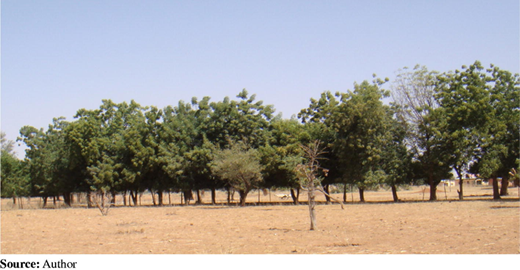
Woodlots were established by the project farmers, associations, schools and private individuals to increase the supply of wood for fuel and construction and to increase income by selling the products of the woodlots. They were generally 0.5‐1.0 acre in size, with mostly eucalyptus, neem and cassia planted (Plate 2).
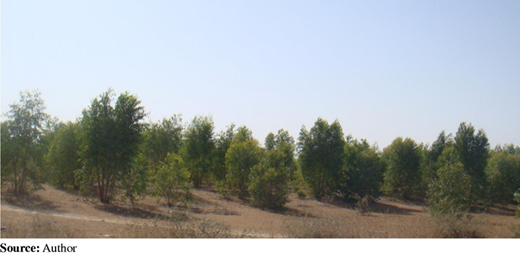
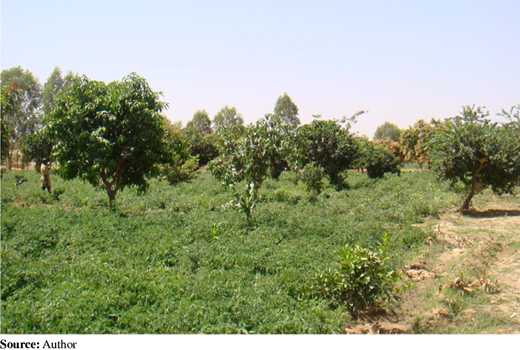
Orchards were developed to achieve revenue generation through the sale of fruits and nuts, as well as improved nutrition through consumption of the products. The species most commonly planted include guava (Psidium guajava), mango (Mangifer indica), moringa (Mornga oleifera) and banana (Musa spp.). Other species planted include cashew (Anacardium occidentale), custard apple (Anona muricata) and citrus (Citrus spp) (Plate 3).
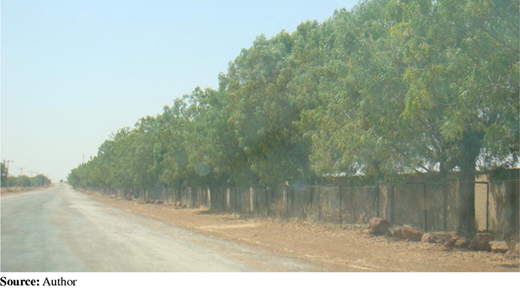
Natural regeneration sites were designed, through farmer awareness, to encourage the establishment and growth of indigenous, multipurpose tree species. This has resulted in reclamation of land and increased production of food, medicines and fuel wood. Roadside plantings were established by schools and communities to stabilize soils, provide fuel wood and poles, serve as windbreaks and provide shade (Plate 4). Nurseries were established to serve as sources of seedlings for the shelterbelts, woodlots and orchards.
Social forestry in the Forestry II project
Social forestry efforts focused on the participation of contact farmers, who were provided with incentives such as fencing materials, training and/or cash payment for surviving seedlings, in exchange for their participation in mobilizing other farmers (“target farmers”) to participate in the afforestation efforts. Farmers were encouraged to plant trees or allow tree regeneration on farms through agro‐forestry information services. Another area of focus was the school programme, which included the support of young foresters clubs, establishment of school woodlots, orchards and nurseries, afforestation training and competitions. Public awareness‐raising about the afforestation project was accomplished through the production and distribution of various extension materials on afforestation.
The evaluation method used for the assessment
The research study stratified the belts by zones, years of planting as well as by species of plants. Also for each of the afforestation programme state, a sample of shelterbelts, woodlots and roadside planting were randomly selected from the available list of these components. In cases where there were two zones of state, the same number of samples, which were planted in the same year where selected in such a way that the various trees species where included. Similarly, in cases where belt of the same species and planted in the same year but of different spacing, samples were selected from the various spacing that were used. About 94 shelterbelts sites were visited and measured 398 sample plots within the shelterbelts for survival rates, and 1,512 sample trees for growth rates in girth and height. About 14 roadsides, 47 sample plots and 213 sample trees were measured to assess the survival and growth rates of road side plantings in the nine afforestation programme states.
Summary of the results and findings
Records from this assessment shows that a total of 1,962 kilometres of shelterbelts were established throughout the afforestation programme states. These shelterbelts occupy a land area of 5,379 hectares. The state average survival rates of these shelterbelts are quite variable, ranging from a low of 48.7 per cent in Bauchi State to a high of 71 per cent in Katsina State. There is no significant difference in the survival rate of neem (58.6 per cent) and that of eucalyptus (57.8 per cent) which are the two species used in shelterbelts. The state average survival rates for the respective years were used to scale down the established number of kilometres of shelterbelts. The state average survival rates for woodlots were generally quite impressive throughout the nine afforestation programme states. However, the average survival rates in Yobe State's woodlots were unexpectedly low, when compared to other afforestation programme states. State average survival rates for woodlots ranges from 43.2 per cent in Yobe State to 85.5 per cent in Katsina State.
The afforestation programme states average woodlot survival rates for neem and eucalyptus are 67.6 and 77.1 per cent, respectively. These average survival rates of woodlots appear to be significantly better than those of shelterbelts. The state average survival rates for cassia semia in Borno and Katsina States, was 95 per cent. A total of 296 kilometres of roadside plantings have been established in the nine afforestation programme states. The survival rates of this component range from 31.7 per cent in Plateau state to 64 per cent in Katsina State. Generally, the roadside component though highly visible, was poorly understood and poorly executed, without community participation.
It was observed that there was poor payment in compensation on lands acquired. This has grieved the local farmers in some cases and they embarked on activities that were inimical to the growth of afforestation project. All afforestation programme states seem to pay very little attention to the maintenance or weeding of the shelterbelts, especially after the initial establishment. This was perhaps responsible for low‐survival rates in some cases, because failures that would have been detected and replanted were not discovered until very late. Unless local alternative protection devices are found to replace fencing wires and posts, no individual or community can afford to establish shelterbelts. Hence, many have raised the question of the continuity and sustainability of these shelterbelts by local communities. There was no evidence, in any afforestation programme state, of any proposed management plan for the comprehensive management of the shelterbelts that have so far been established. At the cessation of external funding, these shelterbelts are not likely to be weeded or even maintained.
Success of the afforestation programme in northern Nigeria
The afforestation programme in northern Nigeria achieved a high level of success. Original targets were closely met and additional activities were undertaken which enhanced the overall impact of the afforestation project and contributed to the sustainability of the afforestation efforts. The project had a positive impact on both the biophysical and socio‐economic environment. Afforestation targets were achieved through shelterbelts and woodlots. Increased crop yields were experienced on farms protected by shelterbelts and windbreaks and through the integration of agro‐forestry in the woodlots. A high level of awareness developed among policy makers, school teachers and students and the rural population of deforestation and desert encroachment, and the need for fuel wood conservation. Increased income was realized from orchards and woodlots. The supply of fuel wood has increased because of the woodlots and shelterbelts. In addition, improved nutrition and health was reported by participating schools and families through increased consumption of fruits.
In terms of social capital, the afforestation project built on existing economic and social systems, including traditional government, and strengthened community‐based organizations, including farmer's self‐help associations. Participating farmers have been empowered to establish and manage their own afforestation projects, which have proved to be a source of income and employment generation. At the state level, training and professional development have built the capacity of the afforestation units to effectively plan, implement and evaluate further afforestation activities.
Integration with other relevant sectors has been established, most notably through the unified agriculture extension services and through the school programme, which has linked forestry with health and education. Among other benefits, this integration has improved small farmer access to credit and contributed to the cost‐effectiveness of the afforestation achievements. Gender was not a focus in the original design of the afforestation project and participation of women was mainly limited to members of young foresters clubs at girls' schools. However, in recognition of the importance of women in afforestation, the afforestation project was later modified to mobilize women to produce and use fuel‐efficient stoves and establish their own orchards and woodlots. These activities have been a source of empowerment for participating women and have a high potential to spread to other women.
Post‐1996 afforestation programmes in northern Nigeria
Since the termination of the Forestry II programme, various efforts have been continued by the frontline states aimed at checkmating the scourge of desertification. For example, governments continue to distribute seedlings to members of the public free of charge. This seedling distribution was further complemented by the awarding of monetary rewards to outstanding farmers and communities. Tree planting campaigns have been intensified by governments in the affected states. Similarly, governments have embarked on both structural and non‐structural methods to check the impacts of environmental degradation. There is a deliberate effort made at distributing cooking stoves to replace the use of firewood. Governments have also embarked on massive construction of drainages, public enlightenment campaigns against unwarranted bush burning and indiscriminate felling of trees as well as application of environmental impact assessments on public and private projects. The frontline states are also engaged in the establishment of Jatropha plantations in forest reserves in order to provide bio‐fuel in order to replenish the soil. In addition, there is the random planting of eucalyptus tree species for sand dune fixation as well as for poles and desert encroachment.
The Nigerian Government also formulated the Nigerian Forest Action Programme (NFAP) in 1997 through articulated planning and involvement of all stakeholders in the forestry sector (FAO, 2003). The policy reform packaged in the NFAP led to the setting up of two committees, i.e. the national committee on the review of forestry and the wildlife legislation and the national forest policy review committee. The former has presented a bill to the national assembly, while the latter visited South Africa and Malaysia to put in proper perspective in their input to the new forestry policy, respectively. Greater emphasis is now placed on community participation in forest management. The former President, Chief Olusegun Obasanjo shortly after assumption of office initiated the development and approval of the blueprint on national forestry programmes which ran from the years 2000‐2003, with an approved budget of N11.25 billion (then $112.5 million) to execute the programme.
Sustainability of the afforestation programme
For afforestation projects to be sustained number of factors are responsible. First, there should be an increasing level of awareness of desertification and the benefits of afforestation among policy makers and the general population in the region. Second, there should be a strong commitment to afforestation among policy makers and leaders at the federal, state, local government and village levels, including traditional leaders. Third, the forestry sector has to be strengthening through integration with other relevant sectors and through the training of forestry officials, extension agents, contact farmers and school headmasters and students. And lastly, continued monitoring and periodic evaluation of any on‐going afforestation project is very important for sustainable management of the project and any plan or policy that is not backed by adequate funding cannot survive or yield tangible results.
Conclusion
The people of the arid and semi‐arid zone demonstrated a keen interest in self‐evaluation and were able to apply the lessons learned during the project activities to modify and improve the project, particularly in terms of community participation and the participation of women. The paper also recognized that it is important to identify and involve stakeholders in planning and implementation in order to create a sense of ownership and to ensure support for implementation and sustainability for future afforestation programmes. There was limited community participation in the design of the afforestation projects. It is necessary to encourage farmers to participate in the planning and implementation of the future programs and also to provide cash and materials in order to ensure effective participation and farmer's support for the afforestation activities to last. These afforestation project innovations can be replicable in other arid regions of the world where there are similar soil types, vegetation, land‐use and social structures. It is anticipated that there would be a high degree of replicability throughout arid zones in Africa, given the similarity of land‐use and social structures along the East‐West Sudan Savannah belt. Replicability of shelterbelts in particular would depend on government commitment and funding for shelterbelt establishment and the participation of local communities in the early stages of planning.
References
Further Reading
About the authors
Nasiru Idris Medugu is a Research Assistant at the Faculty of Built Environment, Universiti Teknologi Malaysia. Nasiru Idris Medugu is the corresponding author and can be contacted at: medugu@gmail.com
M. Rafee Majid is a Senior Lecturer at the Department of Urban and Regional Planning, Universiti Teknologi Malaysia. He is also the Director of the MSc Program in Environmental Planning at the Department.
Foziah Johar is an Associate Professor at the Department of Urban and Regional Planning, Faculty of Built Environment, Universiti Teknologi Malaysia.
I.D. Choji is a Senior Research Fellow at the National Institute for Policy and Strategic Studies in Kuru‐Jos, Nigeria.