For communities threatened by current or impending climate change, adaptation is becoming a necessity. Although little research has been done on human competences so far, this research shows that some appear to facilitate the adaptation process. The purpose of this multiple‐case study is to identify adaptive competences demonstrated by two groups of Canadian citizens: municipal employees in a coastal community and farmers.
As part of workshops based on a problem solving process, the two groups analyzed the impacts of climate change in their field of work and geographical area, chose a problem related to these impacts, suggested and then implemented adaptation measures. The municipal employees worked on sea level rise, whereas the farmers focused on poor soil quality, which makes it vulnerable to bad weather.
By thematically analyzing the verbatim transcripts of the workshops and by building narratives, the authors were able to identify similar adaptive competences in both groups: local knowledge, futures thinking, hindsight, risk prediction, critical thinking, decision‐making, and problem solving (highlighting key problem components, suggesting solutions, and identifying constraints). However, two competences were chiefly found in the group composed of farmers: optimism and openness to novelty.
This study is one of the first to lead to recommendations regarding the pedagogical support of citizens during an adaptation process to climate change. These recommendations might be helpful in many communities where adaptation to climate change is a pressing issue.
1 Introduction
In the Canadian province of New Brunswick, increased annual precipitation, longer heat waves, and more frequent storm surges are predicted because of climate change (New Brunswick Department of Environment, 2006). These phenomena may cause floods and droughts, and limit the availability of drinking water. Coastal communities and the agricultural sector are particularly affected by these events, and citizens must find ways to face extreme weather events to save their resources and their lands, as well as to ensure their own survival. In short, in such circumstances, the population must adapt to maintain an acceptable level of functioning.
Adaptation entails socio‐ecological systems reacting to actual, perceived, or expected environmental changes as well as their impacts (Janssen and Ostrom, 2006). In a context of global changes, human adaptation refers to a process, an action, or efforts exerted by a social group, whether it is a family, a community, or the inhabitants of a region or a country (Smit and Wandel, 2006). A number of factors can influence the adaptive capacity of citizens: genetic traits, resource availability in the affected community, the nature and length of prior exposure to stress (Armstrong, 2000), institutional structure, and human capital (Yohe and Tol, 2002). Although there is little research on the contribution of human capital to adaptation, some citizens' competences may facilitate adaptation to climate change. The concept of competence, as defined here, includes different resources and practices: cognitive and metacognitive (e.g. knowledge, know‐how, knowing how to act, knowing how to observe, control, and improving one's cognitive strategies); conative (motivation to act); physical, social (calling on an expert); spatial (efficient use of space); temporal (relevant organization of time); material (use of a book or tool); and affective (Joannert et al., 2004). According to Westera (2001), competences contribute to the effective application of knowledge and skills in a given context, therefore surpassing these concepts. Competencies are also dynamic and can be developed (Mentkowski, 2000 in Rubin et al. (2007).
During one of the few experiments on the subject, Pruneau et al. (2009) identified a number of competences conducive to adaptation among adults with no high school diploma in rural areas: local knowledge, observation skills, risk prediction, perseverance, and self‐efficacy.
According to Pruneau et al. (2008b), other competences can facilitate adaptation, such as problem solving, futures thinking, and decision‐making. Problem solving is a cognitive process in which an individual seeks to reduce the gap between an initial dissatisfying situation and a desired situation (Proulx, 1999). Given that adaptation presupposes problem solving, this competence may be necessary for successful adaptation. Futures thinking consists of thinking before acting, predicting the future with some degree of certainty, using current trends to make extrapolations, taking into account environmental turbulence to reach objectives, and maintaining a coherent and functional vision of the future (Godet, 2001; Slaughter, 2002). Futures thinking is used when defining hypotheses and images representing what may happen later on and when building a desirable future by suggesting ways of attaining it (Godet, 2001). The use of futures thinking can be relevant in an adaptation process because it is important to plan for the impacts of climate change and the effects of the chosen corrective measures. As for environmental decision‐making, it is defined as the way individuals, groups, and organizations make choices that have an environmental impact (Brewer and Stern, 2005). Every stage of the adaptation process can involve decision‐making: choosing which climate change impact to study, which work strategy to adopt when suggesting adaptations, which measure to implement, which procedure to follow when carrying it out, and which method to use when monitoring. Other competences, such as communication, creativity, and leadership could also be found in citizens who successfully completed an adaptation process.
To identify the specific competences that facilitate climate change adaptation, two groups of citizens were accompanied and observed during an adaptation process. The first group comprised of municipal employees from the city of Bouctouche, in New Brunswick, who worked on adapting to sea level rise. The second group was composed of farmers from Kent County who worked on adjusting their practices to improve their soil's resilience. The multiple‐case study approach provided the means for identifying various adaptive competences. Since the workshops differed in duration and content for each group, the purpose of this research was not to compare the competences displayed by both groups; rather, the purpose was to build a list of competences that can facilitate adaptation in different contexts. In this article, we begin by presenting our research methodology. Then we explain and discuss our results. We end the article with recommendations relative to the pedagogical support of groups during their adaptation process and suggest new research avenues.
2 Methodology
This research was a multiple‐case study. Useful when studying a process among humans, the case study makes it possible to observe adaptation in its natural context (Savoie‐Zajc and Karsenti, 2000) because it is embedded in the comprehensive paradigm. Kent County in New Brunswick was chosen for our study because, in this region, the quantity and intensity of precipitation and storm surges may increase in the future, causing more frequent flooding and a greater risk of rivers overflowing (New Brunswick Department of Environment, 2008). Seven Bouctouche employees (six men and one woman) volunteered to participate in the study: two engineers, one geographer, one biologist, one computer scientist, one environmental scientist, and one city councillor. Five farmers (two men and three women) also agreed to participate in the study. Both groups were told that they would be working with peers and experts to identify and propose adaptations to a problem linked to climate change.
Workshops
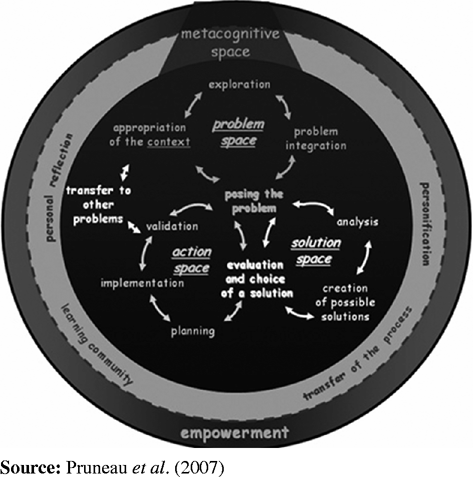
Both groups attended separate workshops, which lasted about two hours each, led by the same researcher and followed a general problem solving process as defined in the model proposed by Pruneau et al. (2007). Pruneau et al. conceive problem solving as a cyclical process consisting of constant back and forth motions between the problem space, the solution space, and the action space (Figure 1). The problem solvers identify an area of concern and explore all of its facets, allowing them to propose solutions and choose one that they will apply after planning their course of action. During the workshops, the participants were given information on climate change causes, signs, and impacts. Often, people tend to approach social problems in ways that overwhelm them and make it difficult to grasp (Weick, 1984). Therefore, we asked the participants to identify a specific problem on which to work. The municipal employees chose to work on sea level rise, while the farmers chose to improve the quality of their soil to make it more resilient to erosion, heavy precipitation, and droughts. Next, the participants carried out an in‐depth analysis of their chosen problem with help from the research team and invited experts. The research team answered the participants' need for information and supported the two groups as they suggested and implemented solutions. By the end of the workshops, municipal employees had implemented some adaptations: writing a grant application to map the town's underground infrastructures and preparing a map of the town highlighting the natural and artificial components that may be affected by different sea water levels. For their part, the farmers planted tillage radish to reduce compaction and improve soil aeration. The farmers also prepared a grant application to obtain mechanized equipment for this purpose and committed themselves to rotating their crops more often.
The first participants to take part in the workshops were the municipal employees. The pedagogical support was enhanced for the second series of workshops in which the farmers participated. After four workshops with the municipal employees, researchers noted that more time should be allowed for the adaptation process, which is why the farmers participated in six workshops instead of four. Moreover, in the workshops with the farmers, we used some educational strategies to strengthen their competences in futures thinking and decision‐making: The Decision Tree, a strategy to identify and assess several alternatives before making a choice, and The Futures Wheel, a visual method of identifying a chain of impacts and risks linked to a problem (Langis et al., 2008). These strategies were used to support the farmers during stages of the process that proved to be more difficult for the municipal employees. To our knowledge, the groups did not meet at other times to discuss the issue of adaptation to climate change.
Data collection
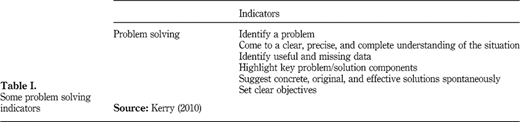
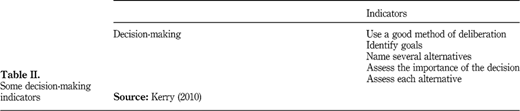
The workshops were observed by two researchers and were videotaped and transcribed to identify the participants' adaptive competences. To this end, Évéquoz (2004) suggested observing people at their task in a context in which competences could be seen. In order to avoid subjectivity, observations were carried out in accordance with specific indicators. Fact sheets describing the competences were prepared to identify participants' competences (see examples in Tables I and II). These fact sheets were created following a literature review on several life skills (Peterson and Seligman, 2004; Évéquoz, 2004; Pruneau et al., 2008a; EPA, 1992; Niss, 2003; Kerry, 2010; Adejumo et al., 2008). The fact sheets included a list of indicators for each competence likely to be demonstrated by the participants: problem solving, risk prediction, futures thinking, math skills, decision‐making, communication, creativity, curiosity, openness, love of learning, etc.
Data analysis
Thematic discourse analysis and writing narratives were used (Paillé and Muchielli, 2003). The verbatim transcripts of the workshops were first subjected to a thematic analysis by three researchers who followed a semi‐open model by using the fact sheets to make it easier to identify competences and their indicators. The three analysts compared their work and calculated the intercoder reliability score (95 percent). While some competences initially described in the fact sheets stood out in the analysis, others were less present, and new competences emerged.
Subsequently, narratives were built for each workshop by two researchers, first individually and then as a team, in order to answer the following questions: What happened during this workshop? How did the participants choose a problem, analyze it, and propose adaptations? Which competences were observed? The grid for building narratives progressively emerged while the first narratives were being written. Narratives included the competences demonstrated by the participants, their ways of working, and their limitations. A critical analysis of the narratives was finally conducted in order to identify the implications of the results.
3 Results
During the adaptation process, both groups went through the main stages of the problem solving model designed by Pruneau et al. (2007), from analyzing the larger problem of climate change to implementing adaptation measures for the specific problem chosen by each group. Similar competences were displayed in both groups: local knowledge, futures thinking, hindsight, risk prediction, critical thinking, decision‐making, and problem solving (highlighting key problem components, suggesting solutions, and identifying constraints). However, optimism and openness to novelty were mainly found in the group of farmers.
To predict climate change impacts, the municipal employees and farmers constantly shared their experiences, their prior observations, and their local knowledge. The municipal employees knew the location of infrastructures, houses, businesses, and underground utilities, as well as the different social groups in the region. This local knowledge enabled them to estimate the zones where flooding risks were more probable. The farmers easily predicted how climatic variations would affect their area. Furthermore, the farmers also shared their knowledge of climate change impacts in other regions of the world, comparing their situation to that of farmers in other regions. This seemed to help them predict impacts.
Futures thinking and hindsight were used by both groups. By talking about a violent storm that happened in 2000 (hindsight), the municipal employees were able to predict several potential impacts of a future storm surge (futures thinking). The farmers were also able to predict potential impacts of climate change (futures thinking) based on weather changes previously observed (hindsight).
Moreover, both groups constantly highlighted key components of the problem: vulnerable places, groups, elements, and infrastructures. Little by little, as the adaptation process progressed, the reasons why the participants identified key components seemed to change. At the beginning of the process, the participants underlined mostly key components in order to improve how they situated the problem geographically and to bring out its characteristics (i.e. the impacts). Towards the end of the process, the participants again emphasized and located the risks, not to analyze them, but rather to suggest solutions for each.
The municipal employees were able to suggest adaptations for several climate change impacts (e.g. flooding, increased erosion, stronger storm surges, and escalation in socio‐economic repercussions). Nevertheless, the municipal employees tended to mention the constraints tied to the implementation of their solutions, as much from a personal point of view (difficulty obtaining sandbags in emergencies) as from a collective standpoint (lack of regulations). In this group, the constraints interfered with finding solutions. The municipal employees were discouraged by the obstacles and hesitated in deciding if their solutions were feasible or not. The farmers were aware of several new techniques in their field of work. They too inferred disadvantages to the solutions they provided, but the advantages seemed to be more important to them.
Both groups made decisions during the adaptation process. As their main problem, the municipal employees chose sea level rise. Based on the decision‐making indicators in Table II, they explored few alternatives before making a choice. Their assessment of the alternatives was not very detailed, and these employees did not yet think about the chain of impacts caused by rising sea levels. Therefore, the employees' decision process resulted in a less suitable choice. According to two local climate change specialists, the region's topography makes it less prone to floods than the municipal employees believed. For their part, the farmers used The Decision Tree to help them select a priority problem. Thanks to this strategy, their extensive experience in farming, and their critical thinking, the farmers assessed the advantages and disadvantages of each alternative before deciding on improving the quality of their soil. The farmers justified this choice by saying that this measure would increase the soil's resilience to heavy rain and drought, which corresponds with recent theories on adaptation in agriculture (EC, 2010).
The farmers also demonstrated interest in learning, openness to novelty, and optimism regarding their own capacity to adapt. These competences seemed to have facilitated their adaptation process. Their interest in learning led them to read documents about agriculture and to attend presentations, thus enabling them to acquire new knowledge. The participants' desire to learn was obvious in the many questions they asked the invited experts. This new knowledge coupled with critical thinking seemed to help them afterward when analyzing the proposed adaptations. The farmers' openness to novelty (i.e. new techniques and equipment) appeared to facilitate their transition toward the action space described in Pruneau et al.'s (2007) problem solving model.
4 Discussion
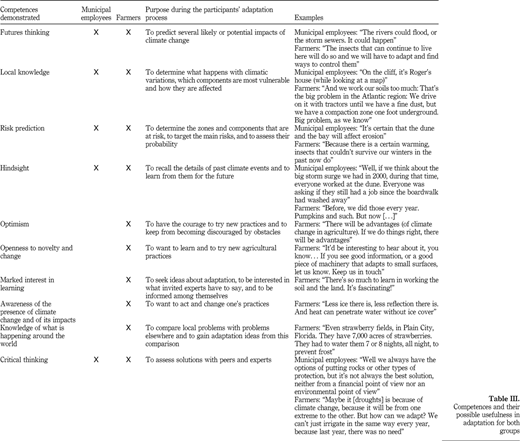
The competences demonstrated are similar in both groups, but a number of additional competences emerged among the farmers. Table III shows the competences observed that seemed to have facilitated the participants' adaptation process and provides an interpretation of the possible usefulness of these competences in adaptation.
The competences, as listed in Table III, seem interdependent. For example, resorting to both futures thinking and hindsight was common to bring out the key components of the problem. Municipal employees had observed and were aware of many aspects of their town: topography, location of businesses and structures, neighbourhoods, citizen groups, and people's values and lifestyles. However, it was not necessarily easy for them to predict how these elements would react to different extreme weather events. For this reason, the municipal employees trusted hindsight to predict potential impacts and reactions. Unlike the municipal employees, the farmers predicted more easily how the climatic variations would affect their fields. Having lived for a long time on their lands, the farmers had observed how different climatic and ecological variables (e.g. insect pests and pollinators) influenced their harvests and had had to adapt over time to various interrelated changes.
Both groups of participants used hindsight to draw from their prior knowledge to refine their climate change analysis. Futures thinking enabled them to see how this information can be used in the future and to determine how systems will work in light of the changes under consideration. These competences were displayed by both groups, even though the farmers – used to dealing with climatic variations – were more knowledgeable about how the changes affected their systems.
Identifying key components seemed to play a double role in adaptation. At the beginning of the process, this competence made it easier to explore the problem by singling out potential impacts, and the places, elements, or actors at risk, which is an important stage of the adaptation process. In fact, according to Burke et al. (2006), a group must understand an event before being able to adapt to it. Toward the end of the process, identifying key components became a platform for finding solutions. The potential impacts and the vulnerable places, elements, and citizens continued to be enumerated, but with the objective of finding solutions through reducing impacts and protecting areas or citizens.
Among the municipal employees, proposing solutions was hindered by the identification of constraints connected to action, which can be explained by their obligation to meet the expectations of both the town council and the citizens. The municipal employees had to make sure that the adaptation measures suggested would be financially feasible and socially accepted. The farmers, as the managers of their own businesses, were neither discouraged by the obstacles nor worried by the reactions of others. It is possible that the farmers could view the future with optimism because they knew they had already managed to overcome other difficulties in the past. Some of the climate change impacts predicted in agriculture are positive, which may be a factor in sustaining the farmers' optimism.
From the outset, the workshop leaders asked the municipal employees to choose a specific problem on which to work, whereas the farmers were given a longer time frame to gather information and analyze climate change. The additional interventions with the second group (farmers) may have promoted the choice of a more suitable specific problem. The decision‐making competence, which is necessary in adaptation, seemed more difficult for the municipal employees to master. This may notably be due to the complexity of environmental problems (Gauthier et al., 1997). In order to facilitate the process with the farmers, the workshop leaders used The Decision Tree so that they could identify the consequences associated with the various alternatives before ultimately choosing soil as their problem. Regarding which adaptation measures to implement, these participants quickly identified those they wished to carry out: planting tillage radish, submitting a grant application for specialized equipment, and practising more crop rotations. This rapid decision could be due to the farmers' decision‐making competence or to the knowledge of their options, given the fact that they discussed the subject during the workshops. Indeed, they justified their choice by saying that minimum tillage would result in improved management of climate change problems.
During the adaptation process, the farmers displayed a marked interest in learning. Since it is important to understand a problem well before adapting to it (Burke et al., 2006), learning is an essential aspect of the adaptation process. Among the farmers, the desire to learn seemed to facilitate their process: newly acquired knowledge was easily added to their considerable prior experience. The process leading up to proposing adaptations was smoother, leaving them more time to assess their solutions (i.e. potential impacts and missing information).
What is more, the farmers were more motivated by the project than the municipal employees. This may be due to how harvests depend on the weather, to their awareness of the need to adapt, or to the positive predictions with respect to climate change impacts on agriculture. They also have greater autonomy to act and control in their line of work, as well as more experience in adaptation. In contrast, municipal employees claimed that climate change adaptation will be important only in the medium to long term. These participants were also under more financial and political constraints, which limited the number and the nature of the adaptations that seemed feasible to them. They might not even share a mental model of the climate change situation (Kaplan and Kaplan, 2009).
5 Conclusion
The objective of this study was to identify competences useful to human adaptation. Some competences seemed to facilitate adaptation in both of the observed groups. Additional competences were identified among the farmers. Knowing and sharing local knowledge seemed to make it possible for participants to improve how they situated the complex problem of climate change in their respective local reality. Futures thinking and hindsight ensured that the participants could use their knowledge and experiences to make predictions in view of improving existing dynamics and anticipating what will happen. Problem solving competences were useful in all the stages of adaptation: to bring out the components important to consider, to provide suitable solutions, and to identify the obstacles that will need to be overcome. Decision‐making skills made it possible to choose a more specific problem to solve, thus reducing the scope of the task to undertake. It would indeed have been overwhelming for the participants to find solutions to all of the climate change impacts. Finally, the desire to learn and motivation seemed to play a role in the smoothness of the process and in the participants' perseverance in a field characterized by uncertainty.
As a result of this case study, we can make a few recommendations to improve the pedagogical support offered to groups in a climate change adaptation process. First, groups must have access to information on climate change and local impacts, in relation to their particular interests. Second, groups must have the necessary time frame and the information they ask for in order for them to lay out the complex problem of climate change correctly, in their field of work and geographical area. In addition, choosing a priority impact, and simultaneously a smaller problem, facilitates the process by reducing the problem space. Therefore, participants would be less inclined to be discouraged and feel powerless when faced with the immensity of the problem. It would also be important to offer participants training in adaptation (with examples) and in the criteria used for assessing adaptations. Some educational strategies also seem to enhance futures thinking and decision‐making in citizens. The use of educational strategies could also reinforce the participants' self‐efficacy in order to avoid becoming discouraged by the constraints. This may be done by giving participants the opportunity to accomplish a first environmental action, underlining the success of their action, presenting significant models that have carried out an adaptation, and encouraging positive thinking (Pruneau, 2009).
This research presents some of limitations. The adaptation process was different in both groups. The farmers were given a greater number of workshops that sometimes provided more direction by resorting to pedagogical strategies: The Futures Wheel and The Decision Tree (Langis et al., 2008). Accompanying other groups through an adaptation process would confirm, confront, or clarify the findings in this study, so that we may identify the most universal adaptive competences. In order to understand the nature and development of the competences stemming from this study, a theoretical study may allow the creation and testing of educational strategies that enhance adaptive competences. Lastly, given the particular adaptive competences demonstrated by the farmers, it would be interesting to measure the environmental, social, and economic impacts of the solutions they implemented, as part of a participatory action research.
References
About the authors
Jackie Kerry has a Master's degree in Environmental Studies from the Université de Moncton as well as a Bachelor's degree in Psychology. As a researcher for the Littoral et vie Research Group, she focuses her work on competencies needed for people to engage in environmental behavior changes. Jackie Kerry is the corresponding author and can be contacted at: jackie.kerry@umoncton.ca
Dr Diane Pruneau is Professor at the Université de Moncton, specialized in environmental education. She is the Director of the Littoral et vie research group, that conducts research projects in environmental education. Her research programs have dealt with the understanding of the link people have with their environment, sustainable communities education, climate change education, the process of taking on environmental actions and developing citizens' sustainability competences.
Sylvie Blain is an Aggregate Professor at the Faculty of Education at the Université de Moncton. With a PhD in Language Didactic from the University of Montreal, she teaches bachelors' and master's courses on language didactic and cognitive strategies.
Joanne Langis has a Master's degree in Environmental Studies from Université de Moncton. She is presently Project Manager for the Littoral et vie Research Group. Her current work is mostly on climate change education and environmental behavior change.
Pierre‐Yves Barbier is a Professor of Qualitative Research Methods. His publications touch upon the phenomena of wholeness emerging from qualitative methodology, environmental education and teaching practice. He is actively involved with a research team, Littoral et Vie, which focuses on environmental education issues such as developing competencies for sustainability and environmental problem solving.
Marie‐Andrée Mallet has a Master's in Public Administration and a Bachelor's degree with a major in Psychology and a minor in Biology from the University of Moncton. She worked for the research group Littoral et vie and is now finishing her Law degree.
Evgueni Vichnevetski, PhD in Physics, graduated from Moscow Engineering Physical Institute (USSR). After working in the field of nuclear physics, materials sciences and physical chemistry for many years, he moved to Canada and worked at the Université de Sherbrooke and Université de Moncton. He published articles in many international journals such as Physical Review, Surface Science, Langmuir, and Journal of Chemical Physics.
Jimmy Therrien has a Master's degree in Environmental Studies from the Université de Moncton. Currently, he is a Researcher for the Littoral et vie Research Group where most of his work is on climate change and sustainable communities education.
Paul Deguire is a Professor at the Department of Mathematics and Statistics at the University of Moncton since 1988. He has also been the Chairman of the Department since 2006.
Viktor Freiman is Associate Professor of Mathematics Education at the Université de Moncton. His research focuses on interdisciplinary problem‐based learning scenarios linking mathematics, science and reading as well as on connections between mathematics, giftedness and use of technology. He developed a website on mathematical problem solving, www.umoncton.ca/cami. He published several articles and chapters on mathematical enrichment and challenge in using technology. He has been a member of the group Littoral et vie since 2005, where he is interested in problem‐solving strategies and mathematical competences in the context of environmental education.
Mathieu Lang received his PhD in philosophy from the Université Laval in 2010. He is actually Assistant Professor at the Faculty of Education of the Université de Moncton. He is specialised in philosophy of education, citizenship education, foundation in education and the development of critical thinking. He has been Chairman of the Ministerial Task Force on Citizenship Education in 2009‐2010 for the Province of New Brunswick.
Anne‐Marie Laroche completed her PhD in 2000 in Soil Sciences. Afterward, she had the opportunity to be a Commissioner for the BAPE (Bureau d'audiences publiques sur l'environnement) for a road construction in Hull, Québec. She went to the Ministère de l'environnement (Québec) as an Engineer and worked on projects related to agricultural contamination problems. Now, she is Professor at Université de Moncton and teaches courses in hydrology and environment. She also worked on research projects on climate change and hydrology, water quantity supply at the watershed scale, to name a few. Over time, Anne‐Marie has developed an expertise on integrated water management at the watershed scale, especially on problems related to water quality and quantity in agricultural areas.