– The purpose of this study is to analyze the determinants of changes in carbon dioxide (CO2) emissions for Turkey by utilizing the autoregressive distributed lag approach to investigate the long-run equilibrium relationships of CO2 emissions between foreign tourist arrivals (FTAs) and electricity consumption (ELC). The results reveal that foreign tourists and ELC are significant determinants of a long-run equilibrium relationship with CO2 emissions from electricity and heat production and CO2 emissions from transport for Turkey, respectively. The results of the conditional error correction models (CECM) confirm that there are long-run causal relationships from the growing number of foreign tourist arrivals and the increase of ELC toward the growth of CO2 emissions during 1960-2010. The results of autoregressive distributed lag (ARDL) error correction models for CO2 emissions also validate significant dynamic relationships between CO2 emissions, ELC and tourist arrivals in the short run.
– ARDL modeling and Bounds test approach were used in this study.
– Rapid tourism development in Turkey has triggered CO2 emissions. The growth of CO2 emissions in Turkey threatens sustainability. The hypothesis of “The growth of CO2 emissions in Turkey” is validated. Tourist arrivals, ELC and CO2 emissions are co-integrated. CECMs confirm the growth of CO2 emissions during 1960-2010. ARDL modeling shows significant relationships between CO2 emissions and other variables.
– Results of ARDL error correction models for CO2 emissions validate the hypothesis that there are significant dynamic relationships between CO2 emissions, ELC and tourist arrivals in Turkey for the short run.
1. Introduction
The danger of global warming and signals of climate change have been under careful consideration by the international community for almost three decades. Abundant use of fossil fuels, especially in electricity and heat production, has enhanced pollution, and scientists are trying to overcome these problems by conducting research on sources of alternative energy. In addition, deforestation has helped to increase climate change, which signaled an immediate need for a remedy for environmental pollution due to the significant increase in anthropogenic greenhouse gases. Carbon dioxide (CO2), which is responsible for most of the greenhouse effect, is the most important danger. The United Nations Conference on Environment and Development (UNCED) in 1992 directed the international community to limit greenhouse emissions, and with the Kyoto Protocol signed in 2005, CO2 emissions have been widely under control in many countries. According to the World Energy Council Turkish National Committee (WECTNC, 2006), Turkey joined the Kyoto Protocol in 2009 and became one of the representative nations among developing countries with very low per capita CO2 emissions (2.8 tons) compared to the Organizations for Economic Co-operation and Development (OECD) average (11.08 tons).
Among OECD countries, Turkey experienced the fastest economic growth during 2003-2010 due to a carefully balanced mix of economic liberalization and growth-stimulating monetary and fiscal policies (OECD/IEA, 2011). Further, since 2010, the Turkish economy has thrived, growing at an average of better than 8 per cent per annum, the highest in Europe and second only to China, thanks to trade diversification and tourism expansion. Since 2010, macroeconomic policies in Turkey have been remarkably successful, stimulating domestic production while also following aggressive tradable export promotion (Rodrik, 2012).
However, this impressive growth performance has been constrained by an increase of CO2 emissions due to the expansion of heavy industrialization and the tourism industry. Even though Turkey tries to comply with international standards, implementation of the Kyoto Protocol does not appear to be very successful. Rapid industrial development might be the first priority for Turkey over environmental concerns. Nonetheless, “sustainability” issues have been placed in the latest development plans; yet the implementation is not very effective.
According to Pamir (2006), Turkey has recently become one of the most important energy-importing economies among the OECD countries, relying on huge imports of oil and natural gas from such sources as Russia, Iran and elsewhere. Turkey not only is heavily exposed to exogenous (external) shocks in world energy markets but also is under the threat of a rapid increase in CO2 emissions.
It is certain that energy availability is a major key to sustain economic growth; yet the long-run relationship between Turkish economic growth and environmental pollution has received virtually no attention. The overall aim of this paper is to fill this important gap.
Our study investigates the long-run equilibrium of the CO2 emissions in Turkey within an open economy model explicitly featuring the relationship between tourism expansion and energy growth. The focal point of this study is to analyze the determinants of changes in CO2 emissions for Turkey by utilizing the autoregressive distributed lag (ARDL) method developed by Pesaran and Shin (1999). By using the ARDL modeling approach for co-integration analysis, this study investigates the long-run equilibrium relationships of the CO2 emissions between foreign tourist arrivals (FTAs) and electricity consumption (ELC). Specifically, the study examines the econometric relationship using a times series approach for the period of 1960-2010, and empirically determines the direction of causality between CO2 emissions and each of the following: electricity and heat production (percentage of total fuel combustion), CO2 emissions from transport (percentage of total fuel combustion), CO2 emissions from electricity and heat production (total million metric tons) and FTAs and ELC, with respect to Turkey. With the help of bounds testing developed by Pesaran et al. (2001), Granger causality tests have been implemented under the conditional error correction models (CECM) whenever level relationships have been obtained.
The study consists of six sections. After this introductory Section 1, a literature review follows in Section 2. Then, Section 3 contains the theoretical framework, and Section 4 details the econometric methodology, data sources and empirical application. Section 5 highlights the findings and policy implications. Finally, Section 6 summarizes the general conclusions emerging from the study.
2. Literature review
The volume of CO2 emissions in Turkey has increased over the past two decades, and the factors causing this expansion are being researched by many academics. Briefly, there are five key factors behind rising CO2 emissions in Turkey:
economic expansion with a gross domestic product (GDP) growth rate of more than 8 per cent per annum;
increasing demand for ELC;
explosive growth in the number of FTAs;
industrialization in several new centers in the Anatolian heartland; and
a population of over 75 million.
All these factors have contributed to an unprecedented increase in the demand for energy, thus causing CO2 emissions.
Turkish energy demands and increasing CO2 emissions have now become a vital field of policy research inside and outside of Turkey. In the literature, Aslan (2014a, 2014b), Nazlioglu et al. (2014), Akbostanci et al. (2011), Halicioglu (2009), Tunc et al. (2007, 2009) and Lise (2006) are the pioneers in the field of CO2 emissions, selectively for the Turkish economy. Tunc et al. (2007) implemented an input–output approach for CO2 emissions for the Turkish economy covering the period 1960-2000. In another study about CO2 emissions in Turkey, Tunc et al. (2009) applied a decomposition analysis for the period 1970-2006. Lise (2006) attempted to check CO2 emissions for the period 1980-2003 and analyzed four aggregate sectors, such as agriculture, industry, transportation and services by using the refined Laspeyres method. Akbostanci et al. (2011) carried out an extremely important study about CO2 emissions in the Turkish manufacturing industry for the period 1995-2001 by implementing a logarithmic mean Divisia index (LMDI) method, which was developed by Ang (2005). Halicioglu (2009) investigated the factors causing CO2 emissions in Turkey for the period 1960-2005 by using time series causality analysis alone. This study will differ from the others by implementing bounds testing, conditional causality and ARDL modeling to measure the effects changing CO2 emissions in the long run and short run for the period 1960-2011, specifically for Turkey.
As emphasized by IEA (2001), Turkey, with her increasing population, growing economy and transforming economic structure from agricultural to industrial, is among the fastest-growing energy markets. According to Tunc et al. (2007), Turkey does not have an important share in world energy consumption; in 2005, the share of primary energy consumption by Turkey of world energy consumption was less than 1 per cent. On the other hand, primary energy and ELC have risen by 5.4 and 7.2 per cent, respectively, due to the growth observed in the industry. WECTNC (2006) highlighted that contrary to consumption, an important increase is not observed in the production of primary energy sources. This leads to an increase in the rate of import dependency and worsens the trade deficit, which causes serious distortions in the current account balance. It is expected that Turkey’s energy demands will continue to increase; inevitably, Turkey is looking for alternative energy sources to meet these future demands. In addition, during the past 10 years, following privatizations, granting new incentives to foreign investments to construct new power stations and pipe lines have expanded.
In the search for alternative energy sources, the Turkish government has also started to explore nuclear energy. This is a controversial subject, especially in view of its environmental risks and the recent negative experiences in Fukushima, Japan, and elsewhere. In Turkey, there is currently a debate on whether to construct a new nuclear power plant in Mersin in the south of Turkey. Not surprisingly, following the Fukushima triple tragic disaster, opposition by environmentalists’ has had an adverse impact on its implementation, and a decision by the Turkish government was recently suspended. As emphasized by Pamir (2006), total and per capita energy consumption in developed countries is rising more rapidly than developing countries. Thus, energy use and environmental risks are going to be on the agenda of developing countries for the coming decades. Churchill (1993) argued that in the following decades, increases in energy demands will emanate from developing countries to a large extent. In hindsight, Turkey was not immune to these and difficult policy choices will remain on the country’s development agenda for the foreseeable future. Analysis of long-term equilibrium energy consumption is, therefore, a critically vital topic for Turkish economic and social development.
Methodologically, the present study has used the latest econometric techniques to provide new impetus to the empirical research on the relationship between the growth of CO2 emissions from electricity and heat production as well as transport, ELC and FTAs. This study differs from the others, as it includes the number of foreign tourists to Turkey over the past two decades. This variable is used as a proxy for population growth, and has a substantial impact on CO2 emissions due to the increasing demand for extra energy.
As far as data sources are concerned, this paper uses time series data from 1960 to 2010 to demonstrate how the growth of ELC and foreign tourists induced a sudden expansion of the CO2 emissions from electricity and heat production as well as transport in Turkey. More specifically, the increase in foreign tourists from overseas stimulated the demand for Turkish tourist resorts (particularly in Antalya in the south of Turkey), and the need for extra ELC in the service industry as well as in manufacturing acted as the main causal factors in the growth of energy consumption and the increase of CO2 emissions in the country. From 1960 to 2010, the growth effect and population effect are identified as the main contributors to CO2 emissions in Turkey. These effects are caused by consumption of hydrocarbon fossil fuels as the primary energy in electricity production, which is required to deliver energy for final consumption. The share of renewable energy sources in the Turkish economy is very limited. During the past two decades, an increasing energy demand due to rapid economic growth in the Turkish economy has been increasingly satisfied by fossil fuels, such as fuel oil, diesel or natural gas.
3. Theory and modeling
The vast amount of research investigating the determinants of CO2 emissions either from electricity and heat production or transport, particularly within the growth accounting framework, has been noted in the preceding section. In particular, this study uses ELC and FTAs as independent variables impacting the growth of CO2 emissions. Thus, the following functional relationship has been carried out: Equation 1
where CO2 emissions (yt) is a function of FTAs and ELC in equation (1). The functional relationships in equation (1) can be expressed in logarithmic form to capture the growth impacts: Equation 2
where at period t, ln y is the natural logarithm of the CO2 emissions (growth of CO2 emissions), ln FTA is the natural logarithm of the FTAs to Turkey, ln ELC is the natural logarithm of ELC, β1 and β2 are elasticity coefficient parameters and ɛ is the random disturbance error term. The expected sign of coefficients for FTA and ELC are positive, implying that the growth in FTAs, thus increasing the overall population in Turkey resulting in more energy demands, and the increasing demand for ELC cause positive impacts on the growth of CO2 emissions from total fuel combustion (through electricity and heat production or transports) in Turkey.
The CO2 emissions in equation (1) may not immediately adjust to its long-run equilibrium level following a change in any of its determinants. Therefore, the speed of adjustment between the short-run and the long-run equilibrium level of CO2 emissions can be captured by estimating the following error correction model shown below: Equation 3
where Δ represents a change in y, FTA and ELC are independent variables and ɛt−1 is the one period lagged error correction term (ECT), which is estimated from equation (2). ECT (ɛt−1) in equation (3) indicates the correction of disturbances between the short-run and the long-run equilibrium values of a dependent variable that is eliminated in each period. As indicated by Gujarati (2003), the expected coefficient sign of the ECT is naturally negative.
4. Methodology and data
This analysis is based on annual time series data with 51 observations covering the period of 1960-2010. The data about ELC and CO2 emissions are all collected from the World Bank (World Economic Outlook, 2012), and data about FTAs are gathered from the Turkish Statistical Institute (TUIK, 2012).
With a full data set, augmented Dickey–Fuller (ADF) and Phillips–Perron (PP)[1] unit root tests have been used to test the integration level and the possible cointegration among the variables (Dickey and Fuller, 1981; Phillips and Perron, 1988). The PP procedures, which compute a residual variance that is robust to autocorrelation, were applied to test for unit roots as an alternative to the ADF unit root test (Katircioglu, 2009a).
The most common debate among researchers is that some results are spurious due to the existence of structural breaks in the time series. Zivot and Andrews (1992) have undertaken more superior results for unit roots with Zivot–Andrews (ZA) tests in the literature. Zivot and Andrews (1992) suggest that a structural break in the mean of a stationary variable is more likely to bias the DF-ADF tests toward the non-rejection of the null of a unit root in the process. Hence, the test has been used in this study because of the possibility of a problem of conventional unit roots, resulting in some breaks in our time series data, particularly for 1999 and 2006. Thus, time series properties of the variables of the study are likely to be affected by these breaks. In the literature, Perron (1989a) was the first to demonstrate that if there are breaks in the series, then the power of the unit root tests may be affected in such a way that the null of non-stationarity is under-rejected. Perron (1989b) carried out tests of the unit root hypothesis against the alternative hypothesis of trend stationarity, with a break in trend occurring at the Great Depression of 1929 or at the 1973 oil shock. Perron’s (1989a) test rejects the unit root of the null hypothesis, although most of the series show that the unit root hypothesis is falsely accepted, whereas these are all trend stationary with a break. One major drawback of this approach is that Perron (1989a) assumes the breakpoints to be known in advance. Zivot and Andrews (1992) argue that under the alternative hypothesis, the breakpoint should be treated as an unknown, and by not doing so, Perron (1989a) biases his results in favor of the rejection of the unit root hypothesis. Zivot and Andrews (1992) utilize the same modeling framework as Perron (1989a), but with an unknown breakpoint instead of a known breakpoint. The empirical findings of Zivot and Andrews (1992) lead to the reversal of the Perron’s (1989a) findings in four out of ten cases.
The null hypothesis in the ZA framework is: Equation 4
The A and C models under an alternative hypothesis are as follows[2]: Equation 5
and Equation 6
where DVTt = 0 if t ≤ Tb and DVTt = t if t > Tb and DVU = 0 if t ≤ Tb DVU = 1 t > Tb + 1, and Tb is the breakpoint.
The A and C models are similar to those in Perron (1989a) with one fundamental difference: Because under the null hypothesis there is no structural break, the dummy variable representing the break is absent from the A and C models. In other words, the breakpoint is assumed to occur once at an unknown point. The goal is to estimate the breakpoint that gives the most weight to the trend stationary alternative. Zivot and Andrews (1992) defined λ = Tb/T, which is chosen in such a way as to minimize the one-sided “t” type statistic for testing the null of the unit root. Consequently, large negative values lead to its rejection.
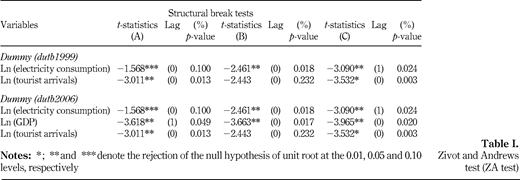
The use of the ZA test in this study is to justify whether there were any structural breaks during 1999 in ELC, FTAs and in any one of the CO2 emissions series to capture the effects of the recession due to the 1998 Asian financial crisis and the parliamentary elections with consecutive demonstrations against the ruling Justice and Development Party’s (Islamic influenced, conservative and liberal party) reform movements in 2006, which might have negative impacts on the Turkish economy. The results for the Zivot and Andrews (1992) tests are shown in Table I.
The bounds tests for cointegration within the ARDL modeling approaches were adopted in this study to investigate any possible long-run equilibrium relationships between each pair of variables under consideration. Pesaran et al. (2001) developed this approach which can be applied irrespective of the order of integration of the variables (irrespective of whether regressors are purely integrated at level, which is I (0), integrated at first difference, which is I (1) or mutually co-integrated). Such a similar methodology in the literature was recently implemented by Aslan (2014a, 2014b), Yorucu (2013), Fuinhas and Marques (2012), Yorucu and Mehmet (2011), Katircioglu (2009a, 2009b, 2010, 2014) and Katircioglu and Yorucu (2009). The ARDL modeling approach involves estimating the following error correction model: Equation 7
In equation (7), Δ is the difference operator, ln Yt is the natural logarithm of the dependent variable, and ln Xt and ln Zt are the independent variables with natural logarithms. The white noise error term ɛ1t is a serially independent random error term with 0 mean and a finite covariance matrix.
The F-tests have been conducted for investigating the possibility of any long-run equilibrium relationships in equation (7). In the case of the availability of one or more long-run equilibrium relationships, the F-test indicates which variable should be normalized. In equation (7), when ln Yt is the dependent variable, the null hypothesis of no level relationship (no cointegration) is H0: σ1Y = σ2Y = σ3Y = 0 and the alternative hypothesis of the level relationship (cointegration) is H1: Some or all of σ1Y, σ2Y and σ3Y are different from 0.
The conditional error correction mechanisms (ECMs) using the ARDL approach will be carried out whenever level relationships have been observed, where equation (3) is being estimated for each CO2 emissions series. Pesaran et al. (2001) also underline that the time series properties of the key variables (i.e. CO2 emissions series, ELC and FTAs) in the conditional ECMs of the present study can be approximated by double-logarithmic EC(p) (error correction at p lag levels that might be different for each explanatory variable) model under the ARDL approach, augmented with an appropriate deterministic, such as intercepts and time trends. Yorucu (2013), Yorucu and Mehmet (2011), Katircioglu (2010) and Ghali and Sakka (2004) also implemented this approach on a similar growth study. As Pesaran and Shin (1999) suggested, the conditional ECM using the ARDL approach can be reconstructed as: Equation 8 where Φj, βij and ϕ are the coefficients for the short-run dynamics of the model’s convergence to equilibrium. The coefficient of γ(1, p) denotes the speed of adjustment and is expected to be negative.
Granger causality tests need to be applied under the CECM whenever level relationships have been discovered with the help of a bounds test. The short-run deviations of the series from their long-run equilibrium path are then corrected by including an ECT that is suggested by Narayan and Smyth (2004). CECMs for Granger causality can then be formulated as follows: Equation 9 where Inline Equation 1
where Δ denotes the difference operator and L denotes the lag operator, standing (L) ΔlnYt that is equal to ΔlnYt−1 which are demonstrated in equation (9) above. The conditional ECTt−1 is the lagged ECT which is derived from the long-run equilibrium model. The random disturbance error term u1t is a serially independent error term with 0 mean and a finite covariance matrix. To reach a conclusion of having conditional Granger causality, statistically significant t-ratios for conditional ECTt−1 must be observed from equation (9) that would meet the condition of having any possible long-run causation.
5. Findings and policy implications
Stationary test results in our empirical part demonstrated that the ELC and the CO2 emissions from transport (percentage of total fuel combustion) variables were found to be stationary at level and integrated of order zero I (0) with trend and intercept, while they were found to be non-stationary without trend.
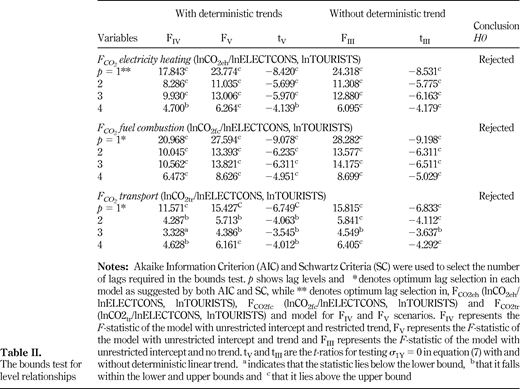
The CO2 emissions from electricity and heat production (percentage of total fuel combustion) variable was found to be stationary at level and integrated of order zero I (0) only with intercept. However, it was found to be non-stationary with trend and intercept. This series then turned to be stationary at its first difference, and integrated of order one, I (1). Both FTAs and CO2 emissions from electricity and heat production (total million metric tons) variables were found to be non-stationary at their levels with or without trend. All series then turned to be stationary at their first differences, and integrated of order one, I (1) as confirmed by both ADF and PP tests. Zivot and Andrews (1992) also validates the structural breaks which confirm the non-stationarity with an unknown break in the series. As there is no unit root consistency among all variables, it is inevitable to use the bounds test to investigate the possibility of any long-run equilibrium relationships between each pair of variables under consideration. Pesaran et al. (2001) stated that the bounds test approach can be implemented irrespective of the order of integration of the variables. The bounds test for cointegration within the ARDL modeling approach was adopted in this study to investigate any possible long-run equilibrium relationship between the CO2 emissions, FTAs and ELC. The bounds test results shown in Table II below summarize the results of possible long-run relationships as suggested by Pesaran et al. (2001) in the model under three different scenarios.
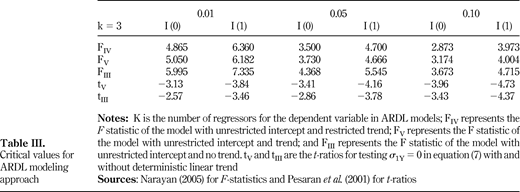
The first scenario is with a restricted deterministic trend (FIV), the second scenario is with an unrestricted deterministic trend (FV) and the third scenario is without a deterministic trend (FIII). Intercepts in these scenarios are all unrestricted [3]. The critical values (k = 3, n = 50, I(0) 3.730, I(1) 4.660) for the F-statistics for small samples are available in Narayan (2005, pp. 1987-1990).
The results of critical values demonstrated in Table III for ARDL suggest that the application of the bounds F-test using the ARDL modeling approach indicate level relationships in our models.
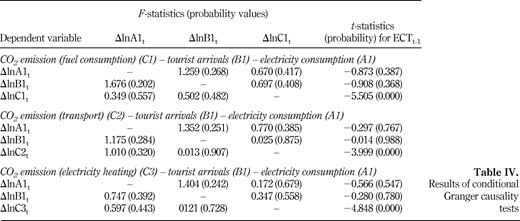
The results of Table IV reveal that there is a unidirectional relationship from the FTAs and ELC toward the CO2 emissions from electricity and heat production (percentage of total fuel combustion), CO2 emissions from transport (percentage of total fuel combustion) and CO2 emissions from electricity and heat production (total million metric tons), which are shown below:
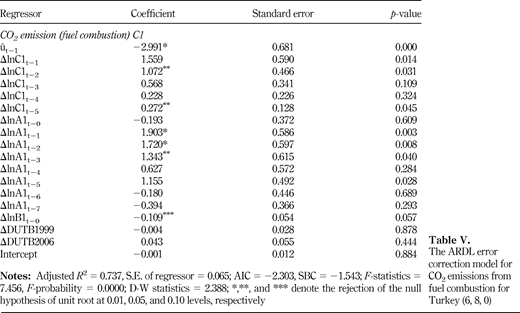
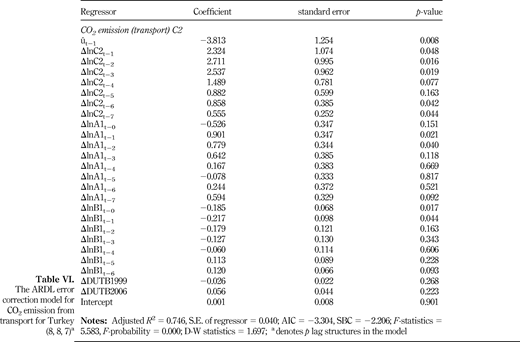
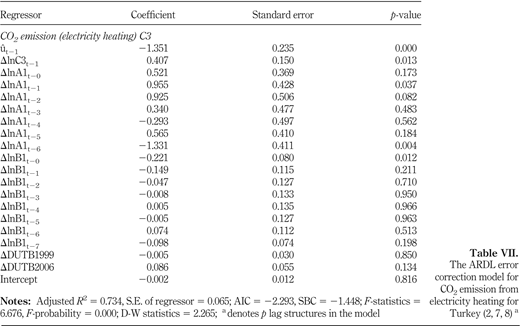
Having level relationships in the bounds tests allow for the implementation of the ARDL approach to estimate the level coefficients as also discussed in and formulated in equation (8) of Tables V-VII.
The resulting estimates of level relationships under the ARDL specification in the case of CO2 emissions from electricity and heat production (percentage of total fuel combustion (1 6, 8, 0), CO2 emissions from transport (8, 8, 7) and CO2 emissions from electricity and heat production (total million metric tons) (2, 7, 8) are as follows: Equation 10 Equation 11 Equation 12 Equation 13 Equation 14 Equation 15 where ût is the ECT and the probabilities of the calculated t-statistics are given in parentheses in the above ECM equations. All the ELC variables in all of the equations (equation 10-12) have been found statistically significant, but the FTA variable has been found statistically significant with correct coefficient signs only in equation (11). The expected coefficient signs for both of the variables are positive; yet the coefficient signs obtained for the FTA variable in equations (10) and (12) are negative. This is due to taking the first difference of the FTA variable with zero lag levels in ARDL estimations.
Different lag levels have been implemented, but no positive results have been obtained in all cases (Lag 1 to Lag 4), although the estimated coefficients are significant at a confidence level of 10 per cent. Neither of the breakdown dummies in the above equations (DM1999 and DM2006) have any significant elasticity coefficients because of low probability values. The ECTs are very high and statistically significant in all of the estimated equations.
The estimated ARDL elasticity coefficients in equation (10) indicate that a 1 per cent increase in the amount of ELC causes a 1.9 per cent increase in CO2 emissions from fuel combustion. The number of FTAs variable in this equation was found to be significant (0.109) at a 10 per cent significance level, but the coefficient sign is negative which contradicts the theory. The short-run deviations of the series from their long-run equilibrium path have been corrected and the ECT obtained here is very high (−2.99) and statistically significant (−0.000) at the 1 per cent level, and has the expected coefficient sign which is consistent with the theory. This shows that the dependent variable (CO2 emissions from electricity and heat production) in the ARDL model converges with its long-run equilibrium level very quickly. Diagnostic tests indicate that both F-statistics (7.456) and R2 statistics (0.737) for the short term are statistically significant and provide no autocorrelation problem (DW = 2.238) for the residuals.
The calculated ARDL elasticity values in equation (11) reveal that a 1 per cent increase in the amount of ELC and a 1 per cent increase in the number of FTAs cause a 0.9 and a 0.12 per cent increase in total CO2 emissions from transport in the percentage of total fuel combustion in Turkey, respectively. The short-run deviations of the series from their long-run equilibrium path have been corrected and the ECT obtained in this study for equation (11) is very high (−3.81), statistically significant (−0.008), and has the expected coefficient sign which is consistent with the theory. This shows that the dependent variable (CO2 emissions from transport) in the ARDL model converges with its long-run equilibrium level at a very high speed. Diagnostic tests indicate that both F-statistics (5.58) and R2 statistics (0.74) for the short term are statistically significant and provide no autocorrelation problem (DW = 1.697) for the residuals.
For equation (12), the computed ARDL elasticity coefficients show that a 1 per cent increase in the amount of ELC causes a 0.955 per cent increase in CO2 emissions from electricity and heat production for Turkey. The number of FTAs variable in this equation was also found to be significant (0.221) at the 5 per cent significance level (0.012), but as in equation (10), the coefficient sign is found to be negative which is not consistent with the theory. The short-run deviations of the series from their long-run equilibrium path have been corrected and the ECT obtained here is high (−1.351) and statistically significant (−0.000) at the 1 per cent level, and has the expected coefficient sign which is consistent with the theory. This shows that the dependent variable (CO2 emissions from electricity and heat production) in the ARDL model converges with its long-run equilibrium level at a very fast rate as expected. Diagnostic tests indicate that both F-statistics (6.676) and R2 statistics (0.734) for the short term are statistically significant and provide no autocorrelation problem with (DW = 2.265) statistics for the residuals.
Under the ARDL mechanism, as a long-run context, the conditional Granger causality test results with F-statistics for short-run causations and t-statistics of ECTs for long-run causations are also presented in Table IV. All conditional causalities are estimated from equation (9).
Results from Table IV reveal unidirectional causalities running from FTAs and ELC toward CO2 emissions from electricity and heat production (percentage of total fuel combustion), CO2 emissions from transport (percentage of total fuel combustion) and CO2 emissions from electricity and heat production (total million metric tons), respectively. The F-statistics for each causality test of CO2 emissions are (−5.505), (−3.999) and (−4.848) correspondingly, and all the ECTs (ECTt−1) in equation (9) are statistically significant at a 1 per cent (0.000) significance level; thus, long-run causation is confirmed from FTAs and ELC toward CO2 emissions. No short-run causations were observed in each case throughout the study. These major findings support the growth of CO2 emissions from electricity and heat production and CO2 emissions from transport due to the growth of FTAs and the increasing demand for ELC hypotheses in the case of Turkey.
6. Conclusion
This paper has studied empirically the growth impact of CO2 emissions caused by an increasing number of FTAs and the rising demand for ELC in Turkey. The results of this study revealed that long-run equilibrium relationships exist at every stage of individual testing between CO2 emissions from electricity and heat production (percentage of total fuel combustion), CO2 emissions from transport (percentage of total fuel combustion), CO2 emissions from electricity and heat production (total million metric tons) and FTAs and ELC, with respect to Turkey. Granger causality tests have been implemented here under CECMs whenever level relationships were obtained with the help of a bounds test, which was developed by Pesaran et al. (2001).
The long-run effects of the growth variables are found to be statistically significant. Also for the short run, the estimated coefficients for FTAs and ELC have been found to be statistically significant. As mentioned earlier, the estimated ARDL elasticity coefficients in equation (10) indicate that a 1 per cent increase in the amount of ELC causes a 1.9 per cent increase in CO2 emissions from fuel combustion. The number of FTAs variable in this equation was found to be significant (0.109) at a 10 per cent significance level, but the coefficient sign is negative which contradicts the theory.
The calculated ARDL elasticity values in equation (11) reveal that a 1 per cent increase in the amount of ELC and a 1 per cent increase in the number of FTAs cause a 0.9 and a 0.12 per cent increase in total CO2 emissions from transport in the percentage of total fuel combustion in Turkey, respectively.
For equation (12), the computed ARDL elasticity coefficients show that a 1 per cent increase in the amount of ELC causes a 0.955 per cent increase in CO2 emissions from electricity and heat production for Turkey. The number of FTAs variable in this equation was also found to be significant (0.221) at the 5 per cent significance level (0.012), but as in equation (10), the coefficient sign is found to be negative due to taking first differences with zero lag level in ARDL estimations.
Furthermore, this study revealed a unidirectional causality running from FTAs and ELC toward CO2 emissions for electricity and heat production (both metric tons and percentage of fuel combustion) and CO2 emissions for transports, respectively. The empirical findings reported here support the dominance of the population growth (through tourist flows) and growth in energy consumption (increasing demand for ELC) as the prime movers in the CO2 emissions of Turkey. As Jobert and Karanfil (2007) mentioned, during the period of 1960-1980 when capital accumulation was realized in Turkey, there were not any serious regulations to reduce energy consumption or any energy-saving technical progress in the industry, which triggered the energy consumption.
As emphasized by Akbostanci et al. (2011), the iron and steel basic industries and the manufacture of cement, lime and plaster are the two dirtiest sectors in Turkey. In addition to these two sectors, petroleum refineries and the manufacture of synthetic resins, plastic materials and plaster are other dirty sectors which contribute to the total average of 74 per cent CO2 emissions in Turkey. For the past two decades, the iron and steel industry alone has been responsible for an average of 40 per cent of the CO2 emissions in Turkey. In energy production, the causes of CO2 emissions are the intensive use of fossil-based energy, such as coal, petroleum and natural gas. The intensive use of coal has been found to be the most harmful material for increasing CO2 emissions in Turkey. It is important for Turkey to focus on reducing environmental damage while meeting the energy demand. Switching to less carbon-intensive energy production is one possibility to decrease emissions. It is well-known that increasing the use of natural gas instead of petroleum and coal will decrease the carbon intensity of energy production. In Turkey, the contributions of natural gas and electricity toward changing the total emissions increased after 1990. Tunc et al. (2009) emphasized that the share of electricity in total energy consumption steadily increased from 4 per cent in 1970 to 17 per cent in 2007, while solid fuels constituted 56 per cent of total energy use in 1970, with their share declining to 28 per cent by 2006. Turkish natural gas imports have increased from 433 cubic million meters in 1987 to 32,200 cubic million meters in 2008 (Narin, 2011).
More attention should be given to promoting alternative energy sources for electricity production, such as wind and solar energy, focusing on more energy-saving measures with effective regulatory and auditing legislation. Finally, the results of this study recommend that Turkey abides the Kyoto Protocol and agrees to follow the environmental standards by enacting more compliance issues and directives to achieve sustainable development.
Turkey should also take the necessary policy measures to diminish CO2 emissions without affecting the explosive growth perspective of the overall economy. In the manufacturing industry, Turkey as a candidate country of the European Union (EU) has to concentrate more on the use of new and energy-saving technologies to comply with UN and the EU environmental standards. In addition, Turkey should reduce her dependency on foreign sources of energy in the long term. As a geo-strategic location, on the 26th of April 2012, Turkey has started drilling (Turkyurdu-1) in Cyprus at Sınırüstü-İskele (Famagusta District of North Cyprus) to search for potential natural gas resources on land and within the Exclusive Economic Zone of 188 miles of 28° west to 33° east altitudes of the Mediterranean, from Datça to Antalya Bay (the region of the Levantin basin), as well as in the South Eastern Mediterranean (the region of Leveathian basin).
According to Hafner and Tagliapietra (2013) in 2010, the US Geological Survey estimated that in the Mediterranean-Nile offshore, there is potential for resources to be discovered which amounts at 6,321 bcm of natural gas, 1.763 Gb of oil and 5.9Gb of NGL. If these figures will be confirmed, then the area would become a world-class natural gas province. An explanatory activity in the offshore area (also called Levantine Basin) encompassed between Israel and Cyprus has confirmed major natural gas fields that could radically change the energy outlook of the area.
The new hydrocarbon resources in the Eastern Mediterranean will either create new disputes in the region, especially between neighboring countries and Turkey, or will bring peace to the Middle East under the leading power of Turkey.
References
Further reading
About the author
Vedat Yorucu was born in 1970 at Nicosia, Cyprus. He received an academic scholarship and completed his PhD in Economics at the University of Leicester in 1998. He obtained his Professor of Economics title from the Higher Education Council of Turkey in 2015. He has received the EU scholarship and carried out a research on “Natural Gas Pricing for the EU-12” at The College of Europe in Bruges during 2014 Summer. Prof Yorucu has published many articles on economics and energy issues in internationally refereed peer journals. He has participated in many international conferences. Besides his academic work, he served as Chief Economic Advisor to the Minister of Economics of North Cyprus for five years (2004-2009). He has been working at the Eastern Mediterranean University since 1998 on full time basis. He is the Vice President of Cyprus Turkish Economic Association. He speaks Turkish, English, Dutch and Greek. Vedat Yorucu can be contacted at: vyorucu@hotmail.com
Notes
The PP approach allows for the presence of unknown forms of autocorrelation with a structural break in the time series and conditional heteroskedasticity in the error term.
The code we utilize here has only model options A and C excluding model B in the original work. Model B incorporates the trend stationary alternative with a change in the trend slope. However, as model C is the most general, it encompasses both the A and B models.
For detailed information, see Pesaran et al. (2001, pp. 295-296).