


– The purpose of this paper is to analyze vulnerability of food crop production to heavy precipitation in north-eastern Ghana, specifically, the upper east region (UER) and the policy implications for adaptation. Heavy precipitation events are a common part of climatic variability; but little attention is given to its impact on livelihoods as compared to droughts in research and policy domains.
– This paper draws on both quantitative and qualitative research methods and data. Rainfall data are analyzed using the Standardized Precipitation Index (SPI). This is compared with quantitative analysis of crop yields and complemented by narratives of farmers from in-depth interviews and focus group discussions.
– The results show that heavy precipitation events often lead to low food crop productivity and this suggests that the latter is vulnerable to the former.
– Although some adaptation is occurring through a wide range of local measures, these are inadequate for eliminating vulnerability. Thus, additional policy measures are recommended for enhancing farmer adaptation, including: incorporating climate change adaptation policies, including adaptation to heavy precipitation into District Development Planning; building human resource capacity for effective implementation of climate change adaptation policies at district levels; improving market access to seed through improved market infrastructure and rural transportation; establishing Community Seed Banks (CSBs) as back up sources of seed; promoting “nursing and transplant” as an alternative planting method for millet and guinea corn; promoting low costs solar drying technologies for drying food crops; and supporting livelihood diversification through credit and business development services.
Introduction
This paper discusses the vulnerability of food crop production to heavy precipitation and the policy implications for adaptation in North-eastern Ghana, specifically in the Upper East Region (UER). In this area, climate variability manifests partly in heavy precipitation events and this is a major concern to farmers because it constraints food crop production. In extreme situations, it leads to total crop failure and hunger. Hence, adaptation to heavy precipitation is important for sustaining food crop farming as a livelihood option. However, this has received little attention in research and policy debates because of a tendency to focus on droughts and a drying trend. The IPCC (2007) recognizes that heavy precipitation events is very likely in most parts of the world and that it will lead to water logging, damaging of crops and soil erosion. Against this background, rain fed agriculture is the major livelihood for a majority of the population in the UER. Hence, understanding farmers' vulnerability to heavy precipitation is necessary for enhancing adaptation through effective policy planning in North-eastern Ghana.
This paper is structured in seven parts. The first part describes the study area and culture of farming while the methodology for the study is discussed in the second part. In part three, we discuss vulnerability of food crop production to climate change in Africa with a focus on heavy precipitation. Empirical discussions on the physical vulnerability of food crop production to heavy precipitation are done in part four. In part five, we examine the wider socio-political and economic factors that shape vulnerability to heavy precipitation. In part six, some policy recommendations for addressing vulnerability are presented. The paper is then concluded in part seven.
The study area and culture of farming
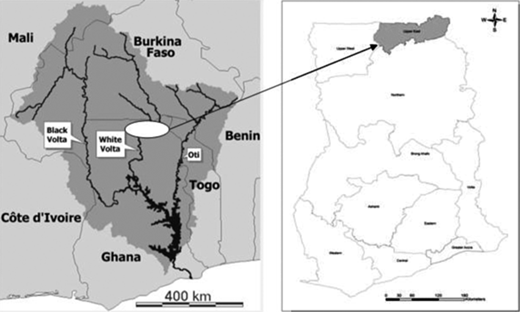
The UER is one of the ten administrative regions of Ghana. Located in the north-eastern corner of Ghana, the region has a land size of 8,842 km2 (Figure 1). It is bordered to the north by Burkina Faso and to the east by Togo. The vegetation is largely of the Sudan Savannah type. It has a tropical climate with alternating short wet and long dry seasons. It is inhabited by about 920,089 people with one of the highest population densities (104) in the country (GSS, 2000). Out of its total population, 87 per cent reside in rural areas and 80 per cent are engaged in subsistence rain fed agriculture as a primary livelihood (RCC, 2008).
In the UER, people generally practice mixed farming on a subsistence scale. The combination includes cropping, poultry and animal husbandry that are interdependent and complementary of one another in household livelihood systems. There is a large extent of homogeneity in farming systems across the region although some pockets of variations exist. In the Atankwidi basin, occupying a large portion of the region and inhabited by different ethnic groups, virtually every household keeps poultry, goats and sheep as part of their farming systems. Although cattle are common, only a few relatively well to do households keep few breading stocks or bullocks. Similarly, virtually every household crops millet (early and late varieties), sorghum, cowpea, groundnuts and increasingly rice and potatoes (Derbile, 2010). Blench (2006) describes this millet as pearl millet and the basis of the cropping system in the region and that, two varieties, a short-season millet harvested in July and a long-season millet, harvested in November or December are cultivated.
Although most households maintain multiple farms, the compound farm, often situated in the immediate surroundings of compounds, is the main farm. These compound farms (Sammani) are sited on family lands handed down from generation to generation within the purview of communal and traditional systems of land tenure. Traditional systems of land tenure are administered by the Tindaana or Tigatuu who acts as custodian of communal lands and held in trust for the people. Landlords (Yidaama), take custody and administer family lands among members of the family for farming purposes. Owing to user rights combined with increasing population, compound farms have been defragmented into smaller parcels of farm lands among family members to meet increasing demand over the years. Thus, soil fertilities on compound farms have decreased considerably because of a combination of continuous cultivation and inadequate soil conservation measures. As a result, many farmers also keep valley bottom or river bank farms or distant bush farms. Compound and river bank farms are put to continuous cultivation while shifting cultivation and bush fallows are no more practiced. Multiple factors including increasing population, increased demand for land, land degradation and climatic changes contributed to the cessation of these farming practices. In the context of a multiple farm culture, Blench (2006) observes that early millet is interplanted with late millet or sorghum on compound farms. The further fields, which include valley bottom or river bank farms or distant bush farms, are planted with sorghum intercropped with cowpeas and occasionally groundnuts (Blench, 2006). Although this is true, some additional cropping patterns are observable. Early millet is commonly intercropped with sorghum in valley bottom or river bank farms, while rice is cultivated as a monocrop on similar fields. Also, late millet and groundnuts are commonly cropped on bush farms as mono crops. In farming practices, animal traction, especially the use of bullock plough is common much as carts drawn by bullocks or donkeys for transporting inputs and produce. However, farmers depend on simple implements such as the hoe for weeding and cutlass for harvesting.
Methodology
This paper combines data from both institutional and community studies. Quantitative data on rainfall and food crop yields were collected from the Meteorological Services Department and the Ministry of Food and Agriculture, respectively. Rainfall data were analyzed using the Standardized Precipitation Index (SPI) after McKee et al. (1993). SPI can be defined as the number of standard deviations that observed cumulative precipitation deviates from the climatological average. The index is based entirely on daily precipitation accumulations and its values compared across different geographic regions and periods. This was compared with an analysis of crop yields and farmer narratives for analyzing vulnerability to heavy precipitation in food crop production. Such farmer narratives were findings from in-depth interviews and focus group discussions (FGDs) conducted among purposively selected farmers in three randomly sampled communities in Kassena-Nankana east and west districts of the region. These communities included Pungu, Mirigu and Sirigu all of which fall within the Atankwidi sub-basin of the White Volta. A series of in-depth interviews were conducted among 12 experienced and knowledgeable farmers four of whom were females. In addition, six FGDs were conducted in the three communities (two per community) among knowledgeable farmers. Focus groups comprised six to eight farmers. Farmers were not sampled according to differentiated socio-economic characteristics (except for gender mix) for analyzing differentiated vulnerability at farmer or household level; rather, some socio-economic characteristics of the wider population was drawn on for situating the wider context of vulnerability to heavy precipitation. These characteristics were predominantly drawn from the empirical study and complemented by a review of political and economic circumstances of underdevelopment in Northern Ghana.
Climate change and agriculture vulnerability in Africa
The evidence shows that the world's climate is changing and this change will impact regional development in various ways. According to climate scientists, increases in global temperatures are largely the result of increased greenhouse gas concentrations and that the continued increases in these concentrations will cause future climate warming. This will cause extreme climatic events such as floods and droughts – impacting on agriculture negatively (Houghton et al., 2001; Smith and Mendelsohn, 2006). Thus, every region will need to plan adaptation to climate change by examining the nature of regional impact (Smith and Mendelsohn, 2006). Given the history of climatic variability, climate specialists predict a mix of droughts and floods of unusual magnitudes for West Africa that will threaten human security (IUCN, 2004; IPCC, 2007). Some climate change projections predict a decline in precipitation in the range of 0.5-40 per cent with an average of 10-20 per cent by 2025. Others predict increases in precipitation. The GLOWA Volta Project (GVP), predict increases in precipitation and discharge for Sub-Saharan West Africa using regional climatic model MM5 (Kunstmann and Jung, 2005). Contrastingly, the IMPETUS Project, which used the regional climatic model, REMO, forecast declines in precipitation and discharge for most parts of West Africa (Paeth and Thamm, 2007). Thus, the science of the future climate is plagued by uncertainties (Carter and La Rovere, 2001). Nonetheless, climate scientists predict climatic extremes that may influence vulnerability of agriculture in West Africa. Thus, our concern in this paper is excessive precipitation events and how to deal with the associated vulnerability in rain fed agricultural systems in North-eastern Ghana.
Conceptually, vulnerability refers to a combination of physical, social, economic and environmental factors or processes that make an entity (e.g. individual, community) susceptible to the impact of a natural hazard (UN/ISDR, 2004; Birkman, 2006). Hence, vulnerability is multifaceted in nature (Bhole, 2002) and has two sides (Chambers, 2006). First, it has an external side comprising contingency, exposure to risks, shocks and stress which an individual, household or community is subject to. Second, it has an internal side comprising defencelessness, meaning the lack of means or ability to anticipate, cope with, resist and recover from such contingencies (Chambers, 2006). The IPCC provides a climate-related definition as – the degree to which a system is susceptible to, or unable to cope with the adverse effects of climate variability as a result of adaptive capacity (IPCC, 2007). The IPCC underscore that Africa is one of the most vulnerable continents to climate variability because it is confronted with multiple stresses and low adaptive capacity. It projects that between 75 million and 250 million people in Africa will be exposed to increased water stress and problems arising from climate variability by 2020. As a result, agricultural production, including access to food, in many African countries would be severely compromised. Yields from agriculture could decline by 50 per cent by 2020 in some countries and undermine food security in the continent (IPCC, 2007). Similar assessments predict climate change-related gross domestic losses of between 2 and 7 per cent for most West African countries by 2100 (IUCN, 2004). The vulnerability of Sub-Saharan Africa (SSA) to climate variability lies in its heavy dependence on rain fed agriculture. Technology for adaptation such as irrigation, capital and high-yield varieties have moved slowly (Evenson and Gollin, 2003; Dinar et al., 2008). Thus, agricultural productivity in SSA is highly dependent on available soil moisture (Rockström and Falkenmark, 2000; Friesen, 2008) and soil moisture is influenced by the extent of precipitation. It is in this context, that excessive soil moisture arising from heavy precipitation, water logging and flooding is a problem for agriculture in SSA, especially North-eastern Ghana.
Vulnerability of food crop production to heavy precipitation in UER
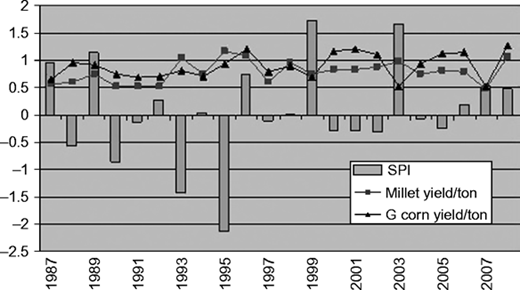
The results show that heavy precipitation as typified by wet years, leads to low-crop productivity. Figure 2 is a comparative analysis of annual rainfall using SPI (SPI values range from −2.0 to +2 with −2.0 representing extreme dry, +2 representing extreme wet and 0±0.5 representing normal precipitation) and food crop productivity (millet and guinea corn) for the UER from 1987 to 2008.
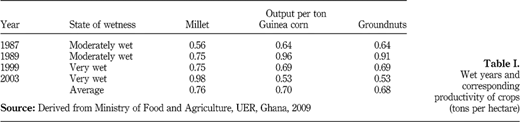
Five extreme wet years arising from heavy precipitation are identified over the period. These include 1987, 1989, 1999 and 2003 with SPI values ranging between 1 and 1.7 (Figure 2). Although 2007 had an SPI value of 0.5, it was also a wet year due to “high-rainfall intensities” and floods occurring during the peak of the rainy season. The corresponding productivities of millet and guinea corn were analyzed for these wet years. The analysis shows that the productivities of millet and guinea corn ranged between 0.5 and 0.8 tons per hectare for wet years compared with a range of 0.5-1.2 tons per hectare for normal years (Figure 2). However, productivity of 0.7 tons per hectare for the wet year of 1989 for both crops and 0.8 tons per hectare for millet in 2003 were exceptionally high compared with productivities for other wet years. Favourable intra-annual distribution of precipitation most likely supported better plant growth for these exceptional wet years. Additional analysis on crop productivity for the wet years of 1987, 1989, 1999 and 2003 are presented in Table I. The analysis shows that lower productivities for millet and guinea corn including a third crop, groundnuts, were associated with wet years than with normal years. For this research, normal years refer to years with SPI indexes ranging from 0±0.5 representing normal precipitation. Average productivities of the three crops were calculated from the source data of the Directorate of the Ministry of Food and Agriculture. From the computations, average productivities for the crops in normal years were as follows: Millet =0.79 ton per hectare; Guinea Corn =0.99 ton per hectare and Groundnuts=0.88 ton per hectare.
For all the crops, average productivities for wet years were relatively lower than average productivities for normal years. The average productivity for millet per hectare for wet years is 0.76 compared with 0.79 for normal years. For guinea corn, the average productivity for wet years is 0.70 tons per hectare compared with 0.99 tons per hectare for normal years. Similarly, average productivity of groundnuts for wet years is 0.68 tons per hectare compared with 0.88 tons per hectare for normal years. Thus, heavy precipitation impacts on crop productivity negatively. This corroborates the assertion that agricultural production and access to food in many African countries risk being compromised by climate variability, including heavy precipitation (IPCC, 2007).
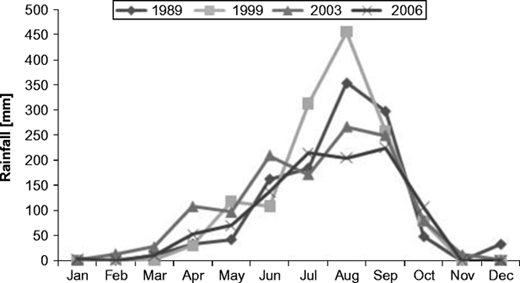
Beyond annualized classification of wet years, intra-annual rainfall distribution periodically give rise to “high-rainfall intensity” at some points in time during the rainy season. Such “high-rainfall intensities” also lead to low-crop productivity and consequently, poor crop yields. This is the reason for making the point earlier on that some years with SPI values below 0.5 which indicate normal years, were indeed wet years. Although SPI values for such years show they were normal rainfall years, “high intensity precipitation” occurring at some points in time during the rainy season adversely affected productivity and crop yields. To illustrate this point, annual distribution of precipitation for three wet years, 1989, 1999 and 2003 are compared with a normal distribution year, 2006 (Figure 3).
From the analysis, distribution patterns of precipitation for the four selected years vary from each other (Figure 3). These variations in rainfall distribution affect food crop production differently. A normal distribution pattern as exemplified by 2006 and other normal years, lead to higher crop productivity compared with most wet years (Figure 2). Local farmers expect a normal distribution pattern and plan their farming activities accordingly. Farmer accounts show that deviations from this normal pattern as exemplified by wet years lead to low productivity. Local farmers classify their farming activities into three different stages. These include:
planting and first weeding;
second weeding and early harvesting; and
third weeding and late harvesting.
Farmers recount experiences of high-intensity precipitation occurring during these stages but the nature of vulnerability, especially physical vulnerability varies with the stage.
Farmer accounts show that their first concern is heavy precipitation occurring during planting and early weeding. This is usually from May to June as typified by the annual distribution for 2003 (Figure 3). This often leads to delays in planting, poor timing in planting and poor germination. It also leads to water logging and prevent or delay first weeding. This result in stunted growth and leads to poor crop yields. A group of six farmers expressed these sentiments during a FGD in Mirigu:
Heavy rainfall may occur at different times. When it occurs at the planting stage, it delays planting and this leads to bad timing. When it occurs soon after planting, it leads to poor germination. In such instances, we have to replant or “fill-in” with surplus seed. Others buy seed from the market or depend on relatives or neighbours for seed. Such precipitation also causes stunted growth, especially in early millet. It prevents timely weeding so that farms become weedy. This leads to poor crop yields and hunger.
A female farmer from Pungu expressed similar sentiments:
Heavy precipitation during the planting season leads to poor germination of “Naara” (early millet), “Talenga” (Guinea corn), “Zea” (late millet) and “Te” (beans). I replant when I have surplus seed; but when it is too late, there is nothing I can do. It also makes soils sticky and hard to weed.
Heavy precipitation may also occur during second weeding and early harvesting. This is usually from July to August. Farmers expect high precipitation during this time, especially in August but excessive precipitation patterns as shown in Figure 3 is destructive. From the illustration, precipitation peaked in August for all three wet years at a little above 250 mm for 2003, 350 mm for 1989 and 450 mm for 1999. However, when heavy precipitation occurs from July through to August, it constraints both second weeding and early harvesting. The annual distribution of rainfall for 1999 fits this scenario (Figure 3). Farmer accounts show that heavy precipitation in July cause water logging in farms and makes weeding impossible. As a result, farms are taken over by weed. Also, harvest of “Naara” is hampered and many times delayed. In the past, “Naara” was harvested in June but farmers delay planting the crop to adapt to a late onset of rains in recent times. As such, heavy precipitation in July coincides with the harvest season of “Naara” and this hampers harvesting. It also hampers drying because farmers depend on sunshine for drying the grains which is often limited or lacking during long periods of heavy precipitation. Farmers resort to indoor drying but this is ineffective as grains easily become mouldy and have an “unpleasant smell” when used for preparing meals. As a result of all these problems, post harvest losses of “Naara” are high. A farmer from Sirigu reflects on his experiences:
In 2007, heavy precipitation and water logging destroyed my crops. It prevented early harvest of “Naara” and “Te”. As a result, most of it was destroyed on the farm. Meeting household food needs was a challenge that year. I sold five goats, five sheep and a bullock and used all proceeds to buy foodstuff to meet our consumption needs.
Narratives of local farmers also point that heavy precipitation during the third weeding and late harvesting season is destructive. This is usually from September to November with heavy precipitation most likely occurring in the former. This conforms to the annual distribution of rainfall for the three selected wet years (Figure 3). After peaking in August, rainfall amounts reduced in September to about 300 mm for 1989 and 1999, and 250 mm for 2003. Although the rainfall amounts reduced, the figures remained high compared with 200 mm for 2006 which was a normal year. Such late season heavy rains disrupt tussling, pollination and seed development of “Talenga” and “Ze”. The account of a female farmer in Mirigu illustrates this point:
A few years ago, heavy rainfall destroyed my “Talenga” on the farm. The rainfall was so heavy that we could not go to the market for two conservative weeks. Most farms were completely submerged in water. A second wave of heavy rainfall followed but this time it came with strong storms that fell plants. I lost most of my crops just as many others in the community. Some grains were loss to domestic poultry that feed on them. Other grains got rotten due to exposure to moisture. Every household had to buy food stuff to meet consumption needs. Many sold livestock to finance purchases but others engaged in wage labour to do same.
The analysis shows that heavy precipitation lead to poor crop yields in the UER in many ways. When heavy precipitation occurs during the planting season, it leads to poor germination, prevents early weeding and makes weeding ineffective for weed control. For instance, when average monthly precipitation during the planting season (May-June) exceed 100 mm as exemplified by 1999 and 2003 (Figure 3), sub-surface soils become saturated and farms became water logged and difficult to weed. In addition, excess moisture is usually a major component of crop losses due to extreme precipitation events (Rosenzweig et al., 2002). Similarly, heavy precipitation at latter stages hampers further weeding, early harvesting and drying of crops. Accompanied by rainstorms, heavy precipitation in the latter part of the farming season often fell plants and disrupts pollination of “Talenga” in particular. All these risks factors lead to poor grain quality, post-harvest losses and overall, poor crop yields.
Thus, far, the discussions elucidate the physical vulnerability of rain fed agriculture to heavy precipitation in the UER. However, these findings are not unique to the UER. Similar patterns are observable within the wider local and global scales. In Burkina Faso, farmers requested forecast information on total amounts of rainfall because of past experiences of the impact of excessive rainfall on food crops. Recent experiences show that cotton and maize yields were compromised by excessive rainfall in the 1999 season and that farmers would have rather planted rice in the low lying fields if they had forecast information about likely high-rainfall intensity (Ingram et al., 2002). This excessive rainfall, particularly experienced by southwest farmers in Burkina Faso in July and August (Ingram et al., 2002), also occurred in the UER. Thus, it coincided with the second and early harvesting season (Figure 3) with devastating consequences on crop yields as described by farmers. In the Nandom area of Northwest Ghana, maize and guinea corn yields were equally affected by high-intensity precipitation the same year (van der Geest, 2004). This suggests that the impact of excessive rainfall that year (1999) transcended national boundaries in the Volta basin. Although these crops often have a potential for good yields especially in low lands, excessive rainfall and floods also easily cause total failure in Northwest Ghana (van der Geest, 2004). In the USA and on a global scale, heavy precipitation and flooding have increased in the past two decades (Milly et al., 2002; Rosenzweig et al., 2002), causing considerable damage to crop production (Rosenzweig et al., 2002). Beyond this, forecast under future climate change reveal increased extreme precipitation events for some parts of the world including the USA and this will increase damages to crops in the future (McCarthy et al., 2001; Rosenzweig et al., 2002). Forecast for the USA show that current maize production losses due to extreme precipitation events may double over the next 30 years and cause additional damages totalling an estimated $3 billion per year (Rosenzweig et al., 2002).
The wider context of vulnerability to heavy precipitation in the UER
In the UER, the wider socio-political, cultural and economic context shapes overall vulnerability to heavy precipitation. In this paper, we limit our discussion to three broad factors for want of space: poor economic infrastructure and underdevelopment of Northern Ghana; the lack of responsive agricultural extension services; and socio-cultural factors, including high dependency ratios and funeral rites.
First, the dependence on rain fed agriculture in the UER region partly arises from limited investments in irrigation infrastructure despite some strides in this area. A majority of the population do not have access to irrigation. The two largest irrigation schemes in the region, the Tono and Vea irrigation schemes have a combined irrigable potential of 4,049 ha but only 1,200 ha is irrigated translating into 29.6 capacity utilization (Agyare et al., 2008). This is because the infrastructure is not fully developed while management problems persist. That apart, access to irrigation at Tono and Vea is skewed in favour of commercial farmers to the disadvantage of subsistence farmers residing in communities around the project sites due to the affluence of the former. Although the region has about 160 small irrigation reservoirs, many more communities do not have such reservoirs and even for communities that have, access is limited due to limited capacities and management problems. Where the water tables are high, farmers have resorted to shallow underground water irrigation by digging wells but this also has its limitations. At independence (1957), Northern Ghana lagged behind the southern half of the country in economic infrastructure and development partly because colonial development policy designated the former as a labour reserve. The rationale was to create conditions necessary for labour to migrate down south for servicing the exploitation of raw materials for export in the southern half of the country (Songsore, 2001; Saaka, 2001). Thus, most infrastructure and development were concentrated in Southern Ghana while Northern Ghana was denied its fair share of investments in economic infrastructure during the era of colonial development. Although successive post independence governments embarked on national and regional development initiatives, investments have not been substantial to meet the infrastructure needs of Northern Ghana. Hence, Northern Ghana and the UER in particular have the highest incidence of poverty in the country. In the northern half of the country, 68 per cent of the population live in poverty compared with the national average of 28.5 per cent in 2006 (Coulombe and Wodon, 2007). Although poverty is not the same as vulnerability (Chambers, 2006), it undermines economic capacities of farmers to invest in ways that help with adaptation to heavy precipitation in rain fed agriculture. For instance farmer responses in the Atankwidi basin and region at large include a range of risk spreading measures such as staggering planting, re-planting and or filling-in. For the larger part of SSA, adaptation measures include diversified cropping, land type diversification, plot fragmentation and shifting crops between land types (Cooper et al., 2008). All these measures help with adaptation to environmental uncertainty but they also require surplus seed stocks and multiple farms such as compound, valley bottom and particularly, irrigated fields in the case of the UER. All these require investment financing and this cannot be done if income is lacking. The lack of investments and stagnation of agricultural production reinforce each other and lead to poverty traps and vulnerability of livelihoods to climatic shocks in rain fed agricultural systems (Collier and Gunning, 1999).
Second, poultry and livestock are a major source of income for “social sustainability” of livelihoods but the lack of responsive and adequate veterinary services affect the industry. In the region and country as a whole, the lack of investments account for this abysmal state of veterinary services. Although farmers put in a lot of effort, virtually every farmer and household has lost most poultry to diseases over the past few years in the Atankwidi basin and probably the region at large. Livestock including goats, sheep and cattle fair poorly because of the lack of adequate feed and water especially in the dry season (Derbile, 2010). Although households still make effort to keep poultry and livestock as part of livelihood diversification strategies, the industry is gradually loosing importance for “social sustainability” of livelihoods and this will likely increase livelihood vulnerability.
Third, socio-cultural factors, including high dependency ratios and customary funeral rites contribute to livelihood vulnerability in the UER, especially in the Atankwidi basin (Derbile, 2010). Household sizes are large and this means more mouths to feed even if heavy precipitation affected crop yields. For instance, 46 per cent of households in the Kassena-Nankana East and West Districts are large household sizes with memberships between six and eight and above (GSS, 2005). This has led to a heavy burden of feeding large numbers of dependants at household levels but this burden is much greater if yields are affected by heavy precipitation. In addition, customary funeral rites are obligatory, held in high esteem but also expensive. Funeral rites are often organized after the production season and often involve offerings including poultry, small ruminants and sometimes cattle. This contributes to depletion of livestock which is an important source of income when the household is in distress. Beyond this, a wide range of staple grains are drawn on from household food stocks for preparing food for guests. Many relations, neighbours and friends also draw on their respective household food stocks for supporting funeral rites of kin (Derbile, 2010). This increases vulnerability of households to hunger, especially when heavy precipitation affected yields in the production season preceding the funeral rite. As a result, it is common for many households to experience food shortages shortly after the funeral rites season is over.
Policy implications for adaptation
Adaptation is important for livelihood security in the UER and some reasonable level of adaptation is occurring. Subsistence farmers are responding to climate change and inventing adaptive mechanisms through their own knowledge. The IPCC recognizes this in its assessment that:
[…] on average, in cereal-cropping systems, adaptations such as changing varieties and planting times enable avoidance of a 10 to 15% reduction in yield, corresponding to 1 to 2 degrees Celsius local temperature increases (IPCC, 2007, p. 38).
As maintained by the IPCC, more extensive adaptation is required than is occurring to reduce vulnerability of people to future climate change. This is because the options for successful adaptation diminish with increasing climatic extremes. Given the importance of food crop production to livelihood sustainability of a majority of the population in the UER, seven policy recommendations are put forward for enhancing adaptation to heavy precipitation at district levels.
First, climate change adaptation should be incorporated into District Development Planning (DDP) in a manner that makes provision for addressing the impact of heavy precipitation on food crop production. Within the context of decentralization, District Assemblies (DAs) are responsible for overall development planning and local governance at the district level in Ghana. However, they often fail to incorporate climate change adaptation into development planning although climate change is a pressing issue of development. While many developing countries often support international conventions on climate change, their development policies do not yet prominently embrace climate change (Beg et al., 2002; Platt, 2007). Institutionalizing policy measures that address climate change adaptation will guarantee continuity of policy planning for addressing livelihood vulnerabilities to heavy precipitation. In Ghana, this will require developing capacities at the national and district levels for supporting local level adaptation but this will be a contested process. At the national level, the National Development Planning Commission (NDPC) should include climate change adaptation in guidelines it periodically issues to DAs for the preparation of medium-term development plans (MTDPs) for district development. This will provide an overarching national policy framework for integrating and harmonizing climate change adaptation into the overall national development agenda. The IPCC calls for such adaptation measures to be integrated into national poverty reduction programmes (IPCC, 2007). At the district level, DAs will be mandated within the legal framework of local governance to include climate change adaptation in the preparation and implementation of MTDPs for district development. However, mainstreaming climate change adaptation into local governance will be a contested process at both national and local levels. While the NDPC could easily include climate change adaptation in guidelines for the preparation of MTDPs as part of its mandate, it will require political commitment at the national level which as already stated, is always lacking among governments. Advocacy from civil society organizations and non-governmental organizations would be needed to create the relevant national consciousness and necessary stimulus for positive action. At the district level, allocation of resources to climate change adaptation activities will be the issue of contestation. Given four years electoral cycles for electing ruling parties and members of parliament, politicians are more interested in deliverables that win favour from voter populations. Should investments at local level have both a climate change adaptation motive and also satisfy the interest of politicians, allocation of resources will easily gain support. If funding some kinds climate change adaptation measures do not seem to cater for the politicians interest at local levels, they are unlikely to be supported even if they have a legislative mandate, especially given competing needs and limited resources. For instance, although South Africa has adopted integrated development planning (IDP) as the cornerstone of post-apartheid planning, there is still no recognition of the likely impacts of climate change in most Municipal IDPs (Platt, 2007). Even at the international level, response measures turn to negate the development of adaptive strategies given diversion of large sums of money into short-term coping strategies, particularly food relief programmes (IPCC, 2007).
Second, mainstreaming climate change adaptation into policy planning and local governance must necessarily go with building the requisite human resource capacity for dealing with climate change adaptation effectively in DDP. Many international initiatives (meetings and commissioned reports) recognize the need for institutional capacity for enhancing community adaptation to climate change (Twomlow et al., 2008). Nonetheless, few emphasize the need for building institutional capacity, especially in technical and new skills for researchers and development professionals within Africa's national and research extension systems (UNDP, 2006; Cooper et al., 2008). As stated already, DAs are the pillars of local governance in Ghana. Yet, one of the nagging problems is the lack of adequate human resource capacity (well qualified, skilful and knowledgeable personnel) for planning and implementation of development programmes effectively at district levels. Capacity trainings for staff of the District Planning and Coordinating Units (DPCUs) of the DAs can enhance their ability to understand climate change issues, alternative policy responses and their implications for development. Such trainings can help district officials facilitate the inclusion of strategic climate change adaptation measures in preparing MTDPs for district development. In addition, a conscious effort must be made to include development practitioners in such trainings, especially those from non-governmental organizations given their important and complementary roles in community development. Such a policy window will stimulate pragmatic innovations for enhancing adaptation to heavy precipitation in rain fed farming systems through DDP. In the ensuing part, we further discuss specific areas of policy interventions that can be explored in DDP for enhancing adaptation to heavy precipitation in the UER.
One important area of intervention is for DAs to improve market and transportation infrastructure for facilitating easy marketing and exchange of seed for supporting farmers' adaptation to heavy precipitation. As the evidence shows, some farmers buy seed from market centres for replanting when germination is poor due to heavy precipitation. However, market and road infrastructure are in a poor state in Northern Ghana and this hamper mobility and marketing activities. Thus, enhancing better access to markets through improved roads and transportation may improve access to new crop varieties. It can also facilitate the exchange of ideas through more regular trips to markets. All these can support adaptation to climate change in Africa (Dinar et al., 2008). For farmer investments to make the necessary impact and improve livelihoods in risk prone environments, a well-functioning market is required. This will require favourable policies and institutional arrangements, basic development infrastructure (irrigation, roads and ICT) and input supply systems (Barret et al., 2002; Cooper et al., 2008).
Furthermore, the establishment of community seed banks (CSBs) can support existing local knowledge systems of adaptation. The discussion reveals that in filling-in and or replanting, farmers first resort to their own surplus seed. When they lack surplus seed, they depend on the generosity of their relatives, friends and neighbours for seed. Similarly, minority ethnic Vietnamese have adapted to climate-related uncertainties in their livelihoods through such social support networks (Buchenrieder, 2006). When this is not possible, farmers resort to market centres for buying grains for “filling-in” or replanting. Although useful, these adaptation measures also have their limitations. When heavy precipitation impacts most families and communities, kinship and social solidarity is limited as a mechanism of support. This is because most families will lack seed of their own and so unable to help others. This also reveals the limits of social solidarity and networking for adapting to climatic extremes. That apart, grains from market centres are not usually treated seed. Thus, this option comes with it another risk of poor germination. CSBs with support from DAs and their District Agricultural Departments (DADs) will provide sustainable sources of seed to local farmers for adapting to climatic extremes. The establishment of CSBs can draw on social solidarity systems in communities for seed mobilization and participatory community-based management for supporting adaptation to climatic extremes. Social networking is one way by which people cope with uncertainty, extend personal support and achieve outcomes that individually they could not have achieved (Buchenrieder, 2006).
In addition, millet and sorghum transplant can help address problems related to poor germination and improve timing of planting. Many farmers are already involved in thinning millet and sorghum for transplanting. Thus, transplanting is a familiar practise of filling-in at a later stage of the farming season; but this practise is closely associated with thinning. Rather than wait to thin for transplanting; we recommend nursing and transplant as an alternative and or supplementary planting method. For instance, guinea corn transplant was piloted with the support of external research agencies in Mirigu. However, this initiative was not successful for a number of reasons. The project failed because of the lack of water for watering nurseries and the lack of fencing materials for protecting nurseries from being destroyed by livestock. It is worthwhile revisiting this initiative and addressing logistical constraints that led to its failure. Nursing and transplant will have many advantages. Nursing and transplant will provide a “back up” to the traditional form of planting and reduce risk of total failure in planting. Aside, nursing and transplant will lead to better timing in planting and adaptation. The evidence reveals that, it is sometimes too late to refill or replant seed. In such circumstances, back-up seedlings could easily have been transplanted.
Also, low costs solar drying technologies can help solve problems of drying millet and guinea corn during periods of heavy precipitation. Low costs solar drying technologies have been tested and found to be suitable for drying agricultural products, including food crops in few African countries. However, uptake has been limited or absent in majority of African countries (UNEP, n.d.). Most farmers in the study area depend on the traditional method of sun drying crops. This involves the spreading of thin layers of crops on open spaces such as concrete floors, roof tops and pitched roadsides to expose the crops to sunshine until the crop is sufficiently dried. Although a lower cost alternative, traditional sun drying is not possible during periods of heavy precipitation. Sun drying is also slow and has more labour and crop handling requirements that is associated with high post-harvest losses. Low cost solar drying systems made of local materials can offset many of the shortcomings associated with sun drying of food crops (Sankat, 2006, pp. 229-31).
Lastly, it is clear that livelihood diversification should be promoted in DDP for reducing vulnerability to environmental uncertainty, especially heavy precipitation. However, livelihood diversification is already a major feature of household livelihood portfolios and arguably an embodiment of the local knowledge of the people in the region, especially in the Atankwidi basin (Derbile, 2010). Hence, livelihood diversification provides an appropriate policy framework for improving livelihoods under environmental uncertainty (Dixon et al., 2001). For the UER, livelihood diversification may be categorized into two different levels. The first level is the combination of food crops with poultry and livestock husbandry as described under the culture of farming. The second level is the diversification into non-farm livelihoods and income sources. In the Atankwidi basin for instance, a wide range of livelihoods fall into the non-farm category but the commonest is retail in grains and livestock. Others include weaving, pottery, carving, local restaurant services, butchery and migration. However, efforts at developing non-farm livelihoods are hampered by the lack of capitalization and inaccessible business support services especially in rural areas. Facilitating access to credit and extending business development services (BDS) to rural areas can provide stimulus for developing livelihood diversification systems that are already in place, and increase non-farm incomes and purchasing power for improving livelihoods for the rural population. Empirical research show that in Northern Nigeria, Sudan and Angola, increasing purchasing power provides a main window for addressing under nutrition and improving food security under global change (Liu et al., 2008).
Conclusion
In this paper, we conclude that food crop production is vulnerable to heavy precipitation in the UER of Ghana. This is because heavy precipitation leads to low food crop productivity and this undermines efforts at attaining food security in the region. Seven policy recommendations are put forward for enhancing adaption to heavy precipitation in food crop production. These include:
incorporating climate change adaptation, including adaptation to heavy precipitation into DDP;
building human resource capacity for enhancing effective implementation of climate change adaptation measures at district levels;
improving market and rural transportation for enhancing market access to seed and food stuff;
establishing CSBs as backup sources of seed;
promoting millet and sorghum transplant as a supplementary method of planting;
promoting low costs solar drying technologies for drying crops during periods of heavy precipitation; and
enhancing access to credit and BDS for suppgorting the development of existing systems of livelihood diversification at household levels.
References
Further Reading
About the authors
Emmanuel Kanchebe Derbile is currently a Lecturer in the Department of Planning and Management, Faculty of Planning and Land Management at the University for Development Studies, Ghana. He has expertise in Development Planning and Management and holds a BA in Integrated Development Studies, an MSc in Development Planning and Management and a PhD in Development Studies. His current research interest is in local knowledge systems, livelihood sustainability and environmental change, including climate change. Emmanuel Kanchebe Derbile is the corresponding author and can be contacted at: derbile_uds@hotmail.com
Raymond Abudu Kasei is currently a Lecturer in the Department of Earth and Environmental Sciences, Faculty of Applied Science at the University for Development Studies, Ghana. He holds a BSc in Physics, an MPhil in Meteorology and Physics and a PhD in Hydrology. His research interest is in climate change, hydrology, meteorology, modeling, environmental and ecological science. Currently, he is working on climate downscaling for West Africa, suitable mapping of valleys for rice production and developing an early warning system for floods in Ghana.

