


– The purpose of this paper is to show how climatic change in Africa is expected to lead to a higher occurrence of severe droughts in semiarid and arid ecosystems. Understanding how crop productions react to such events is, thus, crucial for addressing future challenges for food security and poverty alleviation.
– The authors explored how temperature and rainfall patterns determined maize and beans production in Hai District in Kilimanjaro Region, Tanzania.
– Annual food crops were particularly sensitive to the drought and maize and beans yields were lower than perennial crops during the years of drought. The authors also report strong and significant association between maize and beans production with temperature and rainfall patterns.
– This study highlights how severe droughts can dramatically affect yields of annual crops and suggests that extreme climatic events might act as a major factor affecting agriculture production and food security, delaying or preventing the realization of the Millennium Development Goals.
– This is the first study that highlights how severe droughts can dramatically affect yields of annual crops in Hai District contributing to other climate studies done elsewhere in Tanzania and the world at large.
1. Introduction
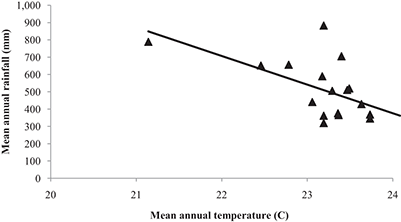
Droughts are of regular occurrence and are expected to become more frequent in most parts of the world, especially the arid and semiarid areas (URT, 2001; Kangalawe et al., 2011; Oxfam, 2012). The first decade of the twenty-first century was the warmest decade recorded since modern measurements began around 1850, which was also marked by dramatic climate and weather extremes, such as long-term droughts in the Amazon Basin, Australia and East Africa (WMO, 2013). Climate change has become a source of uncertainty for planners and decision-makers in climate-sensitive economic sectors. For example, changes in the production of major crops (as influenced by climate) are important drivers of food prices, food security and land-use decisions. Agriculture production in Hai District is the major economic activity that significantly contributes to food production in Tanzania. The six most widely grown crops in Hai District are maize, common bean, coffee, banana, rice and sunflower. Production of these crops accounts for over 46 per cent of Hai District cropland area and more than 82 per cent of food production, grown by more than 80 per cent of the small scale farmers/residents whose primary source of livelihood is agriculture (URT, 2001, 2012b). The past decade has witnessed dramatic decline in rainfall weighted with increased temperature in Hai District (Figure 1). Many studies from around the world have considered the impacts of future climate changes on food production to exhibit several significant trends.
While decline in yields for almost all these crops in other regions of the world have been associated with changes in temperature and rainfall (Rosenzweig and Parry, 1994; Edmonds and Rosenberg, 2005; Fischer et al., 2005; Parry et al., 2005; FAO, 2006; Lobell and Field, 2007; Schlenker and Roberts, 2009; Lobell and Gourdji, 2012), the effects of these past climate changes on crop production in Hai District remain unclear. Understanding how agriculture productions react to such hydric stress is, thus, crucial to address future challenges in food security and poverty alleviation (URT, 2001; Mary and Majule, 2009; Schlenker and Roberts, 2009; Lobell and Gourdji, 2012), especially in these drought-sensitive areas (Lyimo and Kangalawe, 2010; Oxfam, 2012). In such environments, however, a drought can vary in severity: temperature and rainfall projections from Sub-Saharan Africa showed, for example, that there will be roughly 54 per cent increase in armed conflict incidence by the year 2030, which is equivalent to an additional 393,000 battle deaths if future wars are as deadly as recent wars (Burke et al., 2009). Extended periods of severe droughts have far-reaching, negative impacts on the availability of water resources, food and agricultural security, human health, tourism and biodiversity (Oxfam, 2012). In addition, climate change has the potential to undermine economic development, increasing poverty and delaying or preventing the realization of the Millennium Development Goals (MDGs). Such a drought was experienced by farmers in areas across the Horn of Africa, for example, the 2009, and 2011 drought was, in some places, the worst to hit the region for 60 years (Oxfam, 2012; WMO, 2013). As a consequence, normal patterns of temperature and rainfall and farming were disrupted, with production of some (annual) crops going down below the average per unit area production, while some areas experienced total annual harvest loss in Hai District during the years of drought. Annual crops are most sensitive to variations in rainfall and temperature conditions (Agrawala et al., 2003; Gregory et al., 2009). Most of the affected crops during the years of drought among others were maize, beans and coffee (Agrawala et al., 2003), so our analyses focused on production patterns among maize (Zea mays L.) and common bean (Phaseolus vulgaris L.).
This study aims to examine production patterns among different crops as influenced by changes in climate (temperature and rainfall). The study also addresses the following questions:
What are the rainfall and temperature patterns in Hai in the past 11 years?
What is the impact of rainfall and temperature on both maize and beans production in Hai District?
2. Methods
2.1 Study area
The study area in Hai District located in the northern part of Tanzania (latitude 2° 50′-3° 29′S and longitude 30°30′-37°10′ E). Mean annual rainfall is 521 ± 188 mm (n = 40 years), and the mean annual temperature is 23.3 ± 0.66°C (URT, 2012a; Figure 1). The rainfall is bimodal with two rainy seasons, namely, long rainy season which starts in March and ends in June, and the short rainy season is usually between the months of November and December (URT, 2012a, 2012b). In 2009, Hai District experienced the most severe drought in a decade, with only 299 mm of rainfall in 44 days (with only 92 mm of rainfall in 13 days of cropping season) that year (URT, 2012a; Figure 4). In 2003, Hai District experienced the second most severe drought in a decade, with only 346 mm of rain falling in 25 days (with only 265 mm of rainfall in 17 days of cropping season) that year (URT, 2012a; Figure 4).
2.2 Climate and crop production data
The monthly average temperature (minimum and maximum) and rainfall data for the same time period were obtained from the Kilimanjaro International Airport Meteorological Centre. This center facilitates the gathering of data from the national (and the world’s) leading climate data, monitoring, and research centers.
Estimates of Hai District crop yields for 2000-2010 were obtained from the District Agriculture and Livestock Office (URT, 2012b). Seasonal estimates from the available land area data were computed for each crop, with (both commercial and smallholder rainfed sector) production estimated by the annual production of crop in the District. The monitoring of the crop production in Hai District is an ongoing activity managed by Hai District Council (URT, 2012b). Prior to the year 2000, Hai and Siha Districts were under one administrative (Hai) district Council, which have now been divided into two (Siha and Hai) districts; because of this, all the analyses of annual crop production used the end of 2000 as a baseline year for Hai District and were adjusted appropriately to include the crops that were being monitored by Hai District Council only at that time. During the past decade, annual food crop production in Hai District has fluctuated markedly. By the year 2000, Hai District was monitoring its six major crops produced in the area (Table I).
2.3 Statistical analyses
To understand how climate change predicts crop production in Hai District, long-term (40 years) data were used to compare the patterns of rainfall and temperature and annual crop production data collected from the two main food crops: maize and beans. These are the annual crops that are mostly affected by annual variations in temperature and rainfall in Hai and whose productions were recorded for the past decade (Table I). The long-term temperature and rainfall data collected were subjected to statistical analyses for significance levels using correlation analyses in R 2.13.0 (www.r-project.org).
3. Results
There was a significant negative correlation between mean annual rainfall and temperature at Hai District over the past four decades (Pearson’s correlation, r = −0.59, p-value = 0.0072, Figure 1).
Two (2003 and 2009) of 10 years of climate data showed the driest record over the past decade, recording the lowest maize and beans yields (274 and 39 kg ha−1, respectively) in 2003, whereas 100 and 348 kg ha−1 of maize and bean, respectively, were obtained in 2009 (Table I). Although almost all the crops produced at Hai District were found to be influenced by climate change, the most affected ones were maize and bean (Table I). Temperature and rainfall were strongly correlated with maize and beans production, with rainfall having a strong positive association with maize and beans production and temperature having an inverse relationship with maize and beans yields (Figures 2 and 3; Table II). The strength of association between maize production versus temperature and rainfall was also found to be significant (Table II).
4. Discussion
Agriculture is extremely vulnerable to climate change (Antle, 2010). Higher temperatures eventually reduce yields of desirable crops while encouraging weed and pest proliferation (Gregory et al., 2009). Changes in precipitation patterns increase the likelihood of short-run crop failures and long-run production declines. In Hai District, variation in yields on annual food crop production during the non-drought years is generally extremely low, with maize crop having the highest production when compared with other crops. However, in 2003 and 2009, for example almost more than 98 per cent of the maize produced per year did not attain maturity and consequently could not be harvested within that year (Table I; Figures 2 and 3). The rainfall observed in 2005 and 2007 was not substantially higher than that of 2003 and 2009 compared to the correspondent difference in grain yields. The most possible reason could not be attributed only to low rainfall and high temperature, but more importantly to poor rainfall distribution recorded over the entire monitoring period in the district.
Thirteen days of light rainfall (of 92 mm) during the cropping season in 2009 (Figure 4) was grossly inadequate to sustain annual crop, particularly maize and bean, to maturity. On the average, 7.08 mm of rain in 13 days scattered across the cropping season will not be sufficient to meet the transpiration requirement of the annual crop. The remaining amount of rainfall (299 mm) fell during the short season when the crops are usually not cultivated (Figure 4). However, 2003 had a different scenario compared to 2009. Seventeen days of heavy rainfall (265 mm) concentrated majorly in one month of the cropping season (Figure 4), and may also be regarded as poor distribution to efficiently support the performance of crops.
As expected for most annual crop varieties (Agrawala et al., 2003; Gregory et al., 2009), annual food crops in Hai District suffered most from the severe drought. In accordance with previous work on effects of climate change on crop production, maize production was moreover lower among other annual food crops than between perennial crops (URT, 2001; Agrawala et al., 2003). Estimates of the effects of climate change on maize yields are available from model runs of the Crop Environment Resource Synthesis model (CERES-Maize) (Agrawala et al., 2003). In general, simulation results show that maize yields were lower, as a result of higher temperatures and, where applicable, decreased rainfall. The average yield of maize decrease over the entire country was 33 per cent, but simulations produced decreases as high as 84 per cent in the extremely dry regions of Tanzania (Agrawala et al., 2003; Mary and Majule, 2009).
In this study, we also report a strong and significant association between climate change and high variability in the yield patterns of maize over the years in Hai District. These observed reductions in maize yield are mainly due to increases in temperature and decreases in rainfall amount and distribution during the growing season (Figures 2 and 4) that affects development of the crops and their attainment to maturity. The inferred temperature sensitivities were negative for both maize and bean crops (Table II), in agreement with several previous assessments (Agrawala et al., 2003; Lobell and Field, 2007; Schlenker and Roberts, 2009; Lobell and Gourdji, 2012). All instances of significant yield effects were attributable mainly to precipitation trends, as rainfall trends had significant positive associations on yields for both maize and bean. Mechanisms likely responsible for the observed negative relationships include decreases in crop development rates, due to increases in water stress and canopy respiration with warmer temperatures (Lobell and Field, 2007).
The impacts of climate change on agriculture may add significantly to the development challenges of ensuring food security and reducing poverty. The study showed the possible impacts on maize and beans production in Hai District, especially during the years of drought. Estimates of lost production due to climate change from this study are 116,200 tones yr−1 for maize and 16,200 tones yr−1 for bean, which translates to annual District losses of almost $29 and $8.1 million, respectively, using 2012 producer prices in Tanzania.
Although the results indicate an overall reduction of more than 98 per cent in maize production, equivalent to losses of $29 million per year, the aggregate results hide enormous severe consequences for agriculture, food supply, economy and employment, particularly in years where substantial extreme droughts are experienced. For example, whenever the rains fail in Tanzania, it is the agricultural and energy (hydroelectric power) sectors that suffer most. These unprecedented climate extremes should be a wake-up call for all stakeholders, and their impacts urgently need to be assessed at the level of the household, so that poor and vulnerable people dependent on agriculture can be appropriately targeted in research and development activities, and whose object is poverty alleviation.
The observed consequences of climate change on maize production allow us to suggest that the continued reliance on maize as a staple crop over wide areas of the country could be at risk in the face of climate change. Inclusion of drought-tolerant crops such as cassava and sweet potatoes can be one of the strategies to adapt climate change in agricultural production.
Our study illustrates the strong impact of climatic variability on annual food crop production. Some other recent research suggests that while some crops may respond positively to increased atmospheric carbon dioxide concentrations, the associated effects of higher temperatures and altered patterns of precipitation will probably combine to reduce yields (Gregory et al., 2009). Also Gregory et al. (2009)’s study indicated that, while annual crops could be more impacted by climate change, it is likely that perennial crops would be even more susceptible to changes in the climate. Although there will be gains in some crops in some regions of the world, the overall impacts of climate change on agriculture are expected to be negative, threatening the global food security (Easterling, 2007; Mary and Majule, 2009).
The agricultural sector is the leading sector of the economy of Tanzania and accounts for over half of the gross domestic product (GDP) and export earnings (Agrawala et al., 2003). The livelihood of more than 80 per cent of the population that lives in rural areas depends on agriculture (URT, 2001;). The performance of agriculture is therefore a major factor in determining livelihood fortunes. Given the importance of agriculture for GDP, employment, and livelihoods in many developing countries, the impacts of climate change on agriculture are likely to reverberate throughout the economies of these countries (Desanker, 2002). Indirect effects of climate change are likely to be felt, not only in sectors concerned with processing and distributing agricultural products, but also in many other sectors of the economy by impacts on income and consumption (Levira, 2009).
This study thus provides another example of how extreme climatic events such as droughts can strongly affect crop production. The reduced maize production in Hai District is an example of one end of the spectrum in crop production and climate dynamics: a one-site maize production greatly reduced by droughts, whose yield can increase rapidly in the face of availability of enough rainfall and moderate temperature conditions. Knowledge of this variation in maize and beans yield as influenced by climate variability will be important in improving quantitative planning for adaptive and climate change mitigation measures.
Our expanding body of knowledge of how climate affects crop production should help to ensure that any measures and/or decisions that are meant to respond to consequences of climate change are based on the best quantitative information available.
5. Conclusion
Despite our knowledge on the effect of climate change on crop production, there is much empirical information that is needed on the patterns of crop outputs as a function of temperature and rainfall. Here, we demonstrate that rainfall and temperature have a significant relationship with maize and bean outputs. The rainfall had a strong positive association with maize and beans production and whereas temperature had an inverse relationship with maize and beans yields.
With the annual loss of $29 and $8.1 million from maize and bean crops, respectively in Hai District during years of severe and prolonged droughts, our study highlighted how severe droughts can dramatically affect outputs of annual crops. The study further suggested that the extreme climatic events might act as a major factor affecting food security, delaying or preventing the realization of the MDGs.
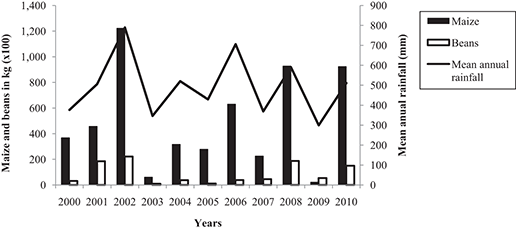
Annual maize and beans output and rainfall patterns in Hai District from 2000 to 2010
Annual maize and beans output and rainfall patterns in Hai District from 2000 to 2010
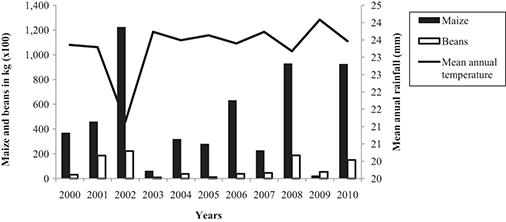
Annual maize and beans output and temperature patterns in Hai District from 2000 to 2010
Annual maize and beans output and temperature patterns in Hai District from 2000 to 2010
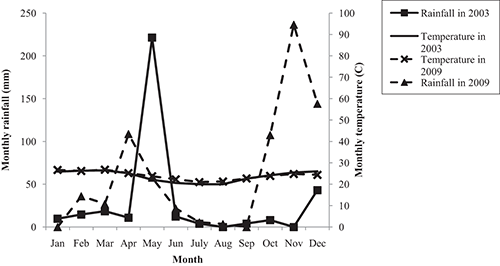
Relationship between monthly rainfall and temperature in Hai District for both 2003 and 2009
Relationship between monthly rainfall and temperature in Hai District for both 2003 and 2009
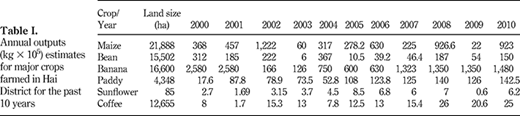
Annual outputs (kg × 10) estimates for major crops farmed in Hai District for the past 10 years
Annual outputs (kg × 10) estimates for major crops farmed in Hai District for the past 10 years
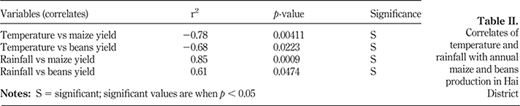
Correlates of temperature and rainfall with annual maize and beans production in Hai District
Correlates of temperature and rainfall with annual maize and beans production in Hai District
References
Further reading
About the authors
Linus K. Munishi is a Lecturer in the School of life sciences and Bio-Engineering at Nelson Mandela African Institute of Science and Technology, Arusha and his research works integrate population biology and aspects of environment/biodiversity and sustainable development. Linus K. Munishi is the corresponding author and can be contacted at: lmkasian@gmail.com
Anza A. Lema is a student doing his Master of Community Development at Mount Meru Univeristy, Arusha.
Patrick A. Ndakidemi is a Professor of crop science and production in the School of life sciences and Bio-Engineering at Nelson Mandela African Institute of Science and Technology, Arusha.
The authors thank the staff at Hai District Council and Kilimanjaro International Airport Meteorological station for providing access to data used in this research. The authors also thank two anonymous reviewers for their valuable contribution to the improvement of this manuscript.

