


Spatio-temporal variations in precipitation pattern of district Sargodha is one of the most significant researchable questions because of the massive reliance on rainfall for agricultural practice in the study area. The pattern of current rainfall in the study area is unexpectedly changed. The purpose of the present study is to examine the changing precipitation pattern and to link it with climate change.
The study was conducted by using rainfall data of the past 30 years collected from 8 meteorological stations around the study area. The averages of rainfall on monthly basis were temporally arranged, and the fluctuation trends were studied using GIS and statistics. The temporal data of rainfall were compared and contrasted with the precipitation normals of the study area from 1981to 2010. The rainfall deviation in the present study was calculated. The spatial pattern of rainfall was plotted by interpolating the eight points of Punjab around the study area for the first two decades, whereas the past decade was analysed by incorporating five more points of Tehsils in the existing eight. The spatial and statistical representation of data were examined by compare and contrast with the previous findings.
The rainfall in the study area showed remarkable changes in magnitude and spatiality. The rainfall in the district is on the rise, whereas the spatial pattern of rainfall is becoming more complex and anomalous in character. This paper provides convincing evidence about the impact of climate change on the magnitude and spatial patterns of precipitation in the study area.
It will be helpful for understanding the shifts in the rainfall pattern in future as well as for the preparation of response to the issue of climate change and its impacts.
The current manuscript, for the very first time, provided detailed insights about the precipitation pattern shifting during the last 30 years in district Sargodha, Punjab, Pakistan. Furthermore, agricultural sector would likely get severally affected because of seasonal changes in climatic factors like rainfall and have strong food security implications. The current findings will be useful to manage the climate change-related issues in Pakistan and helpful for the policy makers to design a coping strategy for climate change impacts.
1. Introduction
The first decade of this century was recorded as the warmest decade since 1850. Tropical areas of the world experienced erratic rainfall, and heat waves struck Europe. The year 2010 broke all previous records in terms of climatic anomalies, for example, European heat waves of 2003, flooding in Pakistan as a result of rainfall pattern shifting in 2010, Katrina in the USA, Nargis Cyclone in coastal Myanmar, and the long-term drought in the Amazon Basin of Brazil, Australia and East Africa. The above-stated episodes of natural calamities are all climate-related phenomena, which can be attributed to the climatic variability and change (WMO, 2013). This has become a serious concern for countries like Pakistan, where understanding and planning about the climate change and variability have not been well received and acted upon despite the fact that Pakistan is one of the most severely affected regions by this spectre.
The most potent variable of climate is the change in the precipitation pattern. The change in climate is used to elaborate as systematic alteration or statistically significant difference in either the average state of the climatic elements such as temperature, precipitation and wind or air pressure. The effects of climate change include fluctuations in the climatic parameters, especially change in atmospheric carbon dioxide (CO2), which could lead to heat stress, ensuing in a change in the rainfall pattern, which can result in either flooding or drought. Climate change has the potential to alter and contaminate the natural hydrological cycle of the globe. In many regions of the world, climate change has a significant effect on precipitation and evapotranspiration (George, 2008). Our ecosystem is showing many evidences which depict the impact of climate change on it. Its repercussions can be viewed on both, the cultural and the physical systems and processes. The impacts of climate change are likely to be greater on those countries which are more dependent on the primary sector of economic activities, primarily because of the increase in uncertainty about productivity from primary sectors. Impacts include reduction in water availability in the already water-stressed areas, changes in the incidence of extreme events such as cyclones and droughts and impacts of sea-level rise in low-lying coastal areas (Wreford et al., 2010). Precipitation can be defined as the fall of moisture in any form from the atmosphere to the land or the ocean (De Blij and Muller, 1996). Humans have caused remarkable changes in global precipitation patterns over the past century, and this shift in precipitation pattern is more significant in the tropics and equatorial regions (Roach, 2007).
Global warming is expected to have profound effects on India, Pakistan and Bangladesh, and it has its repercussion on the summer monsoon rains. The overall global climatic system has become more anomalous than ever before. The northern hemisphere has become stormier during the past 50 years. The model simulations for the future of mid-latitude climate are expected to fluctuate widely over the next 100 years. This variation will augment the frequency of climatic change events. Climate models are indicating an increase in the intensity of the summer monsoons spell as a result of global warming over the next 100 years (Maslin, 2004). The precipitation zonation of Pakistan, through the precipitation effectiveness index, gives an alarming picture about the spatio-temporal shifts in the normal precipitation pattern in Pakistan. The results of zonation show a big shift in the rainfall pattern in upper Indus Plain (Faisal and Sadiq, 2011). The researchers are indicating that the changing climate in the region is reality, and this change in temperature and rainfall pattern is going to pose a serious challenge for us in the near future. We are being admonished by nature that we should act and prepare ourselves wisely for dealing with the challenge (Salma et al., 2012).
The aim of the present study is to determine the changes in the precipitation pattern of Sargodha district in by investigating its degree of change from time to time and place to place in the study area. The mapping of changing precipitation pattern and identification of the rainfall anomalies during 1980-2010 as a response of climate change are the objectives of this research.
2. Material and methods
2.1 Study area
Sargodha is an agricultural region with an area of 5,864 km2 (2,264.1 sq. mi.) and had a population of 2.66 million in 1998 (GOP, 2000). The latitudinal and longitudinal position of the study area is between 31° 34′ and 32° 37′ N and 72° 10′ to 73° 18′ E. It is located in between rivers Jhelum and Chanab. The local name used for this inter-fluve is “Chaj Doab” and is famous because of its fertility. Agriculture is the backbone of the whole district, which is primarily dependent upon rainfall and canal irrigation. The alluvium carried by these two rivers makes the region more fertile for growing citrus fruits. The study area is heavily reliant on rainfall for its agriculture practice. The agricultural type is subsistence in nature and is totally dependent upon natural climatic conditions, especially rains and temperatures.
2.2 Physiography and climate of study area
The study area is located at the Northwestern part of the Indo-Gangetic plains. Its soil is of alluvium origin carried by the Chanab and Jhelum rivers. This old alluvium is a composite of calcareous and silt clay. The northern part of the district is fortified by a salt range while the other three sides are surrounded by rivers. The total land area of the district Sargodha is 5,854 km2, which is predominantly plain, except some remnants of Kirana hills which break the monotony of the plains (Khan, 2006).
The climate of the study area is arid with hot summer and mild winter, in which summers are hot, and the maximum temperature reaches up to 50°C. The summers are long enough, whereas the winters are short and the minima during winter drops below freezing point. The region is primarily arid in nature, where potential evapo-transpiration exceeds from the evaporation. Most of the rainfall occurs because of monsoons in the month of August, in which the area receives up to 250 mm of rainfall (Khan, 2006) [Figure 1(a)].
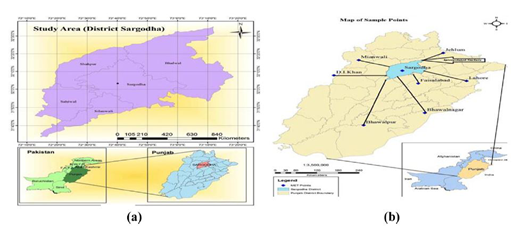
(a) Map of study area (b) Distribution of sample points Interpolation
(a) Map of study area (b) Distribution of sample points Interpolation
2.3 Data sources and its preparation
To understand the changes in the climate of an area, the changes in the heat energy content in the atmosphere are taken under consideration. Regardless of where in the climate system we are looking for evidence of possible change, the golden rule is to identify changes in the climate system that require data series that have been collected over several decades and must amount to at least three at a minimum (Richardson et al., 2011). The data of meteorological parameters, i.e. temperature and rainfall data, were obtained from the Pakistan Meteorological Department, Head Office, Islamabad. The provided data of eight meteorological stations were tabulated and organised on spatio-temporal adequacies for the present research. The district Sargodha has five Tehsils and each one has an Agricultural Department in it. The data since 2006 to 2010 were available there, and these were also converted into a tabular representation and then processed. This sub-data set comprised rainfall in mm which was incorporated in the Data set 1.
In the present study, we divided the 30 years into three equal parts. In this way, the statistical data of the three concerned parameters were divided into three decades, i.e. decade-1, decade-2 and decade-3, which comprise years 1981-1990 for the first one and 1991-2000 and 2001-2010 for the second and third ones, respectively. Each decade was further subdivided into three rainfall-based categories. The rainfall seasonality was divided into three categories according to the precipitation in Pakistan (Khan, 2006) – rainfall received during monsoon months (July, August and September); rainfall received because of western disturbances (December, January, February and March); and rainfall because of thunder and dust storms (October, November, April, May and June).
To generate the interpolated surface, eight meteorological stations of the Punjab Province around district Sargodha were selected on the basis of data availability. These meteorological stations are Bahawalnagar, Bahawalpur, D. I. Khan, Faisalabad, Jhelum, Lahore, Sargodha and Mianwali. Figure 1(b) shows the location of these meteorological stations and indicates the interpolated surface. The data of five subdivisions of district Sargodha were also added for the decade-3. In the decadal division of the 30 years 1981-2010, the data of 5 tehsils of Sargodha were also incorporated into the past decade 2000-2010. This addition made the analysis more authentic and reliable, especially for decade-3. The station names of these meteorological stations are Bhalwal, Sargodha, Shahpur, Sahiwal and Silanwali.
2.4 Organisation and geo-statistical processing of data
The data were organised into three different data sets, which were processed to meet the objectives of the study. These data sets were added to ArcGIS, and an analysis of interpolation was performed in order to generate the surface of study area.
2.5 Geo-statistical analysis (interpolation)
Interpolation is a fascinating tool in ArcGIS which represents the statistically valued point into a spatial surface. The capability of creating a surface from sample data points makes the interpolation a potently useful tool. It can be defined as the process of estimating the unknown values on the basis of the known point (Dobesch et al., 2007).
In the present study, the creation of surface of research area was not an easy task because the spatial distribution of the available known points (Bahawalnagar, Bahawalpur, D. I. Khan, Faisalabad, Jhelum, Lahore, Sargodha and Mianwali) was showing too complex a pattern to select a suitable method of interpolation based upon the spatial locations of the known points. The traditional methods for estimation of rainfall by using the limited known values to the unknown are Theissen polygon, inverse distance weighting (IDW) and isohyetal methods. IDW is a well-known method of interpolation for its statistical and mathematical consideration of values by minimising the other possible error (ESRI, 2004). The understudy area is a piece of almost flat surface of Indo-Gangetic plain. The IDW can be the most suitable method of interpolation for the estimation of isohyetal surfaces. This is the method of interpolation that has been used in the present study. The IDW interpolation method has been used extensively all over the world. It is considered appropriate when input points are sporadically distributed. IDW is also the most suitable because its error estimation is minimum for calculating the precipitation of an area (Modallaldoust, 2010).
2.6 Statistical analysis
The statistically arranged data sets were put into a Special Package for Social Sciences (SPSS Statistic 17.0) to calculate the Central tendency and dispersal trends of the rainfall date.
3. Results and discussion
The seasonal reversal of the wind system as a result of pressure change is called monsoon system (Trenberth and Shea, 2006). The July and August months of the monsoon season depict a remarkable rise. The month of August has been ranked first during the decade by receiving 135.52 mm. The rainfall during the monsoon months since 1981-1990 remained 93.09 mm as compared to 79 and 97 mm during decades-2 and 3, respectively. It has been analysed that the months of July and August remained the recipients of maximum rainfall in Sargodha, and March and April also received above 40 mm in aggregate, which is a considerable amount of rain.
3.1 Decade-1 (2001-2010)
The maps in Figure 2 show the spatial behaviour of rainfall during decade-1, the precipitation because of monsoon (July, August and September). The spatial pattern is also evident in the different months. The north-eastern portion of Tehsil Bhalwal is the recipient of maximum amount of rainfall, especially in August. As we move from northeast to southwest, the rainfall decreases from 170 to 18 mm in the Sahiwal and Silanwali which is a generalised trend of monsoon weather system in Pakistan; it decreases from northeast to southwest in the upper Indus plain. The tehsils can be ranked by visualising the interpolated maps of the monsoon season. Bhalwal is at the top, which is followed by Sargodha as second-highest recipient, with Shahpur at third, Sahiwal at fourth and Silanwali at the fifth positions. The present study is in line with the study done by Hanif et al. (2013), where in the high latitudes of Pakistan manifesting the greater variability, compared to the areas which are near the tropics. The spatial pattern of decade-1 shows the verification of their findings.
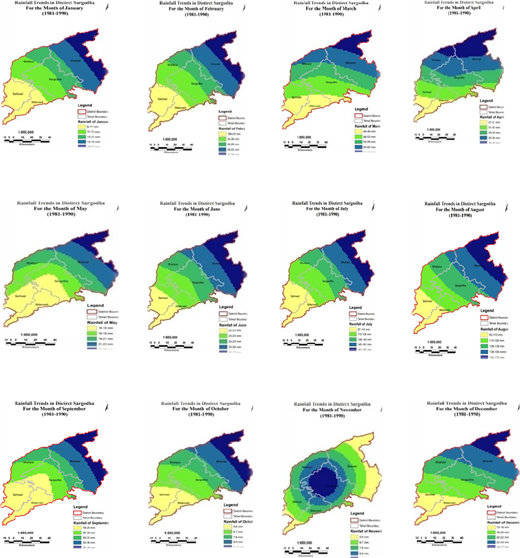
Spatial distribution of rainfall for decade-1
Spatial distribution of rainfall for decade-1
The western disturbance (December, January, February and March) (Figure 2) is an anomalous precipitation holding a weather system which enters Pakistan from West (Khan, 2006). The precipitation received by western depressions or disturbances have been monitored both in summer and winter (Afzal and Zaman, 2010). The spatial expression shows that in these months, as we approach from December to March, the high precipitation trend line shifts from northwest to northeast. Similar findings were also reported by Afzal and Zaman (2010).
The remaining five months are included in Thunderstorm Season (Figure 2). It has two distinctive sub-seasons in it. The months of October and November are included in winter thunderstorms, whereas April, May and June are the summer dust storm months (Khan, 2006). Most of the rainfall is received during the summer dust storms, which sometime receive up to 40 mm only in the month of April. The rainfall is abysmally low during the months of October and November.
The statistical analysis shows the fluctuation of rainfall received during the monsoon months with a slight rise from July to August, whereas there is evidence of a fall in the magnitude of rain from August to September. The Figure 5 gives an average picture of the 10 years of monsoonal rain in Sargodha. The monsoon rain contributes 60 per cent of precipitation of the total received rain of Pakistan (Muslehuddin et al., 2005).
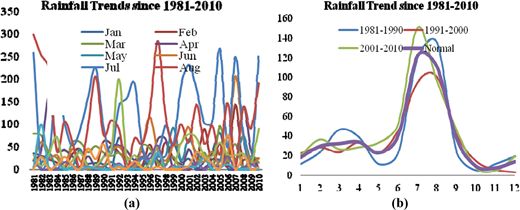
(a) Monthly trend; (b) Inter-decadal comparison
(a) Monthly trend; (b) Inter-decadal comparison
3.2 Decade-2 (2001-2010)
The total rainfall during the second decade was recorded as low as 36 mm, which falls from the 39 mm annual average during the first decade. Decade-2 experienced a great scantiness of rainfall as compared to decade-1. This decade results are in conflict with the IPCC Report 2001 which accentuates the fact that the rainfall in northern Pakistan has increased by 20 per cent during the twentieth century (IPCC technical paper 5, 2001). Decade-2 trend of rainfall is contradictory to the IPCC findings (2007) which state a clear rise in monsoon amount of rain in Pakistan. But, here the readings show a sharp decrease in its 10-year average (Figure 3).
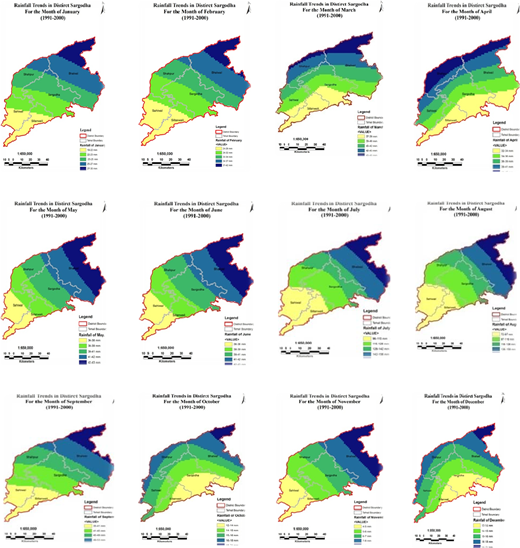
Spatial distribution of rainfall for decade-2
Spatial distribution of rainfall for decade-2
The statistical calculation of the whole decade shows a result that is in line with the decade-1 results in terms of seasonal allocation of precipitation of the study area. Monsoon again proved to contribute to more than 60 per cent of the total annual rainfall in the area, and the results of this decade also endorse the findings of Afzal and Zaman (2010). This inter-decadal decrease in precipitation can be coupled with the local climate variability and change.
The generated surface shows the great variation within the study area which is manifesting the northeast to southwest decrease in the rain during the three months of Monsoon. The average picture shows the paucity of rain in the Sahiwal and Silanwali areas (Figure 3). The generalised picture shows a slight rise in the amount of rainfall as we approach from July to August and then an abrupt fall in September to 42 mm in the month.
The interpolated map surface demonstrates that the weather systems which have been casing rain are coming from the western or north-western side of the study area. This trend is well justified during the months between December and March. The pattern is temporally showing fluctuation from northwest to northeast, as we approach from December to March. The rainfall due to western depressions during decade-2 shows that the amount of precipitation rises sharply from 2.98 mm during December to 22.3 mm during January. It reaches its peak in February at 28.68 mm and then there is a slight decline in the month of March.
The given maps in Figure 3 again show a pattern of rainfall that is not uniform in terms of its spatial and intensity pattern. The intra-seasonal variation does not follow uniformity. The pattern shows that the storms during both seasons have a random spatial pattern. These storms are primarily convectional in nature, especially during the summer season because the plain nature of the landscape of the study area gives rise to the convectional updrafts that lead to rain. However, it is not always the case in the winter season. During the winter months, the rainfall weather system may build up from a mountainous terrain and the whole system may move from one place to another.
The summer dust and thunderstorms cause more rain in the area as compared to the winter months of October and November (Figure 3). The trend line shows a sinusoidal fluctuation during the summer, and there is sharp decline in the amount of rainfall during the winter months when it declines to as low as to 5.67 mm in the last month of winter.
3.3 Decade-3 (2001-2010)
This decade has been observed as being the most climate change stricken period as compared to the previous two decades. This fact is evident from the data since 2000-2010. The trend is again in line with the IPCC findings published in 2007, where the rainfall in monsoonal Asia is seen to be rising. The previous decline in rain during decade-2 can be termed as climate variability rather than a change. It can also be the result of the El Nino-Southern Oscillation (ENSO) phenomenon, which suppresses the monsoonal rain in the region (Chaudhry, 1995).
There is ample amount of rainfall during this decade, especially with a surge in monsoonal precipitation in the region. This rising amount of rain during the 3 months of monsoon contributed more than 65 per cent of the total rain in the study area (Figure 4).
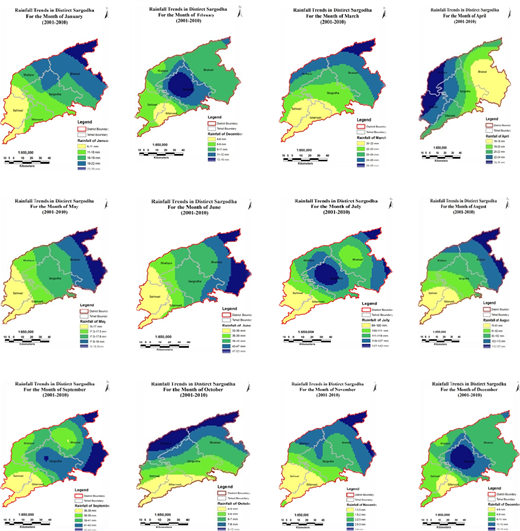
Spatial distribution of rainfall for decade-3
Spatial distribution of rainfall for decade-3
The intensity and frequency of rain increased with a great pace specifically in the monsoon belt of Pakistan, especially during the past decade (IPCC, 2007). The mentioned Figure 4 also shows the change in the magnitude of rain, but its spatial pattern manifests a complex pattern. The isohyetal trends have shifted from the normal pattern to bizarre changes, as the month of July depicts the highest rain in Sargodha city and rain decrease as we approach from the centre to the periphery. August received the maximum amount of rainfall as compared to the other two months but September again signals an amorphous pattern, which is not in any normal sequence. Therefore, all abnormalities can be coupled with the climate variability and change.
The amount of rainfall touches the pinnacle of 151 mm in July, and the curve dives down to 95 mm in August, which further shows a steep decline in September when precipitation approached the figure 46.24 mm.
Western depressions also reveal a similar pattern as this decade showing as whole, the study area has been exposed to a high amount of rainfall again. The spatial pattern is again not according to a systematic and methodical sequence. However, the month of March shows the normal pattern of rainfall distribution.
The Figure 4 reveals a rise, fall, and again a fall trend during the months. The month of February ranked first during the decade and received 36.64 mm rainfall in the study area. The frequency of extreme weather event is expected to rise in the coming future all over the world, especially in the tropical areas (Trenberth and Shea, 2006). The generated interpolated surface is also identical with previous researches. The results also reveal the fact that the magnitude, intensity and frequency of the extreme meteorological events have been witnessed in the study area, especially during the dust and thunderstorm seasons of decade-3.
The amount of precipitation has been maximum during the month of June with 52.18 mm. The inter-seasonal comparison of summer and winter storms shows that the 3 months of summer received far more precipitation as compared to winter, which received only 12 mm in 2 months, which is among the lowest throughout the year.
3.4 Inter decadal comparison of rainfall trends in district Sargodha
The inter-decadal comparison reveals the more comprehensive picture of rainfall variation in all seasons. The data show great shifts in the rainfall amount of the study area.
Figure 5(a) and (b) exposes a comprehensive comparison of each decade using line graphs. The blue colour stands for decade-1 [Figure 5(b)], which is touching high values during the thunderstorms season of summer. The first decade curve overrides the two later decades, although during May and June it again plunges to the lowest values [Figure 5(a)]. The red colour depicts decade-2, which is the most deficient decade among the other two. The lines show the lowest amount of rain, not only by western depressions but also by monsoon. This rain scarcity again can be related with ENSO, which deters the monsoon system from reaching the study area (Chaudhry, 1995). The winter rainfall during these 10 years could not show any remarkable spell; it again recorded the lowest values during the past 20 years. This can be negatively affected by La Nina Phenomenon which has a negative effect on the winter precipitation of Pakistan (Khan, 2004).
The third decade has again manifested a rising trend in the rainfall amount in the study area. It could not show any remarkable rainfall spell during the first six months, but monsoon has been torrential throughout the decade; it surpassed the highest nodes of the decade-1 as well. The total average amount jumped to 43 mm per annum in decade-3 from the 36 mm in decade-2 and 39 mm in decade-1 [Figure 5(b)].
3.5 Spatial variation in monsoon pattern during different decades
The calculation of data reveals the temporal variation of each month of monsoon separately. The pattern of precipitation can easily be analysed as deviating from the normal pattern and distribution of rainfall. The monsoon months of the past decade shows that the monsoon systems are not approaching the research area from the usual side, but rather the maxima of rainfall have been showing its high nodes at the centre of the research area. This shift is more eminent during the past decade as compared to the previous two decades.
The amount of rainfall has been maximum during the month of July and decreases in all decades since 1981-2010. The month of August had experienced considerable amount of pouring rainfall, but the month of September shows the lowest amount of rainfall in the past 30 years, although it shows a good rise as compared to the previous two decades [Figure 5(a)]. The data of each decade clearly reveals the fact that as we approach from December to January, and then February on to March, the amount of rainfall increases in the district. February and March show as the maximum rainfall recipient months in the western depressions. The graphical representation of the data during the summer and winter thunderstorms reveal that the summer months have been the more precipitation recipients as compared to the winter months.
3.6 Yearly comparison of rainfall
The descriptive statistical calculation reveals the yearly trends of rainfall in the study area from 1981 to 2010. The total numbers of the above-average rainy months were identified by reviewing the data sets. Table I shows the frequency of the above normal rainfall that was calculated 13 times in July, 12 for August and 9 times for September. The monsoon rainfall extreme was recorded at 297.5 mm in 1981 in the month of August, 267 mm during July, 2005 and 199.3 mm in September 1992. The statistics reveal that the monsoon has been on surge during decade-1 and decade-3, while the second decade received comparatively low amounts. The data of western disturbances showed the frequency of above average rain 11 times in January, 10 times in February, 14 times in Mach and 10 times in December. The month of March was observed as the most deviant month with 14 above-average rainfall months during the 30 years. The rainfall maxima were recorded in February 2007 with 142 mm. Thunderstorms are also responsible for almost 15-20 per cent of rain in the study area. This season comprises five months which are further subdivided into summer and winter rainfall. The above-normal rainfall was recorded 13 times in April, 11 times in May, 10 times in June, 12 times in October and 6 times in November. The month of April was calculated as the most deviant month during the three decades. The most extreme rainfall spell was gauged in April 1983 with 160.5 mm.
Months received above normal rainfall (mm) since 1981-2010
| Year | January | Year | February | Year | March | Year | April | Year | May | Year | Jun | Year | July | Year | August | Year | September | Year | October | Year | November | Year | December |
|---|---|---|---|---|---|---|---|---|---|---|---|---|---|---|---|---|---|---|---|---|---|---|---|
| 1997 | 19.7 | 1986 | 34.2 | 1983 | 36.5 | 1995 | 39.6 | 2003 | 23 | 1986 | 44.3 | 1992 | 139.4 | 1991 | 107.8 | 1991 | 40.5 | 1986 | 9.1 | 1992 | 9 | 1994 | 17.4 |
| 2008 | 20 | 1992 | 37 | 1992 | 36.8 | 1993 | 41.3 | 1995 | 24 | 1992 | 48.6 | 1993 | 156.1 | 1998 | 119.5 | 1997 | 48.4 | 2004 | 10 | 1984 | 9.9 | 1989 | 22 |
| 2009 | 22 | 1987 | 43.2 | 2003 | 37 | 2009 | 42 | 1997 | 26.9 | 1999 | 50.3 | 1988 | 156.7 | 1996 | 130.2 | 2000 | 57.3 | 2009 | 12 | 2006 | 11 | 2003 | 25 |
| 2001 | 22.8 | 1996 | 54.4 | 1990 | 37.5 | 1985 | 42.5 | 1998 | 29.9 | 1995 | 53.5 | 2002 | 176 | 2008 | 137 | 2005 | 59 | 1992 | 13 | 2003 | 25 | 1982 | 26.5 |
| 1982 | 28.8 | 2005 | 56 | 1988 | 38.1 | 1984 | 43.2 | 2002 | 35 | 2000 | 57.4 | 2000 | 183.9 | 2002 | 142 | 2002 | 68 | 1994 | 13.5 | 1997 | 37.6 | 1985 | 26.7 |
| 1996 | 35.5 | 1991 | 56.5 | 1996 | 45.4 | 1982 | 43.4 | 1983 | 36.6 | 1982 | 60.6 | 1984 | 189.4 | 2006 | 146 | 1984 | 71.5 | 2002 | 15 | 1982 | 98.5 | 2008 | 29 |
| 1981 | 35.6 | 1998 | 60.1 | 1989 | 50.2 | 2001 | 43.4 | 1987 | 43.7 | 2008 | 70 | 1994 | 189.6 | 2010 | 189.6 | 2001 | 78 | 1985 | 16 | – | – | 2002 | 38.3 |
| 2004 | 36 | 1990 | 61 | 1995 | 51.9 | 1991 | 51.5 | 2001 | 67 | 2001 | 92.4 | 1989 | 224.9 | 1989 | 204.8 | 2010 | 89.4 | 1981 | 18.9 | – | – | 1988 | 44.8 |
| 1999 | 57.5 | 2003 | 88.9 | 2007 | 56 | 1992 | 53.1 | 2006 | 72 | 1996 | 114.9 | 2001 | 231 | 1983 | 222 | 1992 | 199.3 | 1996 | 24.2 | – | – | 1990 | 55.6 |
| 1992 | 69.8 | 2007 | 142 | 1986 | 59.3 | 1998 | 66.5 | 2008 | 74 | 2007 | 206 | 2007 | 248 | 1982 | 251.6 | – | – | 1995 | 28 | – | – | 2006 | 77 |
| 2005 | 80 | – | – | 1987 | 60.2 | 1997 | 66.7 | 1999 | 92.2 | – | – | 2010 | 249.2 | 1997 | 283.7 | – | – | 2006 | 28 | – | – | – | – |
| – | – | – | – | 1982 | 74.6 | 2008 | 138 | – | 0 | – | – | 1981 | 257.4 | 1981 | 297.5 | - | - | 1997 | 52.8 | – | – | – | – |
| – | – | – | – | 1981 | 79.2 | 1983 | 160.5 | – | – | – | – | 2005 | 267 | – | – | – | – | – | – | – | – | – | – |
| – | – | – | – | 2005 | 95 | – | – | ||||||||||||||||
| Total | 11 | Total | 10 | Total | 14 | Total | 13 | Total | 11 | Total | 10 | Total | 13 | Total | 12 | Total | 9 | Total | 12 | Total | 6 | Total | 10 |
Table I shows an overall picture of the rainfall trends for all the months during the 30 years since 1981-2010. The months of July and August are eminently visible and touching the high value. This also proves that the most amount of rainfall is received during the two months of monsoon in the study area.
4. Conclusion and future recommendations
Precipitation showed very prominent spatio-temporal variations in the study area.
The rainfall in the study area was studied both statistically and spatially. The statistical trends exhibit that the magnitude of rainfall in the study area increased during the period of 1981 to 2010. Its values were 39.10 mm during 1981-1990, 36.50 mm during 1991-2000 and 43.59 mm in 2001-2010. The precipitation of the study area increased by 4.49 mm in 30 years and the per decade rise in rainfall has been calculated as 1.497 mm. Decade-2 recorded the minimum value with 36.50 mm rainfall in the region. This trend in rainfall shows a sinusoidal behaviour of rise and fall during the time delimited for the study. The rising trend in precipitation is not linear, rather it decreased by 2.6 mm during the period 1991-2000. The rainiest year has been recorded during decade-1, with a value of 63.94 mm in 1981. The lowest ebb of rainfall was observed in 2009, when only 22.18 mm rain was calculated in the study area, which is once again followed by one of the highest rainy spells in 2010 with 50.18 mm rain. The other rainiest years were 2007 with 59.85 mm, 1992 with 58.62 mm and 2005 with 53.75 mm. The years of 1993, 1987, 1985, 1995 and 1986 experienced minimum rainfall recipient years during the three decades.
The month of July was observed as the rainiest month during 1981-2010 with a value of 121.87 mm, followed by August and June with 110.68 and 39.97 mm, respectively. The one rainiest month in the 360 values of 30 years recorded was 297.5 mm in August 1981, followed by 283.7 mm in 1997. The distribution of the top 30 rainiest months was 9 in decade-1, 9 in decade-2 and 12 in decade-3. The past decade has been the rainiest decade among the three, and it is clearly evident that the rainfall is becoming much frequent, intense and torrential, especially during the past quarter of decade-3. The 2010 flooding in Pakistan clearly demonstrates the fact that the region under study has been under the wrath of climatic shifts in the recent past. The data unveils the fact that in future, these climatic anomalies will be more frequent and powerful in the study area.
The spatial pattern of rainfall was intensively studied over the period of 30 years, revealing information about the study area consisting of five tehsils, i.e. Bhalwal in the north and northeast and Silanwali and Sahiwal in the south. The highest isohyetal values were noted in the north and northeast, which showed gradual decrease in the magnitude of rainfall as we moved toward the south and southeast. The normal pattern of rainfall exhibited a slight shift toward the west and southward, which led to arise in the rainfall amount in the region. Monsoon rain as shifted over the study area. The western depression systems normally approach from the western side of the study area, which showed more westward tilt of isohyets from 1981 to 2010. The thunder and dust storm season of rainfall did not show any particular pattern shift, as this type of rain is a locally build-up phenomenon, which might be built up even from the centre of the study area. The overall spatial picture of the rainfall in the study area indicates that the prediction and weather forecasting will become more difficult because of the exhibiting of a nonlinear pattern of isohyets during most of the time in a year. The bottom line of my conclusion is that the amount and pattern of rainfall is passing through a transition phase of change, which will keep on changing in the region in terms of magnitude and spatiality. The revealed facts pose more serious climatic threats for us in all spheres of life because of its abrupt and changing behaviour of rainfall in the study area, which will undermine our response and adaptation strategy to these climatic shifts. This study provides an evidence in the favour of impacts of climate change on the precipitation pattern of the area.
The authors offer sincere thanks to the Meteorological Department Lahore, Government of Pakistan, for providing long-term data of rainfall.

