


In this paper, the international progress of Nationally Appropriate Mitigation Actions (NAMAs), Intended Nationally Determined Contributions (INDCs), and Nationally Determined Contributions (NDCs) under the United Nations Framework Convention on Climate Change are reviewed. The content of Taiwan’s NAMAs and INDCs are also investigated, especially with reference to actions for the electricity sector. To better understand the greenhouse gas (GHG) reduction contribution from the electricity sector, this paper aims to examine challenges and solutions for implementing a carbon trading mechanism in Taiwan’s monopolistic electricity market under the newly passed Greenhouse Gases Emissions Reduction and Management Act (GHG ERMA).
Carbon reduction strategies for the electricity sector are discussed by examining and explaining Taiwan’s official documents and the law of GHG ERMA.
This study finds that market mechanisms should be utilized to allocate appropriate costs and incentives for GHG reductions to transform Taiwan into a low-carbon society.
This study identifies strategies for the electricity sector to reduce GHG emissions, especially the operation of a carbon-trading scheme under a non-liberalized electricity market.
1. Introduction
The United Nations Framework Convention on Climate Change (UNFCCC), ratified in 1992, proposed a global regulatory agreement on anthropogenic greenhouse gas (GHG) emissions. The Parties to the Convention were divided into Annex I Parties (developed and industrialized countries) and non-Annex I Parties (developing countries) (UN, 1992). The Kyoto Protocol was established in 1997 at the UNFCCC’s Conference of the Parties 3 in Kyoto, Japan, to limit global GHG emissions. This Protocol required that 39 Parties (primarily developed countries listed in its Annex B) reduce the volumes of their GHG emissions to 1990-levels between 2008 and 2012 (UN, 1998). The six specified GHGs were CO2, CH4, N2O, PFCs, HFCs and SF6.
Among the various principles set out in the Protocol, the most important was the compliance principle of common but differentiated responsibilities (CBDR), which acknowledged that climate change is an issue that affects all of humankind. While it recognized that all countries have responsibilities toward this issue, it also conceded the different socio-economic conditions and capabilities of individual countries to address climate change (CISDL, 2002). Based on this principle, Annex B countries must stipulate mandatory Quantified Emission Limitation and Reduction Objectives, which are quantitative targets and obligations regarding GHG reduction (or limitation) (Oberthür and Ott, 1999). Such obligations were not specifically imposed on non-Annex B countries. After the Protocol came into effect in 2005, the focus of international negotiations shifted to maintenance of the international climate system after the first commitment period (2008-2012). The most critical program was the Bali Action Plan, adopted during Conference of the Parties 13 (COP13), held in Bali (UNFCCC, 2007).
The COP13 global climate change negotiations reached significant agreements, including passing of the Bali Action Plan that outlined the concept of Nationally Appropriate Mitigation Actions (NAMAs). This Plan clearly stated that developing countries bore the responsibility of mitigation rather than of commitment/obligation, which was to be supported via technology, financing and capacity building. Both the mitigation efforts of developing countries and the commitment efforts of developed countries were to be carried out based on the “measurable, reportable, and verifiable” (MRV) principle to generate transparent and comparable information. Separately, Conference of the Parties 19 (COP19, 2014) confirmed that individual countries – developed and developing – would provide their own commitments to reduce emission volumes post-2020 (Intended Nationally Determined Contributions, INDCs)[1]. As of March 2016, 161 INDCs documents have been submitted to the UNFCCC, which represent the Parties’ primary method of communication (UNFCCC, 2016).
Table I compares NAMAs with INDCs. The basic spirit of NAMAs and INDCs is similar in that they share the concept of CBDR and respective capability. Unlike the top-down approach of the Kyoto Protocol to allocating responsibilities and obligations in terms of reduction volumes, the NAMAs and INDCs emphasize a bottom-up approach, with each country contributing towards reduction volumes (Ye, 2015). Both NAMAs and INDCs operate over short- to medium-term timescales, although the former focus on the pre-2020 period, whereas the latter target the post-2020 period. The actions and implementation procedures for NAMAs were designed by non-Annex I Parties. INDCs are set by both Annex I and non-Annex I Parties and are expected to include comprehensive measures to embrace different mitigation elements, plans and strategies with an absolute emissions target; however, non-Annex I Parties do not necessarily submit absolute emission targets. Moreover, NAMAs are voluntary actions and INDCs are political commitments, with neither being legally binding (Kinver, 2015). The MRV principle is a necessary and crucial element of both NAMAs and INDCs (Boos et al., 2014; UNFCCC, 2015).
Comparison of nationally appropriate mitigation actions (NAMAs) and intended nationally determined contributions (INDCs)
| NAMAs | INDCs | |
|---|---|---|
| Period | 2012-2020 | 2020-2025 or 2020-2030 |
| Initiation | COP13 (2008) | COP19 (2014) |
| Party | Non-Annex 1 Parties | All parties |
| Form | National goals (Parties with larger capacities) or individual actions/policies (least-developed countries) | Absolute, economy-wide emissions target |
| Type | Voluntary actions | Voluntary contributions |
| Main sectors addressed | Energy (37%), transport (18%), buildings (15%), waste (12%), industry (7%), agriculture (5%), forestry (5%) | – |
| Report | Biennial update reports (BURs) National Communication | Communicate or update every five years |
| MRV | Required | Required |
Taiwan declared to the international community that it would develop policies and actions for carbon reduction specific to the country’s unique characteristics. To this end, Taiwan announced targets for emission reductions under the NAMAs in 2010. Its commitment by 2020 is to reach volumes of GHG emissions that are “at least” 30 per cent lower than the forecast baseline of the Business as Usual (BAU) level (EPA-Taiwan, 2010). The GHG reduction target for 2030 in Taiwan’s INDC, which was planned and submitted by EPA-Taiwan, was approved by the Executive Yuan (cabinet) in September 2015. In Taiwan’s INDC, advanced technologies and policy considered GHG reduction mechanisms, including carbon capture and storage (CCS), and the linkage with international carbon markets. Based on these considerations, Taiwan’s INDC target is to reduce GHG emissions by 50 per cent compared to BAU emissions by 2030 (EPA-Taiwan, 2015).
NAMAs and INDCs have been used to construct a carbon-reduction path for Taiwan. The Taiwanese government progressively identified opportunities and strategies for emissions reduction through the formulation of NAMAs and INDCs based on the Sustainable Energy Policy Framework and the National Energy Development Framework (BoE, 2008, 2010). The Taiwanese electricity sector has great potential for emissions reduction because Taiwan’s total GHG emissions are closely linked to fossil fuel-driven power generation. As of 2014, the electricity sector contributed 66 per cent of the country’s total CO2 emissions (BoE, 2015a). Reduction of GHG emissions in this sector is thus a prime focus of Taiwan’s NAMAs, with over 50 per cent of the reduction burden expected to be borne therein (EPA-Taiwan and ITRI, 2010)[2]. Under these circumstances, the electricity sector’s GHG reduction strategies are crucial for the success of Taiwan’s NAMAs and include various technical and economic options. Technical options are:
increasing the proportion of power generated from renewable sources;
strengthening the security and efficiency of thermal power systems;
promoting the adoption of combined heat and power (CHP) cogeneration; and
planning and implementation CCS (EPA, 2010).
In addition to technical reduction strategies, economic tools have been incorporated into Taiwan’s NAMAs to assist emitters in effectively fulfilling their reduction obligations, which include a market mechanism (i.e. carbon trading) and tax incentives (EPA, 2010). To implement either strategy, new systems and breakthroughs are required in the design of legislative standards. Therefore, the Taiwanese government prepared the Energy Tax Bill (still in draft as of August 2016) and passed the Greenhouse Gases Emissions Reduction and Management Act (GHG ERMA) on June 15, 2015. The GHG ERMA outlines the basic principles of a carbon trading mechanism.
Within this framework, this paper focuses on the effective use of a GHG ERMA-based carbon reduction system to reduce carbon emissions by the electricity sector, with a special focus on carbon trading. Section 2 illustrates Taiwan’s NAMAs and investigates carbon reduction targets stipulated in the electricity sector, with the adjustments and response methods of the latter. Section 3 is a review of regulations for carbon trading by the electricity sector under the GHG ERMA. In Section 4, the challenges of implementing trading mechanisms in Taiwan’s electricity market, which is monopolized by a state-owned enterprise, are examined, and suggestions are made for transforming Taiwan into a low-carbon society.
2. The development of Taiwan’s Nationally Appropriate Mitigation Actions
2.1 Nationally Appropriate Mitigation Actions for Taiwan
The concept of NAMAs first emerged in the Bali Action Plan (COP13, 2007). To promote NAMAs, the Copenhagen Accord (COP15, 2009) required non-Annex I Parties to implement mitigation actions. Taiwan is not one of the UNFCCC Parties and so does not bear the burden of carbon reduction obligations under the Kyoto Protocol; however, as one of the members of Earth Village, the Taiwanese government has always sought to actively collaborate on an international level to advance the cause of GHG reduction. In response to the Bali Action Plan and the Copenhagen Accord, the Taiwanese government formulated Taiwan’s NAMAs, including mitigation targets, base year and BAU estimation. Taiwan’s NAMA target is to reduce GHG emissions to <70 per cent of a baseline value by 2020 (EPA-Taiwan, 2010). The Taiwanese government determined CO2 emissions in the year 2005 (257 million tons) as its baseline. To estimate the BAU in 2020, the Industrial Technology Research Institute (hereinafter ITRI) conducted an analysis of three scenarios with different gross domestic product (GDP) growth rate assumptions[3] (EPA-Taiwan and ITRI, 2010). Taiwan must therefore cut 45 per cent (high GDP scenario), 42 per cent, (middle GDP scenario) or 39 per cent (low GDP scenario) of its CO2 emissions (Figure 1) to be compliant[4].
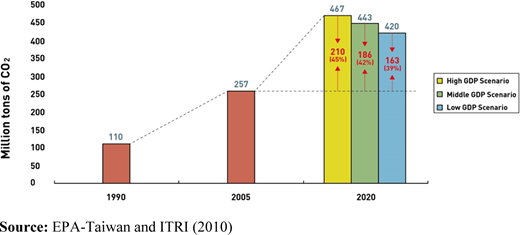
Scenario analysis for CO2 emissions in 2020
Scenario analysis for CO2 emissions in 2020
Alongside “top-down” scenario analyses in which CO2 reduction potential was estimated from economic and energy models, the government also carried out a “bottom-up” assessment using reduction potential data collected from various governmental agencies. All agencies estimated how much their own CO2 emissions could be reduced, for example, by introducing energy conservation/efficiency, clean energy, carbon sinks and/or carbon credits management. The mechanisms, corresponding agencies, projects, estimated reduction amounts and reduction contribution ratios (estimated amount reduced/amount of reduction target) are listed in Table II.
CO2 reduction contributions from various ministries
| Actions to reduce CO2 emissions by various agencies | |||
|---|---|---|---|
| Item | Agency | Projects | Reduction estimation for 2020 (million tons CO2/year) |
| Clean energy | Bureau of Energy | Low-carbon natural gas | 1,600 |
| Renewable energy | 546 | ||
| Combined heat and power | 155.19 | ||
| Solar water heaters | 4.224 | ||
| Energy efficiency and conservation | Bureau of Energy | Efficiency management for energy equipment | 90.4 |
| Energy efficiency improvement for petrochemical and refinery plants | 25 | ||
| Environmental Protection Administration | Multi-reuse of huge waste | 7.69 | |
| Reuse dust collection | 69.7 | ||
| Resource recycling chain Kaohsiung Technology Park | 6.7 | ||
| Higher vehicle emission (CO2) standards | 19.67 | ||
| Industrial Development Bureau | ESCO (energy saving service) | 550 | |
| Voluntary reductions from industrial sector | 400 | ||
| Resource integration in industrial area | 40 | ||
| Reuse industrial waste | 160 | ||
| Promote electric vehicle industry | 35.3 | ||
| Ministry of Interior | Green building standard | 220 | |
| Green building design and improvement demonstration | 10.2 | ||
| Green building standard and certification for new buildings | 118.51 | ||
| Energy efficiency improvement in buildings | 22.14 | ||
| Ministry of Transportation and Communication | Increase transit volumes for high speed rail | 66.5 | |
| Increase transit volumes for Taiwan railways | 4.75 | ||
| Promote public transportation in metropolitan areas | 0.8 | ||
| Promote electronic toll system | 2.76 | ||
| Increase transit volumes for airport public transportation system | 2.66 | ||
| Council of Agriculture | Energy saving and water conservation on farms | 17.8 | |
| Carbon reduction actions for fishing | 26.8 | ||
| Carbon sink | Council of Agriculture | Afforestation | 102.7 |
| Carbon credit | Bureau of Energy | Afforestation in foreign countries | 200 |
These estimated improvements in energy efficiency would only have contributed 3.1 per cent of the total CO2 reduction by all agencies; however, in 2008, the Taiwanese government set an ambitious target for energy efficiency improvement. As revealed in the Sustainable Energy Policy Framework, Taiwan aimed to “improve energy efficiency by 2 per cent per year” (MoEA, 2008)[5]. Inclusion of this 2 per cent efficiency improvement target in modified NAMAs, thus, dramatically changed the expected CO2 reductions (Table III).
Expected results based on an annual 2% improvement in energy efficiency
| Item | Actions to reduce CO2 emissions by various agencies | |||
|---|---|---|---|---|
| Agency | Projects | Quantity (million tons) | Reduction contribution ratio (%) | |
| Conservation | ||||
| (1) Energy intensity to be reduced by 2%/year | 76.180 | 36.3 | ||
| Clean energy | ||||
| (2) Natural gas | BOE | Expand use of low-carbon natural gas, with 14 million tons of natural gas supply forecasted in 2020 | 15.997 | 7.6 |
| (3) Renewable energy | BOE | Development target for renewable energy: cumulative installation capacity of 5.78 million KW by 2020 | 4.961 | 2.5 |
| Use of solar water heaters: cumulative installation area of approximately three million square meters by 2020 | 0.246 | |||
| (4) Nuclear power generation | BOE | Chin Shan Nuclear Power Plant’s commission to be extended; Lungmen Nuclear Power Plant in operation | 28.700 | 13.7 |
| (5) Power generation efficiency | BOE | Improve nuclear power generation efficiency | 0.705 | 1.2 |
| Promote cogeneration system settings | 1.904 | |||
| Carbon sink | ||||
| (6) Carbon sink | Council of Agriculture | Afforestation | 1.080 | 0.5 |
| Carbon credit trading | ||||
| (7) Carbon credit trading | BOE | Planting of Indonesian biodiesel source material | 2.000 | 15.5 |
| Carbon credit trading by the TPC | 30.510 | |||
| Others | ||||
| (8) Gap | 47.717 | 22.7 | ||
To reach the CO2 reduction target outlined in Taiwan’s NAMAs, the volume of CO2 emissions in 2020 would need to be reduced by 210 MT from the projected total of 467 MT (Figure 1). However, the total reduction contribution (92.58 MT) calculated from various agencies’ respective CO2 reduction projects would still leave a deficit of 117.42 MT (56 per cent). Implementation of the annual 2 per cent improvement in energy efficiency would close this gap to 47.72 MT (22.7 per cent) (Figure 2).
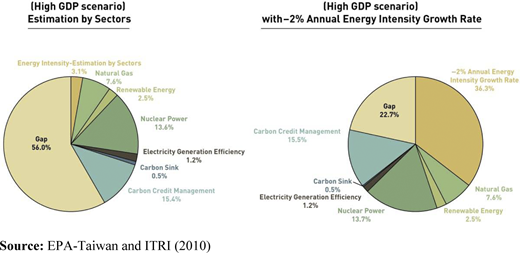
CO2 reductions from various mechanisms and contribution to total reduction targets
CO2 reductions from various mechanisms and contribution to total reduction targets
To reach the reduction goal, the main projects covered under Taiwan’s NAMAs include (EPA, 2010):
Use of legislation as the basis for implementation: Taiwan’s carbon reduction legislation includes four basic regulations: the Renewable Energy Development Act, the Energy Management Act, the GHG ERMA, which has already been passed and the Energy Tax Act (Draft), which is still being studied. The implementation of these four regulations would serve as the legal basis for the country’s promotion of energy conservation and carbon reduction measures.
Implementation of the “Master Plan on Energy Conservation and GHGs Emission Reduction”: In this inter-ministry program, related strategies formulated and implemented by various ministries would be integrated by the Executive Yuan, which would lead promotion of the Master Plan. This plan incorporated ten benchmark programs, such as the “establishment of a low carbon industrial structure” and the “construction of a green transportation network”, thereby helping to achieve the targets set in Taiwan’s NAMAs and shape a low-carbon society (BoE, 2010).
Improvement of social and economic competitiveness: A green economy, designed in line with the concern of environmental protection and social equity, is key to ensuring future competitiveness in the global economy. Taiwan has promoted various programs to stimulate industrial restructuring and improve socio-economic competitiveness, such as the Program for Sunrise Green Energy Industries and the Program to Promote an Eco-city and Green Buildings.
Establishing a carbon management mechanism based on the MRV principle: According to the Copenhagen Accord, NAMAs must comply with the MRV principle. Planning in Taiwan is based on the legislative system, so promotion of the mechanisms for voluntary reductions, checks by industries and preparation of the GHG inventory, registration and voluntary reductions must all comply with the MRV principle.
Strengthening international cooperation on climate change and carbon reduction: These aims are to strengthen interactions with organizations/think tanks from developed countries and other major international organizations; encourage local governments to participate in international conferences related to the organization of low-carbon cities; promote exchanges between low-carbon industries, academic institutions and civilian units; and actively participate in conferences organized by organizations related to the UN or representative civilian activities, so as to establish connections for international cooperation in carbon reduction.
Taiwan’s current NAMAs comprehensively incorporate all sectors (EPA-Taiwan, 2010). As mentioned above, the Taiwanese electricity sector has a predominant role in CO2 reduction because combustion for energy contributed 66 per cent of the country’s CO2 emissions in 2014 (BoE, 2015a). Therefore, focusing on the electricity sector is necessary to effectively design and implement Taiwan’s NAMAs. In the next section, technological options for carbon reduction and challenges faced by the electricity sector in Taiwan are reviewed.
2.2 Carbon reduction options and challenges faced by Taiwan’s electricity sector
Taiwan imports nearly 100 per cent of its energy and the principal energy source for electricity generation is fossil fuels. Coal, which is generally more carbon-intensive than burning natural gas or petroleum, accounted for 47 per cent of Taiwan’s electricity generated in 2014. About 3 per cent of the electricity generated came from oil and 29 per cent came from natural gas. Nuclear power contributed 16 per cent of the electricity generated in 2014, although this percentage has been decreasing since 2009. The remaining 4 per cent was generated from renewable energy sources, which gave rise to few, if any, GHG emissions (BoE, 2015b).
Key technologies for reducing electricity-sector emissions include improvement of energy efficiency, the use of low-carbon alternative energy sources (such as renewable energy or nuclear power) and the adoption of CCS technology (IEA, 2014). Opportunities for efficiency improvements arise during generation, transmission and end use. These include improving power plant efficiency, increasing transmission and distribution efficiency and reducing end-users’ demand through, for example, more efficient appliances in the residential sector or CHP in the industrial sector. Improving the efficiency of fossil fuel-fired power generation is a promising strategy for Taiwan’s electricity sector. Internationally, coal-fired power efficiencies range from 27 to 43 per cent, gas-fired power efficiencies range from 34 to 53 per cent and oil-fired power efficiencies range from 20 to 46 per cent (Hussy et al., 2014). The efficiencies of Taiwan’s coal-, gas- and oil-fired power plants are 36, 32 and 33 per cent, respectively (BoE, 2015b); therefore, there exists great potential for improvements in efficiency. Given that a range of high-efficiency, low-emissions coal technologies has been developed (IEA, 2012), adopting a suitable technology with acceptable costs represents a viable option for improving power generation efficiency.
Renewable energy, natural gas and nuclear power are identified in Taiwan’s NAMAs as technological options for clean energy adoption; however, cost is the main challenge in adopting natural gas and renewable energy, especially with the government-regulated electricity price being very low (Hu et al., 2016). GHG emissions are significantly lower when natural gas is used for power generation than when coal and oil are used; however, the price of the former is also significantly higher than that of the latter two. Moreover, the purchase of natural gas is based on long-term contracts, with the commodity seen as belonging to a seller’s market. Poor national endowment and limited scope for manipulating the energy import market combine to make GHG reduction efforts based on natural gas challenging.
Renewable energy generation involves minimal GHG emissions, and the Taiwanese government has set national targets, designed measures and formulated regulations to utilize the significant potential of renewable energy by expanding domestic renewable installations (Chen et al., 2014). As renewable energy has been identified as a promising contributor to Taiwan’s low carbon future, the Taiwanese government increased its 2030 target for renewable capacity installation from 13,750 to 17,250 MW in 2015 (BoE, 2015c). However, until recently, installation costs have been relatively high – particularly when external costs (e.g. those associated with CO2 emissions) are ignored – and the price of electricity in Taiwan is low.
Nuclear power is considered as one low-carbon option for electricity generation, although issues such as construction safety, the safe operation of such power plants and the disposal of nuclear waste have gradually led to the public favoring cessation of its use in Taiwan[6]. National laws and policies have also followed this trend: Article 23 of the Basic Environment Law, promulgated by presidential order on December 11, 2002, has enshrined the target of becoming a “nuclear-free homeland” in the future. Moreover, Taiwan’s Framework for Energy Development clearly promotes a steady and gradual reduction in the use of nuclear energy (BoE, 2012). The presumed gradual reduction in the proportion of electricity generated from nuclear energy, and the possibility of complete exclusion of nuclear power generation in the future, means that the country’s electricity sector must find alternative methods with which to compensate for the potential energy deficiency. Alternative strategies to reduce GHG emissions will also be needed, such as CCS technologies at power plants.
CCS has become critical technology for mitigating climate change (IEA, 2014). Scenario analyses conducted by the International Energy Agency (IEA) have determined carbon reduction targets that are needed to limit global warming by ≤2°C by 2050. It was noted that CCS could contribute to carbon reduction of 14 per cent and that this would have a direct impact on overall carbon reduction (IEA, 2014). Although some developed countries have initiated pilot studies of CCS operations, there are still considerable uncertainties surrounding its technical feasibility. These include potential threats to the environment arising from CO2 leakage, whether the sequestration of CO2 will be permanent, if the cost of CCS could be reduced and whether CCS can be commercially viable. Moreover, legislation and regulations must be in place before CCS can proceed from the planning stage to commercial implementation. A huge amount of capital and thorough communication with the general public is also required. The IEA has called upon governments worldwide to assist in shaping the CCS market and to attract private investments to gain vital early commercial experience (IEA, 2015). CCS is viewed as a long-term strategy for GHG reduction in Taiwan, despite a small number of public protests against the technology having been reported. Several research projects have been initiated and are being conducted by the Ministry of Science and Technology (under the “National Energy Program”) and the Taiwan Power Company (Li et al., 2013; MoST, 2016). Its social acceptance will be a crucial element in the adoption of CCS in Taiwan (Chen and Ho, 2016).
To accelerate the adoption of efficient alternative energy sources and CCS technologies, Taiwan’s NAMAs contain a carbon trading mechanism as an economic incentive to foster the adoption of carbon reduction technologies in the electricity sector. The carbon trading mechanism also acts as a supplementary option for the electricity sector to reach its NAMAs target, whereby it could meet its reduction goal by purchasing carbon credits in the carbon trade market. The basic principles of the carbon trade mechanism are outlined in the GHG ERMA.
3. Emissions trading mechanisms under the greenhouse gases emissions reduction and management act
3.1 Carbon trading mechanisms in the post-Kyoto period
As a way of urging the contracting Parties to achieve their Quantified Emission Limitation and Reduction Commitments (QELRCs), the Kyoto Protocol incorporated three types of flexibility mechanism: joint implementation (JI) specified under the provisions of Article 6, the clean development mechanism (CDM) under Article 12 and emissions trading (ET) under Article 17. These three Kyoto mechanisms allow Annex I countries to achieve binding reduction targets based on cost-effectiveness.
The first commitment period of the Kyoto Protocol expired in 2012. Although a consensus was reached during Conference of the Parties 18 (COP18) to extend the second commitment period to 2020, the Parties to the Convention have yet to arrive at new reduction targets that are legally binding under international law. Even so, some major countries and regional blocs/organizations (such as China) have already decided to continue with, or even expand, the operation of the emissions credits trading system. By recognizing a mechanism for offsets, the significance of carbon trading will be expanded to include project-based transactions or an offsets market. Under the Kyoto mechanism, ET includes the aforementioned tradable-permit approach, allowance-based transactions and an allowances market, whereas JI and CDM belong to the offsets mechanism and market, or project-based transactions.
To capitalize on the market mechanism for efficient allocation of costs for GHG emissions reductions, Taiwan’s NAMAs have placed significant emphasis on the emissions trading system and have highlighted that the country would legislate an emissions trading mechanism. In fact, in the past, even when the GHG ERMA was still in its legislative stage, Taiwan had already implemented “voluntary reduction projects” for creating carbon credits and “prepared” for a trading market. The voluntary reduction projects have three main purposes:
encouraging participation in voluntary GHG reductions;
providing guidelines for project approval and credit issuance; and
fulfilling Environmental Impact Assessment (EIA) offsets or carbon-neutral requirements (Chien, 2015).
The “carbon credits” are generated from the “early action program” and the “offset project program”, as stipulated by the Environmental Protection Administration-Tai wan (EPA-Taiwan) on September 10, 2010 (most recently revised on July 17, 2012). The early action program is an intensity-based reduction approach and the advanced emissions reduction amount is issued based on legislation. This means that the applicant will get carbon credits once they implement the proposed reduction projects, and their reduction performance in bringing emissions to levels below those announced by the EPA is verified. The offset project program is project-based, and credits are issued based on a planned reduction amount (similar to the CDM). The competent authority (the EPA-Taiwan) determines the amount of credit to be issued based on applications made for each early action or offset project.
3.2 Basic principles of carbon trading under Greenhouse Gases Emissions Reduction and Management Act
Passing of the GHG ERMA legislation was a milestone for Taiwan’s carbon trading mechanism. This Act provides basic principles for carbon trading and is expected to encourage the electricity sector (among others) to reduce carbon emissions in a cost-effective manner. The GHG ERMA outlines three phases for GHG reduction. The main focus of Phase 1 includes mandatory checks and examination of the amounts of GHG emissions by the primary emitters identified by EPA-Taiwan and online declaration of their GHG emissions. Phase 2 will focus on establishing efficiency standards for emissions, referencing the US State of California’s GHG emissions performance standards (EPS) (Aldy and Pizer, 2009). In Phase 3, a total emissions cap and trade format and an economic incentivization mechanism will be implemented. In summary, the GHG ERMA begins with inventory checks and registration (Article 16), and will be followed by the establishment of standards for emissions efficiency (Article 17) before the total cap is finally imposed (Article 18). The trading mechanism and other items under the total cap system are set by the governing authorities enacting administrative orders, as authorized under Paragraph 2 of Article 18 and Articles 20-22. The purpose of the subsidiary administrative orders is to leverage the flexible characteristics of authorization orders to consider fully the effects brought about by the various ministries, businesses, industries and changes in the international environment before formulating an appropriate response. At present, the GHG ERMA has only constructed the framework of the trading mechanism; the detailed cap, trading mechanism and operational procedures will be set in the near future.
Article 18 of the GHG ERMA clearly describes the system for implementation of the emissions inventory, verification and registration and establishes a system for credit allocation, offsets, auction, placing and trading. Together, these facilitate the implementation of a total cap for GHG emissions and an emissions trading system, such that emissions trading will be implemented after the relevant subsidiary legislation has been finalized. At this point, the electricity sector will have to adopt its own reduction measures to satisfy reduction requirements. Application of CDM and the carbon credit business are therefore important supplementary strategies for Taiwan to fill the aforementioned gap in its reduction target. In addition to improving the energy efficiency of its facilities, developing renewable energy and adopting measures such as CCS, the electricity sector can also make good use of the carbon credits trading environment established under the GHG ERMA. The electricity sector can contribute toward the country’s NAMA obligations through the application of CDM and the carbon credit business.
Article 20 of the GHG ERMA stipulates that a phased approach will be adopted when implementing Taiwan’s total cap control. Emissions credits for emissions sources corresponding to the total emissions cap for each phase will be allocated to businesses and industries either for free or through auction and placement. However, the allocated quotas for businesses and industries, the allocation method, conditions, procedures, methods of auction or placement, revocation and retention of allocated quotas and other matters for compliance will have to be separately stipulated using subsidiary legislation.
Linkages between the international trading mechanisms can be ascertained by referring to the regulations in Paragraphs 1 and 2 of Article 21 of the GHG ERMA, which states that upon implementation of the total cap, the emission volumes of regulated emissions sources must not exceed the available credits for deduction in their accounts. The emissions credits include allocated quotas, the implementation of offsets and early action projects, incentives for compliance with efficiency standards and credits acquired through trading or other methods (such as placement). In addition, Paragraphs 3 and 4 of Article 21 further stipulate that when using emissions credits for offsets projects and trading, priority should be given to projects within the country. The accreditation criteria for foreign emissions credits (or overseas carbon credits) are separately determined by the central competent authority. At the very least, they will allow overseas emissions credits to be transferred to accounts of emissions sources and used as deductible emissions credits.
For the emissions sources responsible for specific reduction quotas or major industrial development projects, the priority should be to obtain carbon credits through offset projects or trading within the country. If carbon credits from overseas are still required, the government will establish a separate mechanism to assist them with achieving offsets for projects or trading for carbon credits at lower costs.
3.3 The carbon market for the electricity sector
Although primarily demanding emissions credits available for deduction, the electricity sector can also supply them. The various measures that have been implemented, including power generation using renewable energy sources and the improved efficiencies of thermal power generation and power systems, can all be registered under the sector’s accounts as emissions credits available for deduction or as trading subjects. The emission credits system has been implemented through means such as early action and offset projects or incentives for compliance with energy efficiency standards. In other words, in addition to using various reduction measures to reduce GHG emissions during power generation, the electricity sector can also obtain deductible emissions credits from the market after taking cost and efficiency factors into consideration. It can also consider releasing obtained emissions credits for market trading, and make use of the market mechanism and incentives to appropriately distribute the costs of its reduction efforts.
To operate the carbon trading mechanism for the electricity sector, the Taiwanese could learn from the European Union (EU) emission trading system (ETS) or carbon credits trading system of the “Regional GHG Initiative” (RGGI) initiated by nine states in the northeastern USA. The EU ETS is the first and the largest international “cap and trade” system, and has accounted for a reduction of around 50 per cent of EU GHG emissions. The EU ETS was first introduced in 2005 and covered more than 11,000 power stations in 31 countries (European Commission, 2016). The RGGI is a cooperative mechanism for GHG management with the target of reducing GHG emissions from power plants by 10 per cent before 2018 (RGGI, 2016). The RGGI operates by establishing upper limits for GHG emissions through state regulation by participating states, followed by independent auctions of carbon credits. All power plants located in the states’ territories can auction off or purchase carbon credits from the market, which can be used to offset actual emissions volumes (RGGI, 2016). The operational experience of the EU ETS and RGGI provide valuable information for the Taiwanese government to design its own trading mechanism, both in terms of designing the price and allowance amounts and of evaluation of effectiveness. For example, Schmidt et al. (2012) conducted an empirical assessment and showed that the early phases (1 and 2) of the EU ETS triggered neither investment in non-emitting technologies adoption nor in technological innovation.
4. Challenges and opportunities for Taiwan’s electricity sector using the emission trading mechanism
In Taiwan, the Taiwan Power Company (TPC) is the only vertically integrated business that can transmit and distribute electricity. Currently, the Electricity Act mandates that the businesses within the electricity sector be divided into three categories: power generation, transmission and distribution. Among them, only power generation is open to participation by independent power producers (IPP). In fact, with the exception of electricity for private use, all electricity generated by cogeneration systems, power generation equipment using renewable energy and other power plants registered and built by private owners should be fully sold to the TPC under a power purchase agreement (PPA) signed by (and formulated between) the owners and the TPC (Figure 3).
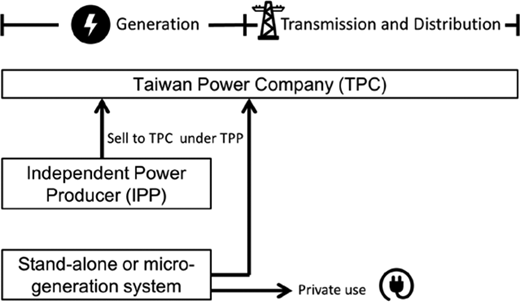
Taiwan’s vertically integrated electricity business
Taiwan’s vertically integrated electricity business
The TPC has monopolized the Taiwanese electricity business and is thus the country’s biggest electricity supplier and GHG emitter. In Taiwan, part of the allocated emission credits will be free (based on past performance), with the remainder allocated by auction. Therefore, before officially starting carbon trading, the Taiwanese government should carefully deal with the “grandfathered permits issues” (i.e. how to allocate initial credits to the TPC).
Currently, power generation within Taiwan’s electricity market is undertaken by the TPC, eight private power generation businesses and power equipment for private use (including cogeneration systems and power generation equipment using renewable energy). Although the term “power plants” does not necessarily refer to plants owned by the TPC, in reality, IPP operations are limited and their contribution is almost insignificant.
Given Taiwan’s aforementioned unique circumstances, the TPC controls hub facilities for power transmission and distribution. Even with the legislature’s current efforts to use a legal route to liberalize the electricity business by unlinking “plant” (power plant) and “network” (transmission and distribution) management companies, it is inevitable that the TPC will still have excessive monopolistic powers. In these circumstances, the ability of the electricity sector to successfully undertake the country’s NAMA obligations essentially rests on the TPC’s ability to reduce emissions.
Considering these factors, if the TPC is unable to adopt its own measures to reduce emissions in the short term, it is very likely to become the biggest demand-side entity in the carbon emissions trading market. The TPC is also likely to prefer adopting a trading method owing to cost-effectiveness. Hence, prior to the liberalization of the electricity sector, allocating a certain quota to the IPPs (especially those in the renewable energy industry) should be considered. This will introduce additional participants who could substantially participate in carbon emissions reduction and trading activities within the electricity sector. In doing so, the TPC will have an incentive to turn toward renewable energy and the IPPs can provide market supply, which will result in active trading.
In addition, if the GHG ERMA legislation is applied (i.e. the carbon credits trading mechanism created under Articles 21 and 22), issues that may arise relating to the TPC as a state-owned enterprise will evidently be ignored. Specifically, the applicability of the carbon trading mechanism under the Government Procurement Act (GPA) will be questionable (The Legislative Yuan, 2011, 2015).
Article 1 of Taiwan’s GPA indicates that it is necessary to “establish a government procurement system based on fair and public procurement procedures, thereby improving procurement efficiency and functionality, and ensuring procurement quality”. As state-owned enterprises are also main entities bound by the GPA, doubts concerning its applicability will unavoidably arise when the TPC constitutes the demand side of carbon trading.
The GPA outlines most of the procedures of the governments’ market behavior; matters not ruled in the GPA shall be governed by other relevant laws. Procurement conducted by any government agency, public school or state-owned enterprise shall also be governed by the provisions of the GPA (cf. regulations in Articles 1 and 3 of the GPA).
The Taiwanese government’s procurement procedure is based on the principle of open tender. The GPA defines procurement as the ordering of projects, purchases of assets and properties, customization, leasing, appointment of tasks and services or employment (cf. regulations in Article 2 of the GPA). Technically, the issue of “buying carbon credits” is not associated with the ordering of projects or the customization or leasing of assets and properties, and it is unrelated to appointment of tasks and services or employment; however, its attributes are close to those of purchasing assets and properties.
At present, all forms of procurement are subject to the GPA. The only exceptions thus far are financial purchases (e.g. investment securities), which are directly related to government financial actions (cf. the Executive Yuan’s Public Construction Commission (88), Engineering Enterprise No. 8811716). According to Article 18 of the GPA, procurement may involve open tendering procedures, selective tendering procedures, or limited tendering procedures. According to Articles 19, 20, 21 and 22 of the GPA:
An entity shall apply open tendering procedures to all procurements of a value reaching the threshold for publication, except which commit the requirements of selective tendering procedures or limited tendering procedures.
Selective tendering procedures can apply to any of the following five situations:
where there is a recurring demand;
where the review of tenders takes a long time;
where the supplier’s cost for preparation of a tender is high;
where the qualification requirements for suppliers are complicated; and
where it is a procurement concerning research and development.
Notably, carbon trading is not included in these five situations. The limited tendering procedures can apply in 16 listed situations, of which the eighth situation “for property purchased on a centralized trading or open auction market” may be adopted if the TPC joins carbon trading (Article 22 of GPA). However, further explanation of this situation is needed.
The TPC clearly has no reason to adopt the selective tendering procedures, and the limited tendering procedures only apply in specific circumstances. Therefore, the simplest way for the TPC to join carbon trading is through an “open tendering procedure” based on the GPA, yet some requirements of this procedure do not fit into any of the ETS systems that exist worldwide. For example, the open tendering procedure requires the mandatory publishing of a notice of invitation to tender, a tenderer has to deposit a bid bond, and at least three or more qualified suppliers must submit their tenders.
The subject considered within the framework of carbon trading is the abstract (non-physical) “quota for emissions allowances”. It is unclear whether such “allowances” fall within the definition of “assets and properties” as stipulated in Article 2 of the GPA. This issue should be clarified in the future under subsidiary legislation of the GHG ERMA and related sections on carbon credit trading. Another issue that must be addressed is the seamless integration of this trading system with the GPA. Otherwise, the TPC, as the core business unit of Taiwan’s electricity sector, will be burdened by the cumbersome GPA and not able to commence trading. One possible solution for this issue is to enact an administrative order expressly excluding carbon credit trading from the GPA.
Another matter related to the aforementioned issues is that of defining the nature of carbon credits (emissions quotas). From a legal standpoint, the nature of emissions quotas can be considered as being classified into many attributes. For example, some define carbon credits as an administrative allowance under public law; however, it also contains some characteristics of private property, despite not strictly being a form of property right. As a case in point, the USA Clean Air Act (2004) recognizes that quotas allocated to individuals by the government can be possessed and transferred; yet, the Act clearly stated that emissions rights for sulfur dioxide do not exhibit the characteristics of property rights. Carbon credits may also be considered a type of right in an environmental capacity, suggesting that they should be usufructuary or, at least, quasi-property rights (with the lack of exclusivity over property rights). They may be considered an asset or property that can be traded, where trading refers to the transfer of assets and goods that need not be tangible or defined by a specific property. A transaction can occur as long as supply and demand exists. In other words, the qualitative aspects of carbon credits (including quotas and offset credits) are not necessary in practice, although the singular fact that carbon credits can be transacted cannot be used to define them as property rights.
The aforementioned qualitative descriptions of carbon credits are applicable in many ways. The only exception is the opinion that they are property rights: given the strict legalism adopted by Taiwan, carbon credits simply cannot be accommodated under property rights law within the country’s existing legal system. As such, it is unclear whether carbon credit trading falls under the definition of asset and property transactions, as defined in Article 2 of the GPA.
Hence, this paper presents the view that these doubts must be proactively clarified by competent authorities overseeing the GPA, with explanations regarding whether it is appropriate to use the law. Otherwise, while preparing subsidiary legislation, the current conditions mean that Taiwan’s electricity sector must be considered primarily as a state-owned enterprise, and alternative means must be found to exempt carbon credits trading under specific conditions from the provisions of the GPA. This is because when the transparency of carbon pricing and other trading mechanisms has been fully considered under the framework of transaction standards, its essence should not violate the provisions under Article 1 of the GPA as referenced above. There should then be no risk that the objectives of this legislation will be contravened.
5. Conclusions and policy implications
It is clear from Taiwan’s energy consumption structure and GHG emissions trends that its electricity sector plays an important and critical role in the promotion of NAMAs and in the design of INDCs/NDCs. Therefore, the focus of this study was to determine ways in which the electricity sector could assist the country in achieving its carbon emission reduction targets. Specifically, during the process of carbon reduction as stipulated in the NAMAs, the sector could make use of relevant policies, technological developments and carbon financing policies or mechanisms and supplement these with international participation. Because the country’s electricity sector is a non-liberalized market, many of the policies promoted by developed countries are not applicable. Given this situation, this study considered Taiwan’s local characteristics and aligned current policies, regulations and measures before proposing specific adjustments or amendments and corresponding strategies that the electricity sector should use.
This study has proposed that the market mechanism should be utilized to appropriately allocate costs and incentives for GHG reductions during the implementation of NAMAs and that carbon financing be used as a policy instrument to support projects for transformation to a low-carbon society. The GHG ERMA legislation, completed in 2015, authorized the government to set an upper limit on industrial GHG emissions and officially established a universal emissions trading system for the entire economy.
This study suggests continued deliberations and announcement of an executive order similar to the incentivization method for allocating GHG emissions to transformation projects for a low-carbon society. The scope and standards for additional carbon credits to be allocated to such projects should be stipulated, and carbon financing under the emissions trading system should be used as a policy instrument. These will help to achieve the long-term goal of transforming Taiwan into a clean, low-carbon society and serve as an important carbon reduction strategy for the electricity sector to respond to the NAMAs and prepare for its NDCs.
Notes
According to the “Adoption of the Paris Agreement”, INDCs will become or be replaced by NDCs after adoption of the Paris Agreement.
Taiwan’s INDCs distributed the GHG burden to each end-user, such as the industrial sector and the transportation sector. Therefore, the share of reduction burden of the electricity sector under the INDCs is around 10.53 per cent, lower than that of the NAMAs. It should be noted that the detailed target and plans of Taiwan’s INDCs are currently under formation and have not been published by the government.
The 2006-2010 GDP data represent the actual growth rate, whereas the 2011-2025 GDP growth rate is projected by economic models. The GDP growth rates for the “high GDP scenario” are 2.64 per cent (2006-2010), 5.30 per cent (2011-2015), 3.61 per cent (2016-2020) and 2.63 per cent (2021-2025). For the “middle GDP scenario”, GDP growth rates are 2.64 per cent (2006-2010), 4.44 per cent (2011-2015), 3.45 per cent (2016-2020) and 2.84 per cent (2021-2025). For the “low GDP scenario”, GDP growth rates are 2.64 per cent (2006-2010), 3.58 per cent (2011-2015), 3.29 per cent (2016-2020) and 3.04 per cent (2021-2025).
Because more than 90 per cent of Taiwan’s GHG emissions are CO2, the government presented its GHG reduction target based on the CO2 reduction estimation.
It should be noted that the 2 per cent target of energy efficiency improvement was achieved in 2014 (BoE, 2015b).
Several anti-nuclear power movements have been organized by the public since 1980s. In response to growing public concerns over the safety issue following Japan’s Fukushima Daiichi nuclear disaster in March 2011, the Taiwanese government suspended construction of the fourth nuclear power plant and sealed the No. 1 reactor of this nuclear power plant for three years, beginning July 1, 2015 (Hsu, 2005; Taiwan Today, 2015).
Financial support for this research from the Ministry of Science and Technology, Taiwan (MOST 105-3113-F-011-002-) is gratefully acknowledged. The authors also thank the anonymous reviewers for suggestions that improved the manuscript.

