The purpose of this paper is to develop a conceptual framework of corporate digital responsibility (CDR) in the sharing economy (SE) by mobilizing and refining the established value-balance-accountability (VBA) framework.
The authors conceptually extend and interpret the VBA framework by considering the position of CDR in the conflicting realm of sharing platforms’ responsibilities and irresponsibilities and associated tensions. Through an integrative perspective, they combine top-down and bottom-up approaches by critically examining and linking together research on the SE, CDR and its dark side, using Airbnb and Uber as illustrative cases.
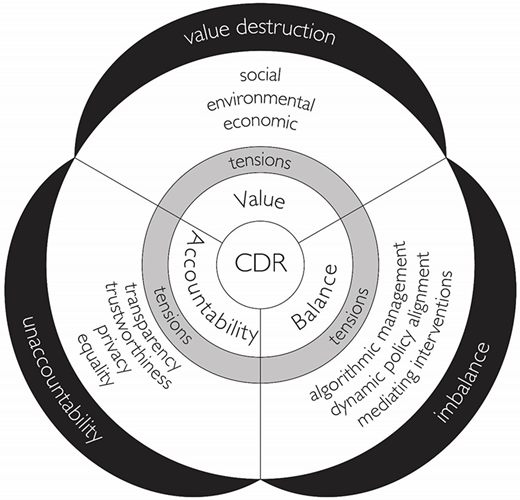
CDR of SE platforms can be subsumed into three distinct categories, that is, value, balance and accountability. Value demonstrates how economic, social and environmental value is created in the digital domain. Balance is manifested in different mechanisms, that is, algorithmic management, dynamic policy alignment and mediating mechanisms, that contribute to aligning the interests of different stakeholders on the platform. Accountability considers the importance of transparency, trustworthiness, equality and privacy in the digital sphere. Because of the multifaceted nature of each dimension, tensions inevitably arise among them. Moreover, the irresponsibility of SE platforms is demonstrated in value destruction, imbalances and unaccountability.
The framework serves as a practical guide for SE platforms, consumer protection agencies and policymakers.
The original contributions of this paper are fourfold: exploring the nuances of CDR in the SE setting; providing a comprehensive conceptual framework based on the VBA model that explains how organizations behave digitally (ir)responsibly; extending the VBA framework with the irresponsibilities to capture the dark side; and detecting the tensions that arise because of the multifaceted nature of each dimension of CDR.
Introduction
The sharing economy (SE), defined as a “scalable socioeconomic system that employs technology-enabled platforms to provide users with temporary access to tangible and intangible resources that may be crowdsourced” (Eckhardt et al., 2019, p. 3), has enabled millions of consumers to realize the value of underused assets. It has also been associated with the rise of billion-dollar companies such as Airbnb and Uber, whose services have been widely adopted and, as a consequence, changed mobility (Hall et al., 2018), hospitality and tourism (Altinay and Taheri, 2019).
Since the inception of the SE, there has been an on-going debate as to whether the tech giants do indeed represent the SE, with Belk (2014), for example, labelling these activities as “pseudo-sharing”. In contrast, others (Slee, 2017) consider the peer-to-peer and profit-driven platforms as the only representatives of the SE. However, as Reinhold and Dolnicar (2018) demonstrated, it is not a question of a dichotomy, but rather a continuum between sharing and exchange. Airbnb, as the market leader in commercial peer-to-peer accommodation, falls in between those two extremes, as the relationships it enables are characterized by both profit motives and communal belonging (Reinhold and Dolnicar, 2018). In contrast, Uber leans more towards profit-driven exchange (Schor, 2016).
The positive and negative effects of the SE have been examined through the lenses of business ethics (Etter et al., 2019) and corporate social responsibility (CSR) (Farmaki et al., 2023). However, these concepts seem insufficient to illuminate the ambivalent role of digital technologies, which are a defining characteristic of the digitally supported businesses and communities in the SE (Sutherland and Jarrahi, 2018). As Yi et al. (2023, p. 36) argue, “social issues in the platform context are in a fluid state because of a lack of institutionalization in technology industries and of an imperative to contain platforms’ power”. The way governments and corporations are approaching governance in the digital domain raises a host of ethical, political and legal issues (Newlands and Lutz, 2020). Accordingly, the development, implementation and use of digital technologies pose critical ethical dilemmas that require more scholarly attention (Wirtz et al., 2023). In this context, the idea of corporate digital responsibility (CDR) has emerged as a relevant starting point for discussions, representing the values and norms that guide a company’s activities with regard to the creation and operation of digital technologies and data (Lobschat et al., 2021).
The digitalization of the economy has led to the shortening of the distance of economic exchange between service providers and their users (Hall et al., 2022). As the SE includes three key actors: the platform (e.g. Airbnb), the providers (e.g. hosts) and the consumers (e.g. guests) (Reinhold and Dolnicar, 2018), it is necessary to account for the roles and relationships among the three main players. From the beginnings of the SE, there have been debates on the extent to which the increasingly powerful platforms fulfil their obligations to their users and society, which makes it an interesting context to reflect on digital responsibility. Eckhardt et al. (2019, p. 16) encouraged scholars to “to develop frameworks that account for not only the possible benefits of the SE but also its potential drawbacks”. Hence, the discussion and conceptual framework development of CDR pertains to the role of the platforms in establishing responsibility towards different stakeholders, which is manifested in the way they not only facilitate but also govern the relationships between consumers and providers in the digital sphere (Bajde et al., 2024). Alternatively, we also consider corporate digital irresponsibility which refers to business practices and activities related to digital technology and data management (Shin et al., 2025) that reveal the platforms’ lack of concern for the interest and welfare of their stakeholders. Recent examples include Airbnb’s trustworthiness algorithm which banned users from the platform without explanation (Blakkarly, 2022) and Uber’s questionable practices of using workers’ “behavioural patterns” to determine their pay (Skelton, 2024). Considering Airbnb has become the poster child of the SE (Dann et al., 2019) and the primary frame for researching this phenomenon (Hall et al., 2022), we will develop the CDR framework and present the key features of CDR in this domain. In addition, we will draw on Uber as a case to demonstrate the relevance of our framework for other SE domains.
The goal of this article is to present a framework that is suited to analyse digital (ir)responsibility in the SE and to shed light on the tensions that the leaders of SE platforms face. We, therefore, draw on the value-balance-accountability (VBA) framework by Schwartz and Carroll (2008), which integrates key ideas from existing frameworks that deal with the role and responsibility of business in society into three core concepts: value, balance and accountability. This article makes four contributions to the literature.
First, while research on CDR has addressed the unique challenges of the digital era and started to gain traction in the academic community in relation to diverse topics such as artificial intelligence, the digital transformation and data privacy (Kunz and Wirtz, 2024; Law et al., 2025), our paper contributes to the existing knowledge of CDR in service settings (Lee et al., 2025; Wirtz et al., 2023) with a particular focus on peer-to-peer services, which offers unique features that are not present in other settings (i.e. traditional dyadic market relationships versus triadic SE market relationships).
Second, we contribute to the overall literature on CDR (Lobschat et al., 2021; Mihale-Wilson et al., 2022) by applying and adapting the VBA framework for analysing and explaining digital responsibility at the organizational level, thus responding to the call by Lobschat et al. (2021, p. 886) for “theoretical approaches and models [that] can help build a robust understanding of how individuals, organizations, and society behave digitally (ir)responsibly”.
Third, we extend the VBA framework by elaborating on each facet in more detail and by highlighting the irresponsibilities to capture the dark side of corporate behaviour. In doing so, we respond to the calls by SE researchers to better examine its dark side and account for not only the possible benefits but also the potential drawbacks (Benoit et al., 2017; Eckhardt et al., 2019).
Fourth, we contribute to the CDR literature by shedding light on the tensions and paradoxes involved in CDR. As Van der Byl and Slawinski (2015) suggested, researchers need to go beyond the win-win situation in which CSR is typically linked to financial performance and examine the conflicting but interconnected aspects that focus on the tensions, paradoxes and trade-offs that exist in this context.
Corporate digital responsibility
CDR has been conceptualized from different perspectives (see Appendix 1 for more details). Mihale-Wilson and colleagues (2022) provide initial examples of companies’ digital responsibilities and norms (e.g. transparency of algorithmic decisions). However, they also point to a lack of studies that “clarify and articulate concrete norms and guidelines which enables companies to assume more responsibility in the digital world” (p. 131). They, therefore, call for research to “expand the CDR concept with currently unconsidered but important facets of corporate responsibility” (Mihale-Wilson et al., 2022, p. 131). In addition, (Gursoy et al.’s 2025, p. 317) review identified “a need for the further development of theoretical frameworks to address emerging challenges in digital responsibility”. Our study responds to these calls by focusing on the responsibilities and irresponsibilities of SE platforms.
Because of the multifaceted nature of the CDR concept, there is a further need for a more comprehensive framework to organize the diverse (ir)responsibilities into a coherent whole. Prior research has made initial attempts in this regard. For instance, Elliot et al. (2021) broadly differentiated between social, environmental and economic responsibilities. While this approach is valuable to assess the impacts of the use of digital technologies and data (i.e. the generation of value), it neglects other important responsibilities that relate to processes (i.e. balancing stakeholder demands) and principles (e.g. transparency and privacy) – all of which are important dimensions of CDR. By leveraging and expanding the well-established VBA framework, we, therefore, also respond to the call by Lobschat and colleagues (2021) for theoretical approaches and models that help to explain how actors behave digitally (ir)responsibly. Finally, the particular features of the SE where there is a triadic market with multiple actors that interact both online and offline provide fertile ground for the platform and its actors to behave both responsibly and irresponsibly in relation to digital technology and data creation, making the SE a relevant context for the investigation of corporate digital (ir)responsibility.
The value-balance-accountability framework
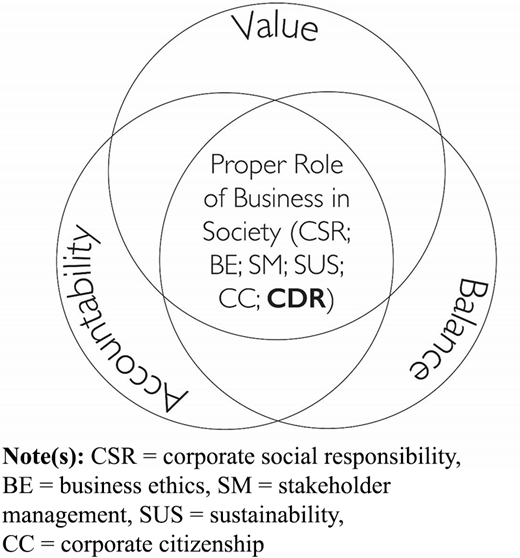
Schwartz and Carroll (2008) developed the VBA framework based on three underlying dimensions (value, balance and accountability) of constructs that connect business and society ( Appendix 2). Because the integrative VBA framework is open to further development and could be used to assess, analyse or link together other fields (Schwartz and Carroll, 2008), we decided to extend it with an additional concept that connects business and society in the digital realm, that is, CDR which can complement the existing five business and society constructs, that is, corporate social responsibility (CSR), business ethics (BE), stakeholder management (SM), sustainability (SUS) and corporate citizenship (CC). We propose that the reasoning and theoretical underpinnings which bind the five business and society concepts and constitute the VBA framework could also explain the main features of CDR. We position CDR, which was not yet conceptualized at the time Schwartz and Carroll (2008) developed the VBA framework, alongside the five main concepts (Figure 1) and propose that CDR represents an additional, novel business and society concept that is also based on value, balance and accountability.
In the following sections, we will present the main features of CDR based on the three dimensions of the VBA framework in the chosen SE setting, with examples from Airbnb and Uber. Considering CDR captures the responsibility of companies in the digital domain, our focus will be on the manifestation of three dimensions, that is, value, balance and accountability in digital interactions among the platforms, consumers and providers. Each of the dimensions is extended to account for the particular features of the SE and the governing role of the SE platforms. As such, the VBA framework may be a useful tool to shed light on the key themes that need to be considered in understanding CDR in the SE. In addition, we extend the VBA framework by including the opposite perspective, in the form of value destruction, imbalance and unaccountability. Furthermore, we discuss the tensions that arise because of the clashes of different elements in a particular dimension (Figure 2). In Appendix 3, we provide a detailed description of the conceptual approach that we used to develop the framework.
Value
The foundation of corporate responsibility is the generation of value, which is created when businesses meet society’s needs by producing goods and services in an efficient manner while avoiding unnecessary negative externalities (Schwartz and Carroll, 2008). According to the triple bottom line framework (Elkington, 1999), three dimensions can be distinguished: social, environmental and economic value. These dimensions have particular features when they are considered in relation to the digital technologies of the SE. We will consider each dimension in turn.
Social value
The SE usually has two types of environments for gaining social value: online platforms and real-world settings. In relation to the former, online SE platforms are a means of social commerce, which itself is a tool of peer-to-peer interactions (Laukkanen and Tura, 2020). Accordingly, SE platforms have a responsibility to their users and communities.
Social value for users: SE platforms have engaged in various activities to generate social value for users, starting from providing the digital infrastructure that users deploy to rent out accommodation or offer rides in a convenient manner. Airbnb uses its algorithm to match users that might be a good fit and offers guidance that is conducive to creating good experiences for both hosts and guests (von Richthofen and Fischer, 2019). In addition, the platform provides opportunities for users to socialize, seek out and provide emotional support and engage in peer learning, for example, an online forum, community events and Facebook groups (Bajde et al., 2024; von Richthofen and von Wangenheim, 2021). Overall, studies indicate that users derive social value from participating in the SE (Schor and Vallas, 2021).
Social value for communities: When it comes to social value for communities, we turn to the concept of digital philanthropy, which describes novel practices of philanthropy that primarily rely on the internet and digital technologies (Song et al., 2023b). For instance, Airbnb established Airbnb.org in 2020, which is “an independent nonprofit dedicated to connecting people in times of crisis to free, temporary housing with the support of Hosts on Airbnb and organizations around the world”. Airbnb.org collaborates with organizations that are dedicated to serving people from marginalized communities. Airbnb further developed supporter badges in relation to this project, which hosts can earn by signing up to donate space to people in need or by becoming a recurring donor (Zare and Dolnicar, 2021).
Environmental value
The SE is associated with environmental value, which means the related businesses have positive impacts on the natural environment and natural capital (Laukkanen and Tura, 2020). In this context, organizations are responsible for engaging in practices that do not compromise the environmental resources of future generations (Elkington, 1999), which relates to issues such as climate change, material consumption and biodiversity.
Environmental value for users: The SE has been associated with the hopes of reducing consumers’ ecological and carbon footprints (Schor and Vallas, 2021). A recent study found that sustainability is one of the drivers of Airbnb users’ loyalty, meaning the environmental benefits associated with peer-to-peer accommodation motivate consumers to be more loyal towards Airbnb (Garrod et al., 2023). In addition, Airbnb users were deeply connected with the origins of the SE, as they saw it as a more environmentally sustainable alternative to traditional economies (Serrano et al., 2021), suggesting that it brings more environmental value to them.
Environmental value for communities: Airbnb is committed to becoming a net zero company by 2030 (Airbnb, 2021), and the company plans to measure and publish its carbon and greenhouse gas emission footprint going forward. In addition, Airbnb provides hosts with suggestions on maintaining eco-friendly listings and partners with other organizations to support efforts for eco-friendly travel (Farmaki et al., 2023).
Economic value
Economic value entails the value (or profits) obtained from assets (products, services, etc.), in other words, the realization of their use value (Bowman and Ambrosini, 2000). While economic value is primarily realized by the individuals involved in the SE, it may bring economic benefits to the wider community as well.
Economic value for users: Economic value is one of the main reasons why providers participate in the SE (Benoit et al., 2017). Both Airbnb hosts and Uber drivers tend to use the app either to earn extra money and supplement their income or as a main source of income (Farmaki and Kaniadakis, 2020). From the perspective of Airbnb guests, economic value refers to the guest’s overall perception that a transaction is worth it economically, meaning it saves money, which is the most important factor for the formation of booking intentions on Airbnb (Dann et al., 2018).
Economic value for communities: The economic benefits of the rise of Airbnb have been associated with the creation of new jobs. It also brings more demand to an area which can boost the local economy (Caldicott et al., 2020). Airbnb guests, for example, spend more money on food and attractions than those in a hotel (Tussyadiah and Pesonen, 2016).
Value destruction.
The extent to which participating in the SE generates value for users remains controversial. Schor and colleagues (2020) identify several factors that shape users’ experiences in the SE, such as their dependence on the platform income. Compared with Uber drivers, Airbnb hosts report relatively favourable experiences, but even they can incur costs (e.g. guest misbehaviour) (Buhalis et al., 2020; Zhang et al., 2019).
Moreover, it has been shown that the same aspects of participating in the SE (e.g. the review system) can in some cases contribute to or hinder users’ well-being (von Richthofen, 2022) and lead to value destruction. Because of the importance of reviews for the success of hosts, they experience pressure, tension and stress about them (Buhalis et al., 2020; Zhang et al., 2019). When it comes to the destruction of social value, there are organizational efforts and uncertainties involved in the relationship between guests and hosts (e.g. the need to send and reply to personal messages at any time, waiting for host’s responses), as well as other unexpected issues (e.g. no shows) (Dann et al., 2018).
Furthermore, participation in the SE sometimes leads to economic impairments, such as financial losses (e.g. non-refunded deposits and hidden extra costs). Various scams have been associated with the Airbnb platform (Dann et al., 2018). Problematic practices are also related to the misrepresentation of the accommodation online, with multiple listings, fake listings and bait-and-switch options (Stathis, 2023), as well as lower than expected apartment quality (Dann et al., 2019) – the guests may feel cheated, having paid for a property that is not as advertised.
In other cases, SE platforms may create economic value for their users but destroy value for other market actors. For example, Uber has not only lowered the barriers for people to become drivers and earn money through their apps but also disrupted the traditional taxi industry (Willis and Tranos, 2021).
Tensions in achieving value
In striving to generate value in one domain, there may be a negative impact on value in another. More specifically, there is a clash between economic value on one side and social and environmental value on the other. While Airbnb may bring economic value for its users by enabling them to generate income through the platform, its effect on communities has been heavily criticized because of its negative social impacts on neighbourhoods, such as decreased quality of life, overcrowding and the resulting gentrification (Guttentag, 2019).
Moreover, when Airbnb was founded, there were hopes that using its platform would provide a more sustainable alternative when travelling (Farmaki et al., 2023). Since then, the drive towards economic value has led researchers to grow rather critical of the platform’s impact on emissions (Cheng et al., 2020). A further negative impact of Airbnb on the environment occurs because Airbnb rentals usually lack environmental features (i.e. solar panels and recycling bins) as well as recommendations for guests on how to keep their environmental footprint to a minimum (Juvan et al., 2022). Similarly, studies indicate that widespread adoption of Uber and other ride hailing platforms has led to more vehicle registrations and miles travelled and contributed to a decline in public transport use (Schor and Vallas, 2021).
Balance
The concept of balance is the process component of the VBA framework and suggests that simply striving for net societal value is not sufficient, as companies also have to maintain a degree of balance in addressing and appropriately responding to potentially conflicting stakeholder interests. The guiding normative principle that companies have to consider when balancing the interests of various stakeholders is fairness (Schwartz and Carroll, 2008). The concept has been defined “as the absence of any prejudice or favoritism towards an individual or a group based on their inherent or acquired characteristics” (Zhou et al., 2020). According to Rubin (2012), there are two main reasons for considering fairness in business: fairness is a virtue and the positive consequences of being fair outweigh the negative ones. When participants in the market perceive the process and outcomes to be fair, individual responses are expected to be positive. However, when individuals perceive outcomes to violate fairness, negative responses can be expected (Schweitzer and Gibson, 2008).
SE platforms have to balance the conflicting interests of its key stakeholders, that is, service providers (e.g. Airbnb hosts and Uber drivers) and consumers (e.g. Airbnb guests and Uber riders). In addition, platforms have to balance the interests within a user group. Issues of balance can arise with regard to all mechanisms that platforms use to govern their users. Below, we shed light on some of the most important mechanisms that SE firms deploy to govern users, namely, algorithmic management, dynamic policy alignment and mediating interventions.
Algorithmic management refers to “oversight, governance and control practices conducted by software algorithms over many remote workers” (Möhlmann and Zalmanson, 2017, p. 4). Whenever guests make a search query, peer-to-peer accommodation platforms such as Airbnb use an algorithm to identify and rank relevant listings on their websites (similarly, ride-hailing apps such as Uber will consider which driver will be hired for a certain ride). The algorithm considers not only the search criteria that users specify but also other factors such as ratings and reviews (Airbnb, 2024). The algorithm, thus, serves as a disciplinary tool, because it incentivizes hosts to respond to inquiries quickly and provide guests a good experience (von Richthofen and von Wangenheim, 2021). When choosing the factors that the algorithm considers, Airbnb has to balance the interests of both user groups – hosts and guests – as well as the interests within each user group.
Another key governance mechanism that platforms use is rules or policies. To that end, Airbnb engages in dynamic policy alignment, where it adjusts the platform’s policies to ensure balance among the (evolving) interests of users, the platform itself and society at large. For instance, Airbnb was initially relatively more focused on the host than the guest experience. This involved providing hosts with considerable autonomy, including who to accept or reject as guests. This made sense in a time when the core of the Airbnb experience was about non-professionals renting out or sharing their space. With the success of the platform, however, Airbnb has managed to attract a much wider variety of hosts and guests, including professional hosts (and even hotels). In consequence, the platform’s policies have become more guest-centric (Farmaki and Kaniadakis, 2020). For example, Airbnb’s cancellation policy has become less strict to attract guests who are used to more flexible cancellation policies that are taken-for-granted in the hotel industry. Another case of dynamic policy alignment was when Uber started to require that all of its users wear a face mask during the COVID-19 pandemic (The New Normal Starts with Your Safety, 2020). That is, some policies are not fixed but can be adapted to suit user needs.
A third mechanism involves mediating interventions. By that we mean that SE platforms such as Airbnb take action to restore balance or fairness in situations of conflict to address imbalances and ensure equitable outcomes. For instance, Airbnb has established an “Airbnb Resolution Centre”, where the platform helps mediate disputes regarding payments, refunds, reviews, etc. (Bajde et al., 2024).
Imbalance
In some cases, platforms may contribute to the imbalance of users’ interests in the SE. During the COVID-19 pandemic, for example, Airbnb’s policies arguably favoured guests over hosts, as guests were able to cancel their trips without a fee even in cases where they had strict cancellation policies (Siebold et al., 2023). While this may not make sense from a balance perspective, it does from a business perspective, because unsatisfied hosts may be more likely to return to the platform than unsatisfied guests – to attract business and because they face higher switching costs compared to guests. Related to the mediating interventions, Airbnb has been accused of siding with guests even when handling guest complaints and refund requests upon discovery of a problem by giving them more time (up to 72 h thereafter) and, consequently, enabling them to “scam” hosts for refunds (Schall, 2022). In addition, algorithms may create an imbalance, as their matching function places greater emphasis on the interests and preferences of guests, while also contributing to the uncertainty and anxiety of the providers who do not have a say in such matters, even though their business depends on the algorithms’ ranking results (Cheng and Foley, 2019).
Tensions in balancing user interests
Below, we outline the tensions that platform leaders have to navigate when balancing different user interests, namely, conflicting logics and the autonomy-control-paradox.
Balancing conflicting logics: The mechanisms that ensure balance are underlined by different institutional logics, wherein the term logics denotes the “socially constructed, historical patterns of cultural symbols and material practices, including assumptions, values, and beliefs, by which individuals and organizations provide meaning to their daily activity, organize time and space, and reproduce their lives and experiences” (Thornton and Ocasio, 1999, p. 804).
SE platforms such as Airbnb have to deal with tensions that emerge from conflicting institutional logics (Scaraboto and Figueiredo, 2022), such as tensions between a regulatory logic where platforms set and enforce institutional norms and regulations, and a competitive logic, where the mechanisms encourage users’ competitiveness to ensure success in the marketplace (Bajde et al., 2024). These logics can be found in Airbnb’s balancing mechanisms, where algorithms are based on the competitive logic, while rules and regulations and mediating interventions stem from the regulatory logic. Whereas the former encourages users towards desirable behaviour to stay “in the game”, the second enforces the desired behaviour set by the platform (Bajde et al., 2024). Sometimes these mechanisms are in conflict. For example, it has been shown that Airbnb’s algorithms do not favour hosts who rely on the mediating interventions of the dispute resolution system (Cheng and Foley, 2019). Furthermore, enforcing strict rules and regulations in cancelations policies – which protects the hosts – may cause tensions if it leads to negative reviews from unsatisfied guests, pushing down hosts in the algorithms’ metrics (Cheng and Jin, 2019).
Balancing the autonomy-control-paradox: Like all organizations, SE platforms face certain paradoxes that cannot be solved but only navigated (Lüscher and Lewis, 2008). In organizational studies, paradoxes refer to “contradictory yet interrelated elements that exist simultaneously and persist over time” and that can be characterized by opposition, interdependence and persistence (Smith and Lewis, 2011, p.382). SE platforms face an autonomy-control-paradox (de Vaujany et al., 2021), which arises because they need to both give autonomy to users and control them. Autonomy is necessary to attract and retain drivers and hosts, as autonomy is a basic psychological need that is essential to experience well-being (Ryan and Deci, 2001). However, SE platforms also need to exercise a certain level of control to institutionalize clear standards and ensure good experiences for users (von Richthofen and von Wangenheim, 2021).
Uber uses a range of mechanisms to control drivers, from constant tracking to algorithms which dynamically adjust prices so that drivers go to areas where demand is surging (Lee et al., 2015). Nevertheless, drivers have also found ways to resist such measures by “gaming the system” (Möhlmann and Zalmanson, 2017). With Airbnb, the picture is more ambivalent. Airbnb hosts maintain autonomy of decision-making in four main areas: listing availability, pricing, booking process and rules for the guest’s stay. However, providing Airbnb hosts with too much autonomy when making decisions on which guests to accept can encourage discrimination, which is against Airbnb’s non-discrimination policy and may lead Airbnb to deactivate or shut down a host’s account.
Accountability
The third dimension of the VBA framework is accountability which can be understood as “the perception of defending or justifying one’s conduct to an audience that has reward or sanction power” (Beu and Buckley, 2001, p. 61). Organizations that accept accountability must acknowledge responsibility for their actions and decisions and take steps to rectify failures and prevent them from happening again in the future (Schwartz and Carroll, 2008). Accountability represents the principal component of the VBA framework and is associated with normative principles such as transparency and trustworthiness (Schwartz and Carroll, 2008). Considering the particular features of the digital domain, we extend this normative framework with the concepts of equality and privacy.
Transparency
Transparency means that organizations provide information in a way that enables stakeholders to “obtain a proper insight into the issues that are relevant for them” (Dubbink et al., 2008, p.391). According to Farmaki and Kaniadakis (2020), transparency may lead to positive word-of-mouth and higher guest satisfaction.
SE platform share information with its users in multiple ways, such as through its website and the general terms and conditions that users have to agree to when signing up on the platform. Airbnb shares details about its reputation system and the search algorithm on its webpages and educates users about the importance of these instruments in tutorials (von Richthofen and von Wangenheim, 2021). By means of their governance choices, platforms also influence the level of transparency between users. Airbnb provides several online incentives, such as badges and coupons, to motivate and stimulate users to upload personal information (Liang et al., 2019). Airbnb hosts are, thus, motivated to disclose more information for a number of reasons, such as getting more reviews and higher ratings (Liang et al., 2019), thereby contributing to online transparency. Moreover, the review system is crucial to creating transparency regarding the accommodation listed on Airbnb. This is because the bilateral system allows both hosts and guests to review and rate each other at the conclusion of every stay, on a scale from one to five (Zervas et al., 2021).
Trustworthiness
Trustworthiness is a key building block of any platform’s CDR (Lobschat et al., 2021), and the SE – where millions of users interact online through various platforms – is built on trust (Song et al., 2023a). As Ert and Fleischer noted, “trust is what makes Airbnb work” – a statement that also applies to other SE firms, such as Uber (MacDonald, 2016). Trust is a subjective feeling that those who are trusted will behave in a certain way according to an implicit or explicit promise they have made (Ert and Fleischer, 2019). Within the SE, users (e.g. guests) have two objects to trust: the platform (e.g. Airbnb) and the users who provide a service or share an asset (e.g. hosts). To facilitate online trust, SE platforms have implemented several trust indicators, such as a reputation system, impression formation and certification (Ert and Fleischer, 2019).
Online ratings and reviews represent the prevalent reputation system in the SE (Benoit et al., 2017). Both Uber drivers and riders, as well as Airbnb hosts and guests, are encouraged to share their experiences online to deal with the problem of trust (Lee et al., 2020; Rosenblat and Stark, 2016). People make inferences about strangers’ characteristics based on their exposure to images, which have been shown to affect trustworthiness (Banerjee et al., 2022; Ert and Fleischer, 2020).
Another indicator of trustworthiness is certification. Superhost status is a badge given to experienced hosts for providing outstanding hospitality on Airbnb (Airbnb, 2024). When studies considered certification as a trust indicator, they reported higher review volumes and prices for accommodation with the Superhost badge (Liang et al., 2017).
Privacy
The literature on online privacy distinguishes two types of concerns: institutional privacy concerns, which pertain to the agent who creates and provides the institutional setting for an online transaction (such as insufficient data protection or data being sold to third parties), and social privacy concerns, where users disclose personal data on these platforms (related to hacking, stalking or identity theft) (Ranzini et al., 2020). As Guo and Hu (2023) pointed out, protecting the privacy of each Airbnb listing should be the utmost priority of data disseminators (i.e. Airbnb or other holders of Airbnb data) when they publicly release information about the listings. People differ in their privacy concerns, with users of Airbnb reporting lower privacy concerns than non-users (Ranzini et al., 2020).
Equality
Another area that platforms are accountable for is equality. (In)equality in the SE has been on the public radar as a result of various media stories and discrimination lawsuits (Lee et al., 2021). As Schor et al. (2016) noted, SE platforms “explicitly advocate for open access and equality of opportunity, if not fairness and even economic egalitarianism”. However, as their study has shown, and contrary to the equality logic, there are situations when inequality occurs. When discussing inequality in the digital domain, a particular focus has been given to digital discrimination, which represents “a range of circumstances in which a person or group is treated less favourably than another person or group based on their background and/or certain personal characteristics with regards to [the] Internet” (Cheng and Foley, 2018, p. 95).
In recent years, SE platforms have deployed a variety of strategies to address digital discrimination. The softer approach is based on orienting participants towards appropriate conduct through advertisements, blog posts, press interviews, speeches at community events and text on websites, where the company’s commitment to non-discrimination and fairness is communicated. A more hardline approach is building an infrastructure that attempts to control conduct through algorithmic management, rules and standards (i.e. community standards and non-discrimination policy), safety-catch features (i.e. not revealing guests’ photos before a booking is made) and sanctions, which threaten or impose negative consequences for breaking the rules (Bajde et al., 2024; von Richthofen and von Wangenheim, 2021).
Unaccountability
SE platforms have been criticized for various transgressions that demonstrated their lack of accountability. Uber has been criticized for a lack of transparency towards drivers (Rosenblat and Stark, 2016). This means that Uber has information about the destination of a ride but strategically decides against disclosing it to drivers to prevent them from cancelling unprofitable rides. Airbnb, in turn, has been criticized for a lack of transparency towards hosts regarding their algorithms (Cheng and Foley, 2019). In addition, Airbnb has been accused of lacking transparency in relation to overly positive reviews which were attributed to strategic manipulations (Zervas et al., 2021).
Irresponsible practices have also been related to privacy concerns. SE platforms require that users disclose information, which can be subject to misuse. Further, all the information that individuals disclose when using Airbnb – such as their geolocation, property listings, booking history, sign-in history and device information – goes beyond that required by traditional accommodation providers, limiting the users’ control over their own data (Blakkarly, 2022).
Another important topic is the question of (in)equality. It has been shown that certain participants in the SE have been discriminated against based on their names (Edelman et al., 2017). Airbnb hosts based in the USA were shown to be less likely to accept booking inquiries from guests with African-American-sounding names than from identical guests with names that sounded distinctively White (Edelman et al., 2017). Similarly, Uber drivers were more likely to cancel accepted rides when travelers were using African-American-sounding names (Ge et al., 2020). A further complication related to discrimination is generated by a platform’s algorithms which can include systematic errors. This means that differential treatment of certain consumer groups based on characteristics such as race, ethnicity, gender, religion and class can be perpetuated (Lee et al., 2021).
Tensions in ensuring accountability
Platforms need to consider the measures that are intended to create trust and transparency between strangers, on the one hand, and those that aim to avoid discrimination and ensure users’ privacy, on the other. Below, we will consider some of the tensions between these dimensions that platforms face more specifically when trying to ensure accountability.
Platforms face a tension with regard to the type and amount of information they require users to provide. Initially, SE platforms encouraged users to provide a lot of information about themselves and upload profile photos (Liang et al., 2019). While research suggests that photos can indeed increase the perceived trustworthiness of hosts (Banerjee et al., 2022), the demand to share personal information also compromises users’ privacy and enables discriminatory practices (Cheng and Foley, 2018).
Moreover, SE platforms face a tension between ensuring users’ privacy on the one hand and being transparent towards society on the other. Airbnb has faced criticism from governments and municipalities for its lack of transparency with regard to the scope and type of its activities, as greater transparency would enable the authorities to collect taxes and enforce regulations more effectively (Schor and Vallas, 2021).
Discussion
In this paper, we set out to explore CDR, apply it to the extended VBA framework and explain its various facets by using Airbnb and Uber, as representative SE platforms. We demonstrated the compatibility of CDR with the original VBA framework, its complementarity with regard to existing concepts and its relevance in the SE domain. Next, we elaborate on the paper’s theoretical contributions and practical implications.
Theoretical contributions
Our article makes four contributions to the literature. First, by exploring CDR in the SE context, we contribute to the conversation of both (CDR and SE) research topic areas. Regarding the SE literature, the CDR concept is ideally suited to analyse and explain corporate responsibility in a realm where algorithms and data play such a central role in the value-creation process. By doing so, we extend prior work that used a CSR perspective to explore the responsibilities of SE platforms (Farmaki et al., 2023) and provide deeper insights into the actual dealings of such platforms (Mody et al., 2021). We, thus, extend the knowledge on the SE by using a well-established framework to systematically present the diverse responsibilities of SE platforms and the related tensions. Our framework is further suited to analyse and reflect on the dark side of the SE – a topic that has gained considerable traction in recent years (Buhalis et al., 2020; Mosaad et al., 2023). While researchers have examined the dynamics of platform–provider relationships through issues related to information asymmetry, uncertain working conditions and relational opportunism (Davlembayeva and Papagiannidis, 2023), we extend their findings to other irresponsible practices related to value destruction, imbalance and unaccountability. Regarding the CDR literature, it is only fitting to examine this concept in the SE context, as digital technology is a driving force of the SE (Cheng et al., 2021). While digital technologies and data play an increasingly important role in all organizations (Lobschat et al., 2021), they have been fundamental for the emergence of SE platforms (Dellaert, 2019). Providing insights into CDR in the unique SE setting complements the knowledge from digital ecosystems (i.e. artificial intelligence (Kunz and Wirtz, 2024)) and service settings in general (Wirtz et al., 2023), while taking the particularities of SE into account.
Second, we contribute to the CDR literature by adapting the VBA model to provide a comprehensive conceptual framework that explains how organizations behave digitally (ir)responsibly. While prior research has identified initial dimensions to assess companies’ responsibilities in the digital realm, such as sustainability (Elliott et al., 2021), transparency (Mihale-Wilson et al., 2022) and privacy (Lobschat et al., 2021), the extended VBA framework helps to organize such diverse responsibilities into a coherent whole. By linking CDR to the VBA framework, we further provide additional support for the claim that the original framework is also applicable in the new, digital era, where companies coalesce into meta-organizations (Yi et al., 2023). In doing so, we complement and reflect on the discussion of CSR and its future developments (Carroll, 2021).
Third, we contribute to the CSR literature by drilling down into each facet of the VBA framework to shed light on its nuanced characteristics and conflicting features. We further demonstrate the need to consider not only the positive aspects of each dimension (generating value, achieving balance and ensuring accountability) but also the negative aspects, which are becoming more prevalent (Mosaad et al., 2023).
Finally, our framework contributes to the CDR literature by detecting some of the key tensions and paradoxes associated with the dimensions of CDR. Wirtz and colleagues (2023) have argued that organizations face a tension between the need to do well (by exploiting data to make a profit) and doing good (by safeguarding consumers’ data). Our study demonstrates that companies not only face trade-offs between striving for profit and presenting digitally responsible behaviour but also between different digital responsibilities.
Practical implications
Our framework offers guidance to SE platforms as well as consumer protection agencies and policymakers, while also providing future research opportunities ( Appendix 4). We demonstrate that CDR is a complex and multifaceted construct. Our framework enables managers to approach CDR in a holistic way. It indicates that it is insufficient to focus on outcomes alone, that is, to create social, environmental and economic value, as SE platforms also have to ensure an appropriate balance between the interests of various stakeholders and demonstrate accountability. Further, the framework could be useful for up-and-coming SE platforms, which are expected to not only benefit their users and providers but also contribute meaningfully to sustainable development (Laker, 2023) by drawing attention to the sustainable components that contribute to value creation. Not being limited to accommodation and transportation, the SE is expanding to various sectors, such as finance, workspaces and even entertainment, accompanied by a growing adoption of blockchain technology (Yahoo Finance, 2025) which may also lead to the question of what constitutes responsibility online.
Moreover, our framework helps managers to navigate CDR and associated tensions by:
shedding light on the balancing mechanisms that market leaders use; and
sensitizing them with regard to the various tensions and paradoxes they will face when balancing the interests between different stakeholders.
It is our hope that our framework will help managers to carry out responsible decision-making and proactively mitigate irresponsible practices. We expect, for instance, that SE platforms will increasingly leverage artificial intelligence to automate tasks and support users.
Furthermore, our framework enables consumer protection agencies and policymakers to assess the conduct of SE platforms, to identify gaps in current regulation, to adapt legal frameworks where needed and to provide guidance to both managers and users of SE platforms. For instance, consumer protection agencies can use our framework to analyse the extent to which a certain SE platform creates social, environmental and economic value for users, communities and society; to examine whether platforms sufficiently balance the interests of different user groups and to assess (un)accountability in the context of the SE.
References
Appendix 1. Conceptualization of corporate digital responsibility
CDR has been conceptualized on both organizational and societal levels. On an organizational level, CDR refers to the “set of values and specific norms that govern an organization’s judgments and choices in matters that relate specifically to digital issues”, that is, digital technology and data (Lobschat et al., 2021, p. 876). Researchers have proposed conceptual frameworks that corporations can apply to develop a robust CDR culture (Lobschat et al., 2021; Wirtz et al., 2023). These involve three broad steps: formulating shared values that support CDR within an organization, specifying CDR norms and translating these values and norms into CDR-related behaviours and artefacts (Lobschat et al., 2021; Wirtz et al., 2023). While these authors offer illustrative examples of CDR values (e.g. respect for others), norms (e.g. safeguarding consumers’ personal data) and behaviours (e.g. give consumers the right to keep personal information private), they do not detail corporations’ responsibilities. Lobschat and colleagues (2021) state, for example, that they “do not seek to promote any specific set of values” for CDR (p. 880).
On a societal level, CDR articulates the responsibilities that companies have regarding the opportunities and challenges associated with the development, implementation and use of digital technology (Mihale-Wilson et al., 2022). From that perspective, CDR is closely related to existing concepts, especially CSR. Both deal with the responsibilities companies have towards society and aim to maximize the benefits and minimize the costs of businesses’ activities (Milhale-Wilson et al., 2022). In contrast, however, CSR affords only a subordinate role to digital technology, whereas CDR revolves around it (Mihale-Wilson et al., 2022). As such, CSR is considered too broad to account for the importance, complexity and particularities of digital technology, which poses novel challenges to corporate responsibility (Lobschat et al., 2021; Mihale-Wilson et al., 2022).
Appendix 2. Description of the value-balance-accountability framework
When examining the constructs that connect business and society, Schwartz and Carroll (2008) noticed a lot confusion regarding the five main constructs, that is, corporate social responsibility (CSR), business ethics (BE), stakeholder management (SM), sustainability (SUS) and corporate citizenship (CC). To address this issue, they decided to unpack or disaggregate each of the concepts to identify the common characteristics that potentially bind them together. They discovered that even though the five business and society concepts differ, they overlap in three core elements underlying each concept, which is how the VBA framework was developed. These three core dimensions are value, balance and accountability and are seen as of fundamental importance by business and society theorists and practitioners.
The normative propositions of the VBA framework are summarized by the authors as follows:
“All organizations and individuals operating within a business context have a responsibility (CSR) as good citizens (CC) to (a) contribute to sustainable (SUS) societal value and (b) appropriately balance stakeholder interests (SM), including shareholders or owners and/or moral standards (BE), while (c) demonstrating sufficient accountability. (Schwartz and Carroll, 2008, p. 173)”
The framework also reflects the three dimensions of corporate social performance proposed by Wood (1991), that is, outcomes (achieving sustainable value), process (i.e. seeking appropriate balance) and principles (i.e. acknowledging accountability). If all three dimensions are not considered, then this can lead to either the collapse of a company or significant harm to society (Schwartz and Carroll, 2008).
Appendix 3. Conceptual approach
In developing our framework, we rely on ordering theory from the typology of theory types, proposed by Sandberg and Alvesson (2021). Ordering theory is a more normative approach that deliberately seeks to organize phenomena in theoretically useful ways. This approach enables researchers to conceptually order and structure phenomena by categorizing, grouping, sorting and shaping them into specific classificatory systems, that can be used for pattern seeking and comparative analyses (Sandberg and Alvesson, 2021). In understanding CDR, ordering theory functions as an aide to present a clear and concise description of the phenomenon through a specific set of dimensions.
We developed the conceptual framework linking CDR and the SE by combining top-down and bottom-up approaches, which were inspired by qualitative research (Turner, 2014). Using a top-down approach, we began with the three categories from the VBA framework as a basis – that is, value, balance and accountability – and connected them to the particular features of CDR. The bottom-up approach involved a critical analysis of the literature on various issues within the SE, identifying key concepts and mapping them on the overarching categories. By merging these two approaches, we developed a comprehensive conceptual framework of CDR in the SE through VBA (Figure 2) that consists of the three main dimensions, the subcategories in each dimension and the tensions and opposing dimensions.
Appendix 4. Future research
There are several research opportunities that stem from the applied VBA framework, both at the general framework level and at that of the individual dimensions. In terms of the holistic approach, it is important to establish what kind of role the various stakeholders play vis-à-vis the platform in establishing and ensuring CDR and the associated culture (Wirtz et al., 2023). Further, as our analysis was based on the Airbnb and Uber platforms, the applicability of the findings to other tourism and hospitality settings has not been established. Whether platforms actually accept and implement CDR can also be seen through their online CSR dialogues (Okazaki et al., 2020), which is another research opportunity. As for the focus on specific dimensions, each dimension of the framework provides additional opportunities to study its features in the SE and the digital environment.
While studies have been conducted that examined value in the SE (Zhang et al., 2019), less is known about the dimensions of value in the digital setting. As such, focusing more research on the perceptions of digital economic, social and environmental value for different stakeholders could provide an interesting research opportunity. As for the contrasting perspective, more insights could be obtained with regard to the deficiencies associated with the three dimensions of value. While researchers have been expressing more interest in the dark side of the SE in general (Buhalis et al., 2020; Mosaad et al., 2023), scholars could shift the focus to more specific issues in the digital realm, such as scams, misrepresentations and algorithmic deficiencies.
Finding a responsible balance between conflicting stakeholder interests has always posed a challenge to organizations, and the two-sided nature of platform markets makes this task arguably even more challenging. There is, thus, potential to examine the balancing of these conflicting interests in more detail, in terms of the mechanisms that provide information, support and benefits. In terms of digital corporate responsibility, it would also be interesting to juxtapose the autonomy-control paradox between different user groups (consumers and providers) and to explore how platforms can navigate this without risking deterring either group.
Scholars have been extensively exploring the individual dimensions of accountability in various studies and their influence on the choice to participate in the SE. In general, the digital aspects of the individual VBA dimensions are still under-investigated. If the various digital accountabilities were compared to non-digital ones (i.e. digital versus non-digital privacy concerns), then the relevance and role of digital responsibilities could be established. Another avenue for future research is to explore how platform leaders navigate the multiplicity of tensions that they face when ensuring accountability – and how their governance choices differ, depending on the institutional differences of various countries and cities.